Cardiff City 0 Newcastle United 1

Posted in Football with tags , , on September 13, 2009 by telescoper

I spent most of this afternoon at Cardiff City’s new stadium at Ninian Park (which is just over the road from the old one, in fact). The date of the fixture between Cardiff and Newcastle had been in my diary for weeks but by the time I got round to buying tickets it was sold out except for the Premier seats at £65 a go. I decided to go for it anyway and me and my colleague Derek (another astronomer) went in the posh lounge for drinks before during and after the game. I even had the proverbial prawn sandwich. It makes a big difference having food and drink available before and during the match, and although I’d never been in the upmarket part of a football stadium for a match before it’s something I could definitely get used to. In fact the comfort level was a bit more like you would find at the Opera (which I’m off to on Friday as it happens) than a football match.  Although the chorus was not very tuneful I enjoyed their renditions of  Chi è il bastardo in nero and l’arbitro è un coglione.

With seats at the top level of a packed stadium, we had an excellent view of the game. The atmosphere was brilliant – a contrast to the mid-week international I watched in an empty ground a few days ago.

Cardiff City were  either very nervous in front of their first full house or perhaps just stunned by the horrible sight of Newcastle United’s hideous away strip of two-tone yellow stripes, shown on the left modelled by defender Steven Taylor. It took the home side ages to settle, especially their back four who looked jittery throughout the game.

Newcastle were all over Cardiff in the first half and it was no surprise when the away side scored, from a poorly-defended corner which was eventually  put away by Coloccini. Thereafter Cardiff attacked only sporadically. Chopra – an ex-Newcastle player himself – carved one good chance but Rae skied his shot. The Toon were comfortably up 1-0 at half time.

There weren’t many clear-cut chances in the second half, with Newcastle content to sit back and protect their lead keeping the ball as long as possible. This might have been a mistake if Cardiff had managed to put anything together going forward, but their attacks were generally disjointed and lacking penetration. Chopra was the home side’s only real threat but he didn’t show much in the second half. Newcastle’s policy of playing a single striker – the lone Ranger – paid off in this phase. Although he rarely threatened goal himself  he provided an extremely useful channel through which  his defence could clear the ball. Alan Smith (captain for the day) played just in front of the back 4 in a 4-5-1 formation and showed good skill as well as determination.

Cardiff threatened a few times – including a shout for a penalty for handball that was rightly turned down by the official – but didn’t really look like getting an equaliser until, in stoppage time, a slip Coloccini let to a foul by Smith. His second yellow card got him sent off and also left Cardiff with a free kick in a dangerous position just outside the Newcastle penalty area. Nothing came of it, however, and shortly afterwards the referee blew the final whistle. Cardiff’s use of free kicks and other set-pieces was very poor throughout the game, in fact.

I’m biased of course but I think Newcastle thoroughly deserved to win. Nolan, Barton, and Smith were much more composed in midfield than their opposite numbers and Harper, who didn’t have that much to do, looked very solid in goal. Missing Ameobi up front through injury they picked a less adventurous side than perhaps they would have done for a home game.

There weren’t many shots on goal at either end and the only goal came from a set piece, but the game was played at a good tempo and was very enjoyable to watch.

I’d like to mention that the Newcastle fans in the far corner to our right at one point started singing “there’s only one Bobby Robson” in honour of the recently deceased legendary Newcastle and England manager. Cardiff fans all round the ground responded spontaneously with respectful applause. Good stuff.

A beautiful sunny day, a big crowd (25,000+), an excellent game, played in a good sporting atmosphere, and of course the right result. What more could you want? Actually, a few more beers down in Cardiff Bay which we had too.

Newcastle United now have 16 points from 6 games and remain unbeaten at the top of the championship. Cardiff City slip back from 4th place to 8th.

Back Early…

Posted in The Universe and Stuff with tags , , , , , on September 11, 2009 by telescoper

As a very quick postscript to my previous post about the amazing performance of Hubble’s spanking new camera, let me just draw attention to a fresh paper on the ArXiv by Rychard Bouwens and collaborators, which discusses the detection of galaxies with redshifts around 8 in the Hubble Ultra Deep Field (shown below in an earlier image) using WFC3/IR observations that reveal galaxies fainter than the previous detection limits.

Amazing. I remember the days when a redshift z=0.5 was a big deal!

To put this in context and to give some idea of its importance, remember that the redshift z is defined in such a way that 1+z is the factor by which the wavelength of light is stretched out by the expansion of the Universe. Thus, a photon from a galaxy at redshift 8 started out on its journey towards us (or, rather, the Hubble Space Telescope) when the Universe was compressed in all directions relative to its present size by a factor of 9. The average density of stuff then was a factor 93=729 larger, so the Universe was a much more crowded place then compared to what it’s like now.

Translating the redshift into a time is trickier because it requires us to know how the expansion rate of the Universe varies with cosmic epoch. The requires solving the equations of a cosmological model or, more realistically for a Friday afternoon, plugging the numbers into Ned Wright’s famous cosmology calculator.

Using the best-estimate parameters for the current concordance cosmology reveals that at redshift 8, the Universe was only about 0.65 billion years old (i.e. light from the distant galaxies seen by HST set out only 650 million years after the Big Bang). Since the current age of the Universe is about 13.7 billion years (according to the same model), this means that the light Hubble detected set out on its journey towards us an astonishing 13 billion years ago.

More importantly for theories of galaxy formation and evolution, this means that at least some galaxies must have formed very early on, relatively speaking, in the first 5% of the time the Universe has been around for until now.

These observations are by no means certain as the redshifts have been determined only approximately using photometric techniques rather than the more accurate spectroscopic methods, but if they’re correct they could be extremely important.

At the very least they provide even stronger motivation for getting on with the next-generation space telescope, JWST.

Atlantes

Posted in Science Politics, The Universe and Stuff with tags , , , , , , on September 10, 2009 by telescoper

I’ve just noticed a  post on another blog about the  meeting of the Herschel ATLAS consortium that’s  going on in Cardiff at the moment, so I thought I’d do a quickie here too. Actually I’ve only just been accepted into the Consortium so quite a lot of the goings-on are quite new to me.

The Herschel ATLAS (or H-ATLAS for short) is the largest open-time key project involving Herschel. It has been awarded 600 hours of observing time  to survey 550 square degrees of sky in 5 wavelenth bands: 110, 170, 250, 350, & 500 microns. It is hoped to detect approximately 250,000 galaxies,  most of them in the nearby Universe, but some will undoubtedly turn out to be very distant, with redshifts of 3 to 4; these are likely to be very interesting for  studies of galaxy evolution.

Herschel is currently in its performance verification (PV) phase, following which there will be a period of science validation (SV). During the latter the ATLAS team will have access to some observational data to have a quick look to see that it’s  behaving as anticipated. It is planned to publish a special issue of the journal Astronomy & Astrophysics next year that will contain key results from the SV phase, although in the case of ATLAS many of these will probably be quite preliminary because only a small part of the survey area will be sampled during the SV time.

Herschel seems to be doing fine, with the possible exception of the HIFI instrument which is currently switched off owing to a fault in its power supply. There is a backup, but the ESA boffins don’t want to switch it back on and risk further complications until they know why it failed in the first place. The problem with HIFI has led to some rejigging of the schedule for calibrating and testing the other two instruments (SPIRE and PACS) but both of these are otherwise doing well.

The data for H-ATLAS proper hasn’t started arriving yet so the meeting here in Cardiff was intended to sort out the preparations, plan who’s going to do what, and sort out some organisational issues. With well over a hundred members, this project has to think seriously about quite a lot of administrative and logistical matters.

One of the things that struck me as particular difficult is the issue of authorship of science papers. In observational astronomy and cosmology we’re now getting used to the situation that has prevailed in experimental particle physics for some time, namely that even short papers have author lists running into the hundreds. Theorists like me usually work in teams too, but our author lists are, generally speaking, much shorter. In fact I don’t have any publications  yet with more than six or seven authors; mine are often just by me and a PhD student or postdoc.

In a big consortium, the big issue is not so much who to include, but how to give appropriate credit to the different levels of contribution. Those senior scientists who organized and managed the survey are clearly key to its success, but so also are those who work at the coalface and are probably much more junior. In between there are individuals who supply bits and pieces of specialist software or extra comparison data. Nobody can pretend that everyone in a list of 100 authors has made an identical contribution, but how can you measure the differences and how can you indicate them on a publication? Or  shouldn’t you try?

Some suggest that author lists should always be alphabetical, which is fine if you’re “Aarseth” but not if you’re “Zel’dovich”. This policy would, however, benefit “al”, a prolific collaborator who never seems to make it as first author..

When astronomers write grant applications for STFC one of the pieces of information they have to include is a table summarising their publication statistics. The total number of papers written has  to be given, as well as the number in which the applicant  is  the first author on the list,  the implicit assumption being that first authors did more work than the others or that first authors were “leading” the work in some sense.

Since I have a permanent job and  students and postdocs don’t, I always make junior collaborators  first author by default and only vary that policy if there is a specific reason not to. In most cases they have done the lion’s share of the actual work anyway, but even if this is not the case it is  important for them to have first author papers given the widespread presumption that this is a good thing to have on a CV.

With more than 100 authors, and a large number of  collaborators vying for position, the chances are that junior people will just get buried somewhere down the author list unless there is an active policy to protect their interests.

Of course everyone making a significant contribution to a discovery has to be credited, and the metric that has been used for many years to measure scientific productivity is the numbered of authored publications, but it does seem to me that this system must have reached breaking point when author lists run to several pages!

It was all a lot easier in the good old days when there was no data…

PS. Atlas was a titan who was forced to hold the sky  on his shoulders for all eternity. I hope this isn’t expected of members of the ATLAS consortium, none of who are titans anyway (as far as I can tell). The plural of Atlas is Atlantes, by the way.

Wales 1 Russia 3

Posted in Football with tags , , on September 10, 2009 by telescoper

I went last night (9th September) to a mixed group of folks from the department (and various of their relatives) to see the FIFA World Cup “Qualifying” game between Wales and Russia at the Millennium Stadium in Cardiff. I put “qualifying” in inverted commas because, even before last night’s game, Wales were in a situation from which they could no longer qualify from their group. Russia, on the other hand, have a good chance – although they will have to beat Germany to be sure – of making it to the finals in South Africa next year.

When we arrived at the stadium (capacity 74,500), it was clear it was going to be pretty empty for this fixture even though the tickets were only £15 each. In fact the crowd numbered less than 12,000, a majority of which were probably Russian supporters, making the atmosphere inside somewhat eery.

To be honest I expected Russia to win the game fairly comfortably, but Wales had much the better of the opening exchanges and had quite a few chances in the first half an hour. Craig Bellamy (captain for the night) always looked lively, but the Welsh attacks usually lacked incisiveness in the final third of the pitch. Frequently resorting to long-range crosses,  but lacking the finish touch of a natural centre-forward, their sorties were usually dealt with fairly comfortably by a well-organized Russian defence.  Russia’s cagier approach meant that they didn’t get inside the Welsh penalty area so often, but when they did they looked threatening, with Hennessey being forced into two excellent saves during the first half.

In possession, Russia generally tried to slow the game down and pass the ball around waiting for a mistake. This wasn’t all that successful because their passing wasn’t particularly accurate and some of their players lacked the composure necessary to make this strategy work. Wales were much more direct and played  at a higher tempo when they had the ball; their players, however, were generally not as skilful as those in the Russian team. The result was an interesting but rather fragmented game.

On 36 minutes, a little against the run of play, a  bit of magic by Andrei Arshavin – by far the best player on the pitch – took him away from his marker and he released Igor Semshov whose perfectly timed run left him clear through on goal. He finished clinically from close range to put the visitors a goal up, which is how it stayed until half time.

About ten minutes into the second half, Wales were back on level terms. Aaron Ramsey’s poorly struck corner kick seemed to surprise the Russian defence who stood like statues as the ball went to James Collins. He jabbed it home between the Russian goalkeeper and the defender on the line who seemed to get in each other’s way.

After that the game opened up a bit but the quality of play deteriorated as Russia seemed to lose patience with its own passing game. Both sides had chances, but as the game wore on Russia seemed the more likely to score. Eventually, about 71 minutes in, clumsy tackling gave Russia  a free kick. It looked too far out to be threatening, but the Welsh wall melted away as Sergei Ignashevich’s accurate but harmless-looking shot approached. The ball could easily have been dealt with had the wall stayed in place, but it passed through and left the goalkeeper Hennessey with no chance.

Wales tried to salvage a draw in the remaining twenty minutes or so.  They were clearly lacking firepower upfront but the manager John Toshack resisted calls from the crowd to put on an extra attacker. In these final stages it was Russia that looked more likely to get another goal. Finally, in injury time, a comical mix-up in the Welsh defence led to a third for Russia, from Roman Pavlyuchenko.

Overall, I think the score flattered Russia quite a lot. They weren’t as good as I had expected them to be and Wales weren’t as anywhere near as bad as I’d feared.  Russia will definitely have to play a lot better than that if they’re going to make any impression at all in South Africa. Wales, on the other hand, should be reasonably pleased with the way they played for most of the game, given the number of inexperienced players in their side.

No doubt, though, that Russia deserved to win.

You can find a fuller report of the match here.

Hubble Flash

Posted in The Universe and Stuff with tags , , , , , on September 9, 2009 by telescoper

Just a quick post to point out that brand new “Early Release” images have just appeared following the recent refurbishment of the Hubble Space Telescope.

You can read the accompanying press release here, so I’ll just post this brief description:

These four images are among the first observations made by the new Wide Field Camera 3 aboard the upgraded NASA Hubble Space Telescope.

The image at top left shows NGC 6302, a butterfly-shaped nebula surrounding a dying star. At top right is a picture of a clash among members of a galactic grouping called Stephan’s Quintet. The image at bottom left gives viewers a panoramic portrait of a colorful assortment of 100,000 stars residing in the crowded core of Omega Centauri, a giant globular cluster. At bottom right, an eerie pillar of star birth in the Carina Nebula rises from a sea of greenish-colored clouds.

My own favourite has to be Stephan’s Quintet, but they all look pretty fantastic.

Also Sprach Zarathustra

Posted in Biographical, Music, Poetry with tags , , , , on September 8, 2009 by telescoper

Today is the 60th anniversary of the death of the great composer Richard Strauss in 1949. I’ve already used up the music which is probably the most appropriate for this occasion, so I thought I’d mark it instead with a clip from the work that is probably most familiar to my likely readership, Also Sprach Zarathustra, as used in the closing stages of Stanley Kubrick’s masterpiece 2001: A Space Odyssey.

This little clip is from the final stages of the film, though the music itself is from the opening segment of the Strauss work, the part that represents the Sunrise.

For people of my age, this music is inextricably linked not only with the film, but also with the TV coverage of the moon landings that happened about the same time as its release, about 40 years ago, and for which it also provided the theme music. I don’t know which came first. I’d love to be able to say that these events are behind what made me become an astrophysicist but, as I’ve explained before, the truth is somewhat different.

Anyway, the theme of transfiguration and rebirth depicted in the movie  seems to me to be one more closely related to Strauss’ earlier work Tod und Verklärung,  and it always makes me think of the following lines from East Coker, the second of the Four Quartets by TS Eliot:

Old men ought to be explorers
Here or there does not matter
We must be still and still moving
Into another intensity
For a further union, a deeper communion
Through the dark cold and the empty desolation,
The wave cry, the wind cry, the vast waters
Of the petrel and the porpoise. In my end is my beginning.

Cosmic Haiku

Posted in Poetry, The Universe and Stuff with tags , , , on September 6, 2009 by telescoper

I haven’t had much time to post today and will probably be too busy next week for anything too substantial, so I thought I’d resort to a bit of audience participation. How about a few Haiku on themes connected to astronomy, cosmology or physics?

Don’t be worried about making the style of your contributions too authentic, just make sure they are 17 syllables in total, and split into three lines of 5, 7 and 5 syllables respectively.

Here’s a few of my own to give you an idea!

Quantum Gravity:
The troublesome double-act
Of Little and Large

Gravity’s waves are
Traceless; which does not mean they
Can never be found

The Big Bang wasn’t
So big, at least not when you
Think in decibels.

Cosmological
Constant and Dark Energy
Are vacuous names

Microwave Background
Photons remember a time
When they were hotter

Isotropic and
Homogeneous metric?
Robertson-Walker

Galaxies evolve
In a complicated way
We don’t understand

Acceleration:
Type Ia Supernovae
Gave us the first clue

Cosmic Inflation
Could have stretched the Universe
And made it flatter

Astrophysicist
Is what I’m told is my Job
Title. Whatever.

Contributions welcome via the comments box. The best one gets a chance to win Bully’s star prize.

Game Theory

Posted in Bad Statistics, Books, Talks and Reviews, The Universe and Stuff with tags , , , on September 5, 2009 by telescoper

Nowadays gambling is generally looked down on as something shady and disreputable, not to be discussed in polite company, or even to be banned altogether. However, the  formulation of the basic laws of probability was almost exclusively inspired by their potential application to games of chance. Once established, these laws found a much wide range of applications in scientific contexts, including my own field of astronomy. I thought I’d illustrate this connection with a couple of examples. You may think that I’m just trying to make excuses for the fact that I also enjoy the odd bet every now and then!

Gambling in various forms has been around for millennia. Sumerian and Assyrian archaeological sites are littered with examples of a certain type of bone, called the astragalus (or talus bone). This is found just above the heel and its shape (in sheep and deer at any rate) is such that when it is tossed in the air it can land in any one of four possible orientations. It can therefore be used to generate “random” outcomes and is in many ways the forerunner of modern six-sided dice. The astragalus is known to have been used for gambling games as early as 3600 BC.
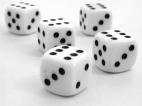
images

Unlike modern dice, which appeared around 2000BC, the astragalus is not symmetrical, giving a different probability of it landing in each orientation. It is not thought that there was a mathematical understanding of how to calculate odds in games involving this object or its more symmetrical successors.

Games of chance also appear to have been commonplace in the time of Christ – Roman soldiers are supposed to have drawn lots at the crucifixion, for example – but there is no evidence of any really formalised understanding of the laws of probability at this time.

Playing cards emerged in China sometime during the tenth century BC and were available in western europe by the 14th Century. This is an interesting development because playing cards can be used for games such as contract Bridge which involve a great deal of pure skill as well as an element of randomness. Perhaps it is this aspect that finally got serious intellectuals (i.e. physicists) excited about probability theory.

The first book on probability that I am aware of was by Gerolamo Cardano. His Liber de Ludo Aleae ( Book on Games of Chance) was published in 1663, but it was written more than a century earlier than this date.  Probability theory really got going in 1654 with a famous correspondence between the two famous mathematicians Blaise Pascal and Pierre de Fermat, sparked off by a gambling addict by the name of Antoine Gombaud, who went by the name of the “Chevalier de Méré” (although he wasn’t actually a nobleman of any sort). The Chevalier de Méré had played a lot of dice games in his time and, although he didn’t have a rigorous mathematical theory of how they worked, he nevertheless felt he had an intuitive  “feel” for what was a good bet and what wasn’t. In particular, he had done very well financially by betting at even money that he would roll at least one six in four rolls of a standard die.

It’s quite an easy matter to use the rules of probability to see why he was successful with this game. The odds  that a single roll of a fair die yields a six is 1/6. The probability that it does not yield a six is therefore 5/6. The probability that four independent rolls produce no sixes at all is (the probability that the first roll is not a six) times (the probability that the second roll is not a six) times (the probability that the third roll is not a six) times (the probability that the fourth roll is not a six). Each of the probabilities involved in this multiplication is 5/6, so the result is (5/6)4 which is 625/1296. But this is the probability of losing. The probability of winning is 1-625/1296 = 671/1296=0.5177, significantly higher than 50%. Sinceyou’re more likely to win than lose, it’s a good bet.

So successful had this game been for de Méré that nobody would bet against him any more, and he had to think of another bet to offer. Using his “feel” for the dice, he reckoned that betting on one or more double-six in twenty-four rolls of a pair of dice at even money should also be a winner. Unfortunately for him, he started to lose heavily on this game and in desperation wrote to his friend Pascal to ask why. This set Pascal wondering, and he in turn started a correspondence about it with Fermat.

This strange turn of events led not only to the beginnings of a general formulation of probability theory, but also to the binomial distribution and the beautiful mathematical construction now known as Pascal’s Triangle.

The full story of this is recounted in the fascinating book shown above, but the immediate upshot for de Méré was that he abandoned this particular game.

To see why, just consider each throw of a pair of dice as a single “event”. There are 36 possible events corresponding to six possible outcomes on each of the dice (6×6=36). The probability of getting a double six in such an event is 1/36 because only one of the 36 events corresponds to two sixes. The probability of not getting a double six is therefore 35/36. The probability that a set of 24 independent fair throws of a pair of dice produces no double-sixes at all is therefore 35/36 multiplied by itself 24 times, or (35/36)24. This is 0.5086, which is slightly higher than 50%. The probability that at least one double-six occurs is therefore 1-0.5086, or 0.4914. Our Chevalier has a less than 50% chance of winning, so an even money bet is not a good idea, unless he plans to use this scheme as a tax dodge.

Both Fermat and Pascal had made important contributions to many diverse aspects of scientific thought in addition to pure mathematics, including physics, the first real astronomer to contribute to the development of probability in the context of gambling was Christiaan Huygens, the man who discovered the rings of Saturn in 1655. Two years after his famous astronomical discovery, he published a book called Calculating in Games of Chance, which introduced the concept of expectation. However, the development of the statistical theory underlying  games and gambling came  with the publication in 1713 of Jakob Bernouilli’s wonderful treatise entitled Ars Conjectandi which did a great deal to establish the general mathematical theory of probability and statistics.

The Inductive Detective

Posted in Bad Statistics, Literature, The Universe and Stuff with tags , , , , , , , on September 4, 2009 by telescoper

I was watching an old episode of Sherlock Holmes last night – from the classic  Granada TV series featuring Jeremy Brett’s brilliant (and splendidly camp) portrayal of the eponymous detective. One of the  things that fascinates me about these and other detective stories is how often they use the word “deduction” to describe the logical methods involved in solving a crime.

As a matter of fact, what Holmes generally uses is not really deduction at all, but inference (a process which is predominantly inductive).

In deductive reasoning, one tries to tease out the logical consequences of a premise; the resulting conclusions are, generally speaking, more specific than the premise. “If these are the general rules, what are the consequences for this particular situation?” is the kind of question one can answer using deduction.

The kind of reasoning of reasoning Holmes employs, however, is essentially opposite to this. The  question being answered is of the form: “From a particular set of observations, what can we infer about the more general circumstances that relating to them?”. The following example from a Study in Scarlet is exactly of this type:

From a drop of water a logician could infer the possibility of an Atlantic or a Niagara without having seen or heard of one or the other.

The word “possibility” makes it clear that no certainty is attached to the actual existence of either the Atlantic or Niagara, but the implication is that observations of (and perhaps experiments on) a single water drop could allow one to infer sufficient of the general properties of water in order to use them to deduce the possible existence of other phenomena. The fundamental process is inductive rather than deductive, although deductions do play a role once general rules have been established.

In the example quoted there is  an inductive step between the water drop and the general physical and chemical properties of water and then a deductive step that shows that these laws could describe the Atlantic Ocean. Deduction involves going from theoretical axioms to observations whereas induction  is the reverse process.

I’m probably labouring this distinction, but the main point of doing so is that a great deal of science is fundamentally inferential and, as a consequence, it entails dealing with inferences (or guesses or conjectures) that are inherently uncertain as to their application to real facts. Dealing with these uncertain aspects requires a more general kind of logic than the  simple Boolean form employed in deductive reasoning. This side of the scientific method is sadly neglected in most approaches to science education.

In physics, the attitude is usually to establish the rules (“the laws of physics”) as axioms (though perhaps giving some experimental justification). Students are then taught to solve problems which generally involve working out particular consequences of these laws. This is all deductive. I’ve got nothing against this as it is what a great deal of theoretical research in physics is actually like, it forms an essential part of the training of an physicist.

However, one of the aims of physics – especially fundamental physics – is to try to establish what the laws of nature actually are from observations of particular outcomes. It would be simplistic to say that this was entirely inductive in character. Sometimes deduction plays an important role in scientific discoveries. For example,  Albert Einstein deduced his Special Theory of Relativity from a postulate that the speed of light was constant for all observers in uniform relative motion. However, the motivation for this entire chain of reasoning arose from previous studies of eletromagnetism which involved a complicated interplay between experiment and theory that eventually led to Maxwell’s equations. Deduction and induction are both involved at some level in a kind of dialectical relationship.

The synthesis of the two approaches requires an evaluation of the evidence the data provides concerning the different theories. This evidence is rarely conclusive, so  a wider range of logical possibilities than “true” or “false” needs to be accommodated. Fortunately, there is a quantitative and logically rigorous way of doing this. It is called Bayesian probability. In this way of reasoning,  the probability (a number between 0 and 1 attached to a hypothesis, model, or anything that can be described as a logical proposition of some sort) represents the extent to which a given set of data supports the given hypothesis.  The calculus of probabilities only reduces to Boolean algebra when the probabilities of all hypothesese involved are either unity (certainly true) or zero (certainly false). In between “true” and “false” there are varying degrees of “uncertain” represented by a number between 0 and 1, i.e. the probability.

Overlooking the importance of inductive reasoning has led to numerous pathological developments that have hindered the growth of science. One example is the widespread and remarkably naive devotion that many scientists have towards the philosophy of the anti-inductivist Karl Popper; his doctrine of falsifiability has led to an unhealthy neglect of  an essential fact of probabilistic reasoning, namely that data can make theories more probable. More generally, the rise of the empiricist philosophical tradition that stems from David Hume (another anti-inductivist) spawned the frequentist conception of probability, with its regrettable legacy of confusion and irrationality.

My own field of cosmology provides the largest-scale illustration of this process in action. Theorists make postulates about the contents of the Universe and the laws that describe it and try to calculate what measurable consequences their ideas might have. Observers make measurements as best they can, but these are inevitably restricted in number and accuracy by technical considerations. Over the years, theoretical cosmologists deductively explored the possible ways Einstein’s General Theory of Relativity could be applied to the cosmos at large. Eventually a family of theoretical models was constructed, each of which could, in principle, describe a universe with the same basic properties as ours. But determining which, if any, of these models applied to the real thing required more detailed data.  For example, observations of the properties of individual galaxies led to the inferred presence of cosmologically important quantities of  dark matter. Inference also played a key role in establishing the existence of dark energy as a major part of the overall energy budget of the Universe. The result is now that we have now arrived at a standard model of cosmology which accounts pretty well for most relevant data.

Nothing is certain, of course, and this model may well turn out to be flawed in important ways. All the best detective stories have twists in which the favoured theory turns out to be wrong. But although the puzzle isn’t exactly solved, we’ve got good reasons for thinking we’re nearer to at least some of the answers than we were 20 years ago.

I think Sherlock Holmes would have approved.

Flame Academy

Posted in Biographical, The Universe and Stuff with tags , , , , , , , on September 2, 2009 by telescoper

I heard on the radio this morning from that nice Mr Cowan that today is the anniversary of the start of the Great Fire of London which burned for four days in 1666. That provides for a bit of delayed synchronicity with yesterday’s post about the dreadful fires in the outskirts of Los Angeles and a similar conflagration in Athens (which now thankfully appears to be under control).

Fires are of course terrifying phenomena, and it must be among most people’s nightmares to be caught in one. The cambridge physicist Steve Gull experienced this at first hand when his boat exploded and caught fire recently. I’ll take this opportunity to wish him a speedy recovery from his injuries.

But frightening as such happenings are, a flame (the visible, light emitting part of a fire) can also be a very beautiful and fascinating spectacle. Flames are stable long-lived phenomena involving combustion in which a “fuel”, often some kind of hydrocarbon, reacts with an oxidizing element which, in the case of natural wildfires at any rate, is usually oxygen. However, along the way, many intermediate radicals are generated and the self-sustaining nature of the flame is maintained by intricate reaction kinetics.

The shape and colour of a flame is determined not just by its temperature but also, in a complicated way, by diffusion, convection and gravity. In a diffusion flame, the fuel and the oxidizing agent diffuse into each other and the rate of diffusion consequently limits the rate at which the flame spreads. Usually combustion takes place only at the edge of the flame: the interior contains unburnt fuel. A candle flame is usually relatively quiescent because the flow of material in it is predominantly laminar. However, at higher speeds you can find turbulent flames, like in the picture below!

Sometimes convection carries some of the combustion products away from the source of the flame. In a candle flame, for example, incomplete combustion forms soot particles which are convected upwards and then incandesce inside the flame giving it a yellow colour. Gravity limits the motion of heavier products away from the source. In a microgravity environment, flames look very different!

All this stuff about flames also gives me the opportunity to mention the great Russian physicist Yakov Borisovich Zel’dovich. To us cosmologists he is best known for his work on the large-scale structure of the Universe, but he only started to work on that subject relatively late in his career during the 1960s.  He in fact began his career as a physical chemist and arguably his greatest contribution to science was that he developed the first completely physically based theory of flame propagation (together with Frank-Kamenetskii). No doubt he used insights gained from this work, together with his studies of detonation and shock waves, in the Soviet nuclear bomb programme in which he was a central figure.

But one thing even Zel’dovich couldn’t explain is why fires are such fascinating things to look at. I remember years ago having a fire in my back garden to get rid of garden rubbish. The more it burned the more things  I wanted to throw on it,  to see how well they would burn rather than to get rid of them. I ended up spending hours finding things to burn, building up a huge inferno, before finally retiring indoors, blackened with soot.

I let the fire die down, but it smouldered for three days.