The Darling Buds of May

Posted in Poetry with tags , on May 20, 2009 by telescoper

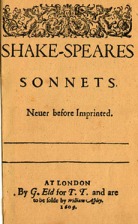
Four hundred years ago today, on the 20th May 1609, William Shakespeare published a collection of 154 Sonnets which arguably represent just as high a  level of literary achievement as his plays.  At any rate they’ve survived in popularity just as well and also furnished a huge number of memorable phrases including, appropriately enough for the time of year, the title of this post. This was, in fact, the only edition of the Sonnets published in Shakespeare’s lifetime and the circumstances of its publication remain uncertain.

Most of the poems concern Shakespeare’s love for a young man,  “Mr WH, the Onlie Begetter of the Sonnets”. However, there is a also group of sonnets addressed to his mistress, an anonymous “dark lady”,  which are far much more sexual in content than those addressed to the “Fair Youth”. The usual interpretation of this is that Shakespeare’s love for the boy was purely Platonic rather than sexual in nature.  Anyway, it was certainly a physical attraction.  Verse after verse speaks of the young man’s beauty. The first group of sonnets even encourage him to get married and have children so his beauty can continue and not die with his death. Sonnet 20 laments that the youth is not a woman, suggesting that this ruled out any sexual contact.  These early poems seem to suggest a slightly distant relationship between the two as if they didn’t really know each other well. However, as the collection goes on the poems become more and more intimate and it’s hard for me to accept that there wasn’t some sort of involvement between the two.  Although homosexual relationships were not officially tolerated in 17th Century England, they were not all that rare especially in the theatrical circles in which Shakespeare worked.

We’ll probably never know who Mr WH was – not Smith presumably – or indeed what was the real nature of his relationship to Shakespeare but we still have the poems. I do think it’s worth remembering, though, that these deep and moving expressions of romantic love were not written from a man to a woman, but from one man to another.  Here is perhaps the most famous one of all, Sonnet 18

Shall I compare thee to a summer’s day?
Thou art more lovely and more temperate:
Rough winds do shake the darling buds of May,
And summer’s lease hath all too short a date;
Sometime too hot the eye of heaven shines,
And often is his gold complexion dimm’d;
And every fair from fair sometime declines,
By chance or nature’s changing course untrimm’d;
But thy eternal summer shall not fade,
Nor lose possession of that fair thou ow’st;
Nor shall Death brag thou wander’st in his shade,
When in eternal lines to time thou grow’st:
So long as men can breathe or eyes can see,
So long lives this, and this gives life to thee.


Charles Ives

Posted in Music with tags , on May 19, 2009 by telescoper

This morning I was woken up  by the lovely voice of Sarah Mohr-Pietsch whispering in my ear. She introduces the Breakfast programme on BBC Radio 3 when Rob Cowan isn’t doing it. As a matter of fact, I thought her name was More-Peach, but there you are. You learn something every day.

This morning Sultry Sarah reminded me that the remarkable composer Charles Ives, whom I’ve blogged about before, died 55 years ago this very day. To find something with which to mark the anniversary I had a quick look on Youtube and found this little gem.

The Housatonic at Stockbridge is best known as the last piece of Charles Ives’ Orchestral Suite No. 1 Three Places in New England. It’s a complex richly-orchestrated piece which is powerfully evocative of both the place (near the Housatonic River at Stockbridge, Massachusetts) and the time (June 1908) when he went walking there with his wife on their honeymoon. It makes great use of one of Ives’ favourite devices of juxtaposing familiar melodies with his own advanced harmonic inventions.

However, this morning I found this wonderful pared-down version for soprano voice and piano which also manages to be beautiful, but in an entirely different way…

Neophlogistonianism

Posted in The Universe and Stuff with tags , , on May 18, 2009 by telescoper

What happens when something burns?

Ask a seventeenth century scientist that question and the chances are the answer would  have involved the word phlogiston, a name derived from the Greek  φλογιστόν, meaning “burning up”. This “fiery principle” or “element” was supposed to be present in all combustible materials and the idea was that it was released into air whenever any such stuff was ignited. The act of burning separated the phlogiston from the dephlogisticated “true” form of the material, also known as calx.

The phlogiston theory held sway until  the late 18th Century, when Antoine Lavoisier demonstrated that combustion results in an increase in weight of the material being burned. This poses a serious problem if burning also involves the loss of phlogiston unless phlogiston has negative weight. However, many serious scientists of the 18th Century, such as Georg Ernst Stahl, had already suggested that phlogiston might have negative weight or, as he put it, “levity”. Nowadays we would probably say “anti-gravity”.

Eventually, Joseph Priestley discovered what actually combines with materials during combustion:  oxygen. Instead of becoming dephlogisticated, things become oxidised by fixing oxygen from air, which is why their weight increases. It’s worth mentioning, though, the name that Priestley used for oxygen was in fact “dephlogisticated air” (because it was capable of combining more extensively with phlogiston than ordinary air). He  remained a phlogistonian longer after making the discovery that should have killed the theory.

So why am I rambling on about a scientific theory that has been defunct for more than two centuries?

Well,  it’s because there just might be a lesson from history about the state of modern cosmology…

The standard cosmological model involves the hypothesis that about 75% of the energy budget of the Universe is in the form of “dark energy”. We don’t know much about what this is, except that in order to make our current understanding work out it has to act like a source of anti-gravity. It does this by violating the strong energy condition of general relativity.

Dark energy is needed to reconcile three basic measurements: (i) the brightness distant supernovae that seem to indicate the Universe is accelerating (which is where the anti-gravity comes in); (ii) the cosmic microwave background that suggests the Universe has flat spatial sections; and (iii) the direct estimates of the mass associated with galaxy clusters that accounts for about 25% of the mass needed to close the Universe.

A universe without dark energy appears not to be able to account for these three observations simultaneously within our current understanding of gravity as obtained from Einstein’s theory of general relativity.

I’ve blogged before, with some levity of my own, about how uncomfortable this dark energy makes me feel. It makes me even more uncomfortable that such an enormous  industry has grown up around it and that its existence is accepted unquestioningly by so many modern cosmologists.

Isn’t there a chance that, with the benefit of hindsight, future generations will look back on dark energy in the same way that we now see the phlogiston theory?

Or maybe the dark energy really is phlogiston. That’s got to be worth a paper! At least I prefer the name to quintessence.

Eurovision

Posted in Opera with tags , on May 16, 2009 by telescoper

Just  in case you’ve had the misfortune to sit through the tedious spectacle that is the annual Eurovision song contest,  let this be a reminder that Eurovision wasn’t always synonymous with utter garbage…

Divided Loyalties

Posted in Biographical, Science Politics with tags , , , , on May 16, 2009 by telescoper

It’s easy to tell that summer is on the way. England are playing the West Indies at Cricket. It’s the penultimate weekend of the Premiership football season. The undergraduates are taking their exams. I’m sitting with a pile of projects to mark. And it’s raining.

I suppose I have to mention the football. My team, Newcastle United, gave themselves a chance of avoiding relegation on Monday night by beating local rivals, Middlesborough 3-1. A win today at home against Fulham would pretty much have guaranteed safety. They lost 1-0. It now looks inevitable that they will be relegated after 16 years in the top flight.

It’s a thankless task being a Newcastle supporter. I’ve followed them all my life and they have managed to avoid winning any competition of any significance since the Fairs cup in 1968 (now called the UEFA cup). They have loyal fans and a wonderful stadium, but somehow seem completely unable to convert that into success on the field. This season they were doomed as soon as the manager Kevin Keegan quit over the owner Mike Ashley’s refusal to allow him to be involved in signing any players. After a period without a manager, during which they lost game after game, the club appointed veteran relegation specialist Joe Kinnear, who did OK for a while then at Christmas had to go into hospital with heart problems. Another run of poor results followed until, in desperation, the club appointed the iconic former player Alan Shearer to his first managerial position. His lack of experience showed, though, and he’s only managed to win one game. In short, the season has been a shambles.

When my father died (about 18 months ago), I thought that my interest in Newcastle United would wane. Football and music were the only two things we had in common after my parents split when I was about 12 and I went to live with my mother. I saw him only rarely in later years,and much of the time we spent together involved talking about football. However, I still find myself getting nervous on match days and looking anxiously for the scores whenever they’ve been playing. It’s like there is an umbilical cord that still connects me to my home town and I can’t get rid of it.

That feeling was reinforced yesterday when, following a conversation at the RAS Club last week, Robert Smith sent me a booklet that he had received when he attended a conference in Newcastle in 1965. The Official Guide to Newcastle upon Tyne (priced 2/6) filled me with a mixture of nostalgia and amusement. Ironically, given the football team’s inadequacies the motto of the city is FORTITER DEFENDIT TRIUMPHANS, which was also the motto of my old school, the Royal Grammar School (also mentioned in the booklet).

The little picture on the left shows the armorial bearings of the City of Newcastle upon Tyne. The official blazon is: Arms:- Gules three Castles triple towered Argent. Crest on a Wreath of the Colours. A Castle as in the arms issuant therefrom from a demi Lion guardant supporting a Flagstaff Or, flying therefrom a forked Pennon of the Arms of Saint George.

Supporters: – on either side a Sea Horse proper crined and finned Or.

Obviously supporters don’t guarantee success, even if they’re proper crined and finned.

Of course, I shall be disappointed if and when Newcastle get relegated next week, but I don’t go along with all the guff in the newspapers about how it will have dire consequences for the city. They’ve been relegated twice before in my lifetime, and the world didn’t end then nor will it now. In any case, I’d reckon the Football Club has taken much more out of the economy of Newcastle in recent years than it has put back into it. Hard-earned cash from supporters has gone straight into the pockets of overpaid players and inept management staff. Maybe relegation will shake the Club up, which will be good in the long run.

Anyway, every cloud has at least one silver lining and this one has two. At the start of the season, I was prescient enough to place a large bet on Newcastle to get relegated at quite long odds. I expect to be handsomely compensated by Mr William Hill when they do go down. The other thing is that they will have to play Cardiff City in the Championship next year, which will give me the chance to see them play in Cardiff’s brand new stadium.

Incidentally, Cardiff City blew their promotion hopes in spectacular fashion. Needing only to avoid losing to Preston North End by 5 goals in order to secure a place in the play-offs, they lost 6-0.

Meanwhile we’ve been coming down slowly from the high that was Thursday’s launch of Herschel and Planck. I was surprised to see Matt Griffin in the department yesterday afternoon because he was actually at the launch in Kourou. He had left after the launch and flown directly back to Cardiff (via Paris). Our other representatives will return over this weekend, and things will start to get back to normal.

Matt told me that he was so impressed with the professionalism of Arianespace, that he wasn’t at all nervous about the launch. Matt’s instrument, SPIRE, will switch on during 22 May and testing will start. I’m sure that Matt and his team will be more than a little nervous about that!

Assuming both Planck and Herschel work satisfactorily, the next problem we will have to face is the deluge of data that will shortly be upon us. The astronomers at Cardiff University have submitted an application for rolling grant support from STFC (not Swindon Town Football Club) to enable us to extract scientific results from new data especially from Herschel. Unfortunately, though, the coffers are pretty bare and it seems very unlikely that we will get the substantial uplift in funding we need to carry out the work on a reasonable timescale.

A rolling grant is intended to support an ongoing research programme. Typically the grants cover 5 years’ funding, enabling the group to offer longer term contracts to staff than is allowed by the 3-year standard grant format. After 3 years of the rolling period, the group has to bid again for another 5 year period but the timing means there is always two years’ grace, meaning that if renewal is not recommended the group still has two years’ funding so the plug isn’t pulled immediately. If an extension is offered but at a reduced level of funding, a group might decide to refuse the new grant and carry on with its existing two years, perhaps to apply in the following round.

The problem with the current financial situation is that STFC barely has the funds needed to continue its existing rolling grants. In other words if all the groups applying for rolling support declined their new contracts and rolled on their existing grants, STFC would only just be able to pay them. In such a situation there would be no new grants or any kind of increase in existing rollers. The implications for successful exploitation of Herschel and Planck appear to be grim and there could well be a lot of difficult decisions within the department to be made if we have to operate within a much reduced budget.

It would be ridiculous if a billion-dollar mission like Herschel ends up stymied because of the relatively small sums needed to exploit the data, but that doesn’t mean it won’t happen. Football teams aren’t the only organizations to suffer from bad management.

Launch Party

Posted in The Universe and Stuff with tags , on May 14, 2009 by telescoper

The Big Day has finally arrived!

I’ve managed to submit my paper to the journal and the ArXiv before the little shindig we’ve been planning for the Planck and Herschel launch gets under way at 1pm. Business as usual so far, though.

Strangely, I haven’t managed to get nervous yet, although I have to say  there are many anxious faces around the department. I just keep telling people how much simpler their life is going to be if it all goes wrong, without all that messy and unnecessarily complicated data to deal with. It bothers me sometimes that I don’t often get nervous expect when watching sport. Mind you, being  a Newcastle United supporter probably makes me more nervous more often than most people.

Anyway, at times like this a  stiff upper lip is obviously called for. Anyone who cracks now is clearly not officer material. There’ll be plenty of time for panic later on.

It’s now about 12.45 and the launch is scheduled for 14.12.  With impeccable timing, the First Minister of Wales, Rhodri Morgan, is due to arrive in the department at 14.30. I hope he doesn’t think it’s going to be delayed especially for him. I also hope we’re not all in tears when he gets here.

We’re going to be watching on a big screen via a satellite downlink. Not quite as good as being there in person, but probably better than watching it on the net (which you can do here).

Anyway, I can hear the wine bottles being opened so I’m going to barge my way to the front of the queue, feigning nerves in order to justify a calming tipple.

I’ll be back later to complete the story, for better or worse.

Fingers crossed. TTFN.

…………


Well here I am back from the do. It all seemed to go pretty well, although I wasn’t paying attention at the exact time of the launch – opening a bottle of wine – so I failed to get nervous even then. As far as I can tell the launch went like clockwork – or at least like Newtonian Mechanics – and the ground station even managed to handshake with both satellites after separation.

I was particularly impressed to see that ESA had roped in affable compère and media god Des Lynam to provide expertise in his accustomed role as  TV anchor man, although for some reason he was operating under the pseudonym of David Southwood:

Anyway, all seems to be set fair. I’m delighted. It will be a while before we get any science results, as it takes several weeks to get to L2.  I’m looking forward to first light from Herschel fairly soon, but science from Planck will be a while coming and even when it does it the information will be strictly controlled.

Anyway, in case you missed it here’s the liftoff!

P.S. We had a few bottles of special Herschel wine. Vintage 2001 Rioja, full-bodied and uncompromising. Not to everyone’s taste. I quite liked it but I was already quite drunk.

Unravelling CERN

Posted in Science Politics, The Universe and Stuff with tags , , on May 13, 2009 by telescoper

A disturbing piece of news passed me by last week. One of the founder members, Austria, has decided to pull out of CERN, the home of the much-vaunted Large Hadron Collider. The announcement was made on 8th May 2009, but I missed it at the time owing to my trip to Berlin.

Austria, a founder member of CERN, has been a member of the 20-nation body since 1959, but its justification for leaving, according to Austria’s Minister for Science Johannes Hahn, is that the CERN subscription ties up about 70% of the nation’s budget for international research. To quote him

“In the meantime there have been diverse research projects in the European Union which offer a very large number of different scientists’ perspectives..”

Austria only contributes 2.2 percent of CERN’s budget, but it will be the first country to leave the organization since Spain’s departure in 1969. Spain rejoined in 1983. According to a statement,

“CERN would be sorry to lose Austria as one of its member states and sincerely believes that it would be in Austria’s best interests to remain a member..”

The immediate consequence of this will be a (small) increase in the subscriptions payable by other member nations in order to plug the funding gap left by Austria’s departure. However, particle physicists will probably see this as a very worrying precedent that might signal to other funding bodies that they could think the previously unthinkable and follow Austria’s example.

The CERN subscription payable by the United Kingdom comes from the budget of the Science and Technology Facilities Council (STFC). Although it amounts to about £82 million, this is about 16% of the STFC budget, which is a much smaller fraction than in the case of Austria. However, the consequences of one of the larger contributors like the UK pulling out of CERN would be extremely serious, because of the large increases in remaining subscriptions that would be needed to fill the gap that would be created.

All this puts even more pressure on the Large Hadron Collider to produce the goods and it also reinforces the view I expressed in one of my first ever blog posts that we may be nearing the time when nations decide that Big Science is just too expensive and  too esoteric to be worth investing in…

STOP PRESS:  New just in from Thomas (below) reveals that the Austrians have done a U-bahn U-turn and are not, after all, going to pull out of CERN.

For more information, see the story in Physics World.

Planckety-Planck

Posted in The Universe and Stuff with tags , on May 12, 2009 by telescoper

With the launch of Planck and Herschel only two days away, excitement is reaching fever pitch. As the countdown inches slowly towards the moment of reckoning the tension mounts…

This post would have been a bit more exciting if all that had been true. Of course we now do have a definite launch window for Planck, 14th May 2009. The launch window opens at 14.12 BST and will remain open for about two hours. Let’s hope they manage to get the thing up in that time, otherwise there’ll be yet another substantial delay.

Planck will be launched with its sister-mission, Herschel.  They will both be carried by an Ariane 5 rocket from the European Space Agency’s launch site in Kourou, French Guyana. Within half an hour of launch, Planck and Herschel will separate and start on their journeys.  While both satellites are going to orbit the second Lagrangian Point (L2), they will have slightly different orbits.  It will take Planck around 6 weeks to get to L2, during which time it will start to cool down its cryogenic systems. Eventually it will be the coolest thing in space.

Of course that is all very exciting, but it would have been a lie to say that the excitement is mounting that much back here at home. Together with the fact that the undergraduate examination period is upon us, the department is extremely quiet and those that are most nervous have taken their jitters to South America. The fact is that most of the people directly involved with Planck or Herschel have actually been invited to the launch and have either already made their way there or have at least set out on their journeys to the jolly.

We do, however, plan to have a small function here to mark the  launch on Thursday with wine and nibbles and talks about the science. I hope it’s not tempting fate. I”m not exactly nervous myself, but probably will get butterflies as we watch the launch on the net. Still, there’ll be wine to steady our nerves…

I  remember very well the “launch”, in 1996, of a mission called Cluster which many of my colleagues at Queen Mary were heavily involved. This was the first flight of Ariane-5. Bugs in the software meant it lost control shortly after launch and the party very soon turned into a wake, although the resulting fireworks were quite spectacular.

Because the Ariane-5 vehicle was brand new, and somewhat untested, the European Space Agency had decided to take advantage of an offer to launch the mission without charge. This seemed like a good deal because the costs of putting an experiment in space are a sizeable fraction of the overall budget for such missions. It turned out, though, that the old expression was true. There’s no such thing as a free launch.

In fact, Cluster did eventually fly using flight spares and a launch on a Russian spacecraft. If Planck and Herschel go boom then there’s no way they can be replaced. It would be a terrible thing if this happened, for a large number of reasons, but Ariane-5 has launched many times since then, and I’m confident that both Planck and Herschel will soon be safely on their way to L2.

But don’t expect any science immediately, especially not from Planck. It will be years before the key science results emerge and, until then, the science team is sworn to secrecy….

The Anachronic Jazz Band

Posted in Jazz with tags , , on May 10, 2009 by telescoper

I heard a record by this band ages and ages ago (probably in the 70s) and was delighted to be reminded of them by finding this little clip on Youtube. It’s a bit of an oddity, but I think it’s  both fun and fascinating.

The Anachronic Jazz Band is, I think, now defunct but they were from Paris originally. The style they played in could probably be described as like the New York style of the late 1920s, with definite touches of Bix Beiderbecke. On the other hand, the tunes they played all came from the era of modern jazz, such as this one which is the Charlie Parker classic Anthropology. I’ve already posted a version of it  by Bud Powell, in fact..

You might think that an uncompromising bebop number like this would pose unsurmountable challenges for a traditional jazz outfit, but I think they pull it off rather well. I think though that they were probably helped by the fact that this tune, like many modern jazz compositions, is actually based on a chord progression belonging to a much more familiar tune. In this case the harmonies actually derive from George Gershwin’s standard I Got Rhythm….

Anyway, perhaps the efforts of this fine little band go some way to showing that there’s more continuity between traditional and modern jazz than one might suppose…

Space Experiments

Posted in Art, Biographical, The Universe and Stuff with tags , , on May 9, 2009 by telescoper

I’ve been disconnected from the blogosphere for a few days,  as one of the consequences of a very interesting trip  to Berlin from which I’ve just returned.

When I received an invitation a few months ago to give a lecture on cosmology at the Institut für Raumexperimente (Institute for Space Experiments), I first thought that the “space experiment” concerned would be the forthcoming Planck mission, which is now firmly scheduled for launch on the afternoon of 14th May 2009. However, the institute I visited  is in fact part of the Universität der Künste Berlin (Arts University of Berlin) . It’s a new project run by Olafur Eliasson, a famous artist and a Professor at the University and I was one of a series of guests invited to talk to the students about various aspects of space and time. Olafur was one of the people behind the Experiment Marathon in Reykjavik which was almost exactly a year ago, and he’d decided to invite me to his new institute here and now as a result of my contribution there and then.

I was quite apprehensive about doing this because I’m really extremely ignorant about art, and didn’t want to appear too much of a philistine. I therefore decided to prepare a talk that was focussed strongly on the science but with just one or two references to works of art.  It turned out that the artist Matthew Ritchie was also around and keen to participate so we decided to do a joint presentation.

The eminent art historian Caroline Jones from MIT also sat in, contributing to the discussion and adding her own insights along the way

Matthew spoke first about how art can draw ideas and inspiration from scientific thought and argued that this was especially relevant today when science is so full of strange and wonderful concepts. Along the way he demonstrated an unexpectedly deep understanding of subjects such as thermodynamics, relativity and quantum theory.

I then took over and talked about cosmology, trying to focus on the interplay between theory and observation in order to convey some sort of idea of how the process of science actually works in this field.  I was particularly keen to get across the idea that we haven’t made scientific progress in cosmology by merely looking and recording. We have had needed to build theoretical frameworks to help us interpret what we see and to plan new observations.

Although we’d only discussed things for a few minutes before the event, as it turned out the two talks dovetailed rather nicely, I think.

When I was finished, Matthew finished by showing some of his own works which are complex, multi-faceted, multi-media creations evocations of and responses to ideas often, but not exclusively, arising from theoretical physics. The photograph above shows one of his installations. I haven’t seen his work up close, but it struck me as astonishingly inventive but at the same time possessing a great unity about it. His works are extremely diverse but they all seem to have a very distinctive signature all of his own.

After the talks and lots of discussion we adjourned for a nice dinner in a local bistro with some of the students who carried on asking about various bits of physics, such as the possible existence of  closed timelike curves. I was delighted by the intensity of their curiosity, which went far beyond that displayed by most physics students!

These days there seem to be quite a lot of initiatives aimed at promoting a dialogue between art and science although most of them don’t seem to be very successful. Science and art are obviously quite different types of activity. Each is also surrounded by a discursive penumbra of metaphors and simplifications that attempts to articulate what is going on inside the field to those outside. Not all artists try to explain their work in this way and neither do all scientists. Often the result is that the arts-science dialogue is simply a coming together of relatively superficial interpretations that does not really bring the core domains any closer. What is particularly impressive about Matthew Ritchie is that he does seem to have deeper insights into science than many artists and he responds to those insights in a way that is highly original.

The other thing that struck me after taking part in this event was the difference between art as a process and the products of that process in terms of “works of art”. Similar  processes are involved in making art as are needed in science, such as those involving problem-solving about how to implement an idea in a painting, sculpture or an equation. What differs is that works of art are, to a greater or lesser extent, consumable by the general public while those of science are not.

 The invitation to do this talk also gave me the chance to take a trip down the Unter den Linden of my memory. I’ve actually been to Berlin twice before. Once, about 25 years ago when I was a student, and then again in the early 90s when I attended a conference in Potsdam.

This time I stayed in a charming but rather antiquated hotel in the Prenzlauer Berg area of the city. Before 1989 this was in East Berlin, on the “wrong” side of the Berlin Wall. It had, however, escaped the total devastation that rained down on most of the rest of Berlin during the later stages of the war and it managed to retain much of its interesting architecture. After reunification it became a rather bohemian area and many artists set up studios there, which is presumably part of the reason my hosts had located there. Prenzlauer Berg had also been a major centre for Berlin’s sizeable  beer-making industry. One of the larger breweries has now been transformed into an exciting arts centre called the Kulturbrauerei and the Institut fur Raümexperimente is itself also housed in buildings that were once part of a brewery.  In fact, the whole area was built in the 19th century, itself a kind of space experiment, and still incorporates many features arising from its origins as an innovative piece of urban planning.

When I first came to the cityof Berlin in 1985 I stayed in the West – with its ostentatiously exuberant and uninhibited nightlife, West Berlin was an amazing place to visit in those days. I did, however, have a pass to travel to the East for a day. I remember walking through Checkpoint Charlie, on Friedrichstrasse, after passing through Potsdammerplatz south of the  Brandenburg Gate and looking eastwards across the strip of waste ground that had been levelled to create a killing zone for  escapees coming in the other direction. The transition from affluent and colourful West Berlin to the dreary drabness of the East was like swtiching channels to find a black-and-white movie on view. It was also frightening because everywhere you looked there were guns pointed at you, especially on the return leg from East to West. I also remember thinking how much the shoddy and unimaginative postwar architecture of East Berlin reminded me of Wolverhampton.

The drastic social and political experiment that lay behind the Berlin Wall was ultimately a failure, but its legacy will only slowly vanish. There are still signs of it even today, almost twenty years after the Wall fell in a metaphorical sense.

This time I reversed my previous path, starting out in the East and walking to the West. This time both sides were in glorious colour. In fact, it was a lovely spring morning and there were tourists everywhere.

Very little of the wall now remains. When I came in the 90s, just  a few years after the momentous events of 1989, much of it was still intact although there was a big gap in the central section. The killing zone was a strip of rubble-strewn ground which it was possible to walk over without any real hindrance.  Hitler’s bunker was located there too, although its position wasn’t advertised for fear of it becoming some kind of grisly  shrine.

At that time path of the wall through the city was easy to follow by eye as it was marked by the tall cranes involved in massive construction projects aimed at removing the scar that the wall had carved across the face of the city.

Returning now to the same location, I found new buildings covering almost all of the old cold war stuff but, in between the offices and administrative buildings, there is also a sombre and very moving Memorial to the Murdered Jews of Europe. Checkpoint Charlie has gone too, of course, but its site is also marked by a museum. Elsewhere in the city only one or two pieces of the wall remain, the biggest one in Bernauer Strasse, not far from my hotel.

It was fascinating to see the how the city slowly is renewing itself. There is still a huge amount of building going on but it’s a wonderful city to move around and it’s very green. The wide boulevards give a tremendous sense of space which contrasts enormously with the creeping claustrophobia of London.

Back from Berlin on Friday lunchtime I had time to pop into the RAS meeting and dine again at the RAS Club before returning on the late train back to Cardiff, bringing closure to a little space-like curve of my own. 

A short trip, but  fascinating and very enjoyable.