The Onions

Posted in Biographical, Jazz with tags , on May 4, 2009 by telescoper

I’m not going to make excuses. This is a piece of pure nostalgia.

We had this old record in the house when I was a little kid. It was quite an innovation at the time. Most of the jazz records my dad had collected were on 10″ shellac discs to be played at 78rpm. This was a very limited format in that you could never get more than about 3 minutes on each side. They were also extremely fragile. Most of the ones we used to have ended up broken into pieces.

But when Humphrey Lyttelton’s band did a concert in 1954 at the then very new Royal Festival Hall in London, the Parlophone label decided to release four tracks on a vinyl EP (extended play). This allowed them to get a longer playing time but also meant that the actual discs  survived a bit longer than 78s used to.

I was born in 1963, about nine years after the record was released but I distinctly remember as a kid sitting in our house in Benwell with this record playing on our little gramophone. I never seemed to be able to shout “Onions” on the right beat in the little two-bar interval left for the purpose. But, then again, neither did many in the audience.

Humph himself (who died a year ago) does the announcement in that instantly recognizeable voice of his. The whole band plays wonderfully too, but I’d like to single out the clarinet of Wally Fawkes for special mention. In case  you didn’t know,  Wally Fawkes  is actually a pseudonym for the award-winning cartoonist Trog. Anyway, on this track he gives an object lesson in how to build a solo: starting off in the smoky lower register then gradually building up steam until just after 2 minutes in he steps on the gas, switches to the upper register and wails like  a banshee. He never plays anything very complicated and I must have heard that moment hundreds of times over the years but it still gives me a buzz!

They sure don’t make them like this any more.

The Cosmic Tightrope

Posted in The Universe and Stuff with tags , , on May 3, 2009 by telescoper

Here’s a thought experiment for you.

Imagine you are standing outside a sealed room. The contents of the room are hidden from you, except for a small window covered by a curtain. You are told that you can open the curtain once and only briefly to take a peep at what is inside, and you may do this whenever you feel the urge.

You are told what is in the room. It is bare except for a tightrope suspended across it about two metres in the air. Inside the room is a man who at some time in the past – you’re not told when – began walking along the tightrope. His instructions were to carry on walking backwards and forwards along the tightrope until he falls off, either through fatigue or lack of balance. Once he falls he must lie motionless on the floor.

You are not told whether he is skilled in tightrope-walking or not, so you have no way of telling whether he can stay on the rope for a long time or a short time. Neither are you told when he started his stint as a stuntman.

What do you expect to see when you eventually pull the curtain?

Well, if the man does fall off sometime it will clearly take him a very short time to drop to the floor. Once there he has to stay there.One outcome therefore appears very unlikely: that at the instant you open the curtain, you see him in mid-air between a rope and a hard place.

Whether you expect him to be on the rope or on the floor depends on information you do not have. If he is a trained circus artist, like the great Charles Blondin here, he might well be capable of walking to and fro along the tightrope for days. If not, he would probably only manage a few steps before crashing to the ground. Either way it remains unlikely that you catch a glimpse of him in mid-air during his downward transit. Unless, of course, someone is playing a trick on you and someone has told the guy to jump when he sees the curtain move.

This probably seems to have very little to do with physical cosmology, but now forget about tightropes and think about the behaviour of the mathematical models that describe the Big Bang. To keep things simple, I’m going to ignore the cosmological constant and just consider how things depend on one parameter, the density parameter Ω0. This is basically the ratio between the present density of the matter in the Universe compared to what it would have to be to cause the expansion of the Universe eventually to halt. To put it a slightly different way, it measures the total energy of the Universe. If Ω0>1 then the total energy of the Universe is negative: its (negative) gravitational potential energy dominates over the (positive) kinetic energy. If Ω0<1 then the total energy is positive: kinetic trumps potential. If Ω0=1 exactly then the Universe has zero total energy: energy is precisely balanced, like the man on the tightrope.

A key point, however, is that the trade-off between positive and negative energy contributions changes with time. The result of this is that Ω is not fixed at the same value forever, but changes with cosmic epoch; we use Ω0 to denote the value that it takes now, at cosmic time t0, but it changes with time.

At the beginning, at the Big Bang itself,  all the Friedmann models begin with Ω arbitrarily close to unity at arbitrarily early times, i.e. the limit as t tends to zero is Ω=1.

In the case in which the Universe emerges from the Big bang with a value of Ω just a tiny bit greater than one then it expands to a maximum at which point the expansion stops. During this process Ω grows without bound. Gravitational energy wins out over its kinetic opponent.

If, on the other hand, Ω sets out slightly less than unity – and I mean slightly, one part in 1060 will do – the Universe evolves to a state where it is very close to zero. In this case kinetic energy is the winner  and Ω ends up on the ground, mathematically speaking.

In the compromise situation with total energy zero, this exact balance always applies. The universe is always described by Ω=1. It walks the cosmic tightrope. But any small deviation early on results in runaway expansion or catastrophic recollapse. To get anywhere close to Ω=1 now – I mean even within a factor ten either way – the Universe has to be finely tuned.

A slightly different way of describing this is to think instead about the radius of curvature of the Universe. In general relativity the curvature of space is determined by the energy (and momentum) density. If the Universe has zero total energy it is flat, so it doesn’t have any curvature at all so its curvature radius is infinite. If it has positive total energy the curvature radius is finite and positive, in much the same way that a sphere has positive curvature. In the opposite case it has negative curvature, like a saddle. I’ve blogged about this before.

I hope you can now see how this relates to the curious case of the tightrope walker.

If the case Ω0= 1 applied to our Universe then we can conclude that something trained it to have a fine sense of equilibrium. Without knowing anything about what happened at the initial singularity we might therefore be pre-disposed to assign some degree of probability that this is the case, just as we might be prepared to imagine that our room contained a skilled practitioner of the art of one-dimensional high-level perambulation.

On the other hand, we might equally suspect that the Universe started off slightly over-dense or slightly under-dense, at which point it should either have re-collapsed by now or have expanded so quickly as to be virtually empty.

About fifteen years ago, Guillaume Evrard and I tried to put this argument on firmer mathematical grounds by assigning a sensible prior probability to Ω based on nothing other than the assumption that our Universe is described by a Friedmann model.

The result we got was that it should be of the form

P(\Omega) \propto \Omega^{-1}(\Omega-1)^{-1}.

I was very pleased with this result, which is based on a principle advanced by physicist Ed Jaynes, but I have no space to go through the mathematics here. Note, however, that this prior has three interesting properties: it is infinite at Ω=0 and Ω=1, and it has a very long “tail” for very large values of Ω. It’s not a very well-behaved measure, in the sense that it can’t be integrated over, but that’s not an unusual state of affairs in this game. In fact it is an improper prior.

I think of this prior as being the probabilistic equivalent of Mark Twain’s description of a horse:

dangerous at both ends, and uncomfortable in the middle.

Of course the prior probability doesn’t tell usall that much. To make further progress we have to make measurements, form a likelihood and then, like good Bayesians, work out the posterior probability . In fields where there is a lot of reliable data the prior becomes irrelevant and the likelihood rules the roost. We weren’t in that situation in 1995 – and we’re arguably still not – so we should still be guided, to some extent by what the prior tells us.

The form we found suggests that we can indeed reasonably assign most of our prior probability to the three special cases I have described. Since we also know that the Universe is neither totally empty nor ready to collapse, it does indicate that, in the absence of compelling evidence to the contrary, it is quite reasonable to have a prior preference for the case Ω=1.  Until the late 1980s there was indeed a strong ideological preference for models with Ω=1 exactly, but not because of the rather simple argument given above but because of the idea of cosmic inflation.

From recent observations we now know, or think we know, that Ω is roughly 0.26. To put it another way, this means that the Universe has roughly 26% of the density it would need to have to halt the cosmic expansion at some point in the future. Curiously, this corresponds precisely to the unlikely or “fine-tuned” case where our Universe is in between  two states in which we might have expected it to lie.

Even if you accept my argument that Ω=1 is a special case that is in principle possible, it is still the case that it requires the Universe to have been set up with very precisely defined initial conditions. Cosmology can always appeal to special initial conditions to get itself out of trouble because we don’t know how to describe the beginning properly, but it is much more satisfactory if properties of our Universe are explained by understanding the physical processes involved rather than by simply saying that “things are the way they are because they were the way they were.” The latter statement remains true, but it does not enhance our understanding significantly. It’s better to look for a more fundamental explanation because, even if the search is ultimately fruitless, we might turn over a few interesting stones along the way.

The reasoning behind cosmic inflation admits the possibility that, for a very short period in its very early stages, the Universe went through a phase where it was dominated by a third form of energy, vacuum energy. This forces the cosmic expansion to accelerate. This drastically changes the arguments I gave above. Without inflation the case with Ω=1 is unstable: a slight perturbation to the Universe sends it diverging towards a Big Crunch or a Big Freeze. While inflationary dynamics dominate, however, this case has a very different behaviour. Not only stable, it becomes an attractor to which all possible universes converge. Whatever the pre-inflationary initial conditions, the Universe will emerge from inflation with Ω very close to unity. Inflation trains our Universe to walk the tightrope.

So how can we reconcile inflation with current observations that suggest a low matter density? The key to this question is that what inflation really does is expand the Universe by such a large factor that the curvature radius becomes infinitesimally small. If there is only “ordinary” matter in the Universe then this requires that the universe have the critical density. However, in Einstein’s theory the curvature is zero only if the total energy is zero. If there are other contributions to the global energy budget besides that associated with familiar material then one can have a low value of the matter density as well as zero curvature. The missing link is dark energy, and the independent evidence we now have for it provides a neat resolution of this problem.

Or does it? Although spatial curvature doesn’t really care about what form of energy causes it, it is surprising to some extent that the dark matter and dark energy densities are similar. To many minds this unexplained coincidence is a blemish on the face of an otherwise rather attractive structure.

It can be argued that there are initial conditions for non-inflationary models that lead to a Universe like ours. This is true. It is not logically necessary to have inflation in order for the Friedmann models to describe a Universe like the one we live in. On the other hand, it does seem to be a reasonable argument that the set of initial data that is consistent with observations is larger in models with inflation than in those without it. It is rational therefore to say that inflation is more probable to have happened than the alternative.

I am not totally convinced by this reasoning myself, because we still do not know how to put a reasonable measure on the space of possibilities existing prior to inflation. This would have to emerge from a theory of quantum gravity which we don’t have. Nevertheless, inflation is a truly beautiful idea that provides a framework for understanding the early Universe that is both elegant and compelling. So much so, in fact, that I almost believe it.

Christopher Logue

Posted in Jazz, Poetry with tags , on May 3, 2009 by telescoper

Poetry is in the news today.

Yesterday’s announcement that the 23rd  Poet laureate is to be Carol Anne Duffy has generated as much comment about her sexual orientation as the undoubted quality of her verse.

But that’s not the point of this post.

I don’t know why but all the stuff in the papers reminded of a very rare recording I heard years ago the poet Christopher Logue with a Jazz group led by the drummer Tony Kinsey.

Christopher Logue is now in his eighties and is probably best known as a regular contributor to the satirical magazine Private Eye (to which I have not yet cancelled my subscription). Among other things in the Eye, he edits the hilarious Pseuds Corner, a collection of the most pretentious drivel culled from newspapers and magazines.

But he’s also a fine poet in his own right and has been for many years.

The first time I heard this old recording made in the late 1950s, I didn’t listen very carefully to the words. I thought it was just a very funny skit – a posh British guy doing beat poems couldn’t possibly be serious, could it?   Especially if it sounds like Allen Ginsberg meets Julian Clary…

..but listening to it again, and especially studying the words it’s grown on me so much I now think it’s a minor masterpiece.

large_8be9743ce0f84fa88d982cbdb1949b9cThere is an audio-only version on Youtube, but it refuses to be embedded. Click here if you want to hear the performance on record.

Now read the lyrics:

1.

Lithe girl, brown girl
Sun that makes apples, stiffens the wheat
Made your body a joy
Tongue like a red bird dancing on ivory
To stretch your arm
Sun grabs at your hair
Like water was falling

Tantalize the sun if you dare
It will leave shadows that match you
Everywhere
Lithe girl, brown girl
Nothing draws me towards you
The heat within you beats me home
Like the sun at high noon

Knowing these things
Perhaps through
Knowing these things
I seek you out
Listening for your voice
For the brush of your arms against wheat
For your step among poppies grown underwater
Lithe girl, brown girl

2.

Steep gloom among pine trees
Waves’ surge breaking
Slow lights that interweave
A single bell

As the day’s end falls into your eyes
The earth starts singing in your body
As the waves sing in a white shell
And the rivers sing within you
And I grow outwards on them
As you direct them
Whither you make them run

I follow for you like a hare
Running reared upright to the hunter’s drum
You turn about me like a belt of clouds
the silence, though it is stupid
Mocks the hours I lay
Troubled by…… nothing

Your arms – translucent stones wherein I lie
Exhausted
And future kisses
Die
Lust
Your mysterious voice
Folds close echoes
That shift throughout the night
Much as the wind
Which moves darkly over the profitable fields
Folds down the wheat
From all its height

3.

In the hot depth of summer
The morning is close, storm-filled
Clouds shift –
White rags waving goodbye
Shaken by the frantic wind as it goes and
As it goes
The wind throbs over us
Love-making silenced

Among the trees like a tongue singing
A warning or just singing the wind throbs
And the quick sparrow’s flight is slapped by the wind
Swift thief destructive as waves
Weightless without form
Struck through and through with flame
Which breaks
Soughing its strength out
At the gates of the enormous, silent, summer wind

4.

That you may hear me
My words narrow occasionally
Like gull-tracks in the sand

Or I let them become
Tuneful beads
Mixed with the sound

Of a drunk hawk’s bell
Flick me your wrists…..
Soft as grape skin – yes

Softer than grapeskin I make them
Which is a kind of treachery against the world

Yet
You who clamber
Over all the desolations of mine
Gentle as ivy
Eat the words’ meaning

Before you came to me
Words were all that you now occupy
And now they’re no more these words
Than ever they knew of my sadness

Yet
Sometimes
Force and dead anguish still drags them
And yes

Malevolent dreams still betimes
Overwhelm them and then

In my bruised voice
You hear other bruised voices
Old agues crying out of old mouths

Do not be angry with me
Lest the wave of that anguish
Drown me again

Even as I sit
Threading a collar of beads for your hands
Softer than grape skin
Hung with a drunk hawk’s bell

I think these are beautiful poems made even more effective by the musical setting. In fact they are loose re-workings of some of the famous love poems of Pablo Neruda. Logue moved far away from the Neruda’s originals, but put them into impressionistic free verse, which he reads in his plummy English accent, while the band provides appropriate backing for the sentiments of the poetry as well as providing improvised passages in between the verses.

Looking at this now, I have no idea why I thought it was meant to be funny.

Good News, Bad News

Posted in Science Politics with tags , , on May 1, 2009 by telescoper

Further to my gloomy prognosis about the implications of the Budget for astronomy research, I’ve managed to glean the following interpretation of the outcome for the Science & Technology Facilities Council (STFC).

Just to remind you that the situation before the budget settlement was announced last week was truly dire, with  falling exchange rates leading to rises in the cost of subscriptions putting pressure on an already overstretched STFC budget. In fact, STFC actually underspent last year but was not allowed to carry the underspend forward into the tax year beginning this April so that has done nothing to help the imminent financial meltdown. The overall  shortfall for 2009-10 was estimated pre-budget to be about £80 million, meaning that £80 million of current commitments would have to be ditched if nothing was done.

First, the good news. After the budget it has emerged that the Department for Innovation, Universities and Skills (DIUS)  has taken steps to “lend” STFC money to plug the shortfall arising from exchange rate fluctuations. This means the actual shortfall is not going to be as large as the previous estimate.

Now the bad news. There is no new money for STFC,  and there is consequently still a serious gap in the finances. There will have to be about £20 million savings this financial year (against current commitment) and about £30 million next year. Not as bad as £80 million, but still very tough.

At this moment the powers that be are dusting off the Programmatic Review which involved the prioritisation of missions and facilities within the STFC remit. There is also yet another review of ground-based astronomy which is meant to be a long-term thing, but will presumably inform the decision-making process in the short term too.

A line had previously drawn as far down the  list of priorities as funding would permit. Now the available funds are less the line will have to rise and some astronomical projects that thought they were safe will have to be ditched after all. This also depends on whether STFC saves money in other ways,  such as from the grants line or by internal savings within its own administration.

It will be a nervous wait for many of us to see where and the axe will fall next…

Space Time

Posted in Biographical, The Universe and Stuff with tags , , on April 30, 2009 by telescoper

I thought anyone reading my rather gloomy recent posts could probably do with a laugh so I thought I’d put this up.

These clips contain a short item  I did about nine or ten years ago for the BBC series Space, which was presented by Sam Neill. Originally we were going to demonstrate wormholes using a snooker table, clever editing and reversed video. The producer, Jeremy,  decided that wouldn’t look spectacular enough so instead we went to St Anton in Austria: I was flown over the Alps in a helicopter and then driven through the Arlberg tunnel in an impressively fast car. Well worth the cost to license fee payers, I’m sure, even if the three-day trip to Austria by me and a crew of six as well as the hire of the helicopter ended up as a mere three minutes of screen time…

The episode I was in, the last of 6 in the series, was called To Boldly Go. I remember suggesting to the producer that the only way to travel faster than light in the manner required was with a split infinitive drive, but they didn’t use that in the final script.

Notice how, in the helicopter sequence, I give the appearance of being completely terrified. A fine piece of acting by me, I thought. *Cough*

Unfortunately my bit is quite a long way into the first clip, so you need to wait until about 09.00, and it runs over the join into the second clip

The item is daft, I know, and I don’t really believe any of that stuff about wormholes… but it was great fun doing it.

The Doomsday Argument

Posted in Bad Statistics, The Universe and Stuff with tags , , , , , on April 29, 2009 by telescoper

I don’t mind admitting that as I get older I get more and  more pessimistic about the prospects for humankind’s survival into the distant future.

Unless there are major changes in the way this planet is governed, our planet may become barren and uninhabitable through war or environmental catastrophe. But I do think the future is in our hands, and disaster is, at least in principle, avoidable. In this respect I have to distance myself from a very strange argument that has been circulating among philosophers and physicists for a number of years. It is called Doomsday argument, and it even has a sizeable wikipedia entry, to which I refer you for more details and variations on the basic theme. As far as I am aware, it was first introduced by the mathematical physicist Brandon Carter and subsequently developed and expanded by the philosopher John Leslie (not to be confused with the TV presenter of the same name). It also re-appeared in slightly different guise through a paper in the serious scientific journal Nature by the eminent physicist Richard Gott. Evidently, for some reason, some serious people take it very seriously indeed.

The Doomsday argument uses the language of probability theory, but it is such a strange argument that I think the best way to explain it is to begin with a more straightforward problem of the same type.

 Imagine you are a visitor in an unfamiliar, but very populous, city. For the sake of argument let’s assume that it is in China. You know that this city is patrolled by traffic wardens, each of whom carries a number on their uniform.  These numbers run consecutively from 1 (smallest) to T (largest) but you don’t know what T is, i.e. how many wardens there are in total. You step out of your hotel and discover traffic warden number 347 sticking a ticket on your car. What is your best estimate of T, the total number of wardens in the city?

 I gave a short lunchtime talk about this when I was working at Queen Mary College, in the University of London. Every Friday, over beer and sandwiches, a member of staff or research student would give an informal presentation about their research, or something related to it. I decided to give a talk about bizarre applications of probability in cosmology, and this problem was intended to be my warm-up. I was amazed at the answers I got to this simple question. The majority of the audience denied that one could make any inference at all about T based on a single observation like this, other than that it  must be at least 347.

 Actually, a single observation like this can lead to a useful inference about T, using Bayes’ theorem. Suppose we have really no idea at all about T before making our observation; we can then adopt a uniform prior probability. Of course there must be an upper limit on T. There can’t be more traffic wardens than there are people, for example. Although China has a large population, the prior probability of there being, say, a billion traffic wardens in a single city must surely be zero. But let us take the prior to be effectively constant. Suppose the actual number of the warden we observe is t. Now we have to assume that we have an equal chance of coming across any one of the T traffic wardens outside our hotel. Each value of t (from 1 to T) is therefore equally likely. I think this is the reason that my astronomers’ lunch audience thought there was no information to be gleaned from an observation of any particular value, i.e. t=347.

 Let us simplify this argument further by allowing two alternative “models” for the frequency of Chinese traffic wardens. One has T=1000, and the other (just to be silly) has T=1,000,000. If I find number 347, which of these two alternatives do you think is more likely? Think about the kind of numbers that occupy the range from 1 to T. In the first case, most of the numbers have 3 digits. In the second, most of them have 6. If there were a million traffic wardens in the city, it is quite unlikely you would find a random individual with a number as small as 347. If there were only 1000, then 347 is just a typical number. There are strong grounds for favouring the first model over the second, simply based on the number actually observed. To put it another way, we would be surprised to encounter number 347 if T were actually a million. We would not be surprised if T were 1000.

 One can extend this argument to the entire range of possible values of T, and ask a more general question: if I observe traffic warden number t what is the probability I assign to each value of T? The answer is found using Bayes’ theorem. The prior, as I assumed above, is uniform. The likelihood is the probability of the observation given the model. If I assume a value of T, the probability P(t|T) of each value of t (up to and including T) is just 1/T (since each of the wardens is equally likely to be encountered). Bayes’ theorem can then be used to construct a posterior probability of P(T|t). Without going through all the nuts and bolts, I hope you can see that this probability will tail off for large T. Our observation of a (relatively) small value for t should lead us to suspect that T is itself (relatively) small. Indeed it’s a reasonable “best guess” that T=2t. This makes intuitive sense because the observed value of t then lies right in the middle of its range of possibilities.

 Before going on, it is worth mentioning one other point about this kind of inference: that it is not at all powerful. Note that the likelihood just varies as 1/T. That of course means that small values are favoured over large ones. But note that this probability is uniform in logarithmic terms. So although T=1000 is more probable than T=1,000,000,  the range between 1000 and 10,000 is roughly as likely as the range between 1,000,000 and 10,000,0000, assuming there is no prior information. So although it tells us something, it doesn’t actually tell us very much. Just like any probabilistic inference, there’s a chance that it is wrong, perhaps very wrong.

 What does all this have to do with Doomsday? Instead of traffic wardens, we want to estimate N, the number of humans that will ever be born, Following the same logic as in the example above, I assume that I am a “randomly” chosen individual drawn from the sequence of all humans to be born, in past present and future. For the sake of argument, assume I number n in this sequence. The logic I explained above should lead me to conclude that the total number N is not much larger than my number, n. For the sake of argument, assume that I am the one-billionth human to be born, i.e. n=1,000,000,0000.  There should not be many more than a few billion humans ever to be born. At the rate of current population growth, this means that not many more generations of humans remain to be born. Doomsday is nigh.

 Richard Gott’s version of this argument is logically similar, but is based on timescales rather than numbers. If whatever thing we are considering begins at some time tbegin and ends at a time tend and if we observe it at a “random” time between these two limits, then our best estimate for its future duration is of order how long it has lasted up until now. Gott gives the example of Stonehenge[1], which was built about 4,000 years ago: we should expect it to last a few thousand years into the future. Actually, Stonehenge is a highly dubious . It hasn’t really survived 4,000 years. It is a ruin, and nobody knows its original form or function. However, the argument goes that if we come across a building put up about twenty years ago, presumably we should think it will come down again (whether by accident or design) in about twenty years time. If I happen to walk past a building just as it is being finished, presumably I should hang around and watch its imminent collapse….

But I’m being facetious.

Following this chain of thought, we would argue that, since humanity has been around a few hundred thousand years, it is expected to last a few hundred thousand years more. Doomsday is not quite as imminent as previously, but in any case humankind is not expected to survive sufficiently long to, say, colonize the Galaxy.

 You may reject this type of argument on the grounds that you do not accept my logic in the case of the traffic wardens. If so, I think you are wrong. I would say that if you accept all the assumptions entering into the Doomsday argument then it is an equally valid example of inductive inference. The real issue is whether it is reasonable to apply this argument at all in this particular case. There are a number of related examples that should lead one to suspect that something fishy is going on. Usually the problem can be traced back to the glib assumption that something is “random” when or it is not clearly stated what that is supposed to mean.

 There are around sixty million British people on this planet, of whom I am one. In contrast there are 3 billion Chinese. If I follow the same kind of logic as in the examples I gave above, I should be very perplexed by the fact that I am not Chinese. After all, the odds are 50: 1 against me being British, aren’t they?

 Of course, I am not at all surprised by the observation of my non-Chineseness. My upbringing gives me access to a great deal of information about my own ancestry, as well as the geographical and political structure of the planet. This data convinces me that I am not a “random” member of the human race. My self-knowledge is conditioning information and it leads to such a strong prior knowledge about my status that the weak inference I described above is irrelevant. Even if there were a million million Chinese and only a hundred British, I have no grounds to be surprised at my own nationality given what else I know about how I got to be here.

 This kind of conditioning information can be applied to history, as well as geography. Each individual is generated by its parents. Its parents were generated by their parents, and so on. The genetic trail of these reproductive events connects us to our primitive ancestors in a continuous chain. A well-informed alien geneticist could look at my DNA and categorize me as an “early human”. I simply could not be born later in the story of humankind, even if it does turn out to continue for millennia. Everything about me – my genes, my physiognomy, my outlook, and even the fact that I bothering to spend time discussing this so-called paradox – is contingent on my specific place in human history. Future generations will know so much more about the universe and the risks to their survival that they won’t even discuss this simple argument. Perhaps we just happen to be living at the only epoch in human history in which we know enough about the Universe for the Doomsday argument to make some kind of sense, but too little to resolve it.

 To see this in a slightly different light, think again about Gott’s timescale argument. The other day I met an old friend from school days. It was a chance encounter, and I hadn’t seen the person for over 25 years. In that time he had married, and when I met him he was accompanied by a baby daughter called Mary. If we were to take Gott’s argument seriously, this was a random encounter with an entity (Mary) that had existed for less than a year. Should I infer that this entity should probably only endure another year or so? I think not. Again, bare numerological inference is rendered completely irrelevant by the conditioning information I have. I know something about babies. When I see one I realise that it is an individual at the start of its life, and I assume that it has a good chance of surviving into adulthood. Human civilization is a baby civilization. Like any youngster, it has dangers facing it. But is not doomed by the mere fact that it is young,

 John Leslie has developed many different variants of the basic Doomsday argument, and I don’t have the time to discuss them all here. There is one particularly bizarre version, however, that I think merits a final word or two because is raises an interesting red herring. It’s called the “Shooting Room”.

 Consider the following model for human existence. Souls are called into existence in groups representing each generation. The first generation has ten souls. The next has a hundred, the next after that a thousand, and so on. Each generation is led into a room, at the front of which is a pair of dice. The dice are rolled. If the score is double-six then everyone in the room is shot and it’s the end of humanity. If any other score is shown, everyone survives and is led out of the Shooting Room to be replaced by the next generation, which is ten times larger. The dice are rolled again, with the same rules. You find yourself called into existence and are led into the room along with the rest of your generation. What should you think is going to happen?

 Leslie’s argument is the following. Each generation not only has more members than the previous one, but also contains more souls than have ever existed to that point. For example, the third generation has 1000 souls; the previous two had 10 and 100 respectively, i.e. 110 altogether. Roughly 90% of all humanity lives in the last generation. Whenever the last generation happens, there bound to be more people in that generation than in all generations up to that point. When you are called into existence you should therefore expect to be in the last generation. You should consequently expect that the dice will show double six and the celestial firing squad will take aim. On the other hand, if you think the dice are fair then each throw is independent of the previous one and a throw of double-six should have a probability of just one in thirty-six. On this basis, you should expect to survive. The odds are against the fatal score.

 This apparent paradox seems to suggest that it matters a great deal whether the future is predetermined (your presence in the last generation requires the double-six to fall) or “random” (in which case there is the usual probability of a double-six). Leslie argues that if everything is pre-determined then we’re doomed. If there’s some indeterminism then we might survive. This isn’t really a paradox at all, simply an illustration of the fact that assuming different models gives rise to different probability assignments.

 While I am on the subject of the Shooting Room, it is worth drawing a parallel with another classic puzzle of probability theory, the St Petersburg Paradox. This is an old chestnut to do with a purported winning strategy for Roulette. It was first proposed by Nicolas Bernoulli but famously discussed at greatest length by Daniel Bernoulli in the pages of Transactions of the St Petersburg Academy, hence the name.  It works just as well for the case of a simple toss of a coin as for Roulette as in the latter game it involves betting only on red or black rather than on individual numbers.

 Imagine you decide to bet such that you win by throwing heads. Your original stake is £1. If you win, the bank pays you at even money (i.e. you get your stake back plus another £1). If you lose, i.e. get tails, your strategy is to play again but bet double. If you win this time you get £4 back but have bet £2+£1=£3 up to that point. If you lose again you bet £8. If you win this time, you get £16 back but have paid in £8+£4+£2+£1=£15 to that point. Clearly, if you carry on the strategy of doubling your previous stake each time you lose, when you do eventually win you will be ahead by £1. It’s a guaranteed winner. Isn’t it?

 The answer is yes, as long as you can guarantee that the number of losses you will suffer is finite. But in tosses of a fair coin there is no limit to the number of tails you can throw before getting a head. To get the correct probability of winning you have to allow for all possibilities. So what is your expected stake to win this £1? The answer is the root of the paradox. The probability that you win straight off is ½ (you need to throw a head), and your stake is £1 in this case so the contribution to the expectation is £0.50. The probability that you win on the second go is ¼ (you must lose the first time and win the second so it is ½ times ½) and your stake this time is £2 so this contributes the same £0.50 to the expectation. A moment’s thought tells you that each throw contributes the same amount, £0.50, to the expected stake. We have to add this up over all possibilities, and there are an infinite number of them. The result of summing them all up is therefore infinite. If you don’t believe this just think about how quickly your stake grows after only a few losses: £1, £2, £4, £8, £16, £32, £64, £128, £256, £512, £1024, etc. After only ten losses you are staking over a thousand pounds just to get your pound back. Sure, you can win £1 this way, but you need to expect to stake an infinite amount to guarantee doing so. It is not a very good way to get rich.

 The relationship of all this to the Shooting Room is that it is shows it is dangerous to pre-suppose a finite value for a number which in principle could be infinite. If the number of souls that could be called into existence is allowed to be infinite, then any individual as no chance at all of being called into existence in any generation!

 Amusing as they are, the thing that makes me most uncomfortable about these Doomsday arguments is that they attempt to determine a probability of an event without any reference to underlying mechanism. For me, a valid argument about Doomsday would have to involve a particular physical cause for the extinction of humanity (e.g. asteroid impact, climate change, nuclear war, etc). Given this physical mechanism one should construct a model within which one can estimate probabilities for the model parameters (such as the rate of occurrence of catastrophic asteroid impacts). Only then can one make a valid inference based on relevant observations and their associated likelihoods. Such calculations may indeed lead to alarming or depressing results. I fear that the greatest risk to our future survival is not from asteroid impact or global warming, where the chances can be estimated with reasonable precision, but self-destructive violence carried out by humans themselves. Science has no way of being able to predict what atrocities people are capable of so we can’t make any reliable estimate of the probability we will self-destruct. But the absence of any specific mechanism in the versions of the Doomsday argument I have discussed robs them of any scientific credibility at all.

There are better grounds for worrying about the future than mere numerology.

How Loud was the Big Bang?

Posted in The Universe and Stuff with tags , , , , , , on April 26, 2009 by telescoper

The other day I was giving a talk about cosmology at Cardiff University’s Open Day for prospective students. I was talking, as I usually do on such occasions, about the cosmic microwave background, what we have learnt from it so far and what we hope to find out from it from future experiments, assuming they’re not all cancelled.

Quite a few members of staff listened to the talk too and, afterwards, some of them expressed surprise at what I’d been saying, so I thought it would be fun to try to explain it on here in case anyone else finds it interesting.

As you probably know the Big Bang theory involves the assumption that the entire Universe – not only the matter and energy but also space-time itself – had its origins in a single event a finite time in the past and it has been expanding ever since. The earliest mathematical models of what we now call the  Big Bang were derived independently by Alexander Friedman and George Lemaître in the 1920s. The term “Big Bang” was later coined by Fred Hoyle as a derogatory description of an idea he couldn’t stomach, but the phrase caught on. Strictly speaking, though, the Big Bang was a misnomer.

Friedman and Lemaître had made mathematical models of universes that obeyed the Cosmological Principle, i.e. in which the matter was distributed in a completely uniform manner throughout space. Sound consists of oscillating fluctuations in the pressure and density of the medium through which it travels. These are longitudinal “acoustic” waves that involve successive compressions and rarefactions of matter, in other words departures from the purely homogeneous state required by the Cosmological Principle. The Friedman-Lemaitre models contained no sound waves so they did not really describe a Big Bang at all, let alone how loud it was.

However, as I have blogged about before, newer versions of the Big Bang theory do contain a mechanism for generating sound waves in the early Universe and, even more importantly, these waves have now been detected and their properties measured.

The above image shows the variations in temperature of the cosmic microwave background as charted by the Wilkinson Microwave Anisotropy Probe about five years ago. The average temperature of the sky is about 2.73 K but there are variations across the sky that have an rms value of about 0.08 milliKelvin. This corresponds to a fractional variation of a few parts in a hundred thousand relative to the mean temperature. It doesn’t sound like much, but this is evidence for the existence of primordial acoustic waves and therefore of a Big Bang with a genuine “Bang” to it.

A full description of what causes these temperature fluctuations would be very complicated but, roughly speaking, the variation in temperature you corresponds directly to variations in density and pressure arising from sound waves.

So how loud was it?

The waves we are dealing with have wavelengths up to about 200,000 light years and the human ear can only actually hear sound waves with wavelengths up to about 17 metres. In any case the Universe was far too hot and dense for there to have been anyone around listening to the cacophony at the time. In some sense, therefore, it wouldn’t have been loud at all because our ears can’t have heard anything.

Setting aside these rather pedantic objections – I’m never one to allow dull realism to get in the way of a good story- we can get a reasonable value for the loudness in terms of the familiar language of decibels. This defines the level of sound (L) logarithmically in terms of the rms pressure level of the sound wave Prms relative to some reference pressure level Pref

L=20 log10[Prms/Pref]

(the 20 appears because of the fact that the energy carried goes as the square of the amplitude of the wave; in terms of energy there would be a factor 10).

There is no absolute scale for loudness because this expression involves the specification of the reference pressure. We have to set this level by analogy with everyday experience. For sound waves in air this is taken to be about 20 microPascals, or about 2×10⁻¹⁰ times the ambient atmospheric air pressure which is about 100,000 Pa.  This reference is chosen because the limit of audibility for most people corresponds to pressure variations of this order and these consequently have L=0 dB. It seems reasonable to set the reference pressure of the early Universe to be about the same fraction of the ambient pressure then, i.e.

Pref~2×10⁻¹⁰ Pamb

The physics of how primordial variations in pressure translate into observed fluctuations in the CMB temperature is quite complicated, and the actual sound of the Big Bang contains a mixture of wavelengths with slightly different amplitudes so it all gets a bit messy if you want to do it exactly, but it’s quite easy to get a rough estimate. We simply take the rms pressure variation to be the same fraction of ambient pressure as the averaged temperature variation are compared to the average CMB temperature,  i.e.

Prms~ a few ×10-5Pamb

If we do this, scaling both pressures in logarithm in the equation in proportion to the ambient pressure, the ambient pressure cancels out in the ratio, which turns out to be a few times 10-5.

AudiogramsSpeechBanana

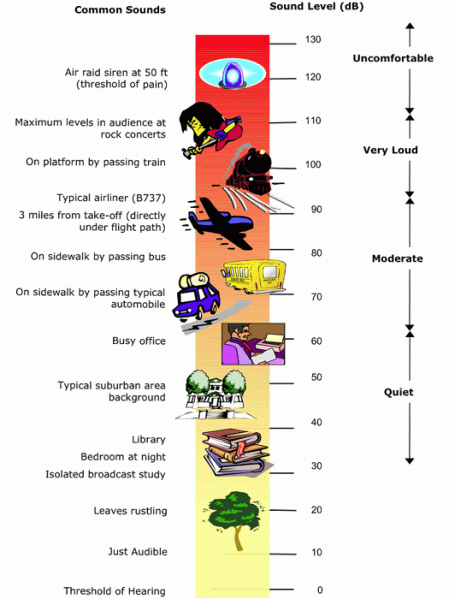
With our definition of the decibel level we find that waves corresponding to variations of one part in a hundred thousand of the reference level  give roughly L=100dB while part in ten thousand gives about L=120dB. The sound of the Big Bang therefore peaks at levels just over  110 dB. As you can see in the Figure above, this is close to the threshold of pain,  but it’s perhaps not as loud as you might have guessed in response to the initial question. Many rock concerts are actually louder than the Big Bang, at least near the speakers!

A useful yardstick is the amplitude  at which the fluctuations in pressure are comparable to the mean pressure. This would give a factor of about 1010 in the logarithm and is pretty much the limit that sound waves can propagate without distortion. These would have L≈190 dB. It is estimated that the 1883 Krakatoa eruption produced a sound level of about 180 dB at a range of 100 miles. By comparison the Big Bang was little more than a whimper.

PS. If you would like to read more about the actual sound of the Big Bang, have a look at John Cramer’s webpages. You can also download simulations of the actual sound. If you listen to them you will hear that it’s more of  a “Roar” than a “Bang” because the sound waves don’t actually originate at a single well-defined event but are excited incoherently all over the Universe.

Deterministic Chaos

Posted in Biographical with tags , on April 25, 2009 by telescoper

Yesterday was the occasion of the Annual Ball of the Cardiff  University School of Physics & Astronomy‘s Student Society Chaos held in the Cardiff Arms Suite of the Millennium Stadium. I had reservations about going because things like this always make me feel very old, but having been persuaded I was determined to have a good time. It turned out to be very enjoyable, so much so that I ended up moving on with some others to a nightclub to continue the party into the small hours. I think I kept up with the youngsters quite well, although I was well and truly knackered when I got home.

I’m also glad I didn’t disgrace myself too much, or if I did I don’t remember…

There was about a hundred people at the Chaos Ball, the vast majority of them students in the department. Not many staff members went along, although those that did all seemed to have a good time. These social events are quite tricky to pull off for a number of reasons. One is that there’s an inevitable “distance” between students and staff, not just in terms of age but also in the sense that the staff have positions of responsibility for the students. Students are not children, of course, so we’re not legally  in loco parentis, but something of that kind of relationship is definitely there. Although it doesn’t stop either side letting their hair down once in a while, I always find there’s a little bit of tension especially if the revels get a bit out of hand.

To help occasions like this I think it’s the responsibility of the staff members present to drink heavily in order to put the students at ease. United by a common bond of inebriation, the staff-student divide crumbles and a good time is had by all.

A couple of other incidents that happened this week serve to illustrate related issues. On Thursday we had to evacuate the building because the fire alarm went off. It turned out that some work being done on the roof had triggered a smoke detector. Although it wasn’t a real emergency, four fire engines arrived and we all stood outside for the best part of an hour while they figured out what had happened and, curiously, how to switch the alarm off.

The fire alarm had gone off, the fire brigade had turned out, but there was no fire to be seen. I joked that the only possible explanation of this state of affairs was that there must be a dark fire…

Standing outside, staff and students chatted casually while waiting to be let back into the building. It was sunny, which added to the conviviality. I realised, though, that I’d  never really spoken to many of my students like that before, i.e. outside the lecture  or tutorial. I see the same faces in my lectures day in, day out but all I do is talk to them about physics. I don’t know them at all. It’s strange.

The other thing was yesterday morning where I was giving one of my first year lectures on Astrophysical Concepts, a course which I really enjoy teaching. The topic was supernovae and it’s a lecture which I always end by doing an impersonation of a supernova explosion. If you want to see it, you’ll have to sign up for the course.

I was doing my PhD in 1987 when a supernova (SN1987A) went off in the Large Magellanic Cloud. It was  a hot topic for a while and I mentioned in my talk. I started to say “Some of you will remember…” then I suddenly realised to my horror that in 1987  nobody in my class had yet been born…

The Shape of Things to Come..

Posted in Science Politics with tags , , on April 24, 2009 by telescoper

The implications of this week’s budget for astronomy are gradually becoming clearer although a full picture is yet to emerge.

The following statement appeared on the webpages of the Science and Technology Facilities Council:

STFC’s budget of £491 million for 2009-10 is evidence of the Government’s commitment to investing in science in a period of severe national and global economic uncertainty.

STFC’s Chief Executive Officer, Professor Keith Mason, said: “Our budget represents a major investment in science at a time of increasing pressure on public spending, and will allow us to fund a wide array of world leading science delivering significant impact for the UK.”

“The budget confirms the Government’s commitment to, and acknowledgement of, investment in curiosity driven and application led research as essential elements to support the country’s economic growth in the short, medium and longer term.”

Professor Mason said the near cash* budget of £491 million was more than the Council’s allocation in the Comprehensice Spending Review (CSR07), thanks to assistance from the Department for Innovation, Universities and Skills (DIUS) in the form of a loan and compensation for foreign exchange exposure. This outcome follows extensive consultation between DIUS and the Research Councils to ameliorate the effect of the fall of the pound. However, it will unfortunately not allow STFC to fund the full science programme planned under its Programmatic Review.

Professor Mason said STFC would now consult on reprioritising its programme across the remainder of the CSR period. This consultation will cover both the short-term items required for 2009-10, and a longer term process to ensure stable platform for planning in the medium to longer term. Council will discuss options for 2009-10 at its meeting on the 28th April.

“For its part STFC has already imposed a series of internal savings, including on travel and severe restrictions on external recruitment. We will seek to identify further savings in order to concentrate resources on funding our core research programme,” Professor Mason said.

It appears, then, that there is to be short-term assistance from the effects of currency fluctuations but this will be in the form of a loan that will eventually have to be paid back from savings found within the programme. I suppose something’s better than nothing, despite the bland language, it is quite clear that we are heading for big cuts in the STFC programme and astronomy will not be immune.

The Times Higher has also covered the budget settlement for science and higher education generally in very downbeat terms. Echoing what I put in my previous post:

Although the Budget maintains an existing commitment to ring-fence the science budget, DIUS had reportedly sought a £1 billion increase in funding for scientific research as part of a stimulus package designed to use science to boost the economy.

Instead of this, research councils will be required to make £106 million in savings, which will then be reinvested elsewhere intheir portfolio “to support key areas of economic potential”.

We await details of where these “savings” will be made. My current understanding is that the STFC needs to find about £10 million immediately although whether this is on top of or including its share of the overall “efficiency savings”, I don’t know. In any case it is clear that this money will be taken from pure science programmes and spent instead on areas deemed to have “economic potential”. It looks like we’re all going to have to hone our bullshitting skills over the next few years.

Jorunn Monrad

Posted in Art with tags , on April 23, 2009 by telescoper

Off the Wall is a small contemporary art gallery in Llandaff, about 15 minutes walk from my home in Pontcanna, Cardiff.  I went there this evening to a private view of some works by Norwegian artist Jorunn Monrad, who lives and works in Milan.

The artist herself was there and I got the chance to talk to her over a glass or two of pink champagne after looking at the paintings.

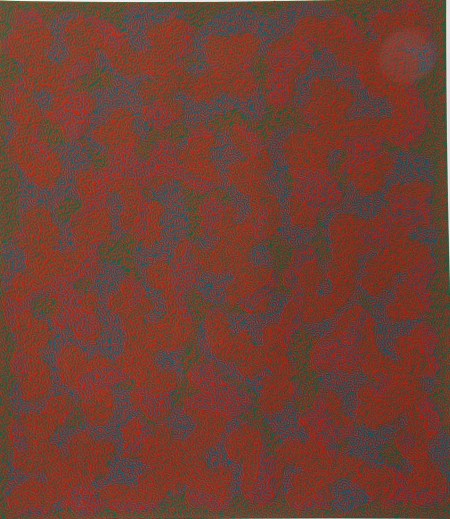
The works on view in her exhibition were all made this year, and they were produced with a technique developed in the Middle Ages that involves egg and casein tempera. The paintings are brilliantly coloured abstract works that involve structures built up  from representations of tiny proto-animals, meticulously painted all over the linen background so that they build up to larger structures. The dramatic colour palette produces interesting visual effects, at times  revealing and at times obscuring patterns present in the paint. The intricate detail and luminous colouring makes for a vivid but sometimes perplexing whole.

Here is an example (although the digital image doesn’t really do justice to the original).

dicembre2008verdevermilion

To quote her own description

My works are rooted in an imagery from my childhood: the snakes of the wooden sculptures of Viking and mediaeval Norwegian art, the forms that were created by nature, like branches, cloudsm forms of branches. The fables, the mysterious nature has also played a part. I have also done research on phenomena that are triggered by the imagery, one may say biological, on which precisely the visions of forms that repeat themselves during falling asleep and waking up can create this kind of visual effects.

From this I have obtained a kind of module, that is a kind of biomorphic form, rather than one specific animal or other, that is merely the building brick of of the structure, but that is multiplied in forms that are vertiginous and sometime perhaps unsettling. The idea is to create a dreamy, moving atmosphere that is nevertheless very different from the effects of op art, in short a less clashing, more “natural” effect.

The effects she achieves are, in some sense, a variation on those I blogged about previously but with elements that are entirely original.

If you’re in Cardiff this small exhibition is well worth seeing. Her paintings are for sale too, with a surprisingly modest price tag. I’m seriously thinking of investing in one myself, in fact.

The exhibition continues at Off the Wall, The Old Probate Registry, Llandaff until 30th May 2009.

PS. In response to the specific request below from Tom Shanks, who is never shy of making an exhibition of himself,  I’ve added this picture of his famous travelling installation:

dscf0001