Economic Impact

Posted in Science Politics with tags , , on April 22, 2009 by telescoper

Like many of my colleagues I’ve been looking nervously through the lengthy documents  produced by HM Treasury to fill in the details of the Chancellor’s Budget speech. I was hoping to find some evidence of a boost for science that might filter down as a rescue package for STFC and might dispel the rumours of savage cuts in the Astronomy programme. Unfortunately I didn’t find any.

No real details about the science programme are given in the lengthy budget report, at least not that I could find this afternoon. There are, however, a couple of worrying pointers that things might be going from bad to worse.

The Chancellor has decided to cut public spending overall by about £15 billion (largely by “efficiency savings”) in order to control the UK’s ballooning public debt. The Department of Innovation, Universities and Skills (DIUS) which sits above the Research Councils in the hierarchy of research management is mentioned twice in the document, in the following passages talking about savings:

£118 million through increasing the effectiveness of research activities funded by the Research Councils by reducing administration costs and refocusing spend on new research priorities;

and

An additional £106 million of savings delivered by the Research Councils within the science and research budget to be re-invested within that budget to support key areas of economic potential.

Both of these look to me like indications that money will be diverted from pure science into technology-driven areas. Far from there being a boost for astronomy, it looks like we face the opposite with money being squeezed from us and re-allocated to areas that can make a stronger case for economic potential.

Another indication of this phase change, which has been in the air for some time, appeared yesterday on the STFC website.  The whole item can be found here, but the salient points are included in the following excerpt

Applicants for STFC rolling and standard grants will now be required to produce an impact plan, identifying the potential economic impacts of their proposal. The change takes effect from 21 April 2009 and will affect grants rounds from autumn 2009 onward.

The change follows a 2006 Research Councils UK project, and subsequent Excellence with Impact report, into the efficiency and value for money of Research Council peer review processes. The report recommended the Research Councils improve guidance to applicants and peer reviewers to ensure a shared understanding about the value of identifying the potential economic impact of research, and that the new requirements be supported in electronic application systems and guidelines.

More details of the spending priorities of DIUS within its overall budget will no doubt emerge in due course and they may yet reveal a tonic of some sort for STFC. What seems more likely, however, is that any such funds will be aimed at space gadgetry rather than at science. I have a feeling that the impact of the economic downturn on UK Astronomy is going to turn out to be dire.

Bixology

Posted in Jazz with tags , , , , on April 21, 2009 by telescoper

 Leon “Bix” Beiderbecke became a jazz-age romantic legend by playing brilliant trumpet and by drinking too much bad prohibition liquor resulting his premature death in 1931, at the age of only 28. His short life was punctuated by episodes of very bad health caused by chronic alcoholism in an era when the only booze that was available was bathtub gin or rotgut whisky. Nevertheless, Bix still gave us some of the greatest ever jazz records.

Although he was of middle-class white origins, Bix’s  playing was deeply admired by leading black musicians of the day. No less a trumpeter than Louis Armstrong refused to play Singin’ the Blues because he felt Bix’s version was so good that it shouldn’t be touched. High praise indeed. Many jazz trumpeters to this day still play some of Bix’s trumpet licks, though few do them justice.

Bix’s trumpet-playing was all quicksilver virtuosity but, above all, he possessed a beautiful ringing, bell-like tone that is quite unlike that of any other trumpeter before or since. His clarion sound even pierces through the hiss and crackle produced by contemporary recording techniques. My favourite example is this, an old tune called At the Jazz Band Ball, where Bix’s trumpet lead is matched in exuberance and skill by Bill Rank (trombone), Frank Signorelli (clarinet) and, particularly,  the superb Adrian Rollini on bass saxophone, who managed to play his enormous and unwieldy instrument not only with great swing but also with a fine sense of humour.

But Bix wasn’t just a trumpeter. He also composed a few pieces for solo piano. I didn’t know about these until about 18 months ago, when I found a recording my Dad had kept of a concert at Newcastle City Hall in which he had played the drums in a trio led by the American jazz pianist Ralph Sutton. Among the numbers they played was a nice tune called, appropriately enough for this blog, In the Dark. The other day I found a clip on Youtube of Ralph Sutton playing the same tune (although not with my Dad). I hadn’t realised that this tune was written by Bix Beiderbecke.

Perhaps I should use it this blog’s signature tune? 

Bix composed other pieces for solo piano too. The most famous, and probably the most interesting because of its unusual harmonic structure, is called In a Mist, but for some reason when Bix’s own recording of this tune was released in the United Kingdom it was renamed Bixology.  Here it is played by the wonderful Marian Macpartland

Budget Boost?

Posted in Science Politics with tags , , , , on April 19, 2009 by telescoper

This Wednesday (22nd April 2009) the Chancellor of the Exchequer, Alistair Darling, will deliver the UK government’s budget for this year. The background is of course the economic recession and the consequent collapse of our public finances. The government will have to borrow an estimated £175 billion over the next year, and it likely that taxes will eventually have to rise considerably to balance the books in the longer term.

Rumours are abounding about what will be in the budget and what won’t. According to today’s Observer, the centrepiece is likely to be a £50 billion scheme to revitalize the housing market.  If this is the case then I think it’s a mistake. Our economy has been run for too long on the basis of money raised from inflated property valuations, and we need to take this opportunity to change to a more sustainable way of running the country. Other schemes that may emerge include a £2 billion scheme to help unemployed young people which is a better idea, but much of it would probably be wasted in bureaucracy rather than doing real good.

My own attention will be focussed on whether there is anything in Alistair Darling’s speech that indicates some help for science, particularly fundamental science like physics and astronomy. In yesterday’s Guardian the Astronomer Royal and President of the Royal Society, Lord Martin Rees argued  for an injection of cash to stimulate science and innovation. About a month ago the BBC reported on efforts by Ministers to convince the treasury of the benefit of a £1 billion stimulus package for science along these lines. However, even if the powers that be listen to this argument (which is, in my view, unlikely), any increase in science funding would not necessarily be directed towards fundamental physics. I think if there isn’t anything for those of us working in astronomy in this budget, then we’re completely screwed.

I believe the funding crisis at the Science & Technology Facilities Council (STFC) was precipitated by a conscious government decision to move funds away from blue skies research and into more applied, technology driven areas.  The 2007 Comprehensive Spending Review was extremely tough on STFC but quite generous to some other agencies.  Moreover, within STFC itself there seems to be a shift from science-driven to technology-driven projects,  signalled by the cancellation of projects such as Clover to save a couple of million, and the allocation of funds to projects such as Moonlite which is devoid of any scientific interest and which could end up costing as much as £150 million over the next five years or so.

The true depth of the ongoing STFC crisis is only gradually becoming apparent. It was bad enough to start with, but has been exacerbated by the fall in value of sterling against the euro since 2007 which has meant that the cost of subscriptions to CERN, ESA and ESO have risen dramatically (by about 40%). These form such a large part of STFC’s expenditure – the CERN subscription alone is £70m out of a total budget of around £800m – that it cannot absorb the increased cost and it is now looking to make swingeing cuts on top of the 25% cut in research grants already implemented.

News emerged last week that STFC has abandoned plans to fund any R&D grants for ESA’s Cosmic Vision programme, and there are dark rumours circulating that it is considering cancelling all astronomy grants this year as well as clawing back money already given to universities in previous rounds. I hope these are not true, but I fear the worst.

Cuts on this scale would be devastating, demoralising, and I honestly think would destroy the United Kingdom as a place to do astronomy. They would also signal a complete breakdown of trust between scientists and the research council that is supposed to support them, if that hadn’t happened already.

Incidentally it is noticeable that STFC hasn’t bothered to report any of these matters publically through its website. Instead, the lead story on the STFC news page is about a visit by Prince Andrew to the Rutherford Appleton Lab. No sign yet, then, of the promised improvement in communication between the STFC Executive and its community.

The way I see it, the urgent issue is not whether we get a stimulus package , but whether we even get the bit of sticking plaster that is needed to  saves physics and astronomy from utter ruin. The cost would be a small fraction of the billions lavished on profligate bankers, but I’m not at all sure that the government either appreciates or cares about the scale of the problem.

Anyway, coincidentally, next week sees the Royal Astronomical Society’s National Astronomy Meeting (NAM), which is this year held jointly with the European Astronomical Society’s JENAM at the University of Hertfordshire. I won’t be going because it has unfortunately been organized in term time apparently because European astronomers refuse to attend meetings in the vacations, at least if they’re in places like Hatfield.  STFC representatives  have been invited; it remains to be seen what, if anything, they will have to say.

The Land of Song

Posted in Music with tags , , on April 18, 2009 by telescoper

I’m sure the Welsh get a bit fed up with everyone saying that they sing so beautifully. But the problem with cliches such as “The Land of Song” is that they are so often true. At Friday’s dinner in honour of Leonid Grischchuk we were treated to a solo rendition of the beautiful old love song Myfanwy in Cardiff Castle, but today I found a much better version featuring the excellent Trelawnyd Male Voice Choir. I think it’s a really wonderful version, but the thing that struck me most was how on Earth can a small farming village with a population of less than a thousand produce so many wonderful tenor voices?

Incidentally, the great Luciano Pavarotti, who died in September 2007, gave his first ever professional performance at the Llangollen International Eisteddfod in Wales, in 1955. It was his success at this festival, with a small choir from Modena that made him decide to turn professional.

Leonid’s Shower

Posted in The Universe and Stuff with tags , , , , on April 18, 2009 by telescoper

Yesterday (17th April) was the last day of our Easter vacation – back to the grind on Monday – and it was also the occasion of a special meeting to mark the retirement of Professor Leonid Petrovich Grishchuk.

Leonid has been a Distinguished Research Professor here in Cardiff since 1995. You can read more of his scientific biography and wider achievements here, but it should suffice to say that he is a pioneer of many aspects of relativistic cosmology and particularly primordial gravitational waves. He’s also a larger-than-life character who is known with great affection around the world.

Among other things, he’s a big fan of football. He still plays, as a matter of fact, although he generally spends more time ordering his team-mates about than actually running around himself. One of his retirement presents was a Cardiff City football shirt with his name on the back.

My first experience of Leonid was many years ago at a scientific meeting at which I attempted to give a talk. Leonid was in the audience and he interrupted me,  rather aggressively. I didn’t really understand his question so he had another go at me in the questions afterwards. I don’t mind admitting that I was quite upset with his behaviour. I think a large fraction of working cosmologists have probably been Grischchucked at one time or another.

Later on, though, people from the meeting were congregating at a bar when he arrived and headed for me. I didn’t really want to talk to him as I felt he had been quite rude. However, there wasn’t really any way of escaping so I ended up talking to him over a beer. We finally resolved the question he had been trying to ask me and his demeanour changed completely. We spent the rest of the evening having dinner and talking about all sorts of things and have been friends ever since.

Over the years I’ve learned that this is very much a tradition amongst Russian scientists of the older school. They can seem very hostile – even brutal – when discussing science, but that was the way things were done in the environment where they learned their trade.  In many cases the rather severe exterior masks a kindly and generous nature, as it certainly does with Leonid.

I also remember a spell in the States as a visitor during which I heard two Russian cosmologists screaming at each other in the room next door. I really thought they were about to have a fist fight. A few minutes later, though, they both emerged, smiling as if nothing had happened…

Appropriately enough Leonid’s bash was held immediately after BritGrav 9, a meeting dedicated to bringing together the gravitational research community of the UK and beyond, and to provide a forum for the exchange of ideas. It aimed to cover all aspects of gravitational physics, both theoretical and experimental, including cosmology, mathematical general relativity, quantum gravity, gravitational astrophysics, gravitational wave data analysis, and instrumentation. I chaired a session during the meeting and found Leonid in characteristic form as a member of the audience, never shy with questions or comments, and quite difficult to keep under control.

I enjoyed the meeting because priority was given to students when allocating speaking slots. I think too many conferences have the same senior scientists giving  the same talk over and over again. Relativists are also quite different to cosmologists in the level of mathematical rigour to which they aspire.  You can bullshit at a cosmology conference, but wouldn’t get away with it in front of a GR audience.

On the evening of 16th April we had a public lecture in Cardiff by Kip Thorne on The Warped Side of the Universe: from the Big Bang to Black Holes and Gravitational Waves and Kip also gave a talk as part of the subsequent meeting on Friday in Leonid’s honour.

lpg008_test

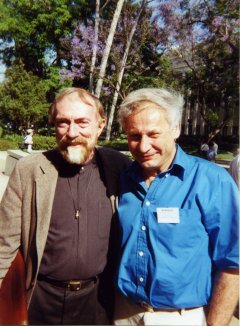
Kip and Leonid are shown together a few years ago in the photograph to the left here. The rest of the LPGFest meeting was interesting and eclectic, with talks from mathematical relativists as well as scientists in diverse fields who had come over from Russia specially to honour Leonid. We later adjourned to a “Welsh Banquet” at the 15th Century Undercroft of Cardiff Castle for dinner accompanied by something described as “entertainment” laid on by the hosts. That part was quite excruciating: like Butlins only not as classy. Heaven knows what our distinguished foreign visitors made of it, although Leonid seemed to think it was great fun, and that’s what matters.

Once the dinner was over it was time for Leonid to be showered with gifts from around the world and, by way of a finale, he was serenaded with a version of From Russian With Love, by Bernie and the Gravitones. Now at last I understand what the phrase “extraordinary rendition” means.

Ode to the Shipping Forecast

Posted in Uncategorized with tags , , , on April 16, 2009 by telescoper

It’s broadcast four times a day on BBC Radio 4 and is immensely popular even with those who know nothing about shipping and live miles from the sea. The Shipping Forecast is as deep a part of British culture as cricket and standing in queues, although it doesn’t take as long as either of those things. It’s like a kind of soothing ritual that tells you that the world is still functioning despite all the stresses of the day. It’s predictable, safe and very conventional, like a meteorological version of the Anglican liturgy, but the combination of the mystical names with numbers and obscure formulae gives it a peculiarly pagan dimension.

I have to admit I’m an addict.
1

The Shipping Forecast is based on the division of the seas around the British Isles into a series of 31 areas, shown on the map, all with wonderfully evocative names. I was born in the Northeast of England so the sequence Forth-Tyne-Dogger always has a particular resonance for me, although living now in Cardiff I now find Lundy-Fastnet-Irish Sea is growing on me. The only problem is it sometimes sounds like Fishnet rather than Fastnet.

The broadcast of the Shipping Forecast always follows a strict format. It always begins with the words “And now the Shipping Forecast, issued by the Met Office on behalf of the Maritime and Coastguard Agency at xx:xx GMT today.”, although some announcers may read out the actual date of issue as opposed to the word “today”.

First are the Gale warnings (winds of force 8 or more, on the Beaufort scale), if any (e.g. There are warnings of gales in Rockall, Malin, Hebrides, Bailey, and Fair Isle). This sometimes follows the opposite format (e.g. There are warnings of gales in all areas except Biscay, Trafalgar and FitzRoy).

The General Synopsis follows, giving the position, pressure (in millibars) and track of pressure areas (e.g. Low, Rockall, 987, deepening rapidly, expected Fair Isle 964 by 0700 tomorrow).

The forecast for each of the 31 shipping areas shown in the map is then read out. Several areas may be combined into a single forecast where the conditions are expected to be similar.

Wind direction is given first, then strength (on the Beaufort scale), followed by precipitation, if any, and (usually) lastly visibility. Change in wind direction is indicated by veering (clockwise change) or backing (anti-clockwise change). Winds of above force 8 are also described by name for emphasis, e.g. Gale 8, Severe Gale 9, Storm 10, Violent Storm 11 and Hurricane force 12. (See Beaufort scale). The word “force” is only officially used when announcing force 12 winds.

Visibility is given in the format: Good, meaning that the visibility is greater than 5 nautical miles; Moderate, where visibility is between 2 and 5 nautical miles; Poor, where visibility is between 1000 metres and 2 nautical miles and Fog, where visibility is less than 1000 metres. When severe winter cold combines with strong winds and a cold sea, icing can occur, normally only in sea area Southeast Iceland; if expected, icing warnings (light, moderate or severe) are given as the last item of each sea area forecast.

The extended shipping forecasts (0520 and 0048 GMT) also include weather reports from a list of additional coastal stations and automatic weather logging stations, which are known by their names, such as Channel Light Vessel Automatic. These are the Coastal Weather Stations, some of which are actually military bases. These add an additional movement to the Symphony of the Shipping Forecast. I’m a particular fan of Sandettie Light Vessel Automatic. It just sounds so good.

You can listen to an example here.

Deeply evocative, but with a perfect control of form and an economy of structure, the Shipping Forecast is ten minutes of pure poetry.

Perception, Piero and Pollock

Posted in Art, The Universe and Stuff with tags , , , , , on April 15, 2009 by telescoper

For some unknown reason I’ve just received an invitation to a private view at a small art gallery that’s about ten minutes’ walk from my house. Cocktails included. I shall definitely go and will blog about it next week. I’m looking forward to it already.

This invitation put me in an artistic frame of mind so, to follow up my post on randomness (and the corresponding parallel version on cosmic variance), I thought I’d develop some thoughts about the nature of perception and the perception of nature.

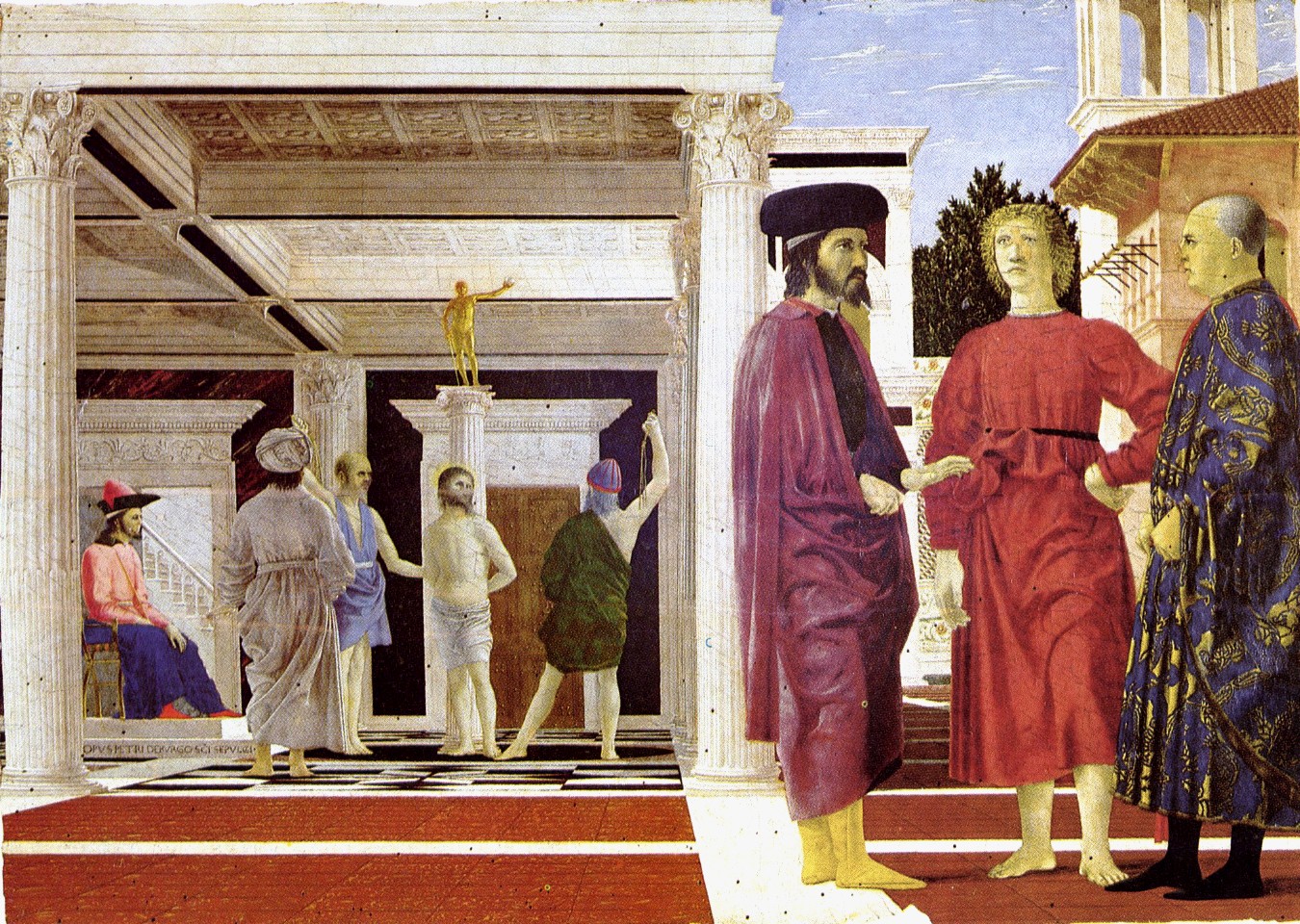
This famous painting is The Flagellation of Christ, by Piero della Francesca. I actually saw it many years ago on one of my many trips to Italy; it’s in an art gallery in Urbino. The first thing that strikes you when you see it is actually that the painting is surprisingly small (about 60cm by 80cm). However, that superficial reaction aside, the painting draws you into it in a way which few other works of art can. The composition is complicated and mathematically precise, but the use of linear perspective is sufficiently straightforward that your eye can quickly understand the geometry of the space depicted and locate the figures and actions within it. The Christ figure is clearly in the room to the left rear and the scene is then easily recognized as part of the story leading up to the crucifixion.

That’s what your eye always seems to do first when presented with a figurative representation: sort out what’s going on and fill in any details it can from memory and other knowledge.

But once you have made sense of the overall form, your brain immediately bombards you with questions. Who are the three characters in the right foreground? Why aren’t they paying attention to what’s going on indoors? Who is the figure with his back to us? Why is the principal subject so far in the background? Why does everyone look so detached? Why is the light coming from two different directions (from the left for the three men in the foreground but from the right for those in the interior)? Why is it all staged in such a peculiar way? And so on.

These unresolved questions lead you to question whether this is the straightforward depiction first sight led you to think it was. It’s clearly much more than that. Deeply symbolic, even cryptic, it’s effect on the viewer is eery and disconcerting. It has a dream-like quality. The individual elements of the painting add up to something, but the full meaning remains elusive. You feel there must be something you’re missing, but can’t find it.

This is such an enigmatic picture that it has sparked some extremely controversial interpretations, some of which are described in an article in the scientific journal Nature. I’m not going to pretend to know enough to comment on the theories, escept to say that some of them at least must be wrong. They are, however, natural consequences of our brain’s need to impose order on what it sees. The greatest artists know this, of course. Although it sometimes seems like they might be playing tricks on us just for fun, part of what makes art great is the way it gets inside the process of perception.

Here’s another example from quite a different artist.

This one is called Lavender Mist. It’s one of the “action paintings” made by the influential American artist Jackson Pollock. This, and many of the other paintings of its type, also get inside your head in quite a disconcerting way but it’s quite a different effect to that achieved by Piero della Francesca.

This is an abstract painting, but that doesn’t stop your eyes seeking within it some sort of point of reference to make geometrical sense of it. There’s no perspective to draw you into it so you look for clues to the depth in the layers of paint. Standing in front of one of these very large works – I find they don’t work at all in reduced form like on the screen in front of you now – you find your eyes constantly shifting around, following lines here and there, trying to find recognizable shapes and to understand what is there in terms of other things you have experienced either in the painting itself or elsewhere. Any order you can find, however, soon becomes lost. Small-scale patterns dissolve away into sea of apparent confusion. Your brain tries harder, but is doomed. One of the biggest problems is that your eyes keep focussing and unfocussing to look for depth and structure. It’s almost impossible to stop yourself doing it. You end up dizzy.

I don’t know how Pollock came to understand exactly how to make his compositions maximally disorienting, but he seems to have done so. Perhaps he had a deep instinctive understanding of how the eye copes with the interaction of structures on different physical scales. I find you can see this to some extent even in the small version of the picture on this page. Deliberately blurring your vision makes different elements stand out and then retreat, particularly the large darkish streak that lies to the left of centre at a slight angle to the vertical.

This artist has also been the subject of interest by mathematicians and physicists because his work seems to display some of the characteristic properties of fractal sets. I remember going to a very interesting talk a few years ago by Richard Taylor of the University of Oregon who claimed that fractal dimensions could be used to authenticate (or otherwise) genuine works by Pollock as he seemed to have his own unique signature.

I suppose what I’m trying to suggest is that there’s a deeper connection than you might think between the appreciation of art and the quest for scientific understanding.

Spiritus Mundi

Posted in Poetry with tags , , on April 14, 2009 by telescoper

I found this poem by Simon Pomery a while ago in the Times Literary Supplement. Something made me cut it out of the paper and keep it. Part of the reason that it made an impression on me was probably that it is taken from a lengthy verse translation of one of Seneca‘s Moral Epistles called Divina Lux (a couple of other fragments of which you can find here) and this is a work I studied a bit in latin classes at School. You can also find prose translations of some of the 124 such Epistles Seneca wrote very near the end of his life here.

The soul of the world abides.
It doesn’t distinguish between
those born in town or country:
it makes its home in the wild sea,
the blur and seam of the horizon,
the cloud-racked firmament itself.
The space that separates the gods
from men unites them also, where stars,
like watchmen, sleep out in the open.

Seneca espoused a Stoic philosophy that was developed later by Marcus Aurelius, whose Meditations is one of my favourite books, although I’ve forgotten too much of my schoolboy Latin to read it in the original. I do, however, keep the paperback English translatlon with me when I go travelling. It is one the greatest works of classical philosophy, but it’s also a collection of very personal thoughts by someone who managed to be an uncompromisingly authoritarian Emperor of Rome at the same time as being a tender and introspective person.

Not that I’ve ever in practice managed to obey his exhortations to self-denial…

A funny thing happened on the way…

Posted in Columbo with tags , on April 13, 2009 by telescoper

Following yesterday’s emergency trip to the vet with Columbo, I took him back this morning. Although still very woozy from the tranquilizers he’s been having, he is much better this morning and the vet suggested no further action would be needed unless he had another episode. When the latest Diazepam wears off, hopefully he will return to some semblance of normality.

By the way, thanks for all the nice messages on here and on facebook. I really appreciate them.

While I was waiting in the reception area, a guy came in to make an appointment. When the receptionist asked what kind of animal he had, he said “Pet Sheep”. The animal concerned was waiting patiently in the back of his car.

It turns out the owner of this particularly sheep, David Palmer, is something of a celebrity and has even featured on Sky News. He found the sheep abandoned and brought it up as a pet. It lives in his house and is very tame, sitting quietly in the car while people chatted around him. It’s a substantial beast, though. Over 20 stones in fact -that’s 280lbs for any transatlantic readers.

I’ve never thought of sheep as pets. There are pet lambs on farms of course: when their mother has died or rejected them they are typically brought up by humans until they’re ready to go to market. But a full-grown sheep is a sizeable beast and, I would have thought, difficult to housetrain. Still, this one seemed quite affectionate. I asked Mr Palmer what he fed the sheep on. The answer was sprouts and carrots.

These days vets have to cope with all kinds of animals as well as the traditional cats and dogs. I’ve seen lizards, snakes, a monkey and vietnamese pig in various waiting rooms during various visits to various vets over the years.

The funniest thing I ever saw, though, wasn’t the sheep but a huge dog; a Great Dane no less. This enormous animal came  into the vet’s surgery with a little old lady in tow. She was like a character out of an old Ealing comedy and the dog was at least shoulder high to her. I thought she could probably ride around on it like a horse.

As they entered, a small dog barked and the Great Dane freaked out and started bounding around the room, knocking over a stand covered in pet treats and toys and generally causing a commotion. The old lady said “Brian! Calm down!”.

Brian. What a name for a Great Dane.

Arrows and Demons

Posted in The Universe and Stuff with tags , , , , , on April 12, 2009 by telescoper

My recent post about randomness and non-randomness spawned a lot of comments over on cosmic variance about the nature of entropy. I thought I’d add a bit about that topic here, mainly because I don’t really agree with most of what is written in textbooks on this subject.

The connection between thermodynamics (which deals with macroscopic quantities) and statistical mechanics (which explains these in terms of microscopic behaviour) is a fascinating but troublesome area.  James Clerk Maxwell (right) did much to establish the microscopic meaning of the first law of thermodynamics he never tried develop the second law from the same standpoint. Those that did were faced with a conundrum.  


The behaviour of a system of interacting particles, such as the particles of a gas, can be expressed in terms of a Hamiltonian H which is constructed from the positions and momenta of its constituent particles. The resulting equations of motion are quite complicated because every particle, in principle, interacts with all the others. They do, however, possess an simple yet important property. Everything is reversible, in the sense that the equations of motion remain the same if one changes the direction of time and changes the direction of motion for all the particles. Consequently, one cannot tell whether a movie of atomic motions is being played forwards or backwards.

This means that the Gibbs entropy is actually a constant of the motion: it neither increases nor decreases during Hamiltonian evolution.

But what about the second law of thermodynamics? This tells us that the entropy of a system tends to increase. Our everyday experience tells us this too: we know that physical systems tend to evolve towards states of increased disorder. Heat never passes from a cold body to a hot one. Pour milk into coffee and everything rapidly mixes. How can this directionality in thermodynamics be reconciled with the completely reversible character of microscopic physics?

The answer to this puzzle is surprisingly simple, as long as you use a sensible interpretation of entropy that arises from the idea that its probabilistic nature represents not randomness (whatever that means) but incompleteness of information. I’m talking, of course, about the Bayesian view of probability.

 First you need to recognize that experimental measurements do not involve describing every individual atomic property (the “microstates” of the system), but large-scale average things like pressure and temperature (these are the “macrostates”). Appropriate macroscopic quantities are chosen by us as useful things to use because they allow us to describe the results of experiments and measurements in a  robust and repeatable way. By definition, however, they involve a substantial coarse-graining of our description of the system.

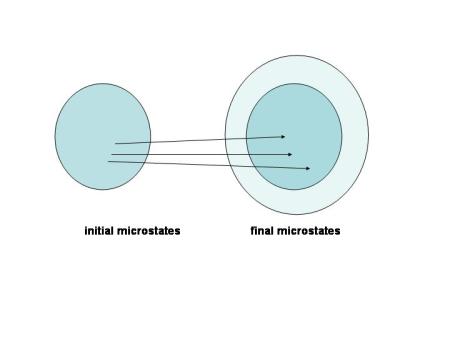
Suppose we perform an idealized experiment that starts from some initial macrostate. In general this will generally be consistent with a number – probably a very large number – of initial microstates. As the experiment continues the system evolves along a Hamiltonian path so that the initial microstate will evolve into a definite final microstate. This is perfectly symmetrical and reversible. But the point is that we can never have enough information to predict exactly where in the final phase space the system will end up because we haven’t specified all the details of which initial microstate we were in.  Determinism does not in itself allow predictability; you need information too.

If we choose macro-variables so that our experiments are reproducible it is inevitable that the set of microstates consistent with the final macrostate will usually be larger than the set of microstates consistent with the initial macrostate, at least  in any realistic system. Our lack of knowledge means that the probability distribution of the final state is smeared out over a larger phase space volume at the end than at the start. The entropy thus increases, not because of anything happening at the microscopic level but because our definition of macrovariables requires it.
ham

This is illustrated in the Figure. Each individual microstate in the initial collection evolves into one state in the final collection: the narrow arrows represent Hamiltonian evolution.


However, given only a finite amount of information about the initial state these trajectories can’t be as well defined as this. This requires the set of final microstates has to acquire a  sort of “buffer zone” around the strictly Hamiltonian core;  this is the only way to ensure that measurements on such systems will be reproducible.

The “theoretical” Gibbs entropy remains exactly constant during this kind of evolution, and it is precisely this property that requires the experimental entropy to increase. There is no microscopic explanation of the second law. It arises from our attempt to shoe-horn microscopic behaviour into framework furnished by macroscopic experiments.

Another, perhaps even more compelling demonstration of the so-called subjective nature of probability (and hence entropy) is furnished by Maxwell’s demon. This little imp first made its appearance in 1867 or thereabouts and subsequently led a very colourful and influential life. The idea is extremely simple: imagine we have a box divided into two partitions, A and B. The wall dividing the two sections contains a tiny door which can be opened and closed by a “demon” – a microscopic being “whose faculties are so sharpened that he can follow every molecule in its course”. The demon wishes to play havoc with the second law of thermodynamics so he looks out for particularly fast moving molecules in partition A and opens the door to allow them (and only them) to pass into partition B. He does the opposite thing with partition B, looking out for particularly sluggish molecules and opening the door to let them into partition A when they approach.

The net result of the demon’s work is that the fast-moving particles from A are preferentially moved into B and the slower particles from B are gradually moved into A. The net result is that the average kinetic energy of A molecules steadily decreases while that of B molecules increases. In effect, heat is transferred from a cold body to a hot body, something that is forbidden by the second law.

All this talk of demons probably makes this sound rather frivolous, but it is a serious paradox that puzzled many great minds. Until it was resolved in 1929 by Leo Szilard. He showed that the second law of thermodynamics would not actually be violated if entropy of the entire system (i.e. box + demon) increased by an amount every time the demon measured the speed of a molecule so he could decide whether to let it out from one side of the box into the other. This amount of entropy is precisely enough to balance the apparent decrease in entropy caused by the gradual migration of fast molecules from A into B. This illustrates very clearly that there is a real connection between the demon’s state of knowledge and the physical entropy of the system.

By now it should be clear why there is some sense of the word subjective that does apply to entropy. It is not subjective in the sense that anyone can choose entropy to mean whatever they like, but it is subjective in the sense that it is something to do with the way we manage our knowledge about nature rather than about nature itself. I know from experience, however, that many physicists feel very uncomfortable about the idea that entropy might be subjective even in this sense.

On the other hand, I feel completely comfortable about the notion:. I even think it’s obvious. To see why, consider the example I gave above about pouring milk into coffee. We are all used to the idea that the nice swirly pattern you get when you first pour the milk in is a state of relatively low entropy. The parts of the phase space of the coffee + milk system that contain such nice separations of black and white are few and far between. It’s much more likely that the system will end up as a “mixed” state. But then how well mixed the coffee is depends on your ability to resolve the size of the milk droplets. An observer with good eyesight would see less mixing than one with poor eyesight. And an observer who couldn’t perceive the difference between milk and coffee would see perfect mixing. In this case entropy, like beauty, is definitely in the eye of the beholder.

The refusal of many physicists to accept the subjective nature of entropy arises, as do so many misconceptions in physics, from the wrong view of probability.