Talking Planck

Posted in The Universe and Stuff with tags , , on April 3, 2009 by telescoper

Since the Planck mission is due to be launched very soon, I thought it would be nice to put this lecture by George Efstathiou here in order to give some background. It’s from a page of science talks about Planck.

George is the Professor of Astrophysics (1909) at the University of Cambridge. The 1909 isn’t when he was born, but when the Chair he holds was set up. I have a hundred-year-old Chair in my house too.
He is also the Director of the impressive Kavli Institute for Cosmology.
He’s a leading member of the Planck science team and is coordinating the UK effort that will be applied to analysing the data. He’s an FRS, citation millionaire, and general all-round clever clogs. He would cut an even more impressive figure were it not for the fact that he supports Arsenal.

Clover Story

Posted in Science Politics, The Universe and Stuff with tags , , on April 2, 2009 by telescoper

Just a quick note for those interested in the story of Clover, Physics World have run a news item on their website.

You may also like to read the article by Alan Heavens over on the e-astronomer.

Note added on Monday 6th April: the Nature slant on the story is now published online, complete with quote from yours truly…

Another update (9th April). Welsh Newspaper The Western Mail has now run a story on the clover cancellation and there was a short item on the BBC Radio Wales News this evening.

Another update (14th April). A statement from Walter Gear, Principal Investigator of the Clover project, about the current status of Clover has been placed on the Cardiff University School of Physics & Astronomy web pages.

Update: 22nd April 2009. Here is the text of a piece I wrote for today’s Research Fortnight:

An undeserved end

Science projects don’t get much purer than CLOVER, an experiment designed to search for evidence of the existence of primordial gravitational waves by making ultra-sensitive measurements of the polarisation of the cosmic microwave background.

From its vantage point in the Atacama Desert in Chile, CLOVER was intended to probe the state of the universe when it was less than a billionth of a billionth of a second old, to test our understanding of the Big Bang theory. Unfortunately, the Science and Technology Facilities Council says it is cancelling funding for the experiment.

Gravitational waves have been studied theoretically and are known to be intimately related to the structure of space-time itself, the understanding of which is arguably the fundamental goal of modern science. The first discovery of the presence of gravitational waves will lead to the emergence of a brand new area of physics. In anticipation of this new science, the CLOVER team—entirely British, with members in the universities of Cardiff, Cambridge, Oxford and Manchester—has established a technical capability in the UK that is second to none. Cancellation will prevent the team from making direct experimental observations of the universe that would not only have been of immense scientific importance, but could also have had deep cultural significance.

So if CLOVER is so good, why is it being cancelled?

The answer lies in an unfortunate combination of circumstances. CLOVER was initially funded in 2004, with
£4.8 million from the Particle Physics and Astronomy Research Council, one of the forerunners of the STFC. This budget was not sufficient to complete the experiment, for two main reasons. First, the original grant did not include the costs of setting up a site, which was originally to be provided by overseas collaborators in Antarctica. When this option fell through, the cost of the alternative site in Chile (approximately £0.8m) had
to be found. Second, there were delays due to technical challenges, such as the need to develop some of the world’s most sensitive far-infrared superconducting cameras. So, the CLOVER team was unable to complete the project within the original budget, and went back to the STFC to request extra money. This brought a third factor into play.

Since 2007, the research councils, including the STFC, have changed their method of funding university-based research. In the new full-economic-costs regime, costs are substantially higher than at the time of the original award. These elements combined to leave the CLOVER team with a shortfall of about £2.6m, bringing the overall cost to completion to about £7.5m, although the increase in resources required would be only around 20 per cent if calculated on the pre-FEC basis of the initial funding.

Unfortunately, despite receiving strong support from the scientific community and being rated extremely highly in recent prioritisation exercises, the STFC Council has decided that it does not have the funds and has abruptly cancelled the CLOVER experiment.

The background to this decision is one of dire financial circumstances within the research council. Created in 2007, the STFC was set up with insufficient funding to continue all the programmes that it inherited from its predecessors. The deficit (of around £80m) has led to swingeing cuts in research grants over the past year. The pound has also fallen dramatically against the euro, increasing the cost of subscriptions to the European Space Agency, Cern and the European Southern
Observatory. The balance sheet of the STFC is now in total disarray. CLOVER is the first casualty in what may become a large-scale cull of fundamental science projects.

The STFC’s decision on CLOVER means that an important instrument will be lost, and the millions already spent on it wasted. The technology will be difficult to replace. The many gifted scientists who have been working on CLOVER will have to leave the UK to continue in the field, and are unlikely to return. Their fate is unlikely to tempt younger people into a career in science either.

In cancelling CLOVER, the council has effectively closed the door on UK involvement in cosmic microwave background science in general, an area that has already led to two Nobel prizes for physics. The decision also provides worrying evidence that the STFC seems to be turning away from fundamental science towards technology- driven projects. For example the lunar probe Moonlite has recently won funding for initial development studies without ever passing through the rigorous peer review required of CLOVER. If this really is the way the STFC is going, then we may be witnessing the beginning of the end for British astronomy.

Progress

Posted in Uncategorized with tags , , on April 1, 2009 by telescoper

slide1

Based on an original idea by Private Eye (with credit to Michelangelo).

PS. I wonder who did the floor of the Sistine Chapel?

The Waste Land

Posted in Poetry, Science Politics, The Universe and Stuff with tags , , , , on April 1, 2009 by telescoper

APRIL is the cruellest month, sending
Clover into the dead land, ditching
The great for the dire, erring
Dead heads caused spring pain.
Keith Mason fucked it up, smothering
Good science with tons of shit, ending
Our little dream; we’re the losers.

After The Waste Land, Part I: The Burial of the Dead, by T.S. Eliot.

Clover and Out

Posted in Science Politics, The Universe and Stuff with tags , , , , , , , , , on March 31, 2009 by telescoper

One of the most exciting challenges facing the current generation of cosmologists is to locate in the pattern of fluctuations in the cosmic microwave background evidence for the primordial gravitational waves predicted by models of the Universe that involve inflation.

Looking only at the temperature variation across the sky, it is not possible to distinguish between tensor  (gravitational wave) and scalar (density wave) contributions  (both of which are predicted to be excited during the inflationary epoch).  However, scattering of photons off electrons is expected to leave the radiation slightly polarized (at the level of a few percent). This gives us additional information in the form of the  polarization angle at each point on the sky and this extra clue should, in principle, enable us to disentangle the tensor and scalar components.

The polarization signal can be decomposed into two basic types depending on whether the pattern has  odd or even parity, as shown in the nice diagram (from a paper by James Bartlett)

The top row shows the E-mode (which look the same when reflected in a mirror and can be produced by either scalar or tensor modes) and the bottom shows the B-mode (which have a definite handedness that changes when mirror-reflected and which can’t be generated by scalar modes because they can’t have odd parity).

The B-mode is therefore (in principle)  a clean diagnostic of the presence of gravitational waves in the early Universe. Unfortunately, however, the B-mode is predicted to be very small, about 100 times smaller than the E-mode, and foreground contamination is likely to be a very serious issue for any experiment trying to detect it.

An experiment called Clover (involving the Universities of  Cardiff, Oxford, Cambridge and Manchester) was designed to detect the primordial B-mode signal from its vantage point in Chile. You can read more about the way it works at the dedicated webpages here at Cardiff and at Oxford. I won’t describe it in more detail here, for reasons which will become obvious.

The chance to get involved in a high-profile cosmological experiment was one of the reasons I moved to Cardiff a couple of years ago, and I was looking forward to seeing the data arriving for analysis. Although I’m primarily a theorist, I have some experience in advanced statistical methods that might have been useful in analysing the output.  It would have been fun blogging about it too.

Unfortunately, however, none of that is ever going to happen. Because of its budget crisis, and despite the fact that it has spent a large amount (£4.5M) on it already,  STFC has just decided to withdraw the funding needed to complete it (£2.5M)  and cancel the Clover experiment.

Clover wasn’t the only B-mode experiment in the game. Its rivals include QUIET and SPIDER, both based in the States. It wasn’t clear that Clover would have won the race, but now that we know  it’s a non-runner  we can be sure it won’t.

**** Energy

Posted in Poetry, The Universe and Stuff with tags , , , , , on March 30, 2009 by telescoper

The phrase expletive deleted was made popular at the time of Watergate after the release of the expurgated tapes made by Richard Nixon in the Oval Office when he was President of the United States of America. These showed that, as well as been a complete crook, he was practically unable to speak a single sentence without including a swear word.

Nowadays the word expletive is generally taken to mean an oath or exclamation, particularly if it is obscene, but that’s not quite what it really means. Derived from the latin verb explere (“to fill out”) from which the past participle is expletus, the meaning of the word in the context of English grammar is  “something added to a phrase or sentence that isn’t strictly needed for the grammatical sense”.  An expletive is added either to fill a syntactical role or, in a poem, simply to make a line fit some metrical rule.

Examples of the former can be found in constructions like “It takes two to Tango” or “There is lots of crime in Nottingham”; neither  “it” nor “there” should really be needed but English likes to have something before the verb.

The second kind of use is illustrated wonderfully by Alexander Pope in his Essay on Criticism, which is a kind of guide to what to avoid in writing poetry. It’s a tour de force for its perceptiveness and humour. The following excerpt is pricelessly apt

These equal syllables alone require,
Tho’ oft the open vowels tire;
While expletives their feeble aid do join;
And ten low words oft creep in one dull line

Here the expletive is “do”,  and it is cleverly incorporated in the line talking about expletives, adding  the syllable needed to fit with a strict pentameter. Apparently, poets often used this construction before Pope attacked it but it quickly fell from favour afterwards.

His other prosodic targets are the “open vowels” which means initial vowels that produce an ugly glottal sound, such as in “oft” (especially ugly when following “Tho”). The last line is brilliant too, showing how using only monosyllabic “low” words makes for a line that plods along tediously just like it says.

It’s amazing how much Pope managed to fit into this poem, given the restrictions imposed by the closed couplet structure he adopted. Each idea is compressed into a unit of twenty syllables, two lines of ten syllables with a rhyme at the end of each. This is such an impressive exercise in word-play that it reminds me a lot of the skill showed by the best cryptic crossword setters. Needless to say I’m no more successful at writing poetry than I am at setting crossword clues.

After my talk in Dublin last Friday, somebody in the audience asked me what I thought about Dark Energy. There’s some discussion in the comments after my post on that too.

The Dark Energy is an ingredient added to the standard model of cosmology to reconcile  observations of a flat Universe with a matter density that seems too low to account for it.

Other than that it makes the  cosmological metric work out satisfactorily (geddit?), we don’t understand what Dark Energy means and would rather it wasn’t there.  Most people think the resulting model is inelegant or even ugly.

In other words, it’s an expletive…

Chelsea Bridge

Posted in Jazz with tags , , , , , , on March 29, 2009 by telescoper

When the great American songwriter Billy Strayhorn saw the beautifully evocative painting (left) by James McNeill Whistler of one of the bridges over the River Thames, it inspired him to write an equally evocative song to be performed by his longstanding musical collaborator and friend Duke Ellington. The song was written in 1941, but it was only years later that he realized that he had named it after the wrong bridge.


The painting was of Battersea Bridge; but he had named the song  Chelsea Bridge, a much less romantic location. Nevertheless, the tune quickly became a standard, and a feature for the band’s star saxophonist, Ben Webster who carried on playing it after he left Duke Ellington’s orchestra in 1943.

By all accounts Ben Webster was a drunken brute of a man but when he played ballads like this he produced music of great warmth and delicacy. In fact, his technique on the tenor sax would probably be called “wrong” by a teacher: he didn’t use his tongue properly on the reed so his notes had to be produced by much more lung power than “normal” players use. Instead of a clean attack, each note is wafted in on a sort of phoohing sound. The breathiness of his tone  is a consequence of this and, although he produced a huge volume which was good for playing in front of a big band like Ellington’s, it also made him unable to play well at faster tempos. His playing on slow ballads, though, was often exquisitely beautiful. Who says everyone has to be a speed merchant?

Ben Webster moved to Copenhagen in 1964 along with several other great Jazz musicians, to escape the racism and consequent lack of opportunity for black artists in  his homeland. He was buried in the part of Copenhagen called Nørrebro when he died in 1973. 

I am a fairly frequent visitor to Copenhagen – I’m going there again in June, in fact – and I did visit his grave once. There’s also a restaurant named after him in the city centre.

Anyway, here he is in in 1964 playing Chelsea Bridge with the marvellous Stan Tracey on piano who featured in a previous post of mine.

The Art of Sheep

Posted in Uncategorized with tags , on March 28, 2009 by telescoper

In case you’re wondering how people pass the time at the weekend here in Wales, get a load of this. It may be the strangest thing you’ve ever seen men do with sheep, but I think it’s wonderful. ..

Only in Wales!

Dublin Back

Posted in Art, Books, Talks and Reviews, Crosswords, The Universe and Stuff with tags , , , , on March 28, 2009 by telescoper

I’m just back from a flying visit to Dublin, where I gave a talk yesterday at a meeting of the Astronomical Science Group of Ireland (ASGI), an organization which promotes scientific collaborations between individuals and institutions on both sides of the border between Northern Ireland and the Republic of Eire. The venue for the twice-yearly meetings moves around both countries, but this time it was held in the splendid environment of Trinity College, Dublin.

It turned out to be an easy trip from Cardiff to Dublin and my first opportunity to try out Cardiff’s fine little airport. A small airline called Air Arann operates the route to Dublin from there, and it all went to schedule despite the plane having to struggle against a 70 mph head wind across the Irish sea. For our small propeller-driven plane, that made a signficant difference to the flying time.

Arriving in Dublin on Thursday I had time to have a nice dinner before settling in to my hotel in the Temple Bar region of the city. There’s a huge concentration of bars and nightclubs there and it’s a traditional area for Stag and Hen Parties. There was plenty of evidence of drunken debauchery going on into the early hours of the morning, which remind me of the way the Irish rugby fans carried on last weekend in Cardiff.

Anyway, the meeting itself was interesting with a wide range of talks most of which were given by PhD students. I enjoy meetings where the younger scientists are encouraged to speak; too many conferences involve the same people giving the same talk time after time. Solar Physics was particularly  well represented, and I learned quite a bit about about things that are far from my own province. 

There isn’t much actual cosmology done in Ireland (North or South) so my brief as invited speaker was to give an overview of the current state of the field for astronomers who are not  experts in cosmological matters. I therefore gave a summary of the concordance model which I’ve blogged about before and then made some comments about things that might point to a more complete theory of the Universe. I also mentioned some of the anomalies in the cosmic microwave background that I’ve also blogged about on here.

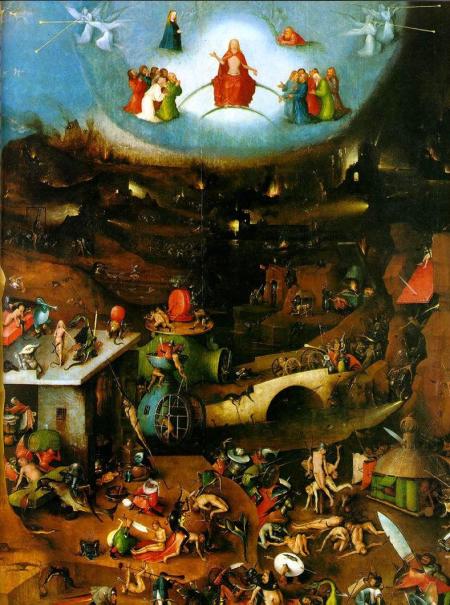
I usually use this piece of Hieronymus Bosch The Last Judgement to illustrate my feelings about the concordance model:
das_letzte_gericht


The top part represents the concordance cosmology. It clearly features an eminent cosmologist surrounded by postdoctoral researchers. Everything appears to be in heavenly harmony, surrounded by a radiant glow of self-satisfaction. The trumpets represent various forms of exaggerated press coverage.

But if you step back from it, and get the whole thing in a proper perspective, you realise that there’s an awful lot going on underneath that’s not so pleasant or easy to interptet. I don’t know what’s going down below there although the unfortunate figures slaving away in miserable conditions and suffering unimaginable torments are obviously supposed to represent graduate students.

The main point is that the concordance model is based on rather strange foundations: nobody understands what the dark matter and dark energy are, for example. Even more fundamentally, the whole thing is based on a shotgun marriage between general relativity and quantum field theory which is doomed to fail somewhere along the line.

Far from being a final theory of the Universe I think we should treat our standard model as a working hypothesis and actively look for departures from it. I’m not at all against the model. As models go, it’s very successful. It’s a good one, but it’s still just a model.

That reminds me of the school report I got after my first year at the Royal Grammar School. The summary at the bottom described me as a “model student”. I was so thrilled I went and looked up the word model in a dictionary and found it said “a small imitation of the real thing.”

Anyway, the talk went down pretty well (I think) and after a quick glass of Guinness (which definitely went down well) I was back to Dublin airport and home to Cardiff soon after that: Cardiff airport to my house was less than twenty minutes. I greatly enjoyed my short visit and was delighted to be asked to do a couple of seminars back there in the near future.

I was in a  good mood when I got home, which got even better when I found out that I won the latest Crossword competition in the Times Literary Supplement. And the prize isn’t even a dictionary. It’s cash!

Honoured amongst bloggers…

Posted in Uncategorized with tags , , , on March 25, 2009 by telescoper

I only have time for a quickie today as I have to spend this evening getting things together for my forthcoming trip to the Irish Republic for a talk in Dublin (which I’ll no doubt ramble on about when I get back).

I hear dark rumblings about the STFC financial crisis turning into a full-scale disaster owing to inept management, but I’ll refrain from going into details until it all becomes official. Suffice to say for now that, if you thought things were bad already, just watch this space…

Anyway, at least today brought some news that flattered my ego. Ian Douglas at the Daily Telegraph has seen fit to put this blog on his list of five great physics blogs. He’s obviously a man of great taste. Quite cute too. I’ll have to revise my opinion of the Daily Telegraph.

But no.

They have boring crosswords.