Silver Linings

Posted in Science Politics, The Universe and Stuff with tags on December 19, 2008 by telescoper

They say that bad news sells newspapers, so I shouldn’t be surprised with the large number of hits my previous post and the one before that about the Research Assessment Exercise has generated.

However, I heard some news today which has at least provided a bit of a silver lining and put me in a better mood for the Christmas break. My recent application for a grant to the Science and Technology Facilities Council to fund research over the next three years into departures from the concordance cosmological model has actually been selected.

Owing to a budgetary crisis, STFC grants rounds have been very competitive in recent years so I’m quite relieved to have been successful in the present dire financial context. Obviously, somebody out there seems to like what I do. Being a theorist I’m also quite cheap, which probably helped. Or maybe it was just an administrative error…

Anyway, thanks to this grant I will be able to employ a postdoctoral research assistant and spend a bit more of my time on research. It also helps fund a bit of infrastructure within the department. Overall it amounts to about £350K which sounds a lot, but is actually quite small by the standards of particle physics and astronomy grants. STFC isn’t actually Tesco but every little helps.

All I have to do now is convince a potential postdoc to come and work with me in the 35th 22nd best Physics department in the country. What could be simpler?

The Authorized Version

Posted in Science Politics with tags , on December 18, 2008 by telescoper

Following on from my previous post about the 2008 Research Assessment Exercise, I’ve been told that Cardiff University’s preferred measure of research activity is not the simple grade point average that I computed there, but an index of research power which is the average multiplied by the number of staff submitted.

Partly out of interest and partly so as not to incur the wrath of the University Thought Police I recalculated the list sorted by the official measure. So here is the authorized version, as sanctioned by the powers that be:

1. University of Cambridge 402.6
2. University of Oxford 371.3
3. Imperial College London 348.7
4. University College London 277.8
5. University of Manchester 215.3
6. University of Durham 191.1
7. University of Edinburgh 169.4
8. University of Warwick 132.6
9. University of Nottingham 126.7
10. University of Glasgow 125.8
11. Queen’s University Belfast 125.0
12. University of Bristol 121.9
13. University of Southampton 120.0
14. University of Birmingham 117.7
15. University of Leicester 114.8
16. University of St Andrews 91.8
17. University of Liverpool 91.7
18. University of Leeds 90.5
19. Queen Mary, University of London 87.5
20. University of Sheffield 86.6
21. Lancaster University 76.6
22. Cardiff University 75.9
23. University of Exeter 75.6
24. University of Strathclyde 74.4
25. University of Hertfordshire 72.8
26. Royal Holloway, University of London 71.3
27. University of Surrey 69.4
28. University of York 67.6
29. University of Bath 57.6
30. University of Sussex 54.0
31. Swansea University 52.9
32. Heriot-Watt University 51.7
33. University of Central Lancashire 51.1
34. Loughborough University 41.9
35. King’s College London 41.8
36. Liverpool John Moores University 39.6
37. Aberystwyth University 35.7
38. Keele University 22.5
39. Armagh Observatory 16.9
40. University of the West of Scotland 6.7
41. University of Kent 6.6
42. University of Brighton 2.3

Well, it’s actually quite surprising how much things change. I don’t think it means very much, but 22nd certainly sounds much better than 35th.

But, being a Newcastle United supporter, I’ve never been a great fan of league tables.

Res Judicata

Posted in Science Politics with tags , , , , on December 18, 2008 by telescoper

Today is the day people working in British Universities have waited for in a mixture of hope and apprehension for several years. The results of the 2008 Research Assessment Exercise (RAE) were published at 0.01am GMT today (18th December).

I had a look just after midnight and the webserver crashed, but only for a few minutes and I soon got back in and found the bad news. The relevant one for me as an astrophysicist is the table for Unit of Assessment 19 which is Physics & Astronomy. Results are given as a list of numbers, consisting of the number of staff entered (not necessarily an integer, for accounting reasons) followed by the percentage of work judged by the panel to be in each of four categories explained in the following excerpt from the RAE website

The quality profiles displayed on this website are the results of the 2008 Research Assessment Exercise (RAE2008), the sixth assessment in this current format of the quality of research conducted in UK Higher Education Institutions (HEIs). The UK funding bodies for England, Northern Ireland, Scotland and Wales will use the RAE2008 results to distribute funding for research from 2009-10.

The results follow an expert review process conducted by assessment panels throughout 2008. Research in all subjects was assessed against agreed quality standards within a common framework that recognised appropriate variations between subjects in terms of both the research submitted and the assessment criteria.

Submissions were made in a standard form that included both quantitative and descriptive elements. Full details of the contents of, and arrangements for making, submissions were published in ‘Guidance on submissions‘ (RAE 03/2005).

The RAE quality profiles present in blocks of 5% the proportion of each submission judged by the panels to have met each of the quality levels defined below. Work that fell below national quality or was not recognised as research was unclassified.

4* Quality that is world-leading in terms of originality, significance and rigour.
3* Quality that is internationally excellent in terms of originality, significance and rigour but which nonetheless falls short of the highest standards of excellence.
2* Quality that is recognised internationally in terms of originality, significance and rigour.
1* Quality that is recognised nationally in terms of originality, significance and rigour.
Unclassified Quality that falls below the standard of nationally recognised work. Or work which does not meet the published definition of research for the purposes of this assessment.

The ‘international’ criterion equates to a level of excellence that it was reasonable to expect for the UOA, even though there may be no current examples of such a level in the UK or elsewhere. It should be noted that ‘national’ and ‘international’ refer to standards, not to the nature or geographical scope of particular subjects.

For my own department, the School of Physics & Astronomy, at Cardiff University, I found the following

Cardiff University (32.30) 5 45 30 20

which means that we entered 32.30 people, but only 5% of the work was judged to be at the top level (4*), 45% at 3*, 30% at 2* and 20% at 1*. On their own these figures don’t mean very much but one can do a quick comparison with the rest of the table to see that for us this is an enormous disappointment. We have a much lower fraction of 4* than the majority of departments, and also a significantly higher fraction of 1*. These findings are very worrying.

If I were working an English University with these results I would be very concerned about their financial implications, but it’s a bit more complicated with us being here in Wales. The numbers given in the table are translated into money by the funding councils and Wales has its own one of these (HEFCW, different from the English HEFCE). There are many fewer physics departments in Wales and we’re not competing with the bigger English ones for funding. We don’t yet know how much our research funds will be cut. It might not be as bad as if we were in England, but it’s clearly not good. We won’t know how much dosh will be involved until March 2009. t’s not just a matter of funding, it’s also the national and international perception of the department in the physics community.

I can see there will be a post mortem to find out what went wrong, as most of us were confident of a much better outcome. Perhaps the format of the RAE (focussing on research papers as the measure of output) is not favourable to a department with so many instrument builders in it?

But with the economy in deep recession making further cuts in research funding likely in the future, and our major external funder (STFC) already struggling to make ends meet, this poor showing in the RAE this has cast a gloomy shadow over Christmas.

Of course many places did much better, including my old department at Nottingham which has

University of Nottingham (44.45) 25 40 30 5

which can be interestingly compared with Cambridge, who have

University of Cambridge (141.25) 25 40 30 5

You can see that apart from the different numbers of staff the profile is exactly the same. I’m sure their publicity machine will pick up on this so I won’t be the last to mention it! Well done, Nottingham!

It will be interesting to see what the newspapers make of the new RAE results. They are significantly more complicated than previous versions which just gave a single number. The scope for flexibility in generating league tables is clearly greatly enhanced by this complexity so we can bet the hacks will have a field day. I thought I’d get a headstart by doing a straightforward ranking using a simple weighted average using 4=4*, 3=3*, etc and then sorting them by the average thus obtained:

1. Lancaster University 2.9
2. University of Bath 2.85
3. University of Cambridge 2.85
4. University of Nottingham 2.85
5. University of St Andrews 2.85
6. University of Edinburgh 2.8
7. University of Durham 2.75
8. Imperial College London 2.75
9. University of Sheffield 2.75
10. University College London 2.75
11. University of Glasgow 2.75
12. University of Birmingham 2.7
13. University of Exeter 2.7
14. University of Sussex 2.7
15. University of Bristol 2.65
16. University of Liverpool 2.65
17. University of Oxford 2.65
18. University of Southampton 2.65
19. Heriot-Watt University 2.65
20. University of Hertfordshire 2.6
21. University of Manchester 2.6
22. University of Warwick 2.6
23. University of York 2.6
24. King’s College London 2.55
25. University of Leeds 2.55
26. University of Leicester 2.55
27. Royal Holloway, University of London 2.55
28. University of Surrey 2.55
29. Swansea University 2.55
30. Queen Mary, University of London 2.5
31. Queen’s University Belfast 2.5
32. Loughborough University 2.45
33. Liverpool John Moores University 2.4
34. University of Strathclyde 2.35
35. Cardiff University 2.35
36. University of Brighton 2.3
37. University of Central Lancashire 2.3
38. Keele University 2.25
39. Armagh Observatory 2.25
40. University of Kent 2.2
41. Aberystwyth University 1.95
42. University of the West of Scotland 1.8

So you can see we are languishing at 35th place out of 42.

This is supposed to be the last RAE and we don’t know what is going to replace it. I don’t at all object to the principle that research funding should be peer-assessed but this particular exercise was enormously expensive in the effort spent at Universities preparing for it, not to mention the ridiculous burden placed on the panel of having to read all those papers.

Crucial Verbalism

Posted in Crosswords, Literature with tags , , , , , on December 13, 2008 by telescoper

It’s a cold and rainy day and I’m lacking the inspiration to do anything energetic before making dinner, so I thought I’d pick something to blog about. Looking back over the past three months or so, I realise I’ve at least mentioned most things that I’m interested in, at least those that I’m willing to write about on here. But there is one other thing I haven’t covered yet and which I spend a lot of my spare time doing (especially during seminars) and that is solving cryptic crossword puzzles. In fact I simply can’t put a crossword down until I’ve solved all the clues, behaviour which I admit is bordering on the pathological. Still, I think of it as a kind of mental jogging, forcing your brain to work in unaccustomed ways is probably good for its fitness for other more useful things.

I can’t remember when I first started doing these, or even how I learned to do them. But then people can learn languages simply by picking them up as they go along so that’s probably how I learned to do crosswords.

If you’ve never done one of these puzzles before, you probably won’t understand the clues at all even if you know the answer and I can’t possibly explain them in a single post. In a nutshell, however, they involve clues that usually give two routes to the word to be entered in the crossword grid. One is a definition of the solution word and the other is a subsidiary cryptic allusion to it. Usually the main problem to be solved involves the identification of the primary definition and secondary cryptic part, which are usually heavily disguised.

The secondary clue can be of many different types. The most straightforward just exploits multiple meanings. For example, take

Fleeces, things often ordered by men of rank [6]

The answer to this is RIFLES which is defined by “fleeces” in one sense, but “men of rank” (soldiers) also order their arms hence giving a different meaning. Other types include puns, riddles, anagrams, hidden words, and so on. Many of these involve an operative word or phrase instructing the solver to do something with the letters in the clue, e.g.

Port’s apt to make you steer it erratically [7]

has the solution TRIESTE, which is an anagram of STEER+IT, port being the definition.

Most compilers agree however that the very best type of clue is of the style known as “&lit” (short for “and literally what it says”). Such clues are very difficult to construct and really beautiful when they work because both the definition and cryptic parts comprise the same words read in different ways. Here’s a simple example

The ultimate of turpitide in Lent [5]

which is FEAST. Here we have “e” as the last letter of turpitude in “fast” (lent) giving “feast” but a feast is exactly what the clue says too. Nice.

Some clues involve more than one element of this type and some defy further explanation altogether, but I hope this at least gives you a clue as to what is involved.

Cryptic crosswords like the ones you find in British newspapers were definitely invented in the United Kingdom, although the crossword itself was probably born in the USA. The first great compiler of the cryptic type used the pseudonym Torquemada in the Observer. During the 1930s such puzzles became increasingly popular with many newspapers, including famously The Times, developing their own distinctive style. People tend to assume that The Times crossword is the most difficult, but I’m not sure. I don’t actually buy that paper but whenever I’ve found one lying around I’ve never found the crossword particularly hard or, more importantly, particularly interesting.

As a Guardian reader, I have to say I enjoy their crosswords best, primarily because each day brings a different setter each of which has a different style to the others. Unlike some other newspapers they are not anonymous, but identified by a weird and wonderful collection of pseudonyms (Janus, Rufus, Shed, Logodaedalus, Gordius, Chifonie, Paul, Quantum, Brummie, etc). The best of them is the great Araucaria (whose name comes from the Monkey-Puzzle tree) and who is revered by crossword fans the length and breadth of the country for the brilliance of his clues. Araucaria is such a witty compiler that his clues often have you laughing out loud when you see how they fall into place. He is, in fact, a retired clergyman called John Graham who has been setting clues for the Guardian and other newspapers and magazines for over forty years. In fact, the Financial Times has a compiler called Cinephile who is the same person. (CINEPHILE is an an anagram of CHILE PINE, which is another word for the Monkey-Puzzle tree).

As it happens, today’s Guardian prize crossword was by Araucaria and, as usual, it was fun although it wasn’t as difficult as many of his. He followed a common tactic of connecting several clues together but as soon as you realise that

Writers’ relation to 10, maybe [6]

is BRONTE (note the position of the apostrophe indicating several writers with the same name, cryptic part is “bro” for relation and an anagram of “ten”) then the various references to the Brontes were straightforward. The only really difficult other clue is

Picture rhyme for MC in MND [10]

the answer to which is ILLUSTRATE (MND is Midsummer Night’s Dream, which explains the rhyme reference to PHILOSTRATE, a character in that play).

I also like to do the bi-weekly crossword set by Cyclops in Private Eye which has clues which are not only clever but also laced with a liberal helping of lavatorial humour and topical commentary which is right up my street. Many of the answers (“lights” in crossword parlance) are quite rude, such as

Local energy source of stress for Bush [5]

which is PUBES (“pub” from “local”+ E for energy +S for “source of stress”; Bush is the definition).

On Saturdays the Guardian crossword involves a prize so I religiously send my completed grid in the post. There are many hundreds of correct entries per week so it’s quite unlikely to win – the winner is drawn “at random” from all the correct entries. I’ve won the prize nine times over the years, an average of once every two years or so, with the result that I now have more dictionaries than I know what to do with. I don’t actually think a dictionary is a very good prize for a crossword puzzle, as surely every solver has one already! A few years ago The Guardian used to offer fancy fountain pens and watches, which are more like it. I also won a digital radio from the Financial Times puzzle, but I’ve got out of the habit of doing that one nowadays. The same is true for Salamanca in the New Statesman, which I won a couple of times years ago but have stopped doing since I lost interest in the rest of the magazine. I send off the answers to the Eye crossword every time but have never won it yet. That one has a cash prize of £100.

Anyway, Torquemada, who I mentioned above, was eventually followed as the Observer’s crossword compiler by the great Ximenes (real name D.S. Macnutt) who wrote a brilliant book called the Art of the Crossword which I heartily recommend if you want to learn more about the subject.

One of the nice stories in his book concerns the fact that crossword puzzles of the cryptic type were actually used to select recruits for British Intelligence during the Second World War, but this had a flip side. In late May 1944 the chief crossword setter for the Daily Telegraph was paid a visit by some heavies from MI5. It turned out that in a recent puzzle he had used (quite innocently and by sheer coincidence) the words MULBERRY, PLUTO, NEPTUNE and OVERLORD all of which were highly confidential code words to be used for the forthcoming D-Day invasion…

The current Observer crossword setter is the estimable Azed (real name Jonathan Crowther) who follows in the footsteps of his predecessor Ximenes. On balance I think this is consistently the best crossword I have ever done, although it is often a source of total frustration because it is quite convoluted and idiosyncratic. It is a bit different from other puzzles because it doesn’t involve any black squares like you would find in the standard `Everyman’ type of grid. This makes a very dense and intricate task for the solver, but does have the advantage that clues intersect more frequently than in the usual type. The problem with solving Azed is usually getting started as the clues are quite difficult and the words often very obscure. The one concession is that all answers are usually in the Chambers dictionary, and if they aren’t the compiler gives another hint. I’ve been tackling Azed for so long now that the Chambers has become in my mind a much more definitive dictionary than the OED. I also have several copies at home in different rooms, and one in my office at work.

Solving the Azed puzzle is hard enough, but for the special competition puzzles every four weeks one also has to supply a clue of one’s own. The winners of this competition are selected by Azed himself and there is an archive on the web of successful clues. As well as the winner of each competition, there is an annual prizewinner who produces the most good clues over the set of 13 competitions each year, and a roll of honour of all contributed clues that are deemed worthy. I’ve gradually clawed my way up this league table from 118th in 2006-7 to 46th in 2007-8 and, after four of the thirteen rounds this year, I’m currently in 28th place. I have to admit though that I am envious of the talents of many of the other competitors who routinely produce brilliant clues that even my best ones can’t compete with. For the same reasons that I don’t really enjoy setting examination questions, I don’t really like writing clues as much as solving them. My position in the roll of honour belies the fact that I’ve never produced a single clue that has won any of the individual competitions. I’m always the bridesmaid. You can find some of my more successful clues on the archive here.

Among those who have done exceedingly well in this competition over the years are the novelist Colin Dexter (in the form of N.C. Dexter) and a chap called C.J. Morse who is in fact the man that provided the name Dexter used for the crossword-loving chief Inspector in his famous detective novels. In turns out that C.J. Morse recently had his eightieth birthday and, as a special present, last Sunday’s Azed puzzle included some of his competition clues, which are real crackers. I won’t repeat them here though as you can find them all on the archive. However, solvers were invited to submit a clue to the word MORSE for the purposes of the competition, so at least I can tell you what my attempt was. Here we go:

His signal art no astronomer can comprehend [5]

By way of explanation, anagram of “astronomer” can give “morse” plus “art no”; comprehend is used in the slightly unusual sense of “comprise”; signal in the sense of “remarkable” plus reference to Morse system of signals. In the context of this puzzle, to celebrate the skills of Mr Morse, I also think this overall qualifies as an “&lit”.

I doubt if it competes with the best of the entries but I’m still quite proud of it.

Misplaced Confidence

Posted in Bad Statistics, The Universe and Stuff with tags , , , on December 10, 2008 by telescoper

From time to time I’ve been posting items about the improper use of statistics. My colleague Ant Whitworth just showed me an astronomical example drawn from his own field of star formation and found in a recent paper by Matthew Bate from the University of Exeter.

The paper is a lengthy and complicated one involving the use of extensive numerical calculations to figure out the effect of radiative feedback on the process of star formation. The theoretical side of this subject is fiendishly difficult, to the extent that it is difficult to make any progress with pencil-and-paper techinques, and Matthew is one of the leading experts in the use of computational methods to tackle problems in this area.

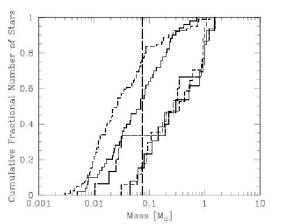
One of the main issues Matthew was investigating was whether radiative feedback had any effect on the initial mass function of the stars in his calculations. The key results are shown in the picture below (Figure 8 from the paper) in terms of cumulative distributions of the star masses in various different situations.

untitled

The question that arises from such data is whether these empirical distributions differ significantly from each other or whether they are consistent with the variations that would naturally arise in different samples drawn from the same distribution. The most interesting ones are the two distributions to the right of the plot that appear to lie almost on top of each other.

Because the samples are very small (only 13 and 15 objects respectively) one can’t reasonably test for goodness-of-fit using the standard chi-squared test because of discreteness effects and because not much is known about the error distribution. To do the statistics, therefore, Matthew uses a popular non-parametric method called the Kolmogorov-Smirnov test which uses the maximum deviation D between the two distributions as a figure of merit to decide whether they match. If D is very large then it is not probable that it can have arisen from the same distribution. If it is smaller then it might have. As for what happens if it is very small then you’ll have to wait a bit.

This is an example of a standard (frequentist) hypothesis test in which the null hypothesis is that the empirical distributions are calculated from independent samples drawn from the same underlying form. The probability of a value of D arising as large as the measured one can be calculated assuming the null is true and is then the significance level of the test. If there’s only a 1% chance of it being as large as the measured value then the significance level is 1%.

So far, so good.

But then, in describing the results of the K-S test the paper states

A Kolmogorov-Smirnov (K-S) test on the …. distributions gives a 99.97% probability that the two IMFs were drawn from the same underlying distribution (i.e. they are statistically indistinguishable).

Agh! No it doesn’t! What it gives is a probability of 99.97% that the chance deviation between the two distributions is expected to be larger than that actually measured. In other words, the two distributions are surprisingly close to each other. But the significance level merely specifies the probability that you would reject the null-hypothesis if it were correct. It says nothing at all about the probability that the null hypothesis is correct. To make that sort of statement you would need to specify an alternative distribution, calculate the distribution of D based on it, and hence determine the statistical power of the test. Without specifying an alternative hypothesis all you can say is that you have failed to reject the null hypothesis.

Or better still, if you have an alternative hypothesis you can forget about power and significance and instead work out the relative probability of the two hypotheses using a proper Bayesian approach.

You might also reasonably ask why might D be so very small? If you find an improbably low value of chi-squared then it usually means either that somebody has cheated or that the data are not independent (which is assumed for the basis of the test). Qualitatively the same thing happens with a KS test.

In fact these two distributions can’t be thought of as independent samples anyway as they are computed from the same initial conditions but with various knobs turned on or off to include different physics. They are not “samples” drawn from the same population but slightly different versions of the same sample. The probability emerging from the KS machinery is therefore meaningless anyway in this context.

So a correct statement of the result would be that the deviation between the two computed distributions is much smaller than one would expect to arise from two independent samples of the same size drawn from the same population.

That’s a much less dramatic statement than is contained in the paper, but has the advantage of not being bollocks.

Operation Skyphoto

Posted in The Universe and Stuff with tags , on December 9, 2008 by telescoper

Katherine Blundell from Oxford just contacted me with a request that I post the following message. I’m more than happy to oblige.

Dear All,

There is a one-off opportunity to buy vintage prints of the original photographic plates of the Palomar All-Sky Survey. Although no longer useful for science (they fell into disuse two decades ago because of modern data digitization) they make rather handsome objets d’art when suitably mounted and framed.

These prints are for sale to raise money for Alexander Thatte’s treatment for leukemia – Alexander is the 5-year old son of two of our colleagues.

The mounted/framed photographs could make very nice Christmas presents. For a small additional payment we can deliver them to you already tastefully gift-wrapped.

A very limited number of photographs have kindly been signed by Jocelyn Bell Burnell – please email us if you wish to request one of these.

Please see http://www.physics.ox.ac.uk/skyphoto for an order form and further details. Please feel free to forward this email to anyone whom you think might be interested in purchasing a piece of astronomical history, and helping a child in need.

Best wishes,

Katherine & the Astro Grads

I can’t think of a better Christmas gift for an astronomer.

Go on. You know you want to.

If you leave it too late to buy your presents you might end up buying something really naff. Like a paperweight.

Look, I’ve even made it easier for you. Just click the link here.

So now there’s no excuse. Do it. Buy one. Now.

Una Grande Vociaccia

Posted in Music, Opera with tags , , , , , , , on December 7, 2008 by telescoper

I missed an important anniversary this week. Had she still been alive, December 2nd 2008 would have been the 85th birthday of the most renowned opera singer of her time, Maria Callas.

She was born in 1923 in New York city of Greek parents who had moved there the previous year, and christened Maria Anna Sofia Cecilia Kalogeropoulou. Disenchanted with her deteriorating marriage, her mother abandoned her husband and took Maria and her sister back to Athens in 1937. Maria enrolled at the National Conservatoire of Greece the same year after winning a scholarship with the quality of her voice, which

was warm, lyrical, intense; it swirled and flared like a flame and filled the air with melodious reverberations.

At this age, Maria was a rather plump young lady with a rather deep voice. Initially, she aspired to be a contralto but at the Conservatoire she was encouraged instead to become a dramatic soprano. Accordingly, she underwent special training to raise her natural pitch (or tessitura) and learned how to control her remarkable voice more accurately so she could sing in a sufficiently disciplined fashion that she could take on the dazzling coloratura passages that she would perform in later years with such success. She also worked on her chest tones to broaden the scope of her voice in the mezzo region. Although she became more technically refined as a singer during this period, there were some things that didn’t change. One was the sheer power of her voice, which is something that we tend to notice less in these days of microphones and studio recordings. People who heard her sing live confess to being shocked at the sheer scale of sound she could deliver without amplification. Perhaps more tellingly, she eschewed many of the devices sopranos tended to use to control the highest notes, usually involving some alteration of the throat to produce accuracy at the expense of a thinner and more constricted tone. When Callas went for a high note, she always did so in a full-throated manner. This often produced a piercing sound that could be intensely dramatic, even to the extent of almost knocking you out of your seat, but it was a very risky approach for a live performance. Audiences simply weren’t used to hearing a coloratura sing with such volume and in such a whole-hearted way. It wasn’t always pretty, but it was certainly remarkable and often very moving. It was this aspect of her voice that led her friend Tito Gobbi (who sang with her in Tosca) to call it una grande vociaccia, which I translate in my schoolboy Italian as meaning something like “a big ugly voice”. That isn’t meant to be as disparaging as it sounds (Gobbi was a great admirer of Callas’ singing).

Having listened to lots of recordings of Maria Callas I have to admit that they are certainly not all good. Sometimes the voice didn’t come off at all. Unkindly, one colleague said that she “sang with her ovaries”. When she talked about her own noice, Callas herself often referred to it as if it were some independent creature over which she had very little control. Anyway, whatever the reason, when she was bad she was definitely bad. But I adopt the philosophy that one should judge artists (and scientists, for that matter) by their best work rather than their worst, and when Callas was good she was simply phenomenal, like a sublime and irresistible force of nature. That’s why they called her La Divina.

Although her talent was very raw in the beginning there was no question that she always had a voice of exceptional power and dramatic intensity. When she started singing professionally she immediately attracted lavish praise from the critics not just for her voice but also for her acting. As a young soprano she sang in an astonishing variety of operas, including Wagner‘s Tristan und Isolde and Die Walküre, neither of which one would now associate with Callas.

It was in the late 194os that Callas began to take an interest in the type of opera that would really make her name. Bel canto opera was rather unfashionable at that time, probably because audiences preferred the grittier and more realistic verismo style. Virtually single-handed, Callas resurrected the bel canto canon by injecting a true sense of drama into works which had previously just been seen as vehicles for the singers to demonstrate their art. Callas brought an entirely new dimension to the great operas by Bellini (Norma, I Puritani, La Somnambula…) and Donizetti (Lucia di Lammermoor, Anna Bolena), although she was sufficiently versatile to also perform brilliantly in the verismo syle of Verdi and Puccini as well as lesser known composers such as Giordano (Andrea Chenier). Recordings of many of these performances are available, but it is sad that this glorious period of her singing career happened just a bit before high quality equipment was available so the true glory of her voice isn’t always evident.

In 1953, Callas decided that she wanted to change her appearance, perhaps so she would look more appropriate for the parts she was playing on stage. At the time she weighed almost 200lbs. In order to lose weight as quickly as possible, she followed the barbarous but highly effective expedient of swallowing a tapeworm. She lost 80lbs in a matter of months. The dramatic loss of weight changed her body and her face, emphasizing her high angular cheekbones and giving her a striking look very well suited to the opera stage. But it also affected her voice somewhat, especially at the upper end where she seems to have found it more difficult to avoid the dreaded “wobble” which was one of the alleged imperfections that critics tended to dwell upon.

Callas also had very poor eyesight which required her to wear very thick spectacles in order to see at all, a thing she refused to do onstage with the result that she was virtually blind during performances. In fact, during a performance of Tosca at Covent Garden she leant too far over a candle and her hair caught fire. Improvising magnificently, Tito Gobbi, as the loathsome Scarpia, extinguished the fire by throwing water at her before the audience had noticed. Although they weren’t much use for seeing with, her eyes were a great asset for her acting, in turns flashing like a demon then shining like an angel.

After her weight loss, Callas was suddenly no longer just a wonderful singer but also a strikingly beautiful woman. Her career took a back seat as she started to revel in the glamorous lifestyle that opened up in front of her. Her voice deteriorated and she performed rather less frequently. Eventually she embarked on a love affair with Aristotle Onassis, a notorious serial collector of trophy women. She hoped to marry him but he abandoned her to marry Jackie Kennedy, widow of John F. Kennedy.

She never really recovered from the failure of this affair, retired from singing and lived out the last years of her life as a virtual recluse in her apartment in Paris. She died in 1977.

I had heard a lot about Maria Callas when I was younger, but the recordings that I listened to (generally from the 1960s) were really not very good as her voice was undoubtedly much diminished by then. I just assumed that, as is the case with many artists, the legend of Callas was all mere hype. Then, about fifteen years ago, I was listening to BBC Radio 3 and they played the final scenes of the great 1954 recording of Norma with Callas in the title role, conducted by Tullio Serafin. I was completely overwhelmed by it and tears flowed freely from my eyes. I’ve always had a tendency to blub when I hear really beautiful music, but as I’ve got older I’ve learned not to be embarrassed by it. At least I don’t cry at football matches.

In England, Callas is probably best remembered for her performances in Tosca in Covent Garden. I have recordings of her in that role and they are really wonderful. But there are many fine recordings of Tosca by other singers, some of which are almost as good. In the case of Norma, though, there isn’t any other performance that comes within a mile of the Callas version. Or if there is, I’ve yet to hear it.

Now I know that there are some people, even opera lovers, who just don’t get Callas at all (just look at the comment boards on Youtube). I grant that she wasn’t always the most accurate singer, and I don’t think you could say her voice had a purely classical beauty. But even if you don’t like her voice you have to admit that she revitalized the opera stage and brought a new public into the theatres. I can’t imagine what the state of opera would be now, if there hadn’t been a Callas and you can’t argue that she is now an iconic figure. What I admire most about her is that, like it or loath it, her voice is instantly recognisable. In this sense, she always puts me in mind of a kind of operatic version of Billie Holliday. She’s a far cry from the many bland mediocrities that pass themselves off as opera singers nowadays.

I’m going to end with the obligatory clips from Youtube. There’s a lot of Callas on there, not all of it good. I’ve chosen a couple of items, although neither of them has a proper video. The first was performed live in 1955 in front of the notoriously difficult audience at La Scala in Milan and recorded from a radio broadcast so that the sound quality is quite poor. A studio recording of this aria, from Andrea Chenier, features most movingly in the film Philadelphia. This live version, however, is notable for a number of reasons. One is that you get some idea of the power of the Callas voice in the way she pushes aside the entire orchestra and is even able to cut through the distortions introduced by the rather primitive recording technology. The second thing is that she sings it so beautifully, with such feeling, lovely phrasing, and so much colour and vitality. Listen to the way the texture of her voice matches perfectly her changing emotions as she tells her story. The shattering, climactic high C that occurs near the end is a perfect example of what I was saying above. She stabs this note out like her life depended on it. It sends shivers down my spine and clearly had the same effect on the audience. The thunderous applause that follows the end of this aria is quite frightening in its intensity, but gives a good idea how much her public adored her. If you can put up with the lo-fi recording, this is certainly a better performance than the studio version.

The final piece has to be from Norma. I think Bellini is a wonderful composer of opera, but he doesn’t make life easy for the singers. There’s never any doubling of the vocal line by the orchestra so the singer is very exposed. This doesn’t bother Maria Callas. This is the famous aria Casta Diva, which has become a kind of signature tune for her and it’s one of the pieces that she always seemed to perform beautifully. It might be a bit hackneyed but I love it and, after all, it’s my blog. There’s also a nice compilation of pictures.

I’d be interested to hear what the general opinion of Callas is based on a sample of the two or three people who read my blog, so please feel free to add your comments!

Pluralia Tantum

Posted in Literature, Pedantry with tags , , , on December 5, 2008 by telescoper

Meanwhile, over on the e-astronomer, Andy Lawrence recently posted an item about the lamentable tendency of astronomers to abuse the English language. The focus of his venom was “extincted”, a word used by many astro-types as an adjective to describe the state of affairs when light from a source (e.g. a quasar) has suffered “extinction” by intervening matter. “Extinction” is formed from the verb “extinguish” in the same way that “distinction” is formed from “distinguish”. Nobody would describe a professor as “distincted” (certainly not if it is Andy Lawrence) so, clearly, “extincted” is inappropriate. Actually if you really want to nit-pick you could object to “extinction” being applied to an object such as a  quasar, when it isn’t actually the object that is suffering from it but the light it has emitted.

But as a gripe, this is fair enough I’d say. Andy went on to encourage his legions of adoring readers to contribute their own pet hates, preferably with an astronomical orientation. My contribution was “decimate” which  means “to remove the tenth part” or “to reduce by ten percent”, from the Roman practice of punishing disobedient legions by killing every tenth man, but is often regrettably now used to mean “annihilate” or “obliterate”. You might think this hasn’t got much to do with astronomy but, sadly, it does. Indeed, a press release from STFC discussing the recent ten percent cuts to its grants budget states that consequent reduction in PDRAS

..will not cause the decimation of physics departments as has been speculated in media reports.

I would expect a civil servant to have done a bit better, so presumably this was written by an astronomer too. At any rate, it is precisely wrong.

You might argue that things like this don’t matter.  Language evolves,  and if modern usage deviates from its previous meanings then we should just let it change. I fully accept the dynamic nature of language and do not by any means object to all such changes. Society changes and so must the words we use. But if a change is (a) a result of sloppiness and (b) results in the loss of a very good use to be replaced by a bad one, then I think educated people should stand their ground and fight it. If we don’t do that language doesn’t just change, it decays.

Most of us practising scientists have to spend a lot of our time writing scientific papers, departmental memos, grant applications and even books. I think many astronomers see this activity as a chore, take no pleasure from it, and invest the minimum care on it. I was fortunate to have a really excellent writer, John Barrow, as my thesis supervisor and he convinced me that it was worth making the effort to write the best prose I could whatever the context. Not only does this attitude eliminate the ambiguity which is the bane of scientific writing. Taking pains over style and grammar also allows one to feel the pleasure of craftsmanship for its own sake. With John’s guidance and encouragement, I learned to enjoy writing through the satisfaction experienced by finding neat forms of words or nice turns of phrase. You never really feel good about what you do if you scrape through at the miminum acceptable level. Try to make the effort and you will be more fulfilled and the long hours of slog you spend putting together a complicated paper will at least be enlivened by a genuine sense of delight when things fall neatly into place, and a warm glow of achievement when you read it back and it sounds not just acceptable but actually good.

But I digress.

One of the other contributors to Andy’s list of examples of bad grammar was a chap called Norman Gray who objected to astronomers’ use of the word “data” as a plural noun, as in “the data indicate” rather than “the data indicates”. I was taken aback by this because I was expecting the opposite objection.

He has a lengthy rant about this on his own blog so I won’t repeat his arguments in detail here, merely a synopsis. The word “data” is formed from the latin plural of the word “datum” (itself formed from the past participle of the latin verb “dare”, meaning “to give”) hence meaning “things given” or words to that effect. The usage of “data” that we use now (to refer to measurements or quantitative information) seems not to have been present in roman or mediaeval times so Norman argues that it is a deliberate archaism to treat it as a latin plural now. He also argues that “data” in modern usage is a “mass noun” so should on that grounds also be treated as singular.

For those of you who aren’t up with such things, English nouns can be of two forms: “count” and “non-count” (or “mass”). Count nouns are those that can be enumerated and therefore have both plural and singular forms:  one eye, two eyes, etc. Non-count nouns (which is a better term than “mass nouns”) are those which describe something which is not enumerable, such as “furniture” or “cutlery”. Such things can’t be counted and they don’t have a different singular and plural forms. You can have two chairs (count noun) but can’t have two furnitures (non-count noun).

Count and non-count nouns require different grammatical treatment. You can ask “how much furniture do you have?” but not how many. The answer to a “how much” question usually requires a unit or measure word (e.g. “a vanload of furniture”) but the answer to a “how many” question would be just a number. Next time you are in a supermarket queue where it says “ten items or less” you will appreciate that it the sign is grammatically incorrect. “Item” is most definitely a count noun, so the correct form should be “ten items or fewer”..

Anyway, Norman Gray asserts that (a) “data” is a non-count noun and that (b) it should therefore be singular. Forms such as “the data are..” are out (“a vile anacoluthon”) and “the data is…” is in.

So is he right?

Not really.  Unkind though it may be to dismantle a carefully constructed obsession, I think his arguments have quite a few problems with them.

For a start, it seems clear to me that there are (at least) two distinct uses of the word data. One is clearly of non-count type. This is the use of “data” to describe an undifferentiated unspecified or unlimited quantity of information such as that stored on a computer disk. Of such stuff you might well ask “how much data do you have?” and the answer would be in some units (e.g. Gbytes). This clearly identifies it as a mass noun.

But there is another meaning, which is that ascribed to specified pieces of information either given (as per the original latin) or obtained from a measurement. Such things are precisely defined, enumerable and clearly therefore of count-noun form. Indeed one such entity could reasonably be called a datum and the plural would be data. This usage applies when the context defines the relevant quantum of information so no unit is required. This is the usage that arises in most scientific papers, as opposed to software manuals. “In Figure 1, the data are plotted…” is correct. Although it sounds clumsy you could well ask in such a situation “how many data do you have?” (meaning how many measurements do you have) and the answer would just be a number. Archaism? No. It’s just right.

To labour the point still further,  here are another two sentences that show the different uses:

“If I had less data my disk would have more free space on it.” (Non-count)

“If I had fewer data I would not be able to obtain an astrometric solution.” (Count).

Contrary to Norman’s claims, it is not unusual for the same words (if they’re nouns) to have both count and non-count forms in different contexts. I give the example of “whisky” as in “my glass is full of whisky” (non-count) versus “two whiskies, please, barman”. His objection to this was that in the second case a whisky is an artefact of a metonymic shift which takes the word “whisky” to refer to the glass containing it.

Metonymy involves using a word related to a thing rather than the word for thing itself, as in “I have hungry mouths to feed”; it’s not really the mouths that are fed, but the people the mouths belong to. In fact there’s a bit of this going on when people talk about sources being “extincted” rather than their light.

This invalidates the example because, Norman alleges, the resulting meaning is different. This objection is a bit silly because the whole point is that the two forms should have different meanings, otherwise why have them? In any case the  example  simply involves me asking for two well-defined quantities of whisky. I’m not convinced of the relevance of metonymy here. What I care about is the whisky, not what it comes in, and when I drink the whisky I don’t drink the glass anyway. Metonymy would apply if I talked about drinking a couple of glasses. Consider “I drank two whiskies, one after the other” versus “I drank two glasses one after the other”. In both cases what has actually been drunk?

There are countless other examples (pun intended). “Fire” can be a mass noun “fire is dangerous”) but also a count noun (“the firemen were fighting three fires simultaneously”). Another nice one  is “hair” which is non-count when it is on someone’s head (“my hair is going grey”) but count when  they, in the plural, are being split.

Interestingly, though, the  non-count forms of these nouns are all singular. Indeed, many non-count nouns exist only in the singular: such nouns are called singularia tantum. Examples include “dust” and “wealth”. So,  if we accept that “data” can be a non-count noun, does that mean that it should necessarily be treated as singular when it does take on that role?

An example that might be taken to support this view could be “statistics” (the field thereof) which is a non-count noun. Although it appears to be derived from a plural, you would certainly say “statistics is a hard subject”  rather than “statistics are a hard subject”.  On the other hand “statistics” can refer to a set, each element of which is a statistic (i.e. a number), thus giving another example of a noun that can be of either count or non-count form; you might reasonably say “the statistics are impressive” in the count case.  The non-count form “statistics” is a better  example of metonymy than the example above, as it refers to the study of the (count) statistics rather than to the things themselves.

In fact there are also mass nouns, described as pluralia tantum, which exist only in the plural. A (not entirely accurate) list is given here. Examples include scissors and pants, for which the normal measure  is a “pair”. Although these are technically non-count nouns (in the sense that you can’t have one scissor, etc) they don’t shed much light on the example in front of us. Perhaps more pertinent is the word “clothes” which is of non-count type but which is certainly plural. You can’t have one “clothe” (or any other number for that matter) but you would definitely say “your clothes are dirty”.

A more subtle example with relevance to the latin root of “data” is “media” which can refer to broadcast media (non-count) or plural of medium (count).  “The media are out to get me”  seems a correct construction to me, so the non-count form of this noun is a plurale tantum (singular of pluralia tantum).

So,  just because a word may be a non-count noun, it doesn’t necessarily have to be singular.

To summarise,  my argument is that (a) it is not correct to assert “data” is a mass noun. It may or may not be, depending on the context. If it is acting as a count noun (which I contend is the case in most science writing) then it is definitely plural. Furthermore, even in cases where it is clearly a mass noun, and especially if you reject the alternative meaning as a count noun, then  it is still by no means obvious that it must be treated as singular (because of the existence of the plurale tantum). In fact I would go a bit further and argue that you can only justify the singular non-count form at all if you accept that there is a count alternative. To be honest, though, I think I prefer the singular interpretation in the non-count case, as in “statistics”. It just sounds better.

If anyone has managed to read all the way through this exercise in pedantry I’d be interested to see any comments on my analysis of data.
Physics Noir

Posted in The Universe and Stuff with tags , , on December 2, 2008 by telescoper

Last week, while I was indisposed with the ‘flu and faced with the imminent danger of having to watch daytime TV, I suddenly remembered that I had bought a boxed set of classic Film Noir on DVD and had only watched one or two of the films. I took the opportunity to watch the whole lot, and very enjoyable it was too. I’ve always been a big fan of this type of film, starting with the glorious Maltese Falcon (which has featured in a previous post of mine) and the classic Double Indemnity. There are probably hundreds of films belonging to this genre and, if the selection I watched last week is anything to go by then they are decidedly variable in quality. Among them, though, was one I had never seen before – Out of the Past – which I think is a masterpiece, containing all the quintessential elements of film noir and many unique features of its own.

It’s difficult to define exactly what turns a film noir, but there are some common characteristics. First the male lead protagonist is far from the dashing romantic character portrayed in mainstream Hollywood fare. Often a troubled and dysfunctional character, cynical and hard-bitten, distrustful and alienated, the classic noir anti-hero is often a private investigator or in any case a loner who lives in a moral vacuum. To counterpoint this, the female lead is usually a femme fatale, glamorous but duplicitous, sexy and dangerous, manipulative and assertive. There are definitely shades of Macbeth in that the female lead is usually a more compelling and impressive personality than the supposed hero. The inversion of stereotypical roles also serves to hold a “dark mirror” up to society, an effect which other elements of these films also strive to achieve.

The plots usually deal with the seedy side of human life: crime, betrayal, jealousy and revenge, much of it sexually motivated. Narrative strategies involve repeated use of flashbacks, first-person voiceovers, dream-like sequences, and unresolved episodes that emphasize the overall lack of moral direction. The photography is dominated by high contrast lights surrounding the protagonists with dark, threatening shadows while odd angles and unbalanced framing produce unstable, disorienting images. The chiaroscuro lighting makes even mundane encounters seem charged with danger or erotic suspense.

di6

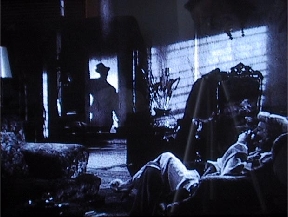
This is a still from Double Indemnity which shows a number of trademark features. The shadows cast by venetian blinds on the wall, the cigarette being smoked by Barbara Stanwyck and the curious construction of the mise en scene are all very characteristic of the style. What is even more wonderful about this particular shot however is the way the shadow of Fred McMurray’s character enters the scene before he does. The Barbara Stanwyck character is just about to shoot him with a pearl-handled revolver so this image suggests that he is already on his way to the underworld.

Noir settings are almost exclusively urban: the resulting iconography consists of images of dark night-time cities with rain-soaked streets reflecting dazzling neon lights that intrude into the picture and fracture the composition. Interiors are almost always cramped and claustrophobic: dingy hotel rooms, night clubs or even the backs of taxi cabs. The dark outside world presses in on the characters and is full of danger. Soundtracks often include jazz in the bebop style from the late 1940s or early 1950s, with its jagged melodic lines and stuttering rythms, emphasizing the psychological instability displayed by the characters and settings.

The protagonists are trapped, perhaps just by mischance, in an alienating lonely world, usually a night-time city, where they are constantly in danger for their lives. The chaotic, random violence of this world gives rise to feelings of persecution and paranoia and a sense that life is absurd, meaningless, without order or purpose, and governed by contingency rather than design.

Much has been written about the origins of Film Noir, but it does seem clear to me that, although it is essentially an American style, it owes many of its roots to European existentialism, a point further reinforced by the fact that many great movie directors of the noir period (including the great Billy Wilder, who directed Double Indemnity) were in fact European emigres.

Anyway, I digress. What I wanted to say really was that during the course of watching all these wonderful films from a bygone age it struck me how much the language and iconography of modern cosmology shares this existentialist heritage. Our new standard cosmological model is full of references to the “dark” sector (dark matter and dark energy) which dominates the energy budget of the Universe, but which not just invisible but also unfathomable. The cosmos is lit by garish starlight from small islands of luminosity embedded in this sea of darkness. Long chains of bright galaxies stretch across space like rows of streetlights whose glare fractures and disturbs the celestial dark. We cling to a precarious existence on a tiny rock that is surrounded by danger. Even the stuff from which our atoms are made is completely overshadowed by alien matter. The universe is oblivious to us and we are irrelevant to it.

But it’s not only the surface imagery of cosmology that resembles that of a noir movie. The exisentialist trend runs deep. Cosmology seems to be abandoning the idea that there is a design behind it all. The idea that there is a single explanatory principle “a theory of everything” that accounts for why our Universe is the way it is and why life is possible within it, is losing ground to the idea that there is a multiverse in which all possible laws of nature are realised; we just live in a place where life happens to be possible. I’m not at all convinced that it is a good route for science to follow, but many cosmologists seem to be accepting this kind of thing as the best we will ever do to explain the Universe.

But if the idea of a world without meaning fills you with existential angst, then don’t worry about it. At least there are plenty of good films to watch.

Nooks and Corners

Posted in Bute Park with tags , on November 30, 2008 by telescoper

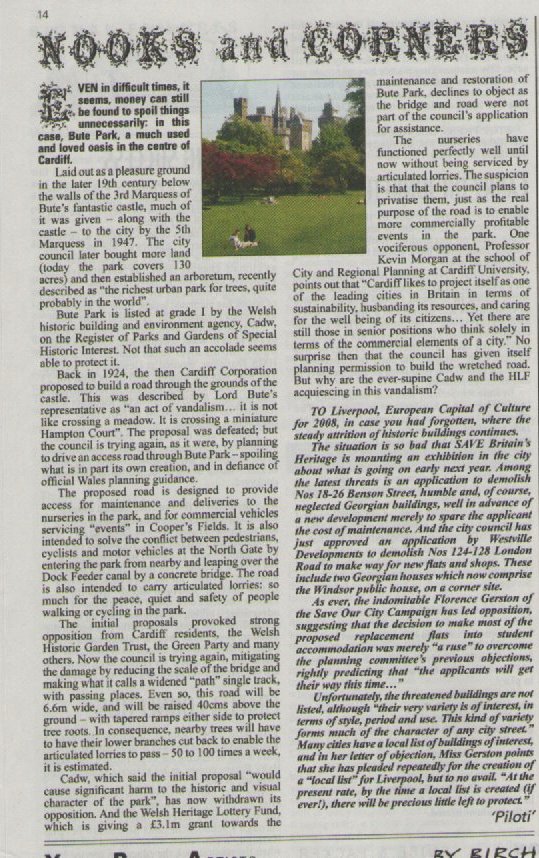
bute-park-storyAs a subscriber to the esteemed organ Private Eye, I was delighted to see that the November 28th 2008 issue carried this article about Cardiff City Council’s disgraceful plans for Bute Park, and the bewildering behaviour of the Welsh Heritage Lottery Fund in supporting the proposal to increase the traffic of articulated lorries through it.

I understand there is to be a public meeting to discuss this on Friday December 12th, but the organizers are having some difficulty finding a representative of the Council who is willing to defend their conduct. I can’t say I’m surprised, but I also hope that it is not too late to persuade the Council to abandon their ridiculous scheme.

I have complained before about precisely the attitude noted in the Eye, namely that the Council sees its Parks mainly as venues for promotional events and other commercialised ventures, whereas I think a Park is best kept as a Park so people can enjoy a bit of Mother Nature in the middle of the City.

As it happens I walked  through Bute Park this afternoon on my way back from Cardiff Bay where I had been paying the deposit and ordering wine for a forthcoming Christmas celebration in one of the restaurants down there. It wasn’t too cold (considering it is the last day of November) primarily because there was very little wind so I walked there and back from my house, doing a little shopping on the way.

The Council gardeners have been hard at work preparing the borders and plots for the winter so these look pretty bare at the moment. The brown fallen leaves blend with the green of the lawns to produce a variegated groundscape which is very beautiful. Enough colour remains amongst the trees because of the presence of evergreens of various types thoughtfully planted amongst the deciduous trees.  On a bright day like this the lack of leaves on other trees really opens up the sightlines in the park so one gets a wonderful sense of space. The landscaping isn’t all that obvious when the woods are thick with greenery, but at this time of year through the minimal foliage the gentle undulations created by Capability Brown can be clearly seen. The Park is more spartan than in the summer, though not at all less enjoyable.

I love to see how Nature marks the passage of time like this. I would hate to live somewhere where the sun shines everyday and where the seasons offer no variety. With winter coming on there’s a sense of battening down the hatches and preparing for the tough times that might lie ahead, but also a reminder that eventually the cycle will begin again in the spring.  There’s a sense of peace that comes from being attuned to this reality that is deeply therapeutic and which, in modern life, especially in cities, is an increasingly rare experience. Please, Council, don’t take this away from Cardiff!