Gearing up for Thursday’s Euclid News

Posted in Euclid, Maynooth, The Universe and Stuff with tags , , , , , , , on May 21, 2024 by telescoper

It’s a hectic time ahead of a Big Event on Thursday 23rd May, which will include the publication of five new Early Release Observations (EROs). I’m not at liberty to say what they are until after 12 noon (CEST) on Thursday except that they’re very pretty. You can watch the live stream here:

Including the five released on November 7th 2023 that will bring the total to ten. All the ERO pictures will be available on the ESA archive here.

Thursday will also see the release of ten scientific papers related to the EROs; they will appear on arXiv on Friday 24th May. These will be the first science results from the Euclid mission.

But that’s not all! Thursday will also see the publication of five papers from the Euclid Consortium (of which I am the sole member based in Ireland). These will be the principal technical reference papers aimed at the astronomical community about the Euclid mission, covering the instruments, cosmology and other astronomy science possibilities, as well as the cosmological simulations used to assist the analysis of the mission. One of these, the main overview paper for the mission, has over a thousand authors (one of whom is your truly).

Thursday’s announcements are likely to significant level of press interest. That’s not only due to the European Space Agency’s own social media feeds and the like, but also local activities in Ireland. For example, there’s this from Science Foundation Ireland using this, from the Little Book of Irish Research:

I have also written a piece for RTÉ Brainstorm, as a kind of update on the one I wrote last year on the occasion of the launch; this will go live after the embargo is lifted on Thursday.
The English Premier League – Classification of Honours

Posted in Football with tags , , , on May 20, 2024 by telescoper

Now all the final results are in and validated, the Board can now proceed to the classification of Honours for the 2023/24 Premier League.

As Chair, I will remind you of the regulations as we go through. Fortunately, as was the case last year, matters are relatively straightforward.

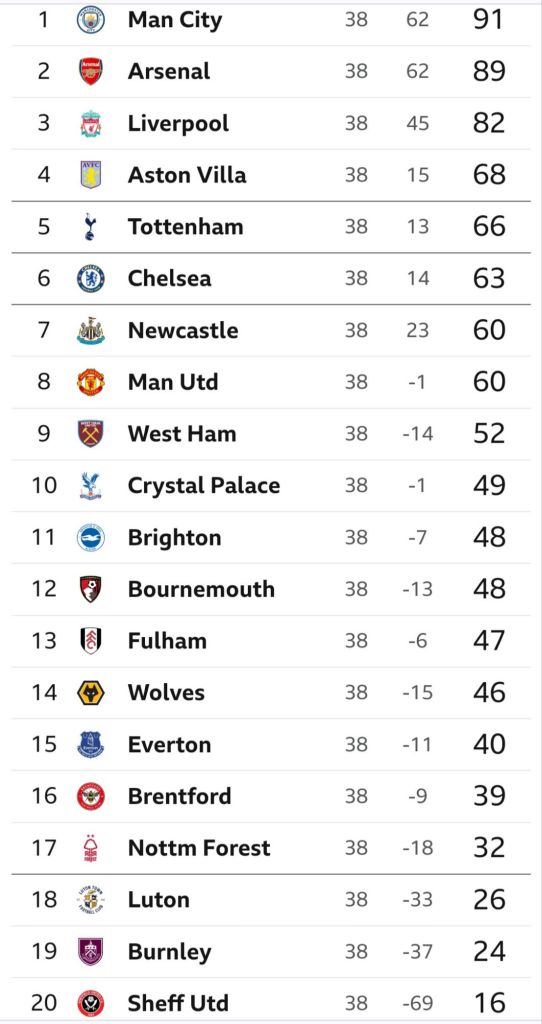
FINAL TABLE

Three candidates (Manchester City, Arsenal, and Liverpool) have a final score greater than or equal to 70 and will therefore be awarded First Class Honours. All three can look forward to further study abroad in Europe next year. Manchester City win this year’s prize for getting the top marks as well as a special award for getting away with so many financial irregularities.

The next five candidates all have scores in the range 60-69 so they are all in the Upper Second Class, i.e. II.1, category though in the case of Newcastle United and Manchester United, only just. Aston Villa will be disappointed to have missed out on a First, but their mark of 68 is nevertheless enough to ensure they will be heading abroad next year along with the top three.

Tottenham and Chelsea (and perhaps Newcastle United) will also get to study abroad next year. Manchester Utd are taking an extra exam on Saturday and if they pass that will get to study abroad, in place of Newcastle.

Only one candidate is in the Lower Second Class (II.2) this year (West Ham), while the next six candidates all get clear Thirds, having marks in the range 40-49. The Board discussed whether to offer Crystal Palace a viva but in the end decided it couldn’t be bothered. Everton only just passed, with a mark of 40, after having points deducted for disciplinary reasons.

Brentford technically failed with a mark of 39 but can pass by compensation.  Nottingham Forest only just scraped through by compensation last year, and did even worse this year including having marks deducted for cheating but, having considered the extenuating circumstances, the Board has decided to allow them yet another go, although they do not qualify for Honours and must be content with being classified as “Ordinary”.

That leaves the three candidates at the bottom of the table – Luton Town, Burnley, and Sheffield United  – who are all “hard fails” . They  will have to terminate the course and consider their options. The Chair has agreed to meet with the Admissions Team to understand how Sheffield United was admitted to the course when they were so clearly under-qualified. Perhaps some form  of administrative error occurred?

The Week(s) Ahead

Posted in Barcelona, Biographical, Euclid, Maynooth with tags , , , , on May 20, 2024 by telescoper

Today is a public holiday in Spain, as it is in much of Europe (including France, Germany, The Netherlands and Denmark). The occasion for the day off is Pentecost (or Whitsuntide as it is known in the UK) which, if I understand correctly, is when the Holy Spirit went down on the Apostles. Actually Pentecost (Whit Sunday) was yesterday, exactly 7 weeks after Easter Sunday, which was quite early this year which is why Pentecost Monday (20th May) is earlier than the fixed Bank Holidays used to mark it in the UK (the last Monday in May, 27th, next Monday) and Ireland (the first Monday of June, 3rd, in two weeks’ time). Could I perhaps take all three off?

Today’s holiday notwithstanding, this is going to be a busy week. On Wednesday and Thursday there is to be an event at the European Space Agency coincident with which, on Thursday 23rd May, there will be a significant press event relating to Euclid. I’m not at liberty to say any more at this point, as everything is strictly embargoed until 12 noon CEST on that day, but I have been writing a piece for RTÉ Brainstorm to come out as soon as the embargo is lifted. Hopefully the Communications team at Maynooth University will get involved in the press activity. Watch this space.

Remarkably for me, I filed the RTÉ Brainstorm piece ahead of the deadline but it’s no time to rest on my laurels because I have another paper to finish this week by a different deadline.

And next week will be busy too. I have to make a short trip to not-Barcelona to do a PhD examination in Newcastle upon Tyne and give a lecture in Oxford, where (so I’m told) there is a University of some sort. Then I have to pass through Maynooth to vote in the Local and European Elections before returning to Barcelona. Having another two Whit Monday holidays is looking like a good plan…

Bullying and Harassment in Astronomy – The Report

Posted in Harassment Bullying etc, LGBTQ+ with tags , , , , , on May 19, 2024 by telescoper

As I advertised a few days ago, The Royal Astronomical Society has now released its report on Bullying and Harassment in Astronomy. You can download the full report (40 pages, PDF) here. I recommend you to read it as the statistics are stark. Here are a couple of graphical summaries from the RAS Website:

Note the greater prevalence of bullying and harassment directed towards LGBT astronomers.

The recommendations include the introduction of more effective bullying and harassment policies, procedures and safeguards to protect all colleagues, to support students, and to ensure that everyone can achieve their potential and work in a safe and satisfying environment, regardless of their background.

Noble sentiments, but the Royal Astronomical Society can do little itself to change policies, as it is not in the position of employer (except for its own staff in Burlington House) and there is no incentive for the universities and research institutions who employ most astronomers to comply. That will only happen if serious sanctions are imposed for mishandling bullying and harassment cases.

My view – born out by experience – is that it can’t be left to individual institutions to deal with this problem. In case after case, instead of dealing properly with bullying and harassment, senior managers have protected the perpetrators and silenced the victims. Reputation management, they call it. What is needed to start with is a system of independent adjudication, as recommended, for example, by the 21 Group.

This problem is neither confined to astronomy nor to the United Kingdom, and at least part of it is due to the ever-increasing cult of managerialism that places institutional branding ahead of positive workplace culture, paying at most lip-service to the latter.

Three New Publications at the Open Journal of Astrophysics

Posted in OJAp Papers, Open Access, The Universe and Stuff with tags , , , , , , , , , on May 18, 2024 by telescoper

It’s time once more for the usual  Saturday roundup of business at the  Open Journal of Astrophysics. The latest batch of publications consists of three papers, taking the count in Volume 7 (2024) up to 39 and the total published by OJAp up to 154. We’re still on track to publish around 100 papers this year, compared to last year’s 50.

All three of this week’s papers involve use of data from the European Space Agency’s Gaia mission, which is proving an immensely rich resource for astrophysics.

First one up is “Asymmetric Drift Map of the Milky Way Disk Populations between 8 -16 kpc with LAMOST and Gaia datasets” which is by  Xin Li (Nanchong, China), Peng Yang (Chengdu, China) , Hai-Feng Wang (Nanchong, China), Qing Li (Jiangmen, China), Yang-Ping Luo (Nanchong, China), Zhi-Quan Luo (Nanchong, China), Guan-Yu Wang (Nanchong, China). This is a study  of the asymmetric drift, the difference of the local circular speed and the mean rotational speed of the stellar population, for various stellar populations in the Milky Way. It is in the folder marked Astrophysics of Galaxies and was published on Tuesday 14th May 2024.

Here is a screen grab of the overlay, which includes the abstract:


You can read the paper directly on arXiv here.

The second paper to announce is “On the formation of a 33 solar-mass black hole in a low-metallicity binary” by Kareem El-Badry (Caltech, USA). It discusses theoretical models for the formation of a black hole in a particular binary system discovered in Gaia data.

This one is in the folder Solar and Stellar Astrophysics and was published on 16th May 2024. The overlay looks like this:


You can read this paper directly on the arXiv here.

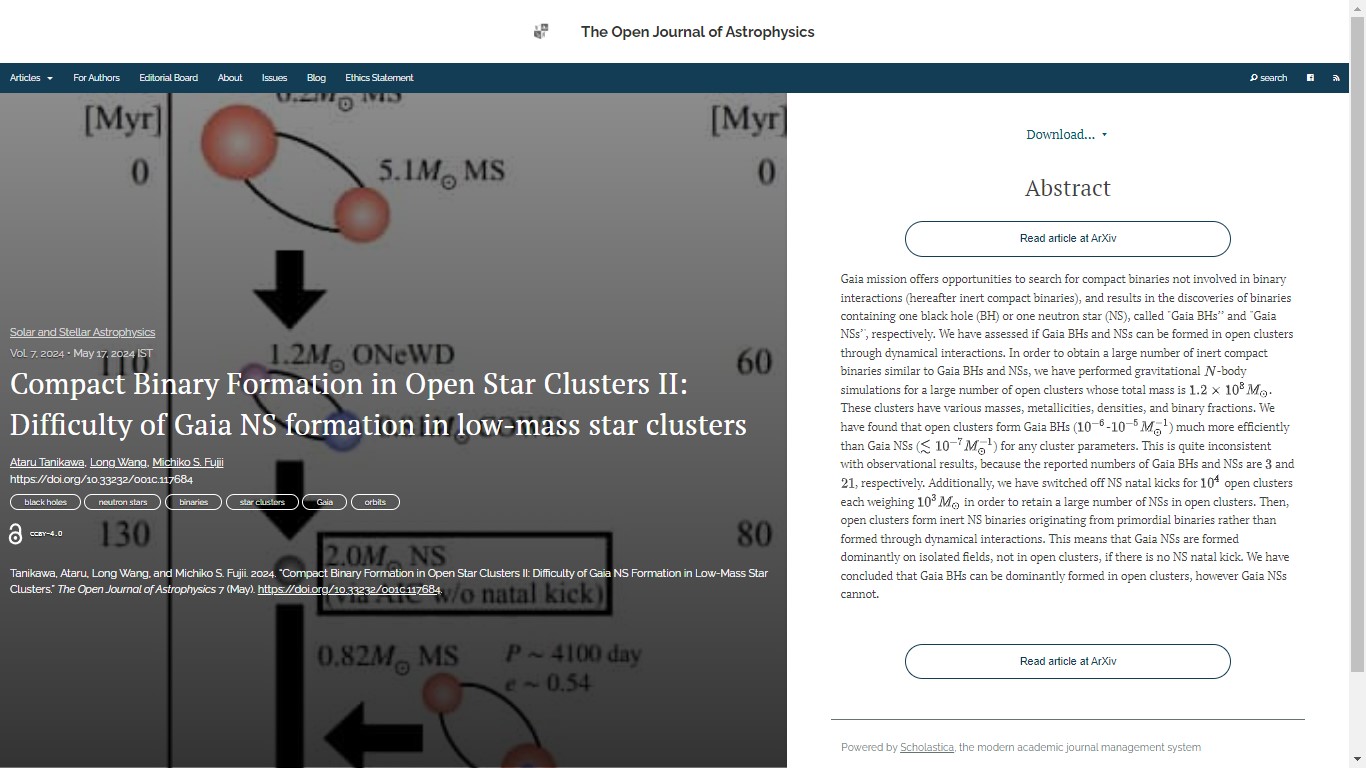
The last paper of this batch, also in the in the folder Solar and Stellar Astrophysics, is entitled “Compact Binary Formation in Open Star Clusters II: Difficulty of Gaia NS formation in low-mass star clusters”  and it presents a discussion of the formation of binary neutron stars and black holes found in Gaia data based on their orbital properties. It was published on Friday May 17th 2024 (i.e. yesterday). The authors are Ataru Tanikawa (Fukui University, Japan), Long Wang (Sun-yat Sen University, China) and  Michiko S. Fujii (Tokyo University, Japan).

Here is a screengrab of the overlay:


To read the accepted version of this on the arXiv please go here.
That’s all for now. Another update next week!


International Day Against Homophobia, Biphobia and Transphobia

Posted in LGBTQ+ with tags on May 17, 2024 by telescoper

I just remembered that today is May 17th which means that it is International Day Against Homophobia Transphobia and Biphobia, This is a worldwide celebration of sexual and gender diversities and a chance to show solidarity against bigotry and intolerance (and there’s a lot of both of those about these days).

The theme for this year is No one left behind: equality, freedom and justice for all:

Examination Time in Maynooth

Posted in Barcelona, Education, Maynooth, The Universe and Stuff with tags , , on May 17, 2024 by telescoper

Today ( Friday 17th May) is the first day of the Summer Examination Period in Maynooth. Although I’m not there right now I thought I’d take the opportunity to wish all students the best for their examinations:

You shouldn’t really be relying on luck of course, so here are some tips for the examination period (especially for physics students, but applicable elsewhere).

  1. Try to get a good night’s sleep before the examination and arrive in plenty of time before the start. Spending all night cramming is unlikely to help you do well.
  2. Prepare well in advance so you’re relaxed when the time comes.
  3. Read the entire paper before starting to answer any questions. In particular, make sure you are aware of any supplementary information, formulae, etc, given in the rubric or at the end.
  4. Start off by tackling the question you are most confident about answering, even if it’s not Question 1. This will help settle any nerves. You’re under no obligation to answer the questions in the order they are asked.
  5. Don’t rush! Students often lose marks by making careless errors. In particular, check all your numerical results on your calculator at least twice
  6. Please remember the units!
  7. Don’t panic! You’re not expected to answer everything perfectly. A first-class mark is anything over 70%, so don’t worry if there are bits you can’t do. If you get stuck on a part of a question, don’t waste too much time on it (especially if it’s just a few marks). Just leave it and move on. You can always come back to it later if you have time.

Meanwhile, in Barcelona, Monday is a public holiday (Pentecost) so I am faced with the prospect of having to endure a long weekend break. Such is life…

The Radio and Microwave Sky from Juno

Posted in The Universe and Stuff with tags , , , , , , , on May 16, 2024 by telescoper

I found out about an interesting paper by Anderson et al. at a discussion group this morning. The abstract reads:

We present six nearly full-sky maps made from data taken by radiometers on the Juno satellite during its 5-year flight to Jupiter. The maps represent integrated emission over ∼4% passbands spaced approximately in octaves between 600 MHz and 21.9 GHz. Long time-scale offset drifts are removed in all bands, and, for the two lowest frequency bands, gain drifts are also removed from the maps via a self-calibration algorithm similar to the NPIPE pipeline used by the Planck collaboration. We show that, after this solution is applied, residual noise in the maps is consistent with thermal radiometer noise. We verify our map solutions with several consistency tests and end-to-end simulations. We also estimate the level of pixelization noise and polarization leakage via simulations.

arXiv:2405.08388

For those of you unaware about Juno, it is a NASA space mission (launched in 2011) intended to study the planet Jupiter (which it is still doing). On the way there, however, this spacecraft made continuous measurements of the radiation field around it, at radio and microwave frequencies. The work described by Anderson et al. involved turning these observations into maps at a range of frequency; they also studied the polarization properties of the radiation.

The full maps and other relevant data can be downloaded here. Here are some pretty pictures (the grey bits represent the parts of the sky that were not covered; radio emission from our own Galaxy is the most obvious component at low frequencies, but it looks more complicated at higher frequencies).

It’s always fun when data sets are used for something so different from the purpose originally intended, and what has come out of this analysis are rather nice maps of the emission from the Milky Way. These might turn out to be useful for many things, such as foreground removal for extragalactic surveys or studies of our own Galaxy.

Bullying and Harassment in Astronomy

Posted in Harassment Bullying etc with tags , , , on May 15, 2024 by telescoper

I have been asked to pass on, via the medium of this blog, the news that this Friday (17th May) the Royal Astronomical Society will launch its report on bullying and harassment in Astronomy. Sorry for the late notice, but no longer being a Fellow of the RAS I didn’t get the announcement directly. Anyway, it’s not too late to sign up to attend Friday’s meeting, either in person or via the live stream, which you can do here:

R.I.P. Roger Corman (1926-2024)

Posted in Biographical, Film with tags , , , on May 14, 2024 by telescoper

I was saddened to hear of the death at the age of 98 of prolific film  producer and director Roger Corman. He is best known, at least to me, as the director of a string of cult low-budget B-movies. They were of variable quality in terms of acting – Corman couldn’t often afford to pay for top-quality actors – but some of the films were outstanding. Roger Corman’s death gives me an excuse to rehash an old post about one of his films.

The first film I remember seeing that really terrified me was House of Usher starring the great Vincent Price, a regular in a series of films by Roger Corman inspired by Edgar Allan Poe, who gives most of his performance in a creepy stage whisper, a film based Poe’s short story The Fall of the House of Usher. When I was around 8 or 9 I was once left home alone on a Friday night by my parents. In those days the BBC used to show horror films late at night on Fridays and, against parental guidance, I decided to watch this one. It scared me witless and when my parents got home they found me a gibbering wreck. I don’t really know why I found it so scary – younger people reared on a diet of slasher movies probably find it very tame, as you don’t actually see anything particularly shocking – but the whole atmosphere of it really got to me. Here’s an example clip.