Today was my first day at EAS 2025 on the nice campus of University College Cork. I managed to register before the first session and found my way around what is clearly a very well organised meeting. They have a very useful app to help attendees navigate both space and time.
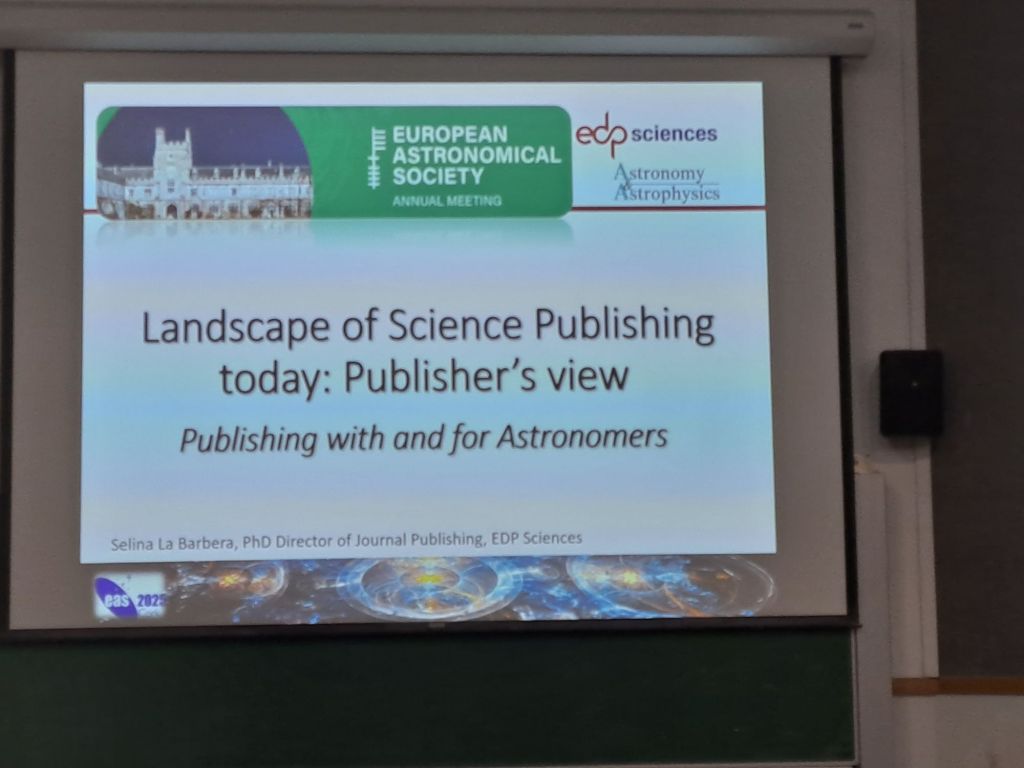
I spent a large part of today at a session about the future of scientific publishing, which was split in two, either side of the morning’s plenary. The first half started with a talk by Selina La Barbera, a representative of EDP Sciences, the publisher of the journal Astronomy and Astrophysics:
It also featured a talk by João Alves, Letters Editor of Astronomy and Astrophysics, and Uta Grothkopf, librarian of the European Southern Observatory. The last talk was full of insights and information. The Q&A was very lively. I was expecting that I might be the one to inject some controversy into the discussion, but I didn’t need to. Issues about the cost of APCs, etc, were raised by others before I got the chance.
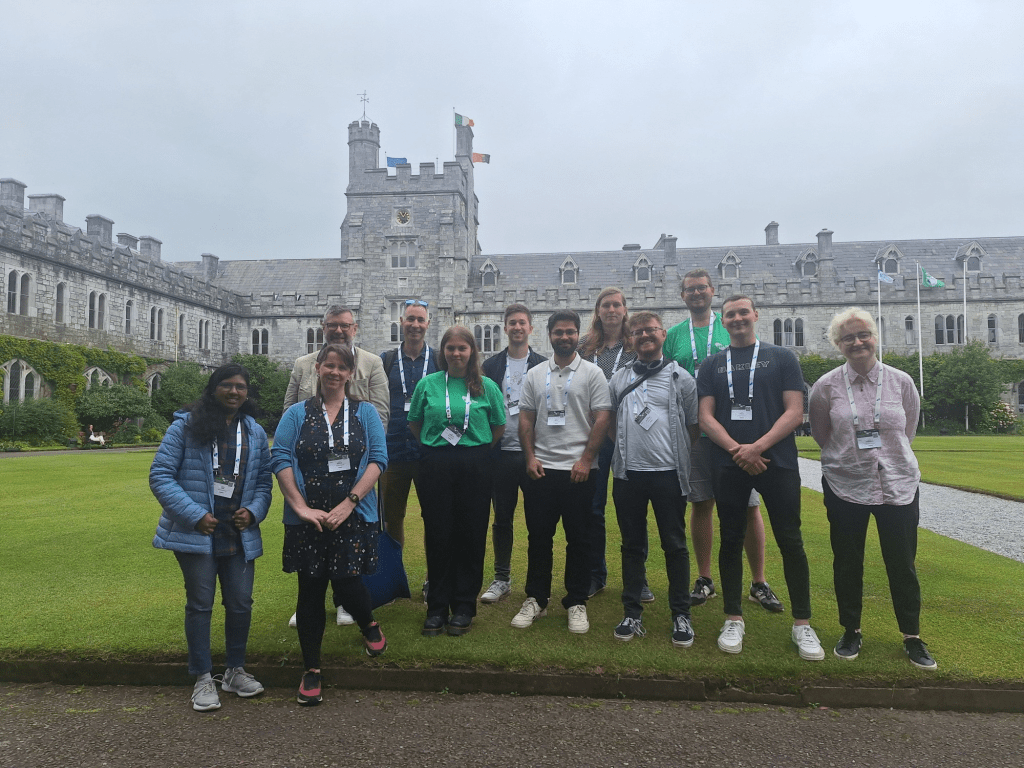
Before the plenary, there was time for a group photograph of staff and students from Maynooth:
The Maynooth Contingent
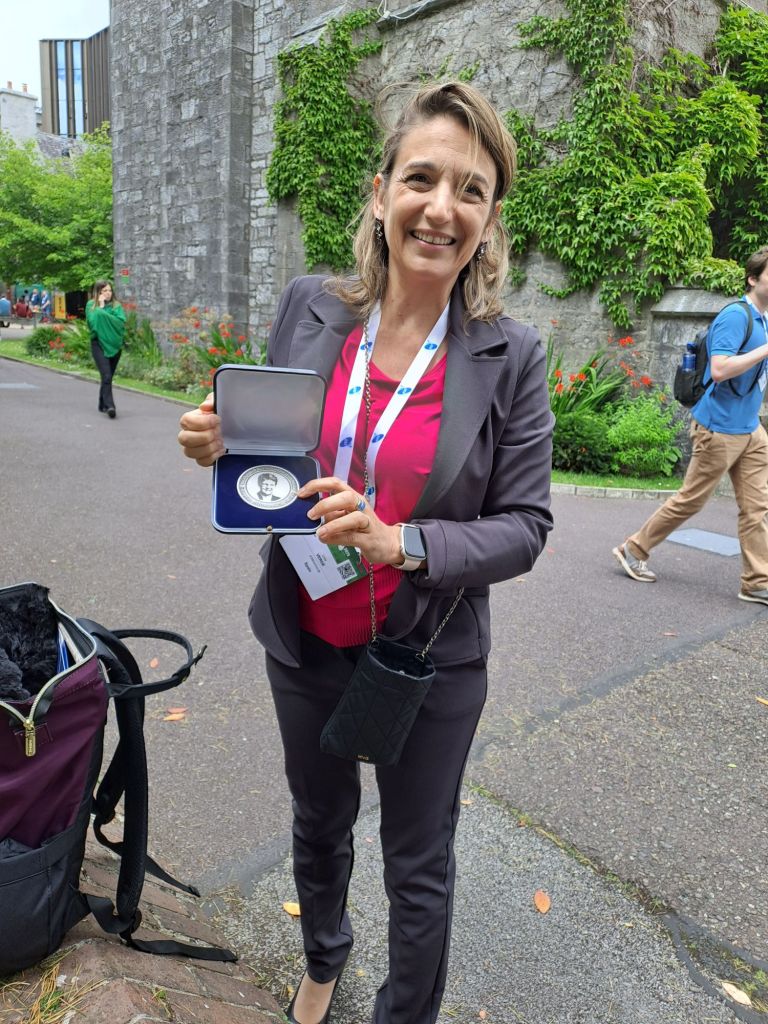
The highlight of the plenary was seeing Licia Verde collect the Jocelyn Bell Burnell Medal on behalf of arXiv, together with Ralph Wijers. They both gave interesting presentations about arXiv too.
Licia, with the EAS Medal she received today.
Back in the special session about publishing, I participated in a panel discussion, which was very lively. On a Zoom call last week in preparation for this, we were a bit worried that not many people would take part, but in the event the room was full and many people asked questions, including many about OJAp, and the discussion went on outside after the session was finished. I think it was a very successful session.
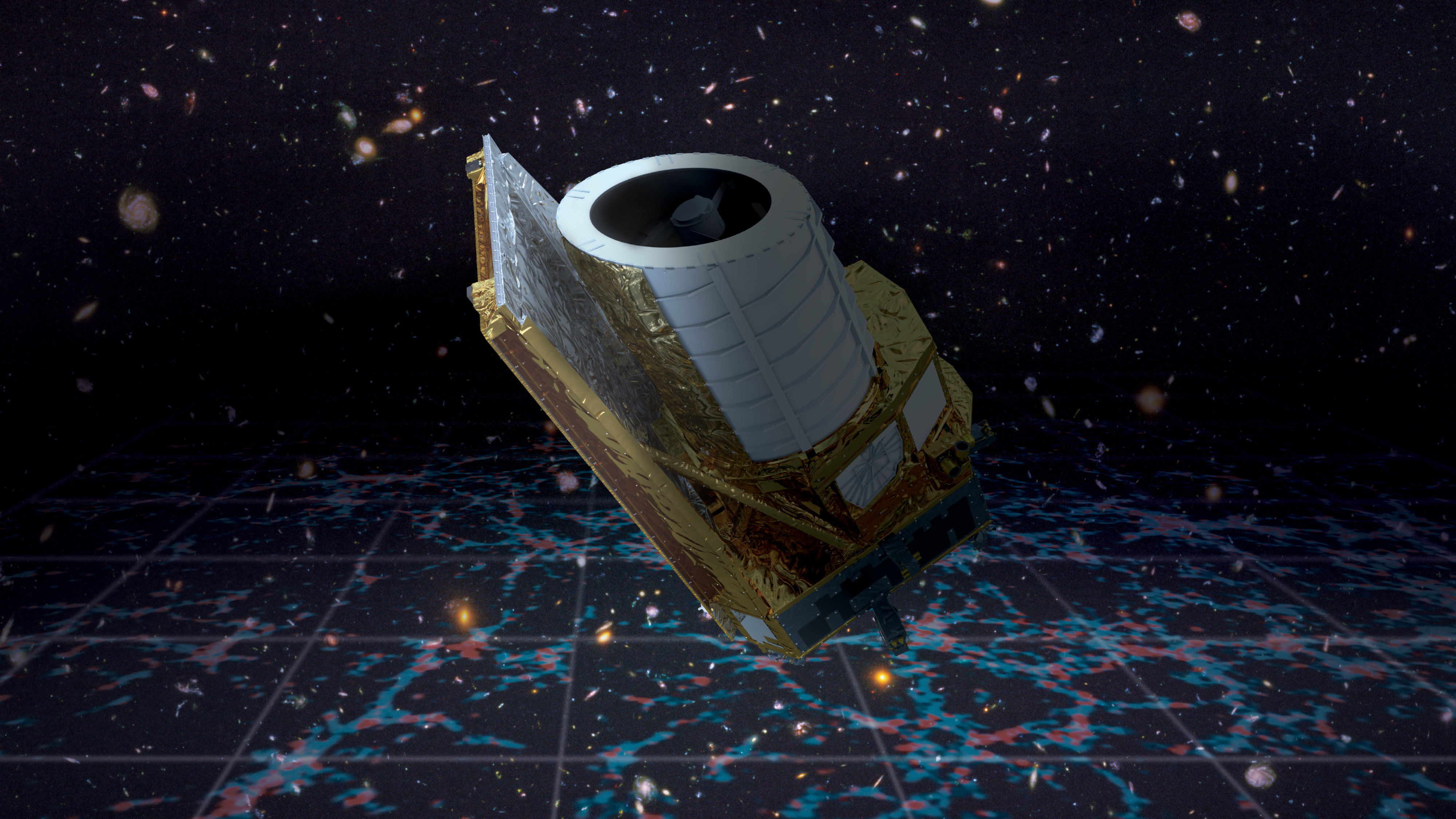
Now that the session I was directly involved in is over, I can relax a bit and be free tomorrow to attend more science sessions, including a couple about Euclid…
A few weeks ago I mentioned the concerning news that arXiv was changing the way it works and moving all of its content into cloud storage. Related to this was a decision made last year to shut down the previously existing arXiv mirror sites. At the time arXiv explained that
The arXiv mirror network served a role – acting as a backup for the corpus, allowing some degree of load distribution, and providing improved access for users who were geographically closer to a mirror – that is no longer necessary. arXiv now has multiple backups for the arXiv corpus in place, and the Fastly CDN (Content Delivery Network) that we use to deliver content provides excellent service throughout the world.
This decision, which puts all the eggs in one basket, is looking very questionable after in the Trump era. The already oppressive restrictions on academic freedom in the United States are expected to escalate further. These developments will affect research infrastructures worldwide. In other words, the USA has become a single-point failure. This ongoing and escalating risk can only be mitigated by moving to a more decentralized and thus more resilient infrastructure.
One move in this direction has been made by the German National Library for Science and Technology which, in German, is the Technische Informationsbibliothek or TIB for short; their website is here. As explained here, TIB is in the process of creating a “dark archive” of the arXiv, i.e. a backup of all the arXiv content. According to TIB,
The establishment of a “dark archive” is an expression of our long-standing commitment to reliable, international scientific provision and as a partner of arXiv. Even though the “dark archive” currently only operates in the background, it is a crucial building block for the long-term safeguarding of digital research content, because in the event of a crisis, we can open the archive.
In other words, there will be a backup that can be activated if the arXiv main site collapses.
I think this is a valuable precaution, and there should probably be more dark mirrors of this kind around the world. As well as this specific measure I also endorse the general philosophy of creating a “more decentralized and thus more resilient infrastructure”. Yesterday I did an interview with a journalist about the Open Journal of Astrophysics at the end of which I said that I thought the future of academic publishing was a federated system of overlays over a wide range of institutional and/or subject repositories. That’s the only way to spread the cost of maintaining the infrastructure in a reasonable way as well as reducing the clear vulnerability of the current system.
arXiv is in the midst of technological modernization to ensure longevity and scalability, and to improve our ability to support the scientific community. We are currently hiring software engineers and developers to work on the arXiv CE (“Cloud Edition”) project and our tech modernization efforts.
It seems that arXiv is going to be moved from local infrastructure at Cornell University to some sort of Google Cloud Platform. I’m not sure what to make of this move. For one thing, I’m deeply suspicious of Google so I hope that measures will be taken to ensure that arXiv remains freely accessible to the global scientific community. I suspect too that Google will use arXiv submissions as it uses everything placed in its control, to train AI. On the other hand, everything on arXiv is currently in the public domain anyway, and there has been evidence of attempts by bots to scrape its content already, causing a (temporary) degradation of service.
What all this means for the Open Journal of Astrophysics, I don’t know. I have however over the past several weeks been setting up several backups of all the papers published by OJAp in various repositories. We are an arXiv-overlay journal, but there’s no reason at all why the overlay model cannot be used with other repositories.
The decision to take these precautions was not motivated by arXiv’s move to the Cloud but by more general worries about the state of affairs in the USA right now. American universities are facing a number of attacks, as the current “Government” pursues an explicitly anti-scientific agenda, so I think it’s wise to consider the risk to Cornell being non-negligible. Obviously we can’t back up the entire arXiv repository, but I think we’ve made all OJAp papers as safe as possible in the event that anything happens to arXiv. I still think it’s unlikely we will need to use them so we’ll continue with arXiv for the forseeable future. Better safe than sorry!
There’s a good piece in Wired about Paul Ginsparg, the physicist who created arXiv. The lede of the article begins Modern science wouldn’t exist without the online research repository known as arXiv. For once, this isn’t an exaggeration. I recommend you read the piece yourself so I won’t say much more about it except that I found it fascinating. I couldn’t resist in including this extract, however, with which I wholeheartedly agree:
Every industry has certain problems universally acknowledged as broken: insurance in health care, licensing in music, standardized testing in education, tipping in the restaurant business. In academia, it’s publishing. Academic publishing is dominated by for-profit giants like Elsevier and Springer. Calling their practice a form of thuggery isn’t so much an insult as an economic observation. Imagine if a book publisher demanded that authors write books for free and, instead of employing in-house editors, relied on other authors to edit those books, also for free. And not only that: The final product was then sold at prohibitively expensive prices to ordinary readers, and institutions were forced to pay exorbitant fees for access.
I’ve written words to that effect so many times I’ve lost count!
Anyway, as if to reinforce the point about the transformative nature of arXiv, it has just been announced that the European Astronomical Society has awarded the 2025 Jocelyn Bell Burnell Inspiration Medal to arXiv “for its impact on astrophysical research thanks to the open, free and world-wide distribution of scientific articles”. What a bold, imaginative and fully justifiable decision that is, and congratulations to arXiv! It is a truth universally acknowledged that every paper in astrophysics worth reading is on arXiv.
I’m planning to be at this year’s EAS meeting in Cork at the end of June when this, and the other EAS awards, will be presented. I’m not sure who will receive it on behalf of arXiv but they’re sure to get a rousing ovation.
Last week I encountered, for the first time, a website called Qeios.com. This is a platform that does peer review of preprints and then posts those approved with Open Access. It also issues a DOI for approved articles. Qeios is also a member of Crossref so presumably the metadata for these articles is deposited there too.
You might think this is the same as what the Open Journal of Astrophysics does, but it is a bit different. For one thing, it is not an arXiv overlay journal so the preprints actually appear on the Qeios platform, though I suppose there’s nothing to stop authors posting on arXiv either before or after Qeios. Since most astrophysicists find their research on arXiv, the overlay concept seems more efficient than the Qeios one.
Anyway, my attention was drawn to Qeios by an astrophysicist who had been asked to review an article for Qeios that is already under consideration by OJAp. In our For Authors page there is this:
No paper should be submitted to The Open Journal of Astrophysics that is already published elsewhere or is being considered for publication by another journal.
This rule is adopted by many journals and has in the past led to authors being banned for breaking it. Apart from anything else it means that the community is not bombarded with multiple review requests for the same paper (as in the case above). There is an issue of research misconduct, the definition of which varies from one institution to another. For reference here is what it says in Maynooth University’s Research Integrity Policy statement:
Publication of multiplier papers based on the same set(s) or sub-set(s) of data is not acceptable, except where there is full cross-referencing within the papers. An author who submits substantially similar work to more than one publisher must disclose this to the publishers at the time of submission.
The document also specifically refers to “artificially proliferating publications” as an example of research misconduct. Authors whose papers do end up in multiple journals could thus find themselves in very hot water with their employers as a consequence.
Getting back to the specifics of Qeios and OJAp, however, there two questions about whether this rule applicable in this situation. One is that the preprint may have been submitted to Qeios after submission to OJAp, which means the rule as written is not violated. Authors of papers published by OJAp retain full copyright of their work so we can’t control what they do after publication, but if they try to publish it again in another journal they will fall foul of the rule there.
The other is whether Qeios counts as a “another journal” in the first place. Instead of going into the definition of what a journal is, I’ll refer you to an old post of mine in which I wrote this:
I’d say that, at least in my discipline, traditional journals are simply no longer necessary for communicating scientific research. I find all the papers I need to do my research on the arXiv and most of my colleagues do the same. We simply don’t need old-fashioned journals anymore. Yet we keep paying for them. It’s time for those of us who believe that we should spend as much of our funding as we can on research instead of throwing it away on expensive and outdated methods of publication to put an end to this absurd system. We academics need to get the academic publishing industry off our backs.
The point that I have made many times is that the only thing that journals do of any importance is to organize peer-review. The publishing side of the business is simply unnecessary. Journals do not add value to an article, they just add cost. The one thing they do – peer review – is not done by them but by members of the academic community.
There is a thread on Bluesky by Ethan Vishniac (Editor-in-Chief of the Astrophysical Journal) about Qeios. There are six parts so please bear with me if I include them all to show context:
This thread is for authors of scientific papers, and particularly astronomers. I struggled a bit with how explicit I had to be, but I think including a name is important. We (meaning all the major journals) have rules against submitting a manuscript to more than one journal at a time. 1/6
People who ignore this rule can find themselves banned from submitting papers for years. Recently we had a case where a potential referee noted that he had just been asked to review the same paper by someone else. 2/6
I wrote the author, who was startled and explained that he had been asked to allow his preprint to be posted at Qeios.com and that he had agreed – the issue of peer review was never raised and posting a preprint is not an ethical violation. It’s a normal part of the process. 3/6
He cc'd me the emails and I would have read it the same way. Qeios.com takes the position that they are not a journal, but a website that vets papers through peer review. The AAS journals (and as far as I know, all other professional journals) does not regard this as a meaningful distinction. 4/6
We ban this kind of simultaneous submission in order to avoid over-burdening the community with review requests and because we do not want to encourage people to shop for a referee who will not give significant feedback. The task of reviewing a paper is time-consuming but important service. 5/6
There is no point in participating in a process which makes this work meaningless. TDLR submit to the AAS journals, or submit to Qeios.com , or any other journal of your choice, but remember that it is a choice. Also, you can post to the ArXiv as well. It's fine. 6/6
This thread repeats much of what I’ve said already, but I’d like to draw your attention to the 4th of these messages, which contains
Qeios.com takes the position that they are not a journal, but a website that vets papers through peer review. The AAS journals (and as far as I know, all other professional journals) does not regard this as a meaningful distinction.
I’m not sure what a journal actually is, as I think it is an outmoded concept, but I agree with Ethan Vishniac that to all intents and purposes Qeios is a journal. It has an ISSN that says as much too. On the other hand, this quote seems to me to contain a tacit acceptance that the only thing that defines a journal is that it vets papers by peer review, which is the point I made above.
I couldn’t resist sharing a piece of fundamental research I found in an article on the arXiv withthe abstract:
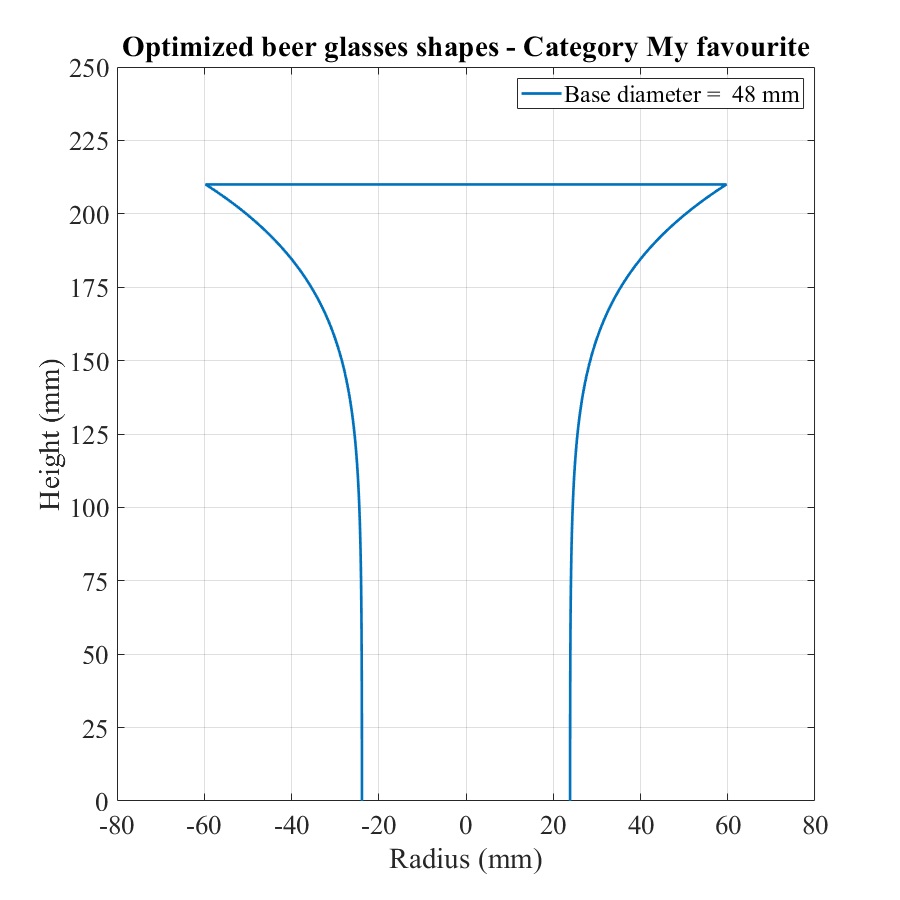
This paper addresses the problem of determining the optimum shape for a beer glass that minimizes the heat transfer while the liquid is consumed, thereby keeping it cold for as long as possible. The proposed solution avoids the use of insulating materials. The glass is modeled as a body of revolution generated by a smooth curve, constructed from a material with negligible thermal resistance, but insulated at the base. The ordinary differential equation describing the problem is derived from the first law of Thermodynamics applied to a control volume encompassing the liquid. This is an inverse optimization problem, aiming to find the shape of the glass (represented by curve S) that minimizes the heat transfer rate. In contrast, the direct problem aims to determine the heat transfer rate for a given geometry. The solution obtained here is analytic, and the resulting function describing the relation between height ans radius of the glass, is in closed form, providing a family of optimal glass shapes that can be manufactured by conventional methods. Special attention is payed to the dimensions and the capacity of the resulting shapes.
arXiv:2410.12043v1
The author’s favourite shape is this:
Of course those of us who are used to proper beer don’t really want it to be cold in the first place, but I hope this doesn’t sound bitter. My main reservation about the conclusion of the paper is that it doesn’t seem to take into account how easy it is to drink from the glass. In that respect, I’m not convinced by the shape above!
We’re now publishing papers at a steady rate at the Open Journal of Astrophysics. This is probably not obvious to outsiders, but our platform actually consists of two different sites, one handling submissions and the other dealing with publishing those papers accepted. Although we have a large (and still expanding) team of volunteer Editors to deal with the former, as Managing Editor I am the only person with the keys to the publishing side of things. This part of the process has been simplified enormously after the automation introduced earlier this year but it still takes some time to do, as I have to check the overlay and metadata before pressing the button to deposit everything with Crossref and make the overlay live. I also announce each paper on social media. This usually takes around 15 minutes per paper, give or take.
Now that I’ve returned to full teaching duties at Maynooth University, I’ve developed a routine to deal with this activity. During workdays I usually wake around 7am, make some coffee, and then check the day’s arXiv mailing to see if any of our accepted papers have been announced. If any have, I do the honours while I have my coffee, and then proceed to shower and breakfast (including Coffee no. 2); if none have, I go straight to shower and breakfast. I’ve been following this routine for quite a while now.
In the last couple of weeks, however, I have noticed quite often when I try to look up newly-announced papers on arXiv that the connection times out with a message saying ‘rate exceeded’. If that happens I just wait a while and try again. It’s not a very serious issue but it does slow down the process.
Well, today I found out the reason via a message on Mastodon. The loading errors at arXiv are caused by people doing many simultaneous downloads in attempts to scrape all the content from arXiv as soon as it is announced. This is almost certainly to provide material for Large Language Models, such as ChatGPT, which are essentially Automated Plagiarism Engines. I propose the acronym APE for the kind of person who engages in this sort of activity.
This is a very tedious development and I hope arXiv can find a way of putting a stop to it without inconveniencing its authentic users. I suggest that the people managing arXiv identify the culprits and send the boys round.
This morning’s arXiv update brought the expected deluge of preprints from Euclid. You can find details of all fifteen of the new articles here. Ten of them relate to the Early Release Observations of which five were announced yesterday and five last November. These are essentially byproducts of the testing and calibration phase of the Euclid mission rather than the main cosmological survey. ESA is making a series of short videos about these results which I will share on here from time to time.
Of more direct relevance to cosmologists such as myself are the following five reference papers:
The overview paper, led by Yannick Mellier (Euclid Consortium Lead), giving a general description of the mission capabilities and science goals, will be the main reference paper and just about every active member of the Euclid Consortium is on the author list (including myself). That’s over a thousand people, not quite at the level of the Large Hadron Collider but getting there. I do think we need to find a better way of giving credit to work in large collaborations than through authorship, but until someone comes up with a workable scheme, and people responsible for hiring researchers adopt it, we’re stuck with what we’ve got. At least I can say that I’ve read that paper (which is 94 pages long, including the author list)
Papers II-IV are technical articles relating to Euclid’s instruments and their calibration, which will also be important references for the survey part of the Euclid mission. Paper V is about the Flagship simulations and the mock catalogues produced therefrom; I discussed these a while ago here. It is led by Francisco Castander of Institut de Ciencies de l’Espai, who organized the meeting I attended recently here in Barcelona.
These papers now now be peer-reviewed and, assuming they are accepted, published in a special issue of Astronomy & Astrophysics (A&A).
My attention was drawn yesterday to the following blog post about Open Access in the field of ecology. I recommend you read it (and the comments, some of which are excellent).
First, whenever I read an article like this from a discipline different from my own it makes me not only feel grateful that we have arXiv but also wonder why so many fields don’t have the equivalent. On the other hand, there is EarthArxiv, but it doesn’t seem to have very many papers on it.
Second, I agree with the author of the post that far too many papers are being published. That is driven by the absurdity of a system that no longer regards the journal article as a means of disseminating scientific results but instead as a kind of epaulette to give status to the author. I also agree that scientists have largely got themselves to blame for this ridiculous situation.
Third, I disagree most strongly with this statement:
First, pipe dreaming academics who believed in the mirage of “Diamond OA” (nobody pays and it is free to publish). Guess what – publishing a paper costs money – $500-$2000 depending on how much it is subsidized by volunteer scientists.
This is nonsense. It does not cost anything like $500-$2000 dollars to publish a paper. Of course it does cost something, but the true amount is trivial – tens of dollars, rather than hundreds or thousands – and can easily be absorbed. The entire annual running costs of OJAp are less than the typical Article Processing Charge for a single paper in a “prestigious” journal. Most money being paid in the form of APC goes directly into profit for the publishers, and the rest is largely wasted on administrative overhead. The Open Journal of Astrophysics is a Diamond Open Access journal, not a mirage. It may be a no-frills service, but it’s a reality. Why doesn’t someone set up an overlay journal on EarthArXiv?
The author of this blog post also spectacularly misses the point with “depending on how much it is subsidized by volunteer scientists”. Volunteer scientists are already subsidizing the profits of profit-making publishers! One of the commenters on the blog post has it right:
On Diamond OA and who pays; we’re already paying the big publishers with both our time and our money to publish in / review for / edit for their journals. Perhaps if we redirected that time to Diamond OA titles things would be somewhat different.
A final comment, only tangentially related to this post, is that I have been (pleasantly) surprised by the extent to which early career researchers have embraced the concept of the Open Journal of Astrophysics when you might have thought that they had more to lose by not publishing in mainstream journals rather than us oldies who don’t care any more. The explanation seems to be that younger people seem to see the absurdity and obvious unsustainability of the current publishing environment more easily than those who have put up with it for decades already.
I’ve been busy all day so just have time to mention an interesting new development to do with arXiv. There is a new site called alphaXiv, which is a forum for anyone to comment line-by-line on arXiv papers. It also allows you to “get responses directly from authors of the paper or from established research teams from Stanford and Harvard”, which seems to imply that authors can’t be from established research teams unless they are from Stanford or Harvard!
I think this is a great idea in principle; it will be fascinating to see how it works out in practice. My main reservation stems from (i) it seems that there is no moderation of comments and (ii) anonymous comments are allowed; there is therefore a significant danger of abusive behaviour as is often the case on, e.g., Reddit.
I’d welcome reactions via the comments box below from anyone who has tried this already or who has thoughts about it generally!
The views presented here are personal and not necessarily those of my employer (or anyone else for that matter).
Feel free to comment on any of the posts on this blog but comments may be moderated; anonymous comments and any considered by me to be vexatious and/or abusive and/or defamatory will not be accepted. I do not necessarily endorse, support, sanction, encourage, verify or agree with the opinions or statements of any information or other content in the comments on this site and do not in any way guarantee their accuracy or reliability.