Archive for arXiv

“Optimized” Beer Glass Shapes

Posted in The Universe and Stuff with tags , , , on October 21, 2024 by telescoper

I couldn’t resist sharing a piece of fundamental research I found in an article on the arXiv withthe abstract:

This paper addresses the problem of determining the optimum shape for a beer glass that minimizes the heat transfer while the liquid is consumed, thereby keeping it cold for as long as possible. The proposed solution avoids the use of insulating materials. The glass is modeled as a body of revolution generated by a smooth curve, constructed from a material with negligible thermal resistance, but insulated at the base. The ordinary differential equation describing the problem is derived from the first law of Thermodynamics applied to a control volume encompassing the liquid. This is an inverse optimization problem, aiming to find the shape of the glass (represented by curve S) that minimizes the heat transfer rate. In contrast, the direct problem aims to determine the heat transfer rate for a given geometry. The solution obtained here is analytic, and the resulting function describing the relation between height ans radius of the glass, is in closed form, providing a family of optimal glass shapes that can be manufactured by conventional methods. Special attention is payed to the dimensions and the capacity of the resulting shapes.

arXiv:2410.12043v1

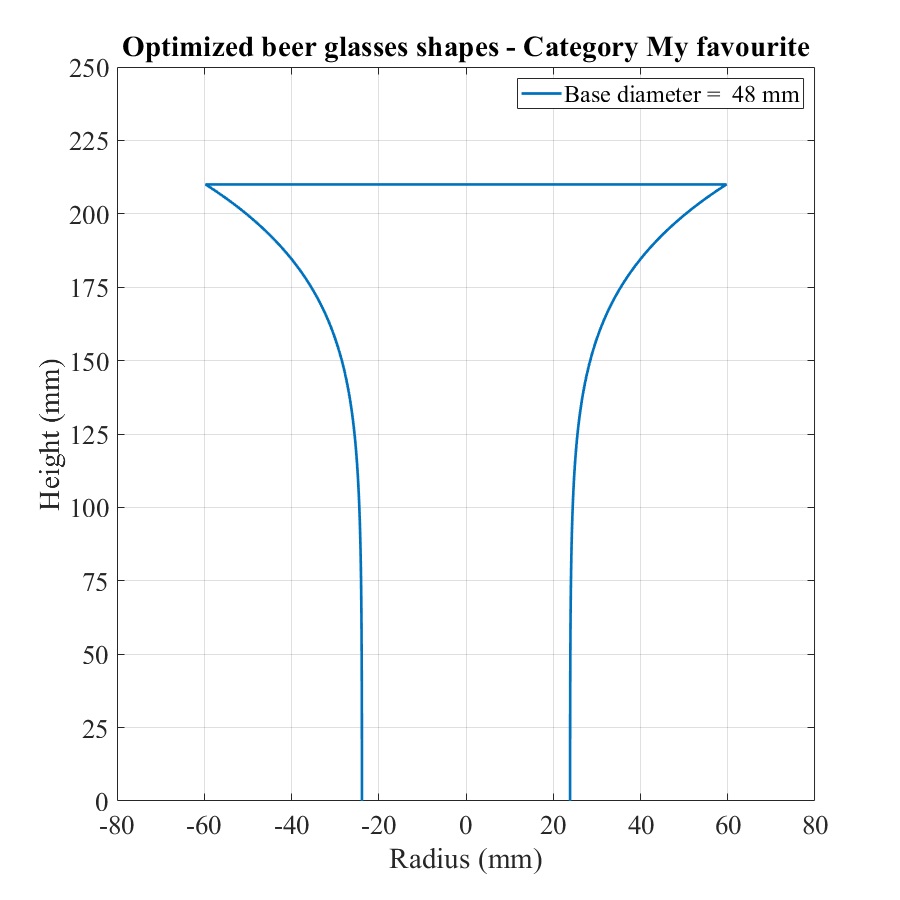
The author’s favourite shape is this:

Of course those of us who are used to proper beer don’t really want it to be cold in the first place, but I hope this doesn’t sound bitter. My main reservation about the conclusion of the paper is that it doesn’t seem to take into account how easy it is to drink from the glass. In that respect, I’m not convinced by the shape above!

The trouble with arXiv

Posted in Biographical, Open Access with tags , , , , on October 17, 2024 by telescoper

We’re now publishing papers at a steady rate at the Open Journal of Astrophysics. This is probably not obvious to outsiders, but our platform actually consists of two different sites, one handling submissions and the other dealing with publishing those papers accepted. Although we have a large (and still expanding) team of volunteer Editors to deal with the former, as Managing Editor I am the only person with the keys to the publishing side of things. This part of the process has been simplified enormously after the automation introduced earlier this year but it still takes some time to do, as I have to check the overlay and metadata before pressing the button to deposit everything with Crossref and make the overlay live. I also announce each paper on social media. This usually takes around 15 minutes per paper, give or take.

Now that I’ve returned to full teaching duties at Maynooth University, I’ve developed a routine to deal with this activity. During workdays I usually wake around 7am, make some coffee, and then check the day’s arXiv mailing to see if any of our accepted papers have been announced. If any have, I do the honours while I have my coffee, and then proceed to shower and breakfast (including Coffee no. 2); if none have, I go straight to shower and breakfast. I’ve been following this routine for quite a while now.

In the last couple of weeks, however, I have noticed quite often when I try to look up newly-announced papers on arXiv that the connection times out with a message saying ‘rate exceeded’. If that happens I just wait a while and try again. It’s not a very serious issue but it does slow down the process.

Well, today I found out the reason via a message on Mastodon. The loading errors at arXiv are caused by people doing many simultaneous downloads in attempts to scrape all the content from arXiv as soon as it is announced. This is almost certainly to provide material for Large Language Models, such as ChatGPT, which are essentially Automated Plagiarism Engines. I propose the acronym APE for the kind of person who engages in this sort of activity.

This is a very tedious development and I hope arXiv can find a way of putting a stop to it without inconveniencing its authentic users. I suggest that the people managing arXiv identify the culprits and send the boys round.

Euclid Paper Day!

Posted in Barcelona, Euclid, Maynooth, The Universe and Stuff with tags , , , , , , , , on May 24, 2024 by telescoper

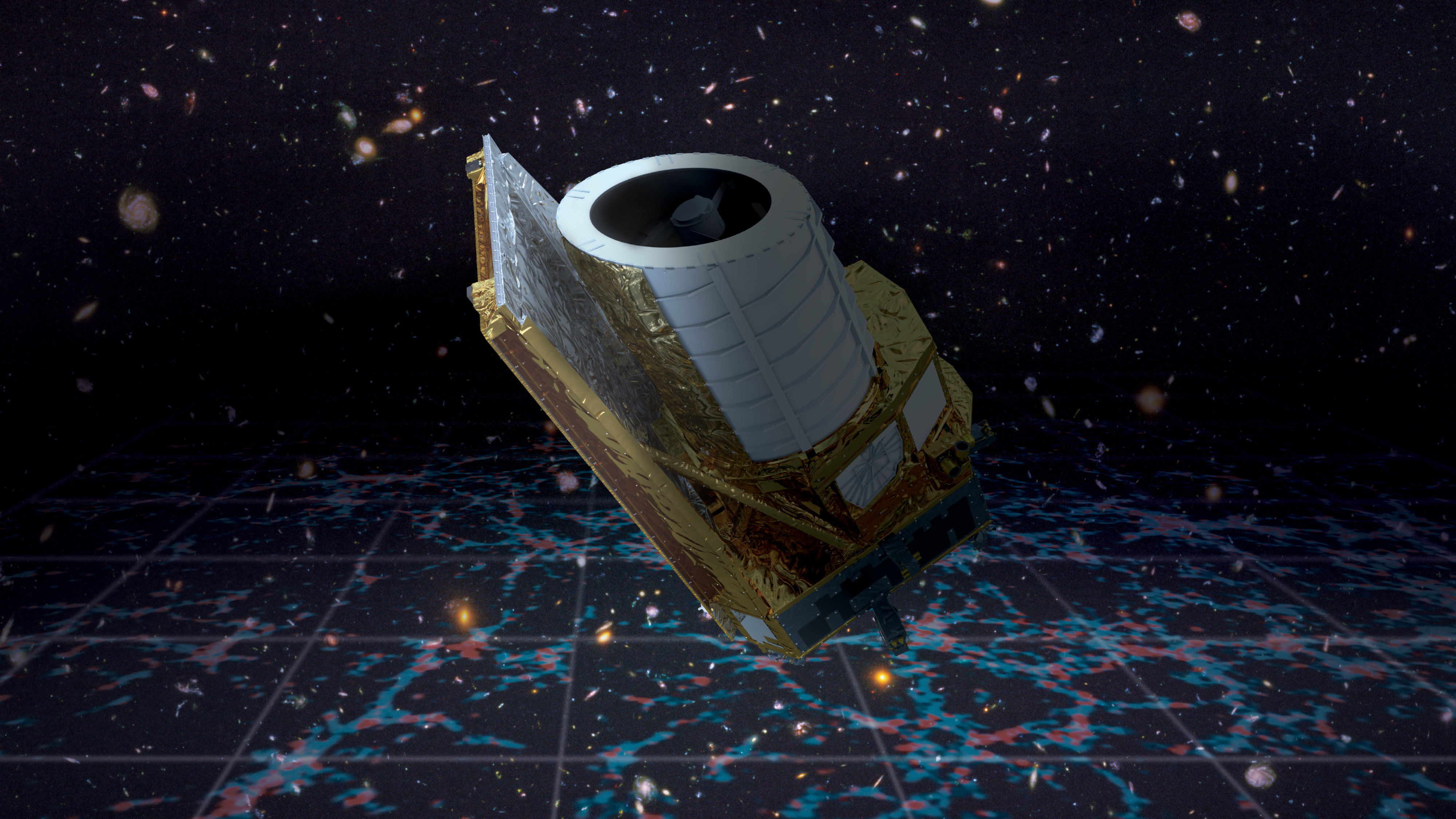
This morning’s arXiv update brought the expected deluge of preprints from Euclid. You can find details of all fifteen of the new articles here. Ten of them relate to the Early Release Observations of which five were announced yesterday and five last November. These are essentially byproducts of the testing and calibration phase of the Euclid mission rather than the main cosmological survey. ESA is making a series of short videos about these results which I will share on here from time to time.

Of more direct relevance to cosmologists such as myself are the following five reference papers:

The overview paper, led by Yannick Mellier (Euclid Consortium Lead), giving a general description of the mission capabilities and science goals, will be the main reference paper and just about every active member of the Euclid Consortium is on the author list (including myself). That’s over a thousand people, not quite at the level of the Large Hadron Collider but getting there. I do think we need to find a better way of giving credit to work in large collaborations than through authorship, but until someone comes up with a workable scheme, and people responsible for hiring researchers adopt it, we’re stuck with what we’ve got. At least I can say that I’ve read that paper (which is 94 pages long, including the author list)

Papers II-IV are technical articles relating to Euclid’s instruments and their calibration, which will also be important references for the survey part of the Euclid mission. Paper V is about the Flagship simulations and the mock catalogues produced therefrom; I discussed these a while ago here. It is led by Francisco Castander of Institut de Ciencies de l’Espai, who organized the meeting I attended recently here in Barcelona.

These papers now now be peer-reviewed and, assuming they are accepted, published in a special issue of Astronomy & Astrophysics (A&A).

Open Access in Ecology

Posted in Open Access with tags , , , , on May 6, 2024 by telescoper

My attention was drawn yesterday to the following blog post about Open Access in the field of ecology. I recommend you read it (and the comments, some of which are excellent).

I will add a few comments of my own here.

First, whenever I read an article like this from a discipline different from my own it makes me not only feel grateful that we have arXiv but also wonder why so many fields don’t have the equivalent. On the other hand, there is EarthArxiv, but it doesn’t seem to have very many papers on it.

Second, I agree with the author of the post that far too many papers are being published. That is driven by the absurdity of a system that no longer regards the journal article as a means of disseminating scientific results but instead as a kind of epaulette to give status to the author. I also agree that scientists have largely got themselves to blame for this ridiculous situation.

Third, I disagree most strongly with this statement:

First, pipe dreaming academics who believed in the mirage of “Diamond OA” (nobody pays and it is free to publish). Guess what – publishing a paper costs money – $500-$2000 depending on how much it is subsidized by volunteer scientists. 

This is nonsense. It does not cost anything like $500-$2000 dollars to publish a paper. Of course it does cost something, but the true amount is trivial – tens of dollars, rather than hundreds or thousands – and can easily be absorbed. The entire annual running costs of OJAp are less than the typical Article Processing Charge for a single paper in a “prestigious” journal. Most money being paid in the form of APC goes directly into profit for the publishers, and the rest is largely wasted on administrative overhead. The Open Journal of Astrophysics is a Diamond Open Access journal, not a mirage. It may be a no-frills service, but it’s a reality. Why doesn’t someone set up an overlay journal on EarthArXiv?

The author of this blog post also spectacularly misses the point with “depending on how much it is subsidized by volunteer scientists”. Volunteer scientists are already subsidizing the profits of profit-making publishers! One of the commenters on the blog post has it right:

On Diamond OA and who pays; we’re already paying the big publishers with both our time and our money to publish in / review for / edit for their journals. Perhaps if we redirected that time to Diamond OA titles things would be somewhat different.

A final comment, only tangentially related to this post, is that I have been (pleasantly) surprised by the extent to which early career researchers have embraced the concept of the Open Journal of Astrophysics when you might have thought that they had more to lose by not publishing in mainstream journals rather than us oldies who don’t care any more. The explanation seems to be that younger people seem to see the absurdity and obvious unsustainability of the current publishing environment more easily than those who have put up with it for decades already.

Introducing alphaXiv

Posted in Open Access with tags , on March 9, 2024 by telescoper

I’ve been busy all day so just have time to mention an interesting new development to do with arXiv. There is a new site called alphaXiv, which is a forum for anyone to comment line-by-line on arXiv papers. It also allows you to “get responses directly from authors of the paper or from established research teams from Stanford and Harvard”, which seems to imply that authors can’t be from established research teams unless they are from Stanford or Harvard!

Anyway, you can try alphaXiv here.

I think this is a great idea in principle; it will be fascinating to see how it works out in practice. My main reservation stems from (i) it seems that there is no moderation of comments and (ii) anonymous comments are allowed; there is therefore a significant danger of abusive behaviour as is often the case on, e.g., Reddit.

I’d welcome reactions via the comments box below from anyone who has tried this already or who has thoughts about it generally!

ArXiv Accessibility

Posted in Open Access with tags , , , , on February 19, 2024 by telescoper

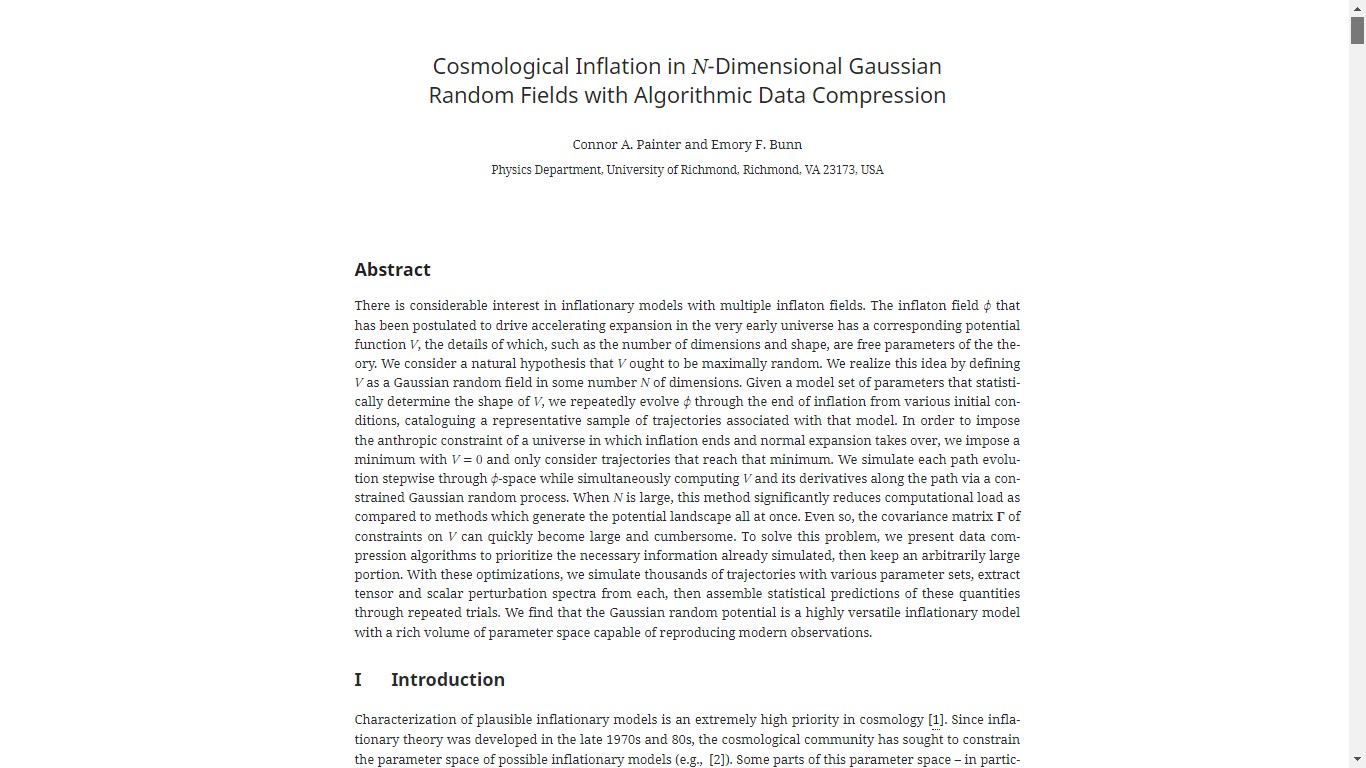
Just over a year ago I did a post about the need to make arXiv more accessible, particularly for readers with some form of visual impairment. Although I missed it at the time, there was an announcement from arXiv in December 2023 that new papers (by which is meant submitted after 1st December 2023) will be available as HTML as well as PDF format. This has been in development for some time, actually, and HTML versions have been available from arXiv labs by changing the address of a paper from, for example, “https://arxiv.org/abs/2111.15014v3” to “https://ar5iv.org/abs/2111.15014v3“. The latter produces this HTML version of one of the papers we have published at the Open Journal of Astrophysics:

As you can see, it works pretty well for this example.

Naturally I tried out the new “beta” release of the HTML generator, which you can now find on the right-hand panel of the abstract page alongside the PDF download instead of fiddling around with the URL. Here is an example of one of our papers on which it works well:

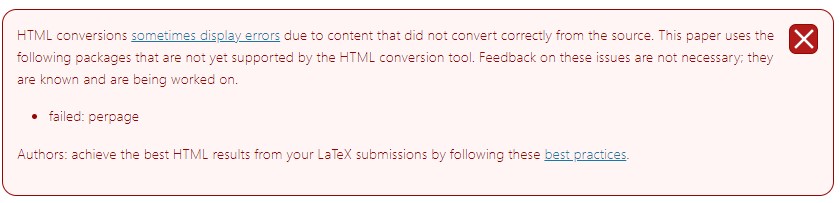
Here it is on another of our OJAp papers which, as you can see, does not work:

You can see the reason for the failure, which is that the LaTex used to generate the paper contains a package the HTML generator does not know about. One of the difficulties for arXiv is that new packages are always being developed and it is hard to keep up. I’m told that on average arXiv achieves ~75% successful conversions (and 97% partial success), but the articles from January 2024 (which contain more new packages) convert with a success rate of only 62%. It’s far from perfect, but it will improve -especially if authors follow the advice on best practice produced by arXiv; I actually think authors have a responsibility to help arXiv as much as possible in this regard.

This all reminds me of past experiences I’ve had teaching theoretical physics to blind and partially-sighted students. Years ago this used to involve making Braille copies of notes, but there are now various bits of software to help such people manage LaTeX both for creating and reading documents. In particular there are programs that can read Latex documents (including formulae and equations) which means that if a lecturer can supply LaTeX source version of their notes, the student can hear them spoken out loud as well as make their own annotations/corrections. While HTML may well be better for some fields, I do wonder if physicists and other people in disciplines that make heavy use of mathematics might prefer to use the LaTeX source code which is already downloadable from arXiv?

Three New Publications at the Open Journal of Astrophysics

Posted in OJAp Papers, Open Access, The Universe and Stuff with tags , , , , , , , , , , , , , , , , , on January 20, 2024 by telescoper

As promised yesterday, it’s time for a roundup of the week’s business at the  Open Journal of Astrophysics. This past week we have published three papers, taking  the count in Volume 7 (2024) up to 4 and the total published by OJAp up to 119. There are quite a few more ready to go as people return from the Christmas break.

In chronological order, the three papers published this week, with their overlays, are as follows. You can click on the images of the overlays to make them larger should you wish to do so.

First one up is “Prospects for studying the mass and gas in protoclusters with future CMB observations” by  Anna Gardner and Eric Baxter (Hawaii, USA), Srinivasan Raghunathan (NCSA, USA), Weiguang Cui (Edinburgh, UK), and Daniel Ceverino (Madrid, Spain). This paper, published on 17th January 2024, uses realistic hydrodynamical simulations to probe the ability of CMB Stage 4-like (CMB-S4) experiments to detect and characterize protoclusters via gravitational lensing and the Sunyaev-Zel’dovich effect. This paper is in the category of Cosmology and Nongalactic Astrophysics.

Here is a screen grab of the overlay, which includes the abstract:


You can find the officially accepted version of the paper on the arXiv here.

The second paper to announce is “SDSS J125417.98+274004.6: An X-ray Detected Minor Merger Dual AGN” and is by Marko Mićić, Brenna Wells, Olivia Holmes, and Jimmy Irwin (all of the University of Alabama, USA).  This presents the discovery of a dual AGN in a merger between the galaxy SDSS J125417.98+274004.6 and dwarf satellite, studied using X-ray observations from the Chandra satellite. The paper was also published on 18th January 2024 in the category Astrophysics of Galaxies . You can see the overlay here:


The accepted version of this paper can be found on the arXiv here.

The last paper of this batch is  entitled “Population III star formation: multiple gas phases prevent the use of an equation of state at high densities” and the authors are:  Lewis Prole (Maynooth, Ireland), Paul Clark (Cardiff, UK), Felix Priestley (Cardiff, UK), Simon Glover (Heidelberg, Germany) and John Regan (Maynooth, Ireland). This paper, which presents a comparison of results obtained using chemical networks and a simpler equation-of-state approach for primordial star formation (showing the limitations of the latter) was published on 19th January 2024 and also in the folder marked Astrophysics of Galaxies.

Here is the overlay:


You can find the full text for this one on the arXiv here.

And that concludes the update. There’ll be more next week!


Two New Publications at the Open Journal of Astrophysics

Posted in OJAp Papers, Open Access, The Universe and Stuff with tags , , , on June 28, 2023 by telescoper

Time to catch up with a couple of recent publications at the Open Journal of Astrophysics.

The first paper was published on Friday 23rd June. It is the 21st in Volume 6 (2023) and the 86th in all.

The primary classification for this paper is Cosmology and Nongalactic Astrophysics and its title is “CosmoPower-JAX: high-dimensional Bayesian inference with differentiable cosmological emulators”. The paper is about a new method, based on machine learning, to construct emulators for cosmological power spectra for the purpose of speeding up inference procedures. The software described in the paper is available here.

The authors are Davide Piras (of the University of Geneva, Switzerland) and Alessio Spurio Mancini (of the Mullard Space Sciences Laboratory, University College, London, UK)

Here is a screen grab of the overlay which includes the abstract:

You can click on the image of the overlay to make it larger should you wish to do so. You can find the officially accepted version of the paper on the arXiv here.

The second paper was published yesterday. It is the 22nd in Volume 6 (2023) and the 87th in all. Although 87 is an unlucky number for Australian cricketers – 13 short of a century – we’re still well on track to reach 100 papers by the end of the year.

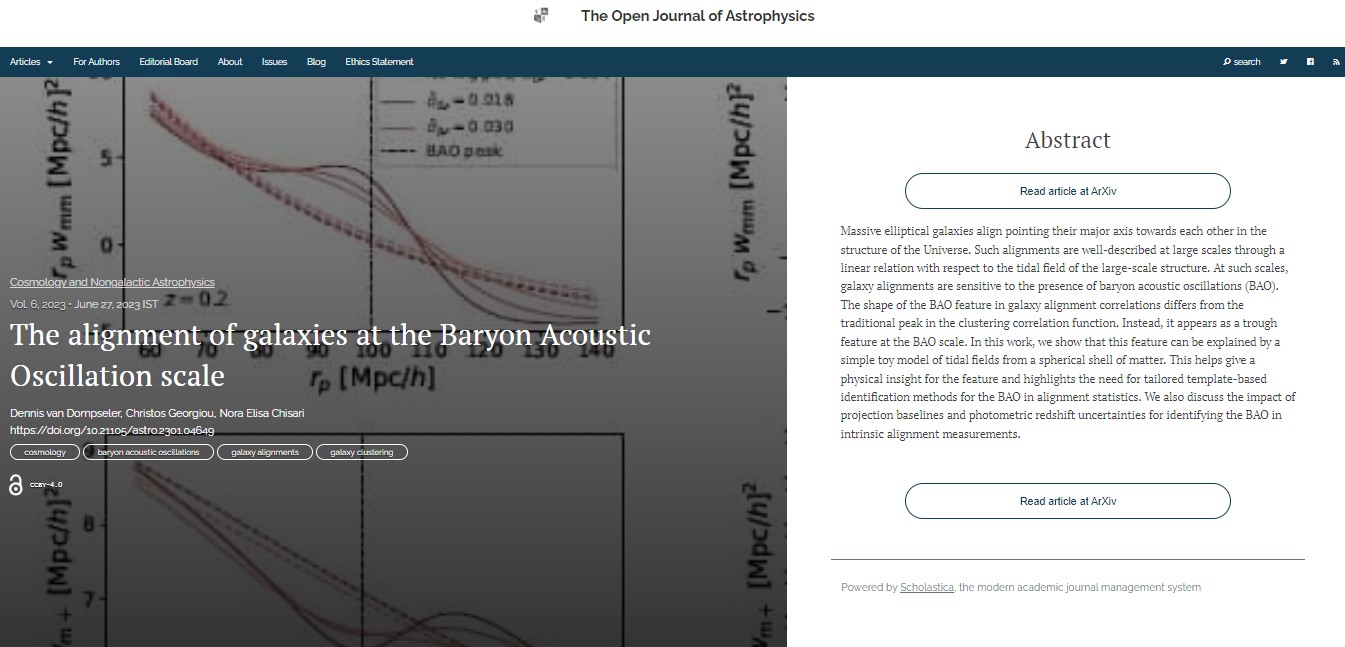
Once again the primary classification for this paper is Cosmology and Nongalactic Astrophysics. The title of this one is “The alignment of galaxies at the Baryon Acoustic Oscillation scale” by Dennis van Dompseler, Christos Georgiou & Nora Elisa Chisari all of Utrecht University, in The Netherlands.

Here is a screen grab of the overlay which includes the abstract:


You can click on the image of the overlay to make it larger should you wish to do so. You can find the officially accepted version of the paper on the arXiv here.

To Preprint or not to Preprint?

Posted in Open Access with tags , , , , on May 16, 2023 by telescoper

In my capacity as managing editor of the Open Journal of Astrophysics I’ve received a few emails recently disagreeing with our policy of asking authors to submit their papers to the arXiv before submitting them to OJAp. Before reflecting on the wider issue, let me just point out that we don’t actually require papers to on the arXiv first. It is possible to submit a PDF directly to the Scholastica platform. We do however say in our For Authors page:

We strongly encourage authors to submit in the manner described above (i.e. on the arXiv first). We can receive and review papers submitted directly to this platform but since the final version must be on the arXiv in order to be published we feel it is far better to submit it there first in order to establish that it is on an appropriate topic for this journal.

Looking back over the 81 papers we have published, only a handful were submitted directly to the platform; the vast majority were put on the arXiv first.

This behaviour is in some sense a continuation of a very old practice in astrophysics. I can’t resist sharing this, one of the interesting astronomical curiosities I’ve acquired over the years, which is a preprint of the classic work of Burbidge, Burbidge, Fowler and Hoyle in 1957 (a paper usually referred to as B2FH after the initials of its authors), which is such an important contribution to the literature that it has its own wikipedia page.

Younger readers will probably not realize that preprints were not always produced in the electronic form they are today. We all used to make large numbers of these and post them at great expense to (potentially) interested colleagues before publication in order to get comments. That was extremely useful because a paper could take over a year to be published after being refereed for a journal: that’s too long a timescale when a PhD or PDRA position is only a few years in duration. The first papers I was given to read as a new graduate student in 1985 were all preprints that were not published until well into the following year. In some cases I had more or less figured out what they were about by the time they appeared in a journal!

The B2FH paper was published in 1957 but the practice of circulating preprints persisted well into the 1990s. Usually these were produced by institutions with a distinctive design, logo, etc which gave them a professional look, which made it easier to distinguish `serious’ papers from crank material (which was also in circulation). This also suggested that some internal refereeing inside an institution had taken place before an “official” preprint was produced and this lending it an air of trustworthiness. Smaller institutions couldn’t afford all this, so were somewhat excluded from the preprint business.

With the arrival of the arXiv the practice of circulating hard copies of preprints in astrophysics gradually died out, to be replaced by ever-increasing numbers of electronic articles. The arXiv does have some gatekeeping – in the sense there are some controls on who can deposit a preprint there – but it is far easier to circulate a preprint now than it was.

It is still the case that big institutions and collaborations insist on quite strict internal refereeing before publishing a preprint – and some even insist on waiting for a paper to be accepted by a journal before adding it to the arXiv – but there’s no denying that among the wheat there is quite a lot of chaff, some of which attracts media coverage that it does not deserve. It must be admitted, however, that the same can be said of some papers that have passed peer review and appeared in high-profile journals! No system that is operated by human beings will ever be flawless, and peer review is no exception.

Nowadays, in astrophysics, the single most important point of access to scientific literature is through the arXiv, which is why the Open Journal of Astrophysics was set up as an overlay journal to provide a level of rigorous peer review for preprints, not only to provide quality control but also to improve papers through the editorial process. In fact, I think the latter is more important than the former.

On SciPost…

Posted in Maynooth, Open Access with tags , , , on April 24, 2023 by telescoper

On of my colleagues this morning passed on details of a recent publication to put on the Twitter feed of the Department of Theoretical Physics at Maynooth. As far as I’m aware this is the first paper authored by a member of the Department to be published on SciPost, a Diamond Open Access journal.

I’ve known about SciPost for quite a while, but have been preoccupied with the Open Journal of Astrophysics (OJAp) and have not tracked its progress very closely, but I’m glad to see it going well. Its business model is very different from the Open Journal of Astrophysics but its commitment to publishing high-quality scientific papers free of charge for authors and readers alike is most commendable. Looking at the physics section I see that there are quite a few highly-cited papers among them, over a wide spread of topics, including high-energy physics. There are only a few papers in Astronomy, however- only three when I looked.

I’ve heard it said that one of the advantages of SciPost is that, because it allows authors to keep the copyright on their publications, they can post articles freely on arXiv for wider distribution without embargo or other restriction. That is true and laudable. The logic of the Open Journal of Astrophysics, however, is that most astrophysicists use arXiv as their primary source of research literature, so if you’re going to read it on arXiv why not dispense with the separate journal and just use an overlay?

Not all research areas are so wedded to the arXiv, however, and it is great that there’s a free alternative. I’m a little surprised that nobody has set up a particle physics overlay journal (yet), as the HEP community seems to use arXiv a lot. When I asked a particle physicist about this they said it had been discussed, but they decided that they were happy enough with SciPost as an OA platform. Fair enough. The important thing to me is to avoid the excessive Article Processing Charges (APCs) imposed by mainstream journals for OA publishing.

I note that the HEP community has SCOAP3, which pays for articles to appear in Open Access form in traditional journals. In other words it hides the cost from the scientists and effectively subsidizes the academic publishing industry. It is important that there are alternatives to traditional journals so that authors to have a choice whether to adopt the SCOAP3 route.

One final comment. On the Finance page for SciPost it states that the estimated average cost per paper published is €400. That’s at 2019 rates. It’s probably higher now. That cost is a lot less than a typical APC but is still about a factor of ten higher than the cost per paper for OJAp. SciPost has a large network of sponsors so it can cover this cost. The overlay model used by arXiv is much cheaper to run.