Archive for arXiv

How do we make accessible research papers a reality?

Posted in Open Access with tags , , , , on March 21, 2023 by telescoper

I wanted to advertise an event – an accessibility forum – organized by arXiv that looks interesting to anyone interested in open access publishing understood in the widest possible sense. It’s advertised as a practical forum, free for all:

Hosted by arXiv, this half-day online forum will center the experiences of academic researchers with disabilities who face barriers to accessing and reading papers. The forum will be useful for people across the academic authoring and publishing ecosystem who are committed to making accessible research papers a reality. Together, we can chart a path towards fully accessible research papers, and leave with practical next steps for our own organizations.

It’s on April 17th, from 1pm to 5pm Eastern Time (USA), which is 6pm to 10pm Dublin Time. You can find more details including information on how to register, here.

We usually focus on open access publishing in terms of the costs involved, but there is much more we can do in other respects to make scientific research as accessible as possible to as wide a community as possible. Having said that, this announcement did inspire me to go off

When I saw the word “ecosystem” in the description above, it reminded me of a brief discussion I had recently with a colleague who asked what I hoped to achieve with the Open Journal of Astrophysics (other than “world domination”). My answer was that I just wanted to show that there is a practical way to bypass the enormous expense of the traditional journal industry. Instead of just sitting around complaining about the state of things I wanted to demonstrate that it doesn’t have to be the way it is. The way the number of submissions to OJAp is increasing, it seems more and more people are becoming convinced.

It seems to me that the switch from subscription charges to the dreaded Article Processing Charge has help generate momentum in this direction, by making it even more explicit that the current arrangements are unsustainable. Previously the profits of the big publishers were hidden in library budgets. Now they are hitting researchers and their grants directly, as authors now have to pay, and people who previously hadn’t thought much about the absurdity of it all are now realizing what a racket academic publishing really is.

Increasing numbers of researchers think that the current ecosystem is doomed. I am convinced that it will die a natural death soon enough. But a question I am often asked is what will replace it? I think the answer to that is very clear: a worldwide network of institutional and/or subject-based repositories that share research literature freely for the common good. Universities and research centres should simply bypass the grotesque parasite that is the publishing industry. Indeed, I would be in favour of hastening the demise of the Academic Journal Racket by having institutions make it a disciplinary offence for any researcher to pay an APC.

We’re lucky in physics and astronomy because arXiv has already done the hard work for us. Indeed, it is now a fact universally acknowledged that every research paper worth reading in these disciplines can be found on arXiv. Old-style journals are no longer necessary. It is great that arXiv is being joined by similar ventures in other fields, such as BiorXiv and EarthArxiv. I’m sure many more will follow. What is needed is a global effort to link these repositories to each other and to peer review mechanisms. One way is through overlays as demonstrated by the Open Journal of Astrophysics, there being no reason why the idea can’t be extended beyond arXiv. Other routes are possible, of course, and I would love to see different models developed. I think the next few years are going to be very exciting.

What should it mean to be an author of a scientific paper?

Posted in Open Access, The Universe and Stuff with tags , , , on February 12, 2023 by telescoper

The implementation of artificial intelligence techniques in tools for generating text (such as ChatGPT) has caused a lot of head-scratching recently as organizations try to cope with the implications. For instance, I noticed that the arXiv recently adopted a new policy on the use of generative AI in submissions. One obvious question is whether ChatGPT can be listed as an author. This has an equally obvious answer: “no”. Authors are required to acknowledge the use of such tools when they have used them in writing a paper.

One particular piece of the new policy statement caught my eye:

…by signing their name as an author of a paper, they each individually take full responsibility for all its contents, irrespective of how the contents were generated. If generative AI language tools generate inappropriate language, plagiarized content, biased content, errors, mistakes, incorrect references, or misleading content, and that output is included in scientific works, it is the responsibility of the author(s).

The first sentence of this quote states an obvious principle, but there are situations in which I don’t think it is applied in practice. One example relates to papers emanating from large collaborations or consortia, where the author lists are often very long indeed, sometimes numbering in the thousands. Not all the “authors” of such papers will have even read the paper, so do they “each individually take full responsibility”? I don’t think so. And how can this principle be enforced as policy?

All large consortia have methods for assigning authorship rights as a way of assigning credit for contributions made. But why does “credit” have to mean “authorship”? Papers just don’t have thousands of authors, in the meaningful sense of the term. It’s only ever a handful of people who actually do any writing. That doesn’t mean that the others didn’t do any work. The project would probably not have been possible without them. It does mean, however, that pretending that they participated in writing the article that describes the work isn’t be the right way to acknowledge their contribution. How are young scientists supposed to carve out a reputation if their name is always buried in immensely long author lists? The very system that attempts to give them credit at the same renders that credit worthless.

As science evolves it is extremely important that the methods for disseminating scientific results evolve too. The trouble is that they aren’t. We remain obsessed with archaic modes of publication, partly because of innate conservatism and partly because the lucrative publishing industry benefits from the status quo. The system is clearly broken, but the scientific community carries on regardless. When there are so many brilliant minds engaged in this sort of research, why are so few willing to challenge an orthodoxy that has long outlived its usefulness.

In my view the real problem is not so much the question of authorship but the very idea of the paper. It seems quite clear to me that the academic journal is an anachronism. Digital technology enables us to communicate ideas far more rapidly than in the past and allows much greater levels of interaction between researchers. The future for many fields will be defined not in terms of “papers” which purport to represent “final” research outcomes, but by living documents continuously updated in response to open scrutiny by the community of researchers. I’ve long argued that the modern academic publishing industry is not facilitating but hindering the communication of research. The arXiv has already made academic journals redundant in many of branches of  physics and astronomy; other disciplines will inevitably follow. The age of the academic journal is drawing to a close. Now to rethink the concept of “the paper”.

In the meantime I urge all scientists to remember that by signing their name as an author of a paper, they individually take full responsibility for all its contents. That means to me that at the very least you should have read the paper you’re claiming to have written.

New Publication at the Open Journal of Astrophysics

Posted in OJAp Papers, Open Access, The Universe and Stuff with tags , , , , , on February 8, 2023 by telescoper

We’re on a bit of a roll at the Open Journal of Astrophysics and it’s time to announce yet another paper. We actually published this one yesterday (7th February 2023), which makes it two in two days. I don’t think we’ll keep up that rate but we have seen a big increase in submissions recently and these are working their way through the system very nicely. We aim to publish accepted papers within a day of the revised version appearing on arXiv.

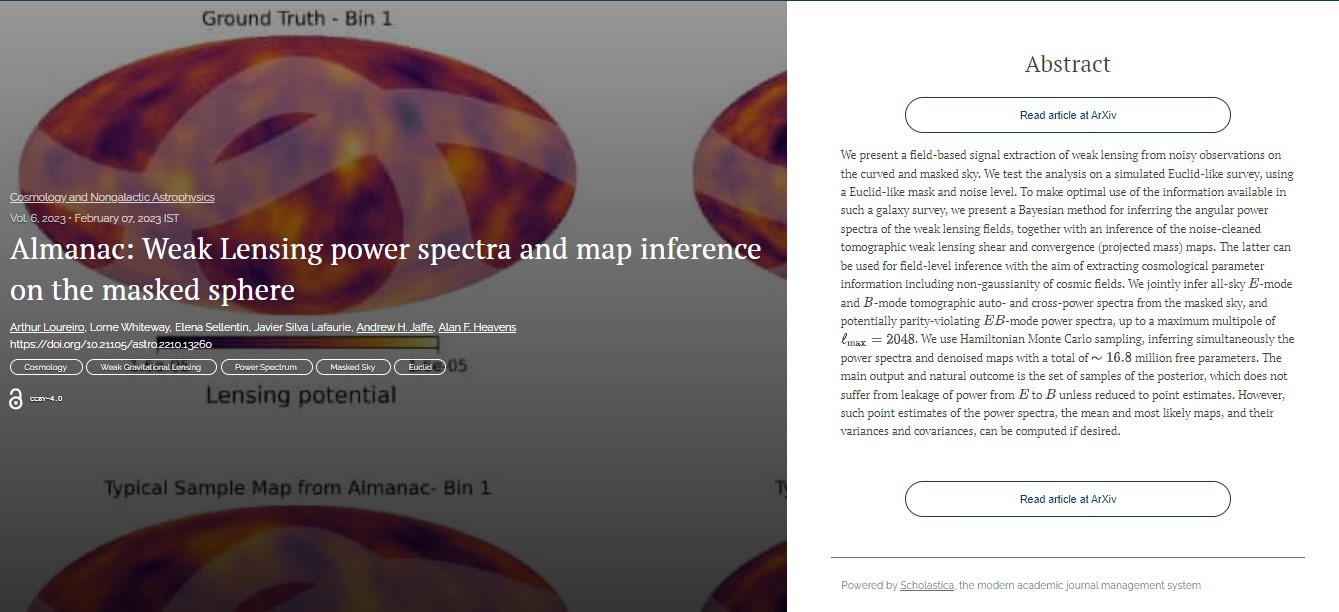
The latest paper is the 6th paper in Volume 6 (2023) as well as the 71st in all. This one is another one for the folder marked Cosmology and Nongalactic Astrophysics. The title is “Almanac: Weak Lensing power spectra and map inference on the masked sphere”. The nub of the problem addressed by this paper is that the usual statistical analysis of data presented in projection on the sky involves spherical harmonics, which are orthogonal functions on the celestial sphere, but when the sky is not completely covered (i.e. part of it is masked), these functions are not orthogonal on what remains.

The authors of this paper are Arthur Loureiro (University of Edinburgh, UK), Lorne Whiteway (University College London, UK), Elena Selentin (Leiden University, NL), Javier Silva Lafaurie (Leiden University, NL), Andrew Jaffe (Imperial College London, UK) and Alan Heavens (Imperial College London, UK)

Here is a screen grab of the overlay which includes the  abstract:


You can click on the image of the overlay to make it larger should you wish to do so. You can find the officially accepted version of the paper on the arXiv here.

Accessibility on arXiv

Posted in Education, Open Access with tags , , , , , on January 20, 2023 by telescoper

There’s an interesting paper on the arXiv that came out before Christmas, but which I’ve only just seen, about attempts to make arXiv content more accessible. Here is the abstract:

The research content hosted by arXiv is not fully accessible to everyone due to disabilities and other barriers. This matters because a significant proportion of people have reading and visual disabilities, it is important to our community that arXiv is as open as possible, and if science is to advance, we need wide and diverse participation. In addition, we have mandates to become accessible, and accessible content benefits everyone. In this paper, we will describe the accessibility problems with research, review current mitigations (and explain why they aren’t sufficient), and share the results of our user research with scientists and accessibility experts. Finally, we will present arXiv’s proposed next step towards more open science: offering HTML alongside existing PDF and TeX formats. An accessible HTML version of this paper is also available at https://info.arxiv.org/about/accessibility_research_report.html

I think this is well worth reading.

This reminds me a bit of the experiences I’ve had teaching theoretical physics to blind and partially-sighted students. Years ago this used to involve making braille copies of notes, but there are now various bits of software to help such people manage LaTeX both for creating and reading documents. In particular there are programs that can read Latex documents (including formulae and equations) which means that if a lecturer can supply LaTeX source version of their notes the student can hear them spoken out loud as well as make their own annotations/corrections. While HTML might be better for some fields, I wonder if physicists and other people in disciplines that make heavy use of mathematics might prefer to use the LaTeX source code which is already downloadable from arXiv?

I’d be interested in views on this through the comments!

ScienceCast and arXiv

Posted in Open Access with tags , , on January 15, 2023 by telescoper

Browsing the arXiv blog, as one does from time to time, I saw an item about ScienceCast and arXiv which I think is worth highlighting here. I wasn’t aware of ScienceCast before seeing the arXiv blog entry so perhaps some readers of this blog hadn’t either.

According to its own website,

ScienceCast provides a website where researchers can create explainer videos in a collaborative space and receive feedback on their work from other researchers through blog posts and chat functions. The platform also provides the ability for users to post datasets supporting the researcher’s work so that the work can be verified by reference to its data.

Although I haven’t used it, the first of these features seems very nice, allowing users to develop video explainers for science projects with feedback from collaborators. This will be of interest to people wanting to make their work a little more accessible and those, especially at the early career stage, who would like advice on video presentations. The second feature may be of less interest to astrophysicists, who already have platforms for sharing data and whose data sets are often very large, but it might work for smaller examples.

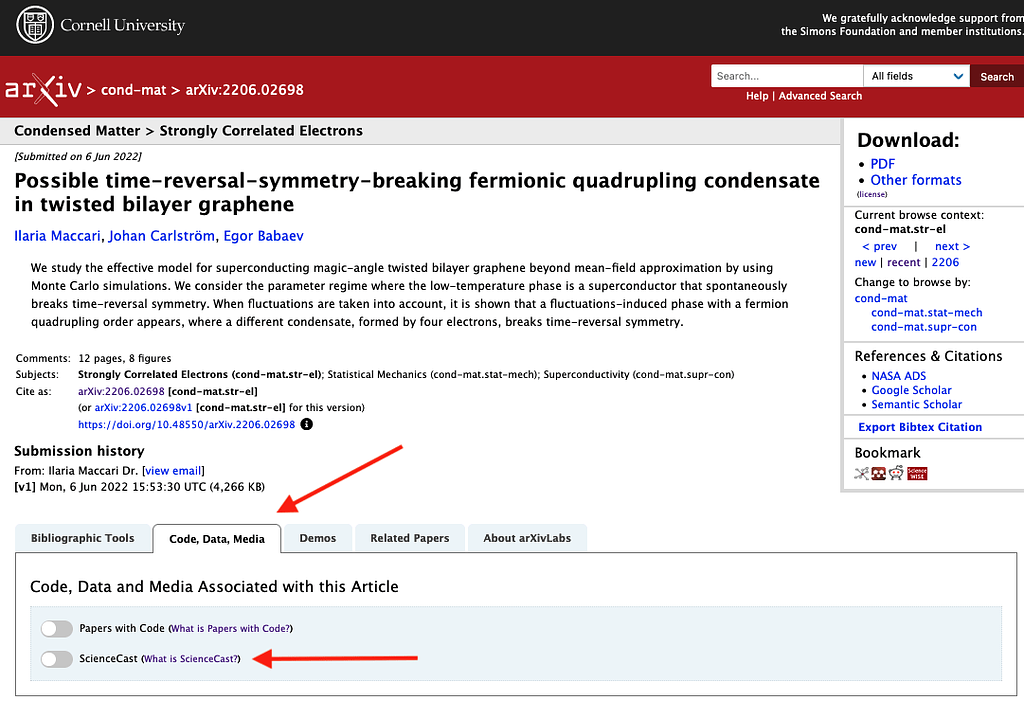
Anyway, the new feature from arXivLabs that the arXiv blog post is about allows users to include ScienceCast material directly on the arXiv. Here’s how it looks:

Activating the ScienceCast feature using the slider allows one to see any content there directly on arXiv. Which is nice. I’ll be interested to see what the uptake is like. I may even play around with it myself, although that will have to wait until I’ve finished marking examinations…

Say hello to ar5iv!

Posted in Open Access with tags , , , on February 16, 2022 by telescoper

Yesterday I stumbled across a new thing which I think is very cool.

Usually if you want to read a paper posted on arXiv you have to view, e.g. a PDF file. Now someone has set up a facility to view every article as a modern HTML5 page. To use this function you just need to change the “X” in the link to an arXiv paper to a “5” and you can view the whole paper, equations and all, in your browser as a web page.

You can check this out using a recent paper from the Open Journal of Astrophysics:

Here is the standard arXiv link to the paper:

https://arxiv.org/abs/2107.05639v2

Now try looking at

https://ar5iv.org/abs/2107.05639v2

I have found a few conversion errors using this facility but I assume these can be ironed out in due course. Now I have to persuade Scholastica to let us link to the ar5iv versions of OJAp papers (although I think the plan is to integrate ar5iv with arXiv at some point).

Happy 30th Birthday to the arXiv!

Posted in Biographical, Open Access, The Universe and Stuff with tags , , , on August 14, 2021 by telescoper

I was reminded yesterday that today, 14th August, is the 30th anniversary of the start of the arXiv so I thought I’d send a quick birthday greeting to mark the occasion. In case you weren’t aware, arXiv is a free distribution service and an open-access archive containing (currently) 1,928,825 scholarly articles in the fields of physics, mathematics, computer science, quantitative biology, quantitative finance, statistics, electrical engineering and systems science, and economics.

There was a precursor to the arXiv in the form of an email distribution list for preprints, but arXiv proper started on 14th August 1991. It was based at Los Alamos National Laboratory (LANL) with a mirror site in SISSA (Trieste) that was used by those of us in Europe. In the beginning, arXiv was quite a small-scale thing and it wasn’t that easy to upload full papers including figures. In fact the SISSA system was run from a single IBM 386 PC (called “Babbage”). As it expanded, the running of arXiv was taken over Cornell University. You can read more about the history here.

You have to remember that journals didn’t generally have electronic submission in those days: you had to send paper manuscripts in the post to the Editorial office. Likewise many of us carried on sending out paper preprints for some time after the arXiv was set up. Younger researchers should be grateful they don’t have to put up with the absolute chore of producing papers the old-fashioned way!

The astrophysics section of arXiv (“astro-ph”) started in April 1992. Although astrophysicists generally were quick to latch on to this new method of distributing preprints, it took me a little time to get onto arXiv: my first papers did not appear there until February 1993; my first publication was in 1986 so there are quite a few of my early papers that aren’t on arXiv at all. In 1993 I was working at Queen Mary & Westfield College (as it was then called). I was working a lot with collaborators based in Italy at the time and they decided to start posting our joint papers on arXiv. Without that impetus it would have taken me much longer to get to grips with it.

In case you’re interested, my first paper to appear on the arXiv was this one on 23rd February 1993 but it was followed a day later by two others, this one and that one. I don’t remember very well, but this was an exercise in catching up and all three of those papers were actually published in journals before we put them on arXiv. It was only later that we got into the habit of posting papers on arXiv at the same time as submitting to a journal, which I think is the best way to do it!

The Open Journal of Astrophysics would not have been possible without the arXiv but in a wider sense the astrophysics community has a very great deal to thank the arXiv for, but remember that it is funded by donations and is run on a shoestring. If you agree that it’s a tremendously useful asset for your research then please consider making a donation.

Catching up on Cosmic Dawn

Posted in The Universe and Stuff with tags , , , , , on June 25, 2021 by telescoper

Trying to catch up on cosmological news after a busy week I came across a number of pieces in the media about “Cosmic Dawn” (e.g. here in The Grauniad). I’ve never actually met Cosmic Dawn but she seems like an interesting lady.

But seriously folks, Cosmic Dawn refers to the epoch during which the first stars formed in the expanding Universe lighting up the Universe after a few hundred million years of post-recombination darkness.

According to the Guardian article mentioned above the new results being discussed are published in Monthly Notices of the Royal Astronomical Society but they’re actually not. Yet. Nevertheless the paper (by Laporte et al.) is available on the arXiv which is where people will actually read it…

Anyway, here is the abstract:

Here is a composite of HST and ALMA images for one of the objects discussed in the paper (MACS0416-JD):

I know it looks a bit blobby but it’s not easy to resolve things at such huge distances! Also, it’s quite small because it’s far away. In any case the spectroscopy is really the important thing, not the images, as that is what determines the redshift. The Universe has expanded by a factor 10 since light set out towards us from an object at redshift 9. I’m old enough to remember when “high redshift” meant z~0.1!

At the end of my talk on Wednesday Floyd Stecker asked me about what the James Webb Space Telescope (due for launch later this year) would do for cosmology and I replied that it would probably do a lot more for galaxy formation and evolution than cosmology per se. I think this is a good illustration of what I meant. Because of its infrared capability JWST will allow astronomers to push back even further and learn even more about how the first stars formed, but it won’t tell us much directly about dark matter and dark energy.

Thirty Years of Preprints

Posted in Open Access with tags , , , , on February 21, 2021 by telescoper

I thought I’d share an interesting paper (by Xie, Shen & Wang) that I found on the arXiv with the title Is preprint the future of science? A thirty year journey of online preprint services. The abstract reads:

Preprint is a version of a scientific paper that is publicly distributed preceding formal peer review. Since the launch of arXiv in 1991, preprints have been increasingly distributed over the Internet as opposed to paper copies. It allows open online access to disseminate the original research within a few days, often at a very low operating cost. This work overviews how preprint has been evolving and impacting the research community over the past thirty years alongside the growth of the Web. In this work, we first report that the number of preprints has exponentially increased 63 times in 30 years, although it only accounts for 4% of research articles. Second, we quantify the benefits that preprints bring to authors: preprints reach an audience 14 months earlier on average and associate with five times more citations compared with a non-preprint counterpart. Last, to address the quality concern of preprints, we discover that 41% of preprints are ultimately published at a peer-reviewed destination, and the published venues are as influential as papers without a preprint version. Additionally, we discuss the unprecedented role of preprints in communicating the latest research data during recent public health emergencies. In conclusion, we provide quantitative evidence to unveil the positive impact of preprints on individual researchers and the community. Preprints make scholarly communication more efficient by disseminating scientific discoveries more rapidly and widely with the aid of Web technologies. The measurements we present in this study can help researchers and policymakers make informed decisions about how to effectively use and responsibly embrace a preprint culture.

The paper makes a number of good arguments, backed up with evidence, as to why preprints are a good idea. I recommend reading it.

Here is Figure 1 from the paper:

(Parts of the chart are difficult to read, so see the paper for details).

This shows that about 50% of all preprints are in the areas of physics and mathematics and their distribution mode is predominantly through the arXiv. Other scientific disciplines have much lower prevalence of preprints, e.g. biology. I’ve been putting my papers on arXiv since the early Nineties, i.e. for most of the duration of the period covered by the paper. I don’t know why other fields are so backward.

It’s standard practice in my own field of astrophysics to put preprints of articles on the arXiv but younger readers will probably not realize that preprints were not always produced in the electronic form they are today. We all used to make large numbers of these and post them at great expense to (potentially) interested colleagues before publication in order to get comments. That was extremely useful because a paper could take over a year to be published after being refereed for a journal: that’s too long a timescale when a PhD or PDRA position is only a few years in duration. The first papers I was given to read as a new graduate student in 1985 were all preprints that were not published until well into the following year. In some cases I had more or less figured out what they were about by the time they appeared in a journal!

The practice of circulating preprints persisted well into the 1990s. Usually these were produced by institutions with a distinctive design, logo, etc which gave them a professional look, which made it easier to distinguish `serious’ papers from crank material (which was also in circulation). This also suggested that some internal refereeing inside an institution had taken place before an “official” preprint was produced and this lending it an air of trustworthiness. Smaller institutions couldn’t afford all this, so were somewhat excluded from the preprint business.

With the arrival of the arXiv the practice of circulating hard copies of preprints in astrophysics gradually died out, to be replaced by ever-increasing numbers of electronic articles. The arXiv does have some gatekeeping – in the sense there are some controls on who can deposit a preprint there – but it is definitely far easier to circulate a preprint now than it was.

It is still the case that big institutions and collaborations insist on quite strict internal refereeing before publishing a preprint – and some even insist on waiting for a paper to be accepted by a journal before adding it to the arXiv – but there’s no denying that among the wheat there is quite a lot of chaff, some of which attracts media coverage that it does not deserve. It must be admitted, however, that the same can be said of some papers that have passed peer review and appeared in high-profile journals! No system that is operated by human beings will ever be flawless, and peer review is no different.

Nowadays, in astrophysics, the single most important point of access to scientific literature is through the arXiv, which is why the Open Journal of Astrophysics was set up as an overlay journal to provide a level of rigorous peer review for preprints, not only to provide a sort of quality mark but also to improve the paper through the editorial process.

So is the preprint the future of science? I think that depends on how far ahead you are willing to look. In my opinion we are currently in an era of transition trying to shoehorn old publishing practices into a digital world. At some point in the future people will realize that the scientific paper itself – whether a preprint or not – is an outmoded 18th Century concept and there are far more effective ways of disseminating scientific ideas and information at our fingertips if only we stopped living in the past.

Two X One Y

Posted in Film, The Universe and Stuff with tags , , on August 22, 2020 by telescoper

I found out yesterday that the title of the above paper (on arXiv here) has been causing a bit of a scandal in the astrophysics community.

When I saw the title I was baffled as to why it could cause offence. Then I was told that it was a reference to pornography. I still didn’t understand at all. Then I was told the title of the film to which it is alleged to refer: Two Girls One Cup. I had never heard of it until yesterday and wish I hadn’t because it’s so gross. It is so notorious that it even has a Wikipedia page describing it and reactions to it. Don’t click if you’re easily disgusted. I am fairly broad-minded but I found it entirely disgusting.

I’m told that the film generated a large number of derogatory and misogynistic memes circulated on social media but they all passed me by too. I must be too old.

But even knowing about the film I still don’t see the paper’s title as a reference to it. Had it been an attempt to be a pun then I would have got it, but I don’t think it is. “Flares” and “shock” don’t rhyme with or sound anything like “girls” and “cup”. If it was meant as a pun it’s a failure on two counts. Is every phrase of the form “Two X One Y” now a reference to scat porn?

If anything I would interpret the title as a reference to the idiomatic expression “to kill two birds with one stone”. Or it could just be a reference to the fact that the paper is about two flares associated with one shock.

Regardless of my opinions, though, if this combination of words has caused offence – whether intentionally or not – then it is not a big deal to change the title and that’s what should be done. I’d suggest that simply inserting “with” or “from” would do the trick.

The comments I saw on Twitter yesterday basically divide into those like me who didn’t get the alleged reference at all and those who were appalled. The latter were almost exclusively younger people based in America (who are more likely to have been exposed to the film) . The authors of the paper are predominantly based outside the USA and in my view it would be a mistake to assume they all share the same cultural experience as a particular demographic of the United States. I think it would be very unfair to jump to the conclusion that the reference is deliberate.

I’m genuinely interested to see what people think about this title. I realise I have spoilt this by giving the background, but here’s a poll. Please answer by giving your initial reaction.

Update: the title has been changed, as I suggested…