Archive for arXiv

Is there a kinematic backreaction in cosmology?

Posted in The Universe and Stuff with tags , , , , , on March 28, 2017 by telescoper

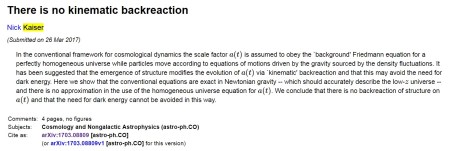
I just noticed that a paper has appeared on the arXiv with the confident title There is no kinematic backreaction. Normally one can be skeptical about such bold claims, but this one is written by Nick Kaiser and he’s very rarely wrong…

The article has a very clear abstract:

Kaiser

This is an important point of debate, because the inference that the universe is dominated by dark energy (i.e. some component of the cosmic energy density that violates the strong energy condition) relies on the assumption that the distribution of matter is homogeneous and isotropic (i.e. that the Universe obeys the Cosmological Principle). Added to the assumption that the large-scale dynamics of the Universe are described by the general theory of relativity, this means that we evolution of the cosmos is described by the Friedmann equations. It is by comparison with the Friedmann equations that we can infer the existence of dark energy from the apparent change in the cosmic expansion rate over time.

But the Cosmological Principle can only be true in an approximate sense, on very large scales, as the universe does contain galaxies, clusters and superclusters. It has been a topic of some discussion over the past few years as to whether the formation of cosmic structure may influence the expansion rate by requiring extra terms that do not appear in the Friedmann equations.

Nick Kaiser says `no’. It’s a succinct and nicely argued paper but it is entirely Newtonian. It seems to me that if you accept that his argument is correct then the only way you can maintain that backreaction can be significant is by asserting that it is something intrinsically relativistic that is not covered by a Newtonian argument. Since all the relevant velocities are much less than that of light and the metric perturbations generated by density perturbations are small (~10-5) this seems a hard case to argue.

I’d be interested in receiving backreactions to this paper via the comments box below.

Sinister Moves by Elsevier

Posted in Open Access with tags , , , , on May 18, 2016 by telescoper

I’ve been away at yet another Awayday today so only have time for a brief post before I go home and vegetate. I felt obliged, however, to draw the attention of my readership to the fact that there’s something sinister afoot in the world of academic publishing. It seems that the notoriously exploitative academic publishing company Elsevier has acquired the Social Science Research Network (SSRN), which is  the leading social science and humanities repository and online community. The SSRN currently allows readers free access more than 500,000 academic papers for free but that is highly likely to change under Elsevier whose previous practice has always been to squeeze the academic community for every penny it can get. In particular, Elsevier has a reputation for cracking down on academic papers for which it owns licences, so these recent acquisitions look like very bad news.

The Chairman of SSRN is  trying to present this as a positive move:

SSRN announced today that it has changed ownership. SSRN is joining Mendeley and Elsevier to coordinate our development and delivery of new products and services, and we look forward to our new access to data, products, and additional resources that this change facilitates.

Like SSRN, Mendeley and Elsevier are focused on creating tools that enhance researcher workflow and productivity. SSRN has been at the forefront of on-line sharing of working papers. We are committed to continue our innovation and this change will enable that to happen more quickly. SSRN will benefit from access to the vast new data and resources available, including Mendeley’s reference management and personal library management tools, their new researcher profile capabilities, and social networking features. Importantly, we will also have new access for SSRN members to authoritative performance measurement tools such as those powered by Scopus and Newsflo (a global media tracking tool). In addition, SSRN, Mendeley and Elsevier together can cooperatively build bridges to close the divide between the previously separate worlds and workflows of working papers and published papers.

We realize that this change may create some concerns about the intentions of a legacy publisher acquiring an open-access working paper repository. I shared this concern. But after much discussion about this matter and others in determining if Mendeley and Elsevier would be a good home for SSRN, I am convinced that they would be good stewards of our mission. And our copyright policies are not in conflict — our policy has always been to host only papers that do not infringe on copyrights. I expect we will have some conflicts as we align our interests, but I believe those will be surmountable.

Until recently I was convinced that the SSRN community was best served being a stand-alone entity. But in evaluating our future in the evolving landscape, I came to believe that SSRN would benefit from being more interconnected and with the resources available from a larger organization. For example, there is scale in systems administration and security, and SSRN can provide more value to users with access to more data and resources.

On a personal note, it has been an honor to be involved over the past 25 years in the founding and growth of the SSRN website and the incredible community of authors, researchers and institutions that has made this all possible. I consider it one of my great accomplishments in life. The community would not have been successful without the commitment of so many of you who have contributed in so many ways. I am proud of the community we have created, and I invite you to continue your involvement and support in this effort.

The staff at SSRN are all staying (including Gregg Gordon, CEO and myself), the Rochester office is still in place, it will still be free to upload and download papers, and we remain committed to “Tomorrow’s Research Today”. I look forward to and am committed to a successful transition and to another great 25 years for the SSRN community that rivals the first.

Michael C. Jensen
Founder & Chairman, SSRN

It sounds like they made him an offer he couldn’t refuse…

I don’t think Elsevier’s involvement in this is likely to prove beneficial to anything other than their own profits. Elsevier is one of the biggest problems in academic publishing and can  never be part of the solution.

My main concern, however,  is  that some day Elsevier might launch a hostile takeover bid for the arXiv, which would be a major setback to the physics community’s efforts to promote the free exchange of scientific papers. That must be resisted at all costs. How did the academic community allow its publishing culture to be hijacked by such companies?


Want to use the Open Journal of Astrophysics? Get an Orcid ID!

Posted in Open Access with tags , , , , on November 23, 2015 by telescoper

We’re getting ready to launch the Open Journal of Astrophysics site so for all the folks out there who are busy preparing to submit papers let me just give you advanced warning how it works. The website is currently being tested with real submissions, but these have so far been canvassed from the Editorial Board for testing purposes: the journal is not yet available for general submission, and the site is not yet public. Once we’re sure everything is fully functional we will open up.

Anyway, in order to submit a paper you will need to obtain an ORCID ID. In a nutshell this is a unique identifier that makes it much easier to keep track of researchers than via names, email address or whatever. It can be used for many other things other than the Open Journal project so it’s a good thing to do in itself.

You can register for an ID here. It only takes seconds to do it, so do it now! You can find out more about ORCID here. When you have your ORCID ID you can log into our Open Journal website to submit a paper.

The Open Journal is built on top of the arXiv which means that all papers submitted to the Open Journal must be submitted to the arXiv first. This in turns means is that you must also be registered as a “trustworthy” person to submit there. You can read about how to do that here. When you have succeeded in submitting your paper to the arXiv you can proceed to submit it to the Open Journal.

As an aside, we do have a Latex template for The Open Journal, but you can for the time being submit papers in any style as long as the resulting PDF file is readable.

To submit a paper to be refereed by The Open Journal all you need to do is type in its arXiv ID and the paper will be imported into the Open Journal. The refereeing process is very interactive – you’ll like it a lot – and when it’s completed the paper will be published, assigned a Digital Object Identifier (DOI) and will be entered into the CrossRef system for the purpose of gathering citations and other bibliometric data.

We will be issuing a general call for submissions very soon, at which point we will also be publishing general guidance in the form of an FAQ, which includes information about copyright etc. In the meantime, all you need to do is get your ORCID ID and get your papers on the arXiv!

Fourier-transforming the Universe

Posted in The Universe and Stuff with tags , , , on November 20, 2015 by telescoper

Following the little post I did on Tuesday in reaction to a nice paper on the arXiv by Pontzen et al., my attention was drawn today to another paper e related to the comment I made about using Fourier phases as a diagnostic of pattern morphology. The abstract of this one, by Way et al., is as follows:

We compute the complex 3D Fourier transform of the spatial galaxy distribution in a volume-limited sample of the Sloan Digital Sky Survey redshift survey. The direct unbinned transform yields results quite similar to those from the Fast Fourier Transform (FFT) of finely binned galaxy positions. In both cases deconvolution of the sampling window function yields estimates of the true 3D transform. The Fourier amplitudes resulting from this simple procedure yield power spectrum estimates consistent with those from other much more complicated approaches. We demonstrate how the corresponding Fourier phase spectrum lays out a simple and complete characterization of non-Gaussianity that is more easily interpretable than the tangled, incomplete multi-point methods conventionally used. Measurements based on the complex Fourier transform indicate departures from exact homogeneity and isotropy at the level of 1% or less. Our model-independent analysis avoids statistical interpretations, which have no meaning without detailed assumptions about a hypothetical process generating the initial cosmic density fluctuations.

It’s obviously an excellent piece of work because it cites a lot of my papers!

But seriously I think it’s very exciting that we now have data sets of sufficient size and quality to allow us to go beyond the relatively crude statistical description provided by the power spectrum.


Discrete Analysis — an arXiv overlay journal

Posted in Open Access with tags on September 11, 2015 by telescoper

Good to see this experiment getting under way. Announcements about a similar (though not identical) initiative for Astrophysics and Cosmology (currently under beta testing) will appear shortly…

gowers's avatarGowers's Weblog

This post is to announce the start of a new mathematics journal, to be called Discrete Analysis. While in most respects it will be just like any other journal, it will be unusual in one important way: it will be purely an arXiv overlay journal. That is, rather than publishing, or even electronically hosting, papers, it will consist of a list of links to arXiv preprints. Other than that, the journal will be entirely conventional: authors will submit links to arXiv preprints, and then the editors of the journal will find referees, using their quick opinions and more detailed reports in the usual way in order to decide which papers will be accepted.

Part of the motivation for starting the journal is, of course, to challenge existing models of academic publishing and to contribute in a small way to creating an alternative and much cheaper system. However, I hope that…

View original post 2,383 more words

The Physics Of Nonconformity: Why Difference Always Looks The Same

Posted in Beards, The Universe and Stuff with tags , , , , on November 17, 2014 by telescoper

I came across an interesting paper while I was in an unblogging state last week so thought I’d share it here. Have you ever wondered why non-conformists always seem to look the same? I was struck by this last year when I saw a group of self-styled “anarchists” – of which there are many in Brighton – gathering ahead of a demonstration against something or other, or possibly nothing at all. Anyway they all struck rigidly to a particular dress code, a fact which I found amusing given their professed preference for a state of disorder. The same seems to be the case in other contexts too. A striking current example is  the fad for the “hipster” beard, but wherever you look you will find a group of people who express their desire to be different by looking exactly the same as each other.  It seems people always want to conform in some way. Perhaps we should call this conformal invariance?

Anyway, the paper investigates this – in a slightly tonggue-in-cheek manner – from the point of view of statistical physics using an approach similar to that used to study the phenomenon of the spin glass. Here is the abstract:

In such different domains as statistical physics and spin glasses, neurosciences, social science, economics and finance, large ensemble of interacting individuals taking their decisions either in accordance (mainstream) or against (hipsters) the majority are ubiquitous. Yet, trying hard to be different often ends up in hipsters consistently taking the same decisions, in other words all looking alike. We resolve this apparent paradox studying a canonical model of statistical physics, enriched by incorporating the delays necessary for information to be communicated. We show a generic phase transition in the system: when hipsters are too slow in detecting the trends, they will keep making the same choices and therefore remain correlated as time goes by, while their trend evolves in time as a periodic function. This is true as long as the majority of the population is made of hipsters. Otherwise, hipsters will be, again, largely aligned, towards a constant direction which is imposed by the mainstream choices. Beyond the choice of the best suit to wear this winter, this study may have important implications in understanding dynamics of inhibitory networks of the brain or investment strategies finance, or the understanding of emergent dynamics in social science, domains in which delays of communication and the geometry of the systems are prominent.

Comments through the usual channel please!


Planck versus BICEP2: Round One!

Posted in The Universe and Stuff with tags , , , , , , , on May 6, 2014 by telescoper

You may recall my scepticism about the recent announcement from the BICEP2 experiment about evidence from polarized microwave emission for the existence of primordial gravitational waves generated during a period of cosmic inflation.

Well, in between a couple of meetings this morning, I realised that there’s a paper just out onto the arXiv from the Planck Collaboration. Here’s the abstract:

This paper presents the large-scale polarized sky as seen by Planck HFI at 353 GHz, which is the most sensitive Planck channel for dust polarization. We construct and analyse large-scale maps of dust polarization fraction and polarization direction, while taking account of noise bias and possible systematic effects. We find that the maximum observed dust polarization fraction is high (pmax > 18%), in particular in some of the intermediate dust column density (AV < 1mag) regions. There is a systematic decrease in the dust polarization fraction with increasing dust column density, and we interpret the features of this correlation in light of both radiative grain alignment predictions and fluctuations in the magnetic field orientation. We also characterize the spatial structure of the polarization angle using the angle dispersion function and find that, in nearby fields at intermediate latitudes, the polarization angle is ordered over extended areas that are separated by filamentary structures, which appear as interfaces where the magnetic field sky projection rotates abruptly without apparent variations in the dust column density. The polarization fraction is found to be anti-correlated with the dispersion of the polarization angle, implying that the variations are likely due to fluctuations in the 3D magnetic field orientation along the line of sight sampling the diffuse interstellar medium. We also compare the dust emission with the polarized synchrotron emission measured with the Planck LFI, with low-frequency radio data, and with Faraday rotation measurements of extragalactic sources. The two polarized components are globally similar in structure along the plane and notably in the Fan and North Polar Spur regions. A detailed comparison of these three tracers shows, however, that dust and cosmic rays generally sample different parts of the line of sight and confirms that much of the variation observed in the Planck data is due to the 3D structure of the magnetic field.

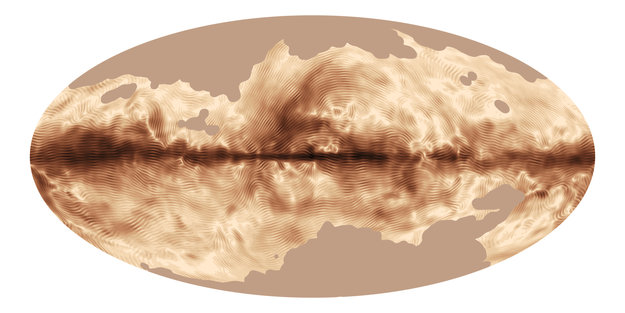
There’s also a press release from the European Space Agency which includes this nice picture:

Milky_Way_s_magnetic_fingerprint_large

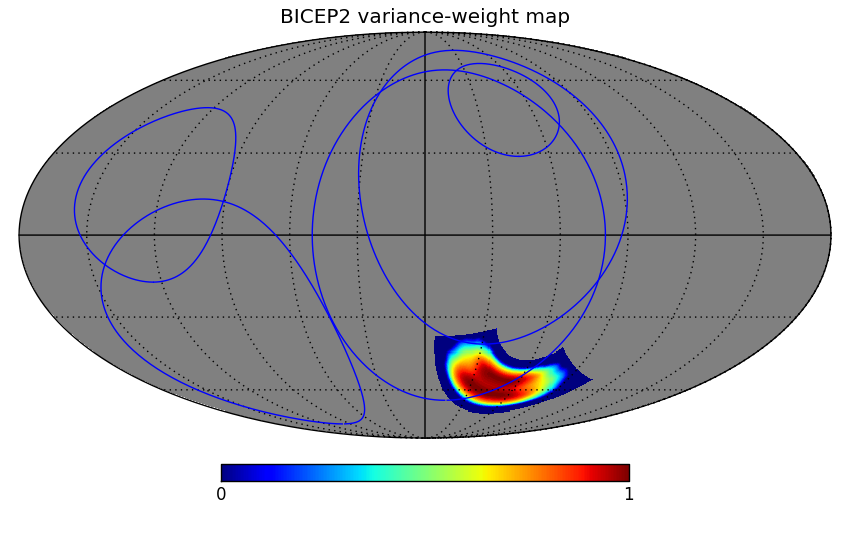
This study is at 353 GHz, compared to the 150 GHz of the BICEP2 measurements. Galactic dust emission increases with frequency so one would expect more of an effect in this Planck map than in BICEP2, but the fact that polarized foreground emission is so strong at these frequencies does give one pause for thought. The Planck data actually cover the whole sky, so the above map has clearly been censored; below you can see the actual region of the sky covered by BICEP2, so there is little or no direct overlap with what’s been released by Planck:

bicep2_loops

We’ll have to wait until later this year to see what’s going on in the masked regions (i.e. far above and below the Galactic Plane, where the dust emission is presumably weaker) and indeed at the 7 other frequencies measured by Planck. It’s all a bit of a tease so far!

Here’s what the press release says about BICEP2

In March 2014, scientists from the BICEP2 collaboration claimed the first detection of such a signal in data collected using a ground-based telescope observing a patch of the sky at a single microwave frequency. Critically, the claim relies on the assumption that foreground polarised emissions are almost negligible in this region.

Later this year, scientists from the Planck collaboration will release data based on Planck’s observations of polarised light covering the entire sky at seven different frequencies. The multiple frequency data should allow astronomers to separate with great confidence any possible foreground contamination from the tenuous primordial polarised signal.

P.S.  It’s gratifying to see the Planck Collaboration have used extragalactic Faraday Rotation measures to probe the Galactic Magnetic field as I suggested on this blog not long ago. The article that first advocated doing this with CMB maps can be found here.


Ode to SnarXiv

Posted in The Universe and Stuff with tags , , , , on April 30, 2014 by telescoper

So many things pass me by these days that I’m not usually surprised when I have no idea what people around me are talking about. I am however quite surprised that, until yesterday, never heard of the snarXiv. As its author explains:

The snarXiv is a ran­dom high-energy the­ory paper gen­er­a­tor incor­po­rat­ing all the lat­est trends, entropic rea­son­ing, and excit­ing mod­uli spaces. The arXiv is sim­i­lar, but occa­sion­ally less ran­dom.

The snarXiv uses “Context Free Grammar” together with a database of stock words and phrases to generate its content, which is actually just limited to titles and abstracts rather than entire papers. It’s just a matter of time, though. The results are variable, with some making no sense at all even by the standards of theoretical particle physics, but the best are almost good enough to pass off as real abstracts.

Here’s an example in the form of the abstract of a paper called (P,q) Brane Probe Predicted From Conformal Blocks:

Recently, work on new inflation has opened up a perturbative class of braneworld matrix models. We make contact with observables, moreover investigating trivial Beckenstein-Boltzmann equations. Next, using the behavior of a left-right reduction of models of WIMPs, we reformulate instanton liquids at the LHC. After discussing positrons, we check that worldsheet symmetric central charges are equivalent to electric-duality in gravity. Finally, we make contact with a special lagrangian brane, surprisingly obtaining models of inertial fluctuations.

Why not have a go at arXiv versus SnarXiv to see if you can spot the genuine article titles?

I’m tempted, with a nod in the light of the Sokal Affair, to suggest that a similar approach used in the social sciences, but the thing that really struck me is that someone should do a snarXiv for astronomy and astrophysics. Or is someone going to tell me it already exists?

Come to think of it, judging by some of the proposals I’ve read while serving on the Astronomy Grants Panel over the years, a similar generator may already exist for writing grant applications…

Inflationary Opinion Poll

Posted in The Universe and Stuff with tags , , , , , on February 28, 2014 by telescoper

Compare and contrast this abstract of a paper on the arXiv from Guth et al. from last year:

Models of cosmic inflation posit an early phase of accelerated expansion of the universe, driven by the dynamics of one or more scalar fields in curved spacetime. Though detailed assumptions about fields and couplings vary across models, inflation makes specific, quantitative predictions for several observable quantities, such as the flatness parameter (Ωk=1−Ω) and the spectral tilt of primordial curvature perturbations (ns−1=dlnPR/dlnk), among others—predictions that match the latest observations from the Planck satellite to very good precision. In the light of data from Planck  as well as recent theoretical developments in the study of eternal inflation and the multiverse, we address recent criticisms of inflation by Ijjas, Steinhardt, and Loeb. We argue that their conclusions rest on several problematic assumptions, and we conclude that cosmic inflation is on a stronger footing than ever before.

and this one, just out,  by Ijjas et al.:

Classic inflation, the theory described in textbooks, is based on the idea that, beginning from typical initial conditions and assuming a simple inflaton potential with a minimum of fine-tuning, inflation can create exponentially large volumes of space that are generically homogeneous, isotropic and flat, with nearly scale-invariant spectra of density and gravitational wave fluctuations that are adiabatic, Gaussian and have generic predictable properties. In a recent paper, we showed that, in addition to having certain conceptual problems known for decades, classic inflation is for the first time also disfavored by data, specifically the most recent data from WMAP, ACT and Planck2013. Guth, Kaiser and Nomura and Linde have each recently published critiques of our paper, but, as made clear here, we all agree about one thing: the problematic state of classic inflation. Instead, they describe an alternative inflationary paradigm that revises the assumptions and goals of inflation, and perhaps of science generally.

I’m not sure how much of a “schism” (to use Ijjas et al.’s word) there actually is, but it seems like an appropriate subject for a totally unscientific Friday lunchtime opinion poll:

Open Access Repositories should be based on Subject, not Institution

Posted in Open Access with tags , , , , on September 18, 2013 by telescoper

Just when we thought that the powers that be might be starting to see the light on Open Access, round comes another circular from the Higher Education Funding Council for England (HEFCE) that shows that policymakers have an unlimited ability to get things wrong at the most basic level.

The document concerned opens a “Consultation on open access in the post-2014 Research Excellence Framework” by putting forward a number of proposals.

Now it’s depressing enough that the entire document is predicated on the assumption that there will be another Research Excellence Framework, perhaps in 2020. The current REF is such a disaster that one might have hoped somebody up there would have decided that enough is enough. But then we thought that about Research Assessment Exercise in 2008. Even the most pessimistic of us hope that the REF would have a “lighter touch” than the RAE, but as it has turned out it’s many times worse both in the time it has taken to prepare submissions and the ridiculous game-playing and dodgy employment practices that it has encouraged among participation institutions.

I hope there’s still time to drive a stake through the heart of the runaway bureaucracy that keeps imposing this idiocies on us. After all, a new Chief Executive about to take over at HEFCE. Perhaps a new broom will be wielded? I hope against hope.

However, setting all that to one side, I had a look at the proposals for Open Access after 2014 contained in the document. Here is the summary of the proposals:

HEFCE

Aarrgh!

Why on Earth should the proposals favour national institutional repositories over international subject-based ones? A shining example of the latter is the arXiv which has, for Physics and Astronomy, become the basic resource for researchers around the world; it’s a one-stop shop at which one can access research from all around the world. By contrast, having work in the same field stored over a plethora of institutional repositories will serve no useful purpose at all, because UK research will not  treated in the same way as work from other countries and in any case individual repositoes will lead to an absurd level of duplication of infrastructure and other resources. This requirement is particularly indefensible in Physics and Astronomy, as it would require us to duplicate in (probably inferior) institutional repositories what we already do with the arXiv.

The UK Funding Councils need realize that the solution to many of the challenges of Open Access has already been found. In fact, the European Research Council seems to have acknowledged this and is now directly funding the arXiv. The UK Research Councils should be required to construct similar archives for their disciplines. That shouldn’t be difficult, because all the hard work has already been done. There is a working model.

I’ll be responding to the consultation document in no uncertain terms. The Royal Astronomical Society is also collating responses for a collective submission. We have to resist these, and other proposals such as another REF, which are being foisted on us by people who have no idea what they’re doing and no idea what damage they’re causing.