It’s time once more for another Saturday update of activity at the Open Journal of Astrophysics. Since the last update we have published a further seven papers, bringing the number in Volume 9 (2026) to 202 and the total so far published by OJAp up to 649. This means that the total in Vol. 9 (2026) has now passed that of Vol. 8 (2025), with more than three months to go.
I continue to include the posts made on our Mastodon account (on Fediscience); these announcements also contain a clickable form of the DOI for each paper. Our Mastodon account has regular updates and other announcements from OJAp too.
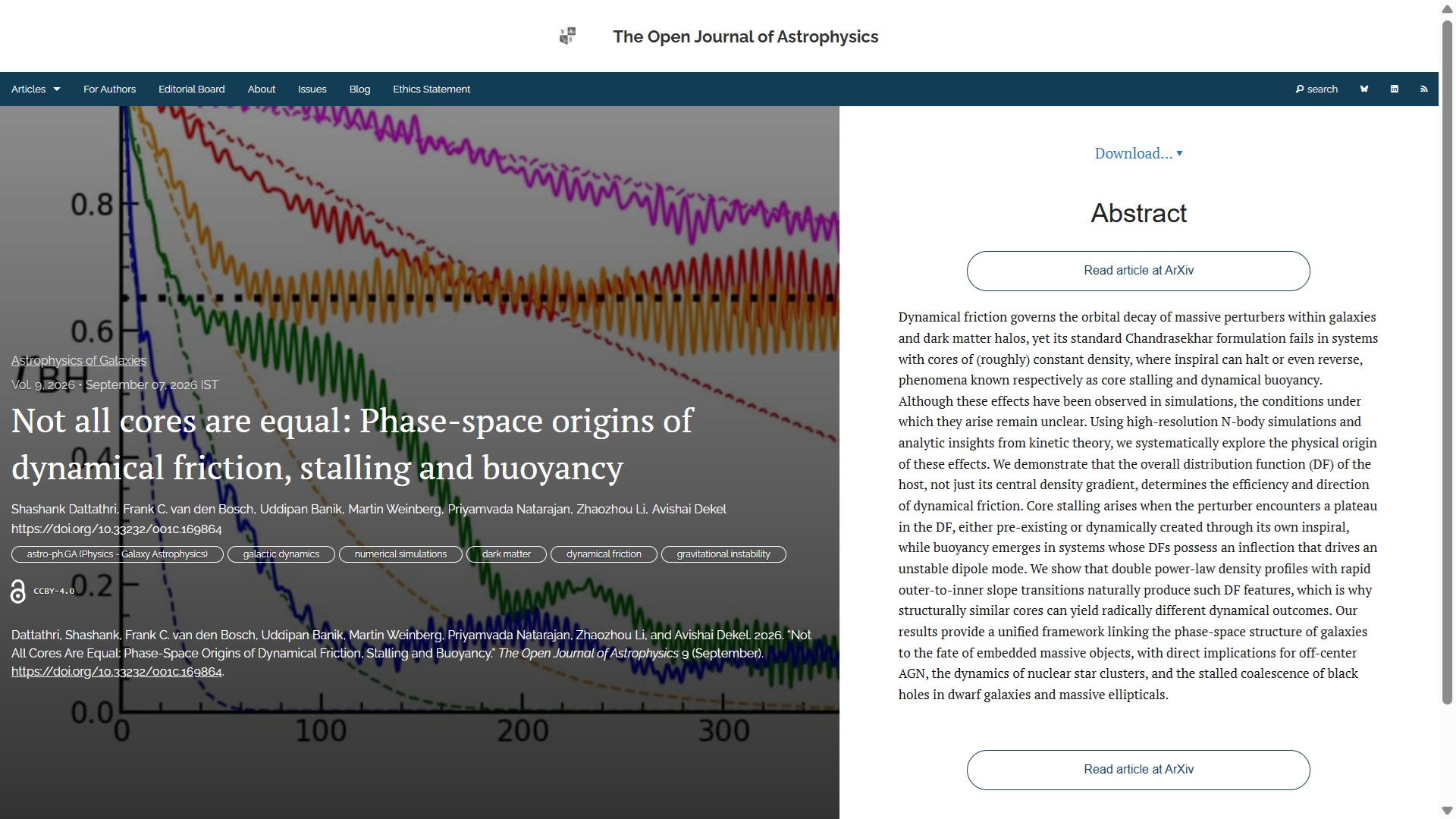
The first paper this week was published on Monday 7th September in the folder Astrophysics of Galaxies. The title is “Not all cores are equal: Phase-space origins of dynamical friction, stalling and buoyancy” and the authors are Shashank Dattathri & Frank C. van den Bosch (Yale U., USA), Uddipan Banik (Princeton U., USA), Martin Weinberg (U. Mass., USA), Priyamvada Natarajan (Yale U., USA), Zhaozhou Li (Nanjing U., China) and Avishai Dekel (The Hebrew U., Israel). The paper describes how the distribution function of a galaxy, not just its central density gradient, influences the efficiency and direction of dynamical friction, affecting the movement of massive objects within it.
The overlay is here:
You can find the officially accepted version on arXiv here and the announcement on Fediverse here:

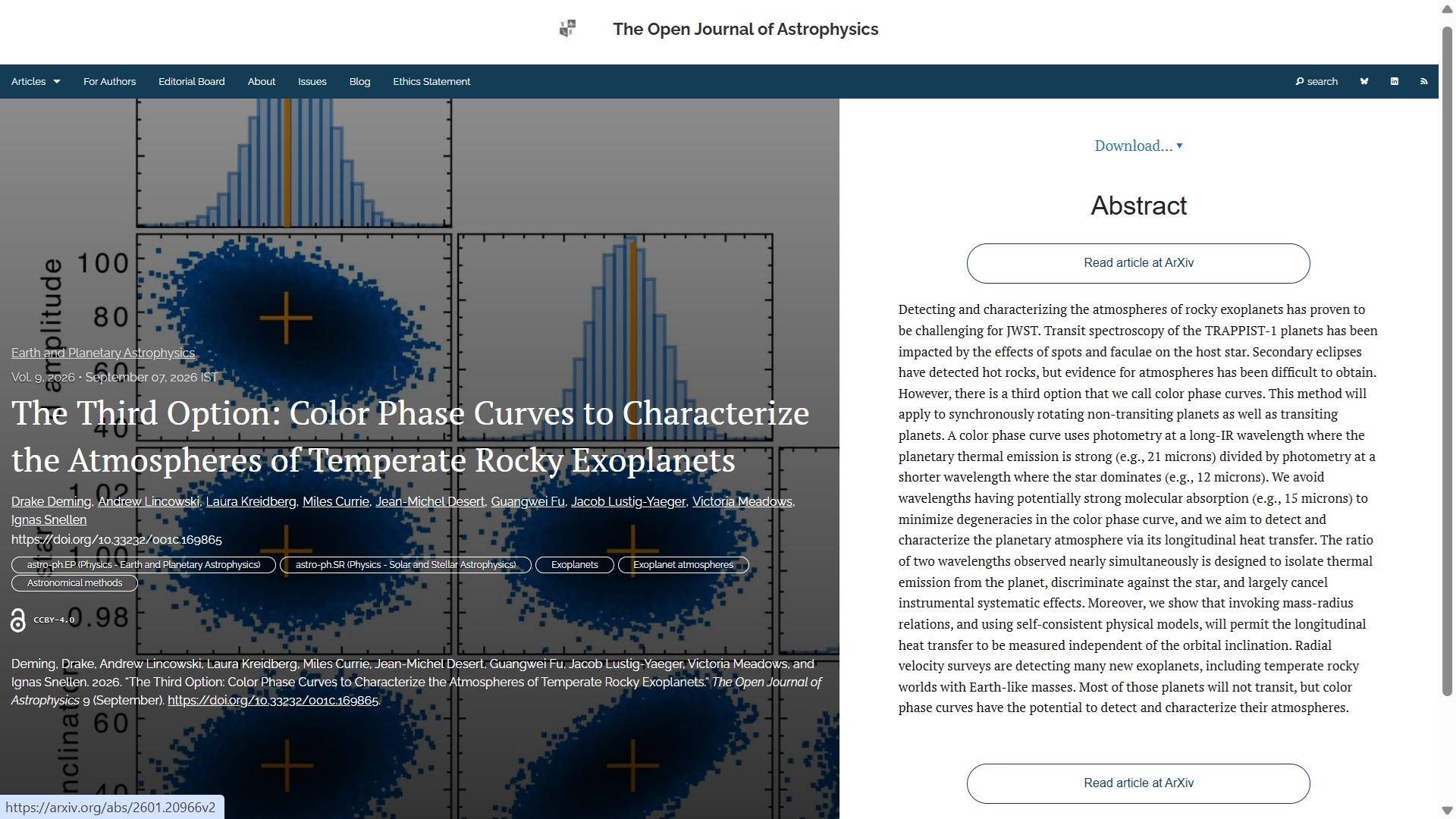
The second paper for this week, also published on Monday 7th September, but in the folder Earth and Planetary Astrophysics, is “The Third Option: Color Phase Curves to Characterize the Atmospheres of Temperate Rocky Exoplanets” by Drake Deming (U. Maryland, USA) and 8 others based in the USA, Germany and The Netherlands. This article presents a A spectroscopic survey of the Carousel lens galaxy cluster, identifying 12 lensed sources and 57 unlensed field galaxies. The findings could help constrain cosmological parameters and cluster properties.
The overlay looks like this:
The official version of the paper can be found on arXiv here and the Fediverse announcement here:
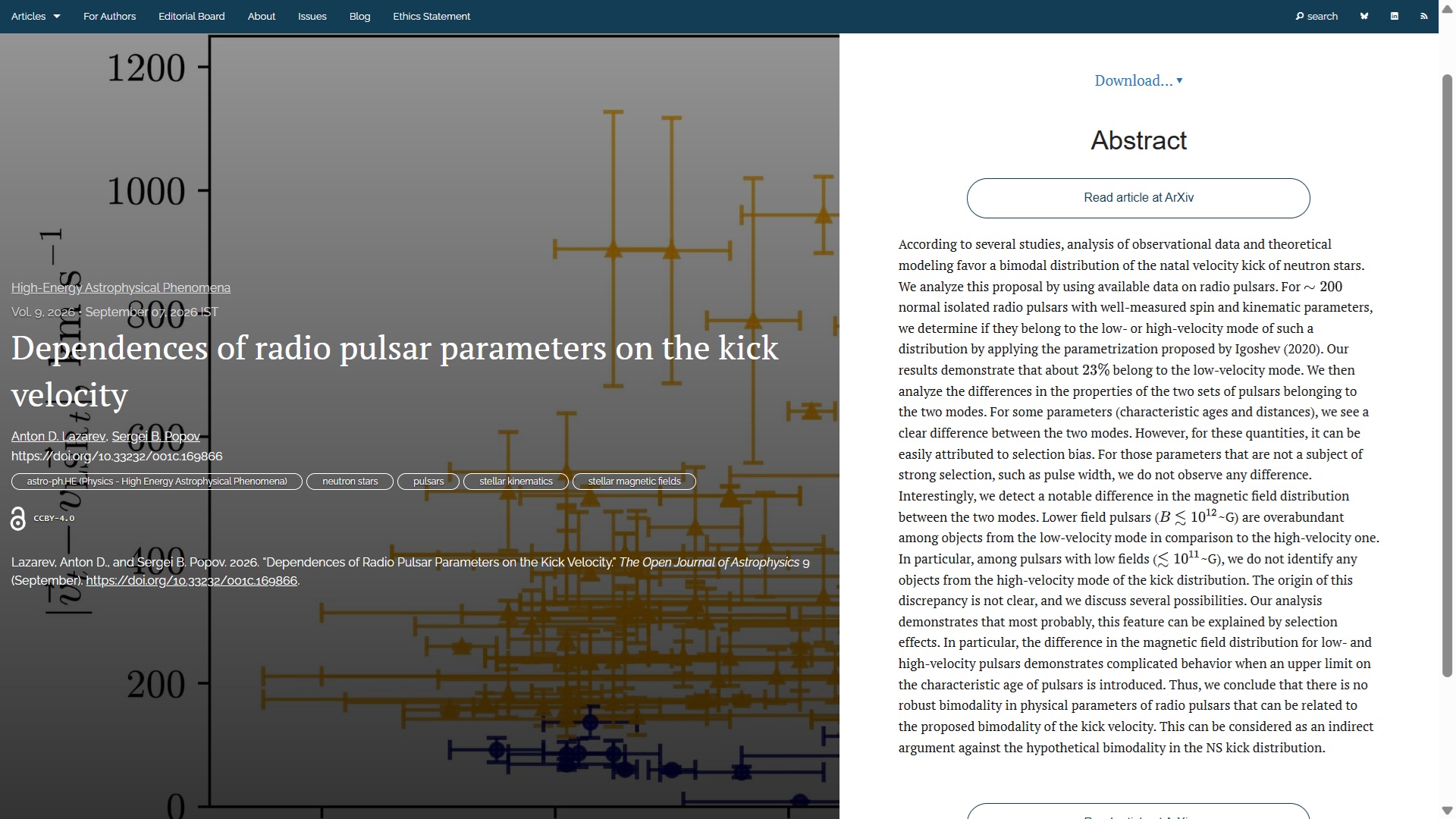
The third paper of the week, also published on Monday 7th September but in the folder High-Energy Astrophysical Phenomena, is “Dependences of radio pulsar parameters on the kick velocity” by Anton D. Lazarev and Sergei B. Popov (Moscow State U., Russia). This study analyzes the velocity kick of neutron stars, finding that 23% belong to the low-velocity mode. Differences in magnetic field distribution emerge, but no significant bimodality in physical parameters.
The overlay is here:
The official version of the paper can be found on arXiv here and the Fediverse announcement here:
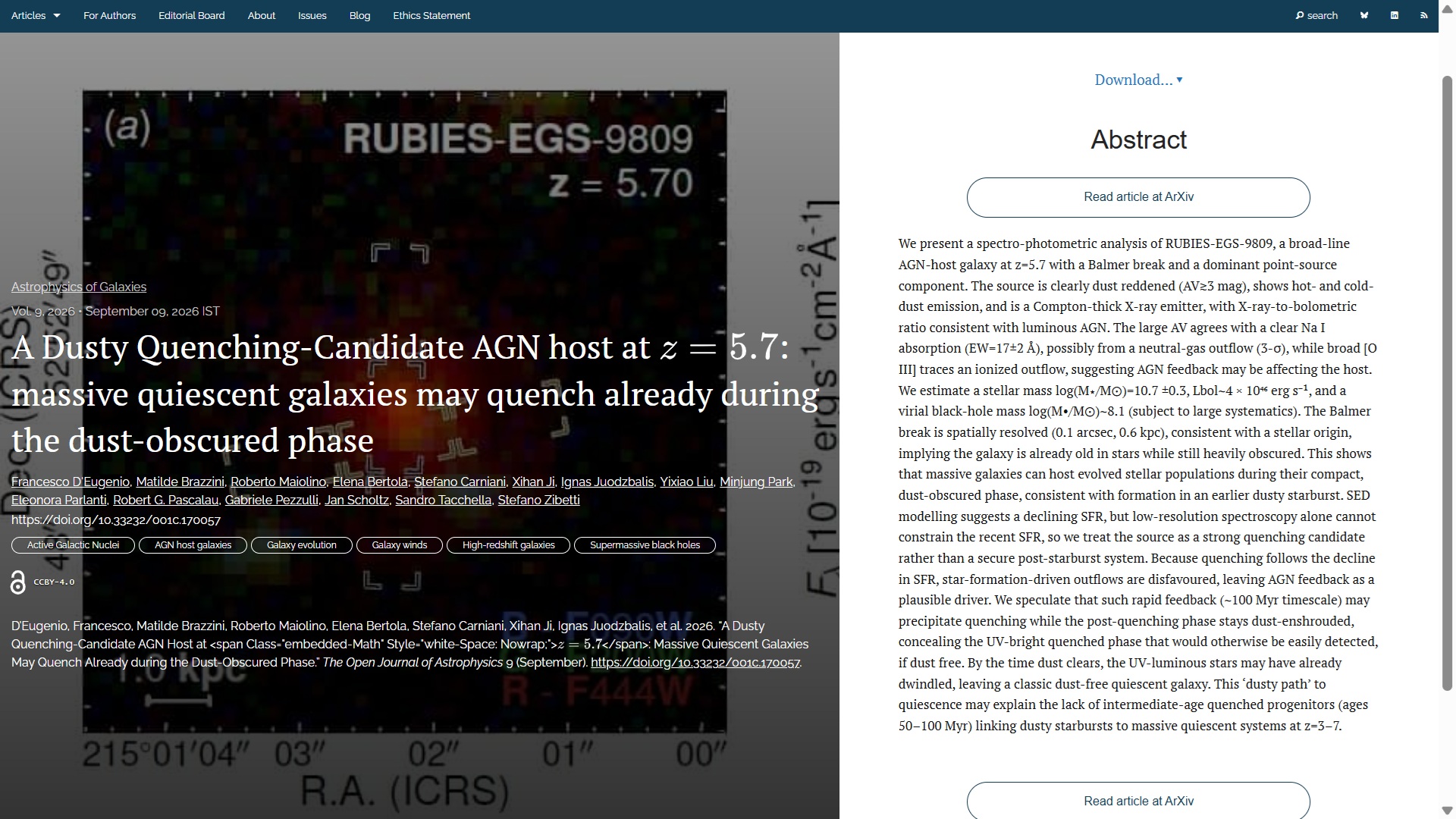
The fourth paper of the week is “A Dusty Quenching-Candidate AGN host at z=5.7: massive quiescent galaxies may quench already during the dust-obscured phase” by Francesco D’Eugenio (U. Cambridge, UK) and 14 others from the UK, Italy, China and The Netherlands. It was published on Wednesday 8th September in the folder Astrophysics of Galaxies. This article concerns RUBIES-EGS-9809, a dust-reddened galaxy with a dominant point-source component, suggests that AGN feedback may influence its host., indicating that massive galaxies can host evolved stellar populations during their dust-obscured phase.
The overlay is here:
The officially-accepted version of the paper can be found on arXiv here and the Fediverse announcement here:
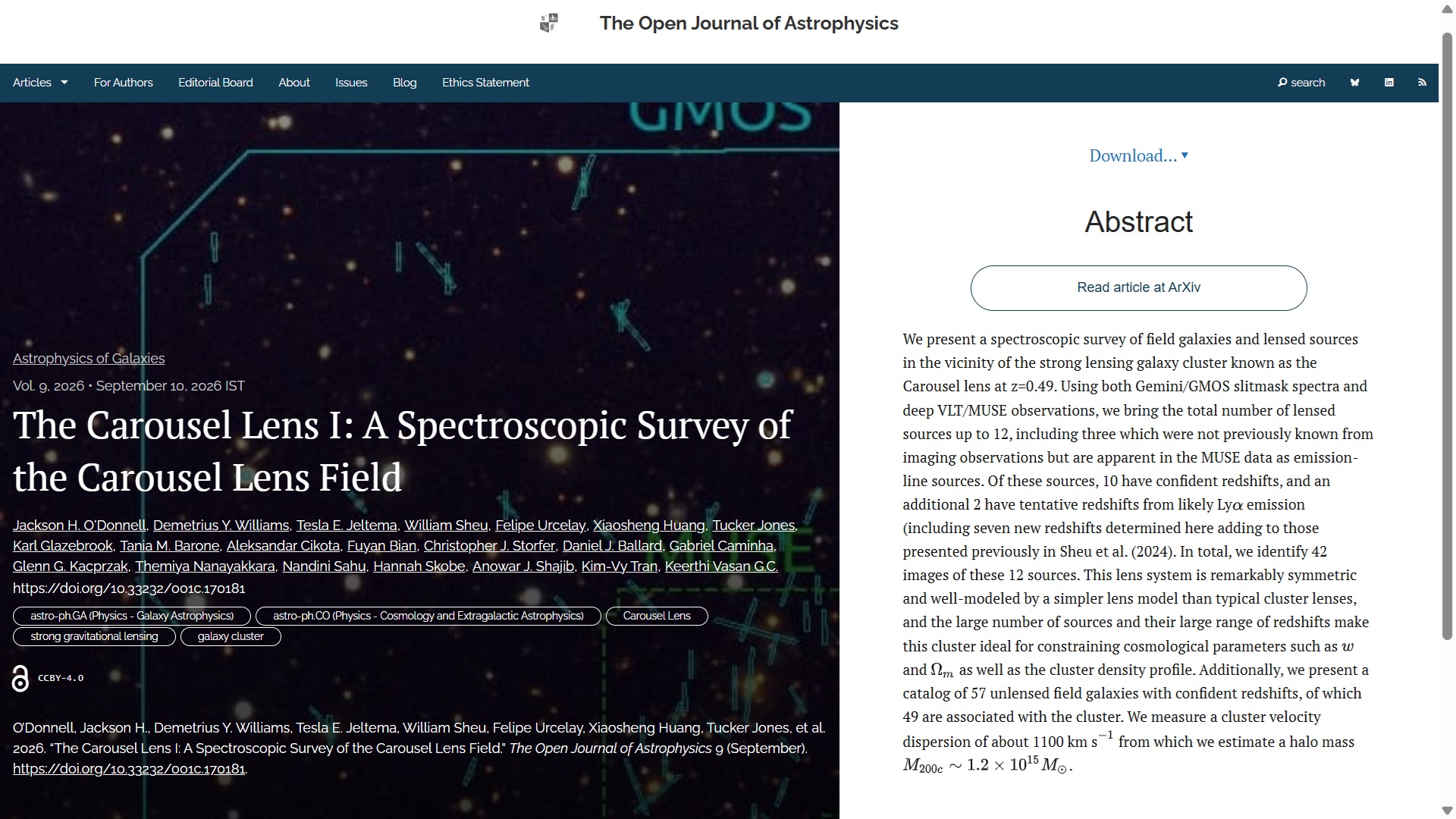
The fifth paper of the week is “The Carousel Lens I: A Spectroscopic Survey of the Carousel Lens Field” by Jackson H. O’Donnell (U.C. Santa Cruz, USA) and 22 others from around the world. This was published in the folder Astrophysics of Galaxies on Thursday 10th September 2026. This paper presents a spectroscopic survey of the Carousel lens galaxy cluster, identifying 12 lensed sources and 57 unlensed field galaxies. The findings could help constrain cosmological parameters and cluster properties.
The overlay for this one looks like this:
The officially-accepted version of this paper is on arXiv here and the Mastodon announcement on the fediverse here:
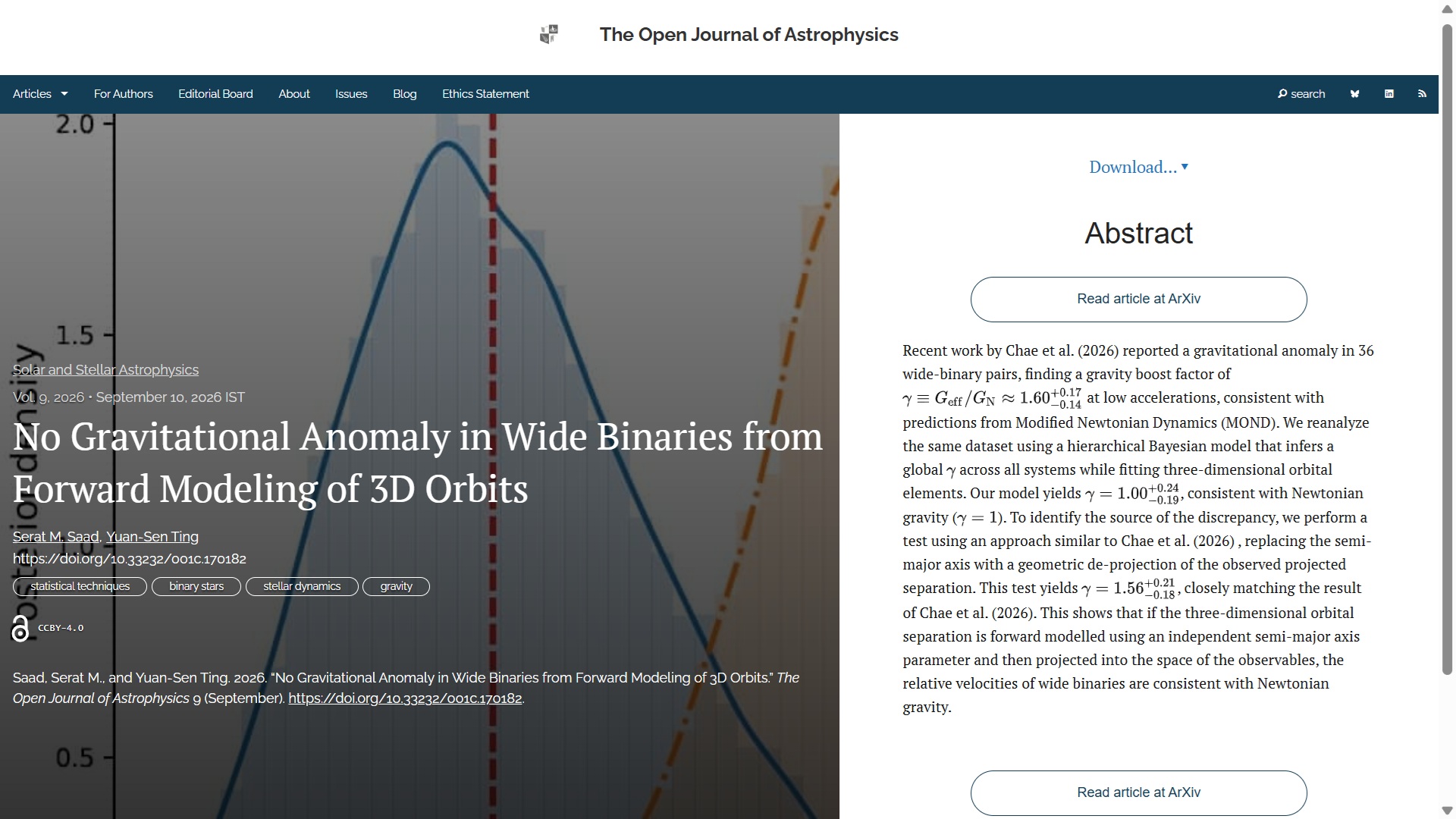
The penultimate, sixth, paper of the week is “No Gravitational Anomaly in Wide Binaries from Forward Modeling of 3D Orbits” by Serat M. Saad and Yuan-Sen Ting (Ohio State U., USA). This was also published on Thursday 10th September, but in the folder Solar and Stellar Astrophysics. The study reanalyzes a dataset on gravitational anomalies, finding results consistent with Newtonian gravity, contrary to previous findings that suggested Modified Newtonian Dynamics. The overlay for this one is here:
The officially accepted version is on arXiv here and the Mastodon announcement here:
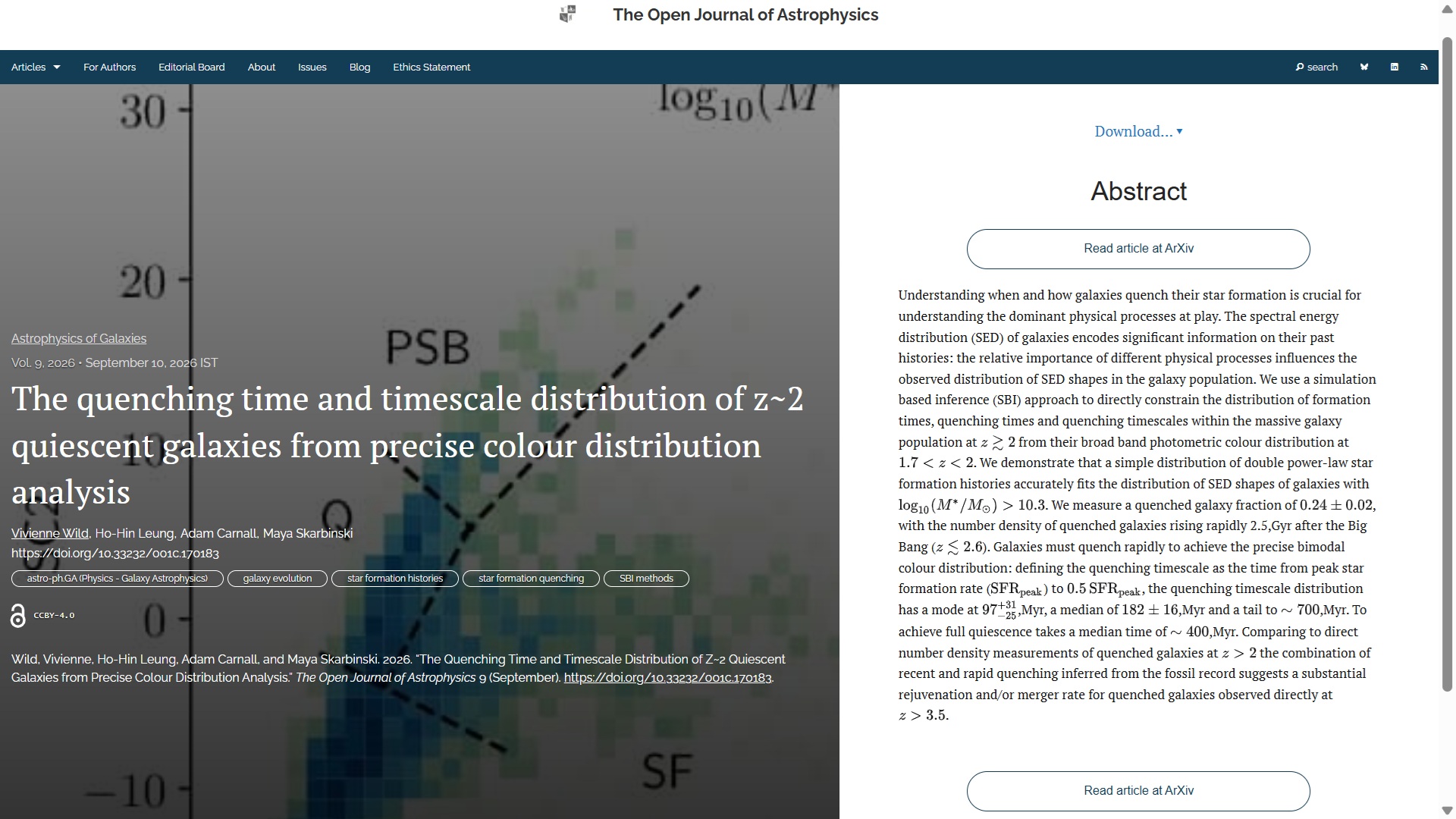
Last but by no means least we have “The quenching time and timescale distribution of z~2 quiescent galaxies from precise colour distribution analysis” by Vivienne Wild (U. St Andrews, UK), Ho-Hin Leung & Adam Carnal (U. Edinburgh, UK) and Maya Skarbinski (Johns Hopkins U., USA). This paper was published on Thursday 10th September in the folder Astrophysics of Galaxies. It describes a study that uses simulation-based inference to analyze galaxy formation and quenching times, revealing that galaxies must quench rapidly post-Big Bang to achieve a specific color distribution.
The overlay is here:
The final version of this paper is on the arXiv here and the Mastodon announcement here:
It is worth mentioning that there was one deferred arXiv mailing this week, due to the Labor Day holiday in the USA, so some papers were therefore published a day later than usual.
That concludes this week’s update. I’ll do another next weekend.


