Archive for astronomy

Galaxies from the Past

Posted in The Universe and Stuff with tags , , , on January 27, 2012 by telescoper

If you were wondering where I got yesterday’s piece from, the answer is that I fired up my old laptop and found it among a lot of old papers there. And by “old laptop”, I mean really old laptop: I bought it in 1995! Anyway, since I haven’t got time to write anything today here is another piece I wrote a long time ago but have only recently unearthed. This one is about Galaxies. It’s a lot longer than yesterday’s effort, but like that one I can’t remember what it was for. Still, some of you might find it interesting. The piece ends with a reference to galaxies observed as they were in the distant past, rather like the article itself!

–0–

A galaxy is a collection of stars, held together by their mutual gravitational attraction and orbiting around their common centre.  Galaxies range in size from dwarf systems of perhaps a few million stars, to giants containing up to a thousand billion. The Sun and all the stars visible in the night sky to the naked eye belong to one such galaxy, our own Galaxy the Milky Way. Although principally recognized through the light given off by their component stars, galaxies also contain other material such as clouds of gas and dust, and significant quantities of dark matter whose nature is not yet understood.

Only stars inside our Galaxy can be resolved with the naked eye; these stars have been studied and catalogued since antiquity. Ancient astronomers  also knew of the existence of a diffuse band of light crossing the sky they could not resolve into individual stars; we now call this the Milky Way. The word galaxy is derived from the Greek galaktos, meaning “milk”. The existence of galaxies other than our own is a much more recent discovery. While even relatively nearby stars appear as point sources of light, the light from other galaxies appears as cloudy and diffuse much like small fragments of the Milky Way. The generic term for a such sources is nebula, the latin word for “mist”.

A Persian astronomer, al-Sufi, in the 10th century AD described such a faint patch of light in the constellation Andromeda which is now known to be another galaxy, but it was only in the 18th Century that a systematic catalogue of  nebulae was compiled, by the French astronomer Charles Messier. Not all the objects he found were other galaxies – some were clouds of dust and gas inside our own – but the Messier catalogue contained 32 objects that we now know to be galaxies, including al-Sufi’s object, which was number 31 in his list. The Andromeda nebula is known to this day as M31. With the increasing power of astronomical telescopes, the list of known nebulae grew to thousands even before the use of astronomical photography became widespread. William and Caroline Herschel and, later, their son John played a leading role in identifying and cataloguing such objects in the early 19th century.

While the existence of large numbers of these nebulae was well established by the start of the 20th Century, their nature remained controversial. Since their distances could not be directly measured, it was possible that they could be inside our own galaxy. Many astronomers believed that the spiral structure seen in some of them, for example M31, suggested that they represented the formative stages of planetary systems like our own Solar System inside the Milky Way. Others argued that the nebulae were very much more distant than that, and were “island universes” on a much larger scale. This debate was only resolved in the 1920s, when Edwin Hubble was able to measure the distances to some nebulae using variable stars called Cepheids. He found them to be far too distant to be inside the Milky Way. This discovery established galaxies as the basic building-blocks of the Universe and gave rise to the field of extragalactic astronomy. Astronomers now estimate that there are as many galaxies in our observable Universe as there are individual stars in our own galaxy, i.e. around a hundred billion.

Galaxies come in a rich variety of shapes and sizes, but there are three basic types: Galaxies come in three basic types: spiral (or disk), elliptical and irregular. Hubble proposed a morphological classification, or taxonomy, for galaxies in which he envisaged the three basic types (spiral, elliptical and irregular) as forming a sequence which in the past was often assumed to represent various evolutionary stages of a galaxy . Although it is now not thought the interpretation as an evolutionary sequence is correct, Hubble’s nomenclature is still commonly used.

Spiral galaxies account for more than half the galaxies observed  in our neighbourhood.  These contain a bright central nucleus surrounded by a flattened disk that sometimes contains beautiful spiral arms. Hubble divided these galaxies into classes labelled as normal (S) or barred (SB) depending on whether the prominent spiral arms emerge directly the nucleus, or originate at the ends of a luminous bar projecting symmetrically through it . Spirals often contain copious amounts of dust, and the spiral arms containing many young stars givin them a noticeably blue colour.  The normal and barred spirals S and SB are further subdivided into a, b or c depending on how tightly the spiral arms are wound up.

The elliptical galaxies (E), which account for only around 10% of observed bright galaxies, are elliptical in shape and have no discernible spiral structure. They are usually red in colour, have very little dust and show no signs of active star formation. The further classification of elliptical galaxies into En depends on the degree of elongation of the galaxy: E0 is nearly spherical; E7 is cigar-shaped. Ellipticals tend to occur in regions of space where there are many other galaxies, giving rise to the idea that they might originally have been spiral galaxies but have lost their spiral structure through mergers or interactions with other galaxies.

The shapes and colours of elliptical galaxies resemble the corresponding properties of spiral nuclei. Elliptical galaxies cover a broad range in mass, from a few hundred thousand to a thousand billion times the mass of the Sun. Spiral galaxies seem to have a smaller spread in mass, typically weighing in at about a hundred billion times the mass of the Sun.

Lenticular, or S0 galaxies, were added later by Hubble to bridge the gap between normal spirals and ellipticals. Around 20% of galaxies we see have this morphology. They are more elongated than elliptical galaxies but have neither bars nor spiral structure.

Irregular galaxies have no apparent structure. They are relatively rare, and are often faint and small so are consequently very hard to see. Their irregularity may stem from the fact that they are have such small masses that the material within them is relatively loosely bound and may have been disturbed by the environment in which they sit.

The classification of galaxies proposed by Hubble applies to “normal” galaxies whose light output is dominated by radiation their constituent population of stars. Stars predominantly emit visible light, which occupies a relatively narrow part of the spectrum of electromagnetic radiation. Spiral galaxies also contain dust which is heated by starlight and radiates in the infra-red. Active galaxies are characterized by the prodigious amounts of energy they emit in regions of the spectrum normal galaxies cannot reach, particularly in radio and X-rays. Much of the energy broadcast by active galaxies is associated with the relatively small nucleus of the galaxy, so the term Active Galactic Nuclei (AGN) is often used to describe these regions. Sometimes the central nucleus is accompanied by a jet of material being ejected at high velocity into the surrounding intergalactic medium. The different types of active galaxy include Seyfert galaxies, radio galaxies, BL Lac objects, and quasars.

Seyfert galaxies are usually spiral galaxies with no radio emission and no evidence of jets. They do, however, emit radiation over a continuous range of frequencies from infra-red to X-rays. Splitting their optical light up into its characteristic spectrum reveals the presence of strong and variable emission lines.  One can see such lines in ordinary stellar spectra and consequently in the spectra of normal galaxies, but they are much more prominent in active galaxies. Radio galaxies, on the other hand, are more commonly elliptical galaxies. These objects are extremely dramatic in their appearance, frequently having two lobes of  radio-emitting material extending far away from the central compact nucleus. There is also sometimes the appearance of a jet of material, extending from the core into the radio lobes. It appears that material is ejected from the nucleus along the jet, eventually being slowed  down by its interaction with the intergalactic medium and forming the radio lobes. The central parts of radio galaxies seem to have properties similar to those of Seyfert galaxies.

BL Lac objects have spectra with no emission lines, but they emit strongly in all wavebands from radio to X-ray frequencies. Their main characteristic, however, is their extremely strong and rapid variability. It is thought that a possible explanation for these objects is that the observer is seeing a jet of material travelling head-on at close to the velocity of light.

The first quasars to be found were detected by their strong radio emission, but they were found to be so small that, like stars but unlike other galaxies, they could not be resolved with optical telescopes. For this reason they became known as quasi-stellar radio sources, or quasars for short. Later on, other such objects were found which did not emit radio waves at all, so the name was changed to quasi-stellar object or QSO, but the name quasar has in any case stuck. It seems that only one in about two hundred quasars is actually radio-loud, but the quasars are still the most powerful of all the active galaxy types.

These different kinds of objects were discovered at different times by different people and were originally thought to be entirely different phenomena. Now, however, there is a unified model in which these structures are all interpreted as having basically similar structure but a different orientation to the observer’s line-of-sight. The engine which powers the activity is thought to be a supermassive black hole, with a mass up to about 100 million solar masses. This seems very large, but is actually just a small fraction of the mass of the host galaxy, which may be a thousand times larger. Material surrounding the black hole is attracted towards it and undergoes a process of accretion, gradually spiralling in and being swallowed. As it spirals in, it forms an accretion disk around the black hole. This disk can be very hot, producing the X-ray radiation frequently seen in AGN, but its presence prevents radiation being transmitted through it. Radiation tends therefore to be beamed out of the poles of the nucleus and does not appear from the equatorial regions which are obscured by the disk. When the beamed radiation interacts with material inside the host galaxy or in the surrounding medium, it forms jets or radio lobes. Depending on the thickness of the disk, the size of the `host’ galaxy ,the amount of gas and dust surrounding the nucleus and the orientation at which the whole system is viewed one can, at least qualitatively, account for the variety of properties listed above.

It is not known what fraction of normal galaxies undergoes activity at some stage in their careers. Although active galaxies are relatively uncommon in our neighbourhood, this may simply be because the active phase lasts for a very short time compared to the total life of a galaxy. For example, if activity only lasts only one-thousandth of the total lifetime, we would expect only to see one in a thousand galaxies at any one time displaying the symptoms. It is perfectly possible, therefore, that the kind of extreme activity displayed by these galaxies is merely a phase through which all galaxies pass. If so, this would suggest that all galaxies should possess a massive black hole at their centre, which is no longer powering an accretion disk because there is insufficient gas left in the surrounding regions. Recent studies using the ultra-high resolution available on the Hubble Space Telescope suggest that most normal galaxies may indeed have black holes in their centres.

A somewhat milder form of activity is displayed by starburst galaxies which, as their name suggests are galaxies undergoing a vigorous period of star formation. Such activity is not thought to involve an active galactic nucleus, but is probably triggered by a tidal interaction between two galaxies moving closely past each other.

The stars in a galaxy exert gravitational forces on each other. This not only holds the galaxy together, it also causes the stars to move. The internal dynamical properties of galaxies are extremely important because they allow astronomers to work out how much matter is there.

In spiral galaxies, the component stars orbit roughly in a plane about the central nucleus. It is this bulk rotation that is responsible for the flattened shape of these systems. Much the same state of affairs applies in the Solar System, with all the planets moving in roughly circular orbits about the Sun. In the case of a disk galaxy that lies edge-on to the observer, stars on one side will be approaching while those on the other will be receding. These motions cause a Doppler shift in the light from different parts of the disk: one side will have a spectrum that is shifted towards blue colours, while the other side will be shifted to the red. One can therefore use spectroscopic methods to plot a graph showing how the rotation speed of material  varies with distance from the centre of rotation. Such a curve is called a rotation curve.  These curves show that the matter in spiral galaxies has a roughly constant velocity out to tens of thousands of light years from the centre. This is surprising because the planets of the Solar System have orbital speeds that fall off quite rapidly with distance from the Sun. Most of the mass of the Solar System lies in the Sun, which is near the centre of motion. Most of the light produced in a galaxy is likewise produced in the central regions. If all the mass in a galaxy were where the stars are, i.e. in the middle, the rotation speed should fall off the further out from the centre one looked. The simplest interpretation of this strange behaviour is that galaxies contain a large amount of material that does not produce starlight and which is not as concentrated in the centre of the galaxy as the stars. To make this work requires galaxies to be embedded in a diffuse halo of dark matter that is about ten times as large as the luminous part of the disk and containing perhaps ten times as much matter.

Dynamical studies of elliptical galaxies are more complicated because the stellar motions within them are not those of simple rotation. Nevertheless, these objects too reveal evidence for dark matter in similar quantity to that in spiral galaxies.

It is thought that less than 10 per cent of the total mass of a galaxy is in visible stars, but the form of the mysterious dark matter is not at all understood. The best candidate at the moment is some form of exotic particle left over from the Big Bang, usually called a WIMP (Weakly Interacting Massive Particle), although no such particle has yet been directly detected.

Galaxies are the basic building blocks of the Universe. They are not, however, the largest structures one can see. They tend not to be isolated, but cluster together. The distribution of nebulae on the sky was thought to be non-uniform even in the days of the Herschels, but it is only in the 20th century that it has become possible to map their three-dimensional positions in a systematic fashion.

The technique used to explore the large-scale distribution of galaxies is based on the discovery of the expanding universe usually attributed to Edwin Hubble, who built  on earlier work by Vesto Slipher. Slipher had discovered that lines in the optical spectra of galaxies were systematically shifted towards the longer wavelength, red end of the electromagnetic spectrum. Hubble extended this study by looking at these redshifts in tandem with the distances he had estimated for the galaxies. He found, to his surprise, that the redshift of a galaxy came out to be proportional to its distance. Contrary to popular belief, Hubble never really interpreted this himself as the result of cosmic expansion but the empirical correlation between redshift and distance now known as Hubble’s Law is the cornerstone of the big-bang cosmology. It is now accepted that the redshift of the galaxies arises from their motion away from the observer, similar to the Doppler shift that causes a change of pitch in a receding police siren. While the accurate determination of extragalactic distances remains difficult, measuring redshifts is rather straightforward. Hubble’s law has been used to chart the pattern traced out by millions of individual galaxies from their spectral shifts.

The general term used to describe a physical  aggregation of many galaxies is a cluster of galaxies, or galaxy cluster. Clusters can be systems of greatly varying size and richness. Our galaxy, the Milky Way,  is a member of the Local Group of galaxies which is a rather small cluster of galaxies of which the only other large member is the Andromeda galaxy (M31). On the other extreme, there are the so-called rich clusters of galaxies, also known as Abell clusters, which contain many hundreds or even thousands of galaxies in a region just few million light years across: prominent nearby examples of such entities are the Virgo and Coma clusters. In between these two extremes, galaxies appear to be distributed in systems of varying density.

Individual galaxy clusters are not the largest structures in the Universe. The distribution of galaxies on scales larger than around 30 million light years also reveals a wealth of complexity. Galaxies are not simply distributed in blobs, like the Abell clusters, but often lie in extended linear structures called filaments, such as the Perseus-Pisces chain, or flattened sheet-like structures like the Great Wall. The latter object is roughly two-dimensional concentration of galaxies, discovered in 1988 by astronomers from the Harvard-Smithsonian Center for Astrophysics. This structure is at least 200 million light years by 600 million light years in size, but is less than 20 million light years thick. It contains many thousands of galaxies and has a mass of at least 1016 solar masses.  The interconnecting network of filaments and sheets is aptly called the “cosmic web”, with rich clusters appearing where the parts of the web join together.

Rich clusters are clustered into enormous loosely-bound agglomerations called superclusters, containing anything from around ten rich clusters to more than 50. The most prominent known supercluster is called the Shapley concentration, while the most nearby is the Local Supercluster, a flattened structure in the plane of which the Local Group is moving. Superclustering is known to exist on scales up to 300 million light years, and superclusters may contain as much as 1017 solar masses of material or more.

These overdense structures are complemented by vast underdense regions known as voids, many of which appear to be roughly spherical.  These regions containing very many fewer galaxies than average, or even no galaxies at all. Voids with density less than 10% of the average density on scales of up to 200 million light years have been found in large-scale redshift surveys.

The existence of galaxies, clusters of galaxies and the overall complexity of large-scale structure in the Universe around us must be contrasted with the extreme simplicity of the very early Universe. Observations of the cosmic microwave background, relic radiation left over from the early stages of the Big Bang, suggest that the initial state of the Universe was almost featureless, with variations in density from place to place of less than one part in a hundred thousand.

The process that is thought to have transformed these smooth beginnings into the clumpiness we see today is called gravitational instability. If the universe were initially exactly smooth, it would have remained so as it expanded and cooled. But if there were small initial variations in density, these would become amplified. A small patch of the Universe that was more dense than average would exert a slightly greater gravitational pull on its surroundings than an average patch. This would cause material to flow in, making it even denser. This, in turn, would make it pull even more than average. This starts a runaway process by which small initial ripples can turn into dense clumps.

This basic idea has been around since it was first suggested by Sir James Jeans more than a hundred years ago, but it is only in the last ten years or so that a convincing picture has been put together explaining how it works in the expanding Universe. According the modern theories, most of the matter in the Universe is in the form of exotic particles left over from the primordial fireball phase that was the Big Bang. These particles are thought to be very slow-moving and are consequently called Cold Dark Matter (CDM). These particles cluster together via the process of gravitational instability, first forming small objects with the mass of a very small dwarf galaxy (around one hundred thousand solar masses). These small seed objects then progressively merge into larger objects in a hierarchical fashion, eventually forming galaxy-sized and cluster-sized dark matter clumps. These form gravitational wells into which gaseous matter falls and becomes trapped. Stars  form as gas clouds cool and fragment in the dark matter clumps. All this happens within a continuous sequence of interaction, disruption and merging. The whole process is extremely complicated, but extensive computer simulations show that the structure produced is very similar to the cosmic web revealed by observations, at least in the essential details.

Further support for these theoretical ideas is provided by observations of galaxies so distant that it has taken their light a large fraction of the age of the Universe to reach us. Looking at such objects allows astronomers to see galaxies in the process of formation.

The Eagle Nebula (as seen by Herschel)

Posted in Poetry, The Universe and Stuff with tags , , , on January 17, 2012 by telescoper

It’s been a while since I posted anything from the Herschel Space Observatory, but here’s a stunning image I just saw on the BBC website which will more than rectify that omission. This is the Eagle Nebula, a much-studied object in terms of the optical light it emits, but this is a remarkable picture taken in the far-infrared part of the spectrum.

For more details, see here.

There’s much more to astronomy than looking at pretty pictures, but the opportunity to stare at things like this is definitely one of the perks of the job. It makes me think of Tennyson’s Poem, The Eagle

He clasps the crag with crooked hands;
Close to the sun in lonely lands,
Ring’d with the azure world, he stands.

The wrinkled sea beneath him crawls;
He watches from his mountain walls,
And like a thunderbolt he falls.

Astronomy in Darkness

Posted in The Universe and Stuff with tags , , , , , , , , on January 14, 2012 by telescoper

Yesterday, being the second Friday of the month, was the day for the Ordinary Meeting of the Royal Astronomical Society (followed by dinner at the Athenaeum for members of the RAS Club). Living and working in Cardiff it’s difficult for me to get the specialist RAS Meetings earlier in the day, but if I get myself sufficiently organized I can usually get to Burlington House in time for the 4pm start of the Ordinary Meeting, which is open to the public.

The distressing news we learnt on Thursday about the events of Wednesday night cast a shadow over the proceedings. Given that I was going to dinner afterwards, for which a jacket and tie are obligatory, I went through my collection of (rarely worn) ties, and decided that a black one would be appropriate. When I arrived at Burlington House I was just in time to hear a warm tribute paid by a clearly upset Professor Roger Davies, President of the RAS and Oxford colleague of the late Steve Rawlings. There then followed a minute’s silence in his memory.

The principal reaction to this news amongst the astronomers present was one of disbelief and/or incomprehension. Some  friends and colleagues of Steve clearly knew much more about what had happened than has so far appeared in the press, but I don’t think it’s appropriate for me to make these public at this stage. We will know the facts soon enough. A colleague also pointed out to me that Steve had spent most of his recent working life as a central figure in the project to build the Square Kilometre Array, which will be the world’s largest radio telescope. He has died just a matter of days before the announcement will be made of where the SKA will actually be built. It’s sobering to think that one can spend so many years working on a project, only for something wholly unforeseen to prevent one seeing it through to completion.

Anyway, the meeting included an interesting talk by Tom Kitching of the University of Edinburgh who talked about recent results from the Canada-France-Hawaii Telescope Lensing Survey (CHFTLenS). The same project was the subject of a press release because the results were presented earlier in the week at the American Astronomical Society meeting in Austin, Texas. I haven’t got time to go into the technicalities of this study – which exploits the phenomenon of weak gravitational lensing to reconstruct the distribution of unseen (dark) matter in the Universe through its gravitational effect on light from background sources – but Tom Kitching actually contributed a guest post to this blog some time ago which will give you some background.

In the talk he presented one of the first dark matter maps obtained from this survey, in which the bright colours represent regions of high dark matter density

Getting maps like this is no easy process, so this is mightily impressive work, but what struck me is that it doesn’t look very filamentary. In other words, the dark matter appears to reside predominantly in isolated blobs with not much hint of the complicated network of filaments we call the Cosmic Web. That’s a very subjective judgement, of course, and it will be necessary to study the properties of maps like this in considerable detail in order to see whether they really match the predictions of cosmological theory.

After the meeting, and a glass of wine in Burlington House, I toddled off to the Athenaeum for an extremely nice dinner. It being the Parish meeting of the RAS Club, afterwards we went through a number of items of Club business, including the election of four new members.

Life  goes on, as does astronomy, even in darkness.

A Quite Interesting Approach to Refereeing

Posted in Television with tags , , , , , on January 4, 2012 by telescoper

Last night I was struggling to compose a clue for the latest Azed Crossword competition (No. 2065) so I gave up and switched on the TV. I ended up watching an episode of QI, a popular entertainment programme in the form of a panel game, hosted by Lord Stephen of Fry. The title stands, I think, for Quite Interesting, rather than the active principle found in chinese medicine, which is an extremely useful word to know in Scrabble if you have a Q and no U.

Anyway, one of the features of said television programme is that if guests answer a question not only incorrectly but also in a manner that’s predictable, stale or  hackneyed,  in such a way that it matches a pre-prepared list of such responses, then a claxon sounds and a penalty of ten points is applied. If you want to hear the claxon…

Press Here

These forfeits are so frequently applied that it is by no means uncommon for the winner of the quiz to have a net score which is negative.

Anyway, watching this it occurred to me that it suggests a quite interesting way of livening up the business of refereeing  grant applications, especially since in these difficult times a good outcome of an application to renew a  geant might well be minus two PDRAs!

It’s quite easy to come up with a list of tedious clichés that you’re likely to find in a cosmology application, e.g. “We have now entered an era of precision cosmology…”,  “Generic inflationary scenario”, “inspired by string theory”, “assuming a linear bias”, etc etc. From now on I’m going to press the buzzer every time I read such a phrase and subtract the resulting penalty from the score assigned to the proposal.

However, it would be unfair to apply this idea just to cosmology proposals. In order to make it more generally applicable, perhaps my loyal readers might suggest, through the Comments Box,  similarly worn out, trite or banal terms appropriate to their own specialism?


Necrodelic Reverie

Posted in Art, The Universe and Stuff with tags , , , on November 25, 2011 by telescoper

Among the delights of having a blog are the friendly emails you get from complete strangers. I got one last week from an artist, who is quite new to me, called Tobias Collier, concerning an old post of mine about randomness. Looking at his website I can see why he was interested in that particular topic, and also found so many things  of interest myself that I decided to do a small showcase here.

According to one of the reviews on his website:

Tobias Collier’s work can be seen as an attempt to visually articulate a great epistemological challenge: that of the human mind encountering the intellectually imponderable. Encompassing elements of sculpture, installation, drawing, performance and video, Tobias Collier’s practice partly relies upon the translation of scientific research methodologies to the processes of art making. Using Art as their field of enquiry, the subsequent works function as mechanisms within the context of a research practice and present a unique combination of scientific processes with poetic artistry.

Playing with current ideas around Astronomy and Cosmology, Tobias Collier’s quotidian metaphors examine our cultural relationship to outer space, using objects of daily existence. They highlight the limitations and inadequacy of man-made processes such as logic (modelling, hypothesizing, inferring and inducing), analogies and metaphors when attempting to comprehend systems and structures that extend beyond our everyday experience.

You can find a host of fascinating things on his website, including sculptures that manage to be both whimsical and profound:

Predicting Random Events, 2011

My favourite pieces, however, admittedly based only on what I have viewed on the website, are the stunning “inductive dot”  drawings, done in ink on paper, and described in the following passage:

The revelation of science that our universe, governed by the second law of thermodynamics, is ultimately fated to a cold quiet ‘heat death’, becomes an unavoidable issue for the work of London based artist Tobias Collier. His response is to propose the pursuit of necrodelic reverie. Small, yet hugely ornate, pointillist drawings are produced as a result of hours of ritualised practice. Like moments in an ongoing process, or records of a timeless activity, the end results are un-human, naturalised, nebulous star-fields or perhaps cloudscapes. In his sculpture references to collapsing or eroded structures, chemical reactions and combustions abound. Conscious cosmic thought entropically linked to the arrow of time, reconciled to universal destiny.

Here’s an example

Necrodelic Reverie, 2010

And this one, reminiscent of cloud formations in a planetary atmosphere:

Untitled, 2010

I find it fascinating that so many contemporary artists take their inspiration, and sometimes their techniques, from the sciences but so few scientists take a reciprocal interest in contemporary art. Anyway, I hope at least a few readers of this blog will now go and have a look at the work of Tobias Collier!


Thinking of Applying for a PhD in Physics or Astronomy?

Posted in Education with tags , , , , , , on November 21, 2011 by telescoper

This afternoon I gave a short talk to our final-year students about postgraduate research in which I passed on some, hopefully useful,  information about how to go about applying for PhDs  in Physics  and Astronomy. I am, for my sins, the Director of Postgraduate Studies within the School of Physics & Astronomy here at Cardiff University.

Although quite a lot of what I talked about was about our own arrangements in Cardiff, I thought I’d jot down here a few general remarks that might be useful to people elsewhere who are thinking of taking the plunge when they graduate. I’m aiming this primarily at UK students applying for places in the UK; special considerations apply for students wanting to do graduate research abroad.

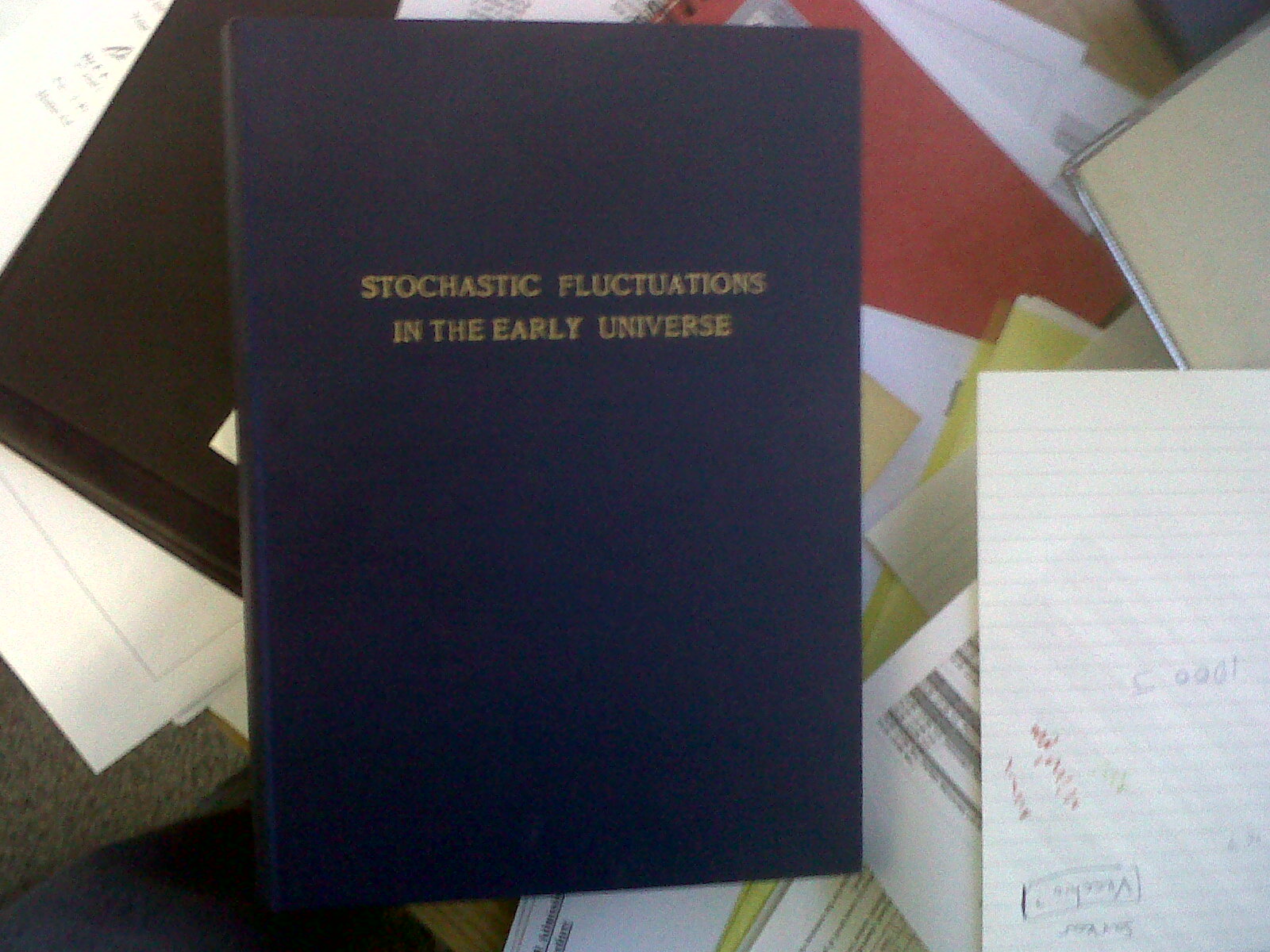
What is a PhD? The answer to that is relatively easy; it’s a postgraduate research degree. In order to obtain a PhD you have to present a thesis like that shown on the left (which happens to be mine, vintage 1988), typically in the range 100-250  pages long. A thesis has to satisfy two conditions for the award of the degree: it should contain original research, which is publishable in an academic journal; and it should present a coherent discussion of that original work within the context of ongoing work in the area of study. In Physics & Astronomy, the PhD is pretty much a prerequisite for any career in academic research, and it usually takes between 3 and 4 years to complete. After submission of the thesis you will have to undergo a viva voce examination conducted by two examiners, one internal and one external. This is quite a tough test, which  can last anywhere between about 2 and about 6 hours, during which you can be asked  detailed questions about your research and wide-ranging questions about the general area.

The Money Side. In the UK most PhDs are supported financially by the research councils, either EPSRC (most physics) or STFC (nuclear & particle physics, astronomy). These generally award quotas of studentships to departments who distribute them to students they admit. A studentship will cover your fees and pay a stipend, currently £13590 pa. That doesn’t sound like a lot, but you should at least remember that it is a stipend rather than a wage; it is therefore not taxed and there is no national insurance payable.

How do I choose a PhD? During the course of a postgraduate degree you are expected to become an expert in the area in which you specialize. In particular you should reach the point where you know more about that specific topic than your supervisor does. You will therefore have to work quite a lot on your own, which means you need determination, stamina and enthusiasm. In my view the most important criterion in your choice of PhD is not the institution where you might study but the project. You need to be genuinely excited by the topic in order to drive yourself to keep through the frustrations (of which there will be many). So, find an area that interests you and find the departments that do active research in that area by looking on the web. Check out the recent publications by staff in each department, to ensure that they are active and to have something to talk about at interview!

Qualifications. Most universities have a formal requirement that candidates for admission to the PhD should have a “good honours degree”, which basically means at least an Upper Second Class Honours degree. Some areas are more competitive than others, however, and in many disciplines you will find you are competing with a great many applicants with First Class degrees.

How to apply successfully. The application procedure at most universities is quite simple and can be done online. You will need to say something about the area in which you wish to do research (e.g. experiment/theory, and particular field, e.g. cosmology or star formation). You’ll also need a CV and a couple of references. Given the competition, it’s essential that you prepare. Give your curriculum vitae some attention, and get other people (e.g. your personal tutor) to help you improve it. It’s worth emphasizing particular skills (e.g. computing). If you get the chance, make use of your summer vacations by taking on an internship or other opportunity to get a taste of research; things like that will undoubtedly give your CV an edge.

The Interview. Good applicants will be invited for an interview, which is primarily to assess whether you have the necessary skills and determination, but also to match applicants to projects and supervisors. Prepare for your interview! You will almost certainly be asked to talk about your final-year project, so it will come across very badly if you’re not ready when they ask you. Most importantly, mug up about your chosen field. You will look really silly if you haven’t the vaguest idea of what’s going on in the area you claimed to be interested in when you wrote your  application!

Don’t be shy! There’s nothing at all wrong with being pro-active about this process. Contact academic staff at other universities by email and ask them about research, PhD opportunities. That will make a good impression. Also, don’t be afraid to ask for advice. Although we’re all keen to recruit good PhD students for our own departments, we academics are  conscious that it is also our job to give impartial advice. Ask your tutor’s opinion.

How many places should I apply for? Some research areas are more fashionable than others so the level of competition varies with field. As a general rule I would advise applying for about half-a-dozen places, chosen because they offer research in the right area. Apply to fewer than that and you might lose out to the competition. Apply to many more and you might not have time to attend the interviews.

What’s the timetable?  Most applications come in early in the new year for entry to the PhD in the following October. The Christmas break is therefore a pretty good time to get your applications sorted out. Interviews are normally held in February or March, and decisions made by late March. STFC runs a deadline system whereby departments can not force students to accept or decline offers before the end of March, so there should be ample time to visit all your prospective departments before having to make any decisions.

That’s all I can think of for now. I hope at least some of these comments are useful to undergraduates anywhere in the UK thinking of applying for a PhD. If there are any further questions, please feel free to ask through the comments box. Likewise if I’ve missed anything important, please feel free to suggest additions in the same manner…

Advice for the REF Panels

Posted in Finance, Science Politics with tags , , , , , on October 30, 2011 by telescoper

I thought I’d post a quick follow-up to last week’s item about the Research Excellence Framework (REF). You will recall that in that post I expressed serious doubts about the ability of the REF panel members to carry out a reliable assessment of the “ouputs” being submitted to this exercise, primarily because of the scale of the task in front of them. Each will have to read hundreds of papers, many of them far outside their own area of expertise. In the hope that it’s not too late to influence their approach, I thought I’d offer a few concrete suggestions as to how things might be improved. Most of my comments refer specifically to the Physics panel, but I have a feeling the themes I’ve addressed may apply in other disciplines.

The first area of  concern relates to citations, which we are told will be used during the assesment, although we’re not told precisely how this will be done. I’ve spent a few hours over the last few days looking at the accuracy and reliability various bibliometric databases and have come to the firm conclusion that Google Scholar is by far the best, certainly better than SCOPUS or Web of Knowledge. It’s also completely free. NASA/ADS is also free, and good for astronomy, but probably less complete for the rest of physics. I therefore urge the panel to ditch its commitment to use SCOPUS and adopt Google Scholar instead.

But choosing a sensible database is only part of the solution. Can citations be used sensibly at all for recently published papers? REF submissions must have been published no earlier than 2008 and the deadline is in 2013, so the longest time any paper can have had to garner citations will be five years. I think that’s OK for papers published early in the REF window, but obviously citations for those published in 2012 or 2013 won’t be as numerous.

However, the good thing about Google Scholar (and ADS) is that they include citations from the arXiv as well as from papers already published. Important papers get cited pretty much as soon as they appear on the arXiv, so including these citations will improve the process. That’s another strong argument for using Google Scholar.

The big problem with citation information is that citation rates vary significantly from field to field sit will be very difficult to use bibliometric data in a formulaic sense, but frankly it’s the only way the panel has to assess papers that lie far from their own expertise. Unless anyone else has a suggestion?

I suspect that what some panel members will do is to look beyond the four publications to guide their assessment. They might, for example, be tempted to look up the H-index of the author if they don’t know the area very well. “I don’t really understand the paper by Professor Poindexter but he has an H-index of 95 so is obviously a good chap and his work is probably therefore world-leading”. That sort of thing.

I think this approach would be very wrong indeed. For a start, it seriously disadvantages early career researchers who haven’t had time to build up a back catalogue of high-impact papers. Secondly, and more fundamentally still, it is contrary to the stated aim of the REF, which is to assess only the research carried out in the assessment period, i.e. 2008 to 2013. The H-index would include papers going back far further than 2008.

But as I pointed out in my previous post, it’s going to be impossible for the panel to perform accurate assessments of all the papers they are given: there will just be far too many and too diverse in content. They will obviously therefore have to do something other than what the rest of the community has been told they will do. It’s a sorry state of affairs that dishonesty is built into the system, but there you go. Given that the panel will be forced to cheat, let me suggest that they at least do so fairly. Better than using the H-index of each individual, use the H-index calculated over the REF period only. That will at least ensure that only research done in the REF period will count towards the REF assessment.

Another bone of contention is the assessment of the level of contribution authors have made to each paper, in other words the question of attribution. In astronomy and particle physics, many important papers have very long author lists and may be submitted to the REF by many different authors in different institutions. We are told that what the panel will do is judge whether a given individual has made a “significant” contribution to the paper. If so, that author will be accredited with the score given to the paper. If not, the grade assigned will be the lowest and that author will get no credit at all. Under this scheme one could be an author on a 4* paper but be graded “U”.

This is fair enough, in that it will penalise the “lurkers” who have made a career by attaching their names to papers on which they have made negligible contributions. We know that such people exist. But how will the panel decide what contribution is significant and what isn’t? What is the criterion?

Take the following example. Suppose the Higgs Boson is discovered at the LHC duringthe REF period. Just about every particle physics group in the UK will have authors on the ensuing paper, but the list is likely to be immensely long and include people who performed many different roles. Who decides where to draw the line on “significance”. I really don’t know the answer to this one, but a possibility might be to found in the use of the textual commentary that accompanies the submission of a research output. At present we are told that this should be used to explain what the author’s contribution to the paper was, but as far as I’m aware there is no mechanism to stop individuals hyping up their involvement.What I mean is I don’t think the panel will check for consistency between commentaries submitted by different people for the same institution.

I’d suggest that consortia  should be required to produce a standard form of words for the textual commentary, which will be used by every individual submitting the given paper and which lists all the other individuals in the UK submitting that paper as one of their four outputs. This will require co-authors to come to an agreement about their relative contributions in advance, which will no doubt lead to a lot of argument, but it seems to me the fairest way to do it. If the collaboration does not produce such an agreement then I suggest that paper be graded “U” throughout the exercise. This idea doesn’t answer the question “what does significant mean?”, but will at least put a stop to the worst of the game-playing that plagued the previous Research Assessment Exercise.

Another aspect of this relates to a question I asked several members of the Physics panel for the 2008 Research Assessment Exercise. Suppose Professor A at Oxbridge University and Dr B from The University of Neasden are co-authors on a paper and both choose to submit it as part of the REF return. Is there a mechanism to check that the grade given to the same piece of work is the same for both institutions? I never got a satisfactory answer in advance of the RAE but afterwards it became clear that the answer was “no”. I think that’s indefensible. I’d advise the panel to identify cases where the same paper is submitted by more than one institution and ensure that the grades they give are consistent.

Finally there’s the biggest problem. What on Earth does a grade like “4* (World Leading)” mean in the first place? This is clearly crucial because almost all the QR funding (in England at any rate) will be allocated to this grade. The percentage of outputs placed in this category varied enormously from field to field in the 2008 RAE and there is very strong evidence that the Physics panel judged much more harshly than the others. I don’t know what went on behind closed doors last time but whatever it was, it turned out to be very detrimental to the health of Physics as a discipline and the low fraction of 4* grades certainly did not present a fair reflection of the UK’s international standing in this area.

Ideally the REF panel could look at papers that were awarded 4* grades last time to see how the scoring went. Unfortunately, however, the previous panel shredded all this information, in order, one suspects, to avoid legal challenges. This more than any other individual act has led to deep suspicions amongs the Physics and Astronomy community about how the exercise was run. If I were in a position of influence I would urge the panel not to destroy the evidence. Most of us are mature enough to take disappointments in good grace as long as we trust the system.  After all, we’re used to unsuccessful grant applications nowadays.

That’s about twice as much as I was planning to write so I’ll end on that, but if anyone else has concrete suggestions on how to repair the REF  please file them through the comments box. They’ll probably be ignored, but you never know. Some members of the panel might take them on board.

Kielder Star Camp

Posted in The Universe and Stuff with tags , , , on October 27, 2011 by telescoper

I  came across a story in the Grauniad about the Kielder Forest Star Camp at which scores of amateur astronomers are gathering along with their tents this week to exploit the darkest skies in England.  The skies are pretty dark above  Cardiff right now, but that’s because of the thick cloud rather than lack of light pollution. I hope they have better weather in Kielder which, if you didn’t know, is in Northumberland. With an area of 250 square miles, Kielder Forest is  England’s largest forest (although it’s actually more of a plantation, being man-made under the auspices the Forestry Commission) and it surrounds Kielder Water, the largest man-made reservoir in the UK. Anyway, as the time-lapse video shows, it’s  a fine spot for astronomy when the clouds stay away; at the end you’ll see the excellent new Kielder Observatory too!

Good luck to all the participants (and, more importantly, clear skies…) .

Posted in Science Politics with tags , , , on October 26, 2011 by telescoper

No time for a post of my own today – it’s our “Staff Away Day” (which owing to budget cuts is only half a day and is being held in Cardiff, at the Millennium Stadium). Anyway, I was going to pass on the same rumours that Andy Lawrence is writing about, and he knows more about this than I do, so over to him for the ongoing ramifications of JWST…

Baby Planet Pictures…

Posted in Astrohype, The Universe and Stuff with tags , , on October 20, 2011 by telescoper

My eye was caught this morning by this dramatic picture on the front page of the Guardian website, linked to a story about the discovery of a very young planet:

I wonder how many people looking at it thought that it was an actual picture of a planet actually forming? In fact the above graphic is just an “artist’s conception” of the view near the planet, which is called LkCa 15b. The real picture is considerably less dramatic:

What you see is (left) a disk of dust and gas surrounding a star cleverly made visible by masking out the light from the star, which is much brighter than the disk.  On the right you can see a blow up of the inner region of the system, which appears to show a Jupiter-like planet associated with an irregular blob of material, out of which it probably condensed and from which it may still be accreting.

The size of the picture on the right is worth noting. The angle indicated is 76 milli-arcseconds. This is the angle subtended by  the  width of a  human hair at distance of about 130 metres…