Archive for Astrophysics

The Laws of Extremely Improbable Things

Posted in Bad Statistics, The Universe and Stuff with tags , , , , , , , , on June 9, 2011 by telescoper

After a couple of boozy nights in Copenhagen during the workshop which has just finished, I thought I’d take things easy this evening and make use of the free internet connection in my hotel to post a short item about something I talked about at the workshop here.

Actually I’ve been meaning to mention a nice bit of statistical theory called Extreme Value Theory on here for some time, because not so many people seem to be aware of it, but somehow I never got around to writing about it. People generally assume that statistical analysis of data revolves around “typical” quantities, such as averages or root-mean-square fluctuations (i.e. “standard” deviations). Sometimes, however, it’s not the typical points that are interesting, but those that appear to be drawn from the extreme tails of a probability distribution. This is particularly the case in planning for floods and other natural disasters, but this field also finds a number of interesting applications in astrophysics and cosmology. What should be the mass of the most massive cluster in my galaxy survey? How bright the brightest galaxy? How hot the hottest hotspot in the distribution of temperature fluctuations on the cosmic microwave background sky? And how cold the coldest? Sometimes just one anomalous event can be enormously useful in testing a theory.

I’m not going to go into the theory in any great depth here. Instead I’ll just give you a simple idea of how things work. First imagine you have a set of n observations labelled X_i. Assume that these are independent and identically distributed with a distribution function F(x), i.e.

\Pr(X_i\leq x)=F(x)

Now suppose you locate the largest value in the sample, X_{\rm max}. What is the distribution of this value? The answer is not F(x), but it is quite easy to work out because the probability that the largest value is less than or equal to, say, z is just the probability that each one is less than or equal to that value, i.e.

F_{\rm max}(z) = \Pr \left(X_{\rm max}\leq z\right)= \Pr \left(X_1\leq z, X_2\leq z\ldots, X_n\leq z\right)

Because the variables are independent and identically distributed, this means that

F_{\rm max} (z) = \left[ F(z) \right]^n

The probability density function associated with this is then just

f_{\rm max}(z) = n f(z) \left[ F(z) \right]^{n-1}

In a situation in which F(x) is known and in which the other assumptions apply, then this simple result offers the best way to proceed in analysing extreme values.

The mathematical interest in extreme values however derives from a paper in 1928 by Fisher \& Tippett which paved the way towards a general theory of extreme value distributions. I don’t want to go too much into details about that, but I will give a flavour by mentioning a historically important, perhaps surprising, and in any case rather illuminating example.

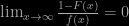
It turns out that for any distribution F(x) of exponential type, which means that

\lim_{x\rightarrow\infty} \frac{1-F(x)}{f(x)} = 0

then there is a stable asymptotic distribution of extreme values, as n \rightarrow \infty which is independent of the underlying distribution, F(x), and which has the form

G(z) = \exp \left(-\exp \left( -\frac{(z-a_n)}{b_n} \right)\right)

where a_n and b_n are location and scale parameters; this is called the Gumbel distribution. It’s not often you come across functions of the form e^{-e^{-y}}!

This result, and others, has established a robust and powerful framework for modelling extreme events. One of course has to be particularly careful if the variables involved are not independent (e.g. part of correlated sequences) or if there are not identically distributed (e.g. if the distribution is changing with time). One also has to be aware of the possibility that an extreme data point may simply be some sort of glitch (e.g. a cosmic ray hit on a pixel, to give an astronomical example). It should also be mentioned that the asymptotic theory is what it says on the tin – asymptotic. Some distributions of exponential type converge extremely slowly to the asymptotic form. A notable example is the Gaussian, which converges at the pathetically slow rate of \sqrt{\ln(n)}! This is why I advocate using the exact distribution resulting from a fully specified model whenever this is possible.

The pitfalls are dangerous and have no doubt led to numerous misapplications of this theory, but, done properly, it’s an approach that has enormous potential.

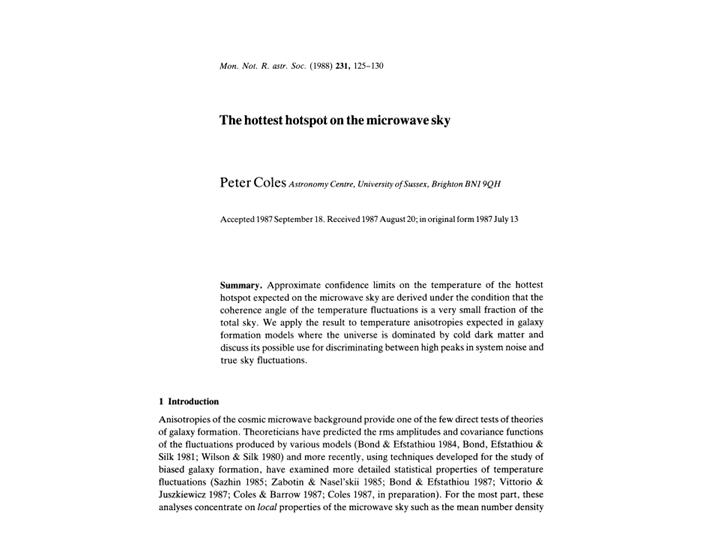
I’ve been interested in this branch of statistical theory for a long time, since I was introduced to it while I was a graduate student by a classic paper written by my supervisor. In fact I myself contributed to the classic old literature on this topic myself, with a paper on extreme temperature fluctuations in the cosmic microwave background way back in 1988..

Of course there weren’t any CMB maps back in 1988, and if I had thought more about it at the time I should have realised that since this was all done using Gaussian statistics, there was a 50% chance that the most interesting feature would actually be a negative rather than positive fluctuation. It turns out that twenty-odd years on, people are actually discussing an anomalous cold spot in the data from WMAP, proving that Murphy’s law applies to extreme events…

Why’s the Sun not Green?

Posted in The Universe and Stuff with tags , , , , on March 11, 2011 by telescoper

It’s Friday afternoon and time for a mildly frivolous post.

I’ve been recently been teaching first-year astrophysics students (and others) about the radiation emitted by stars, and how stellar spectra can be used to diagnose their physical properties.

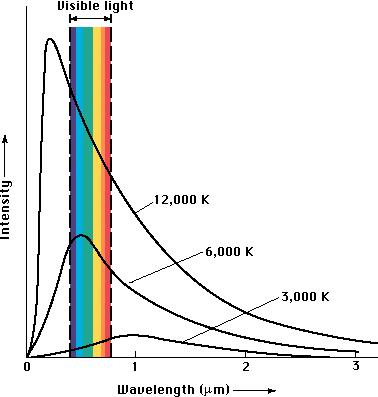
Received wisdom is that the continuous spectrum of light emitted by stars like the Sun is roughly of black-body form, with a peak wavelength inversely proportional to the surface temperature of the star. Here are some examples of black-body curves to illustrate the point.

The Sun has a surface temperature of about 6000 K – actually, more like 5800 K but we won’t quibble. The peak wavelength for the Sun’s spectrum  therefore corresponds to bluey-green light, which is why the Sun appears … er… yellow.

Anyone care to offer an explanation as to why the Sun isn’t green? Answers on a postcard or, preferably, through the comments box.

And while you’re at it, you might want to comment on why,  if the Sun produces so much green light, chlorophyll is actually green?


Share/Bookmark

The Next Decade of Astronomy?

Posted in Science Politics, The Universe and Stuff with tags , , , , , , , on August 14, 2010 by telescoper

I feel obliged to pass on the news that the results of the Decadal Review of US Astronomy were announced yesterday. There has already been a considerable amount of reaction to what the Review Panel (chaired by the esteemed Roger Blandford) came up with from people much more knowledgeable about observational astronomy and indeed US Science Politics, so I won’t try to do a comprehensive analysis here. I draw your attention instead to the report itself  (which you can download in PDF form for free)  and Julianne Dalcanton’s review of, and comments on, the Panel’s conclusions about the priorities for  space-based and ground-based astronomy for the next decade or so over on Cosmic Variance.  There’s also a piece by Andy Lawrence over on The e-Astronomer’s blog. I’ll just mention that Top of the Pops for space-based astronomy is the Wide-Field Infrared Survey Telescope (WFIRST) which you can read a bit more about here, and King of the Castle for the ground-based programme is the Large Synoptic Survey Telescope (LSST). Both of these hold great promise for the area I work in – cosmology and extragalactic astrophysics – so I’m pleased to see our American cousins placing such a high priority on them. The Laser Interferometer Space Antenna (LISA), which is designed to detect gravitational waves, also did very well, which is great news for Cardiff’s Gravitational Physics group.

It will be interesting to see what effect – if any – these priorities have on the ranking of corresponding projects this side of the Atlantic. Some of the space missions involved in the Decadal Review in fact depend on both NASA and ESA so there clearly will be a big effect on such cases. For example, the proposed International X-ray Observatory (IXO) did less well than many might have anticipated, with clear implications for  Europe (including the UK).  The current landscape  of X-ray astronomy is dominated by Chandra and XMM, both of which were launched in 1999 and which are both nearing the end of their operational lives. Since X-ray astronomy can only be done from space, abandoning IXO would basically mean the end of the subject  as we know it, but the question is how to bridge the  the gap between the end of these two missions and the start of IXO even if it does go ahead but not until long after 2020? Should we keep X-ray astronomers on the payroll twiddling their thumbs for the next decade when other fields are desperately short of manpower for science exploitation?

On a more general level, it’s not obvious how we should react when the US gives a high priority to a given mission anyway. Of course, it gives us confidence that we’re not being silly when very smart people across the Pond endorse missions and facilities similar to ones we are considering over here. However, generally speaking the Americans tend to be able to bring missions from the drawing board to completion much faster than we can in Europe. Just compare WMAP with Planck, for instance. Trying to compete with the US, rather than collaborate, seems likely to ensure only that we remain second best. There’s an argument, therefore, for Europe having a programme that is, in some respects at least, orthogonal to the United States; in matters where we don’t collaborate, we should go for facilities that complement rather than compete with those the Americans are building.

It’s all very well talking of priorities in the UK but we all know that the Grim Reaper is shortly going to be paying a visit to the budget of the  agency that administers funding for our astronomy, STFC. This organization went through a financial crisis all of its very own in 2007 from which it is still reeling. Now it has to face the prospect of further savage cuts. The level of “savings” being discussed  – at least 25%  -means that the STFC management must be pondering some pretty drastic measures, even pulling out of the European Southern Observatory (which we only joined in 2002). The trouble is that most of the other ground-based astronomical facilities used by UK astronomers have been earmarked for closure, or STFC has withdrawn from them. Britain’s long history of excellence in ground-based astronomy now hangs in the balance. It’s scary.

I hope the government can be persuaded that STFC should be spared another big cut and I’m sure that there’s extensive lobbying going on.  Indeed, STFC has already requested input to its plans for the ongoing Comprehensive Spending Review (CSR). With this in mind, the Royal Astronomical Society has produced a new booklet designed to point out the  relevance of astronomy to wider society. However I can’t rid from my mind the memory a certain meeting in London in 2007 at which the STFC Chief Executive revealed the true scale of STFC’s problems. He predicted that things would be much worse at the next CSR, i.e. this one. And that was before the Credit Crunch, and the consequent arrival of a new government swinging a very large axe. I wish I could be optimistic but, frankly, I’m not.

When the CSR is completed then STFC will have yet again to do another hasty re-prioritisation. Their Science Board has clearly been preparing:

… Science Board discussed a number of thought provoking scenarios designed to explore the sort of issues that the Executive may be confronted with if there were to be a significant funding reduction as a result of the 2010 comprehensive spending review settlement. As a result of these deliberations Science Board provided the Executive with guidance on how to take forward this strategic planning.

This illustrates a big difference in the way such prioritisation exercises are carried out in the UK versus the USA. The Decadal Review described above is a high-profile study, carried out by a panel of distinguished experts, which takes detailed input from a large number of scientists, and which delivers a coherent long-term vision for the future of the subject. I’m sure not everyone agrees with their conclusions, but the vast majority respect its impartiality and level-headedness and have confidence in the overall process. Here in the UK we have “consultation exercises” involving “advisory panels” who draw up detailed advice which then gets fed into STFC’s internal panels. That bit is much like the Decadal Review. However, at least in the case of the last prioritisation exercise, the community input doesn’t seem to bear any obvious relationship to what comes out the other end. I appreciate that there are probably more constraints on STFC’s Science Board than it has degrees of freedom, but there’s no getting away from the sense of alienation and cynicism this has generated across large sections of the UK astronomy community.

The problem with our is that we always seem to be reacting to financial pressure rather than taking the truly long-term “blue-skies” view that is clearly needed for big science projects of the type under discussion. The Decadal Review, for example, places great importance on striking a balance between large- and small-scale experiments. Here we tend slash the latter because they’re easier to kill than the former. If this policy goes on much longer, in the long run we’ll end up a with few enormous expensive facilities but none of the truly excellent science that can be done from using smaller kit.  A crucial aspect of this that that science seems to have been steadily relegated in importance in favour of technology ever since the creation of STFC.  This must be reversed. We need a proper strategic advisory panel with strong scientific credentials that stands outside the existing STFC structure but which has real influence on STFC planning, i.e. one which plays the same role in the UK as the Decadal Review does in the States.

Assuming, of course, that there’s any UK astronomy left in the next decade…

The Planck Sky

Posted in The Universe and Stuff with tags , , , , , , , on July 5, 2010 by telescoper

Hot from the press today is a release of all-sky images from the European Space Agency’s Planck mission, including about a year’s worth of data. You can find a full set of high-resolution images here at the ESA website, along with a lot of explanatory text, and also here and here. Here’s a low-resolution image showing the galactic dust (blue) and radio (pink) emission concentrated in the plane of the Milky Way but extending above and below it. Only well away from the Galactic plane do you start to see an inkling of the pattern of fluctuations in the Cosmic Microwave Background that the survey is primarily intended to study.

It will take a lot of sustained effort and clever analysis to clean out the foreground contamination from the maps, so the cosmological interpretation will have to wait a while. In fact, the colour scale seems to have been chosen in such a way as to deter people from even trying to analyse the CMB component of the data contained in these images. I’m not sure that will work, however, and it’s probably just a matter of days before some ninny posts a half-baked paper on the arXiv claiming that the standard cosmological model is all wrong and that the Universe is actually the shape of a vuvuzela. (This would require only a small modification of an earlier suggestion.)

These images are of course primarily for PR purposes, but there’s nothing wrong with that. Apart from being beautiful in its own right, they demonstrate that Planck is actually working and that results it will eventually produce should be well worth waiting for!

Oh, nearly forgot to mention that the excellent Jonathan Amos has written a nice piece about this on the BBC Website too.

Experiments and Observations

Posted in Science Politics, The Universe and Stuff with tags , , , , , on May 8, 2010 by telescoper

It’s nice to be able to pass on some upbeat news for once.

The first thing is that, after a lot of delays and a bit of haggling, the School of Physics & Astronomy at Cardiff University has finally issued advertisements for a bunch of new Faculty positions in Experimental Physics. The positions, which are tenured,  involve both Chair and Lecturer/Reader levels and there are several positions available. The School and University  have  put together a handsome start-up package for a new group and there’s plenty of spanking new experimental laboratory space to set up shop. Coupled with the fact that Cardiff is a great city to live in, with low costs and great sporting and cultural infrastructure, this should prove a tempting opportunity for someone to set up their own group.

It’s also a welcome vote of confidence from Cardiff University which, despite cuts in its overall budget, has decided to invest heavily in the School’s strategic plan. I hope and believe we’ll attract a strong field for these appointments and look forward to seeing what develops. We need a shot in the arm and this might just deliver it.

What’s particularly interesting about this clutch of new appointments is that they are open to people working in any area of physics, with the exception of astrophysics. Given the massive cuts in STFC’s budget, this is no time to be expanding in areas covered by its remit. I say that as an astrophysicist, with considerable regret but pragmatism in the face of the changing landscape of British science funding. In times of risk you have to broaden your portfolio. However, that’s not to say that astrophysics at Cardiff is downbeat. Far from it, in fact.

ESA held an international press conference to present exciting new results from the Herschel Observatory at the European Space Research and Technology Centre, Noordwijk, The Netherlands, on Thursday 6 May. A webcast of the press conference with Cardiff’s Professors Matt Griffin and Steve Eales taking part, can be seen at from http://www.esa.int/SPECIALS/Herschel. At the conference Steve Eales talked about the latest results from the Herschel ATLAS survey: an ATLAS of the Universe. ATLAS will cover one eightieth of the sky, four times larger than all the other Herschel surveys combined and is led by Professor Eales and Dr Loretta Dunne at Nottingham University.

Herschel ATLAS has measured the infrared light from thousands of galaxies, spread across billions of light-years. Each galaxy appears as just a pinprick but its brightness allows astronomers to determine how quickly it is forming stars. Roughly speaking, the brighter the galaxy the more stars it is forming. The Herschel images show that in the past there were many more galaxies forming stars much faster than our own Galaxy. But what triggered this frantic activity is not completely understood. Steve Eales said

every time astronomers have observed the universe in a new waveband, they have discovered something new. So as well as our regular science programmes, I am hoping for the unexpected.

I am hoping to get involved with the ATLAS data myself at some point as I am formally a member of the consortium, but I’ve been too busy doing other things to get involved in these initial stages so am not on any of the preliminary science papers. I hope I can get properly involved in this project sooner rather than later…

The ATLAS survey, image courtesy of ESA and the ATLAS consortium

The full press release also includes surprises on how stars are formed including work carried out by Cardiff’s Professor Derek Ward-Thompson. Herschel’s star formation surveys are beginning to reveal the mysteries behind how massive stars are created.

Skepsis

Posted in Politics, The Universe and Stuff with tags , , , , , , on May 1, 2010 by telescoper

This past week was the final week of proper teaching at Cardiff University, so I’ve done my last full lectures, tutorials and exercise classes of the academic year. Yesterday I assessed a bunch of 3rd-year project talks, and soon those students will be handing in their written reports for marking.  Next week will be a revision week, shortly after that the examinations begin. And so the cycle of academic life continues, in a curious parallel to the  football league season – the other routine that provides me with important markers for the passage of the year.

Anyway, this week I gave the last lecture to my first-year class on Astrophysical Concepts. This is a beginning-level course that tries to introduce some of the theory behind astronomy, focussing on the role of gravity. I cover orbits in newtonian gravity, gravity and hydrostatic equilibrium in extended bodies, a bit about stellar structure, gravitational collapse, and so on. In the last part I do a bit of cosmology. I decided to end this time with a lecture about dark energy as, according to the standard model, this accounts for about 75% of the energy budget of the Universe. It’s also something we don’t understand very well at all.

To make a point, I usually show the following picture (credit to the High-z supernova search team).

 What is plotted is the redshift of each supernova (along the x-axis), which relates to the factor by which the universe has expanded since light set out from it. A redshift of 0.5 means the universe was compressed by a factor 1.5 in all dimensions at the time when that particular supernova went bang. The y-axis shows the really hard bit to get right. It’s the estimated distance (in terms of distance modulus) of the supernovae. In effect, this is a measure of how faint the sources are. The theoretical curves show the faintness expected of a standard source observed at a given redshift in various cosmological models. The bottom panel shows these plotted with a reference curve taken out so the trend is easier to see.

The argument from this data is that the high redshift supernovae are fainter than one would expect in models without dark energy (represented by the \Omega_{\Lambda}  in the diagram. If this is true then it means the luminosity distance of these sources is greater than it would be in a decelerating universe. They can be accounted for, however, if the universe’s expansion rate has been accelerating since light set out from the supernovae. In the bog standard cosmological models we all like to work with, acceleration requires that \rho + 3p/c^2 be negative. The “vacuum” equation of state p=-\rho c^2 provides a simple way of achieving this but there are many other forms of energy that could do it also, and we don’t know which one is present or why…

This plot contains the principal evidence that has led to most cosmologists accepting that the Universe is accelerating.  However, when I show it to first-year undergraduates (or even to members of the public at popular talks), they tend to stare in disbelief. The errors are huge, they say, and there are so  few data points. It just doesn’t look all that convincing. Moreover, there are other possible explanations. Maybe supernovae were different beasties back when the universe was young. Maybe something has absorbed their light making them look fainter rather than being further away. Maybe we’ve got the cosmological models wrong.

The reason I show this diagram is precisely because it isn’t superficially convincing. When they see it, students probably form the opinion that all cosmologists are gullible idiots. I’m actually pleased by that.  In fact, it’s the responsibility of scientists to be skeptical about new discoveries. However, it’s not good enough just to say “it’s not convincing so I think it’s rubbish”. What you have to do is test it, combine it with other evidence, seek alternative explanations and test those. In short you subject it to rigorous scrutiny and debate. It’s called the scientific method.

Some of my colleagues express doubts about me talking about dark energy in first-year lectures when the students haven’t learned general relativity. But I stick to my guns. Too many people think science has to be taught as great stacks of received wisdom, of theories that are unquestionably “right”. Frontier sciences such as cosmology give us the chance to demonstrate the process by which we find out about the answers to big questions, not by believing everything we’re told but by questioning it.

My attitude to dark energy is that, given our limited understanding of the constituents of the universe and the laws of matter, it’s the best explanation we have of what’s going on. There is corroborating evidence of missing energy, from the cosmic microwave background and measurements of galaxy clustering, so it does have explanatory power. I’d say it was quite reasonable to believe in dark energy on the basis of what we know (or think we know) about the Universe.  In other words, as a good Bayesian, I’d say it was the most probable explanation. However, just because it’s the best explanation we have now doesn’t mean it’s a fact. It’s a credible hypothesis that deserves further work, but I wouldn’t bet much against it turning out to be wrong when we learn more.

I have to say that too many cosmologists seem to accept the reality of dark energy  with the unquestioning fervour of a religious zealot.  Influential gurus have turned the dark energy business into an industrial-sized bandwagon that sometimes makes it difficult, especially for younger scientists, to develop independent theories. On the other hand, it is clearly a question of fundamental importance to physics, so I’m not arguing that such projects should be axed. I just wish the culture of skepticism ran a little deeper.

Another context in which the word “skeptic” crops up frequently nowadays is  in connection with climate change although it has come to mean “denier” rather than “doubter”. I’m not an expert on climate change, so I’m not going to pretend that I understand all the details. However, there is an interesting point to be made in comparing climate change with cosmology. To make the point, here’s another figure.

There’s obviously a lot of noise and it’s only the relatively few points at the far right that show a clear increase (just as in the first Figure, in fact). However, looking at the graph I’d say that, assuming the historical data points are accurate,  it looks very convincing that the global mean temperature is rising with alarming rapidity. Modelling the Earth’s climate is very difficult and we have to leave it to the experts to assess the effects of human activity on this curve. There is a strong consensus from scientific experts, as monitored by the Intergovernmental Panel on Climate Change, that it is “very likely” that the increasing temperatures are due to increased atmospheric concentrations of greenhouse gas emissions.

There is, of course, a bandwagon effect going on in the field of climatology, just as there is in cosmology. This tends to stifle debate, make things difficult for dissenting views to be heard and evaluated rationally,  and generally hinders the proper progress of science. It also leads to accusations of – and no doubt temptations leading to – fiddling of the data to fit the prevailing paradigm. In both fields, though, the general consensus has been established by an honest and rational evaluation of data and theory.

I would say that any scientist worthy of the name should be skeptical about the human-based interpretation of these data and that, as in cosmology (or any scientific discipline), alternative theories should be developed and additional measurements made. However, this situation in climatology is very different to cosmology in one important respect. The Universe will still be here in 100 years time. We might not.

The big issue relating to climate change is not just whether we understand what’s going on in the Earth’s atmosphere, it’s the risk to our civilisation of not doing anything about it. This is a great example where the probability of being right isn’t the sole factor in making a decision. Sure, there’s a chance that humans aren’t responsible for global warming. But if we carry on as we are for decades until we prove conclusively that we are, then it will be too late. The penalty for being wrong will be unbearable. On the other hand, if we tackle climate change by adopting greener technologies, burning less fossil fuels, wasting less energy and so on, these changes may cost us a bit of money in the short term but  frankly we’ll be better off anyway whether we did it for the right reasons or not. Of course those whose personal livelihoods depend on the status quo are the ones who challenge the scientific consensus most vociferously. They would, wouldn’t they? Moreover, as Andy Lawrence pointed out on his blog recently, the oil is going to run out soon anyway…

This is a good example of a decision that can be made on the basis of a  judgement of the probability of being right. In that respect , the issue of how likely it is that the scientists are correct on this one is almost irrelevant. Even if you’re a complete disbeliever in science you should know  how to respond to this issue, following the logic of Blaise Pascal. He argued that there’s no rational argument for the existence or non-existence of God but that the consequences of not believing if God does exist (eternal damnation) were much worse than those of behaving as if you believe in God when he doesn’t. For “God” read “climate change” and let Pascal’s wager be your guide….

Nobel Betting

Posted in Science Politics, The Universe and Stuff with tags , , , , on October 5, 2009 by telescoper

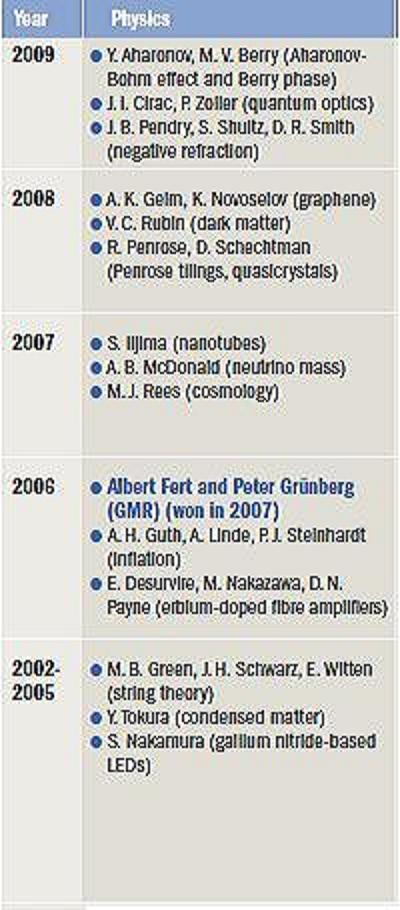
I’m reminded that the 2009 Nobel Prize for Physics will be announced tomorrow, on Tuesday 6th October. A recent article in the Times Higher suggested that British physicists might be in line for glory (based on a study of citation statistics). However, the Table they produced showed that their predictions haven’t really got a good track record so it might be unwise to bet too much on the outcome! This year’s predictions are at the top, with previous years underneath; the only successful prediction is highlighted in blue:

nobel

The problem I think is that it’s difficult to win the Nobel Prize for theoretical work unless confirmed by a definitive experiment, so much as I admire (Lord) Martin Rees – and would love to see a Nobel Prize going to astrophysics generally – I think I’d have to mark him down as an outsider. It would be absurd to give the prize to string theory, of course, as that makes no contact whatsoever with experiment or observation.

I think it would be particularly great if Sir Michael Berry won a share of the physics prize, but we’ll have to wait and see. The other British runner in the paddock is Sir John Pendry. While it would be excellent for British science to have a Nobel prize, what I think is best about the whole show is that it is one of the rare occasions that puts a spotlight on basic science, so it’s good for all of us (even us non-runners).

I think the panel made a bit of a bizarre decision last year and I hope there won’t be another steward’s enquiry this year to distract us from the chance to celebrate the achievements of the winner(s).

I’d be interested to hear any thoughts on other candidates through the comments box. No doubt there’ll be some reactions after the announcement too!

Index Rerum

Posted in Biographical, Science Politics with tags , , , , , , , , , on September 29, 2009 by telescoper

Following on from yesterday’s post about the forthcoming Research Excellence Framework that plans to use citations as a measure of research quality, I thought I would have a little rant on the subject of bibliometrics.

Recently one particular measure of scientific productivity has established itself as the norm for assessing job applications, grant proposals and for other related tasks. This is called the h-index, named after the physicist Jorge Hirsch, who introduced it in a paper in 2005. This is quite a simple index to define and to calculate (given an appropriately accurate bibliographic database). The definition  is that an individual has an h-index of  h if that individual has published h papers with at least h citations. If the author has published N papers in total then the other N-h must have no more than h citations. This is a bit like the Eddington number.  A citation, as if you didn’t know,  is basically an occurrence of that paper in the reference list of another paper.

To calculate it is easy. You just go to the appropriate database – such as the NASA ADS system – search for all papers with a given author and request the results to be returned sorted by decreasing citation count. You scan down the list until the number of citations falls below the position in the ordered list.

Incidentally, one of the issues here is whether to count only refereed journal publications or all articles (including books and conference proceedings). The argument in favour of the former is that the latter are often of lower quality. I think that is in illogical argument because good papers will get cited wherever they are published. Related to this is the fact that some people would like to count “high-impact” journals only, but if you’ve chosen citations as your measure of quality the choice of journal is irrelevant. Indeed a paper that is highly cited despite being in a lesser journal should if anything be given a higher weight than one with the same number of citations published  in, e.g., Nature. Of course it’s just a matter of time before the hideously overpriced academic journals run by the publishing mafia go out of business anyway so before long this question will simply vanish.

The h-index has some advantages over more obvious measures, such as the average number of citations, as it is not skewed by one or two publications with enormous numbers of hits. It also, at least to some extent, represents both quantity and quality in a single number. For whatever reasons in recent times h has undoubtedly become common currency (at least in physics and astronomy) as being a quick and easy measure of a person’s scientific oomph.

Incidentally, it has been claimed that this index can be fitted well by a formula h ~ sqrt(T)/2 where T is the total number of citations. This works in my case. If it works for everyone, doesn’t  it mean that h is actually of no more use than T in assessing research productivity?

Typical values of h vary enormously from field to field – even within each discipline – and vary a lot between observational and theoretical researchers. In extragalactic astronomy, for example, you might expect a good established observer to have an h-index around 40 or more whereas some other branches of astronomy have much lower citation rates. The top dogs in the field of cosmology are all theorists, though. People like Carlos Frenk, George Efstathiou, and Martin Rees all have very high h-indices.  At the extreme end of the scale, string theorist Ed Witten is in the citation stratosphere with an h-index well over a hundred.

I was tempted to put up examples of individuals’ h-numbers but decided instead just to illustrate things with my own. That way the only person to get embarrased is me. My own index value is modest – to say the least – at a meagre 27 (according to ADS).   Does that mean Ed Witten is four times the scientist I am? Of course not. He’s much better than that. So how exactly should one use h as an actual metric,  for allocating funds or prioritising job applications,  and what are the likely pitfalls? I don’t know the answer to the first one, but I have some suggestions for other metrics that avoid some of its shortcomings.

One of these addresses an obvious deficiency of h. Suppose we have an individual who writes one brilliant paper that gets 100 citations and another who is one author amongst 100 on another paper that has the same impact. In terms of total citations, both papers register the same value, but there’s no question in my mind that the first case deserves more credit. One remedy is to normalise the citations of each paper by the number of authors, essentially sharing citations equally between all those that contributed to the paper. This is quite easy to do on ADS also, and in my case it gives  a value of 19. Trying the same thing on various other astronomers, astrophysicists and cosmologists reveals that the h index of an observer is likely to reduce by a factor of 3-4 when calculated in this way – whereas theorists (who generally work in smaller groups) suffer less. I imagine Ed Witten’s index doesn’t change much when calculated on a normalized basis, although I haven’t calculated it myself.

Observers  complain that this normalized measure is unfair to them, but I’ve yet to hear a reasoned argument as to why this is so. I don’t see why 100 people should get the same credit for a single piece of work:  it seems  like obvious overcounting to me.

Another possibility – if you want to measure leadership too – is to calculate the h index using only those papers on which the individual concerned is the first author. This is  a bit more of a fiddle to do but mine comes out as 20 when done in this way.  This is considerably higher than most of my professorial colleagues even though my raw h value is smaller. Using first author papers only is also probably a good way of identifying lurkers: people who add themselves to any paper they can get their hands on but never take the lead. Mentioning no names of  course.  I propose using the ratio of  unnormalized to normalized h-indices as an appropriate lurker detector…

Finally in this list of bibliometrica is the so-called g-index. This is defined in a slightly more complicated way than h: given a set of articles ranked in decreasing order of citation numbers, g is defined to be the largest number such that the top g articles altogether received at least g2 citations. This is a bit like h but takes extra account of the average citations of the top papers. My own g-index is about 47. Obviously I like this one because my number looks bigger, but I’m pretty confident others go up even more than mine!

Of course you can play with these things to your heart’s content, combining ideas from each definition: the normalized g-factor, for example. The message is, though, that although h definitely contains some information, any attempt to condense such complicated information into a single number is never going to be entirely successful.

Comments, particularly with suggestions of alternative metrics are welcome via the box. Even from lurkers.

Astronomy or Astrophysics?

Posted in The Universe and Stuff with tags , , , , , on July 25, 2009 by telescoper

A chance encounter with the parent of a prospective student the other day led eventually to the question What’s the difference between Astronomy and Astrophysics? This is something I’m asked quite often so I thought I’d comment on here for those who might stumble across it. I teach a first-year course module entitled “Astrophysical Concepts”. One of the things I try to do in the first lecture is explain that difference. The Oxford English Dictionary gives the following primary definition for astronomy:

The science which treats of the constitution, relative positions, and motions of the heavenly bodies; that is, of all the bodies in the material universe outside of the earth, as well as of the earth itself in its relations to them.

Astrophysics, on the other hand, is described as

That branch of astronomy which treats of the physical or chemical properties of the celestial bodies.

So astrophysics is regarded as a subset of astronomy which is primarily concerned with understanding the properties of stars and galaxies, rather than just measuring their positions and motions. It is possible to assign a fairly precise date when astrophysics first came into use in English because, at least in the early years of the subject, it was almost exclusively associated with astronomical spectroscopy. Indeed the OED gives the following text as the first occurence of astrophysics, in 1869:

As a subject for the investigations of the astro-physicist, the examination of the luminous spectras of the heavenly bodies has proved a remarkably fruitful one

The scientific analysis of astronomical spectra began with a paper  William Hyde Wollaston in the Philosophical Transactions of the Royal Society Vol. 102, p. 378, 1802. He was the first person to notice the presence of dark bands in the optical spectrum of the Sun. These bands were subsequently analysed in great detail by Joseph von Fraunhofer in a paper published in 1814 and are now usually known as Fraunhofer lines.  Technical difficulties  made it impossible to obtain spectra of stars other than the Sun for a considerable time, but  William Huggins finally succeeded in 1864. A drawing of his pioneering spectroscope is shown below.

Meanwhile, fundamental work by Gustav Kirchoff and Robert Bunsen had been helping  to establish an understanding the spectra produced by hot gases.  The identification of features in the Sun’s spectrum  with similar lines produced in laboratory experiments led to a breakthrough in our understanding of the Universe whose importance shouldn’t be underestimated. The Sun and stars were inaccessible to direct experimental test during the 19th Century (as they are now). But spectroscopy now made it possible to gather evidence about their chemical composition as well as physical properties. Most importantly, spectroscopy provided definitive evidence that the Sun wasn’t made of some kind of exotic unknowable celestial material, but of the same kind of stuff (mainly Hydrogen) that could be studied on Earth.  This realization opened the possibility of applying the physical understanding gained from small-scale experiments to the largest scale phenomena that could be seen. The science of astrophysics was born. One of the leading journals in which professional astronomers and astrophysicists publish their research is called the Astrophysical Journal, which was founded in 1895 and is still going strong. The central importance of the (still) young field of spectroscopy can be appreciated from the subtitle given to the journal: Initially the branch of physics most important to astrophysics was atomic physics since the lines in optical spectra are produced by electrons jumping between different atomic energy levels. Spectroscopy of course remains a key weapon in the astrophysicist’s arsenal but nowadays the term is taken to mean any application of physical laws to astronomical objects. Over the years, astrophysics has gradually incorporated nuclear and particle physics as well as thermodynamics, relativity and just about every other branch of physics you can think of. I realise, however, that this  isn’t really the answer to the question that potential students want to ask. What they (probably) want to know is what is the difference between undergraduate courses called Astronomy and those called Astrophysics? The answer to this one depends very much on where you want to study. Generally speaking the differences are in fact quite minimal. You probably do a bit more theory in an Astrophysics course than an Astronomy course, for example. Your final-year project might have to be observational or instrumental if you do Astronomy, but might be theoretical in Astrophysics.  If you compare the complete list of modules to be taken, however, the difference will be very small.

Over the last twenty years or so, most Physics departments in the United Kingdom have acquired some form of research group in astronomy or astrophysics and have started to offer undergraduate degrees with some astronomical or astrophysical content. My only advice to prospective students wanting to find which course is for them is to look at the list of modules and projects likely to be offered. You’re unlikely to find the name of the course itself to be very helpful in making a choice. One of the things that drew me into astrophysics as a discipline (my current position is Professor of Theoretical Astrophysics) is that it involves such a wide range of techniques and applications, putting apparently esoteric things together in interesting ways to develop a theoretical understanding of a complicated phenomenon. I only had a very limited opportunity to study astrophysics during my first degree as I specialised in Theoretical Physics.  This wasn’t just a feature of Cambridge. The attitude in most Universities in those days was that you had to learn all the physics before applying it to astronomy. Over the years this has changed, and most departments offer some astronomy right from Year 1. I think this change has been for the better because I think the astronomical setting provides a very exciting context to learn physics. If you want to understand, say, the structure of the Sun you have to include atomic physics, nuclear physics, gravity, thermodynamics, radiative transfer and hydrostatics all at the same time. This sort of thing makes astrophysics a good subject for developing synthetic skills while more traditional physics teaching focusses almost exclusively on analytical skills. Indeed, my first-year Astrophysical Concepts course is really a course about modelling and problem-solving in physics.