Archive for Cosmic Microwave Background

Shooting at the Cosmic Circles

Posted in Astrohype, Bad Statistics, The Universe and Stuff with tags , , , , on May 11, 2011 by telescoper

Another brief update post of something that whizzed past while I was away and thought I’d mention now that I’m back.

Remember the (now infamous) paper by Gurzadyan and Penrose about evidence for the Conformal Cyclic Cosmology that I blogged about last year?

The original analysis was comprehensively dissected and refuted by a number of papers within a few days of its appearance – see here, here and here – only for Gurzadyan and Penrose to dig an even bigger hole for themselves with a nonsensical reply.

Undaunted, the dynamic duo of Gurzadyan and Penrose have produced yet another paper on the same subject which came out just as I was heading off on my hols.

There has subsequently been another riposte, by Eriksen and Wehus, although I suspect most cosmologists ceased to care about this whole story some time ago. Although it’s a pretty easy target, the Eriksen-Wehus reply does another comprehensive demolition job. The phrase “shooting fish in a barrel” sprang to my mind, but from facebook I learned that the equivalent idiomatic expression in Italian is sparare sulla Croce Rossa (i.e. shooting on the Red Cross). Perhaps we can add a brand new phrase for “taking aim at an easy target” – shooting at the cosmic circles!

I was struck, however, by the closing sentences of the abstract of Eriksen-Wehus reply:

Still, while this story is of little physical interest, it may have some important implications in terms of scienctific sociology: Looking back at the background papers leading up to the present series by Gurzadyan and Penrose, in particular one introducing the Kolmogorov statistic, we believe one can find evidence that a community based and open access referee process may be more efficient at rejecting incorrect results and claims than a traditional journal based approach.

I wholeheartedly agree. I’ve blogged already to the effect that academic journals are a waste of time and money and we’d be much better off with open access and vigorous internet scrutiny. It may be that this episode has just given us a glimpse of the future of scientific publishing.

Share/Bookmark

Mud Wrestling and Microwaves

Posted in The Universe and Stuff with tags , , , on January 13, 2011 by telescoper

Reading through an interesting blog post about the new results from Planck by the ever-reliable Jonathan Amos (the BBC’s very own “spaceman”), I was reminded of a comment I heard made by Martin Rees (now Lord Rees) many years ago.

The remark concerned the difference between cosmology and astrophysics. Cosmology, said Lord Rees, especially the part of it that concerns the very early Universe, involves abstract mathematical concepts, difficult yet logical reasoning and the ability to see deep things in complicated spatial patterns. In that respect it’s rather like chess. Astrophysics, on the other hand, which is not at all elegant and has so many messy complications that it is sometimes difficult even to work out what is going on or what the rules are, is more like mud wrestling.

The following image, which I borrowed from Jonathan Amos’ piece, explains why I was reminded of this and why some cosmologists are having to abandon chess for mud wrestling, at least for the time being. The picture shows the nine individual frequency maps (spanning the range from 30 GHz to 857 GHz) obtained by Planck.

What we cosmologists really want to see is a pristine map of the cosmic microwave background, the black-body radiation that pervades the entire Universe. It’s black body form means that it would have the same brightness temperature across all frequencies, and would also be statistically homogeneous (i.e. looking roughly the same all across the sky).

What you actually see is a mess. There are strong contributions from the disk of our own Galaxy, some of it extending quite a way above and below the plane of the Milky Way. You can also see complicated residuals produced by the way Planck scans the sky. On top of that there is radiation from individual sources within our Galaxy, other Galaxies and even clusters of Galaxies (which I mentioned a couple of days ago). These “contaminants” constitute valuable raw material for astronomers of various sorts, but for cosmologists they are an unwanted nuisance. Unfortunately, there is no other way to reach the jewels of the CMB than by hacking through this daunting jungle of foregrounds and instrumental artefacts.

Looking at the picture might induce one of two reactions. One would be to assume that there’s no way that all the crud can be removed with sufficient accuracy and precision to do cosmology with what’s left. Another is  to appreciate how well cosmologists have done with previous datasets, especially WMAP, have confidence that they’ll solve the numerous problems associated with the Planck data, but understand why  will take another two years of high-powered data analysis by a very large number of very bright people to extract cosmological results from Planck.

There might be gold at the end of the pipeline, but until then it’s going to be mud, glorious mud…


Share/Bookmark

First Science from Planck

Posted in The Universe and Stuff with tags , , , , , , , , , on January 11, 2011 by telescoper

It’s been quite a long wait for results to emerge from the Planck satellite, which was launched in May 2009, but today the first science results have at last been released. These aren’t to do with the cosmological aspects of the mission – those will have to wait another two years – but things we cosmologists tend to think of as “foregrounds”, although they are of great astrophysical interest in themselves.

For an overview, with lots of pretty pictures,  see the European Space Agency’s Planck site and the UK Planck outreach site; you can also watch this morning’s press briefing in full here.

A repository of all 25 science papers can be found here and there’ll no doubt be a deluge of them on the arXiv tomorrow.

A few of my Cardiff colleagues are currently in Paris living it up at the junket working hard at the serious scientific conference at which these results are being discussed. I, on the other hand, not being one of the in-crowd, am back here in Cardiff, only have a short window in between meetings, project vivas and postgraduate lectures  to comment on the new data. I’m also sure there’ll be a huge amount of interest in the professional media and in the blogosphere for some time to come. I’ll therefore just mention a couple of things that struck me immediately as I went quickly through the papers while I was eating my sandwich; the following was cobbled together from the associated ESA press release.

The first concerns the so-called  ‘anomalous microwave emission’ (aka Foreground X) , which is a diffuse glow most strongly associated with the dense, dusty regions of our Galaxy. Its origin has been a puzzle for decades, but data collected by Planck seem to confirm the theory that it comes from rapidly spinning dust grains. Identifying the source of this emission will help Planck scientists remove foreground contamination which much greater precision, enabling them to construct much cleaner maps of the cosmic microwave background and thus, among other things, perhaps clarify the nature of the various apparent anomalies present in current cosmological data sets.

Here’s a nice composite image of a region of anomalous emission, alongside individual maps derived from low-frequency radio observations as well as two of the Planck channels (left).

Credits: ESA/Planck Collaboration

The colour composite of the Rho Ophiuchus molecular cloud highlights the correlation between the anomalous microwave emission, most likely due to miniature spinning dust grains observed at 30 GHz (shown here in red), and the thermal dust emission, observed at 857 GHz (shown here in green). The complex structure of knots and filaments, visible in this cloud of gas and dust, represents striking evidence for the ongoing processes of star formation. The composite image (right) is based on three individual maps (left) taken at 0.4 GHz from Haslam et al. (1982) and at 30 GHz and 857 GHz by Planck, respectively. The size of the image is about 5 degrees on a side, which is about 10 times the apparent diameter of the full Moon.

The second of the many other exciting results presented today that I wanted to mention is a release of new data on clusters of galaxies – the largest structures in the Universe, each containing hundreds or even thousands of galaxies. Owing to the Sunyaev-Zel’dovich Effect these show up in the Planck data as compact regions of lower temperature in the cosmic microwave background. By surveying the whole sky, Planck stands the best chance of finding the most massive examples of these clusters. They are rare and their number is a sensitive probe of the kind of Universe we live in, how fast it is expanding, and how much matter it contains.

Credits: ESA/Planck Collaboration; XMM-Newton image: ESA

This image shows one of the newly discovered superclusters of galaxies, PLCK G214.6+37.0, detected by Planck and confirmed by XMM-Newton. This is the first supercluster to be discovered through its Sunyaev-Zel’dovich effect. The effect is the name for the cluster’s silhouette against the cosmic microwave background radiation. Combined with other observations, the Sunyaev-Zel’dovich effect allows astronomers to measure properties such as the temperature and density of the cluster’s hot gas where the galaxies are embedded. The right panel shows the X-ray image of the supercluster obtained with XMM-Newton, which reveals that three galaxy clusters comprise this supercluster. The bright orange blob in the left panel shows the Sunyaev-Zel’dovich image of the supercluster, obtained by Planck. The X-ray contours are also superimposed on the Planck image.

UPDATES: For other early perspectives on the early release results, see the blogs of Andrew Jaffe and Stuart Lowe; as usual, Jonathan Amos has done a very quick and well-written news piece for the BBC.


Share/Bookmark

Doubts about the Evidence for Penrose’s Cyclic Universe

Posted in Bad Statistics, Cosmic Anomalies, The Universe and Stuff with tags , , , , , , on November 28, 2010 by telescoper

A strange paper by Gurzadyan and Penrose hit the Arxiv a week or so ago. It seems to have generated quite a lot of reaction in the blogosphere and has now made it onto the BBC News, so I think it merits a comment.

The authors claim to have found evidence that supports Roger Penrose‘s conformal cyclic cosmology in the form of a series of (concentric) rings of unexpectedly low variance in the pattern of fluctuations in the cosmic microwave background seen by the Wilkinson Microwave Anisotropy Probe (WMAP). There’s no doubt that a real discovery of such signals in the WMAP data would point towards something radically different from the standard Big Bang cosmology.

I haven’t tried to reproduce Gurzadyan & Penrose’s result in detail, as I haven’t had time to look at it, and I’m not going to rule it out without doing a careful analysis myself. However, what I will say here is that I think you should take the statistical part of their analysis with a huge pinch of salt.

Here’s why.

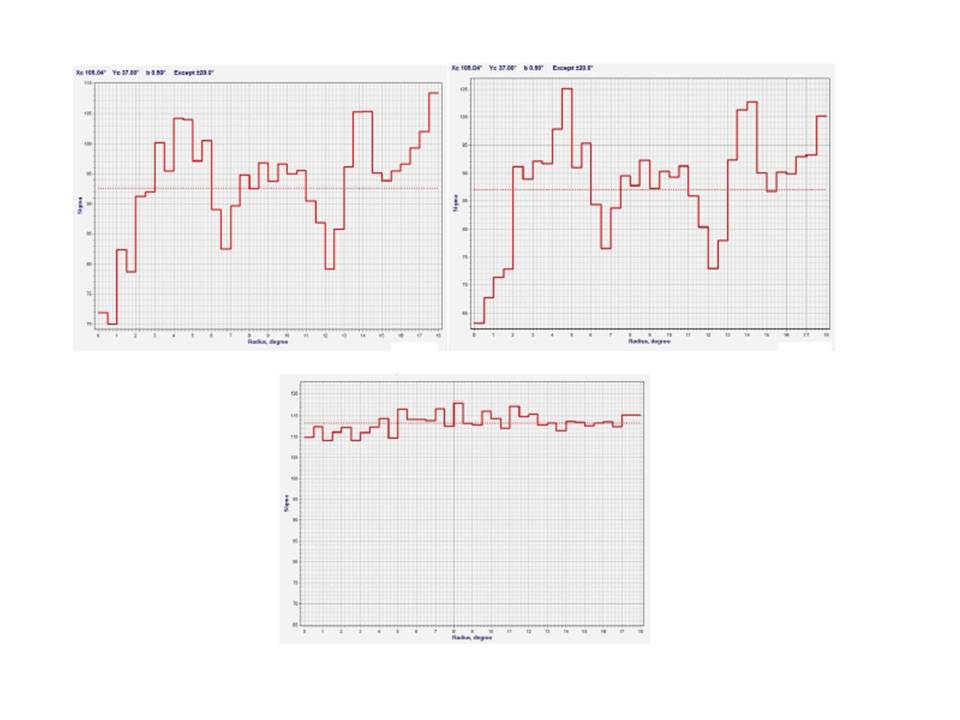
The authors report a hugely significant detection of their effect (they quote a “6-σ” result; in other words, the expected feature is expected to arise in the standard cosmological model with a probability of less than 10-7. The type of signal can be seen in their Figure 2, which I reproduce here:

Sorry they’re hard to read, but these show the variance measured on concentric rings (y-axis) of varying radius (x-axis) as seen in the WMAP W (94 Ghz) and V (54 Ghz) frequency channels (top two panels) compared with what is seen in a simulation with purely Gaussian fluctuations generated within the framework of the standard cosmological model (lower panel). The contrast looks superficially impressive, but there’s much less to it than meets the eye.

For a start, the separate WMAP W and V channels are not the same as the cosmic microwave background. There is a great deal of galactic foreground that has to be cleaned out of these maps before the pristine primordial radiation can be isolated. The fact similar patterns can be found in the BOOMERANG data by no means rules out a foreground contribution as a common explanation of anomalous variance. The authors have excluded the region at low galactic latitude (|b|<20°) in order to avoid the most heavily contaminated parts of the sky, but this is by no means guaranteed to eliminate foreground contributions entirely. Here is the all-sky WMAP W-band map for example:

Moreover, these maps also contain considerable systematic effects arising from the scanning strategy of the WMAP satellite. The most obvious of these is that the signal-to-noise varies across the sky, but there are others, such as the finite size of the beam of the WMAP telescope.

Neither galactic foregrounds nor correlated noise are present in the Gaussian simulation shown in the lower panel, and the authors do not say what kind of beam smoothing is used either. The comparison of WMAP single-channel data with simple Gaussian simulations is consequently deeply flawed and the significance level quoted for the result is certainly meaningless.

Having not looked looked at this in detail myself I’m not going to say that the authors’ conclusions are necessarily false, but I would be very surprised if an effect this large was real given the strenuous efforts so many people have made to probe the detailed statistics of the WMAP data; see, e.g., various items in my blog category on cosmic anomalies. Cosmologists have been wrong before, of course, but then so have even eminent physicists like Roger Penrose…

Another point that I’m not sure about at all is even if the rings of low variance are real – which I doubt – do they really provide evidence of a cyclic universe? It doesn’t seem obvious to me that the model Penrose advocates would actually produce a CMB sky that had such properties anyway.

Above all, I stress that this paper has not been subjected to proper peer review. If I were the referee I’d demand a much higher level of rigour in the analysis before I would allow it to be published in a scientific journal. Until the analysis is done satisfactorily, I suggest that serious students of cosmology shouldn’t get too excited by this result.

It occurs to me that other cosmologists out there might have looked at this result in more detail than I have had time to. If so, please feel free to add your comments in the box…

IMPORTANT UPDATE: 7th December. Two papers have now appeared on the arXiv (here and here) which refute the Gurzadyan-Penrose claim. Apparently, the data behave as Gurzadyan and Penrose claim, but so do proper simulations. In otherwords, it’s the bottom panel of the figure that’s wrong.

ANOTHER UPDATE: 8th December. Gurzadyan and Penrose have responded with a two-page paper which makes so little sense I had better not comment at all.


Share/Bookmark

Hot Stuff, Looking Cool..

Posted in The Universe and Stuff with tags , , , , , on September 15, 2010 by telescoper

It’s nice for a change to have an excuse to write something about science rather than science funding, as a press release appeared today concerning the discovery of a new supercluster by Planck in collaboration with the X-ray observatory XMM-Newton.

The physics behind this new discovery concerns what happens to low-energy photons from the cosmic microwave background (CMB) when they are scattered by extremely hot plasma. Basically, incoming microwave photons collide with highly energetic electrons with the result that they gain energy and so are shifted to shorter wavelengths. The generic name given to this process is inverse Compton scattering, and it can happen in a variety of physical contexts. In cosmology, however, there is a particularly important situation where this process has observable consequences, when CMB photons travel through the extremely hot (but extremely tenuous) ionized gas in a cluster of galaxies. In this setting the process is called the Sunyaev-Zel’dovich effect.

The observational consequence is slightly paradoxical because what happens is that the microwave background can appears to have a lower temperature (at least for a certain range of wavelengths) in the direction of a galaxy cluster (in which the plasma can have a temperature of 10 million degrees or more). This is because fewer photons reach the observer in the microwave part of the spectrum that would if the cluster did not intervene; the missing ones have been kicked up to higher energies and are therefore not seen at their original wavelength, ergo the CMB looks a little cooler along the line of sight to a cluster than in other directions. To put it another way, what has actually happened is that the hot electrons have distorted the spectrum of the photons passing through it.

Here’s an example of the Sunyaev-Zel’dovich effect in action as seen by Planck in seven frequency bands:

At low frequencies (in the Rayleigh-Jeans part of the spectrum) the region where the cluster is looks cooler than average, although at high frequencies the effect is reversed.

The magnitude of the temperature distortion produced by a cluster depends on the density of electrons in the plasma pervading the cluster n, the temperature of the plasma T, and the overall size of the cluster; in fact, it’s propotional to n×T integrated along the line of sight through the cluster.

Why this new result is so interesting is that it combines very sensitive measurements of the microwave background temperature pattern  with sensitive measures of the X-ray emission over the same region of the sky. Plasma hot enough to produce a Sunyaev-Zel’dovich distortion of the CMB spectrum will also generate X-rays through a process known as thermal bremsstrahlung.  The power of the X-ray emission depends on the square of the electron density n2 multiplied by the Temperature T.

Since the Sunyaev-Zel’dovich and X-ray measurements depend on different mathematical combinations of the physical properties involved the amalgamation of these two techniques allows astronomers to probe the internal details of the cluster quite precisely.

The example shown here in the top two panels is of a familiar cluster – the Coma Cluster as mapped by Planck (in microwaves) and, by an older X-ray satellite called ROSAT, in X-rays. The two distributions have very similar morphology, strongly suggesting that they have a common origin in the cluster plasma.

The bottom panels show comparisons with the distribution of galaxies as seen in the optical part of the spectrum. You can see that the hot gas I’ve been talking about extends throughout the space between the galaxies. In fact, there is at least as much matter in the hot plasma as there is in the individual galaxies in objects like this, but it’s too hot to be seen in optical light. This could reasonably be called dark matter when it comes to its lack of optical emission, but it’s certainly not dark in X-rays!

The reason why the intracluster plasma is so hot boils down to the strength of the gravitational field in the cluster. Roughly speaking, the hot matter is in virial equilibrium within the gravitational potential generated by the mass distribution within the cluster. Since this is a very deep potential well, electrons move very quickly in response to it. In fact, the galaxies in the cluster are also roughly in virial equilibrium so they too are pulled about by the gravitational field. Galaxies don’t sit around quietly in clusters, they buzz about like bees in a bottle.

Anyway, the new data arising from the combination of Planck and XMM-Newton has revealed not just one cluster, but a cluster of clusters (i.e. a “supercluster”):

It’s early days for Planck, of course, and this is no more than a taster.
The Planck team is currently analysing the data from the first all-sky survey to identify both known and new galaxy clusters for the early Sunyaev-Zel’dovich catalogue, which will be released in January of 2011 as part of the Early Release Compact Source Catalogue. The full Sunyaev-Zel’dovich catalogue may well turn out to be the most enduring legacy of the Planck mission.


Share/Bookmark

The Planck Sky

Posted in The Universe and Stuff with tags , , , , , , , on July 5, 2010 by telescoper

Hot from the press today is a release of all-sky images from the European Space Agency’s Planck mission, including about a year’s worth of data. You can find a full set of high-resolution images here at the ESA website, along with a lot of explanatory text, and also here and here. Here’s a low-resolution image showing the galactic dust (blue) and radio (pink) emission concentrated in the plane of the Milky Way but extending above and below it. Only well away from the Galactic plane do you start to see an inkling of the pattern of fluctuations in the Cosmic Microwave Background that the survey is primarily intended to study.

It will take a lot of sustained effort and clever analysis to clean out the foreground contamination from the maps, so the cosmological interpretation will have to wait a while. In fact, the colour scale seems to have been chosen in such a way as to deter people from even trying to analyse the CMB component of the data contained in these images. I’m not sure that will work, however, and it’s probably just a matter of days before some ninny posts a half-baked paper on the arXiv claiming that the standard cosmological model is all wrong and that the Universe is actually the shape of a vuvuzela. (This would require only a small modification of an earlier suggestion.)

These images are of course primarily for PR purposes, but there’s nothing wrong with that. Apart from being beautiful in its own right, they demonstrate that Planck is actually working and that results it will eventually produce should be well worth waiting for!

Oh, nearly forgot to mention that the excellent Jonathan Amos has written a nice piece about this on the BBC Website too.

Cosmology on its beam-ends?

Posted in Cosmic Anomalies, The Universe and Stuff with tags , , , , on June 14, 2010 by telescoper

Interesting press release today from the Royal Astronomical Society about a paper (preprint version here) which casts doubt on whether the Wilkinson Microwave Anisotropy Probe supports the standard cosmological model to the extent that is generally claimed. Apologies if this is a bit more technical than my usual posts (but I like occasionally to pretend that it’s a science blog).

The abstract of the paper (by Sawangwit & Shanks) reads

Using the published WMAP 5-year data, we first show how sensitive the WMAP power spectra are to the form of the WMAP beam. It is well known that the beam profile derived from observations of Jupiter is non-Gaussian and indeed extends, in the W band for example, well beyond its 12.’6 FWHM core out to more than 1 degree in radius. This means that even though the core width corresponds to wavenumber l ~ 1800, the form of the beam still significantly affects the WMAP results even at l~200 which is the scale of the first acoustic peak. The difference between the beam convolved Cl; and the final Cl is ~ 70% at the scale of the first peak, rising to ~ 400% at the scale of the second.  New estimates of the Q, V and W-band beam profiles are then presented, based on a stacking analysis of the WMAP5 radio source catalogue and temperature maps. The radio sources show a significantly (3-4σ) broader beam profile on scales of 10′-30′ than that found by the WMAP team whose beam analysis is based on measurements of Jupiter. Beyond these scales the beam profiles from the radio sources are too noisy to give useful information. Furthermore, we find tentative evidence for a non-linear relation between WMAP and ATCA/IRAM 95 GHz source fluxes. We discuss whether the wide beam profiles could be caused either by radio source extension or clustering and find that neither explanation is likely. We also argue against the possibility that Eddington bias is affecting our results. The reasons for the difference between the radio source and the Jupiter beam profiles are therefore still unclear. If the radio source profiles were then used to define the WMAP beam, there could be a significant change in the amplitude and position of even the first acoustic peak. It is therefore important to identify the reasons for the differences between these two beam profile estimates.

The press release puts it somewhat more dramatically

New research by astronomers in the Physics Department at Durham University suggests that the conventional wisdom about the content of the Universe may be wrong. Graduate student Utane Sawangwit and Professor Tom Shanks looked at observations from the Wilkinson Microwave Anisotropy Probe (WMAP) satellite to study the remnant heat from the Big Bang. The two scientists find evidence that the errors in its data may be much larger than previously thought, which in turn makes the standard model of the Universe open to question. The team publish their results in a letter to the journal Monthly Notices of the Royal Astronomical Society.

I dare say the WMAP team will respond in due course, but this paper spurred me to mention some work on this topic that was done by my friend (and former student) Lung-Yih Chiang. During his last visit to Cardiff we discussed this at great length and got very excited at one point when we thought we had discovered an error along the lines that the present paper claims. However, looking more carefully into it we decided that this wasn’t the case and we abandoned our plans to publish a paper on it.

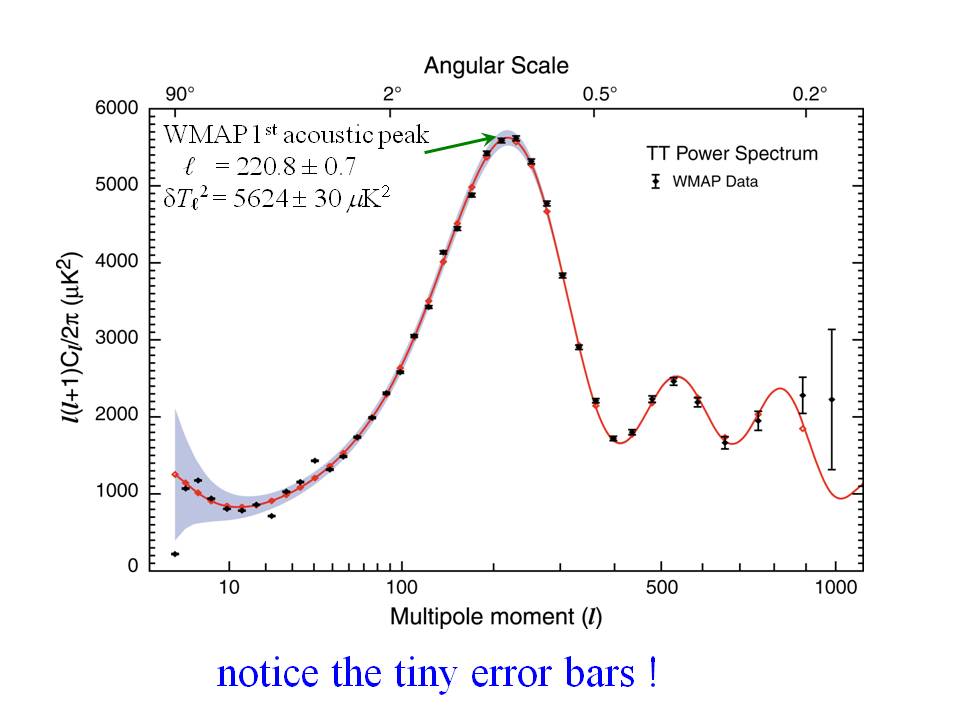
Let me show you a few slides from a presentation that Lung-Yih gave to me a while ago. For a start here is the famous power-spectrum of the temperature fluctuations of the cosmic microwave background which plays an essential role in determining the parameters of the standard cosmology:

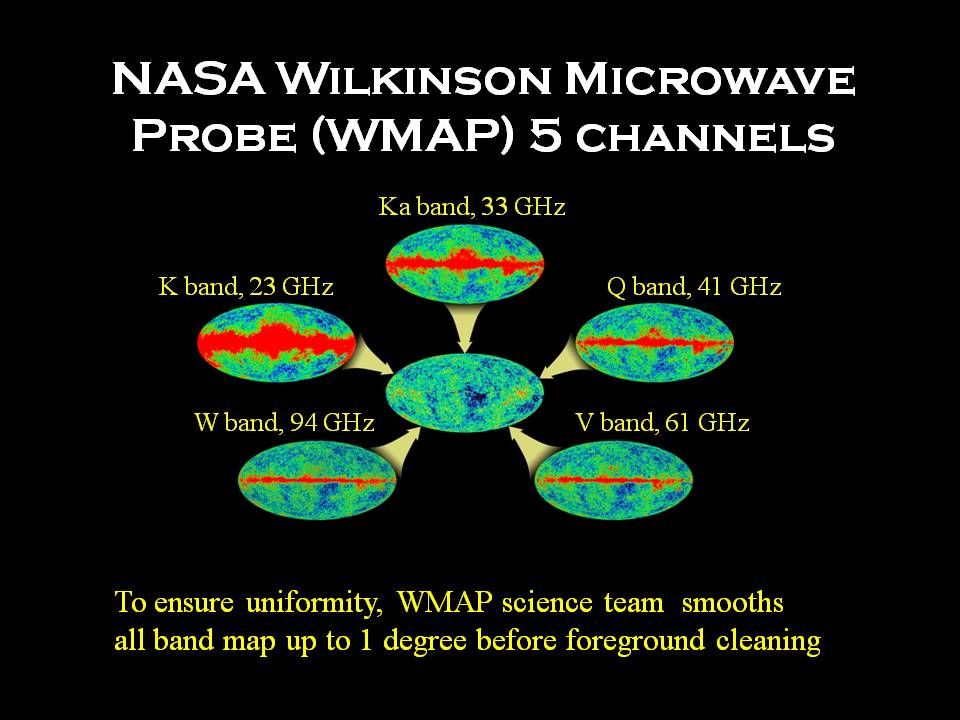
The position of the so-called “acoustic peak” plays an important role in determining the overall curvature of space-time on cosmological scales and the higher-order peaks pin down other parameters. However, it must be remembered that WMAP doesn’t just observe the cosmic microwave background. The signal it receives is heavily polluted by contamination from within our Galaxy and there is also significant instrumental noise.  To deal with this problem, the WMAP team exploit the five different frequency channels with which the probe is equipped, as shown in the picture below.

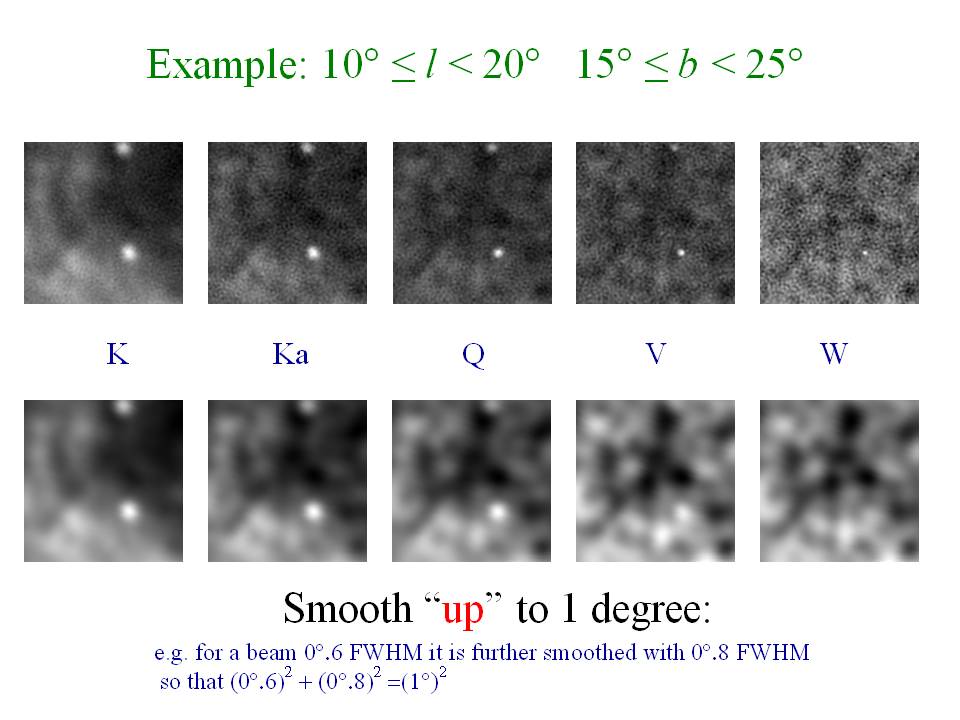
The CMB, being described by a black-body spectrum, has a sky temperature that doesn’t vary with frequency. Foreground emission, on the other hand, has an effective temperature that varies with frequency in way that is fairly well understood. The five available channels can therefore be used to model and subtract the foreground contribution to the overall signal. However, the different channels have different angular resolution (because they correspond to different wavelengths of radiation). Here are some sample patches of sky illustrating this

At each frequency the sky is blurred out by the “beam” of the WMAP optical system; the blurring is worse at low frequencies than at high frequencies. In order to do the foreground subtraction, the WMAP team therefore smooth all the frequency maps to have the same resolution, i.e. so the net effect of optical resolution and artificial smoothing produces the same overall blurring (actually 1 degree).  This requires accurate knowledge of the precise form of the beam response of the experiment to do it accurately. A rough example (for illustration only) is given in the caption above.

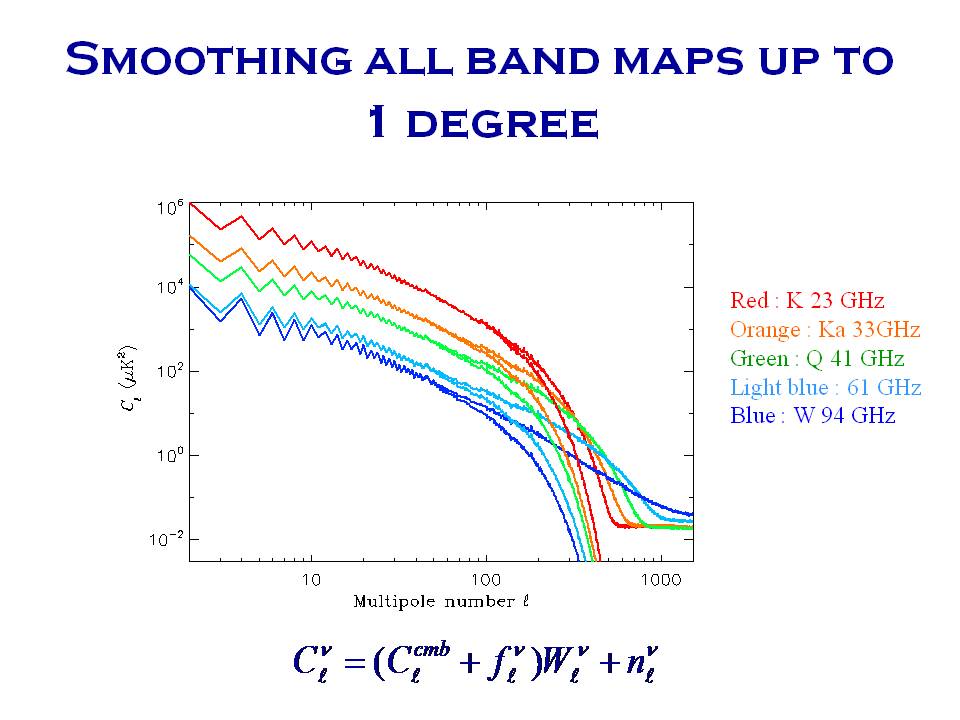
Now, here are the power spectra of the maps in each frequency channel

Note this is Cl not l(l+1)Cl as in the first plot of the spectrum. Now you see how much foreground there is in the data: the curves would lie on top of each other if the signal were pure CMB, i.e. if it did not vary with frequency. The equation at the bottom basically just says that the overall spectrum is a smoothed version of the CMB plus the foregrounds  plus noise. Note, crucially,  that the smoothing suppresses the interesting high-l wiggles.

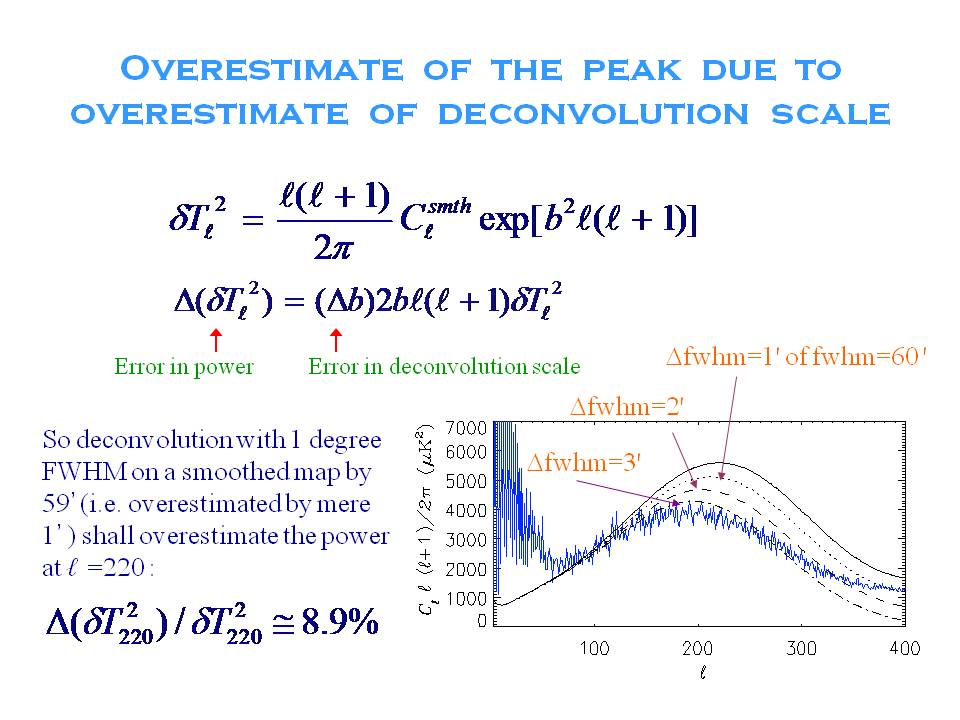
I haven’t got space-time enough to go into how the foreground subtraction is carried out, but once it is done it is necessary to “unblur” the maps in order to see the structure at small angular scales, i.e. at large spherical harmonic numbers l. The initial process of convolving the sky pattern with a filter corresponds to multiplying the power-spectrum with a “window function” that decreases sharply at high l, so to deconvolve the spectrum one essentially has to divide by this window function to reinstate the power removed at high harmonics.

This is where it all gets very tricky. The smoothing applied is very close to the scale of the acoustic peaks so you have to do it very carefully to avoid introducing artificial structure in Cl or obliterating structure that you want to see. Moreover, a small error in the beam gets blown up in the deconvolution so one can go badly wrong in recovering the final spectrum. In other words, you need to know the beam very well to have any chance of getting close to the right answer!

The next picture gives a rough model for how much the “recovered” spectrum depends on the error produced by making even a small error in the beam profile which, for illustration only, is assumed to be Gaussian. It also shows how sensitive the shape of the deconvolved spectrum is to small errors in the beam.

Incidentally, the ratty blue line shows the spectrum obtained from a small patch of the sky rather than the whole sky. We were interested to see how much the spectrum varied across the sky so broke it up into square patches about the same size as those analysed by the Boomerang experiment. This turns out to be a pretty good way of getting the acoustic peak position but, as you can see, you lose information at low l (i.e. on scales larger than the patch).

The WMAP beam isn’t actually Gaussian – it differs quite markedly in its tails, which means that there’s even more cross-talk between different harmonic modes than in this example – but I hope you get the basic point. As Sawangwit & Shanks say, you need to know the beam very well to get the right fluctuation spectrum out. Move the acoustic peak around only slightly and all bets are off about the cosmological parameters and, perhaps, the evidence for dark energy and dark matter. Lung-Yih looked at the way the WMAP had done it and concluded that if their published beam shape was right then they had done a good job and there’s nothing substantially wrong with the results shown in the first graph.

Sawangwit & Shanks suggest the beam isn’t right so the recovered angular spectrum is suspect. I’ll need to look a bit more at the evidence they consider before commenting on that, although if anyone else has worked through it I’d be happy to hear from them through the comments box!

Dark Horizons

Posted in Cosmic Anomalies, The Universe and Stuff with tags , , , , , , on March 21, 2010 by telescoper

Last Tuesday night I gave a public lecture as part of  Cardiff University’s contribution to National Science and Engineering Week. I had an audience of about a hundred people, although more than half were students from the School of Physics & Astronomy rather than members of the public. I’d had a very full day already by the time it began (at 7pm) and I don’t mind admitting I was pretty exhausted even before I started the talk. I’m offering that as an excuse for struggling to get going, although I think I got better as I got into it. Anyway, I trotted out the usual stuff about the  Cosmic Web and it seemed to go down fairly well, although I don’t know about that because I wasn’t really paying attention.

At the end of the lecture, as usual, there was a bit of time for questions and no shortage of hands went up. One referred to something called Dark Flow which, I’ve just noticed, has actually got its own wikipedia page. It was also the subject of a recent Horizon documentary on BBC called Is Everything we Know about the Universe Wrong? I have to say I thought the programme was truly terrible, but that’s par for the course for Horizon these days I’m afraid. It used to be quite an interesting and informative series, but now it’s full of pointless special effects, portentous and sensationalising narration, and is repetitive to the point of torture. In this case also, it also portrayed a very distorted view of its subject matter.

The Dark Flow is indeed quite interesting, but of all the things that might threaten the foundations of the Big Bang theory this is definitely not it. I certainly have never lost any sleep worrying about it. If it’s real and not just the result of a systematic error in the data – and that’s a very big “if” – then the worst it would do would be to tell us that the Universe was a bit more complicated than our standard model. The same is true of the other cosmic anomalies I discuss from time to time on here.  

But we know our standard model leaves many questions unanswered and, as a matter of fact, many questions unasked. The fact that Nature may present us with a few surprises doesn’t mean the whole framework is wrong. It could be wrong, of course. In fact I’d be very surprised if our standard view of cosmology survives the next few decades without major revision. A healthy dose of skepticism is good for cosmology. To some extent, therefore, it’s good to have oddities like the Dark Flow out in the open.

However, that shouldn’t divert our attention from the fact that the Big Bang model isn’t just an arbitrary hypothesis with no justification. It’s the result of almost a century of  vigorous interplay between theory and observation, using an old-fashioned thing called the scientific method. That’s probably too dull for the producers of  Horizon, who would rather portray it as a kind of battle of wills between individuals competing for the title of next Einstein.

Anyway, just to emphasize the fact that I think questioning the Big Bang model is a good thing to do, here is a list of fundamental questions that should trouble modern cosmologists. Most of them are fundamental,  and we do not have answers to them. 

Is General Relativity right?

Virtually everything in the standard model depends on the validity of Einstein’s general theory of relativity (or theory of general relativity…). In a sense we already know that the answer to this question is “no”.

At sufficiently high energies (near the Planck scale) we expect classical relativity to be replaced by a quantum theory of gravity. For this reason, a great deal of interest is being directed at cosmological models inspired by superstring theory. These models require the existence of extra dimensions beyond the four we are used to dealing with. This is not in itself a new idea, as it dates back to the work of Kaluza and Klein in the 1920s, but in older versions of the idea the extra dimensions were assumed to be wrapped up so small as to be invisible. In “braneworld models”, the extra dimensions can be large but we are confined to a four-dimensional subset of them (a “brane”). In one version of this idea, dubbed the Ekpyrotic Universe, the origin of our observable universe lies in the collision between two branes in a higher-dimensional “bulk”. Other models are less dramatic, but do result in the modification of the Friedmann equations at early times.

 It is not just in the early Universe that departures from general relativity are possible. In fact there are many different alternative theories on the market. Some are based on modifications of Newton’s gravitational mechanics, such as MOND, modifications of Einstein’s theory, such as the Brans-Dicke theory, as well as those theories involving extra dimensions, such as braneworld theory, and so on

There remain very few independent tests of the validity of Einstein’s theory, particularly in the limit of strong gravitational fields. There is very little independent evidence that the curvature of space time on cosmological scales is related to the energy density of matter. The chain of reasoning leading to the cosmic concordance model depends entirely this assumption. Throw it away and we have very little to go on.

What is the Dark Energy?

In the standard cosmology, about 75% of the energy density of the Universe is in a form we do not understand. Because we’re in the dark about it, we call it Dark Energy. The question here is twofold. One part is whether the dark energy is of the form of an evolving scalar field, such as quintessence, or whether it really is constant as in Einstein’s original version. This may be answered by planned observational studies, but both of these are at the mercy of funding decisions. The second part is to whether dark energy can be understood in terms of fundamental theory, i.e. in understanding why “empty space” contains this vacuum energy.  I think it is safe to say we are still very far from knowing how vacuum energy on a cosmological scale arises from fundamental physics. It’s just a free parameter.


What is the Dark Matter?

Around 25% of the mass in the Universe is thought to be in the form of dark matter, but we don’t know what form it takes. We do have some information about this, because the nature of the dark matter determines how it tends to clump together under the action of gravity. Current understanding of how galaxies form, by condensing out of the primordial explosion, suggests the dark matter particles should be relatively massive. This means that they should move relatively slowly and can consequently be described as “cold”. As far as gravity is concerned, one cold particle is much the same as another so there is no prospect for learning about the nature of cold dark matter (CDM) particles through astronomical means unless they decay into radiation or some other identifiable particles. Experimental attempts to detect the dark matter directly are pushing back the limits of technology, but it would have to be a long shot for them to succeed when we have so little idea of what we are looking for.

Did Inflation really happen?

The success of concordance cosmology is largely founded on the appearance of “Doppler peaks” in the fluctuation spectrum of the cosmic microwave background (CMB). These arise from acoustic oscillations in the primordial plasma that have particular statistical properties consistent owing to their origin as quantum fluctuations in the scalar field driving a short-lived period of rapid expansion called inflation. This is strong circumstantial evidence in favour of inflation, but perhaps not strong enough to obtain a conviction. The smoking gun for inflation is probably the existence of a stochastic gravitational wave background. The identification and extraction of this may be possible using future polarisation-sensitive CMB studies even before direct experimental probes of sufficient sensitivity become available. As far as I am concerned, the jury will be out for a considerable time.

Despite these gaps and uncertainties, the ability of the standard framework to account for such a diversity of challenging phenomena provides strong motivation for assigning it a higher probability than its competitors. Part of this  is that no other theory has been developed to the point where we know what predictions it can make. Some of the alternative  ideas  I discussed above are new, and consequently we do not really understand them well enough to know what they say about observable situations. Others have adjustable parameters so one tends to disfavour them on grounds of Ockham’s razor unless and until some observation is made that can’t be explained in the standard framework.

Alternative ideas should be always explored. The business of cosmology, however,  is not only in theory creation but also in theory testing. The great virtue of the standard model is that it allows us to make precise predictions about the behaviour of the Universe and plan observations that can test these predictions. One needs a working hypothesis to target the multi-million-pound investment that is needed to carry out such programmes. By assuming this model we can make rational decisions about how to proceed. Without it we would be wasting taxpayers’ money on futile experiments that have very little chance of improving our understanding. Reasoned belief  in a plausible working hypothesis is essential to the advancement of our knowledge.

 Cosmologists may appear a bit crazy (especially when they appear on TV), but there is method in their madness. Sometimes.

First Light from Planck!

Posted in The Universe and Stuff with tags , , , on September 17, 2009 by telescoper

Credit to Andrew Jaffe for alerting me to the fact that ESA’s first press release concerning Planck has now been, well, released…

I last blogged about Planck when it had reached its orbit around L2 and cooled down to its working temperature of 100 milliKelvin. Over the ensuing weeks it has been tested and calibrated, prodded and poked (electronically of course) and generally tuned up. More recently it has completed a “mini-survey” to check that it’s all working as planned.

The way Planck scans means that it takes about six months to cover the whole sky, which is much longer than the two-week period allowed for the mini-survey. This explains the fact that a relatively narrow slice of the celestial sphere has been mapped. However, you can see the foreground emission from the Galactic plane quite clearly. Here is the region shown in the box split into the nine separate frequency channels that Planck observes:

The High Frequency Instrument (HFI) is more sensitive to dust, while the Low Frequency Instrument (LFI) detects more radio emission. It all seems to be working as expected!

And finally here’s a blow up of the smaller square above the Galactic plane shown as seen by  LFI and HFI:

This region is much less prone to foreground emission. The fact that similar structures are seen in the two completely independent receivers shows that the structure is not just instrument noise. In other words, Planck is seeing the cosmic microwave background!

Now Planck will carry out its full survey, scanning the sky for another year or so. There will then be an intense period of data analysis for about another year after which the key science results will be published. Exciting times.

Lessening Anomalies

Posted in Cosmic Anomalies, The Universe and Stuff with tags , , , , , on September 15, 2009 by telescoper

An interesting paper caught my eye on today’s ArXiv and I thought I’d post something here because it relates to an ongoing theme on this blog about the possibility that there might be anomalies in the observed pattern of temperature fluctuations in the cosmic microwave background (CMB). See my other posts here, here, here, here and here for related discussions.

One of the authors of the new paper, John Peacock, is an occasional commenter on this blog. He was also the Chief Inquisitor at my PhD (or rather DPhil) examination, which took place 21 years ago. The four-and-a-half hours of grilling I went through that afternoon reduced me to a gibbering wreck but the examiners obviously felt sorry for me and let me pass anyway. I’m not one to hold a grudge so I’ll resist the temptation to be churlish towards my erstwhile tormentor.

The most recent paper is about the possible  contribution of  the integrated Sachs-Wolfe (ISW) effect to these anomalies. The ISW mechanism generates temperature variations in the CMB because photons travel along a line of sight through a time-varying gravitational potential between the last-scattering surface and the observer. The integrated effect is zero if the potential does not evolve because the energy shift falling into a well exactly balances that involved in climbing out of one. If in transit the well gets a bit deeper, however, there is a net contribution.

The specific thing about the ISW effect that makes it measurable is that the temperature variations it induces should correlate with the pattern of structure in the galaxy distribution, as it is these that generate the potential fluctuations through which CMB photons travel. Francis & Peacock try to assess the ISW contribution using data from the 2MASS all-sky survey of galaxies. This in itself contains important cosmological clues but in the context of this particular question it is a nuisance, like any other foreground contamination, so they subtract it off the maps obtained from the Wilkinson Microwave Anisotropy Probe (WMAP) in an attempt to get a cleaner map of the primordial CMB sky.

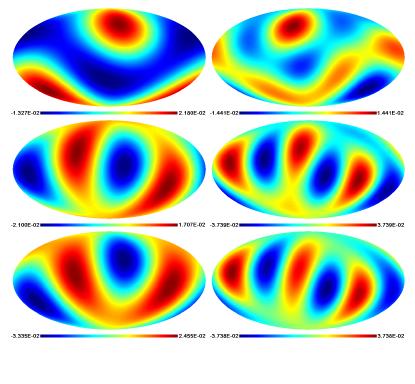
The results are shown in the picture below which presents  the lowest order spherical harmonic modes, the quadrupole (left) and octopole (right) for the  ISW component (top) , WMAP data (middle) and at the bottom we have the cleaned CMB sky (i.e. the middle minus the top). The ISW subtraction doesn’t make a huge difference to the visual appearance of the CMB maps but it is enough to substantially reduce to the statistical significance of at least some of the reported anomalies I mentioned above. This reinforces how careful we have to be in analysing the data before jumping to cosmological conclusions.

peacock

There should also be a further contribution from fluctuations beyond the depth of the 2MASS survey (about 0.3 in redshift).  The actual ISW effect could therefore  be significantly larger than this estimate.