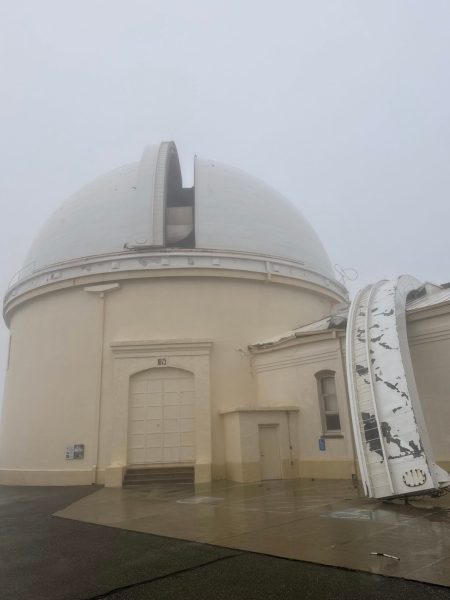
I missed, until now, the news that on Christmas Day, high winds accompanying a violent storm seriously damaged the historic Lick Observatory.
The gales were strong enough to rip one of the shutters from the dome of the 36″ refracting telescope and send it crashing onto the roof of the adjacent building.
The Observatory remains closed to the public while the structural damage is assessed and repairs made. Fortunately it seems nobody was hurt and no instruments were affected.
Here’s a video of the detached shutter being removed
The Lick Observatory is located on Mount Hamilton near San Jose in California. A donation by San Francisco millionaire James Lick enabled the construction of the 36” (diameter) refractor, the most powerful telescope in the world at the time. The Observatory was almost destroyed in 2020 by a wildfire, but the new incident is the most serious damage in its 137-year history.
As I blogged about here, the Lick Observatory played an important role in the development of our understanding of the large-scale structure of the Universe, specifically with the creation of the Lick galaxy survey prepared by Charles Donald Shane and Carl Alvar Wirtanen and published in 1967 (Publ. Lick. Observatory 22, Part 1). In my more poetic moments, the image on the left puts me in mind of W.B. Yeats: Had I the heavens’ embroidered cloths.
That catalogue was still proving a useful resource well into the 1990s; I was part of various analyses of it myself, starting with this paper from 1991. It was eventually superceded by the arrival of large-scale galaxy redshift surveys, but it remaining an amazing achievement.
The Lick Galaxy survey was not performed with the 36″ refractor mentioned above, however, but by twin 20″ Carnegie astrographic telescopes housed in a different dome. As far as I know, these were not damaged in the storm.
Just before the Christmas break I noticed a considerable amount of press coverage claiming that Dark Energy doesn’t exist. Much of the media discussion is closely based on a press release produced by the Royal Astronomical Society. Despite the excessive hype, and consequent initial scepticism, I think the paper has some merit and raises some interesting issues.
The main focus of the discussion is a paper (available on arXiv here) by Seifert et al. with the title Supernovae evidence for foundational change to cosmological models. This paper is accompanied by a longer article called Cosmological foundations revisited with Pantheon+ (also available on arXiv) by a permutation of the same authors, which goes into more detail about the analysis of supernova observations. If you want some background, the “standard” Pantheon+ supernova analysis is described in this paper. The reanalysis presented in the recent papers is motivated an idea called the Timescape model, which is not new. It was discussed by David Wiltshire (one of the authors of the recent papers) in 2007 here and in a number of subsequent papers; there’s also a long review article by Wiltshire here (dated 2013).
So what’s all the fuss about?
Simulation of the Cosmic Web
In the standard cosmological model we assume that, when sufficiently coarse-grained, the Universe obeys the Cosmological Principle, i.e. that it is homogeneous and isotropic. This implies that the space-time is described by a Friedmann–Lemaître–Robertson–Walker metric (FLRW) metric. Of course we know that the Universe is not exactly smooth. There is a complex cosmic web of galaxies, filaments, clusters, and giant voids which comprise the large-scale structure of the Universe. In the standard cosmological model these fluctuations are treated as small perturbations on a smooth background which evolve linearly on large scales and don’t have a significant effect on the global evolution of the Universe.
This standard model is very successful in accounting for many things but only at the expense of introducing dark energy whose origin is uncertain but which accounts for about 70% of the energy density of the Universe. Among other things, this accounts for the apparent acceleration of the Universe inferred from supernovae measurements.
The standard cosmology’s energy budget
The approach taken in the Timescape model is to dispense with the FLRW metric, and the idea of separating the global evolution from the inhomogeneities. The idea instead is that the cosmic structure is essentially non-linear so there is no “background metric”. In this model, cosmological observations can not be analysed within the standard framework which relies on the FLRW assumption. Hence the need to reanalyse the supernova data. The name Timescape refers to the presence of significant gravitational time-dilation effects in this model as distinct from the standard model.
….the supernovae measurements do not directly measure cosmic acceleration. If one tries to account for them with a model based on Einstein’s general relativity and the assumption that the Universe is on large-scales is homogeneous and isotropic and with certain kinds of matter and energy then the observations do imply a universe that accelerates. Any or all of those assumptions may be violated (though some possibilities are quite heavily constrained). In short we could, at least in principle, simply be interpreting these measurements within the wrong framework…
So what to make of the latest papers? I have to admit that I didn’t follow all the steps of the supernova reanalysis. I hope an expert can comment on this! I will therefore restrict myself to some general comments.
My attitude to the standard cosmological model is that it is simply a working hypothesis and we should not elevate it to a status any higher than that. It is based not only on the Cosmological Principle (which could be false), but on the universal applicability of general relativity (which might not be true), and on a number of other assumptions that might not be true either.
It is important to recognize that one of the reasons that the standard cosmology is the front-runner is that it provides a framework that enables relatively straightforward prediction and interpretation of cosmological measurements. That goes not only for supernova measurements but also for the cosmic microwave background, galaxy clustering, gravitational lensing, and so on. This is much harder to do accurately in the Timescape model simply because the equations involved are much more complex; there are few exact solutions of Einstein’s equations that can help. It is important that people work on alternatives such as this.
Second, the idea that inhomogeneities might be much more important than assumed in the standard model has been discussed extensively in the literature over the last twenty years or so under the heading “backreaction”. My interpretation of the current state of play is that there are many unresolved questions, largely because of technical difficulties. See, for example, work by Thomas Buchert (here and, with many other collaborators here) and papers by Green & Wald (here and here). Nick Kasiser also wrote about it here.
The new papers under discussion focus entirely on supernovae measurements. It must be recognized that these provide just one of the pillars supporting the standard cosmology. Over the years, many alternative models have been suggested that claim to “fix” some alleged problem with cosmology only to find that it makes other issues worse. That’s not a reason to ignore departures from the standard framework, but it is an indication that we have a huge amount of data and we’re not allowed to cherry-pick what we want. We have to fit it all. The strongest evidence in favour of the FLRW framework actually comes from the cosmic microwave background (CMB) with the supernovae provide corroboration. I would need to see a detailed prediction of the anisotropy of the CMB before being convinced.
The Timescape model is largely based on the non-linear expansion of cosmic voids. These are undoubtedly important, and there has been considerable observational and theoretical activity in understanding them and their evolution in the standard model. It is not at all obvious to me that the voids invoked to explain the apparent acceleration of the Universe are consistent with what we actually see in our surveys. That is something else to test.
Finally, the standard cosmology includes a prescription for the initial conditions from which the present inhomogeneities grew. Where does the cosmic web come from in the Timescape model?
Anyway, I’m sure there’ll be a lot of discussion of this in the next few weeks as cosmologists return to the Universe from their Christmas holidays!
Comments are welcome through the box below, especially from people who have managed to understand the cos.
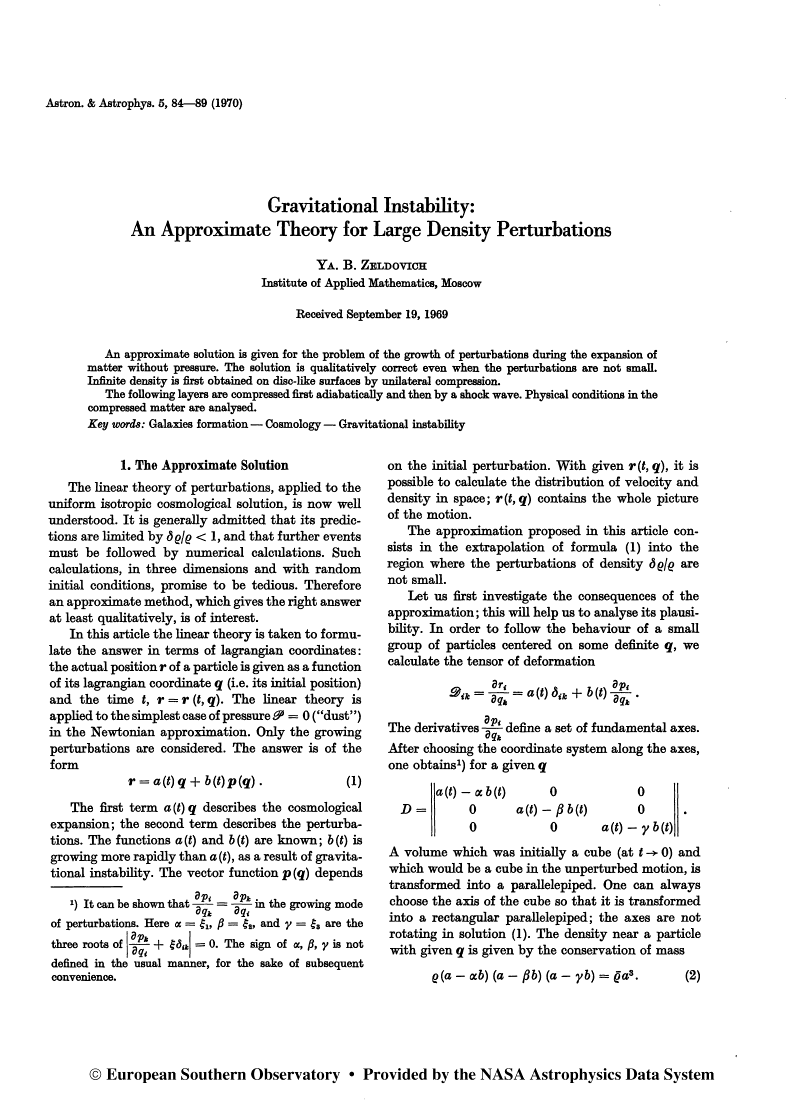
Today it’s Shrove Tuesday but unfortunately I forgot to buy shroves yesterday so will have to make do with pancakes instead, but not the usual kind. I’ve blogged before about the Zel’dovich Approximation (published in Zeldovich, Ya.B. 1970, A&A, 5, 84) but there’s no harm in describing this classic again. Here’s the first page of the original paper:
In a nutshell, this daringly simple approximation considers the evolution of particles in an expanding Universe from an early near-uniform state into the non-linear regime as a sort of ballistic, or kinematic, process. Imagine the matter particles are initial placed on a uniform grid, where they are labelled by Lagrangian coordinates . Their (Eulerian) positions at some later time are taken to be
Here the coordinates are comoving, i.e. scaled with the expansion of the Universe using the scale factor . The displacement between initial and final positions in comoving coordinates is taken to have the form
where is a kind of velocity potential (which is also in linear Newtonian theory proportional to the gravitational potential).If we’ve got the theory right then the gravitational potential field defined over the initial positions is a Gaussian random field. The function is the growing mode of density perturbations in the linear theory of gravitational instability.
This all means that the particles just get a small initial kick from the uniform Lagrangian grid and their subsequent motion carries on in the same direction. The approximation predicts the formation of caustics in the final density field when particles from two or more different initial locations arrive at the same final location, a condition known as shell-crossing. The caustics are identified with the main elements we find in large-scale structure. Because the initial collapse is usually along one direction the dominant structures are known as pancakes (or, as Zel’dovich himself might have called them, blini…).
Here’s a picture of a simulation showing these structures from the classic paper of Davis, Efstathiou, Frenk & White (1985):
Despite its simplicity this approximation is known to perform extremely well at reproducing the morphology of the cosmic web, although it breaks down after shell-crossing has occurred. In reality, bound structures are formed whereas the Zel’dovich approximation simply predicts that particles sail straight through the caustic which consequently evaporates.
How can we map the distribution of galaxies over thousands of millions of light years? What does the Universe look like on these scales? How did get to look like that? And how do we know?This talk will explain how astronomers and cosmologists have come together over the past couple of decades to make huge surveys of the Universe, revealing the existence of a complex but beautiful `Cosmic Web’ with vast chains of galaxies strung out around immense dark voids. These observational breakthroughs have been mirrored by advances in theory and computer simulation that allow us to understand how this amazing structure was born 14 billion years ago in the Big Bang and has been growing and evolving ever since. Free and open to TY, 5th and 6th year students, this talk will be of particular interest in those interested astronomy, space, physics and the Universe itself!
It is on in the morning to make it possible for school students to attend and the talk is adapted to this audience, so it won’t be the same as the one I gave in Dublin last week. The timing seems to have worked because the lecture theatre has over 200 seats in it but is already almost full. There are still a few places available so if you’re in the area you can book here.
I’m interrupting my short break to post a quick reminder that I’m giving a public talk at the Dublin Institute for Advanced Studies (DIAS) this coming Thursday, Dark Matter Day, October 31st 2019, coincidentally the same day as Hallowe’en, or in modern parlance Not-Brexit Day. I am particularly grateful to be invited to give a talk that evening because it allows me to avoid getting involved in trick-or-treat or any of that nonsense.
Here is the nice advert the people at DIAS have made for the event:
The talk is free, but you need to sign up here as the venue is not infinitely large and is already almost full. You can also find some more details about the talk there.
Just a quick post to mention that I’m giving a public talk at the Dublin Institute for Advanced Studies (DIAS) on Dark Matter Day, October 31st 2019, coincidentally the same day as Halloween. I am particularly grateful to be invited to give a talk that evening because it allows me to avoid getting involved in trick-or-treat or any of that nonsense.
Here is the nice advert the people at DIAS have made for the event:
The talk is free, but you need to sign up here as the venue is not infinitely large. You can also find some more details about the talk there.
I saw that there’s a new paper that has just been published in the journal Science by Umehata et al with the title Gas filaments of the cosmic web located around active galaxies in a protocluster. In case you run into a paywall at Science, you may of course, find the paper on the arXiv here.
The abstract reads:
Cosmological simulations predict the Universe contains a network of intergalactic gas filaments, within which galaxies form and evolve. However, the faintness of any emission from these filaments has limited tests of this prediction. We report the detection of rest-frame ultraviolet Lyman-alpha radiation from multiple filaments extending more than one megaparsec between galaxies within the SSA 22 proto-cluster at a redshift of 3.1. Intense star formation and supermassive black-hole activity is occurring within the galaxies embedded in these structures, which are the likely sources of the elevated ionizing radiation powering the observed Lyman-alpha emission. Our observations map the gas in filamentary structures of the type thought to fuel the growth of galaxies and black holes in massive proto-clusters.
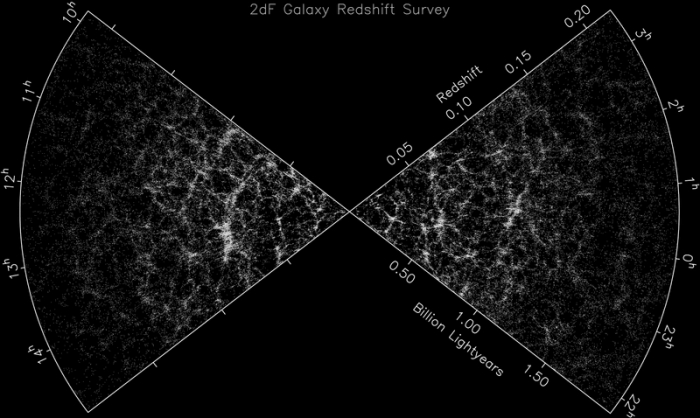
The existence of a complex cosmic web of filaments and voids has been known about for some time as it is revealed on large scales by the distribution of galaxies through redshift surveys:
You can see all my posts agged with `Cosmic Web’ here. There are also good theoretical reasons (besides numerical simulations) for believing this is what the large-scale distribution of matter should look like. Roughly speaking, dense knots of matter lie at the vertices of a three-dimensional pattern traced out by one-dimensional structures.
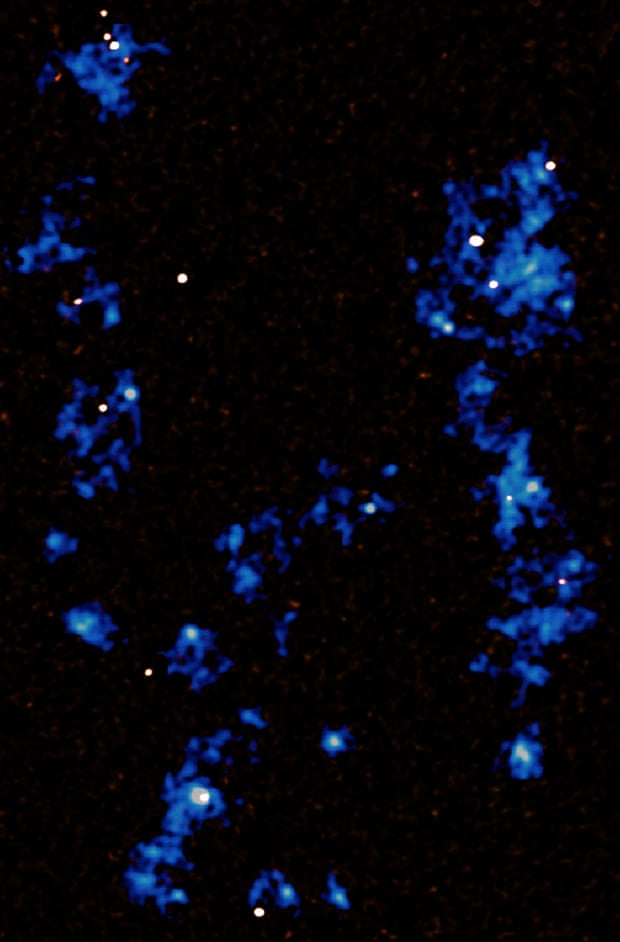
We have also known for some time, however, that there is more going on in cosmic structure than is revealed by light from stars in galaxies. In particular the way gas flows along the filaments into the knots plays an important role in galaxy and cluster formation. This paper reveals the distribution of gas around a giant cluster that has formed at such a node using observations made using the European Southern Observatory’s MUSE instrument.
Here’s a pretty picture:
I found out about this paper from a news piece in the Guardian with the title Scientists observe mysterious cosmic web directly for first time. That’s sufficiently misleading for me to cross-file the paper under `Astrohype’ because, as I explained above, we have been observing the cosmic web for decades. It is however only just becoming possible to observe the diffuse gas rather than having to join the dots between the galaxies so it is an exciting result. My complaint, I suppose, is that the word `directly’ is doing a lot of heavy lifting in the title!
Just before I went off on my break I published another new paper at The Open Journal of Astrophysics, but I didn’t get time to write a post about before going on leave. In fact I completed the publication process using a WIFI connection in the departure lounge at Dublin Airport!
The authors are Miguel Aragon Calvo of Instituto de Astronomía at UNAM in Ensenada, Mexico , Mark Neyrinck of the University of the Basque Country and Joseph Silk – yes, that Joseph Silk! – of the Institut dAstrophysique de Paris Université Pierre et Marie Curie. If the Open Journal project is to succeed we need to get some big names submitting papers, and there aren’t many bigger than Joe Silk so I’m very glad to see him among the author list.
You can find the accepted version on the arXiv here. This version was accepted after modifications requested by the referee and editor. Because this is an overlay journal the authors have to submit the accepted version to the arXiv (which we then check against the copy submitted to us) before publishing; version 3 on the arXiv is the accepted version.
You will see that this is one for the `Astrophysics of Galaxies’ folder. We would be happy to get more submissions from other areas, especially Stellar and Planetary astrophysics. Hint! Hint!
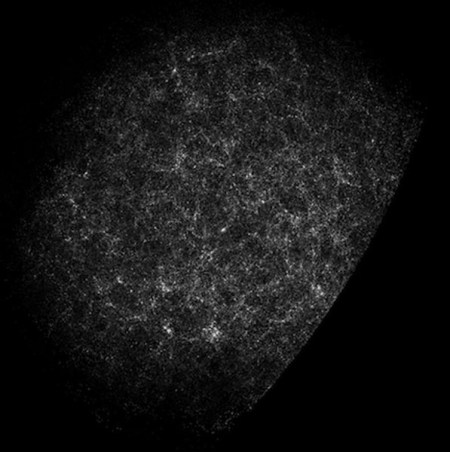
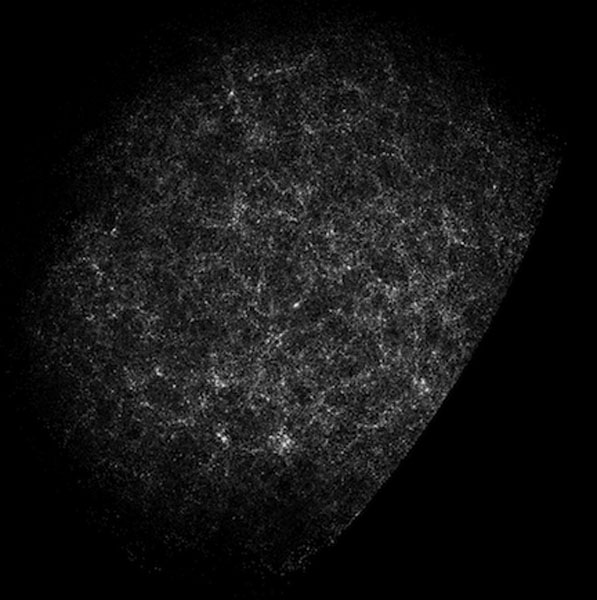
I’ve just given a lecture on cosmology during which I showed a version of this amazing image:
The picture was created in 1977 by Seldner et al. based on the galaxy counts prepared by Charles Donald Shane and Carl Alvar Wirtanen and published in 1967 (Publ. Lick. Observatory 22, Part 1). There are no stars in the picture: it shows the distribution of galaxies in the Northern Galactic sky. The very dense knot of galaxies seen in the centre of the image is the Coma Cluster, which lies very close to the Galactic North pole.The overall impression is of a frothy pattern, which we now know as the Cosmic Web. I don’t think it is an unreasonable claim that the Lick galaxy catalogue provided the first convincing evidence of the form of the morphology of the large-scale structure of the Universe.
The original Shane-Wirtanen Lick galaxy catalogue lists counts of galaxies in 1 by 1 deg of arc blocks, but the actual counts were made in 10 by 10 arcmin cells. The later visualization is based on a reduction of the raw counts to obtain a catalogue with the original 10 by 10 arcmin resolution. The map above based on the corrected counts shows the angular distribution of over 800,000 galaxies brighter than a B magnitude of approximately 19.
The distribution of galaxies is shown only in projection on the sky, and we are now able to probe the distribution in the radial direction with large-scale galaxy redshift surveys in order to obtain three-dimensional maps, but counting so many galaxy images by eye on photographic plates was a Herculean task that took many years to complete. Without such heroic endeavours in the past, our field would not have progressed anything like as quickly as it has.
I’m sorry I missed the 50th anniversary of the publication of the Lick catalogue, and Messrs Shane and Wirtanen both passed away some years ago, but at last I can doff my cap in their direction and acknowledge their immense contribution to cosmological research!
UPDATE: In response to the comments below, I have updated this scan of the original rendition of the Lick counts:
A little bird tweeted at me this morning that today is the 20th anniversary of first light through the Sloan Telescope (funded by the Alfred P. Sloan Foundation) which has, for the past two decades, been surveying as much of the sky as it can from its location in New Mexico (about 25% altogether): the Sloan Digital Sky Survey is now on its 14th data release.
Here’s a picture of the telescope:
For those of you who want the optical details, the Sloan Telescope is a 2.5-m f/5 modified Ritchey-Chrétien altitude-azimuth telescope located at Apache Point Observatory, in south east New Mexico (Latitude 32° 46′ 49.30″ N, Longitude 105° 49′ 13.50″ W, Elevation 2788m). A 1.08 m secondary mirror and two corrector lenses result in a 3° distortion-free field of view. The telescope is described in detail in a paper by Gunn et al. (2006).
A 2.5m telescope of modest size by the standards of modern astronomical research, but the real assets of the Sloan telescope is a giant mosaic camera, highly efficient instruments and a big investment in the software required to generate and curate the huge data sets it creates. A key feature of SDSS is that its data sets are publicly available and, as such, they have been used in countless studies by a huge fraction of the astronomical community.
The Sloan Digital Sky Survey’s original `legacy’ survey was basically a huge spectroscopic redshift survey, mapping the positions of galaxies and quasars in three dimensions to reveal the `cosmic web’ in unprecedented detail:
As it has been updated and modernised, the Sloan Telescope has been involved in a range of other surveys aimed at uncovering different aspects of the universe around us, including several programmes still ongoing.
The views presented here are personal and not necessarily those of my employer (or anyone else for that matter).
Feel free to comment on any of the posts on this blog but comments may be moderated; anonymous comments and any considered by me to be vexatious and/or abusive and/or defamatory will not be accepted. I do not necessarily endorse, support, sanction, encourage, verify or agree with the opinions or statements of any information or other content in the comments on this site and do not in any way guarantee their accuracy or reliability.


 . Their (Eulerian) positions at some later time
  are taken to be
![vec{r}(vec(q),t) = a(t) vec{x}(vec{q},t) = a(t) left[ vec{q} + b(t) vec{s}(vec{q},t) right].](https://s0.wp.com/latex.php?latex=vec%7Br%7D%28vec%28q%29%2Ct%29+%3D+a%28t%29+vec%7Bx%7D%28vec%7Bq%7D%2Ct%29+%3D+a%28t%29+left%5B+vec%7Bq%7D+%2B+b%28t%29+vec%7Bs%7D%28vec%7Bq%7D%2Ct%29+right%5D.&bg=000000&fg=B0B0B0&s=0&c=20201002)
 coordinates are comoving, i.e. scaled with the expansion of the Universe using the scale factor
  . The displacement
  between initial and final positions in comoving coordinates is taken to have the form
 is a kind of velocity potential (which is also in linear Newtonian theory proportional to the gravitational potential).If we’ve got the theory right then the gravitational potential field defined over the initial positions is a Gaussian random field. The function
  is the growing mode of density perturbations in the linear theory of gravitational instability.




 In the Dark