Archive for Cosmology and NonGalactic Astrophysics

Four New Publications at the Open Journal of Astrophysics

Posted in OJAp Papers, Open Access, The Universe and Stuff with tags , , , , , , , , , , , , , , , , , , , on September 14, 2024 by telescoper

Once again, it’s time for a quick update of activity at the Open Journal of Astrophysics. This week we have published another batch of four papers which takes the count in Volume 7 (2024) up to 77 and the total published altogether by OJAp up to 192. Things are picking up again after the summer lull, and we’re moving towards a double century. If we keep up a steady average of four per week we’ll be at 200 per year.

In chronological order, the four papers published this week, with their overlays, are as follows. You can click on the images of the overlays to make them larger should you wish to do so.

First one up is “Quasi-two-dimensionality of three-dimensional, magnetically dominated, decaying turbulence” by Shreya Dwivedi, Chandranathan Anandavijayan, and Pallavi Bhat of TIFR, Bangalore, India. The paper presents an analysis of numerical simulations of MHD turbulence using Minkowski Functionals, with implications for local anisotropies revealed therein. It was published on 9th September 2024 and is in the folder marked High-Energy Astrophysical Phenomena.

Here is a screen grab of the overlay, which includes the abstract:


You can find the officially accepted version of the paper on the arXiv here.

The second paper to announce, also published on 9th September 2024, is “mochi_class: Modelling Optimisation to Compute Horndeski In class” by  Matteo Cataneo (Universität Bonn, Germany) and Emilio Bellini (SISSA, Trieste, Italy). This article presents a cosmological Einstein-Boltzmann solver adapted to work with Horndeski gravity, together with validation tests. It is in the folder Cosmology and NonGalactic Astrophysics.

You can see the overlay here:


The accepted version of this paper can be found on the arXiv here.

The third paper, published on 11th September 2024 in the folder marked High-Energy Astrophysical Phenomena, is by Jonathan Katz of Washington University, St Louis, USA. The title is “The Sources of Fast Radio Bursts” and it presents a discussion of the possible physical origin of Fast Radio Bursts, arguing that they fall into two distinct groups.


The final version accepted on arXiv is here.

Last in this batch, but by no means least, is “RMS asymmetry: a robust metric of galaxy shapes in images with varied depth and resolution” by Elizaveta Sazonova (U. Waterloo, Canada) with 15 other authors spread around the world (in Canada, USA, Australia, Italy, Chile, UK, Poland, Mexico, Germany, and Spain). This paper presents a method of quantifying distortion of galaxy images connected with mergers or other instabilities. It is in the folder marked Astrophysics of Galaxies and was published on September 12th 2024 with this overlay:


You can find the official accepted version on the arXiv here.

That’s all for now. I will post another update in a week.

Two New Publications at the Open Journal of Astrophysics

Posted in OJAp Papers, Open Access, The Universe and Stuff with tags , , , , , , , , , on September 7, 2024 by telescoper

It’s Saturday morning again so here’s another report on activity at the  Open Journal of Astrophysics.  Since the last update we have published two more papers, taking  the count in Volume 7 (2024) up to 73 and the total published by OJAp up to 188.  We’ve still got a few in the pipeline waiting for the final versions to appear on arXiv so I expect we’ll reach the 200 mark fairly soon.

The first paper of the most recent pair, published on September 4th 2024,  and in the folder marked Astrophysics of Galaxies, is “Massive Black Hole Seeds”  by John Regan of the Department of Theoretical Physics at Maynooth University and Marta Volonteri (Sorbonne Université, Paris, France). This article presents a discussion of the pathways to the formation of massive black holes, including both light and heavy initial seeds.

Here is a screen grab of the overlay which includes the abstract:


You can click on the image of the overlay to make it larger should you wish to do so. Those of you who are paying attention will see that there is a bit of a glitch on the left hand side where software has thrown a line break in between the two author names. I have no idea what caused this so I raised a ticket with Scholastica and no doubt it will soon be fixed.  (Update: it is now fixed, 12th September 2024). You can find the officially accepted version of this paper on the arXiv here.

The second paper has the title “The future of cosmological likelihood-based inference: accelerated high-dimensional parameter estimation and model comparison” and was published on 5th September 2024. The authors are Davide Piras (Université de Genève), Alicja Polanska (MSSL) , Alessio Spurio Mancini (Royal Holloway, London), Matthew A. Price(UCL) & Jason D. McEwen (UCL); the latter four are all based in the UK. This paper, which is in  the folder marked Cosmology and NonGalactic Astrophysics, describes an accelerated approach to Bayesian inference in higher-dimensional settings, as required for cosmology, based on recent developments in machine learning and its underlying technology.

Here is a screen grab of the overlay which includes the abstract:


You can click on the image of the overlay to make it larger should you wish to do so. You can find the officially accepted version of the paper on the arXiv here.

That concludes this week’s update. More  next week!

Two New Publications at the Open Journal of Astrophysics

Posted in OJAp Papers, Open Access, The Universe and Stuff with tags , , , , , , , , , , , , on August 31, 2024 by telescoper

I am back in circulation after my little break and, since it’s Saturday, I will resume blogging with another report on activity at the  Open Journal of Astrophysics.  Since the last update we have published two more papers, taking  the count in Volume 7 (2024) up to 71 and the total published by OJAp up to 186.  We’ve still got a few in the pipeline waiting for the final versions to appear on arXiv so I expect we’ll reach the 200 mark fairly soon.

The first paper of the most recent pair, published on August 26th 2024,  is “Impact of lensing of gravitational waves on the observed distribution of neutron star masses”  by Sofia Canevarolo, Loek van Vonderen and Nora Elisa Chisari, all of Utrecht University in the Netherlands. This article presents a discussion of the bias in neutron star mass determinations caused by gravitational lensing of the gravitational waves they produceThe paper is in the folder marked Cosmology and NonGalactic Astrophysics.

Here is a screen grab of the overlay which includes the abstract:


You can click on the image of the overlay to make it larger should you wish to do so. You can find the officially accepted version of the paper on the arXiv here.

The second paper has the title “FORGE’d in FIRE III: The IMF in Quasar Accretion Disks from STARFORGE” and was published (in the early hours of the morning) on 29th August 2024. The authors, all based in the USA, are Philip F. Hopkins (Caltech), Michael Y. Grudic (Carnegie Observatories), Kyle Kremer (Caltech), Stella S. R. Offner (UT Austin), David Guszejnov (UT Austin) and Anna L. Rosen (UCSD). This paper, which is in the folder marked Astrophysics of Galaxies, presents a numerical study of star formation and the initial mass function in quasar accretion disks. The previous two papers in this series have also been published in the OJAp: you can find them here and here; images and movies related to this project can be found here.

Here is a screen grab of the overlay which includes the abstract:


You can click on the image of the overlay to make it larger should you wish to do so. You can find the officially accepted version of the paper on the arXiv here.

That concludes this week’s update. We still have quite a few papers in the pipeline after the summer lull so I expect I’ll have a larger update for you next week!

Four New Publications at the Open Journal of Astrophysics

Posted in OJAp Papers, Open Access, The Universe and Stuff with tags , , , , , , on July 20, 2024 by telescoper

This week we have published four papers at the Open Journal of Astrophysics, which I now present to you here. These four take the count in Volume 7 (2024) up to 60 and the total published altogether by OJAp up to 175. It is gratifying to see the range of high-quality papers published steadily increasing. We are getting several papers submitted every day now.

In chronological order, the four papers published this week, with their overlays, are as follows. You can click on the images of the overlays to make them larger should you wish to do so.

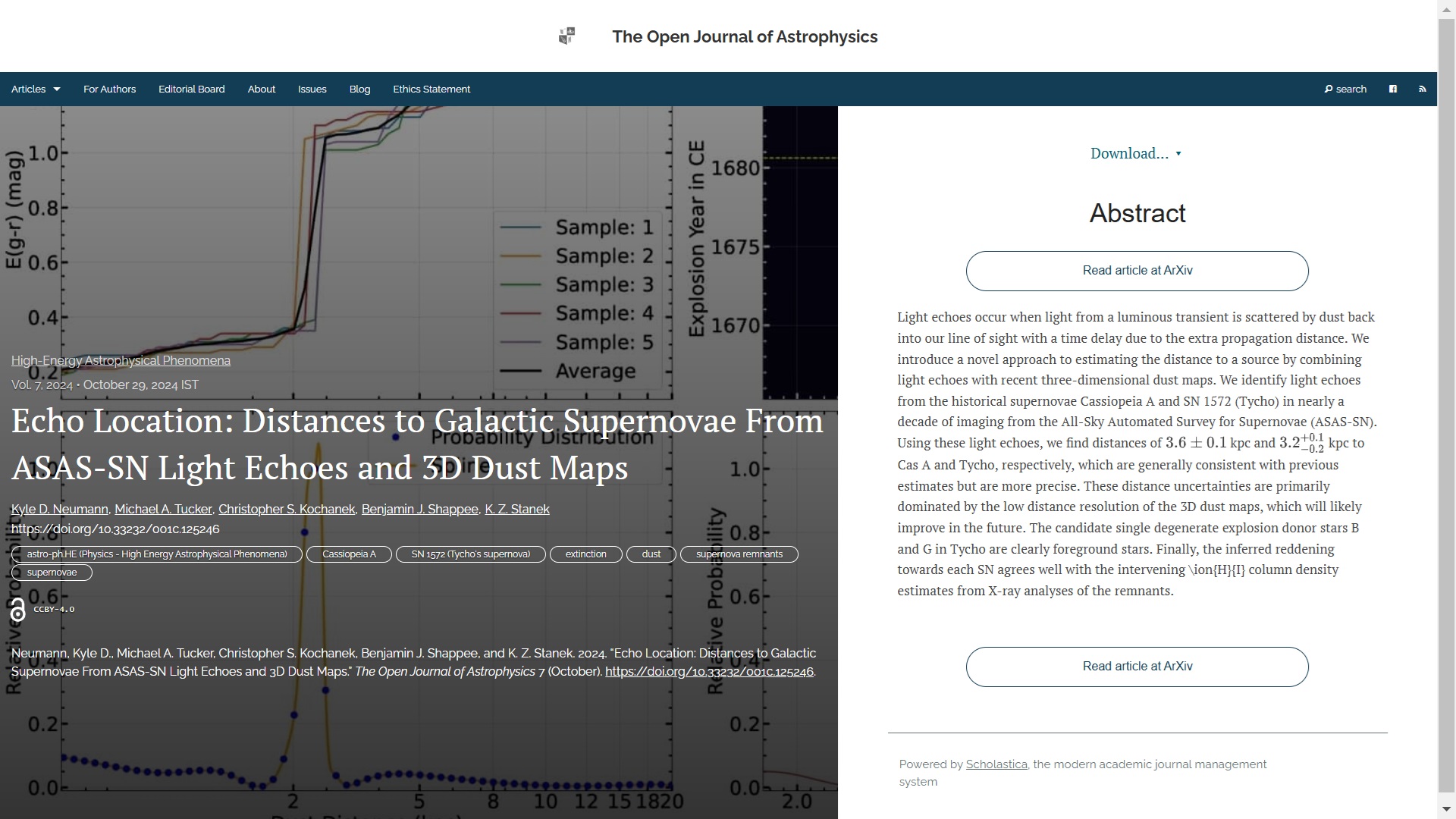
First one up is: “A population of neutron star candidates in wide orbits from Gaia astrometry” by Kareem El-Badry (Caltech, USA) and 12 others based across the world.  The paper presents  a spectroscopic study of neutron star candidates identified using GAIA astrometry to be in wide binary orbits around main sequence stars,  was published on 15th July 2024 and is in the folder marked Solar and Stellar Astrophysics. For more information about this one, see here.

Here is a screen grab of the overlay, which includes the abstract:


You can find the officially accepted version of the paper on the arXiv here.

The second paper to announce is “Systematic Effects in Galaxy-Galaxy Lensing with DESI” and was written by Johannes Ulf Lange (University of Michigan, Ann Arbor, USA) and 58 others, again distributed internationally.  This one reports a study of systematic effects (such as incompleteness and intrinsic alignment) on galaxy-galaxy lensing results from the Dark Energy Spectroscopic Instrument (DESI) survey. This one is in the folder called Cosmology and NonGalactic Astrophysics and was published on 16th July 2024.

You can see the overlay here:


The accepted version of this paper can be found on the arXiv here.

The next paper is also in the folder called Cosmology and NonGalactic Astrophysics.  It is entitled “Unleashing cosmic shear information with the tomographic weak lensing PDF” and is by by Lina Castiblanco (Newcastle Univresity, UK), Cora Uhlemann (Bielefeld University, Germany), Joachim Harnois-Déraps (Newcastle University, UK) and Alexandre Barthelemy (Ludwig-Maximilians-Universität, Germany). This one was published on 17th July 2024.

Here is the overlay:


You can find the full text for this one on the arXiv here.

Last but by no means least, published on 18th July 2024, we have a paper  entitled “When to interfere with dark matter? The impact of wave dynamics on statistics“. The primary classification for this one is again Cosmology and Nongalactic Astrophysics and it discusses the imprint of wave-mechanical behaviour, perhaps associated with ultra-light scalar field dark matter on the statistical properties of large-scale structure. The authors are Alex Gough (Newcastle University, UK) and Cora Uhlemann (Bielefeld University, Germany; who also featured in the author list of the previous paper). This is a paper close to my own interests, but because I know both authors well and was the PhD examiner of the first author I thought it best to recuse myself from an editorial role on this one.


You can click on the image of the overlay to make it larger should you wish to do so. You can find the officially accepted version of the paper on the arXiv here.

It did look likely at one stage that we might publish a paper every day last week, but the final version of one other paper didn’t make it onto arXiv in time to be announced on Friday so I will publish that one on Monday.

Two New Publications at the Open Journal of Astrophysics

Posted in OJAp Papers, Open Access, The Universe and Stuff with tags , , , , , , , , on July 13, 2024 by telescoper

Another Saturday, another update of the  Open Journal of Astrophysics.  Since the last update we have published two more papers, taking  the count in Volume 7 (2024) up to 56 and the total published by OJAp up to 171.  Both these papers were published on Thursday 11th July 2024.

The first paper of the most recent pair, published on July 3rd 2024,  is “Sunyaev-Zeldovich signatures from non-thermal, relativistic electrons using CMB maps” by Sandeep Kumar Acharya of The Open University of Israel, Ra’anana, Israel.  This article presents a discussion the possible effects of non-thermal electron energy distributions on the form of Sunyaev-Zeldovich distortions and how they might be measured. The paper is in the folder marked Cosmology and NonGalactic Astrophysics.

Here is a screen grab of the overlay which includes the abstract:


You can click on the image of the overlay to make it larger should you wish to do so. You can find the officially accepted version of the paper on the arXiv here.

The second paper has the title “On the contribution of dwarf galaxies to reionization of the Universe” and is by Zewei Wu and Andrey Kravtsov of the University of Chicago in the USA. This paper, which is in the folder marked Astrophysics of Galaxies, presents a model of galaxy formation that suggests that radiation from very faint galaxies may contribute significantly to the reionization of the Universe.

Here is a screen grab of the overlay which includes the abstract:


You can click on the image of the overlay to make it larger should you wish to do so. You can find the officially accepted version of the paper on the arXiv here.

That concludes this week’s update. No doubt I’ll have more for you next week!

Two New Publications at the Open Journal of Astrophysics

Posted in OJAp Papers, Open Access, The Universe and Stuff with tags , , , , , , , , , on July 6, 2024 by telescoper

My own laptop is still with the menders but I’ve managed to borrow one until I get it back so I don’t get too far behind. Anyway, it’s Saturday morning, and once again time to post another update relating to the  Open Journal of Astrophysics.  Since the last update we have published two more papers, taking  the count in Volume 7 (2024) up to 54 and the total published by OJAp up to 169.  There was one less arXiv update than usual last week, owing to the holiday on July 4th, so a couple of papers have been delayed.

The first paper of the most recent pair, published on July 3rd 2024,  is “Recovering 21cm Monopole Signals Without Smoothness” by Rugved Pund & Anže Slosar (Stony Brook, NY, USA) and Aaron Parsons (Berkeley, CA, USA) . This paper presents a new method for identifying the ‘Dark Ages’ trough contribution to the monopole of the 21cm radiation background that does not rely on the assumption that the spectrum is smooth. The paper is in the folder marked Cosmology and NonGalactic Astrophysics.

Here is a screen grab of the overlay which includes the abstract:


You can click on the image of the overlay to make it larger should you wish to do so. You can find the officially accepted version of the paper on the arXiv here.

The second paper, also published on 3rd July, has the title “LtU-ILI: An All-in-One Framework for Implicit Inference in Astrophysics and Cosmology”. There are fifteen authors with primary affiliations as follows: Matthew Ho (IAP, Paris, France), Deaglan J. Bartlett (IAP, Paris, France), Nicolas Chartier (Seoul National University, Korea),  Carolina Cuesta-Lazaro (Cfa, Harvard, USA),  Simon Ding (IAP, Paris, France), Axel Lapel (IAP, Paris, France), Pablo Lemos (Université de Montréal, Canada), Christopher C. Lovell (University of Portsmouth, UK),  T. Lucas Makinen (Imperial College, London, UK), Chirag Modi (Flatiron Institute, NY, USA), Viraj Pandya (Columbia University, NY, USA), Shivam Pandey (Columbia University, NY, USA), Lucia A. Perez (Flatiron Institute, NY, USA), Benjamin Wandelt (IAP, Paris, France),  and Greg L. Bryan (Sorbonne Université, Paris, France).

This paper, which is in the folder marked Instrumentation and Methods for Astrophysics, presents a suite of software for rapid, user-friendly, and cutting-edge inference using machine learning in astrophysics and cosmology. The software can be found on Github here.

Here is a screen grab of the overlay which includes the abstract:


You can click on the image of the overlay to make it larger should you wish to do so. You can find the officially accepted version of the paper on the arXiv here.

That concludes this week’s update. No doubt I’ll have more for you next week!

New Publication at the Open Journal of Astrophysics

Posted in OJAp Papers, Open Access, The Universe and Stuff with tags , , , , , on June 29, 2024 by telescoper

It’s a rainy Saturday morning here in Barcelona, and here’s the last update from the Open Journal of Astrophysics before I depart these shores. In fact there is only one paper to report this week, being  the 52nd paper in Volume 7 (2024)  and the 167th altogether. It was published on June 24th 2024. With six months of the year now over, I predict we will have published about 52×12/6=104 papers by the end of the year.

The title is “Comparing Mass Mapping Reconstruction Methods with Minkowski Functionals” and it  is in the folder marked Cosmology and NonGalactic Astrophysics. The authors are: Nisha Grewal (U. Edinburgh, UK), Joe Zuntz (U. Edinburgh, UK) and Tilman Tröster (ETH Zurich, Switzerland);  the paper is about quantifying the accuracy, precision and efficiency of lensing reconstruction methods using topological characteristics known as Minkowski Fuctionals.

Here is the overlay of the paper containing the abstract:


You can click on the image of the overlay to make it larger should you wish to do so. You can also find the officially accepted version of the paper on the arXiv here.

P.S. Since I only had the one paper to publicize this week I took a few minutes to add the overlays to last week’s post, which I couldn’t do at the time because of computer problems.

Three New Publications at the Open Journal of Astrophysics

Posted in OJAp Papers, Open Access, The Universe and Stuff with tags , , , , , , , , , , , , , , , , , on June 8, 2024 by telescoper

Time for another roundup of business at the  Open Journal of Astrophysics. This time I have three papers to announce, which brings the total we have published so far this year (Vol. 7) to 45 and the total published by OJAp to 160. We’re still on track to publish around 100 papers this year or more, compared to last year’s 50.

First one up, published on 3rd June 2024, is “Log-Normal Waiting Time Widths Characterize Dynamics” by Jonathan Katz of Washington University (St Louis, Missouri, USA). This paper presents a discussion of the connection between waiting time distributions and dynamics for aperiodic astrophysical systems, with emphasis on log-normal distributions.  This paper is in the folder marked High-Energy Astrophysical Phenomena.

Here is a screen grab of the overlay, which includes the abstract:


You can read the paper directly on arXiv here.

The second paper to present is “An Empirical Model For Intrinsic Alignments: Insights From Cosmological Simulations” by Nicholas Van Alfen (Northeastern University, Boston, USA), Duncan Campbell (Carnegie Mellon University, Pittsburgh, USA), Jonathan Blazek (Northeastern University), C. Danielle Leonard (Newcastle University, UK), Francois Lanusse (Université Paris-Saclay, France), Andrew Hearin (Argonne National Laboratory, USA), Rachel Mandelbaum (Carnegie Mellon University) and The LSST Dark Energy Science Collaboration.  This paper presents an extension of the halo model (specifically the Halo Occupation Distribution, HOD) to include intrinsic alignment effects for the study of weak gravitational lensing. This paper is in the folder marked Cosmology and Nongalactic Astrophysics. It was published on Tuesday June 4th 2024.

The overlay looks like this:


You can read this paper directly on the arXiv here.

Last, but by no means least, comes  “Towards Cosmography of the Local Universe”  which proposes the multipoles of the distance-redshift relation as new cosmological observables that have a direct physical interpretation in terms of kinematical quantities of the underlying matter flow. This was also published on 4th June. The authors are Julian Adamek (IfA Zurich, Switzerland), Chris Clarkson (Queen Mary, London, UK), Ruth Durrer (Geneva, Switzerland), Asta Heinesen (U. Lyon, France & NBI Copenhagen, Denmark), Martin Kunz (Geneva), and Hayley J. Macpherson (Chicago, USA).

Here is a screengrab of the overlay:


To read the accepted version of this on the arXiv please go here. This paper is also in the folder marked Cosmology and Nongalactic Astrophysics.
That’s it for this week. I aim to post another update next weekend.


Three New Publications at the Open Journal of Astrophysics

Posted in OJAp Papers, Open Access, The Universe and Stuff with tags , , , , , , , , on May 25, 2024 by telescoper

After a very busy and unusual week, it’s time to get back to normal with the usual  Saturday roundup of business at the  Open Journal of Astrophysics. If you want to know how many papers we have published so far this year (Vol. 7), the answer is 42. The total published by OJAp is now 157. We’re still on track to publish around 100 papers this year, possibly more, compared to last year’s 50.

All the members of this week’s trio are in the folder marked Cosmology and Nongalactic Astrophysics, and indeed all three relate in one way or another to the topic of weak gravitational lensing.  All three were published on Wednesday 22nd May 2024.

First one up is “Joint constraints from cosmic shear, galaxy-galaxy lensing and galaxy clustering: internal tension as an indicator of intrinsic alignment modelling error” which is by Simon Samuroff (Northeastern U., USA), Andresa Campos (Carnegie Mellon U., USA), Anna Porredon (Bochum, Germany) and Jonathan Blazek (Edinburgh, UK).   A combined statistical approach to the identification of errors arising in cosmic shear analysis due to intrinsic alignments.

Here is a screen grab of the overlay, which includes the abstract:

You can read the paper directly on arXiv here.

The second paper to present is “A unified linear intrinsic alignment model for elliptical and disc galaxies and the resulting ellipticity spectra” by Basundhara Ghosh (Bangalore, India), with Kai Nussbaumer, Eileen Sophie Giesel & Björn Malte Schäfer (Heidelberg, Germany). It presents a discussion of the physical origin of intrinsic alignments of both elliptical and disk galaxies and the implications for cosmological studies

The overlay looks like this:


You can read this paper directly on the arXiv here.

The last paper of this batch is entitled “Neural style transfer of weak lensing mass maps”  and proposes a generative model for the mass-production of weak-lensing maps. The authors are Masato Shirasaki and Shiro Ikeda (both of the University of Tokyo, Japan)

Here is a screengrab of the overlay:


To read the accepted version of this on the arXiv please go here.
That’s all for now. I will do another update next week.


Four New Publications at the Open Journal of Astrophysics

Posted in OJAp Papers, Open Access, The Universe and Stuff with tags , , , , , , , , , , , , on May 11, 2024 by telescoper

It is time yet again for an update of recent activity at the Open Journal of Astrophysics.
This week we have published four papers, which I now present to you. These four take the count in Volume 7 (2024) up to 36 and the total published by OJAp up to 151. I speculated last week that we would probably pass the 150 mark this week, and so we did. We’re still on target to publish around 100 papers this year.
In chronological order, the four papers published this week, with their overlays, are as follows. You can click on the images of the overlays to make them larger should you wish to do so.
First one up is “Ephemeris Matching Reveals False Positive Validated and Candidate Planets from the K2 Mission” by Drake A. Lehmann (U. Wisconsin-Madison, USA) and Andrew Vanderburg (MIT, USA). It presents a description and application of a technique for identifying false positives among candidate exoplanets. The paper was published on 7th May 2024, is in the folder marked Earth and Planetary Astrophysics, and can be found here.
Here is a screen grab of the overlay, which includes the abstract:

You can find the officially accepted version of the paper on the arXiv here.
The second paper to announce is “Accuracy requirements on intrinsic alignments for Stage-IV cosmic shear” which is by by Anya Paopiamsap, Natalia Porqueres & David Alonso (Oxford, UK) and Joachim Harnois-Deraps & C. Danielle Leonard (Newcastle, UK). This paper sets about quantifying the permissible level of disagreement between the true intrinsic galaxy alignments and the theoretical models thereof that can be allowed for future Stage-IV cosmic shear surveys. This one is in the folder marked Cosmology and Nongalactic Astrophysics. The paper was published on May 9th 2024 and you can see the overlay here:

The accepted version of this paper can be found on the arXiv here.
The next paper, is in the folder Instrumentation and Methods for Astrophysics and is entitled “Optimal Summary Statistics for X-ray Polarization”. The authors are Jeremy Heyl (Uni. British Columbia, Canada), Denis González-Caniulef (Uni. Toulouse, France) and Ilaria Caiazzo (Caltech, USA). This presents new statistical estimators for use in studies of X-ray polarization, with an analytic discussion of their efficiency. It can be found here and the accepted version can be read on arXiv here. Here is the overlay:

The last paper of this batch is called “B-modes from galaxy cluster alignments in future surveys” and is by Christos Georgiou, Thomas Bakx, Juliard van Donkersgoed and Nora Elisa Chisari, all from Utrecht University in The Netherlands. It presents a discussion of the possible detection of cosmic shear B-modes produced by intrinsic alignments in future galaxy surveys.
Here is the overlay:

You can find the full text for this one on the arXiv here. The primary classification for this one is Cosmology and Nongalactic Astrophysics.
And that ends this week’s update. More next week!