Time to announce another publication in the Open Journal of Astrophysics. This one is the ninth paper in Volume 4 (2021) and the 40th in all.
The latest publication is entitled Black Hole Shadow Drift and Photon Ring Frequency Drift. The authors are Emmanuel Frion (Helsinki), Leonardo Giani (Queensland) and Tays Miranda (Jyväskylä).
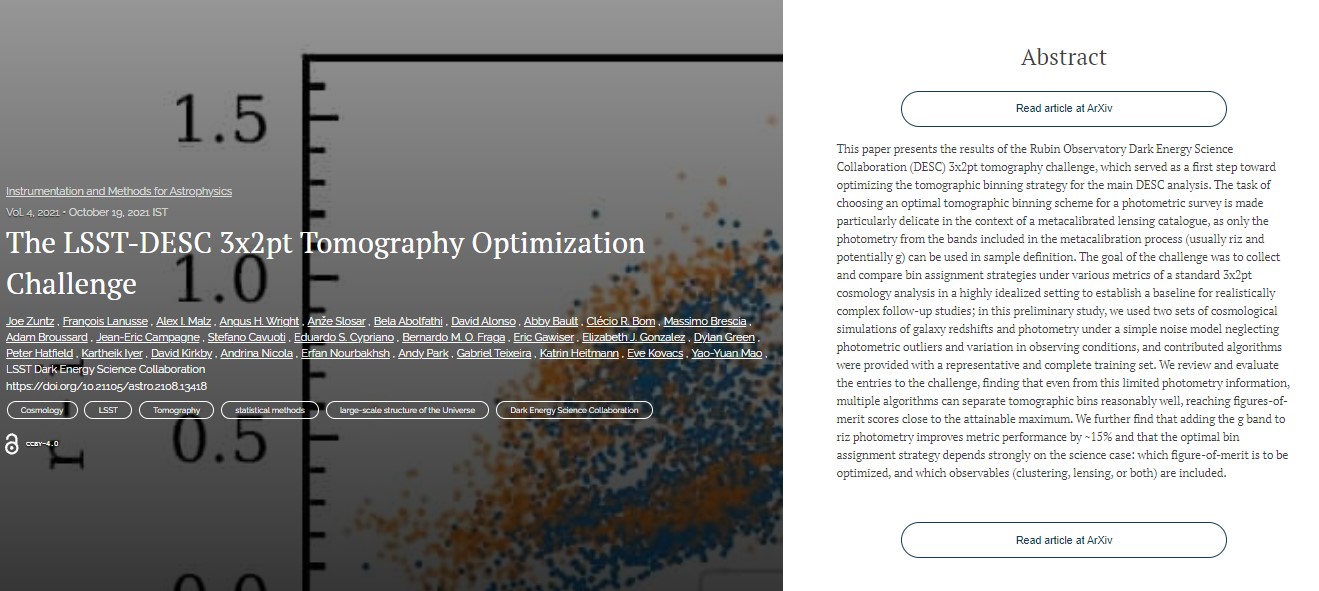
Here is a screen grab of the overlay which includes the abstract:
You can click on the image to make it larger should you wish to do so. You can find the arXiv version of the paper here. This one is also in the folder marked Cosmology and Nongalactic Astrophysics; although primarily in general relativity and quantum cosmology (gr-qc) it is cross-listed in astro-ph so it eligible for publication with us.
The end of the summer has been heralded by the arrival at OJAp HQ of a number of revised versions so I expect to be publishing a few more papers in the next few weeks!
Time to announce another publication in the Open Journal of Astrophysics. This one is the eighth paper in Volume 4 (2021) and the 39th in all.
The latest publication is entitled A Detailed Description of the CAMSPEC Likelihood Pipeline and a Reanalysis of the Planck High Frequency Maps. The authors are George Efstathiou and Steven Gratton of the Kavli Institute for Cosmology at the University of Cambridge.
Here is a screen grab of the overlay which includes the abstract:
You can click on the image to make it larger should you wish to do so. You can find the arXiv version of the paper here. This one is also in the folder marked Cosmology and Nongalactic Astrophysics.
This is a long and detailed paper, running to 92 pages in PDF form. Our Editorial process relies on referees being willing to volunteer their time to read and comment on submissions and this one in particular required a great deal of effort. I am always grateful to referees but in this case I am even more grateful than usual the diligence displayed during and the many useful comments received. I know who our reviewers are and they know who they are, but shall remain anonymous!
I was reminded yesterday that today, 14th August, is the 30th anniversary of the start of the arXiv so I thought I’d send a quick birthday greeting to mark the occasion. In case you weren’t aware, arXiv is a free distribution service and an open-access archive containing (currently) 1,928,825 scholarly articles in the fields of physics, mathematics, computer science, quantitative biology, quantitative finance, statistics, electrical engineering and systems science, and economics.
There was a precursor to the arXiv in the form of an email distribution list for preprints, but arXiv proper started on 14th August 1991. It was based at Los Alamos National Laboratory (LANL) with a mirror site in SISSA (Trieste) that was used by those of us in Europe. In the beginning, arXiv was quite a small-scale thing and it wasn’t that easy to upload full papers including figures. In fact the SISSA system was run from a single IBM 386 PC (called “Babbage”). As it expanded, the running of arXiv was taken over Cornell University. You can read more about the history here.
You have to remember that journals didn’t generally have electronic submission in those days: you had to send paper manuscripts in the post to the Editorial office. Likewise many of us carried on sending out paper preprints for some time after the arXiv was set up. Younger researchers should be grateful they don’t have to put up with the absolute chore of producing papers the old-fashioned way!
The astrophysics section of arXiv (“astro-ph”) started in April 1992. Although astrophysicists generally were quick to latch on to this new method of distributing preprints, it took me a little time to get onto arXiv: my first papers did not appear there until February 1993; my first publication was in 1986 so there are quite a few of my early papers that aren’t on arXiv at all. In 1993 I was working at Queen Mary & Westfield College (as it was then called). I was working a lot with collaborators based in Italy at the time and they decided to start posting our joint papers on arXiv. Without that impetus it would have taken me much longer to get to grips with it.
In case you’re interested, my first paper to appear on the arXiv was this one on 23rd February 1993 but it was followed a day later by two others, this one and that one. I don’t remember very well, but this was an exercise in catching up and all three of those papers were actually published in journals before we put them on arXiv. It was only later that we got into the habit of posting papers on arXiv at the same time as submitting to a journal, which I think is the best way to do it!
The Open Journal of Astrophysics would not have been possible without the arXiv but in a wider sense the astrophysics community has a very great deal to thank the arXiv for, but remember that it is funded by donations and is run on a shoestring. If you agree that it’s a tremendously useful asset for your research then please consider making a donation.
Back from my short trip, I now have time to announce another publication in the Open Journal of Astrophysics. This one was published at the end of last month, but owing to the holiday season there was a delay in activating the DOI and registering the metadata so I have delayed posting about it until just now. It is the seventh paper in Volume 4 (2021) and the 38th in all.
The latest publication is entitled A Differentiable Model of the Assembly of Individual and Populations of Dark Matter Halos. The authors are Andrew P. Hearin, Jonás Chaves-Montero, Matthew R. Becker and Alex Alarcon, all of the Argonne National Laboratory.
Here is a screen grab of the overlay which includes the abstract:
You can click on the image to make it larger should you wish to do so. You can find the arXiv version of the paper here. This one is also in the folder marked Cosmology and Nongalactic Astrophysics.
We’ve had a bit of a surge in submissions over the last few weeks – no doubt due to authors using their “vacation” to finish off papers. August is not the best month for finding referees, but we’ll do our best to process them quickly!
Time to announce another publication in the Open Journal of Astrophysics. This one was actually published at the end of last month, but owing to the holiday season there was a delay in activating the DOI and registering the metadata so I have delayed posting about it until just now. It is the sixth paper in Volume 4 (2021) and the 37th in all.
The latest publication is entitled Euclid: Forecasts for k-cut 3 × 2 point statistics. The first author is Peter L. Taylor of the Jet Propulsion Lab in Pasadena, USA and there are almost 100 authors altogether. This is definitely the paper with the longest author list we have published so far, and also the first paper we have published on behalf of the Euclid Consortium. I am a member of Euclid so I of course recused myself from the editorial process.
Here is a screen grab of the overlay which includes the abstract:
You can click on the image to make it larger should you wish to do so. You can find the arXiv version of the paper here. This one is, fairly obviously, in the Cosmology and Nongalactic Astrophysics folder..
The Euclid Consortium has a strict protocol for papers it publishes which, together with the large number of authors, not to mention the pandemic, meant it took quite a long time to make the revisions suggested by referees. Still, it has turned out a very nice paper I think. I am also very pleased that a major consortium such as Euclid has decided to publish in OJAp.
We have another bunch of papers in the pipeline – in fact one further has already been published – so watch this space for further developments!
I’ll end with a reminder to prospective authors that the OJA now has the facility to include supplementary files (e.g. code or data sets) along with the papers we publish. If any existing authors (i.e. of papers we have already published) would like us to add supplementary files retrospectively then please contact us with a request!
As a cosmologist I am often asked when was the Epoch of Galaxy Formation?
Here I provide the definitive answer: the meeting entitled The Epoch of Galaxy Formation took place in Durham between July 18th and 22nd 1988, i.e. about 33 years ago. Here is a relic of that period.
I am in there with John Barrow to my left (ie your right) . I can also identify Jim Peebles, Simon White, Richard Ellis, George Efstathiou and Carlos Frenk, Martin Rees and Tom Shanks among others but I wonder how many others you can identify…
P.S. Note the male-female asymmetry in cosmology was much greater in this period during the early Universe.
I came across this on social media and thought I’d share it here. It’s a nice graphical demonstration of the interplay between theory and experiment in the field of cosmic microwave background physics. The video was created by Forrest Fankhauser and Lloyd Knox at the University of California, Davis with funding from the National Science Foundation.
As someone famous once said: “we’ve come a long way from pigeon shit…”
Time to announce another publication in the Open Journal of Astrophysics. This one was actually published last Friday, but I didn’t get time to post about it until just now. It is the fifth paper in Volume 4 (2021) and the 36th paper in all.
The latest publication is entitled Gravitational Wave Direct Detection does not Constrain the Tensor Spectral Index at CMB Scalesand the author is Will Kinney of the State University of New York at Buffalo (which is SUNY Buffalo, for short).
Here is a screen grab of the overlay which includes the abstract:
You can click on the image to make it larger should you wish to do so. You can find the arXiv version of the paper here. This one is, fairly obviously, in the Cosmology and Nongalactic Astrophysics folder..
Over the last few months I have noticed that it has taken a bit longer to get referee reports on papers and also for authors to complete their revisions. I think that’s probably a consequence of the pandemic and people being generally overworked. We do have a number of papers at various stages of the pipeline, so although we’re a bit behind where we were last year in terms of papers published I think may well catch up in the next month or two.
I’ll end with a reminder to prospective authors that the OJA now has the facility to include supplementary files (e.g. code or data sets) along with the papers we publish. If any existing authors (i.e. of papers we have already published) would like us to add supplementary files retrospectively then please contact us with a request!
Trying to catch up on cosmological news after a busy week I came across a number of pieces in the media about “Cosmic Dawn” (e.g. here in The Grauniad). I’ve never actually met Cosmic Dawn but she seems like an interesting lady.
But seriously folks, Cosmic Dawn refers to the epoch during which the first stars formed in the expanding Universe lighting up the Universe after a few hundred million years of post-recombination darkness.
According to the Guardian article mentioned above the new results being discussed are published in Monthly Notices of the Royal Astronomical Society but they’re actually not. Yet. Nevertheless the paper (by Laporte et al.) is available on the arXiv which is where people will actually read it…
Anyway, here is the abstract:
Here is a composite of HST and ALMA images for one of the objects discussed in the paper (MACS0416-JD):
I know it looks a bit blobby but it’s not easy to resolve things at such huge distances! Also, it’s quite small because it’s far away. In any case the spectroscopy is really the important thing, not the images, as that is what determines the redshift. The Universe has expanded by a factor 10 since light set out towards us from an object at redshift 9. I’m old enough to remember when “high redshift” meant z~0.1!
At the end of my talk on Wednesday Floyd Stecker asked me about what the James Webb Space Telescope (due for launch later this year) would do for cosmology and I replied that it would probably do a lot more for galaxy formation and evolution than cosmology per se. I think this is a good illustration of what I meant. Because of its infrared capability JWST will allow astronomers to push back even further and learn even more about how the first stars formed, but it won’t tell us much directly about dark matter and dark energy.
I recently came across a comprehensive review article on the arXiv and thought some of my regular readers might find it interesting as a description of the current state of play in cosmology. The paper is called Challenges for ΛCDM: An update and is written by Leandros Perivolaropoulos and Foteini Skara.
Here is the abstract:
A number of challenges of the standard ΛCDM model has been emerging during the past few years as the accuracy of cosmological observations improves. In this review we discuss in a unified manner many existing signals in cosmological and astrophysical data that appear to be in some tension (2σ or larger) with the standard ΛCDM model as defined by the Planck18 parameter values. In addition to the major well studied 5σ challenge of ΛCDM (the Hubble H0 crisis) and other well known tensions (the growth tension and the lensing amplitude AL anomaly), we discuss a wide range of other less discussed less-standard signals which appear at a lower statistical significance level than the H0 tension (also known as ‘curiosities’ in the data) which may also constitute hints towards new physics. For example such signals include cosmic dipoles (the fine structure constant α, velocity and quasar dipoles), CMB asymmetries, BAO Lyα tension, age of the Universe issues, the Lithium problem, small scale curiosities like the core-cusp and missing satellite problems, quasars Hubble diagram, oscillating short range gravity signals etc. The goal of this pedagogical review is to collectively present the current status of these signals and their level of significance, with emphasis to the Hubble crisis and refer to recent resources where more details can be found for each signal. We also briefly discuss possible theoretical approaches that can potentially explain the non-standard nature of some of these signals.
Among the useful things in it you will find this summary of the current ‘tension’ over the Hubble constant that I’ve posted about numerous times (e.g. here):
The views presented here are personal and not necessarily those of my employer (or anyone else for that matter).
Feel free to comment on any of the posts on this blog but comments may be moderated; anonymous comments and any considered by me to be vexatious and/or abusive and/or defamatory will not be accepted. I do not necessarily endorse, support, sanction, encourage, verify or agree with the opinions or statements of any information or other content in the comments on this site and do not in any way guarantee their accuracy or reliability.