Archive for Cosmology

Machine Learning in the Physical Sciences

Posted in The Universe and Stuff with tags , , , , , on March 29, 2019 by telescoper

If, like me, you feel a bit left behind by goings-on in the field of Machine Learning and how it impacts on physics then there’s now a very comprehensive review by Carleo et al on the arXiv.

Here is a picture from the paper, which I have included so that this post has a picture in it:

The abstract reads:

Machine learning encompasses a broad range of algorithms and modeling tools used for a vast array of data processing tasks, which has entered most scientific disciplines in recent years. We review in a selective way the recent research on the interface between machine learning and physical sciences.This includes conceptual developments in machine learning (ML) motivated by physical insights, applications of machine learning techniques to several domains in physics, and cross-fertilization between the two fields. After giving basic notion of machine learning methods and principles, we describe examples of how statistical physics is used to understand methods in ML. We then move to describe applications of ML methods in particle physics and cosmology, quantum many body physics, quantum computing, and chemical and material physics. We also highlight research and development into novel computing architectures aimed at accelerating ML. In each of the sections we describe recent successes as well as domain-specific methodology and challenges.

The next step after Machine Learning will of course be Machine Teaching…

BICEP2: Is the Signal Cosmological?

Posted in Astrohype, The Universe and Stuff with tags , , on March 28, 2019 by telescoper

An article in Physics Today just reminded me just now that I have missed the fifth anniversary of the BICEP2 announcement of `the detection of primordial gravitational waves’. I know I’m a week but I thought I’d reblog the post I wrote on March 19th 2014.You will see that I was sceptical…

..and it subsequently turned out that I was right to be so.

telescoper's avatarIn the Dark

I have a short gap in my schedule today so I thought I would use it to post a short note about the BICEP2 results announced to great excitement on Monday.

There has been a great deal of coverage in the popular media about a “Spectacular Cosmic Discovery” and this is mirrored by excitement at a more technical level about the theoretical implications of the BICEP2 results. Having taken a bit of time out last night to go through the discovery paper, I think I should say that I think all this excitement is very premature. In that respect I agree with the result of my straw poll.

First of all let me make it clear that the BICEP2 experiment is absolutely superb. It was designed and built by top-class scientists and has clearly functioned brilliantly to improve its sensitivity so much that it has gone so…

View original post 1,015 more words

Fine-tuning in Cosmology

Posted in The Universe and Stuff with tags , , , , , on March 25, 2019 by telescoper

I forgot to post a link to a paper by Fred Adams that appeared on the arXiv last month on the topic of the fine-tuning of the Universe which I had bookmarked for a blog a while ago.

My heart always sinks when the arXiv informs me that the abstract of a paper is `abridged’ so here’s the full version from the PDF you can download for yourself here. Please be aware, though, that it’s a lengthy paper running to over two hundred pages:

My own view on this topic is that it is indeed remarkable that the Universe is finely-tuned to exactly the extent required to allow authors to write such long papers about the fine-tuning of the Universe…


The Most Ancient Heavens

Posted in Art, Biographical, Poetry, The Universe and Stuff with tags , , , , , , , , on March 21, 2019 by telescoper

So here I am, in that London, getting ready for the start of a two-day conference at the Royal Astronomical Society on cosmology, large-scale structure, and weak gravitational lensing, to celebrate the work of Professor Alan Heavens, on (or near) the occasion of his 60th birthday. Yes, it is a great name for an astronomer.

I was honoured to be invited to give a talk at this meeting, though my immediate reaction when I was told about was `But he can’t be sixty! He’s only a few years older than me…oh.’ I gather I’m supposed to say something funny after the conference dinner tomorrow night too.

Courtesy of alphabetical order it looks like I’m top of the bill!

Anyway, I’ve known Alan since I was a research student, i.e. over thirty years, and we’re co-authors on 13 papers (all of them since 2011). I’m looking forward to the HeavensFest not only for the scientific programme (which looks excellent) but also for the purpose of celebrating an old friend and colleague.

Just to clear up a couple of artistic points.

First, the title of the meeting, The Most Ancient Heavens, is taken from Ode to Duty by William Wordsworth.

Second, the image on the conference programme shown above is a pastiche of The Creation of Alan Adam which is part of the ceiling of the Sistine Chapel painted by Michelangelo di Lodovico Buonarroti Simoni, known to his friends as Michelangelo. Apparently he worked flat out painting this enormous fresco. It was agony but the ecstasy kept him going. I’ve often wondered (a) who did the floor of the Sistine Chapel and (b) how could Michelangelo create such great art when it was so clearly extremely cold? Anyway, I think that is a picture of Alan at high redshift on the far right, next to the man with beard who at least had the good sense to wear a nightie to spare his embarrassment.

Anyway, that’s all for now. I must be going. Time for a stroll down to Piccadilly.

Update: you can find a bunch of pictures of this conference here.

New Publication at the Open Journal of Astrophysics!

Posted in OJAp Papers, Open Access, The Universe and Stuff with tags , , , , , , , , , on March 20, 2019 by telescoper

It’s nice to be able to announce that the Open Journal of Astrophysics has just published another paper. Here it is!

It’s by Darsh Kodwani, David Alonso and Pedro Ferreira from a combination of Oxford University and Cardiff University.

You can find the accepted version on the arXiv here. This version was accepted after modifications requested by the referee and editor.

This is another one for the `Cosmology and Nongalactic Astrophysics’ folder. We would be happy to get more submissions from other areas of astrophysics. Hint! Hint!

P.S. A few people have asked why the Open Journal of Astrophysics is not listed in the Directory of Open Access Journals. The answer to that is simple: to qualify for listing a journal must publish a minimum of five papers in a year. Since OJA underwent a failure long hiatus after publishing its first batch of papers we don’t yet qualify. However, so far in 2019 we have published four papers and have several others in the pipeline. We will reach the qualifying level soon and when we do I will put in the application!

A Bayesian Look at Cosmic Anomalies

Posted in Cosmic Anomalies with tags , , , on March 3, 2019 by telescoper

I’ve posted a few times on this blog about Cosmic Anomalies, by which I mean apparent departures from the predictions of the standard cosmological model. From time to time I also talk about this subject at seminars and conferences.

There’s an interesting new paper on this topic on the arXiv now by Shaikh et al., with the following abstract:

You can click on the image to make it larger. You can also find the PDF version of the full paper here.

I find this Bayesian analysis of two of the apparent anomalies (low amplitude in the power spectrum at large angular scales and hemispherical power asymmetry) may be different manifestations of the same underlying phenomenon, which would make them easier to account for without invoking new physics. Rather than being two independent statistical flukes these measurements might both be the result of one, which would be more likely to occur in the standard model. This analysis however suggests that this might not be the case after all, and these are two different things after all. This presupposes, however, that the model chosen to describe the asymmetries is appropriate. Anyway, this paper is well worth a read if you’re into Bayesian model testing (which you should be)…

This also gives me the excuse to post the following poll, which has been running for several years (even longer than Brexit):

The Negative Mass Bug

Posted in Astrohype, Open Access, The Universe and Stuff with tags , , , , , on February 25, 2019 by telescoper

You may have noticed that some time ago I posted about  a paper by Jamie Farnes published in Astronomy & Astrophysics but available on the arXiv here which entails a suggestion that material with negative mass might account for dark energy and/or dark matter.

Here is the abstract of said paper:

Dark energy and dark matter constitute 95% of the observable Universe. Yet the physical nature of these two phenomena remains a mystery. Einstein suggested a long-forgotten solution: gravitationally repulsive negative masses, which drive cosmic expansion and cannot coalesce into light-emitting structures. However, contemporary cosmological results are derived upon the reasonable assumption that the Universe only contains positive masses. By reconsidering this assumption, I have constructed a toy model which suggests that both dark phenomena can be unified into a single negative mass fluid. The model is a modified ΛCDM cosmology, and indicates that continuously-created negative masses can resemble the cosmological constant and can flatten the rotation curves of galaxies. The model leads to a cyclic universe with a time-variable Hubble parameter, potentially providing compatibility with the current tension that is emerging in cosmological measurements. In the first three-dimensional N-body simulations of negative mass matter in the scientific literature, this exotic material naturally forms haloes around galaxies that extend to several galactic radii. These haloes are not cuspy. The proposed cosmological model is therefore able to predict the observed distribution of dark matter in galaxies from first principles. The model makes several testable predictions and seems to have the potential to be consistent with observational evidence from distant supernovae, the cosmic microwave background, and galaxy clusters. These findings may imply that negative masses are a real and physical aspect of our Universe, or alternatively may imply the existence of a superseding theory that in some limit can be modelled by effective negative masses. Both cases lead to the surprising conclusion that the compelling puzzle of the dark Universe may have been due to a simple sign error.

Well there’s a new paper just out on the arXiv by Hector Socas-Navarro with the abstract

A recent work by Farnes (2018) proposed an alternative cosmological model in which both dark matter and dark energy are replaced with a single fluid of negative mass. This paper presents a critical review of that model. A number of problems and discrepancies with observations are identified. For instance, the predicted shape and density of galactic dark matter halos are incorrect. Also, halos would need to be less massive than the baryonic component or they would become gravitationally unstable. Perhaps the most challenging problem in this theory is the presence of a large-scale version of the `runaway’ effect, which would result in all galaxies moving in random directions at nearly the speed of light. Other more general issues regarding negative mass in general relativity are discussed, such as the possibility of time-travel paradoxes.

Among other things there is this:

After initially struggling to reproduce the F18 results, a careful inspection of his source code revealed a subtle bug in the computation of the gravitational acceleration. Unfortunately, the simulations in F18 are seriously compromised by this coding error whose effect is that the gravitational force decreases with the inverse of the distance, instead of the distance squared.

Oh dear.

I don’t think I need go any further into this particular case, which would just rub salt into the wounds of Farnes (2018) but I will make a general comment. Peer review is the best form of quality stamp that we have but, as this case demonstrates, it is by no means flawless. The paper by Farnes (2018) was refereed and published, but is now shown to be wrong*. Just as authors can make mistakes so can referees. I know I’ve screwed up as a referee in the past so I’m not claiming to be better than anyone in saying this.

*This claim is contested: see the comment below.

I don’t think the lesson is that we should just scrap peer review, but I do think we need to be more imaginative about how it is used than just relying on one or two individuals to do it. This case shows that science eventually works, as the error was found and corrected, but that was only possible because the code used by Farnes (2018) was made available for scrutiny. This is not always what happens. I take this as a vindication of open science, and an example of why scientists should share their code and data to enable others to check the results. I’d like to see a system in which papers are not regarded as `final’ documents but things which can be continuously modified in response to independent scrutiny, but that would require a major upheaval in academic practice and is unlikely to happen any time soon.

In this case, in the time since publication there has been a large amount of hype about the Farnes (2018) paper, and it’s unlikely that any of the media who carried stories about the results therein will ever publish retractions. This episode does therefore illustrate the potentially damaging effect on public trust that the excessive thirst for publicity can have. So how do we balance open science against the likelihood that wrong results will be taken up by the media before the errors are found? I wish I knew!

The Future Circular Collider: what’s the MacGuffin?

Posted in Science Politics, The Universe and Stuff with tags , , , , , , , on February 7, 2019 by telescoper

I’ve been reading a few items here and there about proposals for a Future Circular Collider, even larger than the Large Hadron Collider (and consequently even more expensive). No doubt particle physicists interested in accelerator experiments will be convinced this is the right move, but of course there are other projects competing for funds and it’s by no means certain that the FCC will actually happen.

One of the important things about `Big Science’ when it gets this big is that it has to capture the imagination of people with political influence if it is to be granted funding. Based on past experience that means that there has to be a Big Discovery to be made or a Big Idea to be tested. This Big Thing has to be simple enough for politicians to understand and exciting enough to capture their imagination (and that of the public). In the case of the Large Hadron Collider (LHC), for example, this was the Higgs Boson. In the case of the Euclid space mission, the motivation is Dark Energy.

The Big Thing that sells a project to politicians is not necessarily the thing that most scientists are interested in. The LHC has done a lot of things other than discover the Higgs, and Euclid will do many things other than probe Dark Energy, but there has to be one thing to set it all in motion. It seems to me that the Big Question about the FCC is whether there is something specific that can motivate this project in the way the Higgs did for the LHC? If so, what is it?

Answers on a postcard or, better, through the comments box below.


Humphrey Bogart with the eponymous Maltese Falcon

Anyway, these thoughts reminded me of the concept of a  MacGuffin. Unpick the plot of any thriller or suspense movie and the chances are that somewhere within it you will find lurking at least one MacGuffin. This might be a tangible thing, such the eponymous sculpture of a Falcon in the archetypal noir classic The Maltese Falcon or it may be rather nebulous, like the “top secret plans” in Hitchcock’s The Thirty Nine Steps. Its true character may be never fully revealed, such as in the case of the glowing contents of the briefcase in Pulp Fiction , which is a classic example of the “undisclosed object” type of MacGuffin, or it may be scarily obvious, like a doomsday machine or some other “Big Dumb Object” you might find in a science fiction thriller.

Or the MacGuffin may not be a real thing at all. It could be an event or an idea or even something that doesn’t actually exist in any sense, such the fictitious decoy character George Kaplan in North by Northwest. In fact North by North West is an example of a movie with more than one MacGuffin. Its convoluted plot involves espionage and the smuggling of what is only cursorily described as “government secrets”. These are the main MacGuffin; George Kaplan is a sort of sub-MacGuffin. But although this is behind the whole story, it is the emerging romance, accidental betrayal and frantic rescue involving the lead characters played by Cary Grant and Eve Marie Saint that really engages the characters and the audience as the film gathers pace. The MacGuffin is a trigger, but it soon fades into the background as other factors take over.

Whatever it is or is not, the MacGuffin is responsible for kick-starting the plot. It makes the characters embark upon the course of action they take as the tale begins to unfold. This plot device was particularly beloved by Alfred Hitchcock (who was responsible for introducing the word to the film industry). Hitchcock was however always at pains to ensure that the MacGuffin never played as an important a role in the mind of the audience as it did for the protagonists. As the plot twists and turns – as it usually does in such films – and its own momentum carries the story forward, the importance of the MacGuffin tends to fade, and by the end we have usually often forgotten all about it. Hitchcock’s movies rarely bother to explain their MacGuffin(s) in much detail and they often confuse the issue even further by mixing genuine MacGuffins with mere red herrings.

Here is the man himself explaining the concept at the beginning of this clip. (The rest of the interview is also enjoyable, convering such diverse topics as laxatives, ravens and nudity..)

There’s nothing particular new about the idea of a MacGuffin. I suppose the ultimate example is the Holy Grail in the tales of King Arthur and the Knights of the Round Table in which the Grail itself is basically a peg on which to hang a series of otherwise disconnected stories. It is barely mentioned once each individual story has started and, of course, is never found. That’s often how it goes with MacGuffins -even the Maltese Falcon turned out in the end to be a fake – they’re only really needed to start things off.

So let me rephrase the question I posed earlier on. In the case of the Future Circular Collider, what’s the MacGuffin?

Negative Mass, Phlogiston and the State of Modern Cosmology

Posted in Astrohype, The Universe and Stuff with tags , , on December 7, 2018 by telescoper

A graphical representation of something or other.

I’ve noticed a modest amount of hype – much of it gibberish – going around about a paper published in Astronomy & Astrophysics but available on the arXiv here which entails a suggestion that material with negative mass might account for dark energy and/or dark matter. Here is the abstract of the paper:

Dark energy and dark matter constitute 95% of the observable Universe. Yet the physical nature of these two phenomena remains a mystery. Einstein suggested a long-forgotten solution: gravitationally repulsive negative masses, which drive cosmic expansion and cannot coalesce into light-emitting structures. However, contemporary cosmological results are derived upon the reasonable assumption that the Universe only contains positive masses. By reconsidering this assumption, I have constructed a toy model which suggests that both dark phenomena can be unified into a single negative mass fluid. The model is a modified ΛCDM cosmology, and indicates that continuously-created negative masses can resemble the cosmological constant and can flatten the rotation curves of galaxies. The model leads to a cyclic universe with a time-variable Hubble parameter, potentially providing compatibility with the current tension that is emerging in cosmological measurements. In the first three-dimensional N-body simulations of negative mass matter in the scientific literature, this exotic material naturally forms haloes around galaxies that extend to several galactic radii. These haloes are not cuspy. The proposed cosmological model is therefore able to predict the observed distribution of dark matter in galaxies from first principles. The model makes several testable predictions and seems to have the potential to be consistent with observational evidence from distant supernovae, the cosmic microwave background, and galaxy clusters. These findings may imply that negative masses are a real and physical aspect of our Universe, or alternatively may imply the existence of a superseding theory that in some limit can be modelled by effective negative masses. Both cases lead to the surprising conclusion that the compelling puzzle of the dark Universe may have been due to a simple sign error.

For a skeptical commentary on this work, see here.

The idea of negative mass is no by no means new, of course. If you had asked a seventeenth century scientist the question “what happens when something burns?”  the chances are the answer would  have involved the word phlogiston, a name derived from the Greek  φλογιστόν, meaning “burning up”. This “fiery principle” or “element” was supposed to be present in all combustible materials and the idea was that it was released into air whenever any such stuff was ignited. The act of burning separated the phlogiston from the dephlogisticated “true” form of the material, also known as calx.

The phlogiston theory held sway until  the late 18th Century, when Antoine Lavoisier demonstrated that combustion results in an increase in weight implying an increase in mass of the material being burned. This poses a serious problem if burning also involves the loss of phlogiston unless phlogiston has negative mass. However, many serious scientists of the 18th Century, such as Georg Ernst Stahl, had already suggested that phlogiston might have negative weight or, as he put it, `levity’. Nowadays we would probably say `anti-gravity.

Eventually, Joseph Priestley discovered what actually combines with materials during combustion:  oxygen. Instead of becoming dephlogisticated, things become oxidised by fixing oxygen from air, which is why their weight increases. It’s worth mentioning, though, the name that Priestley used for oxygen was in fact “dephlogisticated air” (because it was capable of combining more extensively with phlogiston than ordinary air). He  remained a phlogistonian longer after making the discovery that should have killed the theory.

The standard cosmological model involves the hypothesis that about 75% of the energy budget of the Universe is in the form of “dark energy”. We don’t know much about what this is, except that in order to make our current understanding work out it has to act like a source of anti-gravity. It does this by violating the strong energy condition of general relativity.

Dark energy is needed to reconcile three basic measurements: (i) the brightness distant supernovae that seem to indicate the Universe is accelerating (which is where the anti-gravity comes in); (ii) the cosmic microwave background that suggests the Universe has flat spatial sections; and (iii) the direct estimates of the mass associated with galaxy clusters that accounts for about 25% of the mass needed to close the Universe.

A universe without dark energy appears not to be able to account for these three observations simultaneously within our current understanding of gravity as obtained from Einstein’s theory of general relativity.

I’ve blogged before, with some levity of my own, about how uncomfortable this dark energy makes me feel. It makes me even more uncomfortable that such an enormous  industry has grown up around it and that its existence is accepted unquestioningly by so many modern cosmologists.

Isn’t there a chance that, with the benefit of hindsight, future generations will look back on dark energy in the same way that we now see the phlogiston theory?

Or maybe, as the paper that prompted this piece might be taken to suggest, the dark energy really is something like phlogiston. At least I prefer the name to quintessence. However, I think the author has missed a trick. I think to create a properly trendy cosmological theory he should include the concept of supersymmetry, according to which there should be a Fermionic counterpart of phlogiston called the phlogistino..

Circular Polarization in the Cosmic Microwave Background?

Posted in The Universe and Stuff with tags , , , , on November 23, 2018 by telescoper

Some years ago I went to a seminar on the design of an experiment to measure the polarization of the cosmic microwave background. At the end of the talk I asked what seemed to me to be an innocent question. The point of my question was the speaker had focussed entirely on measuring the intensity of the radiation (I) and the two Stokes Parameters that measure linear polarization of the radiation (usually called Q and U). How difficult, I asked, would it be to measure the remaining Stokes parameter V (which quantifies circular polarization)?

There was a sharp intake of breath among the audience as if I had uttered an obscenity, and the speaker responded with a glare and a curt `the cosmic microwave background is not circularly polarized’. It is true that in the standard cosmological theory the microwave background is produced by Thomson scattering in the early Universe which produces partial linear polarization, so that Q and U are non-zero, but not circular polarization, so V=0. However, I had really asked my question because I had an idea that it might be worth measuring V (or at least putting an upper limit on it) in order to assess the level of instrumental systematics (which are a serious issue with polarization measurements).

I was reminded of this episode when I saw a paper on the arXiv by Keisuke Inomata and Marc Kamionkowski which points out that the CMB may well have some level of circular polarization. Here is the abstract of the paper:

(You can click on the image to make it more readable.) It’s an interesting calculation, but it’s hard to see how we will ever be able to measure a value of Stokes V as low as 10-14.

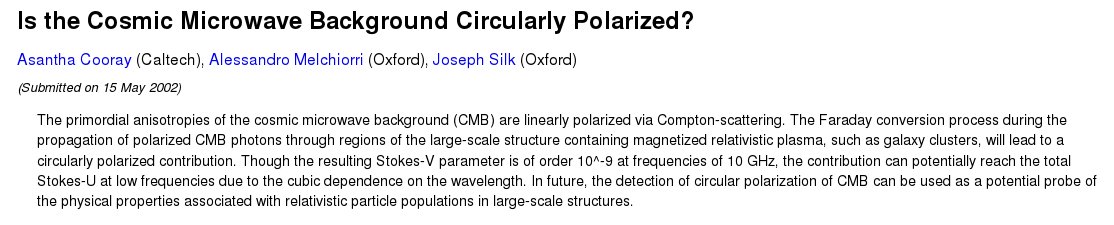
A few years ago there was a paper on the arXiv by Asantha Cooray, Alessandro Melchiorri and Joe Silk which pointed out that the CMB may well have some level of circular polarization. When light travels through a region containing plasma and a magnetic field, circular polarization can be generated from linear polarization via a process called Faraday conversion. For this to happen, the polarization vector of the incident radiation (defined by the direction of its E-field) must have non-zero component along the local magnetic field, i.e. the B-field. Charged particles are free to move only along B, so the component of E parallel to B is absorbed and re-emitted by these charges, thus leading to phase difference between it and the component of E orthogonal to B and hence to the circular polarization. This is related to the perhaps more familiar process of which causes the plane of linear polarization to rotate when polarized radiation travels through a region containing a magnetic field.

Here is the abstract of that paper:

(Also clickable.) This is a somewhat larger effect but differs from the first paper in that it is produced by foreground processes rather than primordial physics. In any case a Stokes V of 10-9 is also unlikely to be measurable at any time in the foreseeable future.