Archive for Cosmology

The Dipole Repeller

Posted in The Universe and Stuff with tags , , , , , , on February 2, 2017 by telescoper

An interesting bit of local cosmology news has been hitting the headlines over the last few days. The story relates to a paper by Yehuda Hoffman et al. published in Nature Astronomy on 30th January. The abstract reads:

Our Local Group of galaxies is moving with respect to the cosmic microwave background (CMB) with a velocity 1 of VCMB = 631 ± 20 km s−1and participates in a bulk flow that extends out to distances of ~20,000 km s−1 or more 2,3,4 . There has been an implicit assumption that overabundances of galaxies induce the Local Group motion 5,6,7 . Yet underdense regions push as much as overdensities attract 8 , but they are deficient in light and consequently difficult to chart. It was suggested a decade ago that an underdensity in the northern hemisphere roughly 15,000 km s−1 away contributes significantly to the observed flow 9 . We show here that repulsion from an underdensity is important and that the dominant influences causing the observed flow are a single attractor — associated with the Shapley concentration — and a single previously unidentified repeller, which contribute roughly equally to the CMB dipole. The bulk flow is closely anti-aligned with the repeller out to 16,000 ± 4,500 km s−1. This ‘dipole repeller’ is predicted to be associated with a void in the distribution of galaxies.

The effect of this “void in the distribution of galaxies” has been described in rather lurid terms as “Milky Way being pushed through space by cosmic dead zone” in a Guardian piece on this research.

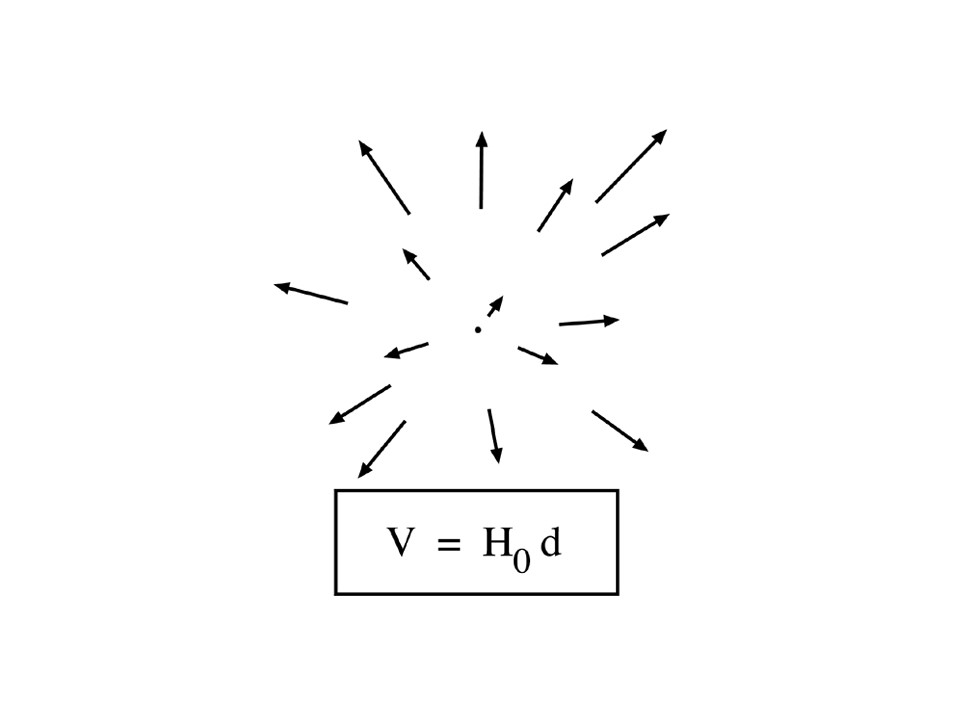
If you’re confused by this into thinking that some sort of anti-gravity is at play, then it isn’t really anything so exotic. If the Universe were completely homogeneous and isotropic – as our simplest models assume – then it would be expanding at the same rate in all directions.  This would be a pure “Hubble flow“, with galaxies appearing to recede from an observer with a speed proportional to their distance:
slide7

But the Universe isn’t exactly smooth. As well as the galaxies themselves, there are clusters, filaments and sheets of galaxies and a corresponding collection of void regions, together forming a huge and complex “cosmic web” of large-scale structure. This distorts the Hubble flow by inducing peculiar motions (i.e. departures from the pure expansion). A part of the Universe which is denser than average (e.g. a cluster or supercluster) expands less  quickly than average, a part which is less dense (i.e. a void) expands more quickly than average. Relative to the global expansion rate, clusters represent a “pull” and voids represent a “push”. That’s really all there is to it.

The difficult part about this kind of study is measuring a sufficient number of peculiar motions of galaxies around our own to make a detailed map of what’s going on in the local velocity field. That’s particularly hard for galaxies near the plane of the Milky Way disk as they tend to be obscured by dust. Nevertheless, after plugging away at this for many years, the authors of the Nature paper have generated some fascinating results. It seems that our Galaxy and other members of the Local Group lie between a dense supercluster (often called the Shapley concentration) and an underdense region, so the peculiar velocity field around us has an approximately dipole structure.

They’ve even made a nice video to show you what’s going on, so I don’t have to explain any further!


Fake News of the Holographic Universe

Posted in Astrohype, The Universe and Stuff with tags , , , , , , on February 1, 2017 by telescoper

It has been a very busy day today but I thought I’d grab a few minutes to rant about something inspired by a cosmological topic but that I’m afraid is symptomatic of malaise that extends far wider than fundamental science.

The other day I found a news item with the title Study reveals substantial evidence of holographic universe. You can find a fairly detailed discussion of the holographic principle here, but the name is fairly self-explanatory: the familiar hologram is a two-dimensional object that contains enough information to reconstruct a three-dimensional object. The holographic principle extends this to the idea that information pertaining to a higher-dimensional space may reside on a lower-dimensional boundary of that space. It’s an idea which has gained some traction in the context of the black hole information paradox, for example.

There are people far more knowledgeable about the holographic principle than me, but naturally what grabbed my attention was the title of the news item: Study reveals substantial evidence of holographic universe. That got me really excited, as I wasn’t previously aware that there was any observed property of the Universe that showed any unambiguous evidence for the holographic interpretation or indeed that models based on this model could describe the available data better than the standard ΛCDM cosmological model. Naturally I went to the original paper on the arXiv by Niayesh Ashfordi et al. to which the news item relates. Here is the abstract:

We test a class of holographic models for the very early universe against cosmological observations and find that they are competitive to the standard ΛCDM model of cosmology. These models are based on three dimensional perturbative super-renormalizable Quantum Field Theory (QFT), and while they predict a different power spectrum from the standard power-law used in ΛCDM, they still provide an excellent fit to data (within their regime of validity). By comparing the Bayesian evidence for the models, we find that ΛCDM does a better job globally, while the holographic models provide a (marginally) better fit to data without very low multipoles (i.e. l≲30), where the dual QFT becomes non-perturbative. Observations can be used to exclude some QFT models, while we also find models satisfying all phenomenological constraints: the data rules out the dual theory being Yang-Mills theory coupled to fermions only, but allows for Yang-Mills theory coupled to non-minimal scalars with quartic interactions. Lattice simulations of 3d QFT’s can provide non-perturbative predictions for large-angle statistics of the cosmic microwave background, and potentially explain its apparent anomalies.

The third sentence (highlighted) states explicitly that according to the Bayesian evidence (see here for a review of this) the holographic models do not fit the data even as well as the standard model (unless some of the CMB measurements are excluded, and then they’re only slightly better)

I think the holographic principle is a very interesting idea and it may indeed at some point prove to provide a deeper understanding of our universe than our current models. Nevertheless it seems clear to me that the title of this news article is extremely misleading. Current observations do not really provide any evidence in favour of the holographic models, and certainly not “substantial evidence”.

The wider point should be obvious. We scientists rightly bemoan the era of “fake news”. We like to think that we occupy the high ground, by rigorously weighing up the evidence, drawing conclusions as objectively as possible, and reporting our findings with a balanced view of the uncertainties and caveats. That’s what we should be doing. Unless we do that we’re not communicating science but engaged in propaganda, and that’s a very dangerous game to play as it endangers the already fragile trust the public place in science.

The authors of the paper are not entirely to blame as they did not write the piece that kicked off this rant, which seems to have been produced by the press office at the University of Southampton, but they should not have consented to it being released with such a misleading title.

How the Nonbaryonic Dark Matter Theory Grew [CEA]

Posted in The Universe and Stuff with tags , , on January 24, 2017 by telescoper

Another arXiver post, this time from the great Jim Peebles. Always a skeptic about dark matter, especially cold dark matter, it is the hallmark of a great scientist that he weighs up the evidence as objectively as possible.

This is a long review, but well worth reading for its important insights and historical perspective. I agree that the case for non-baryonic dark matter is compelling, but it is also far from proved and it’s still possible that an alternative, equally or more compelling, theory will be found.

arxiver's avatararXiver

http://arxiv.org/abs/1701.05837

The evidence is that the mass of the universe is dominated by an exotic nonbaryonic form of matter largely draped around the galaxies. It approximates an initially low pressure gas of particles that interact only with gravity, but we know little more than that. Searches for detection thus must follow many difficult paths to a great discovery, what the universe is made of. The nonbaryonic picture grew out of a convergence of evidence and ideas in the early 1980s. Developments two decades later considerably improved the evidence, and advances since then have made the case for nonbaryonic dark matter compelling.

Read this paper on arXiv…

P. Peebles
Mon, 23 Jan 17
37/55

Comments: An essay to accompany articles on dark matter detection in Nature Astronomy

View original post

Status of Dark Matter in the Universe [CEA]

Posted in The Universe and Stuff with tags , on January 11, 2017 by telescoper

Courtesy of arXiver, here’s a nice review article if you want to get up to date with the latest ideas and evidence about Dark Matter…

arxiver's avatararXiver

http://arxiv.org/abs/1701.01840

Over the past few decades, a consensus picture has emerged in which roughly a quarter of the universe consists of dark matter. I begin with a review of the observational evidence for the existence of dark matter: rotation curves of galaxies, gravitational lensing measurements, hot gas in clusters, galaxy formation, primordial nucleosynthesis and cosmic microwave background observations. Then I discuss a number of anomalous signals in a variety of data sets that may point to discovery, though all of them are controversial. The annual modulation in the DAMA detector and/or the gamma-ray excess seen in the Fermi Gamma Ray Space Telescope from the Galactic Center could be due to WIMPs; a 3.5 keV X-ray line from multiple sources could be due to sterile neutrinos; or the 511 keV line in INTEGRAL data could be due to MeV dark matter. All of these would require further confirmation in other experiments…

View original post 92 more words

Galaxy Formation in the EAGLE Project

Posted in The Universe and Stuff with tags , , , on December 8, 2016 by telescoper

Yesterday I went to a nice Colloquium by Rob Crain of Liverpool John Moores University (which is in the Midlands). Here’s the abstract of his talk which was entitled
Cosmological hydrodynamical simulations of the galaxy population:

I will briefly recap the motivation for, and progress towards, numerical modelling of the formation and evolution of the galaxy population – from cosmological initial conditions at early epochs through to the present day. I will introduce the EAGLE project, a flagship program of such simulations conducted by the Virgo Consortium. These simulations represent a major development in the discipline, since they are the first to broadly reproduce the key properties of the evolving galaxy population, and do so using energetically-feasible feedback mechanisms. I shall present a broad range of results from analyses of the EAGLE simulation, concerning the evolution of galaxy masses, their luminosities and colours, and their atomic and molecular gas content, to convey some of the strengths and limitations of the current generation of numerical models.

I added the link to the EAGLE project so you can find more information. As one of the oldies in the audience I can’t help remembering the old days of the galaxy formation simulation game. When I started my PhD back in 1985 the state of the art was a gravity-only simulation of 323 particles in a box. Nowadays one can manage about 20003 particles at the same time aas having a good go at dealing not only with gravity but also the complex hydrodynamical processes involved in assembling a galaxy of stars, gas, dust and dark matter from a set of primordial fluctuations present in the early Universe. In these modern simulations one does not just track the mass distribution but also various themrmodynamic properties such as temperature, pressure, internal energy and entropy, which means that they require large supercomputers. This certainly isn’t a solved problem – different groups get results that differ by an order of magnitude in some key predictions – but the game has certainly moved on dramatically in the past thirty years or so.

Another thing that has certainly improved a lot is data visualization: here is a video of one of the EAGLE simulations, showing a region of the Universe about 25 MegaParsecs across. The gas is colour-coded for temperature. As the simulation evolves you can see the gas first condense into the filaments of the Cosmic Web, thereafter forming denser knots in which stars form and become galaxies, experiencing in some cases explosive events which expel the gas. It’s quite a messy business, which is why one has to do these things numerically rather than analytically, but it’s certainly fun to watch!

Does the fine structure constant vary?

Posted in The Universe and Stuff with tags , , on November 16, 2016 by telescoper

No.

A Non-accelerating Universe?

Posted in Astrohype, The Universe and Stuff with tags , , , , , on October 26, 2016 by telescoper

There’s been quite a lot of reaction on the interwebs over the last few days much of it very misleading; here’s a sensible account) to a paper by Nielsen, Guffanti and Sarkar which has just been published online in Scientific Reports, an offshoot of Nature. I think the above link should take you an “open access” version of the paper but if it doesn’t you can find the arXiv version here. I haven’t cross-checked the two versions so the arXiv one may differ slightly.

Anyway, here is the abstract:

The ‘standard’ model of cosmology is founded on the basis that the expansion rate of the universe is accelerating at present — as was inferred originally from the Hubble diagram of Type Ia supernovae. There exists now a much bigger database of supernovae so we can perform rigorous statistical tests to check whether these ‘standardisable candles’ indeed indicate cosmic acceleration. Taking account of the empirical procedure by which corrections are made to their absolute magnitudes to allow for the varying shape of the light curve and extinction by dust, we find, rather surprisingly, that the data are still quite consistent with a constant rate of expansion.

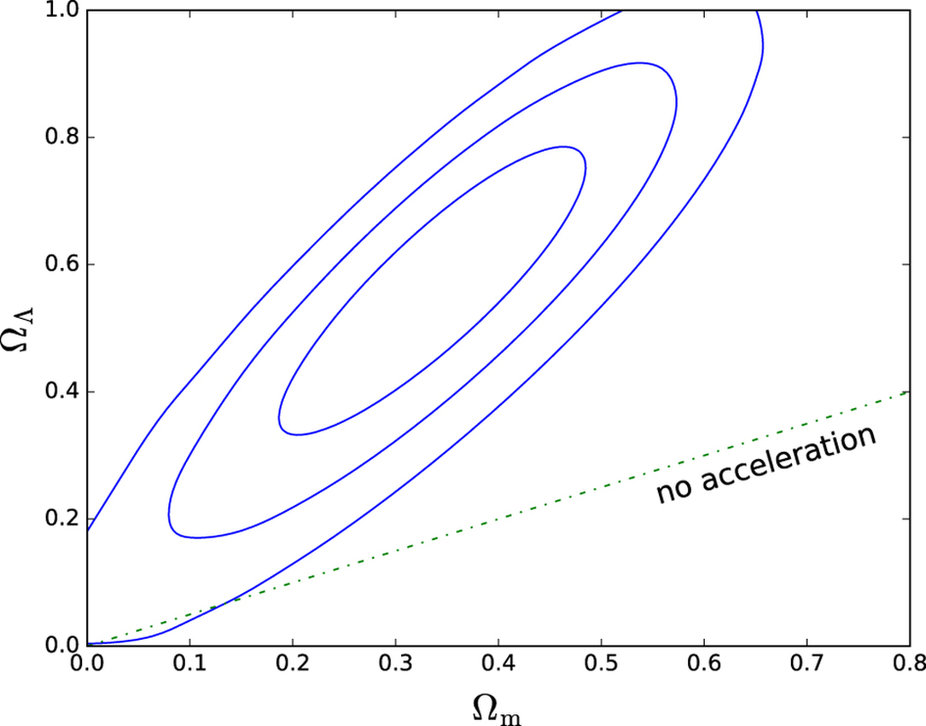
Obviously I haven’t been able to repeat the statistical analysis but I’ve skimmed over what they’ve done and as far as I can tell it looks a fairly sensible piece of work (although it is a frequentist analysis). Here is the telling plot (from the Nature version)  in terms of the dark energy (y-axis) and matter (x-axis) density parameters:

lambda

Models shown in this plane by a line have the correct balance between Ωm, and ΩΛ to cancel out the decelerating effect of the former against the accelerating effect of the latter (a special case is the origin on the plot, which is called the Milne model and represents an entirely empty universe). The contours show “1, 2 and 3σ” contours, regarding all other parameters as nuisance parameters. It is true that the line of no acceleration does go inside the 3σcontour so in that sense is not entirely inconsistent with the data. On the other hand, the “best fit” (which is at the point Ωm=0.341, ΩΛ=0.569) does represent an accelerating universe.

I am not all that surprised by this result, actually. I’ve always felt that taken on its own the evidence for cosmic acceleration from supernovae alone was not compelling. However, when it is combined with other measurements (particularly of the cosmic microwave background and large-scale structure) which are sensitive to other aspects of the cosmological space-time geometry, the agreement is extremely convincing and has established a standard “concordance” cosmology. The CMB, for example, is particularly sensitive to spatial curvature which, measurements tells us, must be close to zero. The Milne model, on the other hand, has a large (negative) spatial curvature entirely excluded by CMB observations. Curvature is regarded as a “nuisance parameter” in the above diagram.

I think this paper is a worthwhile exercise. Subir Sarkar (one of the authors) in particular has devoted a lot of energy to questioning the standard ΛCDM model which far too many others accept unquestioningly. That’s a noble thing to do, and it is an essential part of the scientific method, but this paper only looks at one part of an interlocking picture. The strongest evidence comes from the cosmic microwave background and despite this reanalysis I feel the supernovae measurements still provide a powerful corroboration of the standard cosmology.

Let me add, however, that the supernovae measurements do not directly measure cosmic acceleration. If one tries to account for them with a model based on Einstein’s general relativity and the assumption that the Universe is on large-scales is homogeneous and isotropic and with certain kinds of matter and energy then the observations do imply a universe that accelerates. Any or all of those assumptions may be violated (though some possibilities are quite heavily constrained). In short we could, at least in principle, simply be interpreting these measurements within the wrong framework, and statistics can’t help us with that!

KiDS-450: Testing extensions to the standard cosmological model [CEA]

Posted in The Universe and Stuff with tags , , , on October 19, 2016 by telescoper

Since I’ve just attended a seminar in Cardiff by Catherine Heymans on exactly this work, I couldn’t resist reblogging the arXiver entry for this paper which appeared on arXiv a couple of days ago.

The key finding is that the weak lensing analysis of KIDS data (which is mainly to the distribution of matter at low redshift) does seem to be discrepant with the predictions of the standard cosmological model established by Planck (which is sensitive mainly to high-redshift fluctuations).

Could this discrepancy be interpreted as evidence of something going on beyond the standard cosmology? Read the paper to explore some possibilities!

arxiver's avatararXiver

http://arxiv.org/abs/1610.04606

We test extensions to the standard cosmological model with weak gravitational lensing tomography using 450 deg$^2$ of imaging data from the Kilo Degree Survey (KiDS). In these extended cosmologies, which include massive neutrinos, nonzero curvature, evolving dark energy, modified gravity, and running of the scalar spectral index, we also examine the discordance between KiDS and cosmic microwave background measurements from Planck. The discordance between the two datasets is largely unaffected by a more conservative treatment of the lensing systematics and the removal of angular scales most sensitive to nonlinear physics. The only extended cosmology that simultaneously alleviates the discordance with Planck and is at least moderately favored by the data includes evolving dark energy with a time-dependent equation of state (in the form of the $w_0-w_a$ parameterization). In this model, the respective $S_8 = sigma_8 sqrt{Omega_{rm m}/0.3}$ constraints agree at the $1sigma$ level, and there is `substantial concordance’ between…

View original post 159 more words

A Universe of Two Trillion Galaxies

Posted in The Universe and Stuff with tags , , , , , on October 13, 2016 by telescoper

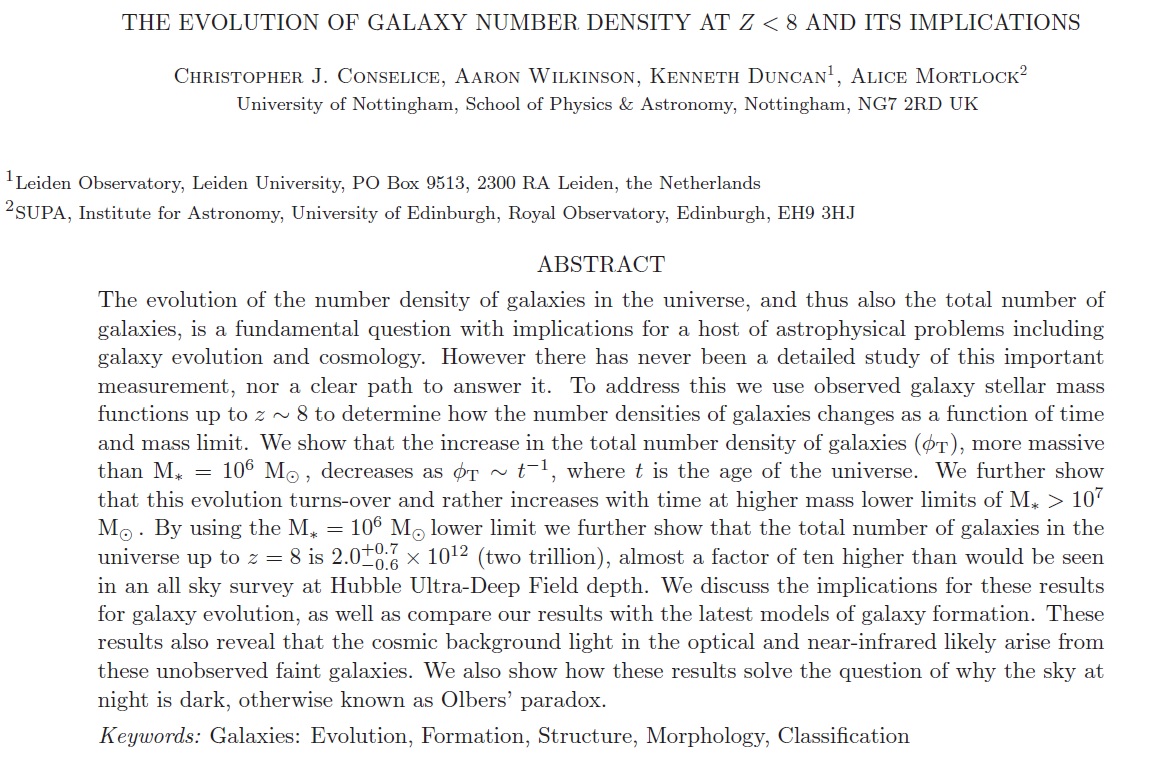
I just saw a press-release that describes a paper, just out, authored by Chris Conselice et al from the University of Nottingham (in the Midlands), with this here abstract:

conselice

The key conclusion of this paper is that when the universe was only a few billion years old there were about ten times as many galaxies in a given volume of space as there are within a similar volume today, but most of these galaxies were much lower mass systems than, e.g., the Milky Way. In fact their masses are similar to those of the satellite galaxies surrounding the Milky Way. These objects are numerous but so faint that even in very deep surveys with very big telescopes they are very easy to miss.

Here’s an image from a deep survey: this is from the Hubble Space Telescoper Great Observatories Deep Survey (HST-GOODS).

hst_goods-south

You can click on this to make it larger if you wish. This is typical of a “pencil beam” survey. It opens a very small window on the heavens – about a millionth of its total area of the sky – in a direction chosen to avoid having too many bright stars from our own Galaxy getting in the way. When you look at such a patch with a big telescope for a long time, what you see is basically all galaxies. The few stars in the above image can be identified by the diffraction patterns they produce, but almost every fuzzy blob in the picture is a galaxy. It looks like there are a lot of galaxies in this image, but the real number seems to be substantially higher than we thought.

When I’ve given popular talks about this kind of thing I’ve always said something like “There are at least as many galaxies in the observable Universe as there are stars in our own Galaxy”. It turns out that I was wise to include the “at least as”. There are about 100 billion (1011) stars in the Milky Way, but the latest estimate is now that there are two trillion (2 ×10¹²) galaxies in the observable Universe. I quote Douglas Adams:

“The Universe, as has been observed before, is an unsettlingly big place, a fact which for the sake of a quiet life most people tend to ignore. Many would happily move to somewhere rather smaller of their own devising, and this is what most beings in fact do.

I believe this explains a lot about modern politics.


General Relativity and Cosmology: Unsolved Questions and Future Directions [CL]

Posted in The Universe and Stuff with tags , on October 12, 2016 by telescoper

I missed this when it appeared on the arXiv last week, but now that I’ve read it I couldn’t resist reblogging this nice review of the current state of General Relativity and its alternatives, with an emphasis on the cosmological ramifications.

arxiver's avatararXiver

http://arxiv.org/abs/1609.09781

For the last 100 years, General Relativity (GR) has taken over the gravitational theory mantle held by Newtonian Gravity for the previous 200 years. This article reviews the status of GR in terms of its self-consistency, completeness, and the evidence provided by observations, which have allowed GR to remain the champion of gravitational theories against several other classes of competing theories. We pay particular attention to the role of GR and gravity in cosmology, one of the areas in which one gravity dominates and new phenomena and effects challenge the orthodoxy. We also review other areas where there are likely conflicts pointing to the need to replace or revise GR to represent correctly observations and consistent theoretical framework. Observations have long been key both to the theoretical liveliness and viability of GR. We conclude with a discussion of the likely developments over the next 100 years.

Read this paper…

View original post 17 more words