Archive for Cosmology

BICEP3 Cometh…

Posted in The Universe and Stuff with tags , , , , , on January 6, 2016 by telescoper

Back in the office after the Christmas and New Year break, with a mountain of stuff to work through..

Anyway, I saw this paper on the arXiv yesterday and thoought I’d share it here. It’s from a paper by Wu et al. entitled Initial Performance of BICEP3: A Degree Angular Scale 95 GHz Band Polarimeter.  The abstract follows:

BICEP3 is a 550 mm aperture telescope with cold, on-axis, refractive optics designed to observe at the 95 GHz band from the South Pole. It is the newest member of the BICEP/Keck family of inflationary probes specifically designed to measure the polarization of the cosmic microwave background (CMB) at degree-angular scales. BICEP3 is designed to house 1280 dual-polarization pixels, which, when fully-populated, totals to 9× the number of pixels in a single Keck 95 GHz receiver, thus further advancing the BICEP/Keck program’s 95 GHz mapping speed. BICEP3 was deployed during the austral summer of 2014-2015 with 9 detector tiles, to be increased to its full capacity of 20 in the second season. After instrument characterization measurements were taken, CMB observation commenced in April 2015. Together with multi-frequency observation data from Planck, BICEP2, and the Keck Array, BICEP3 is projected to set upper limits on the tensor-to-scalar ratio to r 0.03 at 95% C.L..

It all looks very promising, with science results likely to appear later this year, but who will win the race to find those elusive primordial B-modes?


The Dark Energy MacGuffin

Posted in Science Politics, The Universe and Stuff with tags , , , , , , , , on December 19, 2015 by telescoper

Back from a two-day meeting in Edinburgh about the Euclid Mission, I have to spend a couple of days this weekend in the office before leaving for the holidays. I was a bit surprised at the end of the meeting to be asked if I would be on the panel for the closing discussion, discussing questions raised by the audience. The first of these questions was – and I have to paraphrase becase I don’t remember exactly – whether it would be disappointing if the Euclid mission merely confirmed that observations were consistent with a “simple” cosmological constant rather than any of the more exotic (and perhaps more exciting) alternatives that have been proposed by theorists. I think that’s the likely outcome of Euclid, actually, and I don’t think it would be disappointing if it turned out to be the case. Moreover, testing theories of dark energy is just one of the tasks this mission will undertake and it may well be the case that in years to come Euclid is remembered for something other than dark energy. Anyway, this all triggered a memory of an old post of mine about Alfred Hitchcock so with apologies for repeating something I blogged about 4 years ago, here is a slight reworking of an old piece.

–0–

Unpick the plot of any thriller or suspense movie and the chances are that somewhere within it you will find lurking at least one MacGuffin. This might be a tangible thing, such the eponymous sculpture of a Falcon in the archetypal noir classic The Maltese Falcon or it may be rather nebulous, like the “top secret plans” in Hitchcock’s The Thirty Nine Steps. Its true character may be never fully revealed, such as in the case of the glowing contents of the briefcase in Pulp Fiction , which is a classic example of the “undisclosed object” type of MacGuffin, or it may be scarily obvious, like a doomsday machine or some other “Big Dumb Object” you might find in a science fiction thriller. It may even not be a real thing at all. It could be an event or an idea or even something that doesn’t exist in any real sense at all, such the fictitious decoy character George Kaplan in North by Northwest. In fact North by North West is an example of a movie with more than one MacGuffin. Its convoluted plot involves espionage and the smuggling of what is only cursorily described as “government secrets”. These are the main MacGuffin; George Kaplan is a sort of sub-MacGuffin. But although this is behind the whole story, it is the emerging romance, accidental betrayal and frantic rescue involving the lead characters played by Cary Grant and Eve Marie Saint that really engages the characters and the audience as the film gathers pace. The MacGuffin is a trigger, but it soon fades into the background as other factors take over.

Whatever it is or is not, the MacGuffin is responsible for kick-starting the plot. It makes the characters embark upon the course of action they take as the tale begins to unfold. This plot device was particularly beloved by Alfred Hitchcock (who was responsible for introducing the word to the film industry). Hitchcock was however always at pains to ensure that the MacGuffin never played as an important a role in the mind of the audience as it did for the protagonists. As the plot twists and turns – as it usually does in such films – and its own momentum carries the story forward, the importance of the MacGuffin tends to fade, and by the end we have usually often forgotten all about it. Hitchcock’s movies rarely bother to explain their MacGuffin(s) in much detail and they often confuse the issue even further by mixing genuine MacGuffins with mere red herrings.

Here is the man himself explaining the concept at the beginning of this clip. (The rest of the interview is also enjoyable, convering such diverse topics as laxatives, ravens and nudity..)


There’s nothing particular new about the idea of a MacGuffin. I suppose the ultimate example is the Holy Grail in the tales of King Arthur and the Knights of the Round Table and, much more recently, the Da Vinci Code. The original Grail itself is basically a peg on which to hang a series of otherwise disconnected stories. It is barely mentioned once each individual story has started and, of course, is never found.

Physicists are fond of describing things as “The Holy Grail” of their subject, such as the Higgs Boson or gravitational waves. This always seemed to me to be an unfortunate description, as the Grail quest consumed a huge amount of resources in a predictably fruitless hunt for something whose significance could be seen to be dubious at the outset.The MacGuffin Effect nevertheless continues to reveal itself in science, although in different forms to those found in Hollywood.

The Large Hadron Collider (LHC), switched on to the accompaniment of great fanfares a few years ago, provides a nice example of how the MacGuffin actually works pretty much backwards in the world of Big Science. To the public, the LHC was built to detect the Higgs Boson, a hypothetical beastie introduced to account for the masses of other particles. If it exists the high-energy collisions engineered by LHC should reveal its presence. The Higgs Boson is thus the LHC’s own MacGuffin. Or at least it would be if it were really the reason why LHC has been built. In fact there are dozens of experiments at CERN and many of them have very different motivations from the quest for the Higgs, such as evidence for supersymmetry.

Particle physicists are not daft, however, and they have realised that the public and, perhaps more importantly, government funding agencies need to have a really big hook to hang such a big bag of money on. Hence the emergence of the Higgs as a sort of master MacGuffin, concocted specifically for public consumption, which is much more effective politically than the plethora of mini-MacGuffins which, to be honest, would be a fairer description of the real state of affairs.

Even this MacGuffin has its problems, though. The Higgs mechanism is notoriously difficult to explain to the public, so some have resorted to a less specific but more misleading version: “The Big Bang”. As I’ve already griped, the LHC will never generate energies anything like the Big Bang did, so I don’t have any time for the language of the “Big Bang Machine”, even as a MacGuffin.

While particle physicists might pretend to be doing cosmology, we astrophysicists have to contend with MacGuffins of our own. One of the most important discoveries we have made about the Universe in the last decade is that its expansion seems to be accelerating. Since gravity usually tugs on things and makes them slow down, the only explanation that we’ve thought of for this perverse situation is that there is something out there in empty space that pushes rather than pulls. This has various possible names, but Dark Energy is probably the most popular, adding an appropriately noirish edge to this particular MacGuffin. It has even taken over in prominence from its much older relative, Dark Matter, although that one is still very much around.

We have very little idea what Dark Energy is, where it comes from, or how it relates to other forms of energy we are more familiar with, so observational astronomers have jumped in with various grandiose strategies to find out more about it. This has spawned a booming industry in surveys of the distant Universe (such as the Dark Energy Survey or the Euclid mission I mentioned in the preamble) all aimed ostensibly at unravelling the mystery of the Dark Energy. It seems that to get any funding at all for cosmology these days you have to sprinkle the phrase “Dark Energy” liberally throughout your grant applications.

The old-fashioned “observational” way of doing astronomy – by looking at things hard enough until something exciting appears (which it does with surprising regularity) – has been replaced by a more “experimental” approach, more like that of the LHC. We can no longer do deep surveys of galaxies to find out what’s out there. We have to do it “to constrain models of Dark Energy”. This is just one example of the not necessarily positive influence that particle physics has had on astronomy in recent times and it has been criticised very forcefully by Simon White.

Whatever the motivation for doing these projects now, they will undoubtedly lead to new discoveries. But my own view is that there will never be a solution of the Dark Energy problem until it is understood much better at a conceptual level, and that will probably mean major revisions of our theories of both gravity and matter. I venture to speculate that in twenty years or so people will look back on the obsession with Dark Energy with some amusement, as our theoretical language will have moved on sufficiently to make it seem irrelevant.

But that’s how it goes with MacGuffins. Even the Maltese Falcon turned out in the end to be a fake.

Einstein’s Legacy

Posted in The Universe and Stuff with tags , , , , , , , on November 29, 2015 by telescoper

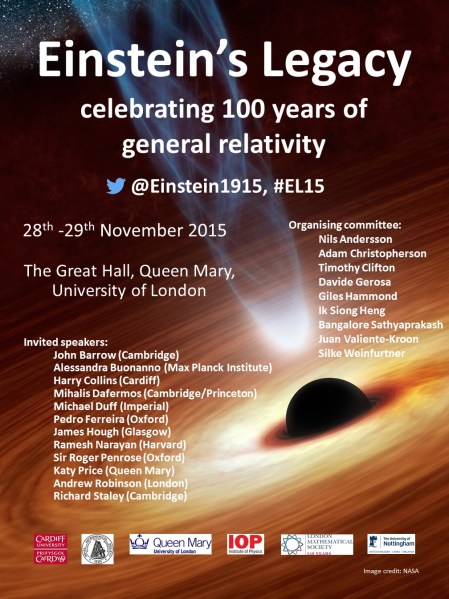
Yesterday I braved the inclement weather and the perils of weekend travel on Southern Trains to visit Queen Mary College, in the East End of London, for the following event:

GR100

I used to work at  Queen Mary, but haven’t been back for a while. The college and environs have been smartened up quite a lot since I used to be there, as seems to be the case for the East End generally. I doubt if I could afford to live there now!

Owing to a little local difficulty which I won’t go into, I was running a bit late so I missed the morning session. I did, however, arrive in time to see my former colleague Bangalore Sathyaprakash from Cardiff talking about gravitational waves, Jim Hough from Glasgow talking about experimental gravity – including gravitational waves but also talking about the puzzling state of affairs over “Big G” – and Pedro Ferreira from Oxford whose talk on “Cosmology for the 21st Century” gave an enjoyable historical perspective on recent developments.

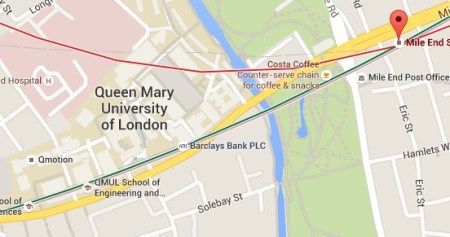
The talks were held in the Great Hall in the People’s Palace on Mile End Road, a large venue that was pretty full all afternoon. I’m not sure whether it was the District/Hammersmith & City Line or the Central Line (or both) that provided the atmospheric sound effects, especially when Jim Hough described the problems of dealing with seismic noise in gravitational experiments and a train rumbled underneath right on cue.

UPDATE: Thanks to Bryn’s comment (below) I looked at a map: the Central Line goes well to the North whereas the District and Hammersmith & City Line go directly under the main buildings adjacent to Mile End Road.

Under-QM

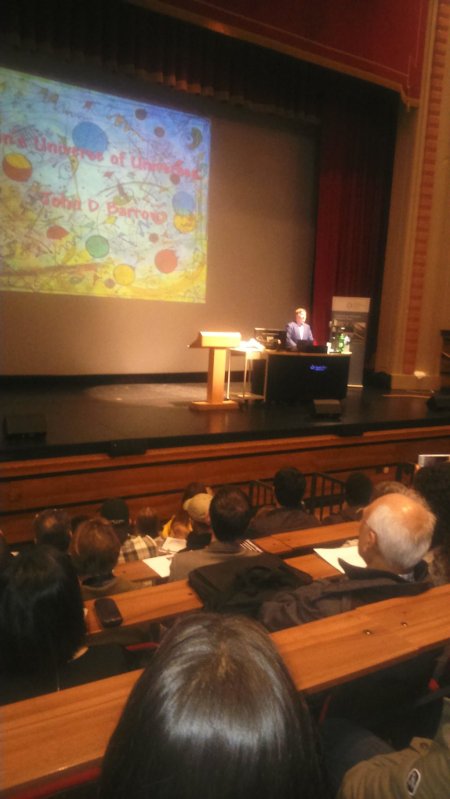
Anyway, the venue was even fuller for the evening session, kicked off by my former PhD supervisor, John Barrow:

Einstein's Legacy

This session was aimed at a more popular audience and was attended by more than a few A-level students. John’s talk was very nice, taking us through all the various cosmological models that have been developed based on Einstein’s theory of General Relativity.

Finally, topping the bill, was Sir Roger Penrose whose talk was engagingly lo-tech in terms of visual aids but aimed at quite a high level. His use of hand-drawn transparencies was very old-school, but a useful side-effect was that he conveyed very effectively how entropy always increases with time.

Penrose covered some really interesting material related to black holes and cosmology, especially to do with gravitational entropy, but my heart sank when he tried at the end to resurrect his discredited “Circles in the Sky” idea. I’m not sure how much the A-level students took from his talk, but I found it very entertaining.

The conference carries on today, but I couldn’t attend the Sunday session owing to pressure of work. Which I should be doing now!

P.S. I’ll say it before anyone else does: yes, all the speakers I heard were male, as indeed were the two I missed in the morning. I gather there was one cancellation  of a female speaker (Alessandra Buonanno), for whom Sathya stood in.  But still.


Life as a Condition of Cosmology

Posted in The Universe and Stuff with tags , , , , , , , on November 7, 2015 by telescoper

Trigger Warnings: Bayesian Probability and the Anthropic Principle!

Once upon a time I was involved in setting up a cosmology conference in Valencia (Spain). The principal advantage of being among the organizers of such a meeting is that you get to invite yourself to give a talk and to choose the topic. On this particular occasion, I deliberately abused my privilege and put myself on the programme to talk about the “Anthropic Principle”. I doubt if there is any subject more likely to polarize a scientific audience than this. About half the participants present in the meeting stayed for my talk. The other half ran screaming from the room. Hence the trigger warnings on this post. Anyway, I noticed a tweet this morning from Jon Butterworth advertising a new blog post of his on the very same subject so I thought I’d while away a rainy November afternoon with a contribution of my own.

In case you weren’t already aware, the Anthropic Principle is the name given to a class of ideas arising from the suggestion that there is some connection between the material properties of the Universe as a whole and the presence of human life within it. The name was coined by Brandon Carter in 1974 as a corrective to the “Copernican Principle” that man does not occupy a special place in the Universe. A naïve application of this latter principle to cosmology might lead us to think that we could have evolved in any of the myriad possible Universes described by the system of Friedmann equations. The Anthropic Principle denies this, because life could not have evolved in all possible versions of the Big Bang model. There are however many different versions of this basic idea that have different logical structures and indeed different degrees of credibility. It is not really surprising to me that there is such a controversy about this particular issue, given that so few physicists and astronomers take time to study the logical structure of the subject, and this is the only way to assess the meaning and explanatory value of propositions like the Anthropic Principle. My former PhD supervisor, John Barrow (who is quoted in John Butterworth’s post) wrote the definite text on this topic together with Frank Tipler to which I refer you for more background. What I want to do here is to unpick this idea from a very specific perspective and show how it can be understood quite straightfowardly in terms of Bayesian reasoning. I’ll begin by outlining this form of inferential logic.

I’ll start with Bayes’ theorem which for three logical propositions (such as statements about the values of parameters in theory) A, B and C can be written in the form

P(B|AC) = K^{-1}P(B|C)P(A|BC) = K^{-1} P(AB|C)

where

K=P(A|C).

This is (or should be!)  uncontroversial as it is simply a result of the sum and product rules for combining probabilities. Notice, however, that I’ve not restricted it to two propositions A and B as is often done, but carried throughout an extra one (C). This is to emphasize the fact that, to a Bayesian, all probabilities are conditional on something; usually, in the context of data analysis this is a background theory that furnishes the framework within which measurements are interpreted. If you say this makes everything model-dependent, then I’d agree. But every interpretation of data in terms of parameters of a model is dependent on the model. It has to be. If you think it can be otherwise then I think you’re misguided.

In the equation,  P(B|C) is the probability of B being true, given that C is true . The information C need not be definitely known, but perhaps assumed for the sake of argument. The left-hand side of Bayes’ theorem denotes the probability of B given both A and C, and so on. The presence of C has not changed anything, but is just there as a reminder that it all depends on what is being assumed in the background. The equation states  a theorem that can be proved to be mathematically correct so it is – or should be – uncontroversial.

To a Bayesian, the entities A, B and C are logical propositions which can only be either true or false. The entities themselves are not blurred out, but we may have insufficient information to decide which of the two possibilities is correct. In this interpretation, P(A|C) represents the degree of belief that it is consistent to hold in the truth of A given the information C. Probability is therefore a generalization of the “normal” deductive logic expressed by Boolean algebra: the value “0” is associated with a proposition which is false and “1” denotes one that is true. Probability theory extends  this logic to the intermediate case where there is insufficient information to be certain about the status of the proposition.

A common objection to Bayesian probability is that it is somehow arbitrary or ill-defined. “Subjective” is the word that is often bandied about. This is only fair to the extent that different individuals may have access to different information and therefore assign different probabilities. Given different information C and C′ the probabilities P(A|C) and P(A|C′) will be different. On the other hand, the same precise rules for assigning and manipulating probabilities apply as before. Identical results should therefore be obtained whether these are applied by any person, or even a robot, so that part isn’t subjective at all.

In fact I’d go further. I think one of the great strengths of the Bayesian interpretation is precisely that it does depend on what information is assumed. This means that such information has to be stated explicitly. The essential assumptions behind a result can be – and, regrettably, often are – hidden in frequentist analyses. Being a Bayesian forces you to put all your cards on the table.

To a Bayesian, probabilities are always conditional on other assumed truths. There is no such thing as an absolute probability, hence my alteration of the form of Bayes’s theorem to represent this. A probability such as P(A) has no meaning to a Bayesian: there is always conditioning information. For example, if  I blithely assign a probability of 1/6 to each face of a dice, that assignment is actually conditional on me having no information to discriminate between the appearance of the faces, and no knowledge of the rolling trajectory that would allow me to make a prediction of its eventual resting position.

In tbe Bayesian framework, probability theory  becomes not a branch of experimental science but a branch of logic. Like any branch of mathematics it cannot be tested by experiment but only by the requirement that it be internally self-consistent. This brings me to what I think is one of the most important results of twentieth century mathematics, but which is unfortunately almost unknown in the scientific community. In 1946, Richard Cox derived the unique generalization of Boolean algebra under the assumption that such a logic must involve associated a single number with any logical proposition. The result he got is beautiful and anyone with any interest in science should make a point of reading his elegant argument. It turns out that the only way to construct a consistent logic of uncertainty incorporating this principle is by using the standard laws of probability. There is no other way to reason consistently in the face of uncertainty than probability theory. Accordingly, probability theory always applies when there is insufficient knowledge for deductive certainty. Probability is inductive logic.

This is not just a nice mathematical property. This kind of probability lies at the foundations of a consistent methodological framework that not only encapsulates many common-sense notions about how science works, but also puts at least some aspects of scientific reasoning on a rigorous quantitative footing. This is an important weapon that should be used more often in the battle against the creeping irrationalism one finds in society at large.

To see how the Bayesian approach provides a methodology for science, let us consider a simple example. Suppose we have a hypothesis H (some theoretical idea that we think might explain some experiment or observation). We also have access to some data D, and we also adopt some prior information I (which might be the results of other experiments and observations, or other working assumptions). What we want to know is how strongly the data D supports the hypothesis H given my background assumptions I. To keep it easy, we assume that the choice is between whether H is true or H is false. In the latter case, “not-H” or H′ (for short) is true. If our experiment is at all useful we can construct P(D|HI), the probability that the experiment would produce the data set D if both our hypothesis and the conditional information are true.

The probability P(D|HI) is called the likelihood; to construct it we need to have   some knowledge of the statistical errors produced by our measurement. Using Bayes’ theorem we can “invert” this likelihood to give P(H|DI), the probability that our hypothesis is true given the data and our assumptions. The result looks just like we had in the first two equations:

P(H|DI) = K^{-1}P(H|I)P(D|HI) .

Now we can expand the “normalising constant” K because we know that either H or H′ must be true. Thus

K=P(D|I)=P(H|I)P(D|HI)+P(H^{\prime}|I) P(D|H^{\prime}I)

The P(H|DI) on the left-hand side of the first expression is called the posterior probability; the right-hand side involves P(H|I), which is called the prior probability and the likelihood P(D|HI). The principal controversy surrounding Bayesian inductive reasoning involves the prior and how to define it, which is something I’ll comment on in a future post.

The Bayesian recipe for testing a hypothesis assigns a large posterior probability to a hypothesis for which the product of the prior probability and the likelihood is large. It can be generalized to the case where we want to pick the best of a set of competing hypothesis, say H1 …. Hn. Note that this need not be the set of all possible hypotheses, just those that we have thought about. We can only choose from what is available. The hypothesis may be relatively simple, such as that some particular parameter takes the value x, or they may be composite involving many parameters and/or assumptions. For instance, the Big Bang model of our universe is a very complicated hypothesis, or in fact a combination of hypotheses joined together,  involving at least a dozen parameters which can’t be predicted a priori but which have to be estimated from observations.

The required result for multiple hypotheses is pretty straightforward: the sum of the two alternatives involved in K above simply becomes a sum over all possible hypotheses, so that

P(H_i|DI) = K^{-1}P(H_i|I)P(D|H_iI),

and

K=P(D|I)=\sum P(H_j|I)P(D|H_jI)

If the hypothesis concerns the value of a parameter – in cosmology this might be, e.g., the mean density of the Universe expressed by the density parameter Ω0 – then the allowed space of possibilities is continuous. The sum in the denominator should then be replaced by an integral, but conceptually nothing changes. Our “best” hypothesis is the one that has the greatest posterior probability.

From a frequentist stance the procedure is often instead to just maximize the likelihood. According to this approach the best theory is the one that makes the data most probable. This can be the same as the most probable theory, but only if the prior probability is constant, but the probability of a model given the data is generally not the same as the probability of the data given the model. I’m amazed how many practising scientists make this error on a regular basis.

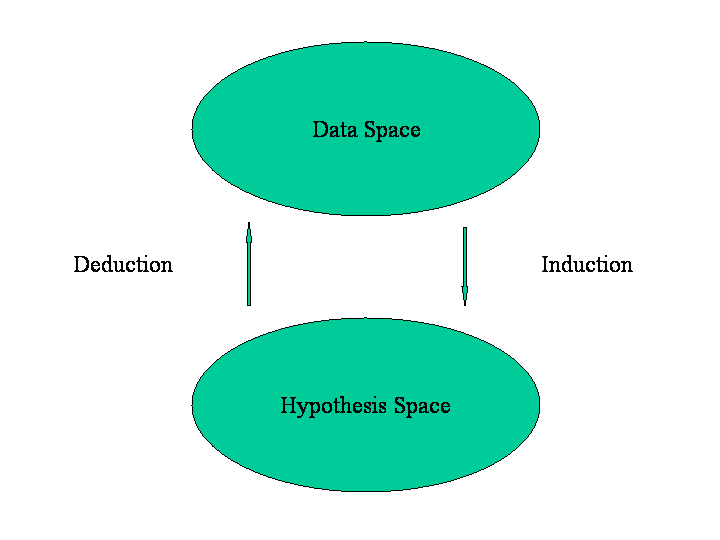
The following figure might serve to illustrate the difference between the frequentist and Bayesian approaches. In the former case, everything is done in “data space” using likelihoods, and in the other we work throughout with probabilities of hypotheses, i.e. we think in hypothesis space. I find it interesting to note that most theorists that I know who work in cosmology are Bayesians and most observers are frequentists!


As I mentioned above, it is the presence of the prior probability in the general formula that is the most controversial aspect of the Bayesian approach. The attitude of frequentists is often that this prior information is completely arbitrary or at least “model-dependent”. Being empirically-minded people, by and large, they prefer to think that measurements can be made and interpreted without reference to theory at all.

Assuming we can assign the prior probabilities in an appropriate way what emerges from the Bayesian framework is a consistent methodology for scientific progress. The scheme starts with the hardest part – theory creation. This requires human intervention, since we have no automatic procedure for dreaming up hypothesis from thin air. Once we have a set of hypotheses, we need data against which theories can be compared using their relative probabilities. The experimental testing of a theory can happen in many stages: the posterior probability obtained after one experiment can be fed in, as prior, into the next. The order of experiments does not matter. This all happens in an endless loop, as models are tested and refined by confrontation with experimental discoveries, and are forced to compete with new theoretical ideas. Often one particular theory emerges as most probable for a while, such as in particle physics where a “standard model” has been in existence for many years. But this does not make it absolutely right; it is just the best bet amongst the alternatives. Likewise, the Big Bang model does not represent the absolute truth, but is just the best available model in the face of the manifold relevant observations we now have concerning the Universe’s origin and evolution. The crucial point about this methodology is that it is inherently inductive: all the reasoning is carried out in “hypothesis space” rather than “observation space”.  The primary form of logic involved is not deduction but induction. Science is all about inverse reasoning.

Now, back to the anthropic principle. The point is that we can observe that life exists in our Universe and this observation must be incorporated as conditioning information whenever we try to make inferences about cosmological models if we are to reason consistently. In other words, the existence of life is a datum that must be incorporated in the conditioning information I mentioned above.

Suppose we have a model of the Universe M that contains various parameters which can be fixed by some form of observation. Let U be the proposition that these parameters take specific values U1, U2, and so on. Anthropic arguments revolve around the existence of life, so let L be the proposition that intelligent life evolves in the Universe. Note that the word “anthropic” implies specifically human life, but many versions of the argument do not necessarily accommodate anything more complicated than a virus.

Using Bayes’ theorem we can write

P(U|L,M)=K^{-1} P(U|M)P(L|U,M)

The dependence of the posterior probability P(U|L,M) on the likelihood P(L|U,M) demonstrates that the values of U for which P(L|U,M) is larger correspond to larger values of P(U|L,M); K is just a normalizing constant for the purpose of this argument. Since life is observed in our Universe the model-parameters which make life more probable must be preferred to those that make it less so. To go any further we need to say something about the likelihood and the prior. Here the complexity and scope of the model makes it virtually impossible to apply in detail the symmetry principles usually exploited to define priors for physical models. On the other hand, it seems reasonable to assume that the prior is broad rather than sharply peaked; if our prior knowledge of which universes are possible were so definite then we wouldn’t really be interested in knowing what observations could tell us. If now the likelihood is sharply peaked in U then this will be projected directly into the posterior distribution.

We have to assign the likelihood using our knowledge of how galaxies, stars and planets form, how planets are distributed in orbits around stars, what conditions are needed for life to evolve, and so on. There are certainly many gaps in this knowledge. Nevertheless if any one of the steps in this chain of knowledge requires very finely-tuned parameter choices then we can marginalize over the remaining steps and still end up with a sharp peak in the remaining likelihood and so also in the posterior probability. For example, there are plausible reasons for thinking that intelligent life has to be carbon-based, and therefore evolve on a planet. It is reasonable to infer, therefore, that P(U|L,M) should prefer some values of U. This means that there is a correlation between the propositions U and L in the sense that knowledge of one should, through Bayesian reasoning, enable us to make inferences about the other.

It is very difficult to make this kind of argument rigorously quantitative, but I can illustrate how the argument works with a simplified example. Let us suppose that the relevant parameters contained in the set U include such quantities as Newton’s gravitational constant G, the charge on the electron e, and the mass of the proton m. These are usually termed fundamental constants. The argument above indicates that there might be a connection between the existence of life and the value that these constants jointly take. Moreover, there is no reason why this kind of argument should not be used to find the values of fundamental constants in advance of their measurement. The ordering of experiment and theory is merely an historical accident; the process is cyclical. An illustration of this type of logic is furnished by the case of a plant whose seeds germinate only after prolonged rain. A newly-germinated (and intelligent) specimen could either observe dampness in the soil directly, or infer it using its own knowledge coupled with the observation of its own germination. This type, used properly, can be predictive and explanatory.

This argument is just one example of a number of its type, and it has clear (but limited) explanatory power. Indeed it represents a fruitful application of Bayesian reasoning. The question is how surprised we should be that the constants of nature are observed to have their particular values? That clearly requires a probability based answer. The smaller the probability of a specific joint set of values (given our prior knowledge) then the more surprised we should be to find them. But this surprise should be bounded in some way: the values have to lie somewhere in the space of possibilities. Our argument has not explained why life exists or even why the parameters take their values but it has elucidated the connection between two propositions. In doing so it has reduced the number of unexplained phenomena from two to one. But it still takes our existence as a starting point rather than trying to explain it from first principles.

Arguments of this type have been called Weak Anthropic Principle by Brandon Carter and I do not believe there is any reason for them to be at all controversial. They are simply Bayesian arguments that treat the existence of life as an observation about the Universe that is treated in Bayes’ theorem in the same way as all other relevant data and whatever other conditioning information we have. If more scientists knew about the inductive nature of their subject, then this type of logic would not have acquired the suspicious status that it currently has.
Do Primordial Fluctuations have a Quantum Origin?

Posted in The Universe and Stuff with tags , , , , , , on October 21, 2015 by telescoper

A quick lunchtime post containing a confession and a question, both inspired by an interesting paper I found recently on the arXiv with the abstract:

We investigate the quantumness of primordial cosmological fluctuations and its detectability. The quantum discord of inflationary perturbations is calculated for an arbitrary splitting of the system, and shown to be very large on super-Hubble scales. This entails the presence of large quantum correlations, due to the entangled production of particles with opposite momentums during inflation. To determine how this is reflected at the observational level, we study whether quantum correlators can be reproduced by a non-discordant state, i.e. a state with vanishing discord that contains classical correlations only. We demonstrate that this can be done for the power spectrum, the price to pay being twofold: first, large errors in other two-point correlation functions, that cannot however be detected since hidden in the decaying mode; second, the presence of intrinsic non-Gaussianity the detectability of which remains to be determined but which could possibly rule out a non-discordant description of the Cosmic Microwave Background. If one abandons the idea that perturbations should be modeled by Quantum Mechanics and wants to use a classical stochastic formalism instead, we show that any two-point correlators on super-Hubble scales can exactly be reproduced regardless of the squeezing of the system. The later becomes important only for higher order correlation functions, that can be accurately reproduced only in the strong squeezing regime.

I won’t comment on the use of the word “quantumness” nor the plural “momentums”….

My confession is that I’ve never really followed the logic that connects the appearance of classical fluctuations to the quantum description of fields in models of the early Universe. People have pointed me to papers that claim to spell this out, but they all seem to miss the important business of what it means to “become classical” in the cosmological setting. My question, therefore, is can anyone please point me to a book or a paper that addresses this issue rigorously?

Please let me know through the comments box, which you can also use to comment on the paper itself…

The Meaning of Cosmology

Posted in Biographical, The Universe and Stuff with tags , , , , on September 27, 2015 by telescoper

I know it’s Sunday, and it’s also sunny, but I’m in the office catching up with my ever-increasing backlog of work so I hope you’ll forgive me for posting one from the vaults, a rehash of an old piece that dates from 2008..

–o–

When asked what I do for a living, I’ve always avoided describing myself as an astronomer, because most people seem to think that involves star signs and horoscopes. Anyone can tell I’m not an astrologer anyway, because I’m not rich. Astrophysicist sounds more impressive, but perhaps a little scary. That’s why I usually settle on the “Cosmologist”. Grandiose, but at the same time somehow cuddly.

I had an inkling that this choice was going to be a mistake at the start of my first ever visit to the United States, which was to attend a conference in memory of the great physicist Yacov Borisovich Zel’dovich, who died in 1989. The meeting was held in Lawrence, Kansas, home of the University of Kansas, in May 1990. This event was notable for many reasons, including the fact that the effective ban on Russian physicists visiting the USA had been lifted after the arrival of glasnost to the Soviet Union. Many prominent scientists from there were going to be attending. I had also been invited to give a talk, the only connection with Zel’dovich that I could figure out was that the very first paper I wrote was cited in the very last paper to be written by the great man.

I think I flew in to Detroit from London and had to clear customs there in order to transfer to an internal flight to Kansas. On arriving at the customs area in the airport, the guy at the desk peered at my passport and asked me what was the purpose of my visit. I said “I’m attending a Conference”. He eyed me suspiciously and asked me my line of work. “Cosmologist,” I proudly announced. He frowned and asked me to open my bags. He looked in my suitcase, and his frown deepened. He looked at me accusingly and said “Where are your samples?”

I thought about pointing out that there was indeed a sample of the Universe in my bag but that it was way too small to be regarded as representative. Fortunately, I thought better of it. Eventually I realised he thought cosmologist was something to do with cosmetics, and was expecting me to be carrying little bottles of shampoo or make-up to a sales conference or something like that. I explained that I was a scientist, and showed him the poster for the conference I was going to attend. He seemed satisfied. As I gathered up my possessions thinking the formalities were over, he carried on looking through my passport. As I moved off he suddenly spoke again. “Is this your first visit to the States, son?”. My passport had no other entry stamps to the USA in it. “Yes,” I said. He was incredulous. “And you’re going to Kansas?”

This little confrontation turned out to be a forerunner of a more dramatic incident involving the same lexicographical confusion. One evening during the Zel’dovich meeting there was a reception held by the University of Kansas, to which the conference participants, local celebrities (including the famous writer William Burroughs, who lived nearby) and various (small) TV companies were invited. Clearly this meeting was big news for Lawrence. It was all organized by the University of Kansas and there was a charming lady called Eunice who was largely running the show. I got talking to her near the end of the party. As we chatted, the proceedings were clearly winding down and she suggested we go into Kansas City to go dancing. I’ve always been up for a boogie, Lawrence didn’t seem to be offering much in the way of nightlife, and my attempts to talk to William Burroughs were repelled by the bevy of handsome young men who formed his entourage, so off we went in her car.

Before I go on I’ll just point out that Eunice – full name Eunice H. Stallworth – passed away suddenly in 2009. I spent quite a lot of time with her during this and other trips to Lawrence, including a memorable day out at a pow wow at Haskell Indian Nations University where there was some amazing dancing.

Anyway, back to the story. It takes over an hour to drive into Kansas City from Lawrence but we got there safely enough. We went to several fun places and had a good time until well after midnight. We were about to drive back when Eunice suddenly remembered there was another nightclub she had heard of that had just opened. However, she didn’t really know where it was and we spent quite a while looking for it. We ended up on the State Line, a freeway that separates Kansas City Kansas from Kansas City Missouri, the main downtown area of Kansas City actually being for some reason in the state of Missouri. After only a few moments on the freeway a police car appeared behind us with its lights blazing and siren screeching, and ushered us off the road into a kind of parking lot.

Eunice stopped the car and we waited while a young cop got out of his car and approached us. I was surprised to see he was on his own. I always thought the police always went around in pairs, like low comedians. He asked for Eunice’s driver’s license, which she gave him. He then asked for mine. I don’t drive and don’t have a driver’s license, and explained this to the policeman. He found it difficult to comprehend. I then realised I hadn’t brought my passport along, so I had no ID at all.

I forgot to mention that Eunice was black and that her car had Alabama license plates.

I don’t know what particular thing caused this young cop to panic, but he dashed back to his car and got onto his radio to call for backup. Soon, another squad car arrived, drove part way into the entrance of the parking lot and stopped there, presumably so as to block any attempted escape. The doors of the second car opened and two policemen got out, kneeled down and and aimed pump-action shotguns at us as they hid behind the car doors which partly shielded them from view and presumably from gunfire. The rookie who had stopped us did the same thing from his car, but he only had a handgun.

“Put your hands on your heads. Get out of the car. Slowly. No sudden movements.” This was just like the movies.

We did as we were told. Eventually we both ended up with our hands on the roof of Eunice’s car being frisked by a large cop sporting an impressive walrus moustache. He reminded me of one of the Village People, although his uniform was not made of leather. I thought it unwise to point out the resemblance to him. Declaring us “clean”, he signalled to the other policemen to put their guns away. They had been covering him as he searched us.

I suddenly realised how terrified I was. It’s not nice having guns pointed at you.

Mr Walrus had found a packet of French cigarettes (Gauloises) in my coat pocket. I clearly looked scared so he handed them to me and suggested I have a smoke. I lit up, and offered him one (which he declined). Meanwhile the first cop was running the details of Eunice’s car through the vehicle check system, clearly thinking it must have been stolen. As he did this, the moustachioed policeman, who was by now very relaxed about the situation, started a conversation which I’ll never forget.

Policeman: “You’re not from around these parts, are you?” (Honestly, that’s exactly what he said.)

Me: “No, I’m from England.”

Policeman: “I see. What are you doing in Kansas?”

Me: “I’m attending a conference, in Lawrence..”

Policeman: “Oh yes? What kind of Conference?”

Me: “It’s about cosmology”

At this point, Mr Walrus nodded and walked slowly to the first car where the much younger cop was still fiddling with the computer.

“Son,” he said, “there’s no need to call for backup when all you got to deal with is a Limey hairdresser…”.

Gamma-Ray Bursts and the Cosmological Principle

Posted in Astrohype, Bad Statistics, The Universe and Stuff with tags , , , on September 13, 2015 by telescoper

There’s been a reasonable degree of hype surrounding a paper published in Monthly Notices of the Royal Astronomical Society (and available on the arXiv here). The abstract of this paper reads:

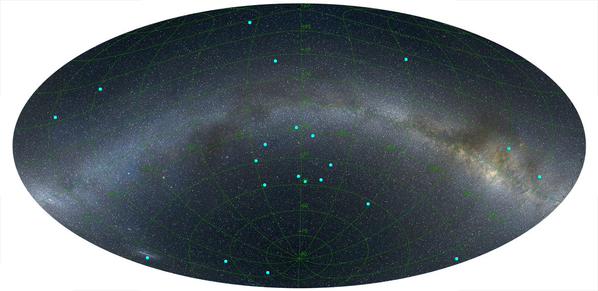
According to the cosmological principle (CP), Universal large-scale structure is homogeneous and isotropic. The observable Universe, however, shows complex structures even on very large scales. The recent discoveries of structures significantly exceeding the transition scale of 370 Mpc pose a challenge to the CP. We report here the discovery of the largest regular formation in the observable Universe; a ring with a diameter of 1720 Mpc, displayed by 9 gamma-ray bursts (GRBs), exceeding by a factor of 5 the transition scale to the homogeneous and isotropic distribution. The ring has a major diameter of 43° and a minor diameter of 30° at a distance of 2770 Mpc in the 0.78 < z < 0.86 redshift range, with a probability of 2 × 10⁻⁶ of being the result of a random fluctuation in the GRB count rate. Evidence suggests that this feature is the projection of a shell on to the plane of the sky. Voids and string-like formations are common outcomes of large-scale structure. However, these structures have maximum sizes of 150 Mpc, which are an order of magnitude smaller than the observed GRB ring diameter. Evidence in support of the shell interpretation requires that temporal information of the transient GRBs be included in the analysis. This ring-shaped feature is large enough to contradict the CP. The physical mechanism responsible for causing it is unknown.

The so-called “ring” can be seen here:
ring_Australia

In my opinion it’s not a ring at all, but an outline of Australia. What’s the probability of a random distribution of dots looking exactly like that? Is it really evidence for the violation of the Cosmological Principle, or for the existence of the Cosmic Antipodes?

For those of you who don’t get that gag, a cosmic antipode occurs in, e.g., closed Friedmann cosmologies in which the spatial sections take the form of a hypersphere (or 3-sphere). The antipode is the point diametrically opposite the observer on this hypersurface, just as it is for the surface of a 2-sphere such as the Earth. The antipode is only visible if it lies inside the observer’s horizon, a possibility which is ruled out for standard cosmologies by current observations. I’ll get my coat.

Anyway, joking apart, the claims in the abstract of the paper are extremely strong but the statistical arguments supporting them are deeply unconvincing. Indeed, I am quite surprised the paper passed peer review. For a start there’s a basic problem of “a posteriori” reasoning here. We see a group of objects that form a map of Australia ring and then are surprised that such a structure appears so rarely in simulations of our favourite model. But all specific configurations of points are rare in a Poisson point process. We would be surprised to see a group of dots in the shape of a pretzel too, or the face of Jesus, but that doesn’t mean that such an occurrence has any significance. It’s an extraordinarily difficult problem to put a meaningful measure on the space of geometrical configurations, and this paper doesn’t succeed in doing that.

For a further discussion of the tendency that people have to see patterns where none exist, take a look at this old post from which I’ve taken this figure which is generated by drawing points independently and uniformly randomly:

pointaI can see all kinds of shapes in this pattern, but none of them has any significance (other than psychological). In a mathematically well-defined sense there is no structure in this pattern! Add to that difficulty the fact that so few points are involved and I think it becomes very clear that this “structure” doesn’t provide any evidence at all for the violation of the Cosmological Principle. Indeed it seems neither do the authors. The very last paragraph of the paper is as follows:

GRBs are very rare events superimposed on the cosmic
web identified by superclusters. Because of this, the ring is
probably not a real physical structure. Further studies are
needed to reveal whether or not the Ring could have been
produced by a low-frequency spatial harmonic of the large-
scale matter density distribution and/or of universal star
forming activity.

It’s a pity that this note of realism didn’t make it into either the abstract or, more importantly, the accompanying press release. Peer review will never be perfect, but we can do without this sort of hype. Anyway, I confidently predict that a proper refutation will appear shortly….

P.S. For a more technical discussion of the problems of inferring the presence of large structures from sparsely-sampled distributions, see here.

The Best of Times

Posted in Literature, The Universe and Stuff with tags , , on September 3, 2015 by telescoper

Well, I made it to Pisa Airport in time to sample the Club Europe lounge, which offers free wifi access (as well as other luxuries).  It seems I have a bit of time before my flight so thought I’d do a quick post about this morning’s events. I had the honour to be asked, along with Rocky Kolb, to deliver the concluding remarks for the meeting I’ve been at since Monday. Rocky and I had a quick discussion yesterday about what we should do and we agreed that we shouldn’t try to do a conventional “summary” of the workshop, but instead try something different. In the end we turned to Charles Dickens for inspiration and based the closing remarks on the following text:

IT WAS the best of times, it was the worst of times, it was the age of wisdom, it was the age of foolishness, it was the epoch of belief, it was the epoch of incredulity, it was the season of Light, it was the season of Darkness, it was the spring of hope, it was the winter of despair, we had everything before us, we had nothing before us, we were all going direct to Heaven, we were all going direct the other way…

This is of course part of the famous opening paragraph of Book 1 of A Tale of Two Cities.

The idea was to use the text to discuss different perspectives on the state of the Universe, or at least of cosmology. For example, the fact that we now have huge amounts of cosmological data might lead you to view that this is the  “the best of times” for cosmology. On the other hand, this has made life much harder for theorists as everything is now so heavily constrained that it is much more difficult to generate viable alternative models than it was thirty years ago.  We also now have a standard cosmological model which some physicists believe in very strongly, whereas others are much more skeptical.  This the “epoch of belief” for some but the “epoch of incredulity” for others. Now that the field is dominated by large collaborations in which it is hard for younger researchers to establish themselves, is this a “winter of despair” or do the opportunities presented by the new era of cosmology offer a “spring of hope”.

I haven’t got time to summarize all the points that came up, but it was fun acting as a “feed” for Rocky who had a stream of amusing and insightful comments. There aren’t any “right” or “wrong” answers of course, but it seemed to be an interesting way to get people thinking about where on the “best of times/worst of times” axis they would position themselves.

My own opinion is that cosmology has changed since I started (thirty years ago) and the challenges by the current generation are different from, and in many ways tougher than, those faced by my generation, who were lucky to have been able to learn quite a lot using relatively simple ideas and techniques. Now most of the “easy” stuff has been done, but solving difficult puzzles is immensely rewarding not only for the scientific insights the answers reveal, but also for their own sake. The time to despair about a field is not when it gets tough, but when it stops being fun. I’m glad to say we’re a long way from that situation in cosmology.


Adventures with the One-Point Distribution Function

Posted in Bad Statistics, Books, Talks and Reviews, Talks and Reviews, The Universe and Stuff with tags , , on September 1, 2015 by telescoper

As I promised a few people, here are the slides I used for my talk earlier today at the meeting I am attending. Actually I was given only 30 minutes and used up a lot of that time on two things that haven’t got much to do with the title. One was a quiz to identify the six famous astronomers (or physicists) who had made important contributions to statistics (Slide 2) and the other was on some issues that arose during the discussion session yesterday evening. I didn’t in the end talk much about the topic given in the title, which was about how, despite learning a huge amount about certain aspects of galaxy clustering, we are still far from a good understanding of the one-point distribution of density fluctuations. I guess I’ll get the chance to talk more about that in the near future!

P.S. I think the six famous faces should be easy to identify, so there are no prizes but please feel free to guess through the comments box!

Why traditional scientific journals are redundant

Posted in Open Access, The Universe and Stuff with tags , , , , on August 20, 2015 by telescoper

Was it really six years ago that I first blogged about the Academic Journal Racket which siphons off millions from hard-pressed research budgets into the coffers of profiteering publishing houses?

Change is coming much more slowly over the last few years than I had anticipated when I wrote that piece, but at least there are signs that other disciplines are finally cottoning on to the fact that the old-style model of learned journals is way past its sell-by date. This has been common knowledge in Physics and Astronomy for some time, as I’ve explained many times on this blog. But, although most wouldn’t like to admit it, academics are really a very conservative bunch.

Question: How many academics does it take to change a lightbulb?

Answer: Change!!???

Today I came across a link to a paper on the arXiv which I should have known about before; it’s as old as my first post on this subject. It’s called Citing and Reading Behaviours in High-Energy Physics. How a Community Stopped Worrying about Journals and Learned to Love Repositories, and it basically demonstrates that in High-Energy Physics there is a massive advantage in publishing papers in open repositories, specifically the arXiv.Here is the killer plot:

citations_arXivThis contains fairly old data (up to 2009) but I strongly suspect the effect is even more marked than it was six years ago.

I’d take the argument further, in fact. I’d say that journals are completely unnecessary. I find all my research papers on the arXiv and most of my colleagues do the same. We don’t need journals yet we keep paying for them. The only thing that journals provide is peer review, but that is done free of charge by academics anyway. The profits of their labour go entirely to the publishers.

Fortunately, things will start to change in my own field of astrophysics – for which the picture is very similar to high-energy physics. All we need to do is to is dispense with the old model of a journal and replace it with a reliable and efficient reviewing system that interfaces with the arXiv. Then we’d have a genuinely useful thing. And it’s not as far off as you might think.

Watch this space.