Archive for Cosmology

A Galaxy at Record Redshift?

Posted in The Universe and Stuff with tags , , , , , on July 13, 2015 by telescoper

Skimming through the arXiv this morning I discovered a paper by Zitrin et al. with the following abstract:


abstract_z

I’m not sure if the figures are all significant, but a redshift of z=8.68 makes this the most distant spectroscopically confirmed galaxy on record with a present proper distance of about 9.3 Gpc according to the standard cosmological model, just pipping the previous record holder (whose redshift was in any case disputed). Light from this galaxy has taken about 13.1 Gyr to reach us; that means light set out from it when the Universe was only about 4% of its current age, only about 600 million years after the Big Bang. (Those figures were obtained using the inestimable Ned Wright’s cosmology calculator.)

We are presumably seeing a very young object, in which stars are forming at a considerable rate to account for its brightness. We don’t know exactly when the first stars formed and began to ionize the intergalactic medium, but every time the cosmic distance record is broken we push that time back closer to the Big Bang.

Mind you, I can’t say I’m overwhelmingly convinced by the identification of the redshifted Lyman-α line:

high_zBut what do I know? I’m a theorist whose suspicious of data. Any observers care to comment?

Phlogiston, Dark Energy and Modified Levity

Posted in History, The Universe and Stuff with tags , , on May 21, 2015 by telescoper

What happens when something burns?

Had you aslked a seventeenth-century scientist that question and the chances are the answer would  have involved the word phlogiston, a name derived from the Greek  φλογιστόν, meaning “burning up”. This “fiery principle” or “element” was supposed to be present in all combustible materials and the idea was that it was released into air whenever any such stuff was ignited. The act of burning was thought to separate the phlogiston from the dephlogisticated “true” form of the material, also known as calx.

The phlogiston theory held sway until  the late 18th Century, when Antoine Lavoisier demonstrated that combustion results in an increase in weight of the material being burned. This poses a serious problem if burning also involves the loss of phlogiston unless phlogiston has negative weight. However, many serious scientists of the 18th Century, such as Georg Ernst Stahl, had already suggested that phlogiston might have negative weight or, as he put it, “levity”. Nowadays we would probably say “anti-gravity”.

Eventually, Joseph Priestley discovered what actually combines with materials during combustion:  oxygen. Instead of becoming dephlogisticated, things become oxidised by fixing oxygen from air, which is why their weight increases. It’s worth mentioning, though, the name that Priestley used for oxygen was in fact “dephlogisticated air” (because it was capable of combining more extensively with phlogiston than ordinary air). He  remained a phlogistonian longer after making the discovery that should have killed the theory.

So why am I rambling on about a scientific theory that has been defunct for more than two centuries?

Well,   there just might be a lesson from history about the state of modern cosmology. Not long ago I gave a talk in the fine city of Bath on the topic of Dark Energy and its Discontents. For the cosmologically uninitiated, the standard cosmological model involves the hypothesis that about 75% of the energy budget of the Universe is in the form of this “dark energy”.

Dark energy is needed to reconcile three basic measurements: (i) the brightness distant supernovae that seem to indicate the Universe is accelerating (which is where the anti-gravity comes in); (ii) the cosmic microwave background that suggests the Universe has flat spatial sections; and (iii) the direct estimates of the mass associated with galaxy clusters that accounts for about 25% of the mass needed to close the Universe. A universe without dark energy appears not to be able to account for these three observations simultaneously within our current understanding of gravity as obtained from Einstein’s theory of general relativity.

We don’t know much about what this dark energy is, except that in order to make our current understanding work out it has to produce an effect something like anti-gravity, vaguely reminiscent of the “negative weight” hypothesis mentioned above. In most theories, the dark energy component does this by violating the strong energy condition of general relativity. Alternatively, it might also be accounted for by modifying our theory of gravity in such a way that accounts for anti-gravity in some other way. In the light of the discussion above maybe what we need is a new theory of levity? In other words, maybe we’re taking gravity too seriously?

Anyway, I don’t mind admitting how uncomfortable this dark energy makes me feel. It makes me even more uncomfortable that such an enormous  industry has grown up around it and that its existence is accepted unquestioningly by so many modern cosmologists. Isn’t there a chance that, with the benefit of hindsight, future generations will look back on dark energy in the same way that we now see the phlogiston theory?

Or maybe the dark energy really is phlogiston. That’s got to be worth a paper!

Ned Wright’s Dark Energy Piston

Posted in The Universe and Stuff with tags , , , , on April 29, 2015 by telescoper

Since Ned Wright picked up on the fact that I borrowed his famous Dark Energy Piston for my talk I thought I’d include it here in all its animated glory to explain a little bit better why I think it was worth taking the piston.

The two important things about dark energy that enable it to reconcile apparently contradictory observations within the framework of general relativity are: (i) that its energy-density does not decrease with the expansion of the Universe (as do other forms of energy, such as radiation); and (ii) that it has negative pressure which, among other things, means that it causes the expansion of the universe to accelerate.

piston-animThe Dark Energy Piston (above) shows how these two aspects are related. Suppose the chamber of the piston is filled with “stuff” that has the attributes described above. As the piston moves out the energy density of dark energy does not decrease, but its volume does, so the total amount of energy in the chamber must increase. Since the system depicted here consists only of the piston and the chamber, this extra energy must have been supplied as work done by the piston on the contents of the chamber. For this to have happened the stuff inside must have resisted being expanded, i.e. it must be in tension. In other words it has to have negative pressure.

Compare the case of “ordinary” matter, in the form of an ideal gas. In such a case the stuff inside the piston does work pushing it out, and the energy density inside the chamber would therefore decrease.

If it seems strange to you that something that is often called “vacuum energy” has the property that its density does not decrease when it subjected to expansion, then just consider that a pretty good definition of a vacuum is something that, when you do dilute it, you don’t any less!

So how does this dark vacuum energy stuff with negative pressure cause the expansion of the Universe to accelerate?

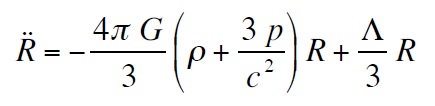
Well, here’s the equation that governs the dynamical evolution of the Universe:

DecelerationI’ve included a cosmological constant term (Λ) but ignore this for now. Note that if the pressure p is small (e.g. how it would be for cold dark matter) and the energy density ρ is positive (which it is for all forms of energy we know of) then in the absence of Λ the acceleration is always negative, i.e. the universe decelerates. This is in accord with intuition: because gravity always pulls we expect the expansion to slow down by the mutual attraction of all the matter. However, if the pressure is negative, the combination in brackets can be negative so can imply accelerated expansion.

In fact if dark energy stuff has an equation of state of the form p=-ρc2 then the combination in brackets leads to a fluid with precisely the same effect that a cosmological constant would have, so this is the simplest kind of dark energy.

When Einstein introduced the cosmological constant in 1915/6 he did it by modifying the left hand side of his field equations, essentially modifying the law of gravitation. This discussion shows that he could instead have modified the right hand side by introducing a vacuum energy with an equation of state p=-ρc2. A more detailed discussion of this can be found here.

Anyway, which way you like to think of dark energy the fact of the matter is that we don’t know how to explain it from a fundamental point of view. The only thing I can be sure of is that whatever it is in itself, dark energy is a truly terrible name for it.

I’d go for “persistent tension”…

Dark Energy and its Discontents – the Talk

Posted in Biographical, Books, The Universe and Stuff with tags , , , on April 28, 2015 by telescoper

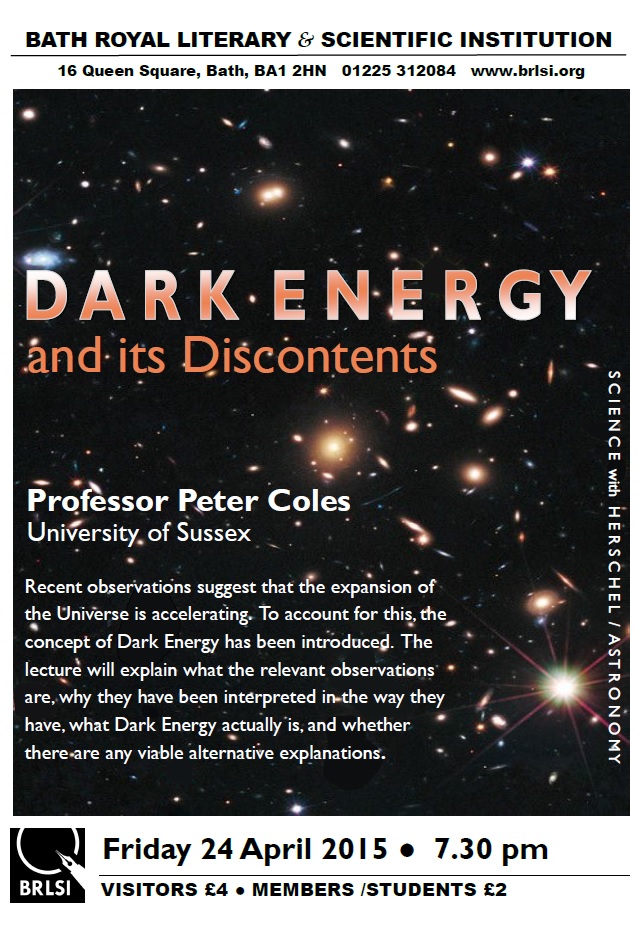
Yet another very busy day, so I just have time to post the slides of the talk I gave last week, on  Friday 24th April 2015, entitled Dark Energy and its Discontents, at the very posh-sounding Bath Royal Literary and Scientific Institution. Here is the poster


Bath_lecture


And here are the slides – though I didn’t get through them all on the night!…

The Supervoid and the Cold Spot

Posted in Astrohype, Cosmic Anomalies, The Universe and Stuff with tags , , , , , on April 21, 2015 by telescoper

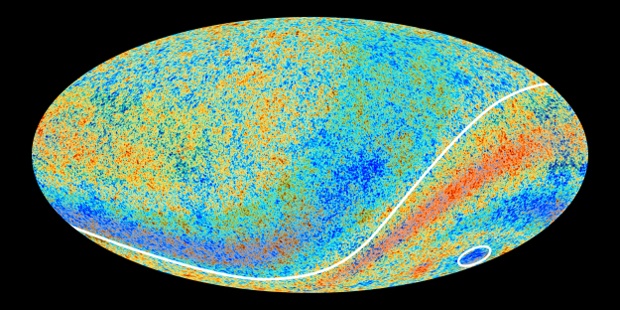
While I was away at the SEPnet meeting yesterday a story broke in the press broke about the discovery of a large underdensity in the distribution of galaxies. The discovery is described in a paper by Szapudi et al. in the journal Monthly Notices of the Royal Astronomical Society. The claim is that this structure in the galaxy distribution can account for the apresence of a mysterious cold spot in the cosmic microwave background, shown here (circled) in the map generated by Planck:

Planck_coldspot

I’ve posted about this feature myself here in the category Cosmic Anomalies.

The abstract of the latest paper is here:

We use the WISE-2MASS infrared galaxy catalogue matched with Pan-STARRS1 (PS1) galaxies to search for a supervoid in the direction of the cosmic microwave background (CMB) cold spot (CS). Our imaging catalogue has median redshift z ≃ 0.14, and we obtain photometric redshifts from PS1 optical colours to create a tomographic map of the galaxy distribution. The radial profile centred on the CS shows a large low-density region, extending over tens of degrees. Motivated by previous CMB results, we test for underdensities within two angular radii, 5°, and 15°. The counts in photometric redshift bins show significantly low densities at high detection significance, ≳5σ and ≳6σ, respectively, for the two fiducial radii. The line-of-sight position of the deepest region of the void is z ≃ 0.15–0.25. Our data, combined with an earlier measurement by Granett, Szapudi & Neyrinck, are consistent with a large Rvoid = (220 ± 50) h−1 Mpc supervoid with δm ≃ −0.14 ± 0.04 centred at z = 0.22 ± 0.03. Such a supervoid, constituting at least a ≃3.3σ fluctuation in a Gaussian distribution of the Λ cold dark matter model, is a plausible cause for the CS.

The result is not entirely new: it has been discussed at various conferences over the past year or so (e.g this one) but this is the first refereed paper showing details of the discovery.

This gives me the excuse to post this wonderful cartoon, the context of which is described here. Was that really in 1992? That was twenty years ago!

Anyway, I just wanted to make a few points about this because some of the press coverage has been rather misleading. I’ve therefore filed this one in the category Astrophype.

First, the “supervoid” structure that has been discovered is not a “void”, which would be a region completely empty of galaxies. As the paper makes clear it is less dramatic than that: it’s basically an underdensity of around 14% in the density of galaxies. It is (perhaps) the largest underdensity yet found on such a large scale – though that depends very much on how you define a void – but it is not in itself inconsistent with the standard cosmological framework. Such large underdensities are expected to be rare, but rare things do occur if you survey a large enough volume of the universe. Large overdensities also arise as statistical fluctuations in large volumes.

Second, and probably most importantly, although this “supervoid” is in the direction of the CMB Cold Spot it cannot on its own explain the Cold Spot; the claim in the abstract that it provides a plausible explanation of the cold spot is simply incorrect. A void can affect the measured temperature of the CMB through the Integrated Sachs-Wolfe effect: photons travelling through such a structure are redshifted as they travel through the underdense region, so the CMB looks cooler in the direction of the void. However, even optimistic calculations of the magnitude of the effect suggest that this particular “void” can only account for about 10% of the signal associated with the Cold Spot. This is a reasonably significant contribution but it does not account for the signal on its own.

This is not to say however that it is irrelevant. It could well be that the supervoid actually sits in front of a region of the CMB sky that was already cold, as a result of a primordial fluctuation rather than a line-of-sight effect. Such an effect could well arise by chance, at least with some probability. If the original perturbation were a “3σ” temperature fluctuation then the additional effect of the supervoid would turn it into a 3.3σ effect. Since this pushes the event further out into the tail of the probability distribution it makes a reasonably uncommon feature look  less probable. Because the tail of a Gaussian distribution drops off very quickly this has quite a large effect on the probability. For example, a fluctuation of 3.3σ or greater has a probability of 0.00048 whereas one of 3.0σ has a probability of 0.00135, about a factor of 2.8 larger. That’s an effect, but not a large one.

In summary, I think the discovery of this large underdensity is indeed interesting but it is not a plausible explanation for the CMB Cold Spot. Not, that is, unless there’s some new physical process involved in the propagation of light that we don’t yet understand.

Now that would be interesting…

Dark Matter from the Dark Energy Survey

Posted in The Universe and Stuff with tags , , , on April 14, 2015 by telescoper

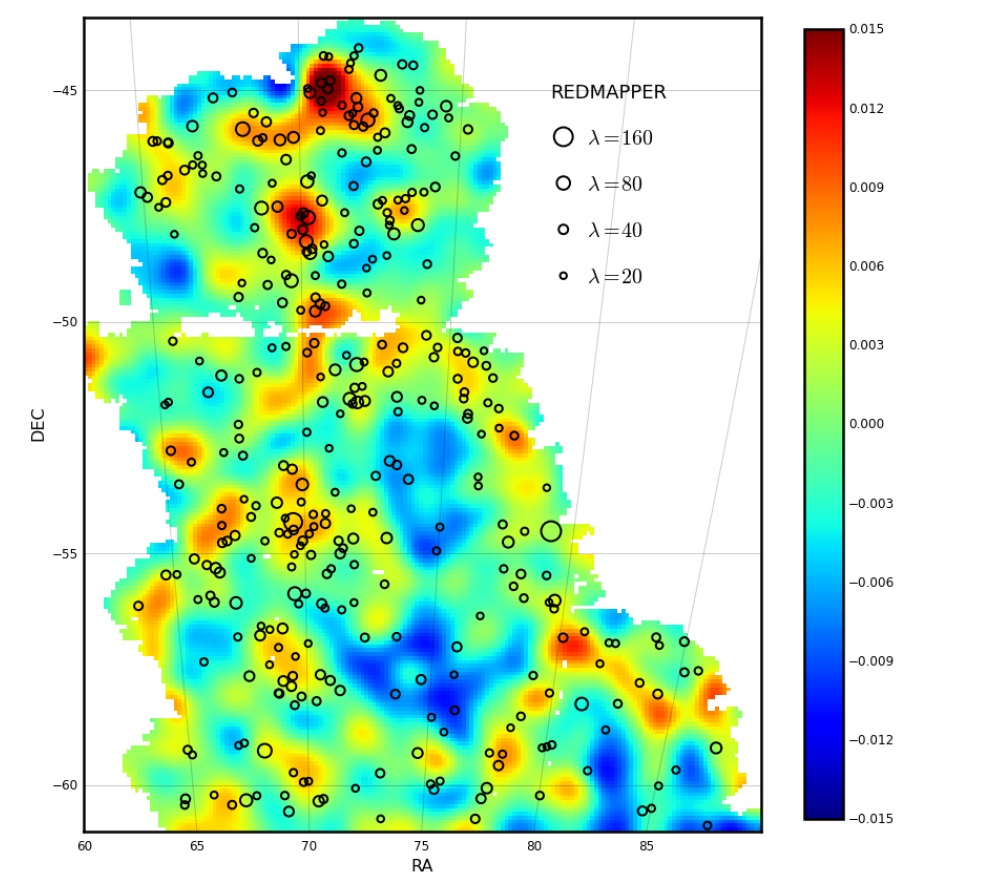
I’m a bit late onto this story which has already been quite active in the media today, and has generated an associated flurry of activity on social media, but I thought it was still worth passing it on via the medium of this blog. The Dark Energy Survey has just released a number of papers onto the arXiv, the most interesting of which (to me) is entitled Wide-Field Lensing Mass Maps from DES Science Verification Data. The abstract reads as follows (the link was added by me):

Weak gravitational lensing allows one to reconstruct the spatial distribution of the projected mass density across the sky. These “mass maps” provide a powerful tool for studying cosmology as they probe both luminous and dark matter. In this paper, we present a weak lensing mass map reconstructed from shear measurements in a 139 deg^2 area from the Dark Energy Survey (DES) Science Verification (SV) data overlapping with the South Pole Telescope survey. We compare the distribution of mass with that of the foreground distribution of galaxies and clusters. The overdensities in the reconstructed map correlate well with the distribution of optically detected clusters. Cross-correlating the mass map with the foreground galaxies from the same DES SV data gives results consistent with mock catalogs that include the primary sources of statistical uncertainties in the galaxy, lensing, and photo-z catalogs. The statistical significance of the cross-correlation is at the 6.8 sigma level with 20 arcminute smoothing. A major goal of this study is to investigate systematic effects arising from a variety of sources, including PSF and photo-z uncertainties. We make maps derived from twenty variables that may characterize systematics and find the principal components. We find that the contribution of systematics to the lensing mass maps is generally within measurement uncertainties. We test and validate our results with mock catalogs from N-body simulations. In this work, we analyze less than 3% of the final area that will be mapped by the DES; the tools and analysis techniques developed in this paper can be applied to forthcoming larger datasets from the survey.

This is by no means a final result from the Dark Energy Survey, as it was basically put together in order to test the telescope, but it is interesting from the point of view that it represents a kind of proof of concept. Here is one of the key figures from the paper which shows a reconstruction of the mass distribution of the Universe (dominated by dark matter) obtained indirectly by the Dark Energy Survey using distortions of galaxy images produced by gravitational lensing by foreground objects, onto which the positions of large galaxy clusters seen in direct observations have been plotted. Although this is just a small part of the planned DES study (it covers only 0.4% of the sky) it does seem to indicate that the strong concentrations of dark matter (red) do corrrelate with the positions of concentrations of galaxy clusters.

DES_MAP

It all seems to work, so hopefully we can look forward to lots of interesting science results in future!

P.S. When I first saw the map it looked like a map of the North of England Midlands and I was surprised to see that the survey showed such strong support for the Greens…

Why the Big Bang wasn’t as loud as you think…

Posted in The Universe and Stuff with tags , , , , , on March 31, 2015 by telescoper

So how loud was the Big Bang?

I’ve posted on this before but a comment posted today reminded me that perhaps I should recycle it and update it as it relates to the cosmic microwave background, which is what I work on on the rare occasions on which I get to do anything interesting.

As you probably know the Big Bang theory involves the assumption that the entire Universe – not only the matter and energy but also space-time itself – had its origins in a single event a finite time in the past and it has been expanding ever since. The earliest mathematical models of what we now call the  Big Bang were derived independently by Alexander Friedman and George Lemaître in the 1920s. The term “Big Bang” was later coined by Fred Hoyle as a derogatory description of an idea he couldn’t stomach, but the phrase caught on. Strictly speaking, though, the Big Bang was a misnomer.

Friedman and Lemaître had made mathematical models of universes that obeyed the Cosmological Principle, i.e. in which the matter was distributed in a completely uniform manner throughout space. Sound consists of oscillating fluctuations in the pressure and density of the medium through which it travels. These are longitudinal “acoustic” waves that involve successive compressions and rarefactions of matter, in other words departures from the purely homogeneous state required by the Cosmological Principle. The Friedman-Lemaitre models contained no sound waves so they did not really describe a Big Bang at all, let alone how loud it was.

However, as I have blogged about before, newer versions of the Big Bang theory do contain a mechanism for generating sound waves in the early Universe and, even more importantly, these waves have now been detected and their properties measured.

Planck_CMB

The above image shows the variations in temperature of the cosmic microwave background as charted by the Planck Satellite. The average temperature of the sky is about 2.73 K but there are variations across the sky that have an rms value of about 0.08 milliKelvin. This corresponds to a fractional variation of a few parts in a hundred thousand relative to the mean temperature. It doesn’t sound like much, but this is evidence for the existence of primordial acoustic waves and therefore of a Big Bang with a genuine “Bang” to it.

A full description of what causes these temperature fluctuations would be very complicated but, roughly speaking, the variation in temperature you corresponds directly to variations in density and pressure arising from sound waves.

So how loud was it?

The waves we are dealing with have wavelengths up to about 200,000 light years and the human ear can only actually hear sound waves with wavelengths up to about 17 metres. In any case the Universe was far too hot and dense for there to have been anyone around listening to the cacophony at the time. In some sense, therefore, it wouldn’t have been loud at all because our ears can’t have heard anything.

Setting aside these rather pedantic objections – I’m never one to allow dull realism to get in the way of a good story- we can get a reasonable value for the loudness in terms of the familiar language of decibels. This defines the level of sound (L) logarithmically in terms of the rms pressure level of the sound wave Prms relative to some reference pressure level Pref

L=20 log10[Prms/Pref].

(the 20 appears because of the fact that the energy carried goes as the square of the amplitude of the wave; in terms of energy there would be a factor 10).

There is no absolute scale for loudness because this expression involves the specification of the reference pressure. We have to set this level by analogy with everyday experience. For sound waves in air this is taken to be about 20 microPascals, or about 2×10⁻¹⁰ times the ambient atmospheric air pressure which is about 100,000 Pa.  This reference is chosen because the limit of audibility for most people corresponds to pressure variations of this order and these consequently have L=0 dB. It seems reasonable to set the reference pressure of the early Universe to be about the same fraction of the ambient pressure then, i.e.

Pref~2×10⁻¹⁰ Pamb.

The physics of how primordial variations in pressure translate into observed fluctuations in the CMB temperature is quite complicated, because the primordial universe consists of a plasma rather than air. Moreover, the actual sound of the Big Bang contains a mixture of wavelengths with slightly different amplitudes. In fact here is the spectrum, showing a distinctive signature that looks, at least in this representation, like a fundamental tone and a series of harmonics…

Planck_power_spectrum_orig


If you take into account all this structure it all gets a bit messy, but it’s quite easy to get a rough but reasonable estimate by ignoring all these complications. We simply take the rms pressure variation to be the same fraction of ambient pressure as the averaged temperature variation are compared to the average CMB temperature,  i.e.

Prms~ a few ×10-5Pamb.

If we do this, scaling both pressures in logarithm in the equation in proportion to the ambient pressure, the ambient pressure cancels out in the ratio, which turns out to be a few times 10-5. With our definition of the decibel level we find that waves of this amplitude, i.e. corresponding to variations of one part in a hundred thousand of the reference level, give roughly L=100dB while part in ten thousand gives about L=120dB. The sound of the Big Bang therefore peaks at levels just a bit less than 120 dB.

cooler_decibel_chart

As you can see in the Figure above, this is close to the threshold of pain,  but it’s perhaps not as loud as you might have guessed in response to the initial question. Modern popular beat combos often play their dreadful rock music much louder than the Big Bang….

A useful yardstick is the amplitude  at which the fluctuations in pressure are comparable to the mean pressure. This would give a factor of about 1010 in the logarithm and is pretty much the limit that sound waves can propagate without distortion. These would have L≈190 dB. It is estimated that the 1883 Krakatoa eruption produced a sound level of about 180 dB at a range of 100 miles. By comparison the Big Bang was little more than a whimper.

PS. If you would like to read more about the actual sound of the Big Bang, have a look at John Cramer’s webpages. You can also download simulations of the actual sound. If you listen to them you will hear that it’s more of  a “Roar” than a “Bang” because the sound waves don’t actually originate at a single well-defined event but are excited incoherently all over the Universe.

Forthcoming Attraction: Dark Energy and its Discontents

Posted in Talks and Reviews, The Universe and Stuff with tags , , on March 11, 2015 by telescoper

Busy again today, so just time for a spot of gratuitous self-promotion. I shall be giving a public lecture on Friday 24th April 2015 at the very posh-sounding Bath Royal Literary and Scientific Institution. Here is the poster, which explains all. Will I see any readers of this blog there?

Bath_lecture

Parametric Resonance – It Don’t Mean A Thing If It Ain’t Got That Swing

Posted in The Universe and Stuff with tags , , , on March 10, 2015 by telescoper

It’s a small universe world. This  lunchtime I turned up to the local Cosmology discussion group for a talk on reheating after inflation during which the topic of parametric resonance came up. To illustrate the concept the speaker showed this nice video, and there was my esteemed former University of Nottingham colleague and fellow jazz enthusiast Roger Bowley explaining all!


Four Times a Supernova

Posted in The Universe and Stuff with tags , , , , on March 9, 2015 by telescoper

I’ve been a bit pressed for time recently (to put it mildly) so am a bit late catching up on a wonderful observation (by Kelly et al.) reported in last week’s issue of Science. Here’s the abstract:

In 1964, Refsdal hypothesized that a supernova whose light traversed multiple paths around a strong gravitational lens could be used to measure the rate of cosmic expansion. We report the discovery of such a system. In Hubble Space Telescope imaging, we have found four images of a single supernova forming an Einstein cross configuration around a redshift z = 0.54 elliptical galaxy in the MACS J1149.6+2223 cluster. The cluster’s gravitational potential also creates multiple images of the z = 1.49 spiral supernova host galaxy, and a future appearance of the supernova elsewhere in the cluster field is expected. The magnifications and staggered arrivals of the supernova images probe the cosmic expansion rate, as well as the distribution of matter in the galaxy and cluster lenses.

And here’s a nice picture of the system which I ripped of from a nice report in Physics World:

PW-2015-03-05-Commissariat-supernovae

Multiple images of background objects caused by gravitational lensing have been observed before, but the key thing about this particular “Einstein Cross” is that the background object is a type of exploding star called a supernova. That means that the light it emits will decay over time. That light reaches us via four different paths around the intervening galaxy cluster so monitoring the different evolution in the four images will yield direct measurements of the physical scale of the cluster and hopefully  answer a host of interesting cosmological questions.