Archive for Cosmology

A Dark Expletive

Posted in Poetry, The Universe and Stuff with tags , , , , , , , on November 13, 2012 by telescoper

A news item today about BOSS (yet another observational cosmology survey) gives me an excuse to recycle an idea from an old post.

The phrase expletive deleted was made popular at the time of Watergate after the release of the expurgated tapes made by Richard Nixon in the Oval Office when he was President of the United States of America. These showed that, as well as been a complete crook, he was practically unable to speak a single sentence without including a swear word.

Nowadays the word expletive is generally taken to mean an oath or exclamation, particularly if it is obscene, but that’s not quite what it really means. Derived from the latin verb explere (“to fill out”) from which the past participle is expletus, the meaning of the word in the context of English grammar is  “something added to a phrase or sentence that isn’t strictly needed for the grammatical sense”.  An expletive is added either to fill a syntactical role or, in a poem, simply to make a line fit some metrical rule.

Examples of the former can be found in constructions like “It takes two to Tango” or “There is a lot of crime in Nottingham”; neither  “it” nor “there” should really be needed but English just seems to like to have something before the verb.

The second kind of use is illustrated wonderfully by Alexander Pope in his Essay on Criticism, which is a kind of guide to what to avoid in writing poetry. It’s a tour de force for its perceptiveness and humour. The following excerpt is pricelessly apt

These equal syllables alone require,
Tho’ oft the open vowels tire;
While expletives their feeble aid do join;
And ten low words oft creep in one dull line

Here the expletive is “do”,  and it is cleverly incorporated in the line talking about expletives, adding  the syllable needed to fit with a strict pentameter. Apparently, poets often used this construction before Pope attacked it but it quickly fell from favour afterwards.

His other prosodic targets are the “open vowels” which means initial vowels that produce an ugly glottal sound, such as in “oft” (especially ugly when following “Tho”). The last line is brilliant too, showing how using only monosyllabic “low” words makes for a line that plods along tediously just like it says.

It’s amazing how much Pope managed to fit into this poem, given the restrictions imposed by the closed couplet structure he adopted. Each idea is compressed into a unit of twenty syllables, two lines of ten syllables with a rhyme at the end of each. This is such an impressive exercise in word-play that it reminds me a lot of the skill showed by the best cryptic crossword setters. Needless to say I’m no more successful at writing poetry than I am at setting crossword clues.

Anyway, what’s all this got to do with cosmology?

Well, I was reminded of it when I attended the 2012 Gerald Whitrow Lecture by Andrew Liddle last Friday at the Royal Astronomical Society, during which he talked, amongst other things, about Dark Energy.

The Dark Energy is an ingredient added to the standard model of cosmology to reconcile  observations of a flat Universe with a matter density that seems too low to account for it.

Other than that it makes the  cosmological metric work out satisfactorily (geddit?), we don’t understand what Dark Energy really is  or why there is as much of it. Indeed, many of us would rather it wasn’t there at all, because we think the resulting model is inelegant or even ugly, and are trying to think of other cosmological models that do not require  its introduction.

In other words, Dark Energy is an expletive (though not one that’s been deleted).

Incidentally, one of the things Andrew said in his talk – and I agree with him 100% – is that in some sense we already know enough about dark energy from observations that we know we don’t understand it at all from a theoretical point of view. Bigger and better surveys, such as Euclid, producing more and more data will characterize its properties with greater statistical accuracy, but they won’t on their own solve the Dark Energy puzzle. For that we need better theoretical understanding.

My own view is that the problem of the vacuum energy is of the same character as the ultraviolet catastrophe that ushered in the era of quantum physics: a big problem that needs a big solution. What I mean by that is that it’s not something that can be resolved by tinkering with the existing theoretical framework. Something much more radical is needed.

Three Astronomy Jobs at Sussex

Posted in The Universe and Stuff with tags , , , on October 18, 2012 by telescoper

Following hard on the heels of Tuesday’s news, here is an announcement of three (new, permanent) jobs in Astronomy at the University of Sussex. Full details are in the above link, but the gist is that applications are invited for 3 permanent, full-time faculty positions within the Astronomy Centre.

The 8 existing faculty have research interests that span the observation, modelling/simulation and theory of extragalactic astronomy and cosmology.  We are seeking talented and ambitious colleagues whose research interests complement and extend our current activity.

This advertisement will in due course appear elsewhere, e.g. in the November AAS Jobs Register.

I’ll be interested to see how many people apply as a result of seeing this here announcement, so if you do fill in an application form  be sure to answer the question “Where did you see this post advertised” with “In the Dark”!

R.I.P. Leonid Grishchuk

Posted in The Universe and Stuff with tags , , , on September 14, 2012 by telescoper

As I was travelling to Heathrow airport in order to fly to the USA (from where I am posting this message), I heard the sad news of the death of a dear and respected colleague, Professor Leonid Petrovich Grishchuk.

Leonid was a  Distinguished Research Professor here in Cardiff from  1995 until his retirement in 2009 and was frequently to be found in the department after that. You can read more of his scientific biography and wider achievements here, but it should suffice to say that he was a pioneer of many aspects of relativistic cosmology and particularly primordial gravitational waves. He was also a larger-than-life character,  held in great affection by many scientists and friends around the world.

My first experience of Leonid was many years ago at a scientific meeting at which I attempted to give a talk. Leonid was in the audience and he interrupted me,  rather aggressively. I didn’t really understand his question so he had another go at me in the questions afterwards. I don’t mind admitting that I was quite upset with his behaviour. I think a large fraction of working cosmologists have probably been “Grischchucked” at one time or another. Later on, though, people from the meeting were congregating at a bar when he arrived and headed for me. I didn’t really want to talk to him as I felt he had been quite rude. However, there wasn’t really any way of escaping so I ended up talking to him over a beer. We finally resolved the question he had been trying to ask me and his demeanour changed completely. We spent the rest of the evening having dinner and talking about all sorts of things and were good friends ever since. Over the years I’ve learned that this is very much a tradition amongst Russian scientists of the older school. They can seem very hostile – even brutal – when discussing science, but that was the way things were done in the environment where they learned their trade.  In many cases the rather severe exterior masks a kindly and generous nature, as it certainly did with Leonid. Leonid’s confrontational behaviour was partly sport – once you got used to that twinkle in his eye it was impossible to take offence – but partly a genuine desire to cut away the flannel and get to the heart of things. He detested bullshit and had no time for people who traded in it.

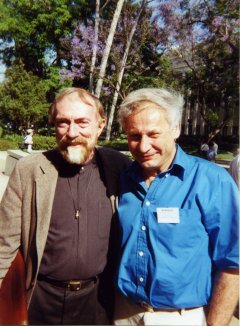
Here’s a picture of Leonid taken a few years ago with his longstanding friend Professor Kip Thorne.

lpg008_test

Some months ago Leonid was struck down by a brain tumour, against which he struggled bravely. On Monday this week, however, the doctors were forced to admit that the treatment had failed and Leonid could not live much longer. Fortunately his death, when it came, was peaceful. He passed away in his sleep on Wednesday night.

Farewell, Leonid. We’ll all miss you.

The Importance of Being Homogeneous

Posted in The Universe and Stuff with tags , , , , , , , , on August 29, 2012 by telescoper

A recent article in New Scientist reminded me that I never completed the story I started with a couple of earlier posts (here and there), so while I wait for the rain to stop I thought I’d make myself useful by posting something now. It’s all about a paper available on the arXiv by Scrimgeour et al. concerning the transition to homogeneity of galaxy clustering in the WiggleZ galaxy survey, the abstract of which reads:

We have made the largest-volume measurement to date of the transition to large-scale homogeneity in the distribution of galaxies. We use the WiggleZ survey, a spectroscopic survey of over 200,000 blue galaxies in a cosmic volume of ~1 (Gpc/h)^3. A new method of defining the ‘homogeneity scale’ is presented, which is more robust than methods previously used in the literature, and which can be easily compared between different surveys. Due to the large cosmic depth of WiggleZ (up to z=1) we are able to make the first measurement of the transition to homogeneity over a range of cosmic epochs. The mean number of galaxies N(<r) in spheres of comoving radius r is proportional to r^3 within 1%, or equivalently the fractal dimension of the sample is within 1% of D_2=3, at radii larger than 71 \pm 8 Mpc/h at z~0.2, 70 \pm 5 Mpc/h at z~0.4, 81 \pm 5 Mpc/h at z~0.6, and 75 \pm 4 Mpc/h at z~0.8. We demonstrate the robustness of our results against selection function effects, using a LCDM N-body simulation and a suite of inhomogeneous fractal distributions. The results are in excellent agreement with both the LCDM N-body simulation and an analytical LCDM prediction. We can exclude a fractal distribution with fractal dimension below D_2=2.97 on scales from ~80 Mpc/h up to the largest scales probed by our measurement, ~300 Mpc/h, at 99.99% confidence.

To paraphrase, the conclusion of this study is that while galaxies are strongly clustered on small scales – in a complex `cosmic web’ of clumps, knots, sheets and filaments –  on sufficiently large scales, the Universe appears to be smooth. This is much like a bowl of porridge which contains many lumps, but (usually) none as large as the bowl it’s put in.

Our standard cosmological model is based on the Cosmological Principle, which asserts that the Universe is, in a broad-brush sense, homogeneous (is the same in every place) and isotropic (looks the same in all directions). But the question that has troubled cosmologists for many years is what is meant by large scales? How broad does the broad brush have to be?

I blogged some time ago about that the idea that the  Universe might have structure on all scales, as would be the case if it were described in terms of a fractal set characterized by a fractal dimension D. In a fractal set, the mean number of neighbours of a given galaxy within a spherical volume of radius R is proportional to R^D. If galaxies are distributed uniformly (homogeneously) then D = 3, as the number of neighbours simply depends on the volume of the sphere, i.e. as R^3, and the average number-density of galaxies. A value of D < 3 indicates that the galaxies do not fill space in a homogeneous fashion: D = 1, for example, would indicate that galaxies were distributed in roughly linear structures (filaments); the mass of material distributed along a filament enclosed within a sphere grows linear with the radius of the sphere, i.e. as R^1, not as its volume; galaxies distributed in sheets would have D=2, and so on.

We know that D \simeq 1.2 on small scales (in cosmological terms, still several Megaparsecs), but the evidence for a turnover to D=3 has not been so strong, at least not until recently. It’s just just that measuring D from a survey is actually rather tricky, but also that when we cosmologists adopt the Cosmological Principle we apply it not to the distribution of galaxies in space, but to space itself. We assume that space is homogeneous so that its geometry can be described by the Friedmann-Lemaitre-Robertson-Walker metric.

According to Einstein’s  theory of general relativity, clumps in the matter distribution would cause distortions in the metric which are roughly related to fluctuations in the Newtonian gravitational potential \delta\Phi by \delta\Phi/c^2 \sim \left(\lambda/ct \right)^{2} \left(\delta \rho/\rho\right), give or take a factor of a few, so that a large fluctuation in the density of matter wouldn’t necessarily cause a large fluctuation of the metric unless it were on a scale \lambda reasonably large relative to the cosmological horizon \sim ct. Galaxies correspond to a large \delta \rho/\rho \sim 10^6 but don’t violate the Cosmological Principle because they are too small in scale \lambda to perturb the background metric significantly.
The discussion of a fractal universe is one I’m overdue to return to. In my previous post  I left the story as it stood about 15 years ago, and there have been numerous developments since then, not all of them consistent with each other. I will do a full “Part 2” to that post eventually, but in the mean time I’ll just comment that this particularly one does seem to be consistent with a Universe that possesses the property of large-scale homogeneity. If that conclusion survives the next generation of even larger galaxy redshift surveys then it will come as an immense relief to cosmologists.

The reason for that is that the equations of general relativity are very hard to solve in cases where there isn’t a lot of symmetry; there are just too many equations to solve for a general solution to be obtained.  If the cosmological principle applies, however, the equations simplify enormously (both in number and form) and we can get results we can work with on the back of an envelope. Small fluctuations about the smooth background solution can be handled (approximately but robustly) using a technique called perturbation theory. If the fluctuations are large, however, these methods don’t work. What we need to do instead is construct exact inhomogeneous model, and that is very very hard. It’s of course a different question as to why the Universe is so smooth on large scales, but as a working cosmologist the real importance of it being that way is that it makes our job so much easier than it would otherwise be.

P.S. And I might add that the importance of the Scrimgeour et al paper to me personally is greatly amplified by the fact that it cites a number of my own articles on this theme!

A Flight Through the Universe

Posted in The Universe and Stuff with tags , , on August 15, 2012 by telescoper

Today I’m taking a flight back from Copenhagen to London, a flight through a very small part of the Universe, so it seems apt to put it in perspective by posting this nice video produced on behalf of the the Sloan Digital Sky Survey. I’ve even had the nerve to copy the blurb:

This animated flight through the universe was made by Miguel Aragon of Johns Hopkins University with Mark Subbarao of the Adler Planetarium and Alex Szalay of Johns Hopkins. There are close to 400,000 galaxies in the animation, with images of the actual galaxies in these positions (or in some cases their near cousins in type) derived from the Sloan Digital Sky Survey (SDSS) Data Release 7. Vast as this slice of the universe seems, its most distant reach is to redshift 0.1, corresponding to roughly 1.3 billion light years from Earth. SDSS Data Release 9 from the Baryon Oscillation Spectroscopic Survey (BOSS), led by Berkeley Lab scientists, includes spectroscopic data for well over half a million galaxies at redshifts up to 0.8 – roughly 7 billion light years distant – and over a hundred thousand quasars to redshift 3.0 and beyond.

Click here for more information about BOSS and the latest data release.

The Epoch of Galaxy Formation, Durham 1988.

Posted in Biographical, The Universe and Stuff with tags , , , on August 2, 2012 by telescoper

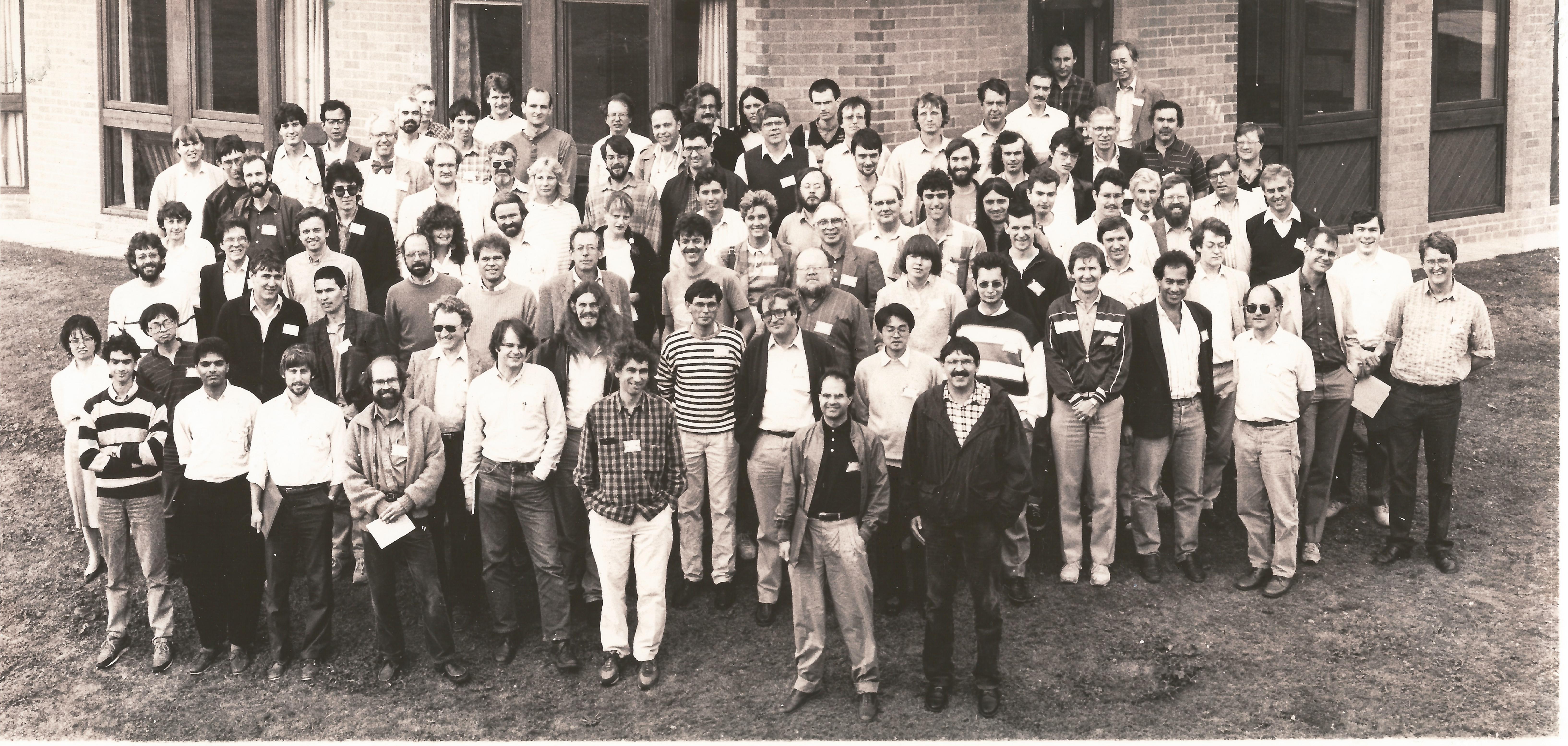
The previous old conference photograph I posted seemed to be quite popular, so I thought I’d try an even older vintage. This was also taken at Durham, but at a meeting entitled The Epoch of Galaxy Formation, which took place between July 18th and 22nd 1988. Appropriately enough, this one is in glorious monochrome. Spot any familiar faces?

The Origins of the Expanding Universe

Posted in Books, Talks and Reviews, The Universe and Stuff with tags , , , , on July 30, 2012 by telescoper

Not having much time to write anything particularly original, I thought I’d use this blog to advertise a forthcoming centenary celebration which I hope to attend and speak at, if my recovery goes to plan.  The text below is taken from the conference website for a meeting due to take place at the Lowell Observatory in Flagstaff, Arizona from September 13-15. I’m sure they won’t mind me borrowing it, as it helps promote the event.  Registration is open until 10th August…

On September 17, 1912, Vesto Slipher obtained the first radial velocity of a “spiral nebula” – the Andromeda Galaxy. Using the 24-inch telescope at Lowell Observatory, he followed up with more Doppler shifts, and wrote a series of papers establishing that large velocities, usually in recession, are a general property of the spiral nebulae. Those early redshifts were recognized as remarkable by Slipher, and were critical to the discovery of what came eventually to be called the expanding Universe. Surprisingly, Slipher’s role in the story remains almost unknown to much of the astronomical community.

The nature, and especially the distance, of spiral nebulae was fiercely argued – most famously in the 1920 Shapley-Curtis debate. Hubble’s 1923 discovery of Cepheids in Andromeda, along with Henrietta Leavitt’s period-luminosity relation for Cepheids, led to a distance scale for the nebulae, enabling Lemaitre (1927) to derive a linear relation between velocity and distance (including a “Hubble constant” and, by 1931, a Primeval Atom theory).

Meanwhile, a new concept of space and time was formulated by Einstein, providing a new language in which to understand the large-scale Universe. By 1932, all the major actors had arrived on stage, and Universal expansion – the most general property of the Universe yet found – acquired a solid basis in observation and in the (relativistic) concept of space. “Space expands”… or does it? How did Lemaitre and Hubble interpret this concept? How do we interpret it? It continues to evolve today, with cosmic inflation and dark energy presenting new challenges still not fully assimilated.

This conference is in honor of Vesto Melvin Slipher and is timed to coincide with the 100th anniversary of the first measured Doppler shift in a Galaxy (then known as a Spiral-Nebula) on September 17, 1912:Slipher 1913 Lowell Obs 2, 56

We are bringing together astronomers and historians of science to explore the beginnings and trajectories of the subject, at the place where it began. 

A Grand Design Challenge

Posted in Astrohype, The Universe and Stuff with tags , , , , , on July 20, 2012 by telescoper

While I’m incarcerated at home I thought I might as well make myself useful by passing on an interesting news item I found on the BBC website. This relates to a paper in the latest edition of Nature that reports the discovery of what appears to be a classic “Grand Design” spiral galaxy at a redshift of 2.18. According to the standard big bang cosmology this means that the light we are seeing set out from this object over 10 billion years ago, so the object formed about 3 billion years after the big bang.

I found this image of the object – known to its friends as BX442 – and was blown away by it..

..until I saw the dreaded words “artist’s rendering”. The actual image is somewhat less impressive.

But what’s really interesting about the study reported in Nature are the questions it asks about how this object first into our understanding of spiral galaxy formation. According to the prevailing paradigm, galaxies form hierarchically by progressively merging smaller clumps into bigger ones. The general expectation is that at high redshift – corresponding to earlier stages of the formation process – galaxies are rather clumpy and disturbed; the spiral structure we see in nearby galaxies is rather flimsy and easily disturbed, so it’s quite surprising to see this one. Does BX442 live in an especially quiet environment? Have we seen few high-redshift spirals because they are rare, or because they are hard to find? Answers to these and other questions will only be found by doing systematic surveys to establish the frequency and distribution of objects like this, as well as the details of their internal kinematics.

Quite Interesting.

A Return to O-levels?

Posted in Education, The Universe and Stuff with tags , , , , , , , on June 21, 2012 by telescoper

I woke up this morning as usual to the 7am news on BBC Radio 3, which included an item about how Education Secretary Michael Gove is planning to scrap the current system of GCSE Examinations and replace them with something more like the old GCE O-levels, which oldies like me took way back in the mists of time.

There is a particular angle to this in Wales, because Michael Gove doesn’t have responsibility for education here. That falls to the devolved Welsh Government, and in particular to Leighton Andrews. He’s made it quite clear on Twitter that he has no intention to take  Wales  back to O-levels. Most UK media sources – predominantly based in London – seem to have forgotten that Gove speaks for England, not for the whole United Kingdom.

This is not the central issue, however. The question is whether GCSEs are, as Michael Gove claims, “so bad that they’re beyond repair”. Politicians, teachers and educationalists are basically saying that students are doing better; others are saying that the exams are easier. It’s a shouting match that has been going for years and which achieves very little. I can’t add much to it either, because I’m too old to have done GCSEs – they hadn’t been invented then. I did O-levels.

It does, however, give me the excuse to show you  the O-level physics paper I took way back in 1979. I’ve actually posted this before, but it seems topical to put it up again:

You might want to compare this with a recent example of an Edexcel GCSE (Multiple-choice) Physics paper, about which I have also posted previously.

I think most of the questions in the GCSE paper are much easier than the O-level paper above. Worse, there are many that are so sloppily put together that they  don’t make any sense at all. Take Question 1:

I suppose the answer is meant to be C, but since it doesn’t say that A is the orbit of a planet, as far as I’m concerned it might just as well be D. Are we meant to eliminate D simply because it doesn’t have another orbit going through it?

On the other hand, the orbit of a moon around the Sun is in fact similar to the orbit of its planet around the Sun, since the orbital speed and radius of the moon around its planet are smaller than those of the planet around the Sun. At a push, therefore you could argue that A is the closest choice to a moon’s orbit around the Sun. The real thing would be something close to a circle with a 4-week wobble variation superposed.

You might say I’m being pedantic, but the whole point of exam questions is that they shouldn’t be open to ambiguities like this, at least if they’re science exams. I can imagine bright and knowledgeable students getting thoroughly confused by this question, and many of the others on the paper.

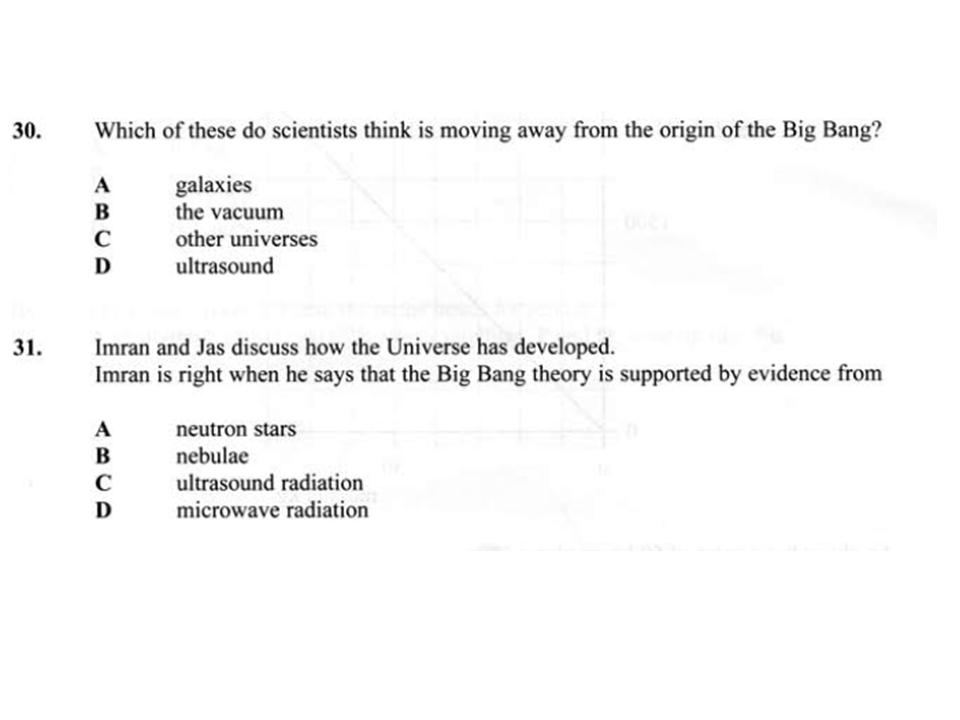
Here’s a couple more, from the “Advanced” section:

The answer to Q30 is, presumably, A. But do any scientists really think that galaxies are “moving away from the origin of the Big Bang”?  I’m worried that this implies that the Big Bang was located at a specific point. Is that what they’re teaching?

Bearing in mind that only one answer is supposed to be right, the answer to Q31 is presumably D. But is there really no evidence from “nebulae” that supports the Big Bang theory? The expansion of the Universe was discovered by observing things Hubble called “nebulae”..

I’m all in favour of school students being introduced to fundamental things such as cosmology and particle physics, but my deep worry is that this is being done at the expense of learning any real physics at all and is in any case done in a garbled and nonsensical way.

Lest I be accused of an astronomy-related bias, anyone care to try finding a correct answer to this question?

The more of this kind of stuff I see, the more admiration I have for the students coming to study physics and astronomy at University. How they managed to learn anything at all given the dire state of science education represented by this paper is really quite remarkable.

Ultimately, however, the issue is not whether we have GCSEs or O-level examinations. There’s already far too much emphasis in the education system on assessment instead of   learning. That runs all the way through schools and into the university system. The excessive time we spend examining students reduces what we can teach them and turns the students’ learning experience into something resembling a treadmill. I agree that we need better examinations than we have now, but we also need   fewer. And we need to stop being obsessed by them.

ESA Endorses Euclid

Posted in Euclid, Science Politics, The Universe and Stuff with tags , , , , , , on June 20, 2012 by telescoper

I’m banned from my office for part of this morning because the PHYSX elves are doing mandatory safety testing of all my electrical whatnots. Hence, I’m staying at home, sitting in the garden, writing this little blog post about a bit of news I found on Twitter earlier.

Apparently the European Space Agency, or rather the Science Programme Committee thereof, has given the green light to a space mission called Euclid whose aim is to “map the geometry of the dark Universe”, i.e. mainly to study dark energy. Euclid is an M-class mission, pencilled in for launch in around 2019, and it is basically the result of a merger between two earlier proposals, the Dark Universe Explorer (DUNE, intended to measure effects of weak gravitational lensing) and the Spectroscopic All Sky Cosmic Explorer (SPACE, to measure wiggles in the galaxy power spectrum known as baryon acoustic oscillations); Euclid will do both of these.

Although I’m not directly involved, as a cosmologist I’m naturally very happy to see this mission finally given approval. To be honest, I am a bit sceptical about how much light Euclid will actually shed on the nature of dark energy, as I think the real issue is a theoretical not an observational one. It will probably end up simply measuring the cosmological constant to a few extra decimal places, which is hardly the issue when the value we try to calculate theoretically is a over a hundred orders of magnitude too large! On the other hand, big projects like this do need their MacGuffin..

The big concern being voiced by my colleagues, both inside and outside the cosmological community, is whether Euclid can actually be delivered within the agreed financial envelope (around 600 million euros). I’m not an expert in the technical issues relevant to this mission, but I’m told by a number of people who are that they are sceptical that the necessary instrumental challenges can be solved without going significantly over-budget. If the cost of Euclid does get inflated, that will have severe budgetary implications for the rest of the ESA science programme; I’m sure we all hope it doesn’t turn into another JWST.

I stand ready to be slapped down by more committed Euclideans for those remarks.