Archive for Cosmology

Three New Publications at the Open Journal of Astrophysics

Posted in OJAp Papers, Open Access, The Universe and Stuff with tags , , , , , , , , , , , , , , on August 10, 2024 by telescoper

It’s Saturday so it’s time once again for another roundup of business at the  Open Journal of Astrophysics. After last week’s summer lull, this week I have three papers to announce, which brings the total we have published so far this year (Vol. 7) to 67 and the total published by OJAp to 182.

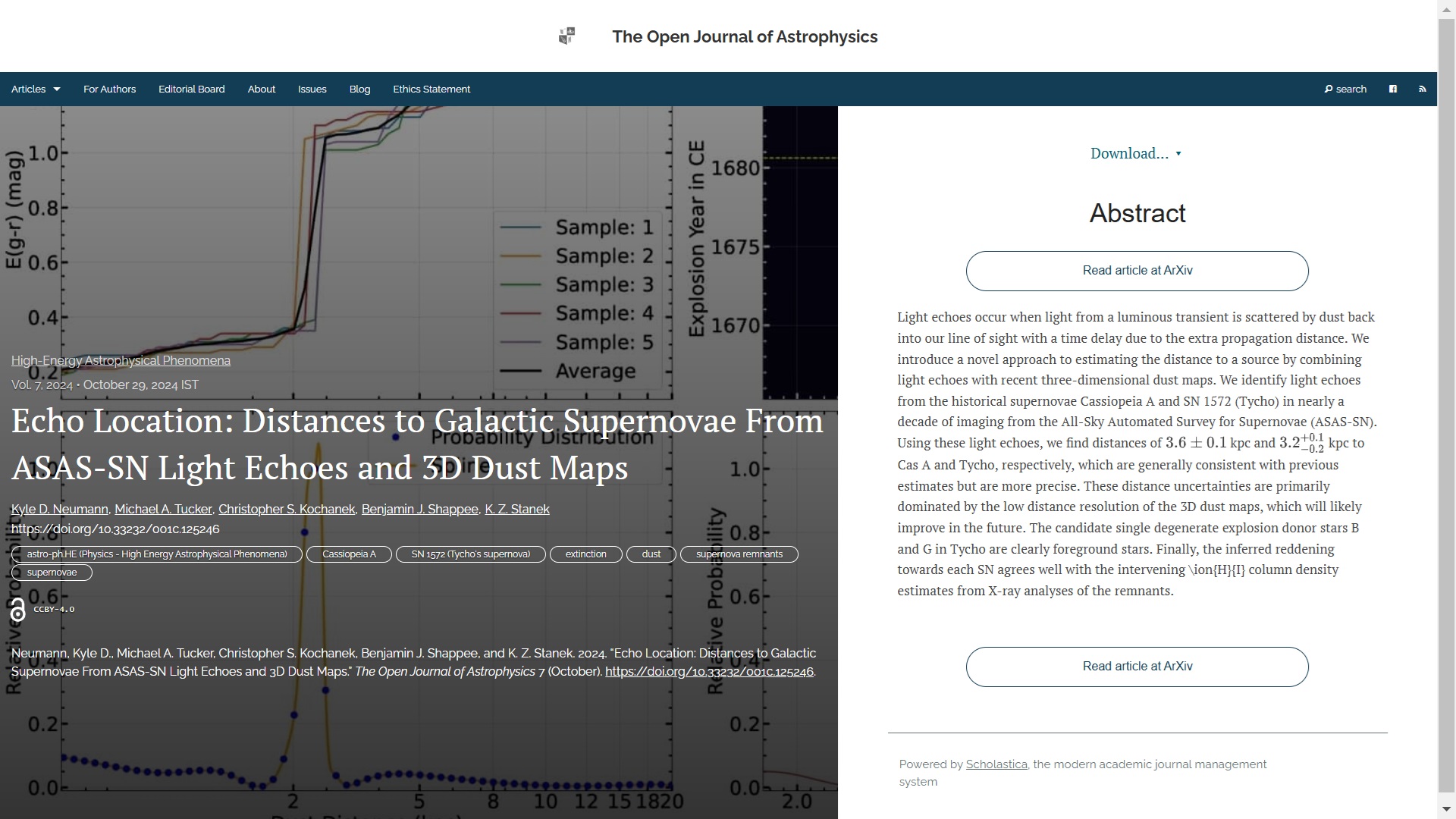
First one up, published on 7th August 2024, is “Brightest Cluster Galaxy Offsets in Cold Dark Matter” by Jonathan Katz of Washington University (St Louis, Missouri, USA),  a simulation-based study of the distribution of the position of brightest cluster galaxies relative to the dark matter distribution and its possible use as a cosmological probe.  The authors are Cian Roche (MIT), Michael McDonald (MIT), Josh Borrow (MIT), Mark Vogelsberger (MIT), Xuejian Shen (MIT), Volker Springel (MPA Garching), Lars Hernquist (Harvard), Ruediger Pakmor (Harvard), Sownak Bose (Durham, UK) and Rahul Kannan (York U., Canada). This paper is in the folder marked Astrophysics of Galaxies.

Here is a screen grab of the overlay, which includes the abstract:


You can read the paper directly on arXiv here.

The second paper to present is “LAMOST J1010+2358 is not a Pair-Instability Supernova Relic” by five authors based in the USA: Pierre Thibodeaux (Chicago), Alexander P. Ji (Chicago), William Cerny (Yale), Evan N. Kirby (Notre Dame) and Joshua D. Simon (Carnegie Observatories) .  As the title makes clear, the paper presents arguments against previous claims that a particular star is not a pair-instability supernova relic. This paper is in the folder marked Solar and Stellar Astrophysics. It was published on Friday August 9th 2024.

The overlay looks like this:


You can read this paper directly on the arXiv here.

Last, but by no means least, comes  “A Pilot Search for Gravitational Self-Lensing Binaries with the Zwicky Transient Facility“, results of a trial search for signals of gravitational lensing of one component in a binary system by a compact companion, with a discussion of future prospects for larger surveys. This one, which was also published on 9th August, is in the folder marked High-Energy Astrophysical Phenomena. The authors are Allison Crossland & Eric C Bellm (U. Washington), Courtney Klein (UC Irvine), James R. A. Davenport (U. Washington), Thomas Kupfer (Hamburg Observatory) and Steven L. Groom, Russ R. Laher & Reed Riddle (Caltech).

Here is a screengrab of the overlay:

To read the accepted version of this on the arXiv please go here.

That’s it for this week. I hope to post another update next weekend.

R.I.P. Peter Thomas (1961-2024)

Posted in R.I.P. with tags , , , , , on July 25, 2024 by telescoper

Once again I have to use this blog to pass on some very sad news. Professor Peter Thomas of Sussex University passed away last weekend at the age of 62.

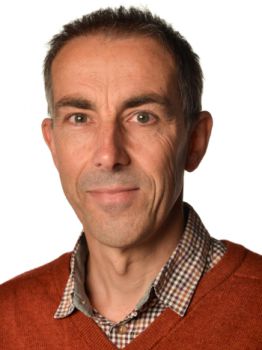
Peter Thomas (left) joined the University of Sussex as a lecturer in the Astronomy Centre in 1989 and remained there for his entire career. I know from my own time as Head of School that he was an excellent colleague. who made huge contributions to the University and indeed to his research discipline of cosmology.

Peter studied Mathematics at Cambridge University, graduating in 1983 and then did Part III (also known as the Certificate of Advanced Study) which he obtained in 1984. He stayed in Cambridge to do a PhD in the Institute of Astronomy under the supervision of Andy Fabian on Cooling Flows and Galaxy Formation, which he completed in 1987. He then spent a couple of years in Toronto as a Postdoctoral Fellow at the Canadian Institute for Theoretical Astrophysics (CITA) before taking up his lectureship at Sussex in 1989. His main research interests were in in the areas of galaxy formation, including numerical and semi-analytic models, and computer simulations of the formation of clusters of galaxies.  He was a widely known and very highly respected researcher in the field of theoretical cosmology and extragalactic astrophysics.

I was a PDRA in the Astronomy Centre at Sussex when Peter joined in 1989; he was Professor in the Department of Physics & Astronomy when I returned there as Head of School of Mathematical and Physical Sciences in 2013, a position he himself subsequently held. He was a much-valued member of staff who made huge contributions to the Astronomy Centre, the Department of Physics & Astronomy, the School of Mathematical and Physical Sciences, and the University of Sussex as a whole. I also remember him as a colleague on various panels for PPARC and then STFC on which he served diligently.

Having known Peter for 35 years, and being of similar age, it was a shock to hear that he passed away. I understand that he had been suffering from cancer for over a year. I send my deepest condolences to his family, friends and colleagues. I understand that his funeral will be a private family affair, but there will be a more public occasion to celebrate his life at a later date.

Two New Publications at the Open Journal of Astrophysics

Posted in OJAp Papers, Open Access, The Universe and Stuff with tags , , , , , , , , on July 13, 2024 by telescoper

Another Saturday, another update of the  Open Journal of Astrophysics.  Since the last update we have published two more papers, taking  the count in Volume 7 (2024) up to 56 and the total published by OJAp up to 171.  Both these papers were published on Thursday 11th July 2024.

The first paper of the most recent pair, published on July 3rd 2024,  is “Sunyaev-Zeldovich signatures from non-thermal, relativistic electrons using CMB maps” by Sandeep Kumar Acharya of The Open University of Israel, Ra’anana, Israel.  This article presents a discussion the possible effects of non-thermal electron energy distributions on the form of Sunyaev-Zeldovich distortions and how they might be measured. The paper is in the folder marked Cosmology and NonGalactic Astrophysics.

Here is a screen grab of the overlay which includes the abstract:


You can click on the image of the overlay to make it larger should you wish to do so. You can find the officially accepted version of the paper on the arXiv here.

The second paper has the title “On the contribution of dwarf galaxies to reionization of the Universe” and is by Zewei Wu and Andrey Kravtsov of the University of Chicago in the USA. This paper, which is in the folder marked Astrophysics of Galaxies, presents a model of galaxy formation that suggests that radiation from very faint galaxies may contribute significantly to the reionization of the Universe.

Here is a screen grab of the overlay which includes the abstract:


You can click on the image of the overlay to make it larger should you wish to do so. You can find the officially accepted version of the paper on the arXiv here.

That concludes this week’s update. No doubt I’ll have more for you next week!

Why Do We Need Simulations for the Euclid Telescope?

Posted in Euclid, The Universe and Stuff with tags , , on June 23, 2024 by telescoper

Until I can get my laptop fixed and/or get a new one, my ability to write blog posts is a bit limited. At least there is a sizeable collection of things to share, including a steady supply of  new videos from the Euclid Consortium like this one:

Three New Publications at the Open Journal of Astrophysics

Posted in OJAp Papers, Open Access, The Universe and Stuff with tags , , , , , , , , , , , , , , , , , on June 8, 2024 by telescoper

Time for another roundup of business at the  Open Journal of Astrophysics. This time I have three papers to announce, which brings the total we have published so far this year (Vol. 7) to 45 and the total published by OJAp to 160. We’re still on track to publish around 100 papers this year or more, compared to last year’s 50.

First one up, published on 3rd June 2024, is “Log-Normal Waiting Time Widths Characterize Dynamics” by Jonathan Katz of Washington University (St Louis, Missouri, USA). This paper presents a discussion of the connection between waiting time distributions and dynamics for aperiodic astrophysical systems, with emphasis on log-normal distributions.  This paper is in the folder marked High-Energy Astrophysical Phenomena.

Here is a screen grab of the overlay, which includes the abstract:


You can read the paper directly on arXiv here.

The second paper to present is “An Empirical Model For Intrinsic Alignments: Insights From Cosmological Simulations” by Nicholas Van Alfen (Northeastern University, Boston, USA), Duncan Campbell (Carnegie Mellon University, Pittsburgh, USA), Jonathan Blazek (Northeastern University), C. Danielle Leonard (Newcastle University, UK), Francois Lanusse (Université Paris-Saclay, France), Andrew Hearin (Argonne National Laboratory, USA), Rachel Mandelbaum (Carnegie Mellon University) and The LSST Dark Energy Science Collaboration.  This paper presents an extension of the halo model (specifically the Halo Occupation Distribution, HOD) to include intrinsic alignment effects for the study of weak gravitational lensing. This paper is in the folder marked Cosmology and Nongalactic Astrophysics. It was published on Tuesday June 4th 2024.

The overlay looks like this:


You can read this paper directly on the arXiv here.

Last, but by no means least, comes  “Towards Cosmography of the Local Universe”  which proposes the multipoles of the distance-redshift relation as new cosmological observables that have a direct physical interpretation in terms of kinematical quantities of the underlying matter flow. This was also published on 4th June. The authors are Julian Adamek (IfA Zurich, Switzerland), Chris Clarkson (Queen Mary, London, UK), Ruth Durrer (Geneva, Switzerland), Asta Heinesen (U. Lyon, France & NBI Copenhagen, Denmark), Martin Kunz (Geneva), and Hayley J. Macpherson (Chicago, USA).

Here is a screengrab of the overlay:


To read the accepted version of this on the arXiv please go here. This paper is also in the folder marked Cosmology and Nongalactic Astrophysics.
That’s it for this week. I aim to post another update next weekend.


Is machine learning good or bad for the natural sciences?

Posted in The Universe and Stuff with tags , , , , , , , on May 30, 2024 by telescoper

Before I head off on a trip to various parts of not-Barcelona, I thought I’d share a somewhat provocative paper by David Hogg and Soledad Villar. In my capacity as journal editor over the past few years I’ve noticed that there has been a phenomenal increase in astrophysics papers discussing applications of various forms of Machine Leaning (ML). This paper looks into issues around the use of ML not just in astrophysics but elsewhere in the natural sciences.

The abstract reads:

Machine learning (ML) methods are having a huge impact across all of the sciences. However, ML has a strong ontology – in which only the data exist – and a strong epistemology – in which a model is considered good if it performs well on held-out training data. These philosophies are in strong conflict with both standard practices and key philosophies in the natural sciences. Here, we identify some locations for ML in the natural sciences at which the ontology and epistemology are valuable. For example, when an expressive machine learning model is used in a causal inference to represent the effects of confounders, such as foregrounds, backgrounds, or instrument calibration parameters, the model capacity and loose philosophy of ML can make the results more trustworthy. We also show that there are contexts in which the introduction of ML introduces strong, unwanted statistical biases. For one, when ML models are used to emulate physical (or first-principles) simulations, they introduce strong confirmation biases. For another, when expressive regressions are used to label datasets, those labels cannot be used in downstream joint or ensemble analyses without taking on uncontrolled biases. The question in the title is being asked of all of the natural sciences; that is, we are calling on the scientific communities to take a step back and consider the role and value of ML in their fields; the (partial) answers we give here come from the particular perspective of physics

arXiv:2405.18095

P.S. The answer to the question posed in the title is probably “yes”.

Three New Publications at the Open Journal of Astrophysics

Posted in OJAp Papers, Open Access, The Universe and Stuff with tags , , , , , , , , on May 25, 2024 by telescoper

After a very busy and unusual week, it’s time to get back to normal with the usual  Saturday roundup of business at the  Open Journal of Astrophysics. If you want to know how many papers we have published so far this year (Vol. 7), the answer is 42. The total published by OJAp is now 157. We’re still on track to publish around 100 papers this year, possibly more, compared to last year’s 50.

All the members of this week’s trio are in the folder marked Cosmology and Nongalactic Astrophysics, and indeed all three relate in one way or another to the topic of weak gravitational lensing.  All three were published on Wednesday 22nd May 2024.

First one up is “Joint constraints from cosmic shear, galaxy-galaxy lensing and galaxy clustering: internal tension as an indicator of intrinsic alignment modelling error” which is by Simon Samuroff (Northeastern U., USA), Andresa Campos (Carnegie Mellon U., USA), Anna Porredon (Bochum, Germany) and Jonathan Blazek (Edinburgh, UK).   A combined statistical approach to the identification of errors arising in cosmic shear analysis due to intrinsic alignments.

Here is a screen grab of the overlay, which includes the abstract:

You can read the paper directly on arXiv here.

The second paper to present is “A unified linear intrinsic alignment model for elliptical and disc galaxies and the resulting ellipticity spectra” by Basundhara Ghosh (Bangalore, India), with Kai Nussbaumer, Eileen Sophie Giesel & Björn Malte Schäfer (Heidelberg, Germany). It presents a discussion of the physical origin of intrinsic alignments of both elliptical and disk galaxies and the implications for cosmological studies

The overlay looks like this:


You can read this paper directly on the arXiv here.

The last paper of this batch is entitled “Neural style transfer of weak lensing mass maps”  and proposes a generative model for the mass-production of weak-lensing maps. The authors are Masato Shirasaki and Shiro Ikeda (both of the University of Tokyo, Japan)

Here is a screengrab of the overlay:


To read the accepted version of this on the arXiv please go here.
That’s all for now. I will do another update next week.


Euclid Paper Day!

Posted in Barcelona, Euclid, Maynooth, The Universe and Stuff with tags , , , , , , , , on May 24, 2024 by telescoper

This morning’s arXiv update brought the expected deluge of preprints from Euclid. You can find details of all fifteen of the new articles here. Ten of them relate to the Early Release Observations of which five were announced yesterday and five last November. These are essentially byproducts of the testing and calibration phase of the Euclid mission rather than the main cosmological survey. ESA is making a series of short videos about these results which I will share on here from time to time.

Of more direct relevance to cosmologists such as myself are the following five reference papers:

The overview paper, led by Yannick Mellier (Euclid Consortium Lead), giving a general description of the mission capabilities and science goals, will be the main reference paper and just about every active member of the Euclid Consortium is on the author list (including myself). That’s over a thousand people, not quite at the level of the Large Hadron Collider but getting there. I do think we need to find a better way of giving credit to work in large collaborations than through authorship, but until someone comes up with a workable scheme, and people responsible for hiring researchers adopt it, we’re stuck with what we’ve got. At least I can say that I’ve read that paper (which is 94 pages long, including the author list)

Papers II-IV are technical articles relating to Euclid’s instruments and their calibration, which will also be important references for the survey part of the Euclid mission. Paper V is about the Flagship simulations and the mock catalogues produced therefrom; I discussed these a while ago here. It is led by Francisco Castander of Institut de Ciencies de l’Espai, who organized the meeting I attended recently here in Barcelona.

These papers now now be peer-reviewed and, assuming they are accepted, published in a special issue of Astronomy & Astrophysics (A&A).

New Results from Euclid

Posted in Euclid, Maynooth, The Universe and Stuff with tags , , , , on May 23, 2024 by telescoper

As it was foretold, exciting new results from the European Space Agency’s Euclid mission have now been released.

You can read more about these images here.

Together with the five images released last November that makes a total of ten Early Release Observations from the pre-survey phase of Euclid. It’s not all about the pictures, however. Today also saw the release of ten scientific papers to go with these images, as well as five reference papers for the main survey. You can find them all, with accompanying information here. They will be announced on arXiv tomorrow.

You might also be interested to read my Euclid piece on RTÉ Brainstorm which has just appeared. This is not just about the new images, but gives an update on what Euclid has been up to since launch, and what we can expect in the future. There’s also a version adapted for Maynooth University PR purposes here. It includes this quote:

Today’s release of new data and technical papers from Euclid is exciting in itself but also marks the start, after months of painstaking calibration and testing of the instruments, of Euclid’s main cosmological survey. We are on the threshold of a new era in cosmology. Maynooth is the only University in Ireland to be involved in this mission and it is very exciting to be at the forefront of such an important scientific development.

I’m also quoted in a piece in the Irish Times. You’ll probably find the article blocked by a paywall but my bit is:

Two New Publications at the Open Journal of Astrophysics

Posted in OJAp Papers, The Universe and Stuff with tags , , , , , , on May 4, 2024 by telescoper

It’s Saturday morning in Barcelona, and time to post another update relating to the  Open Journal of Astrophysics.  Since the last update we have published two more papers, taking  the count in Volume 7 (2024) up to 32 and the total published by OJAp up to 147. There’s every chance we will reach 150 next week.

The first paper of the most recent pair – published on  Monday 29th April- is “Supernovae in 2023 (review): possible breakthroughs by late observations” by Noam Soker of Technion in Haifa, Israel. It presents  a discussion of observations of the aftermath of supernovae explosions, such as supernova remnants, and how these may shed light on the explosion mechanism. This one is in the folder marked High-Energy Astrophysical Phenomena.

Here is a screen grab of the overlay which includes the abstract:


You can click on the image of the overlay to make it larger should you wish to do so. You can find the officially accepted version of the paper on the arXiv here.

The second paper was published on Thursday 2nd May and has the title “ΛCDM is alive and well” The authors are: Alain Blanchard (Université de Toulouse, France), Jean-Yves Héloret (Université de Toulouse, France), Stéphane Ilíc (Université Paris-Saclay, France), Brahim Lamine (Université de Toulouse, France) and Isaac Tutusaus (Université de Genève, Switzerland). This one, which is in the folder marked Cosmology and NonGalactic Astrophysics, presents a review of  review of the alleged tensions between observations and the standard cosmological model.

I did a post recently relating to a Royal Society Meeting on this topic. The first version of this paper appeared on arXiv about two years ago but the final version is extensively modified.

Here is a screen grab of the overlay which includes the abstract:


You can click on the image of the overlay to make it larger should you wish to do so. You can find the officially accepted version of the paper on the arXiv here.

And that concludes this week’s update. More next week!