Archive for Cosmology

Preparing for Euclid’s First Images

Posted in Euclid, The Universe and Stuff with tags , , , on November 3, 2023 by telescoper

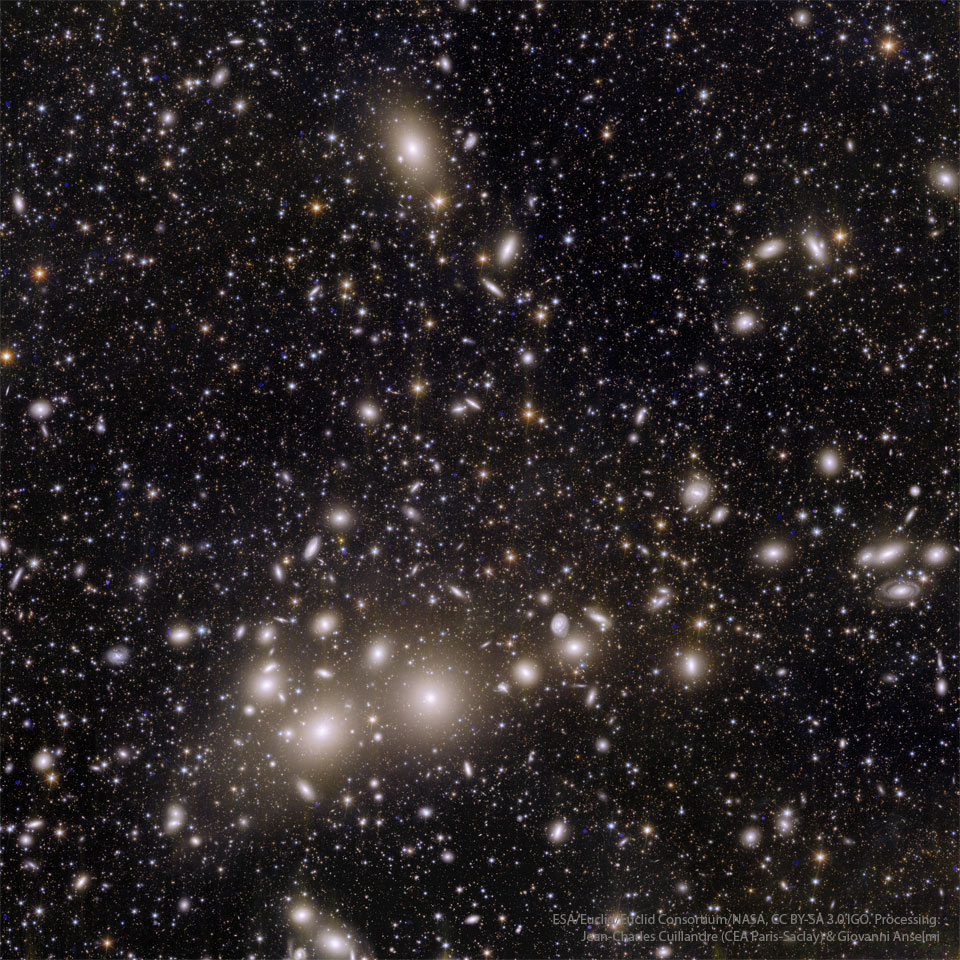
Another quick update about the release of the Early Release Observations (EROs) from Euclid, due to take place next Tuesday 7th November. For one thing, here is a little taster video.

Five images will be released on Tuesday. I know what the Early Release Observations are but you will have to wait until Tuesday to find out. If I told you now I’d have to kill you…

Euclid Update!

Posted in Euclid with tags , , , on October 30, 2023 by telescoper

Just a quick post to give advanced notice that, gremlins in the pointing system having been dispelled, the first actual science images from European Space Agency’s Euclid mission will be released on Tuesday 7th November at 14.00 Central European (not Summer) Time, CET. These are called the Early Release Observations (EROs) – they won’t be part of the full survey, but are just to demonstrate the performance of the telescope and detectors.

You can watch the press conference on the new ESA Web TV channel. I’ll post more about the EROs after they become public, but not before.

New Publication at the Open Journal of Astrophysics

Posted in OJAp Papers, Open Access, The Universe and Stuff with tags , , , , , on October 22, 2023 by telescoper

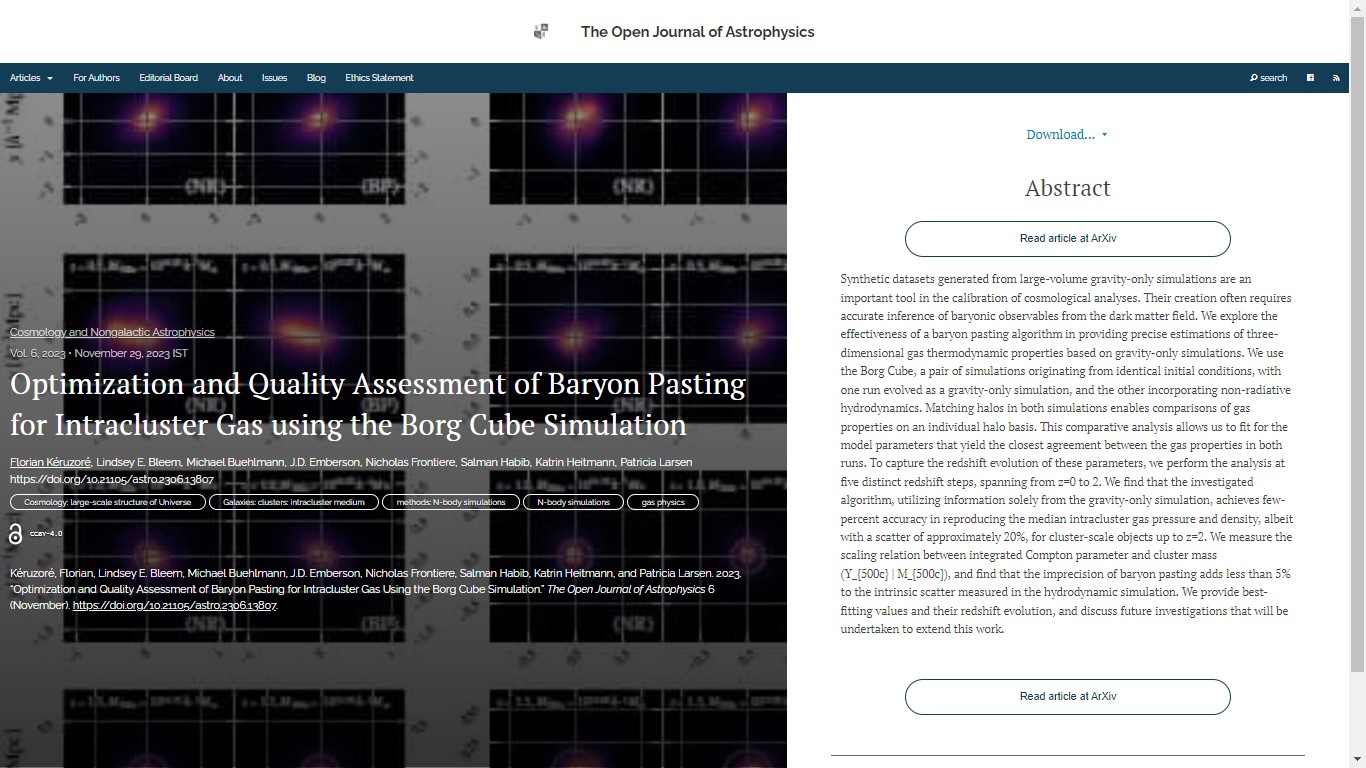
It’s Sunday but I’ll be a bit busy next week so I’m taking the opportunity today to announce yet another new paper at the Open Journal of Astrophysics. This one was published on Friday 20th October.

The latest paper is the 41st  so far in Volume 6 (2023) and the 106th in all. It is a product of the Dark Energy Survey team and the Kilo-Degree Survey Collaboration, which amounts to about 160 authors altogether. The corresponding author for this article was the Astronomer Royal for Scotland Professor Catherine Heymans, no less.

The primary classification for this paper is Cosmology and NonGalactic Astrophysics and its title is “DES Y3 + KiDS-1000: Consistent cosmology combining cosmic shear surveys”. The article presents a joint analysis of the Dark Energy Survey Year 3 data and the Kilo-Degree Survey data, with a discussion of the implications for cosmological parameters. The key figure – a very important one – is this:

If you want to know more about the result and why it is so important you could read the paper. It is, however, rather long: 40 pages including 21 figures and 15 tables. Do not despair, though, because here is a video explaining the work in the series of Cosmology Talks presented by Shaun Hotchkiss:

Anyway, here is the overlay of the paper containing the abstract:

You can click on the image of the overlay to make it larger should you wish to do so. You can find the officially accepted version of the paper on the arXiv here.

Two New Publications at the Open Journal of Astrophysics

Posted in OJAp Papers, Open Access, The Universe and Stuff with tags , , , , , , , , on October 20, 2023 by telescoper

It’s Friday so it’s a good time to catch up with the week’s action at the Open Journal of Astrophysics, where there have been two new publications so far this week. These papers take us up to a total of 40  in Volume 6 (2023) and 105 in total since we started publishing.

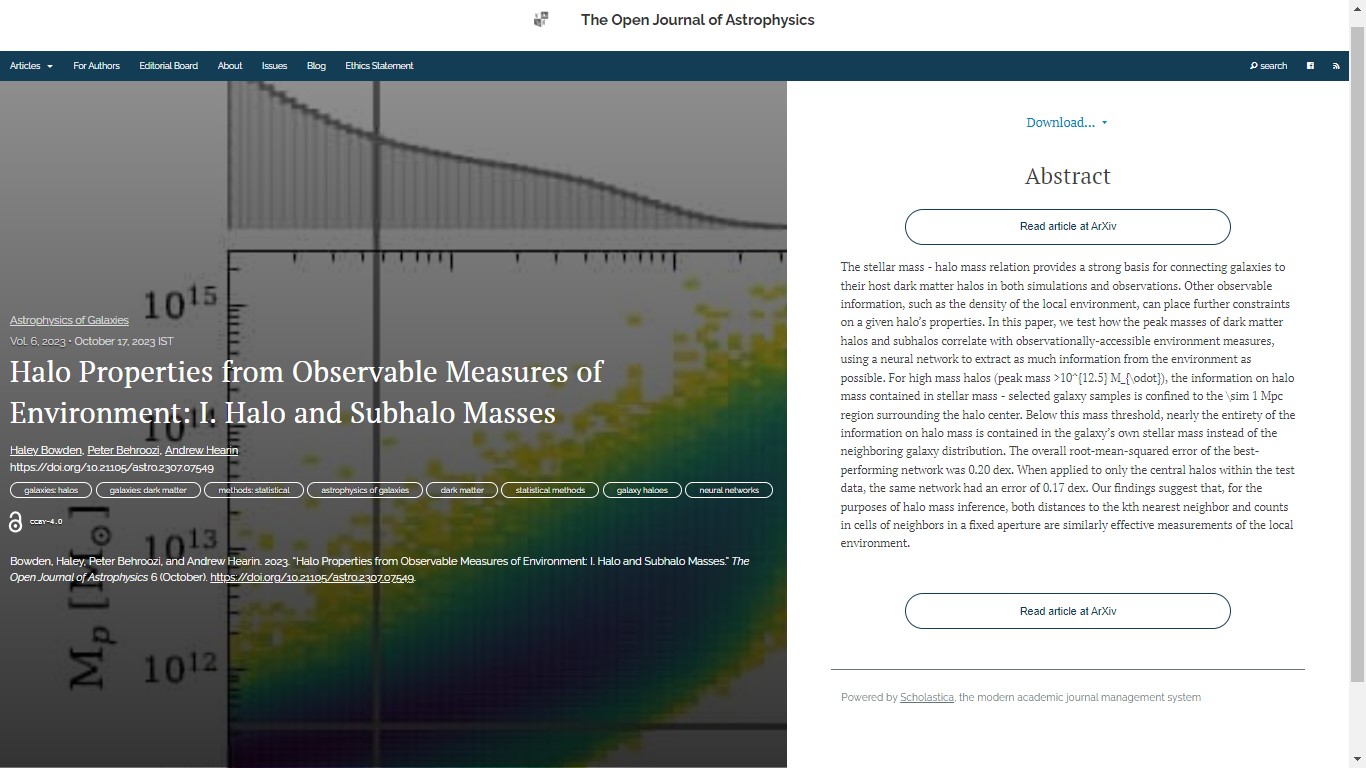
The title of the first paper is “Halo Properties from Observable Measures of Environment: I. Halo and Subhalo Masses” and its primary classification is Astrophysics of Galaxies. it is an exploration using neural networks of how the peak masses of dark matter halos and subhaloes correlate with observationally-accessible measures of their dependence on environment.

The authors based in the United States of America: Haley Bowden and Peter Behroozi of the University of Arizona, and Andrew Hearin of the Argonne National Laboratory

Here is a screen grab of the overlay which includes the abstract:


You can click on the image of the overlay to make it larger should you wish to do so. You can find the officially accepted version of the paper on the arXiv here.

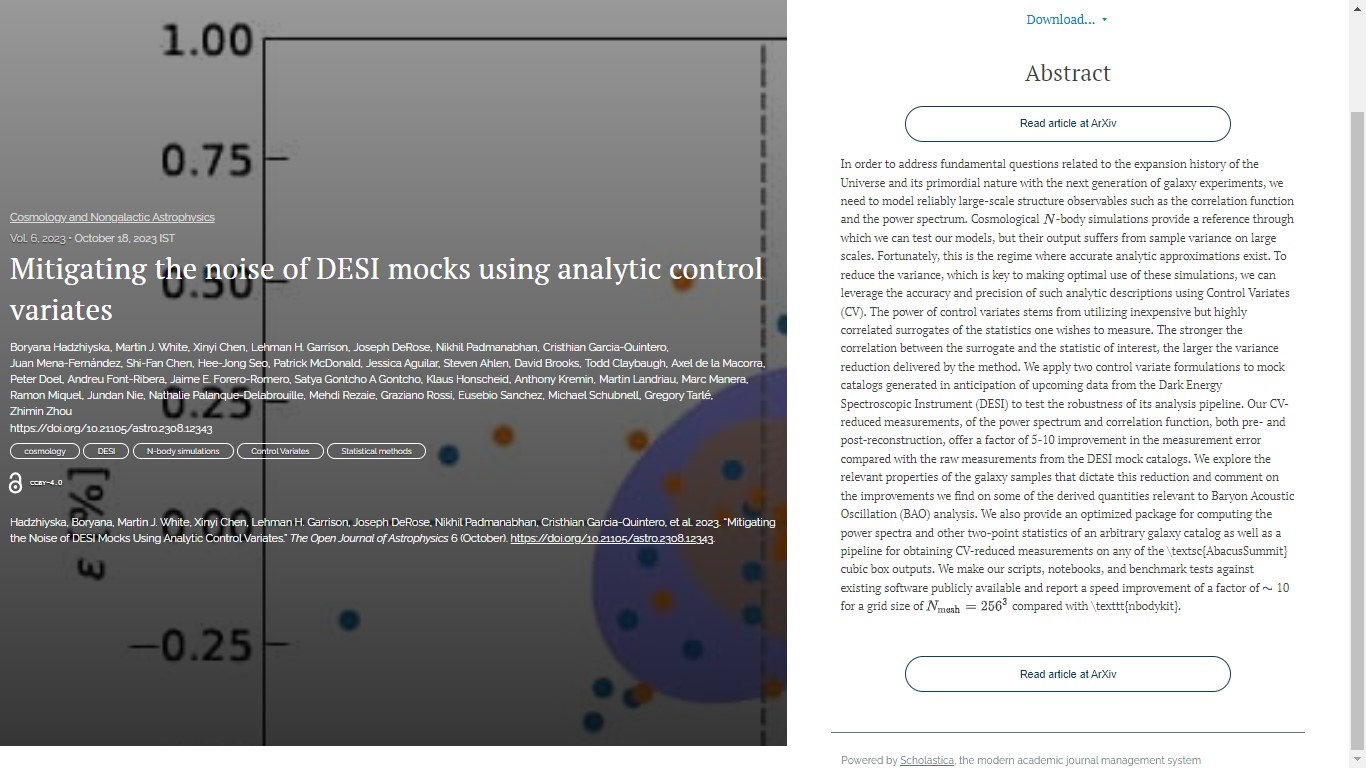
The second paper was published on 18th October 2023.  The primary classification for this one is Cosmology and Nongalactic Astrophysics and is “Mitigating the noise of DESI mocks using analytic control variates”. For those of you not up with the lingo, DESI stands for the Dark Energy Spectroscopic Instrument and you can read more about it here.

The lead author for this one is Boryana Hadzhiyska of the Lawrence Berkeley Laboratory and the University of California, Berkeley (USA) and there are 32 other authors. This paper presents a method for reducing the effects of sample variance on cosmological simulations using analytical approximations and tests it using DESI data.

Here is a screen grab of the overlay which includes the abstract:


You can click on the image of the overlay to make it larger should you wish to do so. You can find the officially accepted version of the paper on the arXiv here.

The Return of a Small Universe?

Posted in The Universe and Stuff with tags , , , , on October 5, 2023 by telescoper

Today I attended a cosmology discussion group where the paper being considered was by Jean-Luc Lehners and Jerome Quintin and was entitled A small Universe. Here is the abstract:

Many cosmological models assume or imply that the total size of the universe is very large, perhaps even infinite. Here we argue instead that the universe might be comparatively small, in fact not much larger than the currently observed size. A concrete implementation of this idea is provided by the no-boundary proposal, in combination with a plateau-shaped inflationary potential. In this model, opposing effects of the weighting of the wave function and of the criterion of allowability of the geometries conspire to favour small universes. We point out that a small size of the universe also fits well with swampland conjectures, and we comment on the relation with the dark dimension scenario.

arXiv:2309.03272

This paper is based on rather speculative arguments. I don’t have anything against those, but the discussion of this particular case reminded me that the idea that the Universe might be much smaller than we think is one that has come and gone many times during my lifetime. The point is that Einstein’s equations of general relativity are local in that they relate the geometric properties of space-time at specific coordinate position to the energy and momentum at the same position. When we make cosmological models based on these equations we usually assume a great deal of symmetry, i.e. that defined in a certain way the spatial sections which form surfaces of simultaneity have the same curvature everywhere, regardless of spatial position. The standard cosmology takes this curvature to be zero, in fact, so the spatial sections are Euclidean (flat), though the curvature could be positive or negative.

Usually when we assume the universe is flat we also assume that it is infinite, but it is possible in principle that a flat universe could be finite, for example in the case of a cube with opposite faces identified so that it has a sort of toroidal symmetry that has no physical edge. The size of the notional cube defines a topological scale which is independent of Einstein’s equations. That’ just a simple example: the topology does not have to be based on a cube; it could be, for example, a rhombic dodecahedron…

Likewise when we talk about a universe with negative spatial curvature we also assume it to be infinite, but that doesn’t have to be the case either: there are spaces with negative spatial curvature which are finite. A manifestation of this idea that I remember from way back in 1999 was a paper by Neil Cornish and David Spergel entitled A small universe after all?

Observing a small universe from the inside produces many interesting effects like a sort of cosmic hall of mirrors. For instance, if you can see far enough you will see the back of your own head. More realistically, the observed large-scale structure of the universe would repeat, and there would be correlated features in the cosmic microwave background. The idea is therefore amenable to observational test; the absence of any of the predicted correlations places constrains the topological scale to be comparable to the size of the observable universe or larger. Of course if it’s infinitely large then the small universe is not small at all…

(For a bit of gratuitous self-promotion, I refer you to a paper I wrote with Graca Rocha and Patrick Dineen back in 2004 using the WMAP observations of the CMB to constrain compact topologies. Given the wealth of new data we have acquired since then I’m sure the constraints are even stronger now.)

Anyway, my point is that speculative ideas are all very well but they don’t mean much if you can’t test them. This one at least has the virtue of making testable predictions.

New Publication at the Open Journal of Astrophysics

Posted in OJAp Papers, Open Access, The Universe and Stuff with tags , , , on September 28, 2023 by telescoper

Time to announce yet another new paper at the Open Journal of Astrophysics. This one was published yesterday (27th September 2023).

The latest paper is the 37th  so far in Volume 6 (2023) and the 102nd in all. The authors are Joe McCaffrey (Maynooth, Ireland), Samantha Hardin (Georgia Tech, USA), John Wise (Georgia Tech) and John Regan (Maynooth). As this one involved two authors from my own Department, I recused myself from the editorial process, although it is work I am very interested in.

The primary classification for this paper is Astrophysics of Galaxies and its title is “No Tension: JWST Galaxies at z>10 Consistent with Cosmological Simulations”.  I’ve blogged about this paper before, a few months ago, when it appeared on the arXiv. The editorial process on this one has been very thorough and  it has been a few rounds with the reviewers before being accepted for publication. The authors may have found this a bit irksome, but I think the process improved them paper considerably, which is what it is meant to do.

As many of you will be aware, there’s been a considerable to-do not to mention a hoo-hah about the detections by JWST of some galaxies at high redshift. Some of these have been shown not to be galaxies at high redshift after all, but some around z=10 seem to be genuine. This paper is a response to claims that these somehow rule out the standard cosmological framework.

The key figure in the current paper is this:

The solid curves show the number of galaxies of a given mass one would expect to see as a function of redshift in fields comparable to those observed with estimated values from observations (star-shaped symbols). As you can see the observed points are consistent with the predictions. There’s no tension, so you can all relax.

Anyway, here is a screen grab of the overlay of the published version which includes the  abstract:


You can click on the image of the overlay to make it larger should you wish to do so. You can find the officially accepted version of the paper on the arXiv here.

The Universe from Einstein to Euclid

Posted in Biographical, Talks and Reviews with tags , , on September 7, 2023 by telescoper

As we head into the Day 2 of the ITP2023 I thought I’d share the slides I used for the public talk I gave last night. We had an audience of around a hundred which wasn’t bad given that it is graduation week and the undergraduates aren’t back!

Here is the abstract used to advertise the talk:

Euclid is the name of a new scientific mission from the European Space Agency, launched on July 1st, designed to explore the composition and evolution of the Universe. The Euclid mission takes its name from the ancient Greek mathematician regarded by many as the Father of geometry. Until the last century, Euclid’s theorems were assumed not just to be mathematical notions, but to describe the geometrical structure of the physical Universe. Einstein’s general theory of relativity swept that idea aside and gave us new ways of describing space, by unifying it with time, and by allowing it to be affected by matter in a manner very different from that formulated by Euclid. Over the past century, this theory has proved to be very effective at describing the properties of the Universe as observed by modern astronomical telescopes, while also suggesting the existence of dark matter and dark energy.

The Euclid telescope will create an enormous map of the large-scale structure of the Universe across space and time by observing billions of galaxies out to 10 billion light-years, across more than a third of the sky. Euclid will explore how the Universe has expanded and how galaxies and clusters of galaxies have formed over cosmic history, and how space itself is distorted by these structures.

This talk will discuss our modern ideas of space and time, how the Euclid mission will try to test whether or not they are correct and shed light on the nature of dark matter and dark energy.

And here are the slides:

Obviously I cut a number of long stories very short, which probably contributed to why I had a lot of questions from the audience at the end of the talk. I always assume that’s a basically a good sign because it shows people are interested, but it also makes me worry that I didn’t explain things very well!

We didn’t finish until past 9 o’clock and it was a very warm evening, so I was very happy to have a few pints afterwards in O’Neills…

R.I.P. Mark Birkinshaw (1954-2023)

Posted in Biographical, R.I.P., The Universe and Stuff with tags , , , , on August 17, 2023 by telescoper

I just heard this morning of the passing of Mark Birkinshaw (left) who was, since 1992, William P. Coldrick Professor of Cosmology and Astrophysics at the University of Bristol. Before that he held positions in Cambridge and Harvard.

I’m told that he died in hospital of a “short but serious illness”.

Among other important contributions to cosmology and astrophysics, in 1984, along with Steve Gull of Cambridge and Harry Hardebeck of the Owens Valley Observatory, was the first to measure experimentally the Sunyaev-Zel’dovich effect in a galaxy cluster; the reference is here.

It was in Cambridge as an undergraduate that I first met Mark Birkinshaw. He taught the long vacation course on Physical Applications of Complex Variables that I took in the summer of 1984. It was a tough course but he was an excellent teacher. All these years later I still have my handwritten notes for that course as well as the handouts. I still use them too.

After that I saw him regularly at conferences and seminars and on various committees for PPARC and then STFC. He was extremely diligent in such “community service” roles and was an invaluable contributor owing to his wide range of knowledge beyond his own speciality.

Having been a mainstay of astrophysics research at Bristol University for over thirty years, Mark will be greatly missed. I send condolences to his friends and colleagues at Bristol and elsewhere in the world, and especially to Diana. You can send thoughts, tributes and condolences and/or make a charitable donation in Mark’s memory here, where there are also details of the funeral arrangements.

New Publication at the Open Journal of Astrophysics

Posted in OJAp Papers, Open Access, The Universe and Stuff with tags , , , , , , on July 22, 2023 by telescoper

Time to announce yet another new paper at the Open Journal of Astrophysics. This one was published yesterday, on 21st July 2023.

The latest paper is the 27th  so far in Volume 6 (2023) and the 92nd in all. The authors are Sohan Ghodla, Richard Easther, M.M. Briel and J.J. Eldridge, all of the University of Auckland in New Zealand.

The primary classification for this paper is Cosmology and Nongalactic Astrophysics and its title is “Observational implications of cosmologically coupled black holes”.  The paper elucidates some of the consequences of a suggestion that the interaction between black holes and the global properties of space-time underlying explanation for dark energy. The key result is that the existence of cosmologically-coupled black holes implies a much larger rate of black-hole merger events than is observed.

The papers to which this is a response are mentioned here. For reference ,these earlier works were published in The Astrophysical Journal and The Astrophysical Journal Letters. There is also a detailed twitter thread about this paper by Richard Easter, posted when it was submitted as a preprint to the arXiv last month:


Anyway, here is a screen grab of the overlay of the published version which includes the  abstract:


You can click on the image of the overlay to make it larger should you wish to do so. You can find the officially accepted version of the paper on the arXiv here.

The Hubble Constant: A Historical Review

Posted in The Universe and Stuff with tags , , , , , on May 29, 2023 by telescoper

I bookmarked this paper on arXiv a week or so ago with the intention of sharing it here, but evidently forgot about it. Anyway, as its name suggests, it’s a review by Brent Tully from a historical perspective of measurements of the Hubble Constant. I’m not sure whether it is intended for publication in a book – as it opens with the heading “Chapter 1” – but it’s well worth reading whatever its purpose. Here is the abstract:

For 100 years since galaxies were found to be flying apart from each other, astronomers have been trying to determine how fast. The expansion, characterized by the Hubble constant, H0, is confused locally by peculiar velocities caused by gravitational interactions, so observers must obtain accurate distances at significant redshifts. Very nearby in our Galaxy, accurate distances can be determined through stellar parallaxes. There is no good method for obtaining galaxy distances that is applicable from the near domain of stellar parallaxes to the far domain free from velocity anomalies. The recourse is the distance ladder involving multiple methods with overlapping domains. Good progress is being made on this project, with satisfactory procedures and linkages identified and tested across the necessary distance range. Best values of H0 from the distance ladder lie in the range 73 – 75 km/s/Mpc. On the other hand, from detailed information available from the power spectrum of fluctuations in the cosmic microwave background, coupled with constraints favoring the existence of dark energy from distant supernova measurements, there is the precise prediction that H0 = 67.4 to 1%. If it is conclusively determined that the Hubble constant is well above 70 km/s/Mpc as indicated by distance ladder results then the current preferred LambdaCDM cosmological model based on the Standard Model of particle physics may be incomplete. There is reason for optimism that the value of the Hubble constant from distance ladder observations will be rigorously defined with 1% accuracy in the near future.

Brent Tully, arXiv:2305.11950

Here is the concluding paragraph:

As the 20th century came to an end, ladder measurements of the Hubble constant were at odds with the favored cosmological model of the time of cold dark matter with Λ =0. The new favorite became the ΛCDM model with dark energy giving rise
to acceleration of space in a topologically flat universe. Yet ladder measurements, continuously improving, create doubts that this currently favorite model is complete. Yes, there is a Hubble tension.