Archive for Cosmology

New Publication at the Open Journal of Astrophysics

Posted in OJAp Papers, Open Access, The Universe and Stuff with tags , , , on September 28, 2023 by telescoper

Time to announce yet another new paper at the Open Journal of Astrophysics. This one was published yesterday (27th September 2023).

The latest paper is the 37th  so far in Volume 6 (2023) and the 102nd in all. The authors are Joe McCaffrey (Maynooth, Ireland), Samantha Hardin (Georgia Tech, USA), John Wise (Georgia Tech) and John Regan (Maynooth). As this one involved two authors from my own Department, I recused myself from the editorial process, although it is work I am very interested in.

The primary classification for this paper is Astrophysics of Galaxies and its title is “No Tension: JWST Galaxies at z>10 Consistent with Cosmological Simulations”.  I’ve blogged about this paper before, a few months ago, when it appeared on the arXiv. The editorial process on this one has been very thorough and  it has been a few rounds with the reviewers before being accepted for publication. The authors may have found this a bit irksome, but I think the process improved them paper considerably, which is what it is meant to do.

As many of you will be aware, there’s been a considerable to-do not to mention a hoo-hah about the detections by JWST of some galaxies at high redshift. Some of these have been shown not to be galaxies at high redshift after all, but some around z=10 seem to be genuine. This paper is a response to claims that these somehow rule out the standard cosmological framework.

The key figure in the current paper is this:

The solid curves show the number of galaxies of a given mass one would expect to see as a function of redshift in fields comparable to those observed with estimated values from observations (star-shaped symbols). As you can see the observed points are consistent with the predictions. There’s no tension, so you can all relax.

Anyway, here is a screen grab of the overlay of the published version which includes the  abstract:


You can click on the image of the overlay to make it larger should you wish to do so. You can find the officially accepted version of the paper on the arXiv here.

The Universe from Einstein to Euclid

Posted in Biographical, Talks and Reviews with tags , , on September 7, 2023 by telescoper

As we head into the Day 2 of the ITP2023 I thought I’d share the slides I used for the public talk I gave last night. We had an audience of around a hundred which wasn’t bad given that it is graduation week and the undergraduates aren’t back!

Here is the abstract used to advertise the talk:

Euclid is the name of a new scientific mission from the European Space Agency, launched on July 1st, designed to explore the composition and evolution of the Universe. The Euclid mission takes its name from the ancient Greek mathematician regarded by many as the Father of geometry. Until the last century, Euclid’s theorems were assumed not just to be mathematical notions, but to describe the geometrical structure of the physical Universe. Einstein’s general theory of relativity swept that idea aside and gave us new ways of describing space, by unifying it with time, and by allowing it to be affected by matter in a manner very different from that formulated by Euclid. Over the past century, this theory has proved to be very effective at describing the properties of the Universe as observed by modern astronomical telescopes, while also suggesting the existence of dark matter and dark energy.

The Euclid telescope will create an enormous map of the large-scale structure of the Universe across space and time by observing billions of galaxies out to 10 billion light-years, across more than a third of the sky. Euclid will explore how the Universe has expanded and how galaxies and clusters of galaxies have formed over cosmic history, and how space itself is distorted by these structures.

This talk will discuss our modern ideas of space and time, how the Euclid mission will try to test whether or not they are correct and shed light on the nature of dark matter and dark energy.

And here are the slides:

Obviously I cut a number of long stories very short, which probably contributed to why I had a lot of questions from the audience at the end of the talk. I always assume that’s a basically a good sign because it shows people are interested, but it also makes me worry that I didn’t explain things very well!

We didn’t finish until past 9 o’clock and it was a very warm evening, so I was very happy to have a few pints afterwards in O’Neills…

R.I.P. Mark Birkinshaw (1954-2023)

Posted in Biographical, R.I.P., The Universe and Stuff with tags , , , , on August 17, 2023 by telescoper

I just heard this morning of the passing of Mark Birkinshaw (left) who was, since 1992, William P. Coldrick Professor of Cosmology and Astrophysics at the University of Bristol. Before that he held positions in Cambridge and Harvard.

I’m told that he died in hospital of a “short but serious illness”.

Among other important contributions to cosmology and astrophysics, in 1984, along with Steve Gull of Cambridge and Harry Hardebeck of the Owens Valley Observatory, was the first to measure experimentally the Sunyaev-Zel’dovich effect in a galaxy cluster; the reference is here.

It was in Cambridge as an undergraduate that I first met Mark Birkinshaw. He taught the long vacation course on Physical Applications of Complex Variables that I took in the summer of 1984. It was a tough course but he was an excellent teacher. All these years later I still have my handwritten notes for that course as well as the handouts. I still use them too.

After that I saw him regularly at conferences and seminars and on various committees for PPARC and then STFC. He was extremely diligent in such “community service” roles and was an invaluable contributor owing to his wide range of knowledge beyond his own speciality.

Having been a mainstay of astrophysics research at Bristol University for over thirty years, Mark will be greatly missed. I send condolences to his friends and colleagues at Bristol and elsewhere in the world, and especially to Diana. You can send thoughts, tributes and condolences and/or make a charitable donation in Mark’s memory here, where there are also details of the funeral arrangements.

New Publication at the Open Journal of Astrophysics

Posted in OJAp Papers, Open Access, The Universe and Stuff with tags , , , , , , on July 22, 2023 by telescoper

Time to announce yet another new paper at the Open Journal of Astrophysics. This one was published yesterday, on 21st July 2023.

The latest paper is the 27th  so far in Volume 6 (2023) and the 92nd in all. The authors are Sohan Ghodla, Richard Easther, M.M. Briel and J.J. Eldridge, all of the University of Auckland in New Zealand.

The primary classification for this paper is Cosmology and Nongalactic Astrophysics and its title is “Observational implications of cosmologically coupled black holes”.  The paper elucidates some of the consequences of a suggestion that the interaction between black holes and the global properties of space-time underlying explanation for dark energy. The key result is that the existence of cosmologically-coupled black holes implies a much larger rate of black-hole merger events than is observed.

The papers to which this is a response are mentioned here. For reference ,these earlier works were published in The Astrophysical Journal and The Astrophysical Journal Letters. There is also a detailed twitter thread about this paper by Richard Easter, posted when it was submitted as a preprint to the arXiv last month:


Anyway, here is a screen grab of the overlay of the published version which includes the  abstract:


You can click on the image of the overlay to make it larger should you wish to do so. You can find the officially accepted version of the paper on the arXiv here.

The Hubble Constant: A Historical Review

Posted in The Universe and Stuff with tags , , , , , on May 29, 2023 by telescoper

I bookmarked this paper on arXiv a week or so ago with the intention of sharing it here, but evidently forgot about it. Anyway, as its name suggests, it’s a review by Brent Tully from a historical perspective of measurements of the Hubble Constant. I’m not sure whether it is intended for publication in a book – as it opens with the heading “Chapter 1” – but it’s well worth reading whatever its purpose. Here is the abstract:

For 100 years since galaxies were found to be flying apart from each other, astronomers have been trying to determine how fast. The expansion, characterized by the Hubble constant, H0, is confused locally by peculiar velocities caused by gravitational interactions, so observers must obtain accurate distances at significant redshifts. Very nearby in our Galaxy, accurate distances can be determined through stellar parallaxes. There is no good method for obtaining galaxy distances that is applicable from the near domain of stellar parallaxes to the far domain free from velocity anomalies. The recourse is the distance ladder involving multiple methods with overlapping domains. Good progress is being made on this project, with satisfactory procedures and linkages identified and tested across the necessary distance range. Best values of H0 from the distance ladder lie in the range 73 – 75 km/s/Mpc. On the other hand, from detailed information available from the power spectrum of fluctuations in the cosmic microwave background, coupled with constraints favoring the existence of dark energy from distant supernova measurements, there is the precise prediction that H0 = 67.4 to 1%. If it is conclusively determined that the Hubble constant is well above 70 km/s/Mpc as indicated by distance ladder results then the current preferred LambdaCDM cosmological model based on the Standard Model of particle physics may be incomplete. There is reason for optimism that the value of the Hubble constant from distance ladder observations will be rigorously defined with 1% accuracy in the near future.

Brent Tully, arXiv:2305.11950

Here is the concluding paragraph:

As the 20th century came to an end, ladder measurements of the Hubble constant were at odds with the favored cosmological model of the time of cold dark matter with Λ =0. The new favorite became the ΛCDM model with dark energy giving rise
to acceleration of space in a topologically flat universe. Yet ladder measurements, continuously improving, create doubts that this currently favorite model is complete. Yes, there is a Hubble tension.

R.I.P. Jim Hartle (1939-2023)

Posted in R.I.P., The Universe and Stuff with tags , , , , on May 27, 2023 by telescoper

It’s another one of the occasions on which I have to use this blog to pass on some sad news. Renowned physicist James B. Hartle has passed away.

Jim Hartle’s scientific work was concerned with the application of Einstein’s theory of general relativity to astrophysics, especially gravitational waves, relativistic stars, black holes, and cosmology, specifically the theory of the wave function of the universe. For much of his career he was interested in the earliest moments of the big bang where the subjects of quantum mechanics, gravity theory and cosmology overlap, leading among other things to the Hartle-Hawking conjecture.

Jim Hartle was one of the speakers at the very first scientific conference I attended in Cargèse, Corsica way back in 1986. I remember his lectures very well after all these years, not least because he was so witty. I remember his response when someone asked him about the existence of large dimensionless numbers in cosmology: “…it’s a property that numbers have that some of them are larger than others.”

Condolences to his family, friends and colleagues. Rest in peace, Jim Hartle (1939-2023).

The Euclid Launch Kit!

Posted in Euclid, The Universe and Stuff with tags , , , , , on May 17, 2023 by telescoper

As the launch of the European Space Agency’s Euclid mission approaches, though we don’t know official launch date yet, the associated publicity machines are ramping up for the big occasion. The latest bit of merch is the Euclid Launch Kit.

Sadly, this does not allow you to build your own Falcon 9 launcher which is what I inferred from the name. What it is is an interactive PDF file that allows you to navigate around and learn things about the satellite, its orbit, its instruments and the science case. I think it’s pretty good. You can download it here. It’s over 100 MB though, so beware if you have a very slow connection.

To whet your appetite, here some graphics extracted from the launch kit. You can click on the tiles to make them bigger.

The two science images relate to weak gravitational lensing and baryon acoustic oscillations; for more details you can click on the relevant links.

New Publication at the Open Journal of Astrophysics

Posted in OJAp Papers, The Universe and Stuff with tags , , , , , , , on April 25, 2023 by telescoper

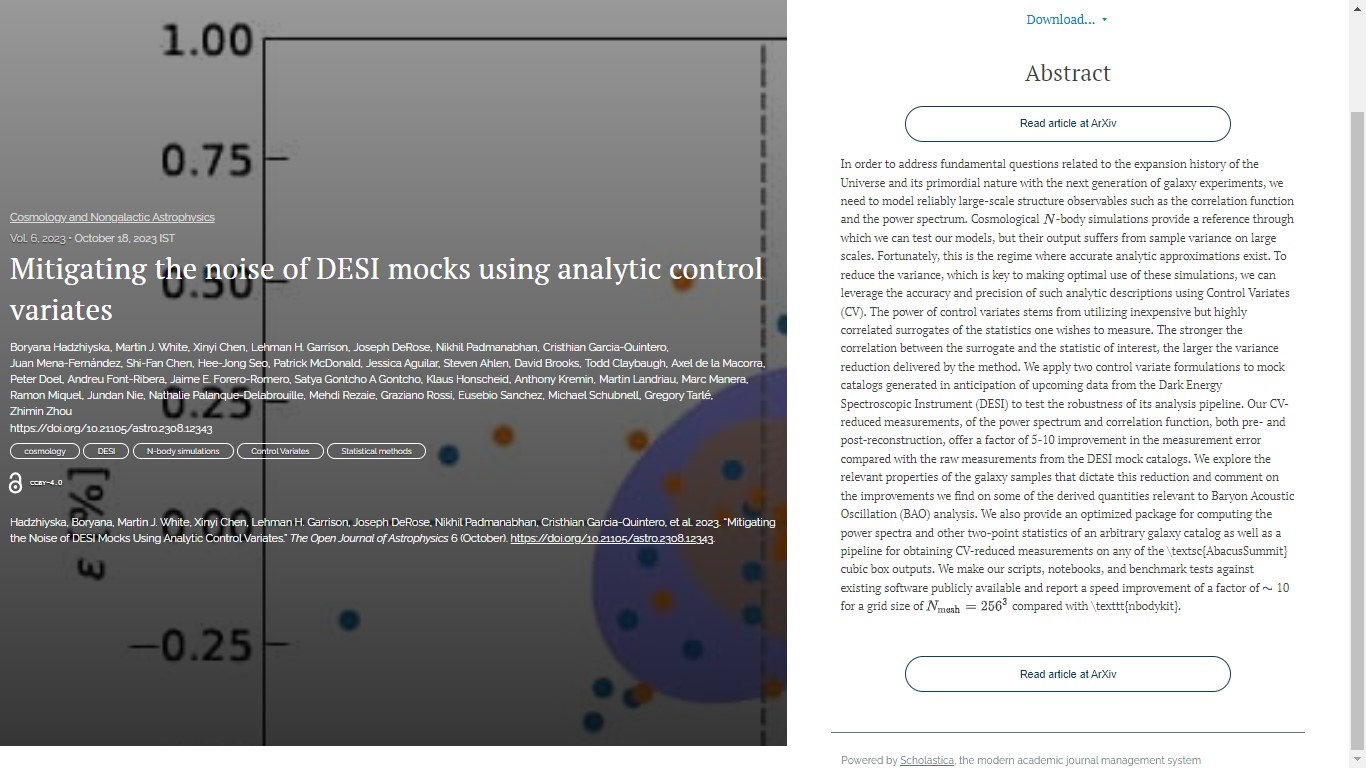
It’s time once more to announce a new paper at the Open Journal of Astrophysics. The latest paper is the 13th paper so far in Volume 6 (2023) and the 78th in all. This one is another for the folder marked Cosmology and NonGalactic Astrophysics and its title is “The catalog-to-cosmology framework for weak lensing and galaxy clustering for LSST”.

The lead author is Judit Prat of the University of Chicago (Illinois, USA) and there are 21 co-authors from elsewhere in the USA and in the UK. The paper is written on behalf of the LSST Dark Energy Science Collaboration (LSST DESC), which is the international science collaboration that will make high accuracy measurements of fundamental cosmological parameters using data from the Rubin Observatory Legacy Survey of Space and Time (LSST). The OJAp has published a number of papers involving LSST DESC, and I’m very happy that such an important consortium has chosen to publish with us.

Here is a screen grab of the overlay which includes the  abstract:

You can click on the image of the overlay to make it larger should you wish to do so. You can find the officially accepted version of the paper on the arXiv here.

New Results from the Atacama Cosmology Telescope

Posted in The Universe and Stuff with tags , , , , , , on April 12, 2023 by telescoper

I wish to draw your attention to a clutch of new papers out on the arXiv today (here, here and here) which describe latest results from the Atacama Cosmology Telescope (ACT for short). There was a webinar about this yesterday, which I failed to attend because I forgot about it.

The first of the papers listed above summarizes the key science results, which include a mass map obtained from gravitational lensing of the cosmic microwave background and its implications for cosmology.

As cosmic background photons propagate freely through space, i.e. without scattering, from the time of recombination to the observer, they are deflected by the gravitational effect of the large-scale distribution of matter in the Universe. This lensing effect leaves imprints in the temperature and polarization anisotropies, which can be used to reconstruct a map of the lensing potential, the gradient of which determines the lensing deflections. Structures in the CMB temperature pattern look bigger on the sky if we view them through an overdense clump of dark matter. By looking how the typical size of hot and cold spots in the CMB temperature map vary across the sky, it is possible to reconstruct the lensing deflections and hence the distribution of dark matter integrated along the line of sight. Since the structure through which the radiation passes is changing with time, this sort of map can provide constraints on models for the evolution of structure.

To cut a long story short, here is the map obtained using Data Release 6 of the ACT data over about 25% of the sky:

There’s a lot of information in the three papers but the key conclusion can be found in the last sentence of the abstract of the first paper:

Our results provide independent confirmation that the universe is spatially flat, conforms with general relativity, and is described remarkably well by the ΛCDM model, while paving a promising path for neutrino physics with gravitational lensing from upcoming ground-based CMB surveys.

Nothing revolutionary, then, but interesting nevertheless. There is an article on the BBC website about these results.

What’s a good Cosmological Model?

Posted in Books, The Universe and Stuff with tags , , , on April 2, 2023 by telescoper

Some years ago – actually about 30! – I wrote a book with George Ellis about the density of matter in the Universe. Many of the details in that book are of course out of date now but the main conclusions still stand. We started the book with a general discussion of cosmological models which I think also remains relevant today so I thought I’d do a quick recap here.

Anyone who takes even a passing interest in cosmology will know that it’s a field that’s not short of controversy, sometimes reinforced by a considerable level of dogmatism in opposing camps. In understanding why this is the case, it is perhaps helpful to note that much of the problem stems from philosophical disagreements about which are the appropriate criteria for choosing a “good” (or at least acceptable) theory of cosmology. Different approaches to cosmology develop theories aimed at satisfying different criteria, and preferences for the different approaches to a large extent reflect these different initial goals. It would help to clarify this situation if one could make explicit the issues relating to choices of this kind, and separate them from the more `physical’ issues that concern the interpretation of data.

The following philosophical diversion was intended to initiate a debate within the cosmological community. Some cosmologists in effect claim that there is no philosophical content in their work and that philosophy is an irrelevant and unnecessary distraction from their work as scientists. I would contend that they are, whether they like it or not, making philosophical (and, in many cases, metaphysical) assumptions, and it is better to have these out in the open than hidden.

To provide a starting point for, consider the following criteria, which might be applied in the wider context for scientific theories in general, encapsulating the essentials of this issue:

One can imagine a kind of rating system which judges cosmological models against each of these criteria. The point is that cosmologists from different backgrounds implicitly assign a different weighting to each of them, and therefore end up trying to achieve different goals to others. There is a possibility of both positive and negative ratings in each of these areas.

Note that such categories as “importance”, “intrinsic interest” and “plausibility” are not included. Insofar as they have any meaning apart from personal prejudice, they should be reflected in the categories above, and could perhaps be defined as aggregate estimates following on from the proposed categories.

Category 1(c) (“beauty”) is difficult to define objectively but nevertheless is quite widely used, and seems independent of the others; it is the one that is most problematic . Compare, for example, the apparently “beautiful” circular orbit model of the Solar System with the apparently ugly elliptic orbits found by Kepler. Only after Newton introduced his theory of gravitation did it become clear that beauty in this situation resided in the inverse-square law itself, rather than in the outcomes of that law. Some might therefore wish to omit this category.

One might think that category 1(a) (“logical consistency'”) would be mandatory, but this is not so, basically because we do not yet have a consistent Theory of Everything.

Again one might think that negative scores in 4(b) (`confirmation’) would disqualify a theory but, again, that is not necessarily so, because measurement processes, may involve systematic errors and observational results are all to some extent uncertain due to statistical limitations. Confirmation can therefore be queried. A theory might also be testable [4(a)] in principle, but perhaps not in practice at a given time because the technology may not exist to perform the necessary experiment or observation.

The idea is that even when there is disagreement about the relative merits of different models or theories, there is a possibility of
agreement on the degree to which the different approaches could and do meet these various criteria. Thus one can explore the degree to which each of these criteria is met by a particular cosmological model or approach to cosmology. We suggest that one can distinguish five broadly different approaches to cosmology, roughly corresponding to major developments at different historical epochs:

These approaches are not completely independent of each other, but any particular model will tend to focus more on one or other aspect and may even completely leave out others. Comparing them with the criteria above, one ends up with a star rating system something like that shown in the Table, in which George and I applied a fairly arbitrary scale to the assignment of the ratings!

To a large extent you can take your pick as to the weights you assign to each of these criteria, but my underlying views is that without a solid basis of experimental support [4(b)], or at least the possibility of confirmation [4(a)], a proposed theory is not a ‘good’ one from a scientific point of view. If one can say what one likes and cannot be proved wrong, one is free from the normal constraints of scientific discipline. This contrasts with a major thrust in modern cosmological thinking which emphasizes criteria [2] and [3] at the expense of [4].