Some weeks ago I posted an item about recent results that have emerged from the DESI (Dark Energy Spectroscopic Instrument) Collaboration. I have been a bit busy since then but I just saw that there is one of those Cosmology Talks about these results which I thought I would pass on. The contributors are Arnaud de Mattia, Hector Gil-Marín and Pauline Zarrouk and they are talking about the analsysis they have done using the “full shape” of the galaxy power spectrum. It’s quite a long video, but very illuminating.
Archive for DESI
Cosmology Talks: Recent DESI Power Spectrum Results
Posted in The Universe and Stuff with tags Cosmology, Cosmology Talks, Dark Energy, Dark Energy Spectroscopic Instrument, DESI, Physics on December 12, 2024 by telescoperNew Results from DESI
Posted in Barcelona, The Universe and Stuff with tags astronomy, Cosmology, Dark Energy, Dark Energy Spectroscopic Instrument, dark matter, DESI, ICCUB, Physics on November 20, 2024 by telescoper
I’ve just got time between meetings to mention that a clutch of brand new papers has emerged from the DESI (Dark Energy Spectroscopic Instrument) Collaboration. There is a press release discussing the results from the Lawrence Berkeley Laboratory here and one from the ICCUB in Barcelona here; several members of the group I visited there during sabbatical are working on DESI. Congratulations to them.
I haven’t had time to read them yet, but a quick skim suggests that the results are consistent with the standard cosmological model.
The latest batch contains three Key Publications:
- DESI Collaboration et al., DESI 2024 II: Sample Definitions, Characteristics, and Two-point Clustering Statistics
- DESI Collaboration et al., DESI 2024 V: Full-Shape Galaxy Clustering from Galaxies and Quasars
- DESI Collaboration et al., DESI 2024 VII: Cosmological Constraints from the Full-Shape Modeling of Clustering Measurements
together with the companion supporting papers:
- Ishak et al. (2024), Modified Gravity Constraints from the Full Shape Modeling of Clustering Measurements from DESI 2024
- Rosado-Marín et al. (2024), Mitigating Imaging Systematics for DESI 2024 Emission Line Galaxies and Beyond
- Bianchi et al. (2024), Characterization of DESI fiber assignment incompleteness effect on 2-point clustering and mitigation methods for Y1 analysis
- Forero-Sánchez et al. (2024), Analytical and EZmock covariance validation for the DESI 2024 results
- Findlay et al. (2024), Exploring HOD-dependent systematics for the DESI 2024 Full-Shape galaxy clustering analysis
The links lead to the arXiv version of these papers. These articles can also be found, along with previously released publications by the DESI Collaboration, here.
Anyone who has read the latest papers is welcome to comment through the box below!
Evolving Dark Energy or Supernovae Systematics?
Posted in The Universe and Stuff with tags Cosmology, Dark Energy, Dark Energy Spectroscopic Instrument, Dark Energy Survey, DES, DESI, evolving dark energy, Pantheon on August 15, 2024 by telescoperA few months ago I posted an item about the release new results from the Dark Energy Spectroscopic Instrument (DESI). That was then followed by a presentation explaining the details which you can find here to find out more about the techniques involved. At the time the new DESI results garnered a lot of media attention much of it about claims that the measurements provided evidence for “New Physics”, such as evolving dark energy. Note that the DESI results themselves did not imply this. Only when combined with supernova measurements did this suggestion arise.
Now there’s a new preprint out by George Efstathiou of Cambridge. The abstract is here:
Recent results from the Dark Energy Spectroscopic Instrument (DESI) collaboration have been interpreted as evidence for evolving dark energy. However, this interpretation is strongly dependent on which Type Ia supernova (SN) sample is combined with DESI measurements of baryon acoustic oscillations (BAO) and observations of the cosmic microwave background (CMB) radiation. The strength of the evidence for evolving dark energy ranges from ~3.9 sigma for the Dark Energy 5 year (DES5Y) SN sample to ~ 2.5 sigma for the Pantheon+ sample. Here I compare SN common to both the DES5Y and Pantheon+ compilations finding evidence for an offset of ~0.04 mag. between low and high redshifts. Correcting for this offset brings the DES5Y sample into very good agreement with the Planck LCDM cosmology. Given that most of the parameter range favoured by the uncorrected DES5Y sample is discrepant with many other cosmological datasets, I conclude that the evidence for evolving dark energy is most likely a result of systematics in the DES5Y sample.
Here are a couple of figures from the paper illustrating the difference in parameter constraints using the uncorrected (left) and corrected (right) Dark Energy (Survey) 5 year Supernova sample.


The y-axis shows a parameter wa, which is zero in the standard model with non-evolving dark energy; the non-zero value implied by the left hand panel using the uncorrected data.
Just as with the Hubble Tension I blogged about yesterday, the evidence for a fundamental revision of our standard model may be nothing of the sort but some kind of systematic error. I think we can expect a response from the Dark Energy Survey (DES) team. Grab your popcorn.
Cosmology Talks: Cosmological Constraints from BAO
Posted in The Universe and Stuff, YouTube with tags astronomy, Cosmology, Cosmology Talks, Dark Energy, Dark Energy Spectroscopic Instrument, DESI, Physics, Science, Shaun Hotchkiss, Universe on April 5, 2024 by telescoperHere’s another video in the Cosmology Talks series curated by Shaun Hotchkiss. This one very timely after yesterday’s announcement. Here is the description on the YouTube page:
The Dark Energy Spectroscopic Instrument (DESI) has produced cosmological constraints! And it is living up to its name. Two researchers from DESI, Seshadri Nadathur and Andreu Font-Ribera, tell us about DESI’s measurements of the Baryon Acoustic Oscillations (BAO) released today. These results use one full year of DESI data and are the first cosmological constraints from the telescope that have been released. Mostly, it is what you might expect: tighter constraints. However, in the realm of the equation of state of dark energy, they find, even with BAO alone, that there is a hint of evidence for evolving dark energy. When they combine their data with CMB and Supernovae, who both also find small hints of evolving dark energy on their own, the evidence for dark energy not being a cosmological constant jumps as high as 3.9σ with one combination of the datasets. It seems there still is “concordance cosmology”, it’s just not ΛCDM for these datasets. The fact that all three probes are tentatively favouring this is intriguing, as it makes it unlikely to be due to systematic errors in one measurement pipeline.
My own take is that the results are very interesting but I think we need to know a lot more about possible systematics before jumping to conclusions about time-varying dark energy. Am I getting conservative in my old age? These results from DESI do of course further underline the motivation for Euclid (another Stage IV survey), which may have an even better capability to identify departures from the standard model.
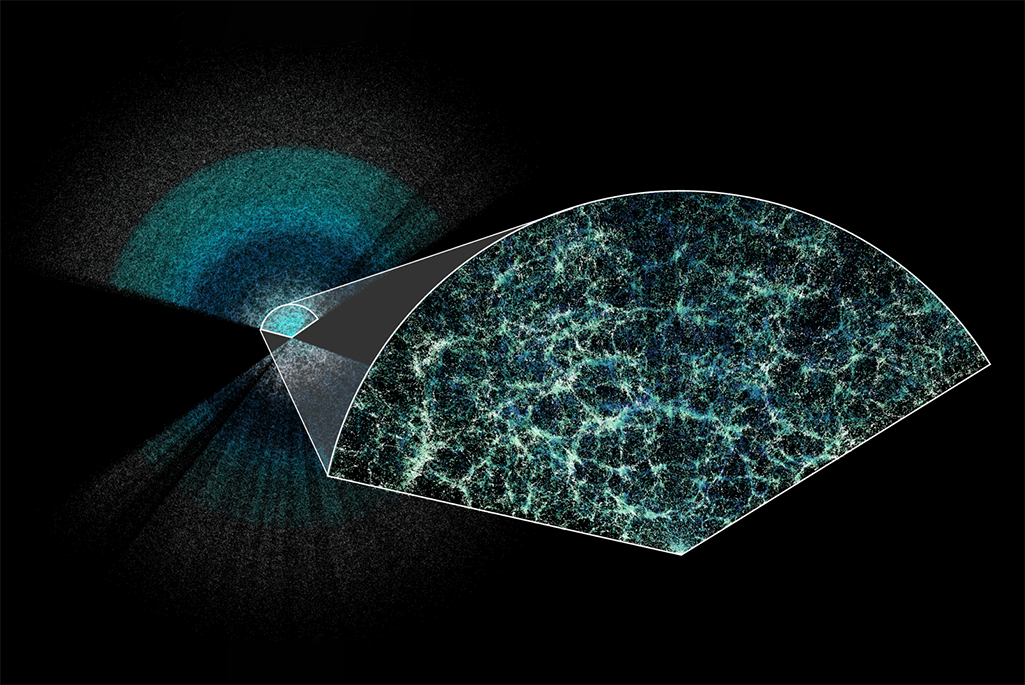
P.S. Here’s a nice graphic showing the cosmic web showing revealed by the DESI survey:
DESI Year 1 Results: Baryon Acoustic Oscillations
Posted in Barcelona, Euclid, The Universe and Stuff with tags baryon acoustic oscillations, Cosmology, Dark Energy Spectroscopic Instrument, DESI, Hubble Tension on April 4, 2024 by telescoperThere has been a lot of excitement around the ICCUB today – the press have been here and everything – ahead of the release of the Year 1 results from the Dark Energy Spectroscopic Instrument (DESI). The press release from the Lawrence Berkeley Laboratory in California can be found here.
The papers were just released at 5pm CEST and can be found here. The key results pertain to Baryon Acoustic Oscillations (BAOs) which can be used to track the expansion rate and geometry of the Universe. This is one of the techniques that will be used by Euclid.
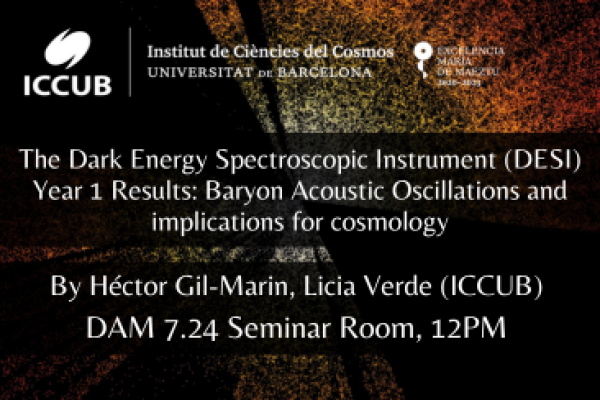
There’s a lot of technical information to go through and I have to leave fairly soon. Fortunately we have seminar tomorrow that will explain everything at a level I can understand:
I will update this post with a bit more after the talk, but for the time being I direct you to the high-level cosmological implications are discussed in this paper (which is Paper VI from DESI).
If your main interest is in the Hubble Tension then I direct you to this Figure:
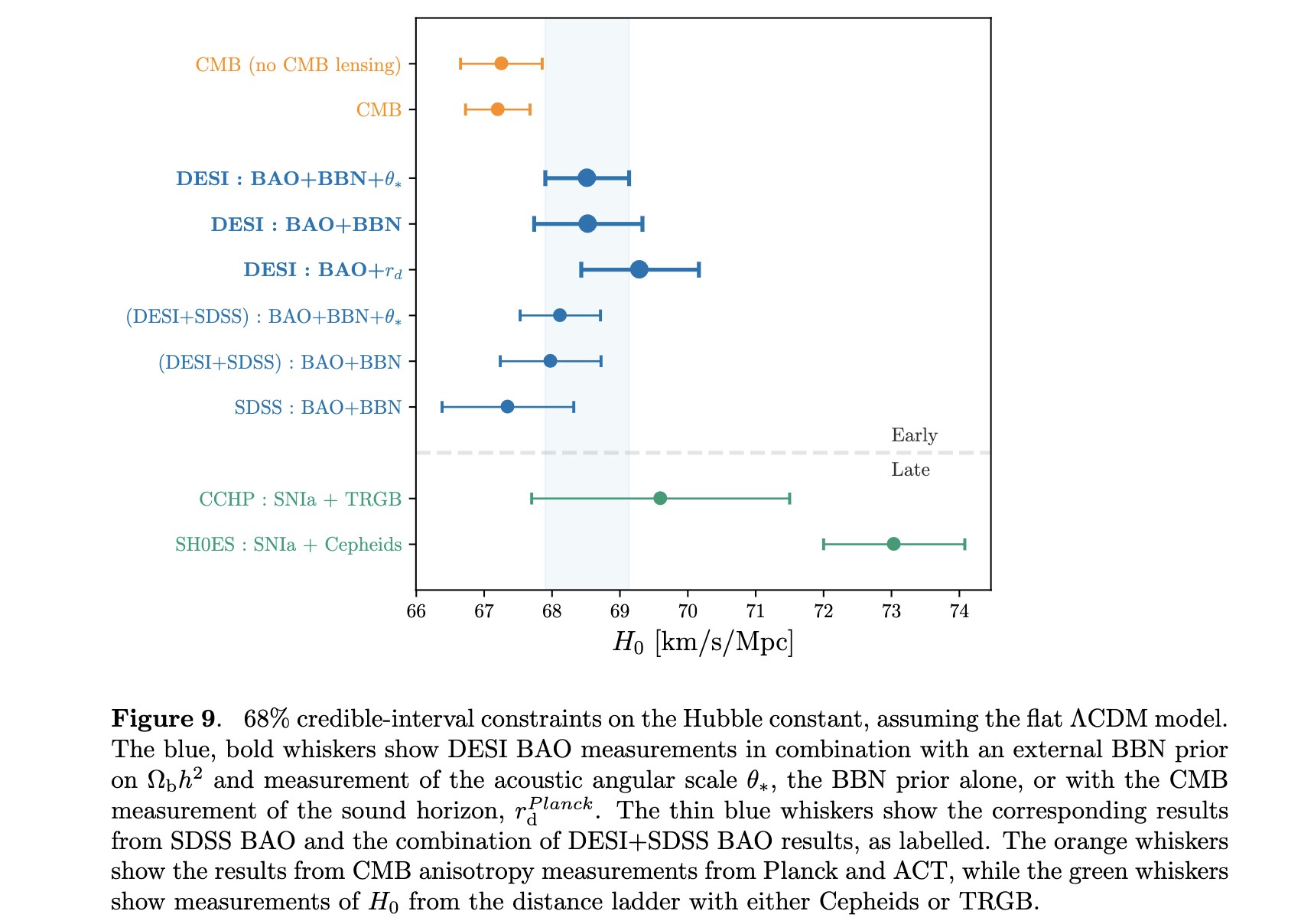
Depending on the other data sets included, the value obtained is around 68.5 ± 0.7 in the usual units, closer to the (lower) Planck CMB value than the (higher) Supernovae values but not exactly in agreement; the error bars are quite small too.
You might want to read my thoughts about distances estimated from angular diameters compared with distances measured using luminosity distances here.
If you’re wondering whether there is any evidence for departures from the standard cosmology, another pertinent comment is:
In summary, DESI data, both alone and in combination with other cosmological probes, do not show any evidence for a constant equation of state parameter different from −1 when a flat wCDM model is assumed.
DESI 2024 VI: Cosmological Constraints from the Measurements of Baryon Acoustic Oscillations
More complicated models of time-varying dark energy might work, but there’s no strong evidence from the current data.
That’s all from me for now, but feel free to comment through the box below with any hot takes!
UPDATE: As expected there has been quite a lot of press coverage about this – see the examples below – mostly concentrating on the alleged evidence for “new physics”. Personally I think the old physics is fine!
- https://www.theguardian.com/science/2024/apr/04/biggest-ever-3d-map-universe-dark-energy-data-scientists
- https://www.independent.co.uk/space/dark-energy-desi-universe-cosmos-b2523458.html
- https://www.nytimes.com/2024/04/04/science/space/astronomy-universe-dark-energy.html
- https://www.ireland-live.ie/news/uk/1467529/scientists-make-largest-and-most-precise-3d-map-of-expanding-universe.html
- https://www.quantamagazine.org/dark-energy-may-be-weakening-major-astrophysics-study-finds-20240404/
- https://arstechnica.com/science/2024/04/dark-energy-might-not-be-constant-after-all/
- https://www.newscientist.com/article/2425253-there-are-hints-that-dark-energy-may-be-getting-weaker/
- https://amp.smh.com.au/world/north-america/astronomers-may-have-got-dark-energy-all-wrong-it-s-great-news-for-the-universe-20240405-p5fhq0.html
- https://www.france24.com/en/live-news/20240404-the-universe-s-accelerated-expansion-might-be-slowing-down
First Light at the Dark Energy Spectroscopic Instrument
Posted in The Universe and Stuff with tags Cosmology, Dark Energy, Dark Energy Cosmology, Dark Energy Spectroscopic Instrument, DESI, Galaxy redshift surveys, redshift surveys on November 4, 2019 by telescoperWhile I was away last week there was quite a lot of press coverage (e.g. here) about the new Dark Energy Spectroscopic Instrument, which has just seen first light. I didn’t have time to mention this until now, and in any case I have little to add to the coverage that has already appeared, but it does give me the excuse to post this nice video – which features quite a few people I actually know! – to describe the huge galaxy survey that DESI will perform. It’s hard to believe that when I started in the field in 1985 the largest such survey, which took several years to compile, had only a few thousand galaxies in it. The DESI instrument will be able to determine spectra of more sources than that in a single pointing of the telescope that lasts about 20 minutes. Overall it should determine redshifts of over 35 million galaxies! Vorsprung durch Technik.


