Archive for Diamond Open Access

Weekly Update from the Open Journal of Astrophysics – 22/02/2025

Posted in OJAp Papers, Open Access, The Universe and Stuff with tags , , , , , , , , , , , , , , , , , , on February 22, 2025 by telescoper

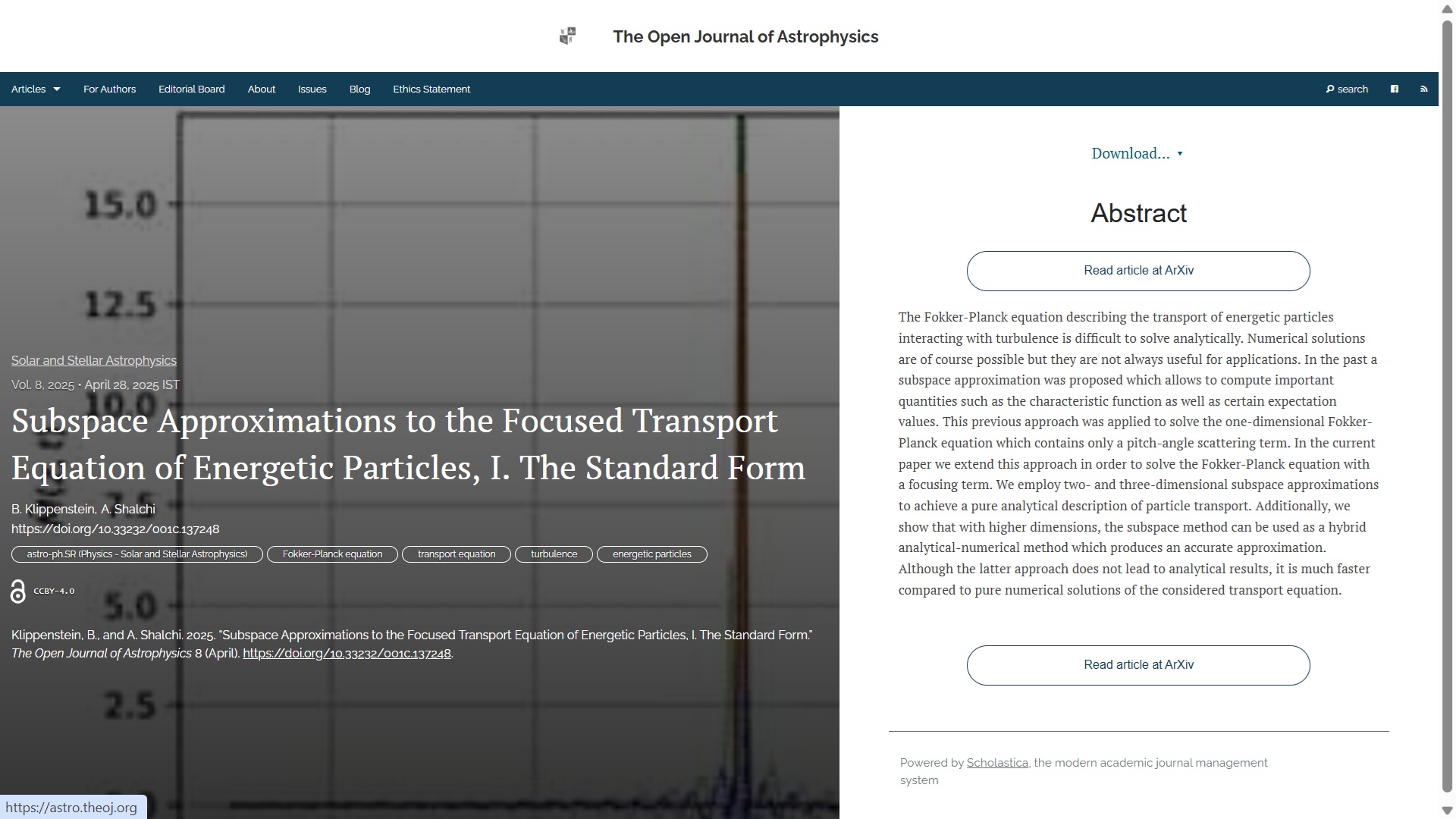
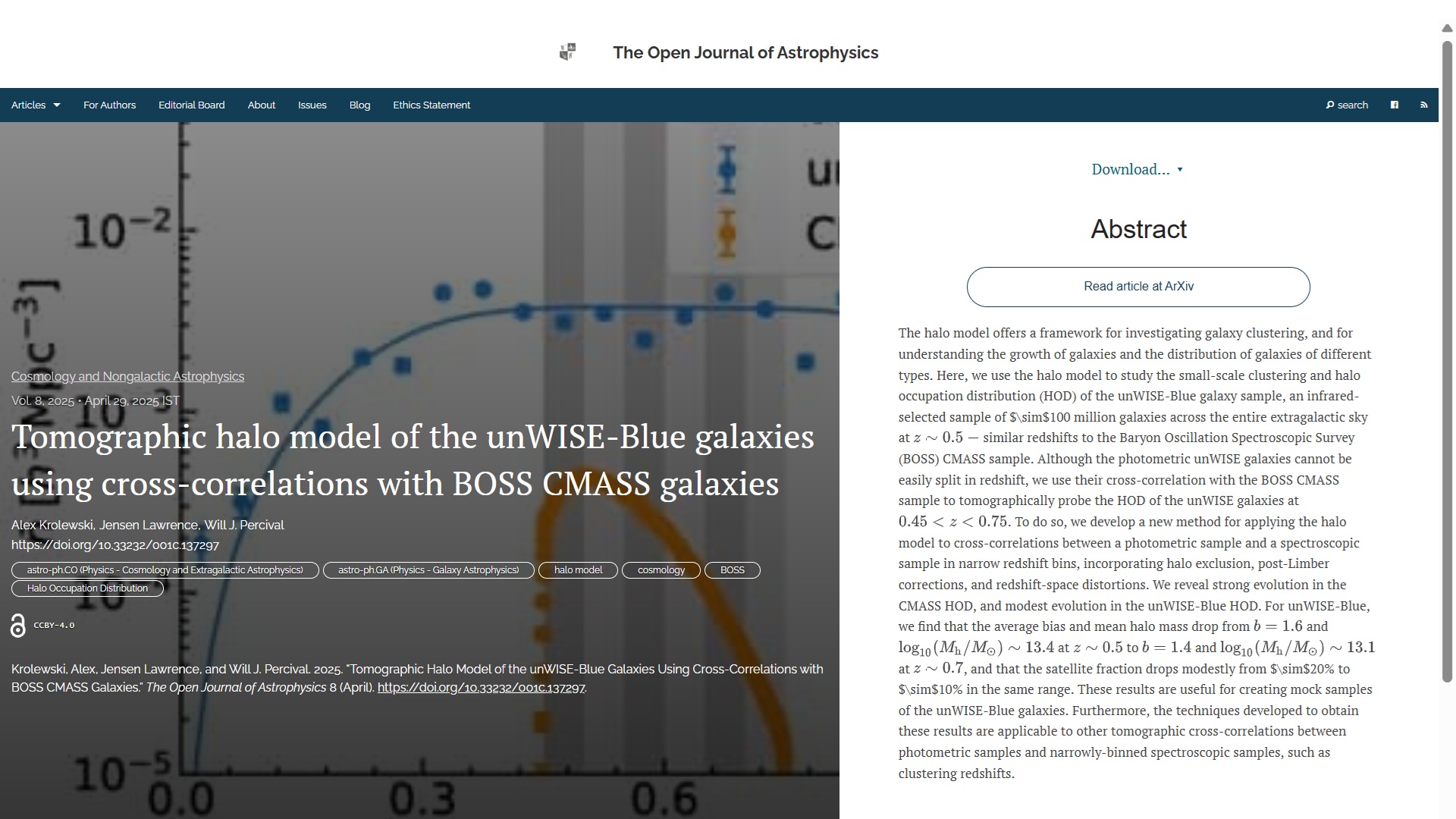
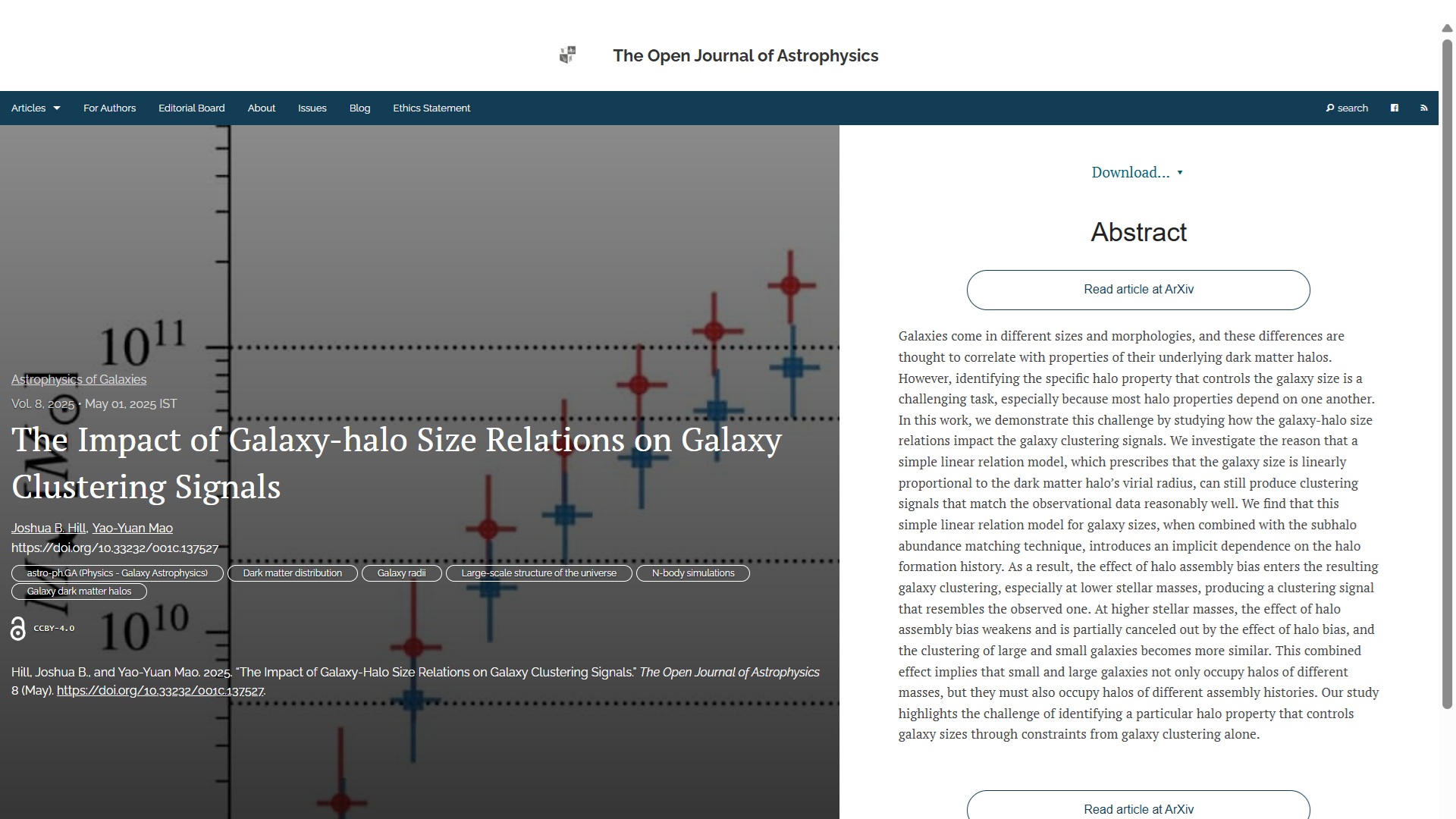
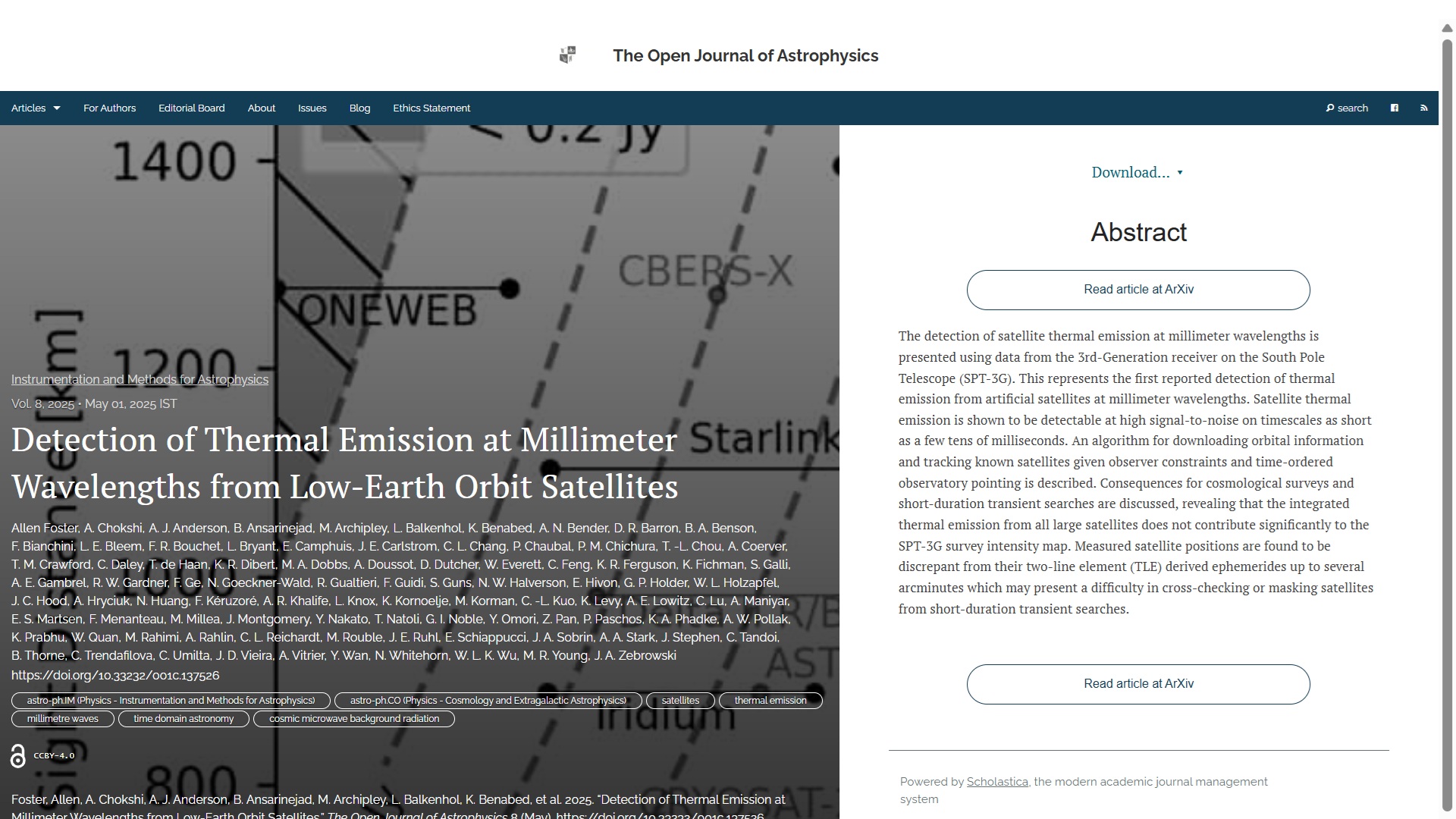
It’s Saturday morning again so it’s time for an update of papers published at the Open Journal of Astrophysics. Things have picked up a bit after a quiet couple of weeks. Since the last update we have published four new papers which brings the number in Volume 8 (2025) up to 18 and the total so far published by OJAp up to 253.

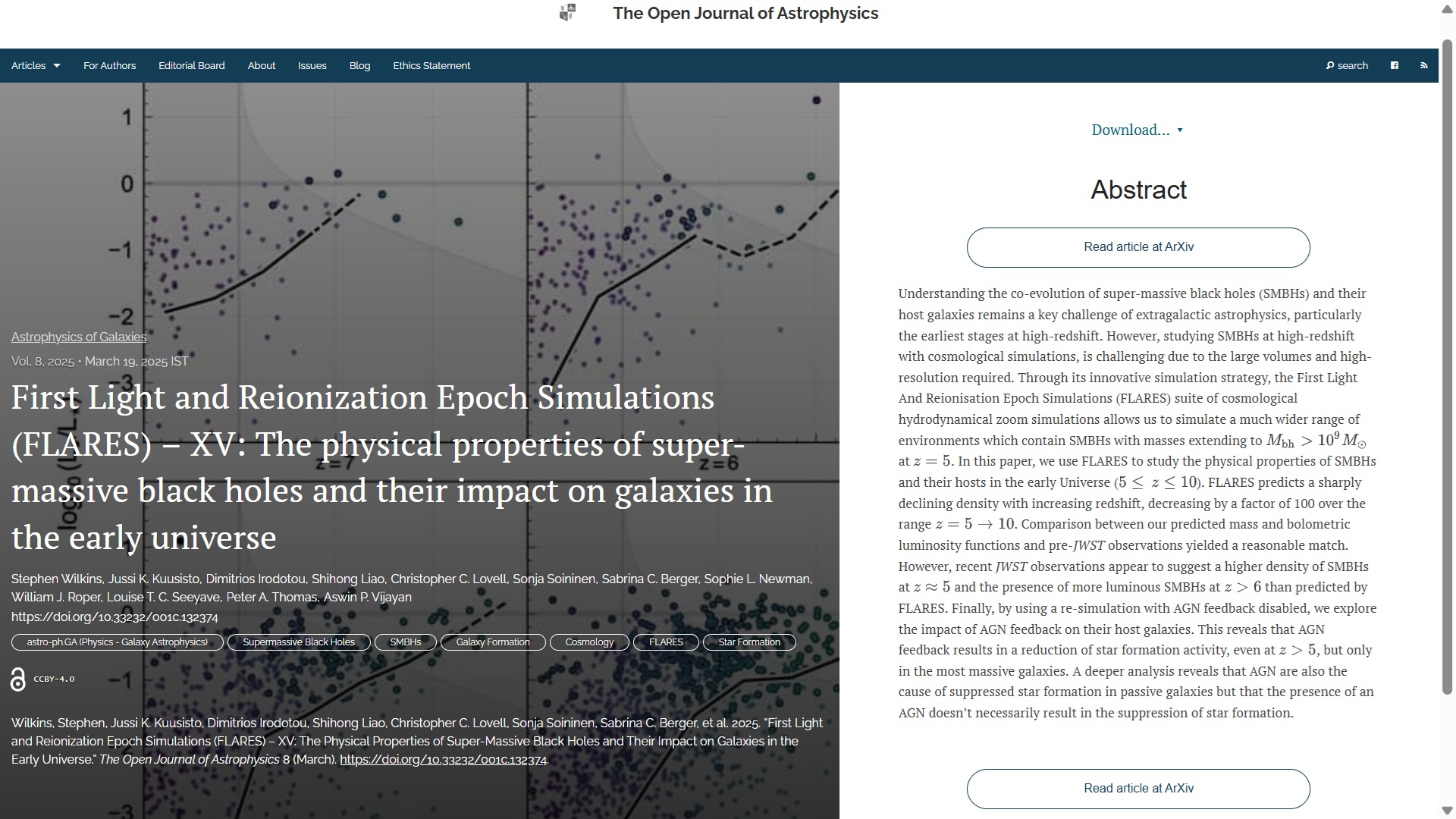
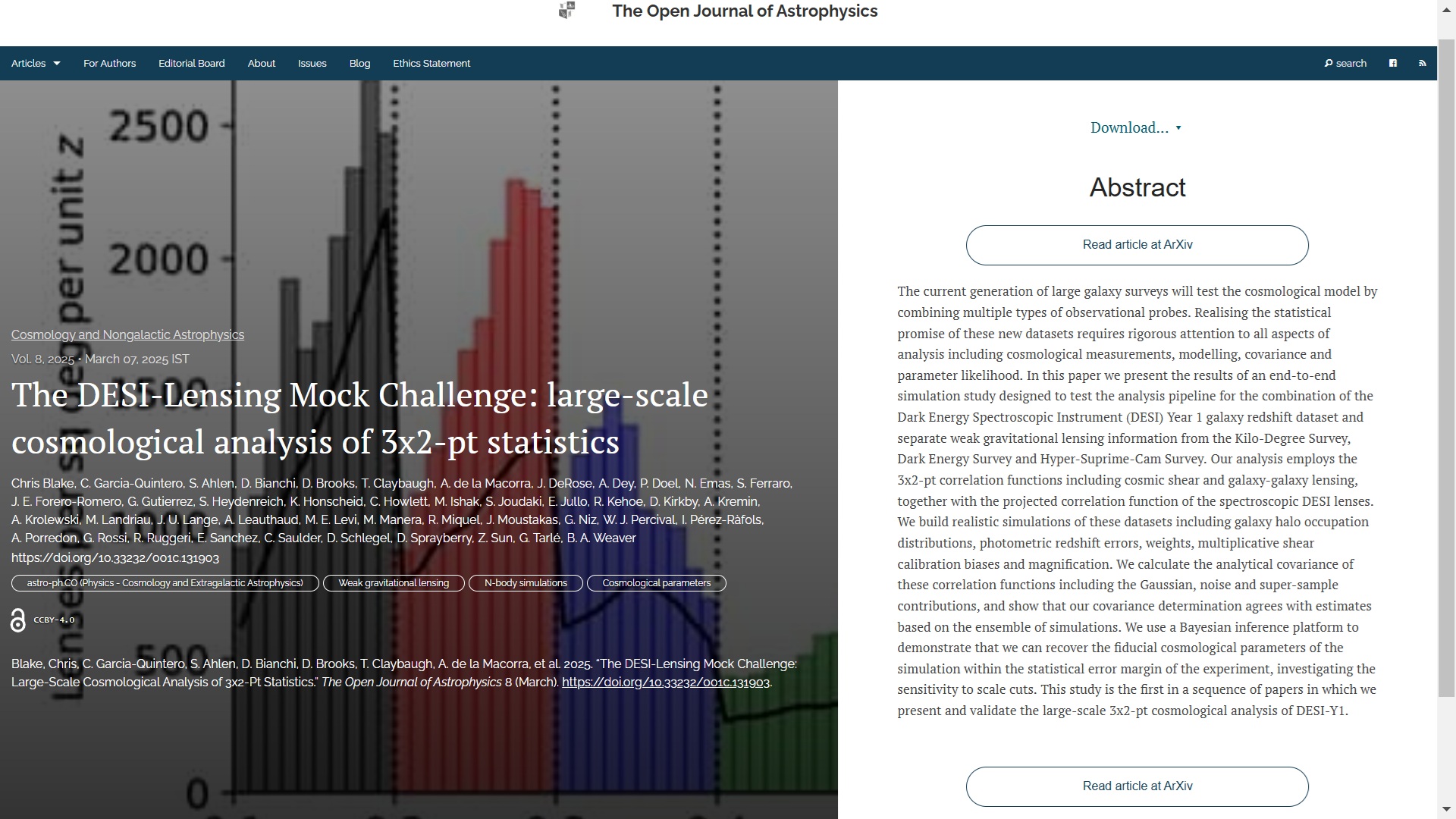
In chronological order of publication, the four papers published this week, with their overlays, are as follows. You can click on the images of the overlays to make them larger should you wish to do so.

The first paper to report is in fact our 250th paper:  “Untangling Magellanic Streams” by Dennis Zaritsky (Steward Observatory), Vedant Chandra (Harvard), Charlie Conroy (Harvard), Ana Bonaca (Carnegie Observatories), Phillip A. Cargile (Harvard), and Rohan P. Naidu (MIT), all based in the USA. This paper is in the folder marked Astrophysics of Galaxies and it reports on spectroscopic study aimed at teasing out the stellar populations of different strands of the Magellanic Stream. It was published on Tuesday 18th February 2025. Here is the overlay:

You can read the officially accepted version of this paper on arXiv here.

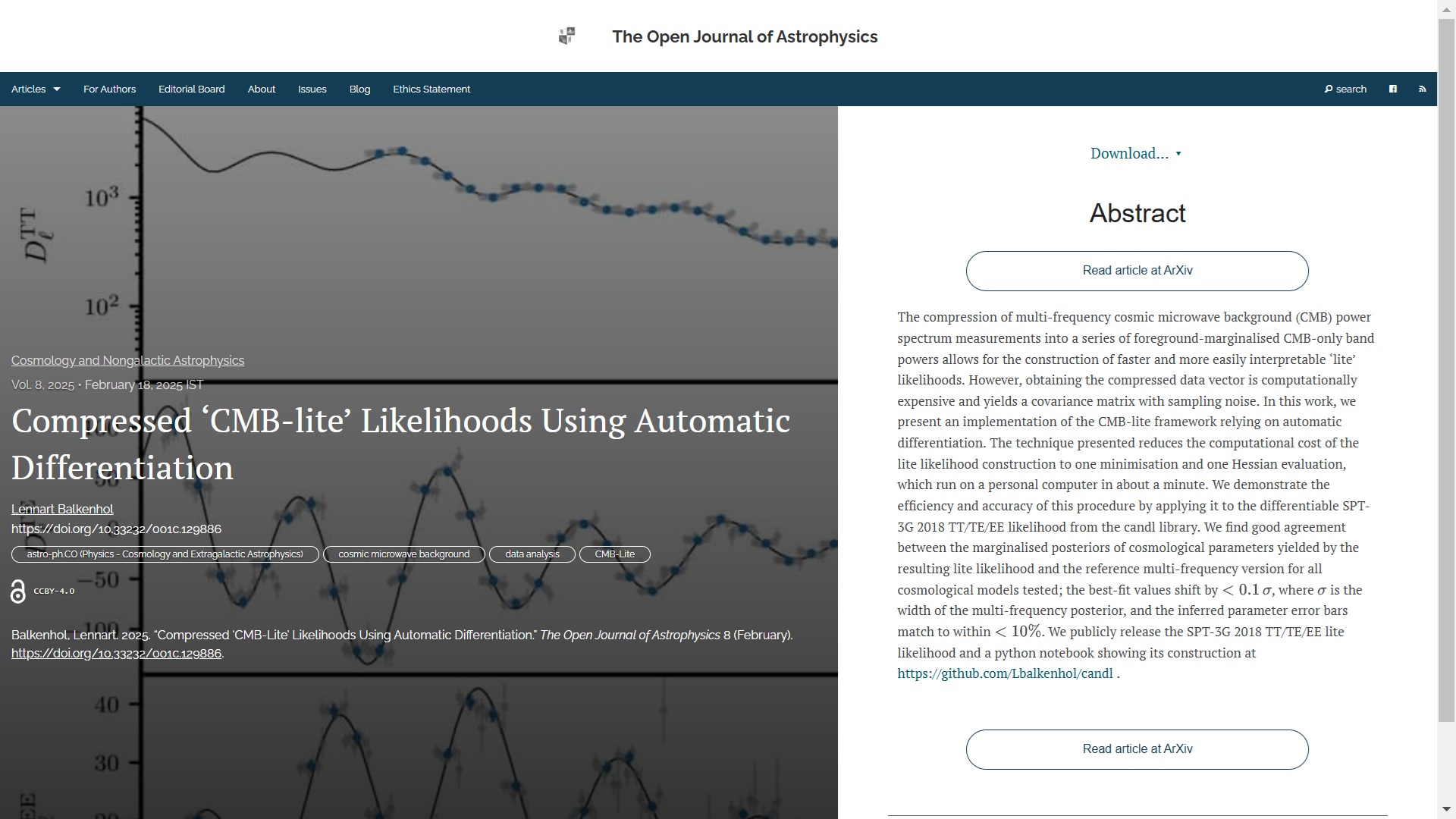
The second paper of the week  is “Compressed ‘CMB-lite’ Likelihoods Using Automatic Differentiation” by Lennart Balkenhol (Institut d’Astrophysique de Paris, France) which was one of two papers published on Wednesday 19th February. It appears in the folder Cosmology and Nongalactic Astrophysics and it describes an implementation of the CMB-lite framework relying on automatic differentiation to reduce the computational cost of the lite likelihood construction.  The overlay is here:

You can find the officially accepted version of this paper on arXiv here.

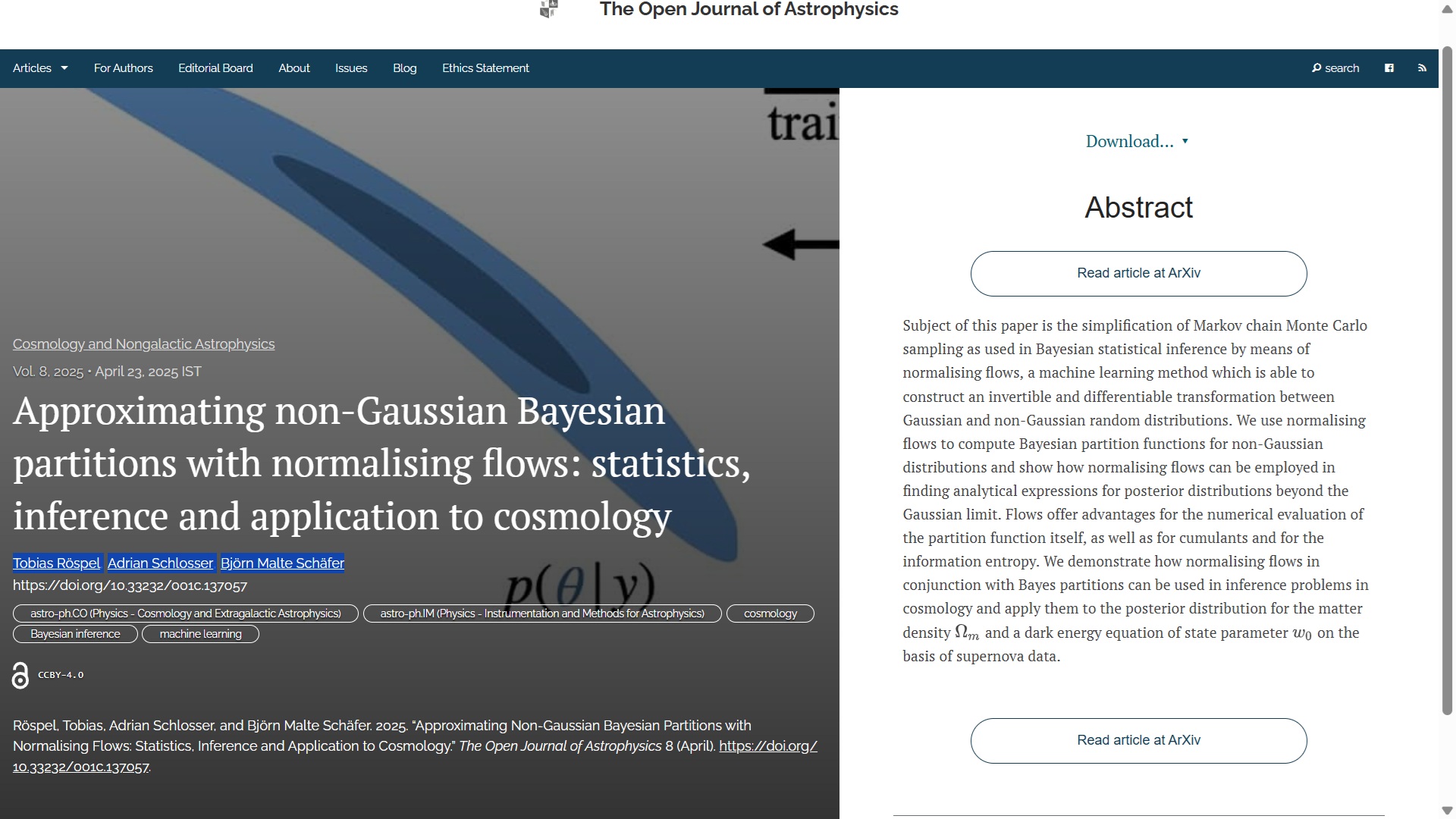
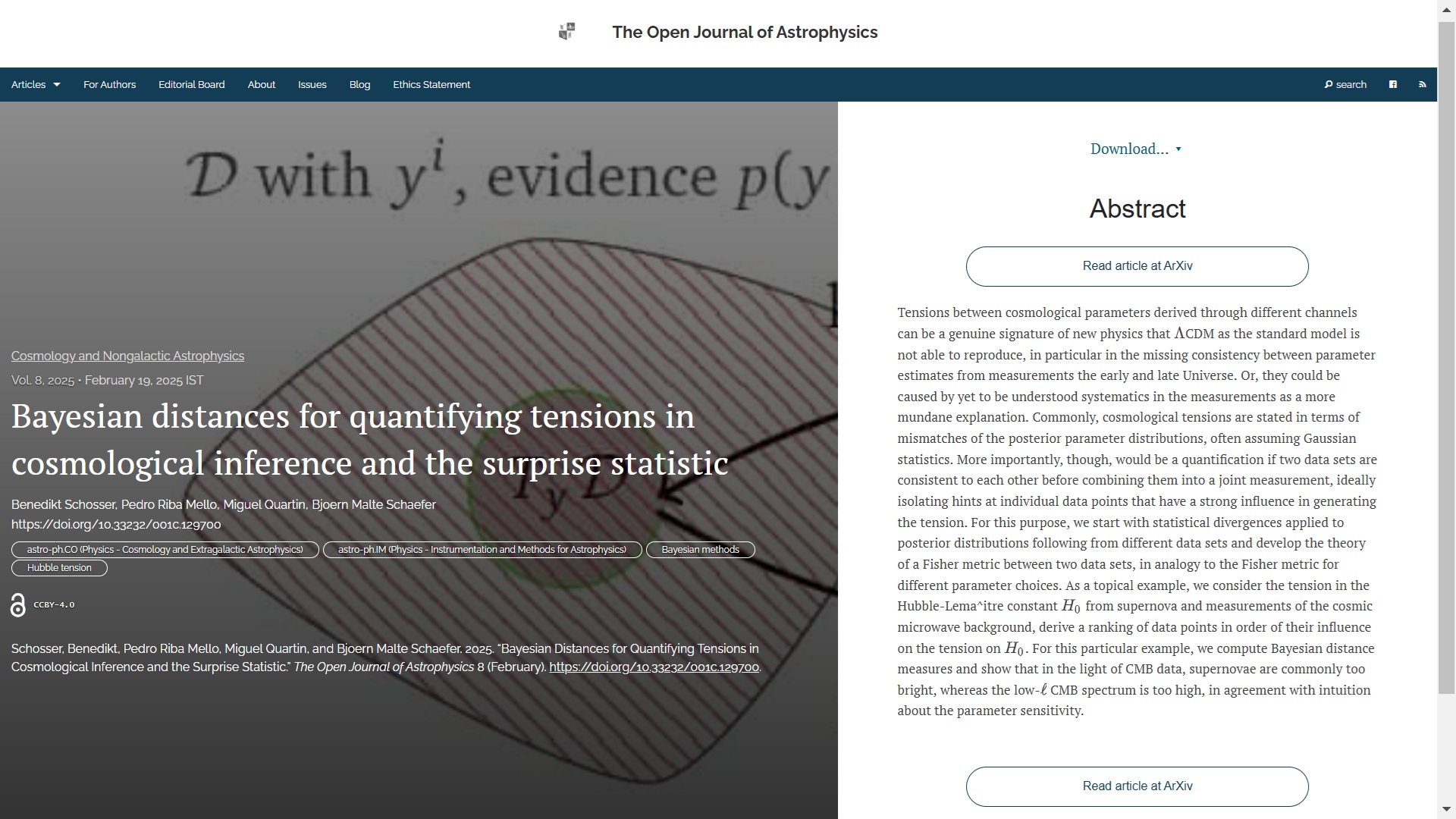
The next paper, also published on Wednesday 19th February in the folder Cosmology and Nongalactic Astrophysics is “Bayesian distances for quantifying tensions in cosmological inference and the surprise statistic” by Benedikt Schosser (Heidelberg, Germany), Pedro Riba Mello & Miguel Quartin (Rio de Janeiro, Brazil) and Bjoern Malte Schaefer (Heidelberg).  It presents a discussion of statistical divergences applied to posterior distributions following from different data sets and their use in quantifying discrepancies or tensions.

Here is the overlay:

The official published version can be found on the arXiv here.

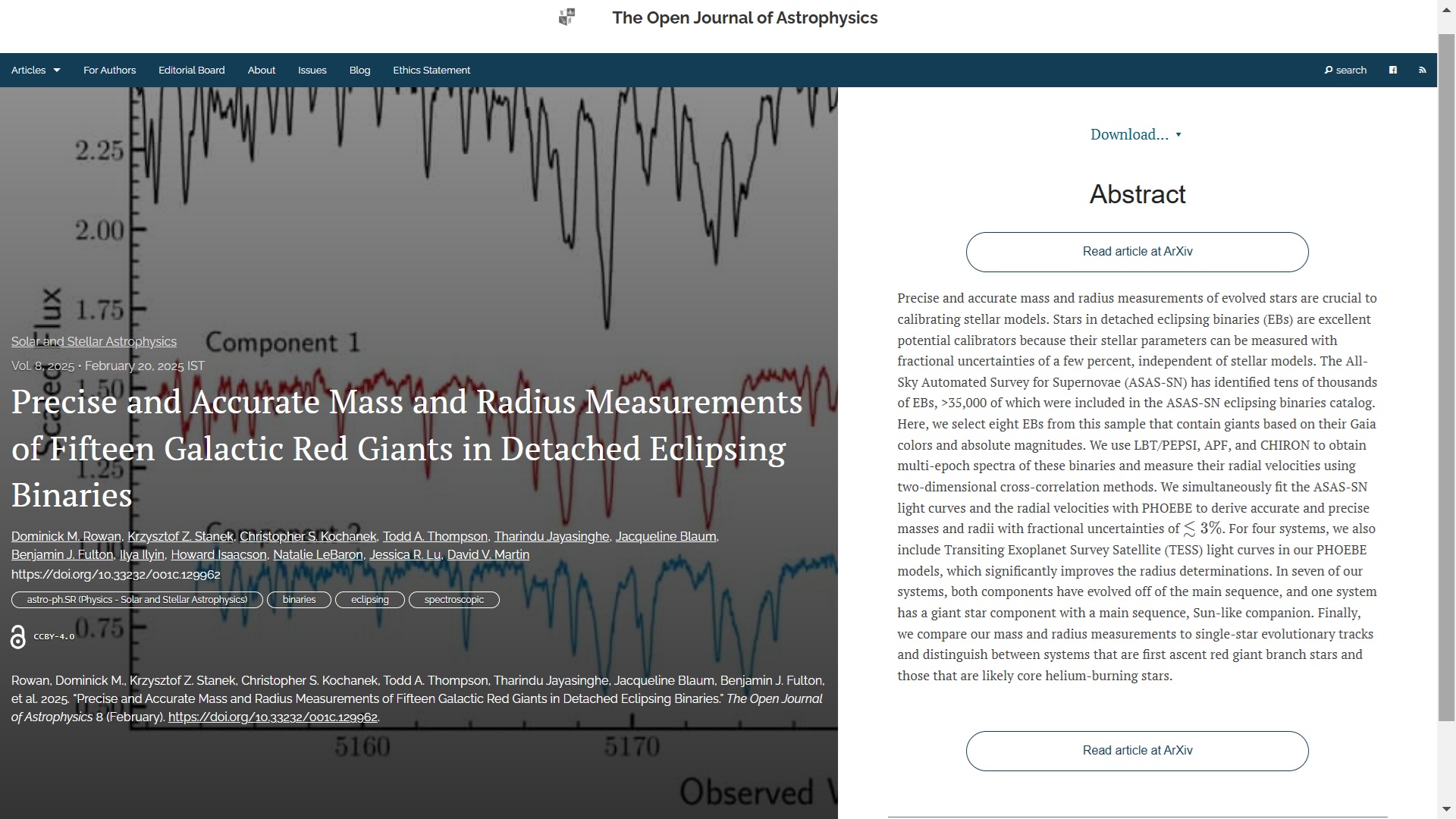
Finally in this batch we have “Precise and Accurate Mass and Radius Measurements of Fifteen Galactic Red Giants in Detached Eclipsing Binaries” by Dominick M. Rowan,  Krzysztof Z. Stanek,  Christopher S. Kochanek & Todd A. Thompson (Ohio State University), Tharindu Jayasinghe (independent researcher),  Jacqueline Blaum (UC Berkeley),  Benjamin J. Fulton (NASA/Caltech),  Ilya Ilyin (AIP Potsdam, Germany),  Howard Isaacson, Natalie LeBaron  &  Jessica R. Lu (UC Berkeley), and  David V. Martin (Tufts University, USA).  This paper was published on Thursday 20th February 2025 in the folder Solar and Stellar Astrophysics and it presents a compilation of mass and readius measurements of red giant stars obtained using spectroscopic measurements together with light curves and the eclipsing binary models obtained using PHOEBE.

The overlay is here:

You can find the “final” version on arXiv here.

That’s all for this week. I’ll do another update next Saturday.

Weekly Update from the Open Journal of Astrophysics – 08/02/2025

Posted in OJAp Papers, Open Access, The Universe and Stuff with tags , , , , , , , on February 8, 2025 by telescoper

It’s Saturday morning, so once again it’s time for an update from the Open Journal of Astrophysics. Since the last update we have published one new paper, which brings the number in Volume 8 (2025) up to 12 and the total so far published by OJAp up to 247.

Galaxy evolution in the post-merger regime. III – The triggering of active galactic nuclei peaks immediately after coalescence” was written by Sara Ellison, Leonardo Ferreira, Robert Bickley & Tess Grindlay (U. Victoria, Canada), Samir Salim (Indiana U., USA), Shoshannah Byrne-Mamahit (Victoria), Shobita Satyapal (George Mason U., USA), David R. Patton (Trent U., Canada) and Jillian M. Scudder (Oberlin College, USA).  It was published on 4th February 2025 and is in the folder marked Astrophysics of Galaxies. The paper describes an investigation into the timescale of triggering of AGN activity after galaxy mergers and concluding that most occurs immediately after coalescence. 

You can find the officially accepted version of this paper on arXiv here.

That’s all for this week. I’ll have more updates next Saturday.

Weekly Update from the Open Journal of Astrophysics – 01/02/2025

Posted in OJAp Papers, Open Access, The Universe and Stuff with tags , , , , , , , , , , , , , , , , , , on February 1, 2025 by telescoper

It’s Saturday morning, so once again it’s time for an update of papers published at the Open Journal of Astrophysics. There were no papers to report last week but since the last update we have published four new papers, which brings the number in Volume 8 (2025) up to 11 and the total so far published by OJAp up to 246.

In chronological order of publication, the four papers published this week, with their overlays, are as follows. You can click on the images of the overlays to make them larger should you wish to do so.

First one up is  “A halo model approach for mock catalogs of time-variable strong gravitational lenses” by Katsuya T. Abe & Masamune Oguri (Chiba U, Japan), Simon Birrer & Narayan Khadka (Stony Brook, USA), Philip J. Marshall (Stanford, USA), Cameron Lemon (Stockholm U., Sweden), Anupreeta More (IUCAA, India), and the LSST Dark Energy Science Collaboration. It was published on 27th January 2025 in the folder marked Cosmology and NonGalactic Astrophysics. The paper discusses how to generate mock catalogs of strongly lensed QSOs and Supernovae on galaxy-, group-, and cluster-scales based on a halo model that incorporates dark matter halos, galaxies, and subhalos.


You can find the officially accepted version of this paper on arXiv here.

This paper, also published on Monday 27th January 2025, but in the folder Astrophysics of Galaxies, is “The Soltan argument at redshift 6: UV-luminous quasars contribute less than 10% to early black hole mass growth” by Knud Jahnke (MPI Heidelberg, Germany). This paper presents an argument that almost all growth of supermassive black hole mass at z>6 does not take place in UV-luminous quasars.

Here is a screen grab of the overlay, which includes the abstract:You can find the officially accepted version of the paper on the arXiv here.

The third paper to announce, published on 29th January 2025 in the folder Cosmology and NonGalactic Astrophysics, is “A Heavy Seed Black Hole Mass Function at High Redshift – Prospects for LISA” by Joe McCaffrey & John Regan (Maynooth U., Ireland), Britton Smith (Edinburgh U., UK), John Wise (Georgia Institute of Technology, USA), Brian O’Shea (Michigan State U., USA) and Michael Norman (University of California, San Diego). This is a numerical study of the growth rates of massive black holes in the early Universe and implications for their detection via gravitational wave emission.

You can see the overlay here:


The accepted version of this paper can be found on the arXiv here.

The last paper of this batch is “Forecasting the Detection of Lyman-alpha Forest Weak Lensing from the Dark Energy Spectroscopic Instrument and Other Future Surveys” by Patrick Shaw & Rupert A. C. Croft (Carnegie Mellon U., USA) and R. Benton Metcalf (U. Bologna, Italy). This paper, published on January 30th 2025, is about extending the applicationof  Lyman-α forest weak gravitational lensing to lower angular source densities than has previously been done, with forecasts for future spectral surveys. It is in the folder marked Cosmology and NonGalactic Astrophysics.

The overlay is here


You can find the accepted version on arXiv here.

Incidentally, we currently have 121 papers under review, including 81 under a revise and resubmit request.

That’s all for this week. I’ll do another update next Saturday.
Weekly Update from the Open Journal of Astrophysics – 18/01/2025

Posted in OJAp Papers, Open Access, The Universe and Stuff with tags , , , , , , , , , , on January 18, 2025 by telescoper

It’s Saturday morning so once again it’s time for an updated of papers published at the Open Journal of Astrophysics. Since the last update we have published three new papers which brings the number in Volume 8 (2025) up to 7 and the total so far published by OJAp up to 242.

In chronological order of publication, the three papers published this week, with their overlays, are as follows. You can click on the images of the overlays to make them larger should you wish to do so.

First one up is “Potential-density pairs for Galaxy discs with exponential or sech^2 vertical profile” by Walter Dehnen and Shera Jafaritabar (Heidelberg, Germany). This paper was published on Tuesday 14th January 2025 in the folder marked Astrophysics of Galaxies. It presents a new set of analytic models for the structure of disc galaxies. The overlay, which includes the abstract, is here:

You can find the officially accepted version of this paper on arXiv here.

The second paper, which was published on Thursday 17th January 2025 also in the folder Astrophysics of Galaxies, is “Quantifying Bursty Star Formation in Dwarf Galaxies” by Yuan-Sen Ting (Ohio State University) and Alexander Ji (U. Chicago). This paper describes an application of Gaussian mixture models to distinguish between discontinuous and continuous star formation histories in dwarf galaxies.

Here is a screen grab of the overlay, which includes the abstract:You can find the officially accepted version of the paper on the arXiv here.

The third paper to announce, also published on 17th January 2025 but in the folder Cosmology and NonGalactic Astrophysics, is “Fast Projected Bispectra: the filter-square approach” by Lea Harscouet, Jessica A. Cowel, Julia Ereza & David Alonso (Oxford U., UK), Hugo Camacho (Brookhaven National Laboratory, USA), Andrina Nicola (Bonn, Germany) and Anže Slosar (Brookhaven). This paper presents Presenting the filtered-squared bispectrum (FSB), a fast and robust estimator of the projected bispectrum for use on cosmological data sets.

You can see the overlay here:

The accepted version of this paper can be found on the arXiv here.

That’s all for this week. I’ll do another update next Saturday.

Weekly Update from the Open Journal of Astrophysics – 11/01/2025

Posted in OJAp Papers, Open Access, The Universe and Stuff with tags , , , , , , , , , , , , on January 11, 2025 by telescoper

Welcome to the first update of 2025 from the Open Journal of Astrophysics. For the new year we have started Volume 8. Since the last update of 2024 we have published four new papers which brings the total so far published by OJAp up to 239.

In chronological order of publication, the four papers published this week, with their overlays, are as follows. You can click on the images of the overlays to make them larger should you wish to do so.

First one up is “Weak-Lensing Shear-Selected Galaxy Clusters from the Hyper Suprime-Cam Subaru Strategic Program: I. Cluster Catalog, Selection Function and Mass–Observable Relation” by Kai-Feng Chen (MIT, USA), I-Non Chiu (National Cheng University, Taiwan), Masamune Oguri (Chiba University, Japan), Yen-Ting Lin (IAAAS, Taiwan), Hironao Miyatake (Nagoya, Japan), Satoshi Miyazaki (Nat. Astr. Obs. Japan), Surhud More (IUCAA, India), Takashi Hamana (Nat. Astr. Obs. Japan), Markus M. Rau Carnegie Mellon University, USA), Tomomi Sunayama (Steward Obs., USA), Sunao Sugiyama (U. Penn, USA), Masahiro Takada (U. Tokyo, Japan).

This paper, which was published on Monday 6th January 2025 is in the folder Cosmology and NonGalactic Astrophysics, discusses steps towards towards the extraction of cosmogical constraints from a sample of galaxy clusters selected via weak gravitational lensing

Here is a screen grab of the overlay, which includes the abstract:

You can find the officially accepted version of the paper on the arXiv here.

The second paper to announce, published on 7th January 2025 and also in the folder Cosmology and NonGalactic Astrophysics, is “Cosmology on point: modelling spectroscopic tracer one-point statistics” by Beth McCarthy Gould (Newcastle U., UK), Lina Castiblanco (Bielefeld, Germany), Cora Uhlemann (Bielefeld, Germany), and Oliver Friedrich (LMU, Germany).

You can see the overlay here:

The accepted version of this paper can be found on the arXiv here.

The third paper, published on 9th January 2025, also in the folder Cosmology and NonGalactic Astrophysics, is “Probing Environmental Dependence of High-Redshift Galaxy Properties with the Marked Correlation Function” by Emy Mons and Charles Jose (Cochin University of Science and Technology, India). This paper uses the marked two-point correlation function to measure the environmental dependence of galaxy clustering at high redshift.

Here is the overlay:

The final version accepted on arXiv is here.

Last of this quartet, also published on 9th January 2025, but in the folder Astrophysics of Galaxies is “The infrared luminosity of retired and post-starburst galaxies: A cautionary tale for star formation rate measurements” by Vivienne Wild (St Andrews, UK), Natalia Vale Asari (Universidade Federal de Santa Catarina, Brazil), Kate Rowlands (STScI, Sara L. Ellison (U. Victoria, Canada), Ho-Hin Leung (St Andrews), Christy Tremonti (U. Wisconsin-Madison, USA).

The paper proposes an extension of the semi-analytic formalism to weak lensing and thermal Sunyaev-Zeldovich (tSZ) fields directly on the full-sky, with an emphasis on higher-order correlations. The overlay is here:

You can find the official accepted version on the arXiv here.

That’s all for this week. I’ll do another update next Saturday.
New Publication at the Open Journal of Astrophysics

Posted in OJAp Papers, Open Access, The Universe and Stuff with tags , , , , , on December 28, 2024 by telescoper

I wasn’t planning to do the usual weekly update of activity at the Open Journal of Astrophysics this morning as I thought we wouldn’t publish any more papers between last week’s update and the Christmas break. However, one final version did hit the arXiv on Christmas Eve so I decided to publish it straight away. This brings the total for Volume 7 (2024) to 120 – a neat average of ten a month – and the overall total to 235.

Here’s a table showing the sequence of papers published over the last six years and the series formed from the aforementioned sequence:

Year201920202021202220232024
Papers1215171750120
Total16314865115235

Anyway, the new paper is “Galaxy evolution in the post-merger regime. II – Post-merger quenching peaks within 500 Myr of coalescence” by Sara Ellison (U. Victoria, Canada), Leonardo Ferreira (U. Victoria), Vivienne Wild, (St Andrews, UK), Scott Wilkinson (U. Victoria), Kate Rowlands, (STScI, USA) & David R. Patton (Trent U., Canada). It was published on 24th December 2024 in the folder marked Astrophysics of Galaxies. It comprises an investigation of the possibility that quenching of star formation is a consequence of galaxy-galaxy interactions and mergers. The overlay is here:

You can find the officially accepted version on arXiv here.

Well, that definitely concludes the updates for 2024. I’ll be back on January 4th with the first update of 2025.

Extrapolation of the Open Journal of Astrophysics

Posted in Open Access with tags , , on December 18, 2024 by telescoper

This morning I published another paper at the Open Journal of Astrophysics, taking the total number of publications for this year to 115 and the total altogether to 230. This means that we have now published as many papers this year as we have in all previous years combined. Here’s a table showing the sequence of papers published over the last six years and the series formed from the aforementioned sequence:

Year201920202021202220232024
Papers1215171750115*
Total16314865115230

(*=not out)

We’ll probably publish a few more by the end of the year – there seems to be a bit of a rush right now of people submitting papers before the break – so the final column may change. Anyway, the bigger question is I wonder what will happen next year? Extrapolating from the last two years using a simple model, we will publish about 230 papers next year, 460 the year after that, then 920, 1820, etc. Even at that optimistic rate it will take us several years to catch up to the big astronomical publishers, who publish thousands of papers per year.

As Niels Bohr once said “Prediction is very difficult, especially about the future” but I wonder if anyone would like to make a guess as to how many papers we will publish in 2025. This time next year we’ll see who was closest. The prize will be a year’s free subscription to the Open Journal of Astrophysics.

Still, after a slow start it’s very gratifying to be accelerating. I’m certainly glad that I managed to use some of my sabbatical time automating the publishing side of the OJAp operation otherwise I’d definitely be struggling to keep up!

Anyway, this gives me the opportunity to make a small announcement about the forthcoming Christmas break. The site will remain open for submissions throughout the festive season, but please be aware that our volunteer Editors all deserve a bit of rest – as do referees – so progress may be slow at this time.

You may or may not know that the Scholastica platform we use is actually two distinct websites: one for peer review (used by all editors and authors); and the other for publishing (to which I, as Managing Editor, have sole access). I will be taking a break over Christmas and also preparing Volume 8 (2025) for the new year, so publishing will be suspended from 24th December until 2nd January (inclusive). If you want your paper to be published in 2024 the final version must be on arXiv by Monday 23rd December at the latest, otherwise it will be held over until 2025.

Four New Publications at the Open Journal of Astrophysics

Posted in OJAp Papers, Open Access, The Universe and Stuff with tags , , , , , , , , , , , , , on December 14, 2024 by telescoper

It’s Saturday morning once again so here’s another quick update of activity at the Open Journal of Astrophysics. Since the last update a week ago we have published  four papers, which takes the count in Volume 7 (2024) up to 114 and the total published altogether by OJAp up to 229. If we publish just one more paper between now and the end of the year, we will have published as many papers in 2024 as we have in all previous years.

Anyway, in chronological order of publication, the four papers published this week, with their overlays, are as follows. You can click on the images of the overlays to make them larger should you wish to do so.

First one up is “Star formation beyond galaxies: widespread in-situ formation of intra-cluster stars” by Niusha Ahvazi & Laura V. Sales (UC Riverside, USA), Julio F. Navarro (U. Victoria, Canada), Andrew Benson (Carnegie Obs. USA), Alessandro Boselli (Aix Marseille U., France) and Richard D’Souza (Vatican Obs.). The paper, which is in the folder marked Astrophysics of Galaxies, The paper presents a simulation-based analysis of a diffuse star forming component in galaxy clusters extending for hundreds of kiloparsecs and tracing the distribution of neutral gas in the cluster host halo.

Here is a screen grab of the overlay, which includes the abstract:

You can find the officially accepted version of the paper on the arXiv here.

The second paper to announce, published on 10th December 2024 in the folder Cosmology and NonGalactic Astrophysics, is “Cosmological Constraints from Combining Photometric Galaxy Surveys and Gravitational Wave Observatories” by E.L. Gagnon, D. Anbajagane, J. Prat, C. Chang, and J. Frieman (all of U. Chicago, USA). This article quantifies the expected cosmological information gain from combining the forecast LSST 3x2pt analysis with the large-scale auto-correlation of GW sources from proposed next-generation GW experiments.

You can see the overlay here:

The accepted version of this paper can be found on the arXiv here.

The third paper, also published on 10th December 2024, but in the folder marked Earth and Planetary Astrophysics, has the title “A potential exomoon from the predicted planet obliquity of β Pictoris b” and is written by Michael Poon, Hanno Rein, and Dang Pham all of the University of Toronto, Canada. It presents discussion, based on the β Pictoris system, of the idea that the presence of exomoons can excite misalignment between the spin and orbit axis (obliquity) in exoplanet systems

Here is the overlay

The final version accepted on arXiv is here.

Last of this quartet, published on 11th December 2024, and in the folder Cosmology and NonGalactic Astrophysics is “Map-level baryonification: Efficient modelling of higher-order correlations in the weak lensing and thermal Sunyaev-Zeldovich fields” and is by Dhayaa Anbajagane & Shivam Pandey (U. Chicago) and Chihway Chang (Columbia U.), all based in the USA.

The paper proposes an extension of the semi-analytic formalism to weak lensing and thermal Sunyaev-Zeldovich (tSZ) fields directly on the full-sky, with an emphasis on higher-order correlations. The overlay is here:

You can find the official accepted version on the arXiv here.

That’s all for this week. I’ll do another update next Saturday, and that will probably be the last one of the year. If we publish just one more paper between now and 31st December, we will have published as many papers in 2024 as we have in all previous years put together!

The Future of Diamond Open Access in Astrophysics

Posted in Biographical, Open Access with tags , , , , , , on November 17, 2024 by telescoper

The Open Journal of Astrophysics is now reasonably well established as a Diamond Open Access journal for the astrophysics community. We have published over a hundred articles so far this year at such a low cost that we can make our publications free to read and to publish. Thanks for all this is due to the volunteers on our Editorial Board, the excellent team at Maynooth University library, who have supported this project for 6 years, to the arXiv, as well of course to the authors who have chosen to publish with us.

Although we have established a good base, we’re still much smaller than the mainstream journals publishing just a few percent of their output. There is no sign of a slowdown at OJAp. Indeed there are signs that pace will pick up. I heard last week, for example, that Oxford University Press (the publisher of Monthly Notices of the Royal Astronomical Society) has decided to cancel the ‘Read-and-Publish’ agreement that allowed authors from Australian institutions to avoid APCs. I imagine we’ll get quite a few more submissions from Down Under thanks to that decision.

Nevertheless, we’ve a long way to go to catch up with the likes of A&A, MNRAS and ApJ in terms of numbers. If activity continues to grow then we will incur greater costs – our provider, Scholastica, charges us per paper. Those costs will still be smaller than regular journals, but I think it’s unfair that the expense of running a journal that serves the global astrophysics community should fall entirely on one small University in Ireland.

Expense is only one issue. I never envisaged that OJAp would be unique. It was more intended to be a proof of concept. I would like to see a range of Diamond Open Access journals offering a choice for authors and serving different sub-disciplines. Most universities nowadays have publishing operations so there could be network of federated journals, some based on arXiv and some based on other repositories. Perhaps institutions are worried about the expense but, as we have shown the actual cost, is far less than they are wasting on Article Processing Charges. I rather think it’s not the money that is the issue, just the unimaginatively risk-averse thinking in what passes these days for university management.

There are two simple – but not mutually exclusive – possibilities.

One is that astrophysics institutions club together and donate funds not only to keep OJAp going, but also to allow us to invest in improvements. A donation equivalent to the cost of just one APC for a typical journal would help us enormously. We do actually get some donations already, but more would always be welcome. In the long run, an investment in Diamond Open Access would pay back many times in savings; OJAp has already saved the worldwide community over £500,000.

The other is that other members of the community follow the lead of OJAp and set up their own journals. I wouldn’t see others as much as competitors, more as allies with community-led federated system. In the light of the OUP decision mentioned above, why don’t Australian research institutions set up their own version of OJAp? I’d be happy to discuss how to start up such a journal with anyone interested.

If you would like to discuss either of these possibilities please use the comment box below or email me here.

P.S. There is another issue concerning the future of OJAp, which is that I will be retiring in a few years, but now isn’t the time to discuss that one!

Two New Publications at the Open Journal of Astrophysics

Posted in OJAp Papers, Open Access, The Universe and Stuff with tags , , , , , , , , on November 16, 2024 by telescoper

Once again it’s time for a Saturday morning update on activity at the  Open Journal of Astrophysics.  Since the last update we have published two more papers, taking  the count in Volume 7 (2024) up to 104 and the total published by OJAp up to 219.

The first paper of the most recent pair, published on November 13 2024,  in the folder Cosmology and NonGalactic Astrophysics, is “Stochastic Super-resolution of Cosmological Simulations with Denoising Diffusion Models” by Andreas Schanz, Florian List and Oliver Hahn (all based in the University of Vienna, Austria). It presents a  discussion of denoising diffusion in generative models for achieving super-resolution in simulations of cosmic large-scale structure.

Here is a screen grab of the overlay which includes the abstract:


You can click on the image of the overlay to make it larger should you wish to do so.  You can find the officially accepted version of this paper on the arXiv here.

The second paper to be published this week is also in the folder marked Cosmology and NonGalactic Astrophysics. It was published on November 14 and has the title “Halo mass functions at high redshift” by Hannah O’Brennan, John A. Regan, Chris Power (*), Saoirse Ward, John Brennan, and Joe McCaffrey. Five of the six authors are colleagues of mine from the National University of Ireland, Maynooth; Chris Power (marked with a *) is from the University of Western Australia.

Here is a screen grab of the overlay which includes the abstract:


You can click on the image of the overlay to make it larger should you wish to do so. You can find the officially accepted version of the paper on the arXiv here.

That concludes this week’s update. More  next week!