This morning I gave a short talk at the “Astronomy Tea” at the Sydney Institute for Astronomy. No prizes for guessing what I talked about. The talk was followed by questions and then by a huge thunderstorm.
As the first month of 2024 is now over, I thought I’d post an update relating to the Open Journal of Astrophysics. Since the last update we have published two papers, taking the count in Volume 7 (2024) up to 9 (the total for January) and the total published by OJAp up to 124. We will have others soon, but I will be travelling for the first few days of February so the next update will be in a week or so.
Using our sophisticated forecasting algorithm, based on the first month of 2024 as input, I predict that we will publish around 9×12=108 papers in 2024, more than double last year’s total of 50.
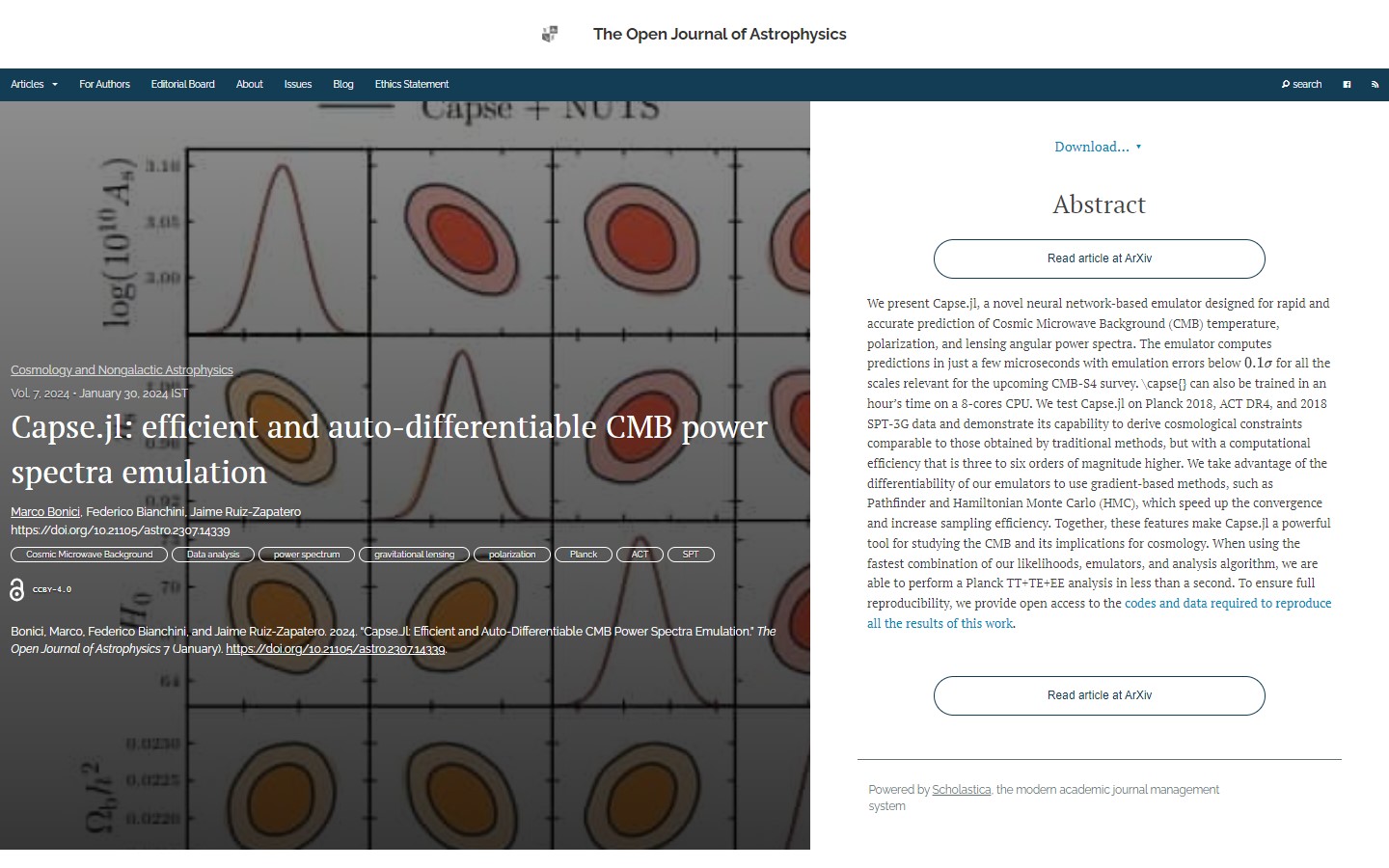
Anyway, the first paper of the most recent pair – published on January 30th – is “Capse.jl: efficient and auto-differentiable CMB power spectra emulation”, by Marco Bonici (INAF Milano, Italy & Waterloo, Canada), Federico Bianchini (Stanford, USA) and Jaime Ruiz-Zapatero (Oxford, UK). This paper presents an emulator for rapid and accurate prediction of Cosmic Microwave Background (CMB) temperature, polarization, and lensing angular power spectra, that works much faster than traditional methods. The code is written in Julia, in which language we are seeing an increasing number of submissions to OJAp.
Here is a screen grab of the overlay which includes the abstract:
You can click on the image of the overlay to make it larger should you wish to do so. You can find the officially accepted version of the paper on the arXiv here.
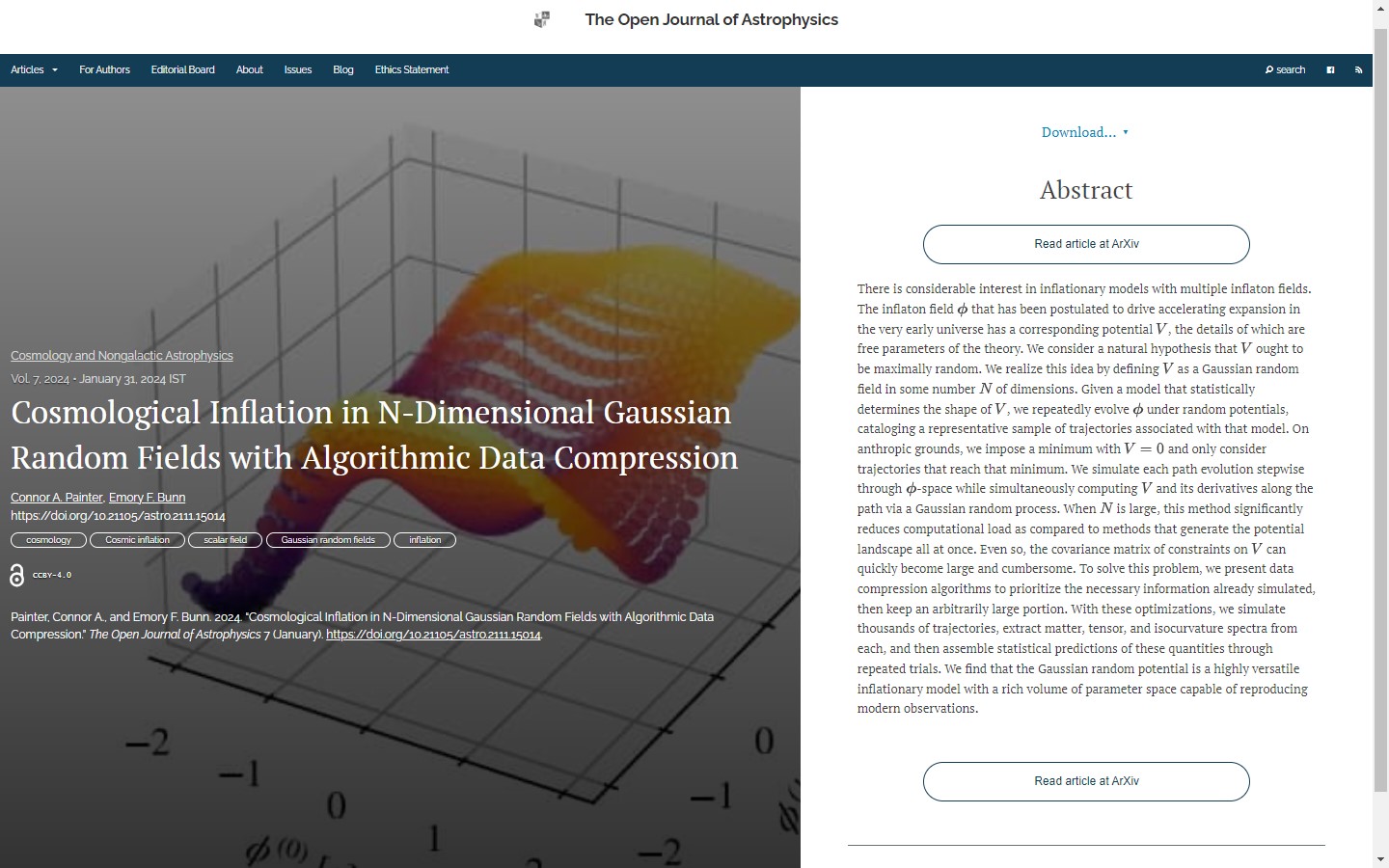
The second paper was published yesterday (31st January 2024) and has the title “Cosmological Inflation in N-Dimensional Gaussian Random Fields with Algorithmic Data Compression” which is a study of inflationary models with Gaussian random potentials for multiple scalar fields, tracking the evolutionary trajectories numerically. The authors are Connor Painter and Emory Bunn, both the Physics Department at the University of Richmond, Virginia (USA). Ted Bunn (as he is usually known) is a longstanding member of the Editorial Board of the Open Journal of Astrophysics (and was thereby excluded from any involvement in the editorial process for this paper).
Here is a screen grab of the overlay which includes the abstract:
You can click on the image of the overlay to make it larger should you wish to do so. You can find the officially accepted version of the paper on the arXiv here.
A week or so before Christmas I posted about a new organization called Irish Open Access Publishers whose mission statement is as follows:
Irish Open Access Publishers (IOAP) is a community of practice driven by Irish open access publishers for Irish open access publishers. The IOAP promotes engagement with the Diamond Open Access publishing model (free to publish and free to read) as well as indexing on the Directory of Open Access Journals and the Directory of Open Access Books. The aim of this dynamic community of practice is to promote publishing activity that is free of pay walls and publication embargoes to further the dissemination of high quality scholarly output to all in society.
These aims are laudable and I support them wholeheartedly. I should also mention that the Open Journal of Astrophysics is listed in the Directory of Open Access Journals here, where you will find details of all the papers we have published so far. This index is all part of the service. We have also been accepted for inclusion in Scopus, in case that matters to you.
Anyway, I thought I would remind readers of this blog (both of them) about the fact that the IOAP is offering a new set of awards, for which nominations are now open:
(Unfortunately the links in the above image are not clickable, but you can the award details here…)
Nominations for the first three categories are by self-nomination only. I will of course, on behalf of Maynooth Academic Publishing, the Editorial Board, the authors, and everyone who has helped behind the scenes, be nominating the Open Journal of Astrophysics.
Nominations for the final category, Outstanding Contribution to the OA Field are described thus:
Category 4 welcomes third party as well as self nominations from academics, students, librarians, research managers, academic leaders, publishers and other stakeholders across further and higher education for an individual who has made an outstanding contribution to open access publishing in Ireland. Nominations from scholarly societies and other scholarly organisations are also welcome. Nominations for individuals based in Northern Ireland are also invited.
Self nominations are restricted to individuals based in Ireland including Northern Ireland. Third party nominations are invited from individuals based in Ireland including Northern Ireland as well as individuals based overseas. All third party nominations must be for individuals practising in the field of open access publishing in Ireland including Northern Ireland solely.
Notice that nominations are not restricted to individuals based in Ireland. So, wherever you are, if you can think of any individual based in Ireland who has done enough to merit being described as having made an “outstanding contribution”, perhaps not only for being a long-term advocate of Diamond Open Access but also for setting up and being Managing Editor of a successful Diamond Open Access journal in the field of astrophysics, then please feel free to nominate me them. I hope you get the message. If you want subtle, you’ve come to the wrong place!
The nomination form is here. The closing date for nominations is 1st February 2024.
I know it’s New Year’s Day but I am going to start 2024 the way I mean to continue it, i.e. by banging on about Diamond Open Access. In that vein I am delighted to share a link to a discussion document (by Pierre Mounier & Johan Rooryck) that echoes much of what I have been saying on the subject for quite a while (e.g. here). In my view the ratio of talk to action has been far too high in this context, and the good thing about this document is that it makes concrete practical proposals for a global infrastructure that could support the transition to Diamond Open Access worldwide:
The infrastructure will take the shape of a four-level federation, with each level having its own responsibilities to achieve the shared goal of strengthening diamond open access as a leading scholarly communication model. These levels and their responsibilities are presented in this paper, initiating a discussion with diamond OA communities and other stakeholders in the research landscape. We invite you to come forward and join this discussion.
A global system of federated diamond Open Access repositories would enable a truly innovative and equitable ecosystem for scholarly publication and realize the vision of research as a global public good, which is what it should be. I think Ireland is in a good position to play a leading role in this revolution, actually, as there is much going on in this respect (e.g. in the construction of a national peer review platform).
Last week I found out about a new organization called Irish Open Access Publishers whose mission statement is as follows:
Irish Open Access Publishers (IOAP) is a community of practice driven by Irish open access publishers for Irish open access publishers. The IOAP promotes engagement with the Diamond Open Access publishing model (free to publish and free to read) as well as indexing on the Directory of Open Access Journals and the Directory of Open Access Books. The aim of this dynamic community of practice is to promote publishing activity that is free of pay walls and publication embargoes to further the dissemination of high quality scholarly output to all in society.
These aims are laudable and I support them wholeheartedly. I should also mention that the Open Journal of Astrophysics is listed in the Directory of Open Access Journals here, where you will find details of all the papers we have published so far. This index is all part of the service.
The reason I found out about the existence of IOAP is that they are offering a new set of awards, for which nominations are now open:
(Unfortunately the links in the above image are not clickable, but you can the award details here…)
Nominations for the first three categories are by self-nomination only. I will of course, on behalf of Maynooth Academic Publishing, the Editorial Board, the authors, and everyone who has helped behind the scenes, be nominating the Open Journal of Astrophysics.
Nominations for the final category, Outstanding Contribution to the OA Field are described thus:
Category 4 welcomes third party as well as self nominations from academics, students, librarians, research managers, academic leaders, publishers and other stakeholders across further and higher education for an individual who has made an outstanding contribution to open access publishing in Ireland. Nominations from scholarly societies and other scholarly organisations are also welcome. Nominations for individuals based in Northern Ireland are also invited.
Self nominations are restricted to individuals based in Ireland including Northern Ireland. Third party nominations are invited from individuals based in Ireland including Northern Ireland as well as individuals based overseas. All third party nominations must be for individuals practising in the field of open access publishing in Ireland including Northern Ireland solely.
Notice that nominations are not restricted to individuals based in Ireland. So, wherever you are, if you can think of any individual based in Ireland who has done enough to merit being described as having made an “outstanding contribution”, perhaps not only for being a long-term advocate of Diamond Open Access but also for setting up and being Managing Editor of a successful Diamond Open Access journal in the field of astrophysics, then please feel free to nominate me them. I hope you get the message. If you want subtle, you’ve come to the wrong place!
The nomination form is here. The closing date for nominations is 1st February 2024.
A few days ago I posted an item about how the current system of scientific publication is under such intolerable strain that it is no longer fit for purpose. This is something I’ve felt for a while. Some time ago I wrote a post musing about what should replace it. That article included this:
I know I’m not alone in thinking that the current publishing ecosystem is doomed and will die a natural death soon enough. In my view the replacement should be a worldwide network of institutional and/or subject-based repositories that share research literature freely for the common good.
The Open Journal of Astrophysics was set up to demonstrate a way of achieving this kind of change in the field of Astrophysics. With this in mind I was delighted to to see a paper in PLOS Biology by Richard Sever (published just yesterday) with the following abstract:
Academic journals have been publishing the results of biomedical research for more than 350 years. Reviewing their history reveals that the ways in which journals vet submissions have changed over time, culminating in the relatively recent appearance of the current peer-review process. Journal brand and Impact Factor have meanwhile become quality proxies that are widely used to filter articles and evaluate scientists in a hypercompetitive prestige economy. The Web created the potential for a more decoupled publishing system in which articles are initially disseminated by preprint servers and then undergo evaluation elsewhere. To build this future, we must first understand the roles journals currently play and consider what types of content screening and review are necessary and for which papers. A new, open ecosystem involving preprint servers, journals, independent content-vetting initiatives, and curation services could provide more multidimensional signals for papers and avoid the current conflation of trust, quality, and impact. Academia should strive to avoid the alternative scenario, however, in which stratified publisher silos lock in submissions and simply perpetuate this conflation.
(I added the emphasis). In case you were not aware, Richard Sever is a cofounder of the preprint servers bioRxiv and medRxiv.
I’m very glad to see similar thoughts to those I expressed about astrophysics being echoed in the field of biomedicine. I hope that more disciplines follow this path. The way it is realized will no doubt be domain-specific, but the benefits of such a new ecosystem will be for all science.
I took the liberty of reblogging this short post by Olivier Pourret about “No Pay” Open Access to direct readers to it and to make a couple of points. One is that you have to realize that “publishing-industry representatives” have a vested interest in the much of the discussion is about possible models for what might happen in the future, some of us have been busy making “No Pay” Open Access real in the here and now.
For some background, the article refers to a Council of Europe a document (PDF) that calls for “transparent, equitable, and open access to scholarly publications”. In its conclusions, the Council calls on the Commission and the member states to support policies towards a scholarly publishing model that is not-for-profit, open access and multi-format, with no costs for authors or readers. In other words, it calls for Diamond Open Access. The covering press release includes:
If we really believe in open science, we need to make sure that researchers can make their findings available and re-usable and that high-quality scientific articles are openly accessible to anyone that needs to read them. This should be particularly the case for research that benefits from public funding: what has been paid by all should be accessible to all.
Mats Persson, Swedish Minister for Education, Ministry of Education and Research
This is clearly how Open Access should be, though I am still worried that the sizeable publishing lobby will still try to persuade research agencies and institutions to pay the existing fees on behalf of authors, which does not solve the problem but merely hides it.
I know I’m not alone in thinking that the current publishing ecosystem is doomed and will die a natural death soon enough. In my view the replacement should be a worldwide network of institutional and/or subject-based repositories that share research literature freely for the common good. Universities and research centres should simply bypass the grotesque parasite that is the publishing industry. Indeed, I would be in favour of hastening the demise of the Academic Journal Racket by having institutions make it a disciplinary offence for any researcher to pay an APC to any journal.
We are lucky in physics and astronomy because arXiv has already done the hard work for us. With the existence of arXiv, old-style journals are no longer necessary. It is great that arXiv is being joined by similar ventures in other fields, such as BiorXiv and EarthArxiv. A list of existing repositories can be found here. I’m sure many more will follow. The future is Diamond.
What is needed is a global effort to link these repositories to each other and to peer review mechanisms. One way is through overlays, as demonstrated by the Open Journal of Astrophysics, there being no reason why the idea can’t be extended beyond arXiv. Other routes are possible, of course, and some of these are mentioned in the article I reposted. I would love to see different models developed, but that needs action, not words.
As it was foretold the Council of Europe has now released a document (PDF) that calls for “transparent, equitable, and open access to scholarly publications”. In its conclusions, the Council calls on the Commission and the member states to support policies towards a scholarly publishing model that is not-for-profit, open access and multi-format, with no costs for authors or readers. In other words, it calls for Diamond Open Access. The covering press release includes:
If we really believe in open science, we need to make sure that researchers can make their findings available and re-usable and that high-quality scientific articles are openly accessible to anyone that needs to read them. This should be particularly the case for research that benefits from public funding: what has been paid by all should be accessible to all.
Mats Persson, Swedish Minister for Education, Ministry of Education and Research
This is clearly how Open Access should be, though I am still worried that the sizeable publishing lobby will still try to persuade research agencies and institutions to pay the existing fees on behalf of authors, which does not solve the problem but merely hides it.
I know I’m not alone in thinking that the current publishing ecosystem is doomed and will die a natural death soon enough. The replacement should be a worldwide network of institutional and/or subject-based repositories that share research literature freely for the common good. Universities and research centres should simply bypass the grotesque parasite that is the publishing industry. Indeed, I would be in favour of hastening the demise of the Academic Journal Racket by having institutions make it a disciplinary offence for any researcher to pay an APC to any journal.
We are lucky in physics and astronomy because arXiv has already done the hard work for us. With the existence of arXiv, old-style journals are no longer necessary. It is great that arXiv is being joined by similar ventures in other fields, such as BiorXiv and EarthArxiv. A list of existing repositories can be found here. I’m sure many more will follow. The future is Diamond.
What is needed is a global effort to link these repositories to each other and to peer review mechanisms. One way is through overlays as demonstrated by the Open Journal of Astrophysics, there being no reason why the idea can’t be extended beyond arXiv. Other routes are possible, of course, and I would love to see different models developed. I hope the European Council call will result in more support for Diamond Open Access. But whether this happens or not, I think the next few years are going to be very exciting.
The current state of play with regard to Open Access publishing is very disappointing. The academic publishing industry seems to have persuaded the powers that be to allow them to charge exorbitant article processing charges (APCs) to replace revenues lost from subscriptions when they publish a paper free to readers. This simply transfers the cost from reader to author, and excludes those authors who can’t afford to pay.
This current system of ‘Gold’ Open Access is a scam, and it’s a terrible shame we have ended up having it foisted upon us. Fortunately, being forced to pay APCs of many thousands of euros to publish their papers, researchers are at last starting to realize that they are being ripped off. Recently, the entire Editorial Board of Neuroimage and its sister journal Neuroimage: Reportsresigned in protest at the `extreme’ APC levels imposed by the publisher, Elsevier. I’m sure other academics will follow this example, as it becomes more and more obvious that the current arrangements are unsustainable. Previously the profits of the big publishers were hidden in library budgets. Now they are hitting researchers and their grants directly, as authors now have to pay, and people who previously hadn’t thought much about the absurdity of it all are now realizing what a racket academic publishing really is.
The people at the top have been slow to grasp this reality, but there are signs that this is at last happening, In the USA there has been the Nelson Memorandum (see discussion here). Now there is movement in the European Union, with member states apparently set on agreeing a text to be published next month (May 2023) that calls for immediate open access the default, with no author fees. This is clearly how Open Access should be, though I am still worried that the sizeable publishing lobby will try to persuade research agencies and institutions to pay the existing fees on behalf of authors, which does not solve the problem but merely hides it.
I know I’m not alone in thinking that the current publishing ecosystem is doomed and will die a natural death soon enough. The replacement should be a worldwide network of institutional and/or subject-based repositories that share research literature freely for the common good. Universities and research centres should simply bypass the grotesque parasite that is the publishing industry. Indeed, I would be in favour of hastening the demise of the Academic Journal Racket by having institutions make it a disciplinary offence for any researcher to pay an APC.
We are lucky in physics and astronomy because arXiv has already done the hard work for us. Indeed, it is now a truth universally acknowledged* that every new research paper worth reading in these disciplines can be found on arXiv. Old-style journals are no longer necessary. It is great that arXiv is being joined by similar ventures in other fields, such as BiorXiv and EarthArxiv. A list of existing repositories can be found here. I’m sure many more will follow. What is needed is a global effort to link these repositories to each other and to peer review mechanisms. One way is through overlays as demonstrated by the Open Journal of Astrophysics, there being no reason why the idea can’t be extended beyond arXiv. Other routes are possible, of course, and I would love to see different models developed. I think the next few years are going to be very exciting.
*It is also a truth universally acknowledged that anyone who doesn’t understand the reference to “a truth university acknowledged” has not read Pride and Prejudice by Jane Austen…
I came across an interesting document concerning Diamond Open Access journals and thought I’d share it here. These are journals of the good sort that charge neither authors nor readers. In particular they do not charge exorbitant Article Processing Charges, like Open Access journals of the bad sort do. The Open Journal of Astrophysics is a “diamond journal“.
The document describes an initiative (“Action Plan”) that aims for a scholarly publishing infrastructure that is equitable, community-driven, academic-led and -owned. This will enable the global research community to take charge of a scholarly communication system by and for research communities. It therefore welcomes all researchers, organisations, disciplines, and journals who share its vision and ethos to endorse it.
You might also want to endorse the plan, or persuade your organization/university/research lab to do so. You can do that here.
Endorsing the Action Plan does not entail any financial commitment, but makes you part of the Diamond Open Access community and engages you in the creation of conditions that will strengthen the sector. An overview of endorsing persons and organisations will be publicly available.
Perusing the list of endorsing institutes, I see Cardiff University is in there, but sadly not Maynooth (yet…)
The views presented here are personal and not necessarily those of my employer (or anyone else for that matter).
Feel free to comment on any of the posts on this blog but comments may be moderated; anonymous comments and any considered by me to be vexatious and/or abusive and/or defamatory will not be accepted. I do not necessarily endorse, support, sanction, encourage, verify or agree with the opinions or statements of any information or other content in the comments on this site and do not in any way guarantee their accuracy or reliability.




 In the Dark