Archive for Diamond Open Access

Open Access in Ecology

Posted in Open Access with tags , , , , on May 6, 2024 by telescoper

My attention was drawn yesterday to the following blog post about Open Access in the field of ecology. I recommend you read it (and the comments, some of which are excellent).

I will add a few comments of my own here.

First, whenever I read an article like this from a discipline different from my own it makes me not only feel grateful that we have arXiv but also wonder why so many fields don’t have the equivalent. On the other hand, there is EarthArxiv, but it doesn’t seem to have very many papers on it.

Second, I agree with the author of the post that far too many papers are being published. That is driven by the absurdity of a system that no longer regards the journal article as a means of disseminating scientific results but instead as a kind of epaulette to give status to the author. I also agree that scientists have largely got themselves to blame for this ridiculous situation.

Third, I disagree most strongly with this statement:

First, pipe dreaming academics who believed in the mirage of “Diamond OA” (nobody pays and it is free to publish). Guess what – publishing a paper costs money – $500-$2000 depending on how much it is subsidized by volunteer scientists. 

This is nonsense. It does not cost anything like $500-$2000 dollars to publish a paper. Of course it does cost something, but the true amount is trivial – tens of dollars, rather than hundreds or thousands – and can easily be absorbed. The entire annual running costs of OJAp are less than the typical Article Processing Charge for a single paper in a “prestigious” journal. Most money being paid in the form of APC goes directly into profit for the publishers, and the rest is largely wasted on administrative overhead. The Open Journal of Astrophysics is a Diamond Open Access journal, not a mirage. It may be a no-frills service, but it’s a reality. Why doesn’t someone set up an overlay journal on EarthArXiv?

The author of this blog post also spectacularly misses the point with “depending on how much it is subsidized by volunteer scientists”. Volunteer scientists are already subsidizing the profits of profit-making publishers! One of the commenters on the blog post has it right:

On Diamond OA and who pays; we’re already paying the big publishers with both our time and our money to publish in / review for / edit for their journals. Perhaps if we redirected that time to Diamond OA titles things would be somewhat different.

A final comment, only tangentially related to this post, is that I have been (pleasantly) surprised by the extent to which early career researchers have embraced the concept of the Open Journal of Astrophysics when you might have thought that they had more to lose by not publishing in mainstream journals rather than us oldies who don’t care any more. The explanation seems to be that younger people seem to see the absurdity and obvious unsustainability of the current publishing environment more easily than those who have put up with it for decades already.

The Gates Foundation and Open Access

Posted in Open Access with tags , , , , , on April 9, 2024 by telescoper

There has been quite a lot of reaction (e.g. here) to the recent announcement of a new Open Access Policy by the Bill & Melinda Gates Foundation, which is one of the one of the world’s top funders of biomedical research. This mandates the distribution of research it funds as preprints and also states that it will not pay Article Processing Charges (APCs). The essentials of the policy, which comes into effect on 1st January 2025, are these:

  1. Funded Manuscripts Will Be Available. As soon as possible and to the extent feasible, Funded Manuscripts shall be published as a preprint in a preprint server recognized by the foundation or preapproved preprint server which applies a sufficient level of scrutiny to submissions. Accepted articles shall be deposited immediately upon publication in PubMed Central (PMC), or in another openly accessible repository, with proper metadata tagging identifying Gates funding. In addition, grantees shall disseminate Funded Manuscripts as described in their funding agreements with the foundation, including as described in any proposal or Global Access commitments.
  2. Dissemination of Funded Manuscripts Will Be On “Open Access” Terms. All Funded Manuscripts, including any subsequent updates to key conclusions, shall be available immediately, without any embargo, under the Creative Commons Attribution 4.0 International License (CC BY 4.0) or an equivalent license. This will permit all users to copy, redistribute, transform, and build on the material in any medium or format for any purpose (including commercial) without further permission or fees being required.
  3. Gates Grantees Will Retain Copyright. Grantees shall retain sufficient copyright in Funded Manuscripts to ensure such Funded Manuscripts are deposited into an open-access repository and published under the CC-BY 4.0 or equivalent license.
  4. Underlying Data Will Be Accessible Immediately. The Foundation requires that underlying data supporting the Funded Manuscripts shall be made accessible immediately and as open as possible upon availability of the Funded Manuscripts, subject to any applicable ethical, legal, or regulatory requirements or restrictions. All Funded Manuscripts must be accompanied by an Underlying Data Availability Statement that describes where any primary data, associated metadata, original software, and any additional relevant materials or information necessary to understand, assess, and replicate the Funded Manuscripts findings in totality can be found. Grantees are encouraged to adhere to the FAIR principles to improve the findability, accessibility, interoperability, and reuse of digital assets.
  5. The Foundation Will Not Pay Article Processing Charges (APC). Any publication fees are the responsibility of the grantees and their co-authors.
  6. Compliance Is A Requirement of Funding. This Open Access policy applies to all Funded Manuscripts, whether the funding is in whole or in part. Compliance will be continuously reviewed, and grantees and authors will be contacted when they are non-compliant.
    • As appropriate, Grantees should include the following acknowledgment and notice in Funded Manuscripts:
    • “This work was supported, in whole or in part, by the Bill & Melinda Gates Foundation [Grant number]. The conclusions and opinions expressed in this work are those of the author(s) alone and shall not be attributed to the Foundation. Under the grant conditions of the Foundation, a Creative Commons Attribution 4.0 License has already been assigned to the Author Accepted Manuscript version that might arise from this submission. Please note works submitted as a preprint have not undergone a peer review process.”

Reactions to this new policy are generally positive, except (unsurprisingly) for the academic publishing industry.

For what it’s worth, my view is that it is a good policy, and I wish more funders went along this route, but it falls short of being truly excellent. As it stands, the policy seems to encourage authors to put the “final” version of their articles in traditional journals, without these articles being freely available through Open Access. That falls short of goal establishing a global worldwide network of institutional and/or subject-based repositories, linked to peer review mechanisms such as overlays, that share research literature freely for the common good. To help achieve that aim, the Gates’ Foundation should to encourage overlays rather than traditional journals as the way to carry out peer review. Perhaps this will be the next step?

Open Access Talk at UNSW

Posted in Biographical, Open Access, The Universe and Stuff with tags , , , on February 21, 2024 by telescoper

After an exciting start to the day involving a fire alarm and consequent evacuation of my hotel, I today ventured into the suburbs of Sydney via the Light Rail system (i.e. the tram) to the University of New South Wales. The tram ride took about 20 minutes from Central and, incidentally, took me right past the Sydney Cricket Ground. Anyway, the UNSW campus at Kensington is very impressive:

After a few gremlins with the WIFI connection, the talk I gave was a longer version of the one I did at the University of Sydney on Monday. In discussions with the Astrophysics group at UNSW, I found they were particularly unhappy about the decision of Monthly Notices of the Royal Astronomical Society to charge a high level of APC (Article Processing Artificial Profit Charge) so is looking at alternative journals that aren’t so exploitative. A journal has no right to call itself “open access” if it excludes researchers on grounds of cost. The problem with the Open Journal of Astrophysics in this case is that they need their publications to be in “high impact journals” for research assessment purposes, and OJAp doesn’t have an “official” journal impact factor yet. The fascination of bureaucrats with the obviously flawed journal impact factor disturbs me greatly but I hope we will have one soon so we may be able to help them out before too long.

Anyway, here are the slides from today’s talk:

Talking Down Under

Posted in OJAp Papers, Open Access, The Universe and Stuff with tags , , , on February 19, 2024 by telescoper

This morning I gave a short talk at the “Astronomy Tea” at the Sydney Institute for Astronomy. No prizes for guessing what I talked about. The talk was followed by questions and then by a huge thunderstorm.

Here are the slides:

P.S. Today was the first day of teaching of the new academic year at the University of Sydney, so the campus was much busier today than it has been.

Two New Publications at the Open Journal of Astrophysics

Posted in OJAp Papers, Open Access, The Universe and Stuff with tags , , , , , , , , , , , on February 1, 2024 by telescoper

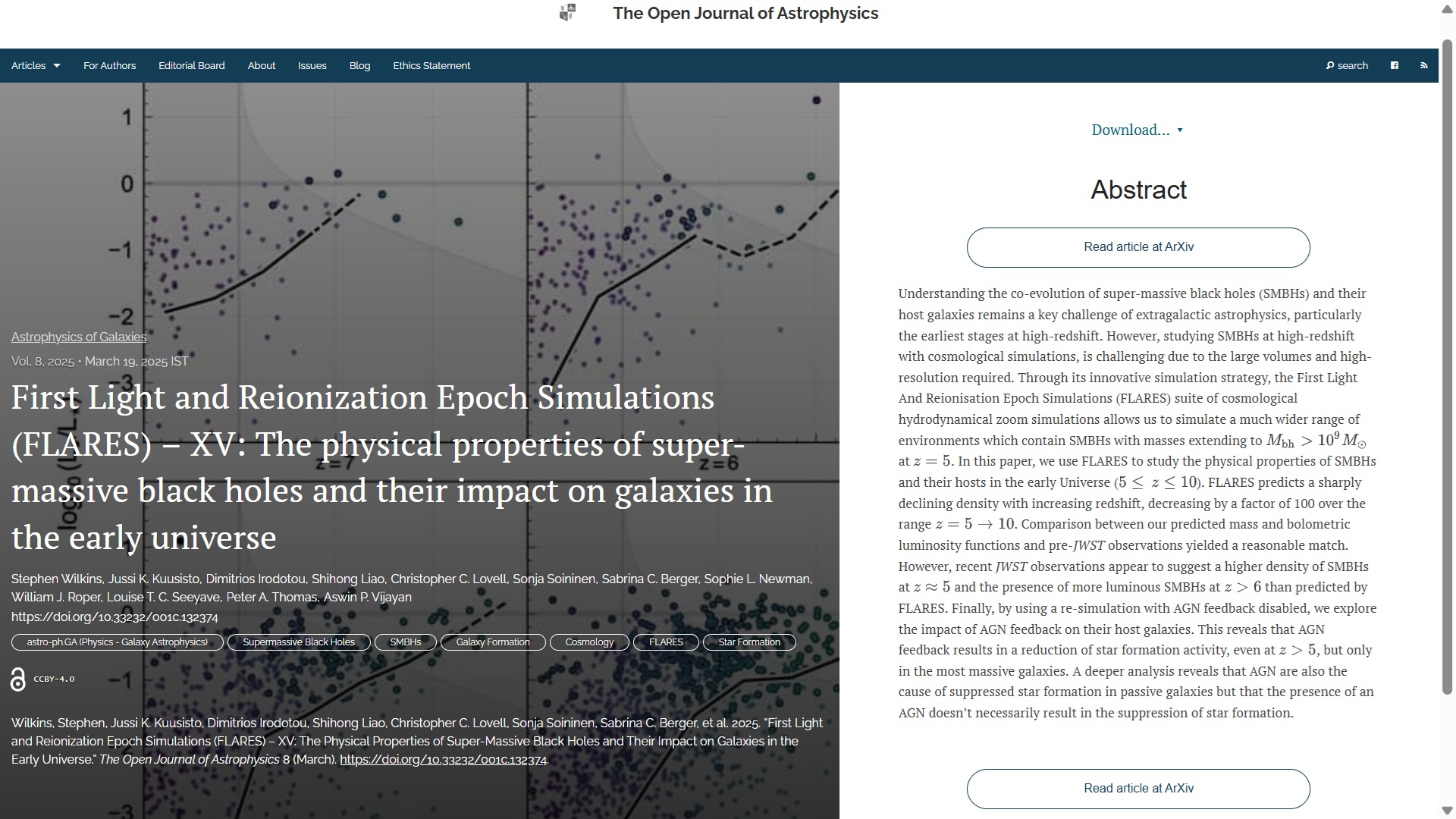
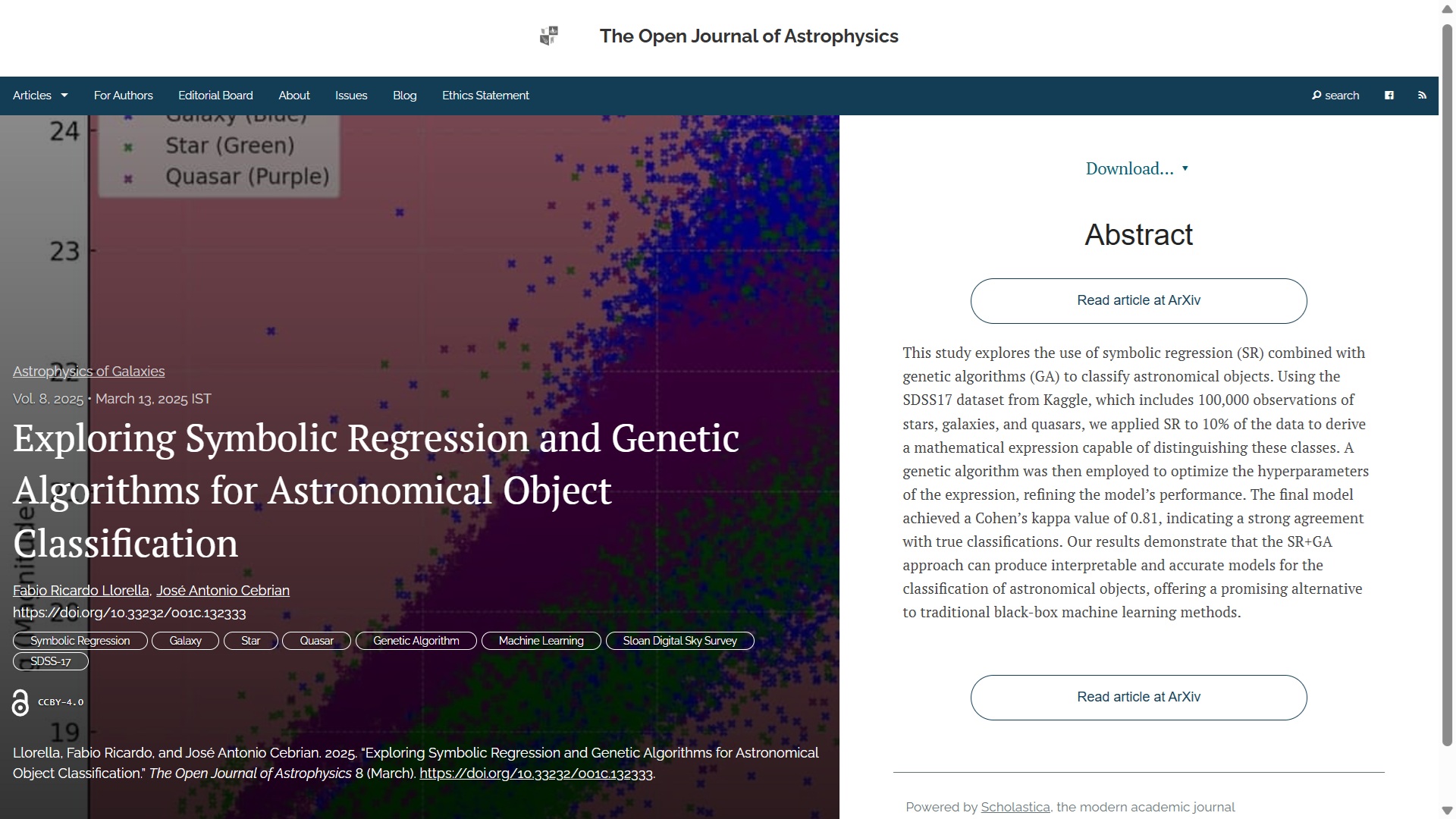
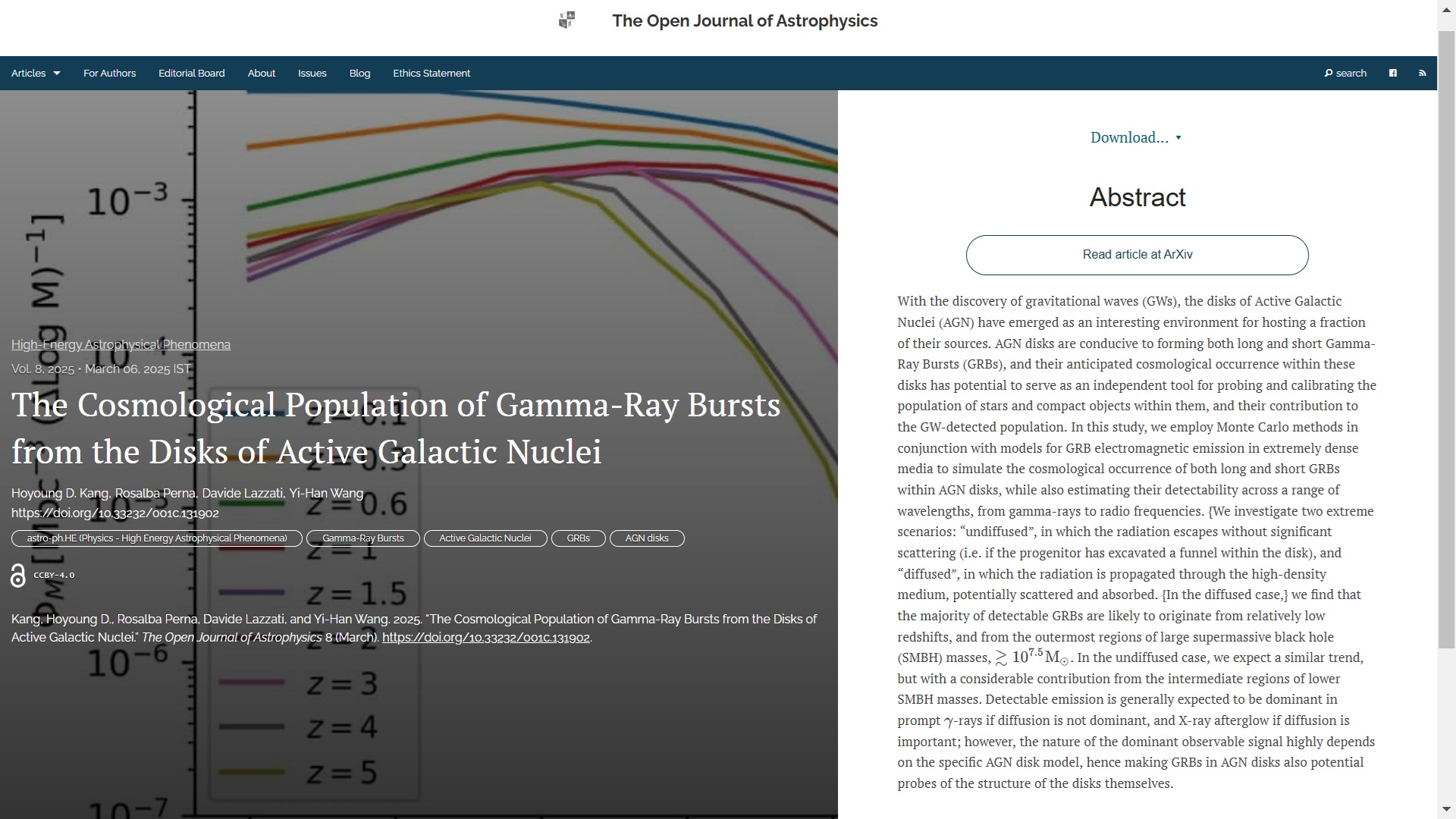
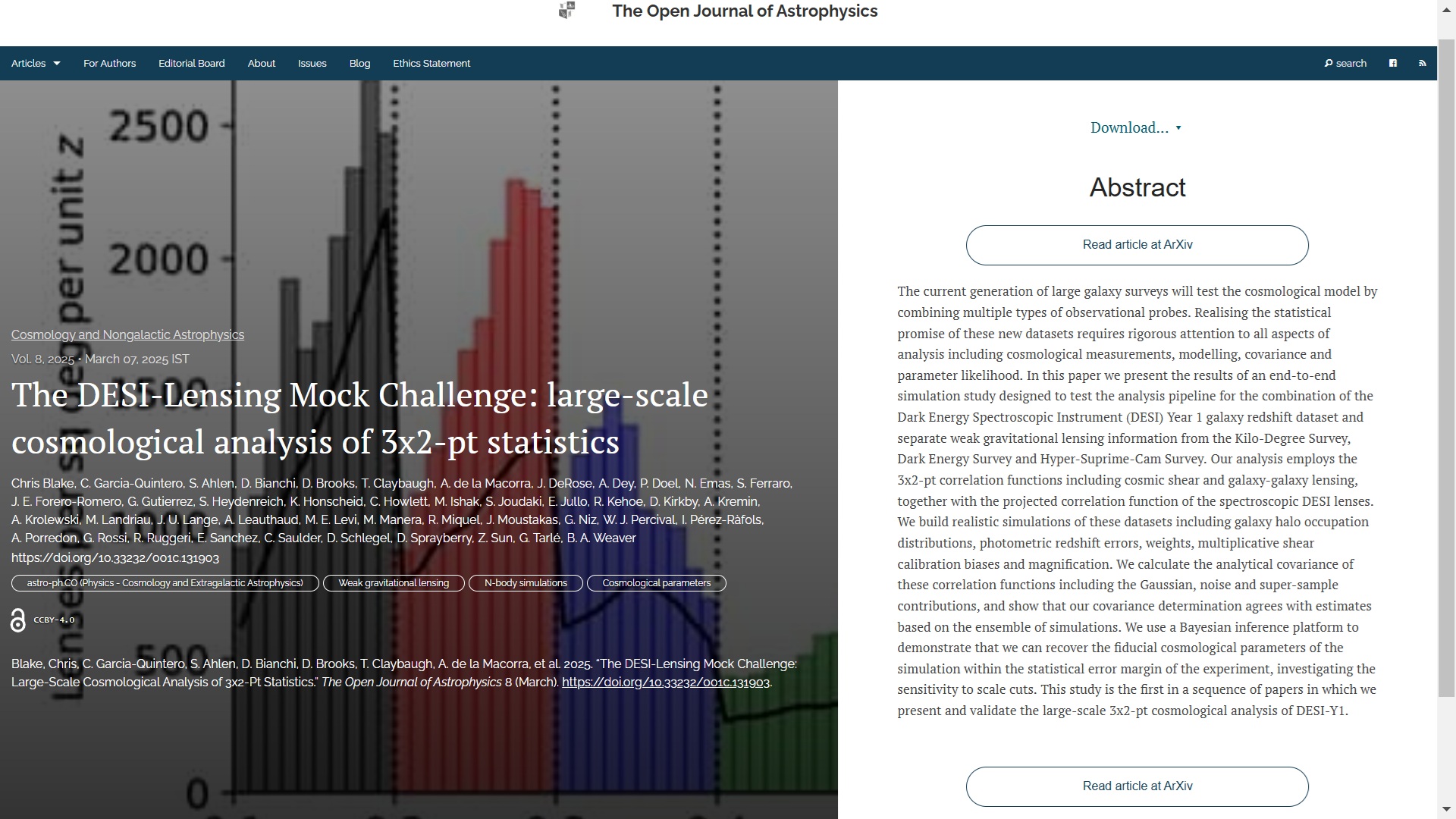
As the first month of 2024 is now over, I thought I’d post an update relating to the  Open Journal of Astrophysics.  Since the last update we have published two papers, taking  the count in Volume 7 (2024) up to 9 (the total for January) and the total published by OJAp up to 124. We will have others soon, but I will be travelling for the first few days of February so the next update will be in a week or so.

Using our sophisticated forecasting algorithm, based on the first month of 2024 as input, I predict that we will publish around 9×12=108 papers in 2024, more than double last year’s total of 50.

Both the current papers discussed here are in the folder marked Cosmology and NonGalactic Astrophysics, our most popular category.

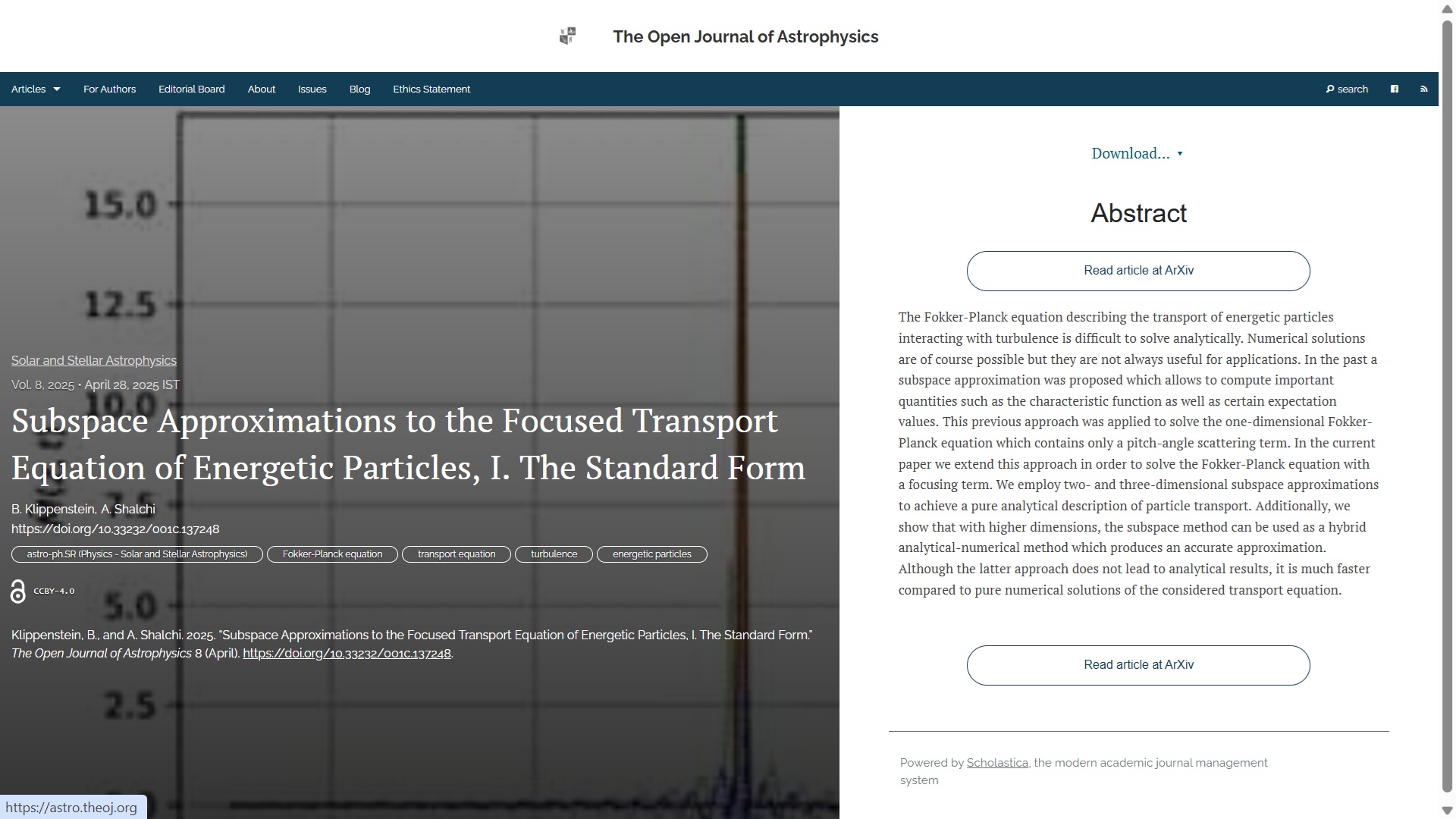
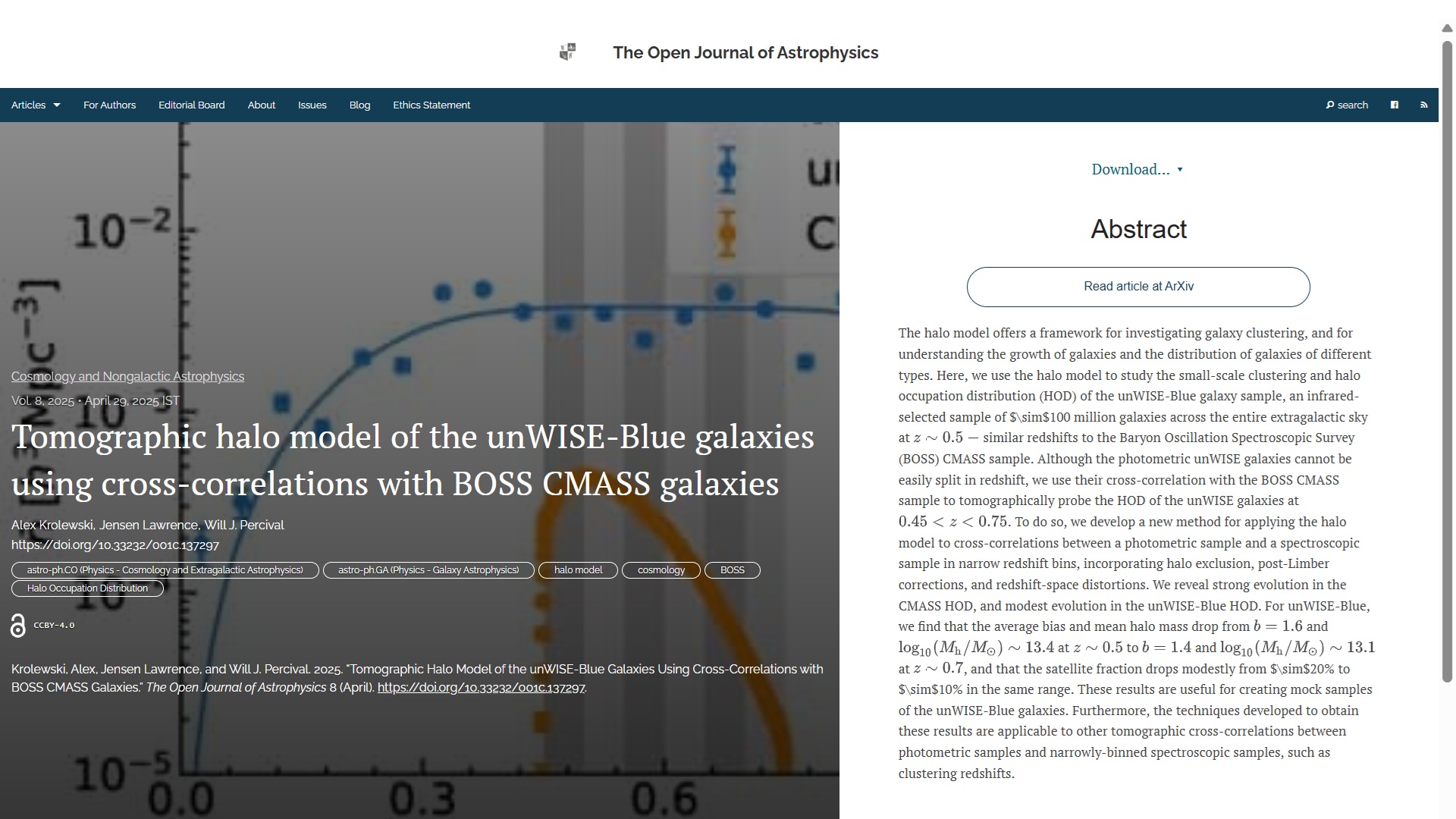
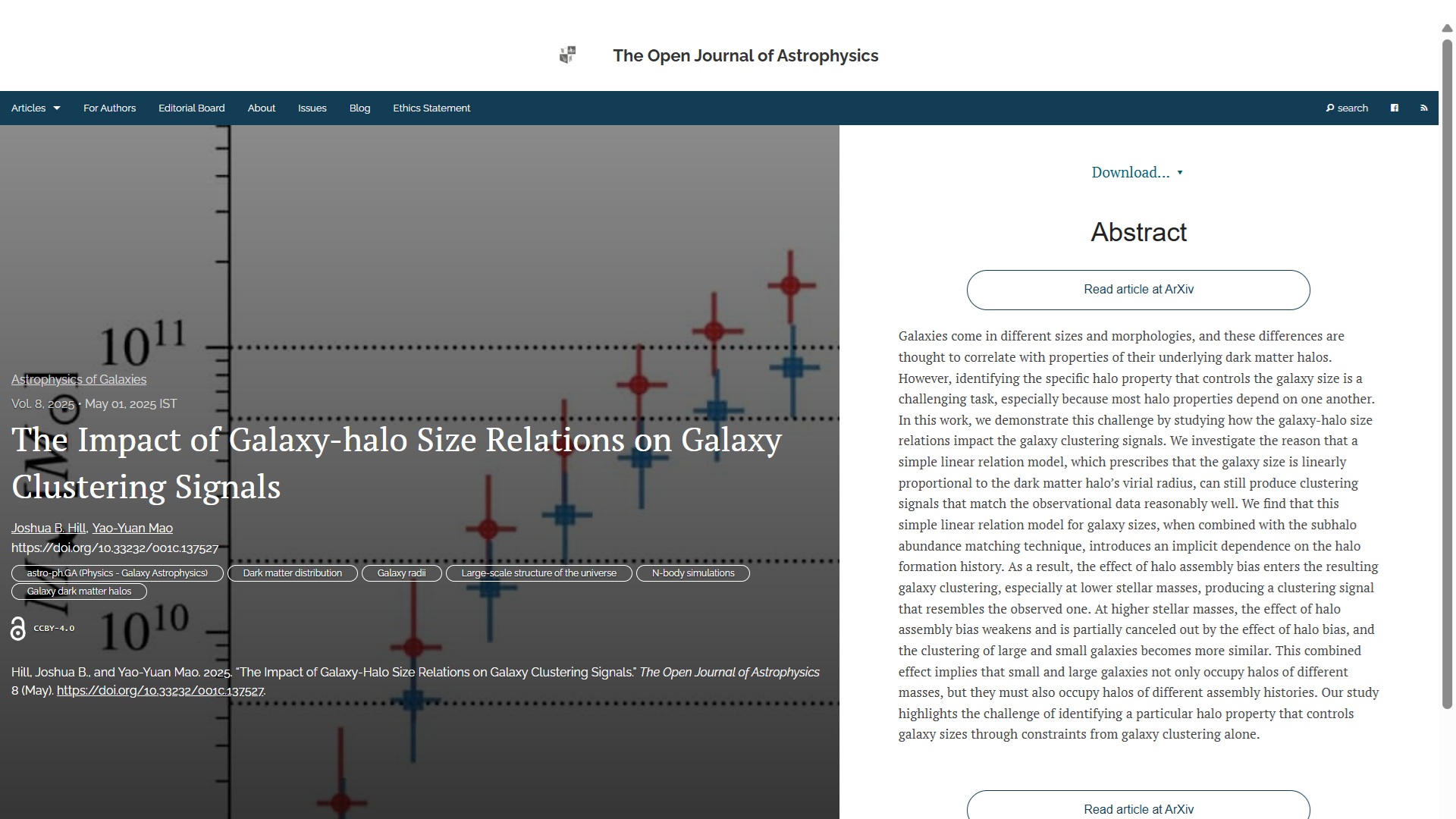
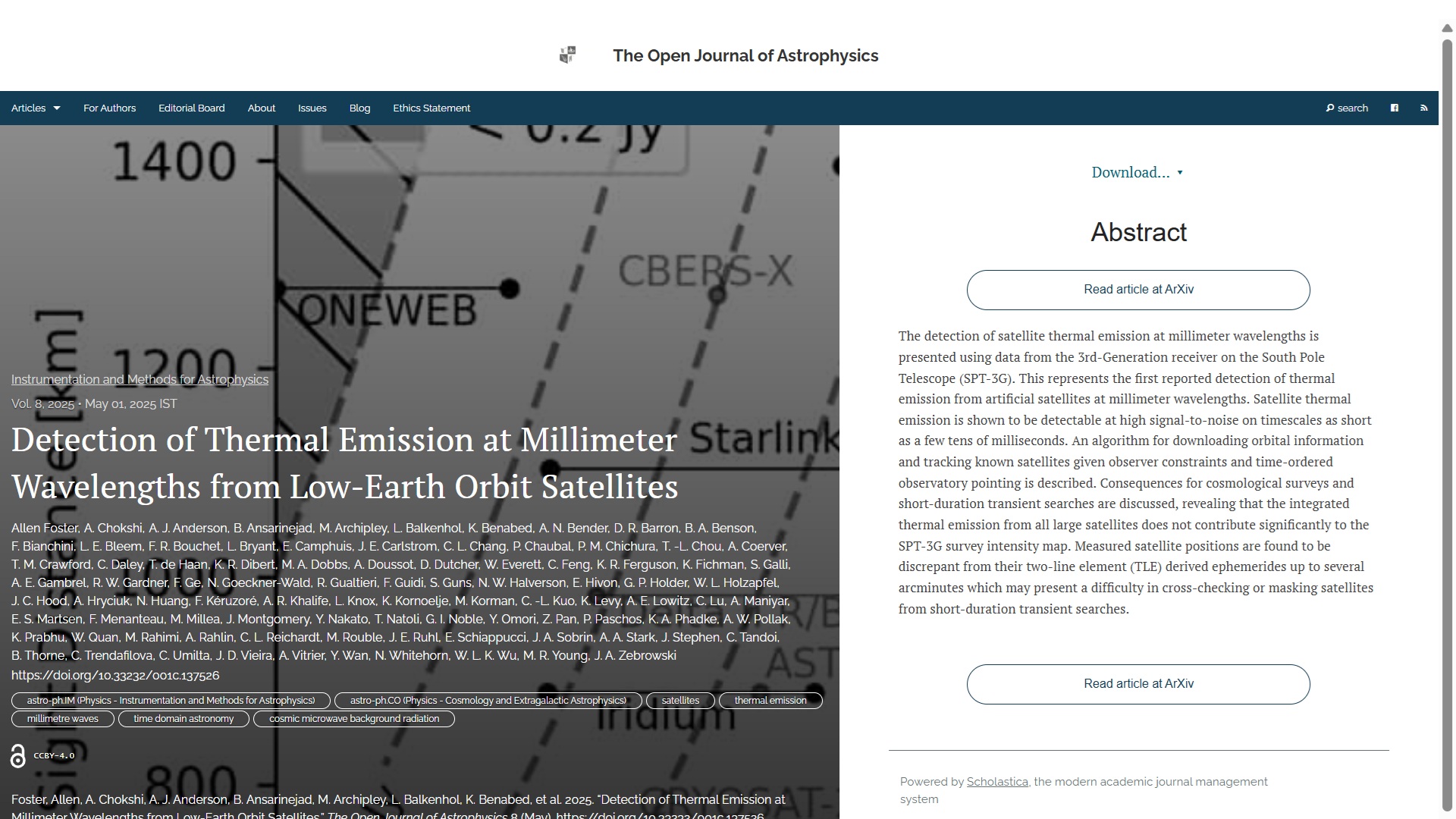
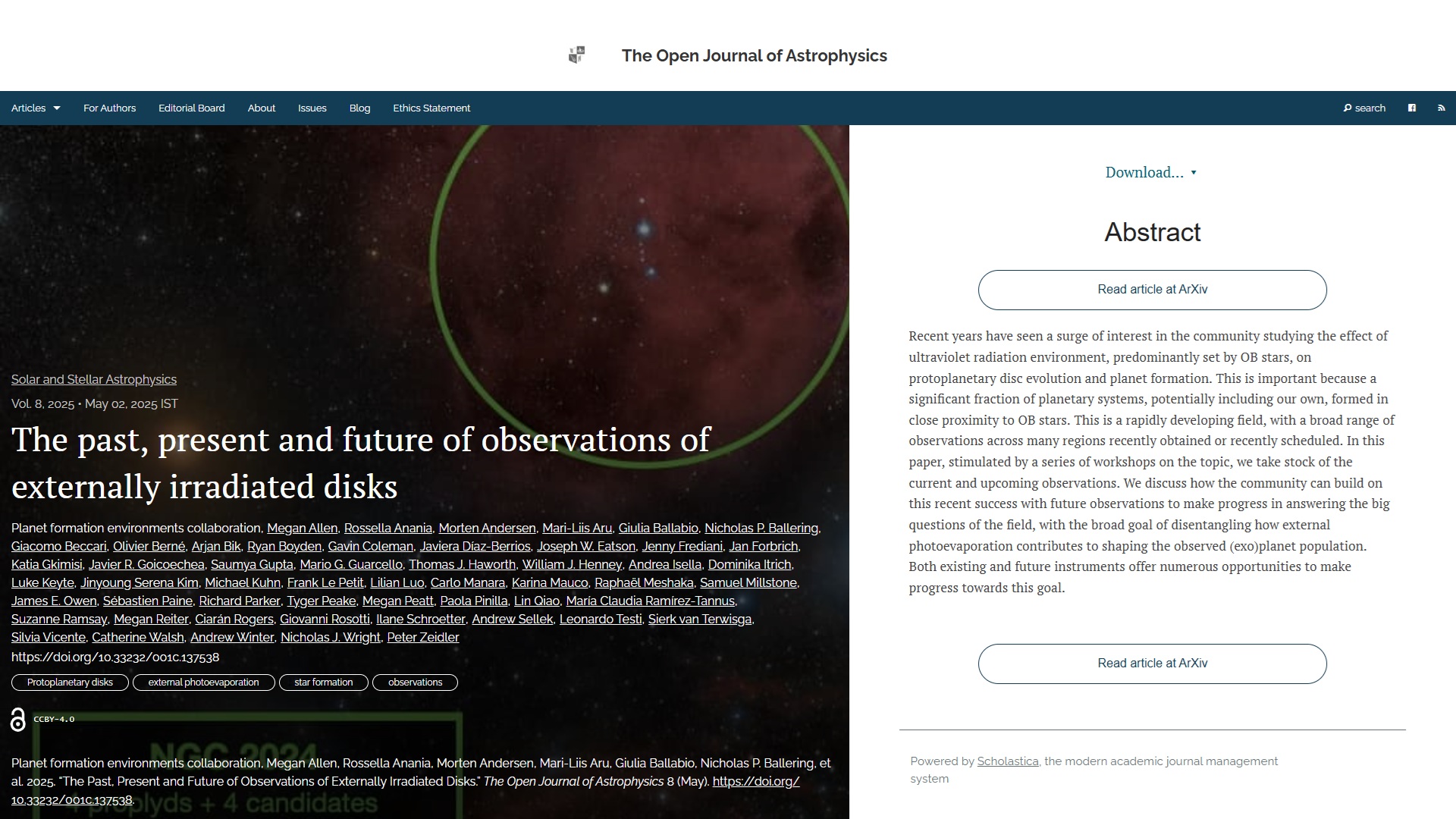
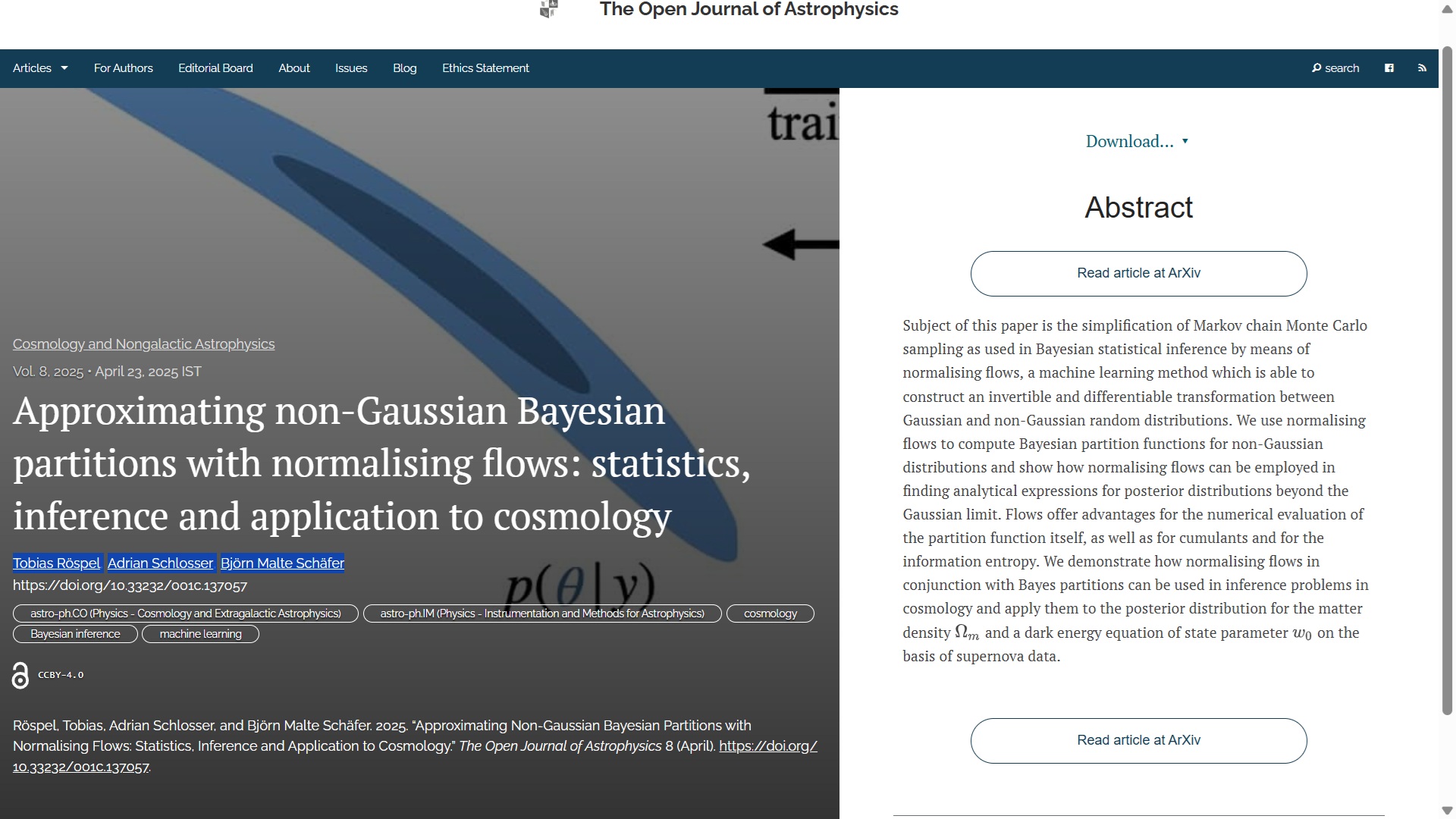
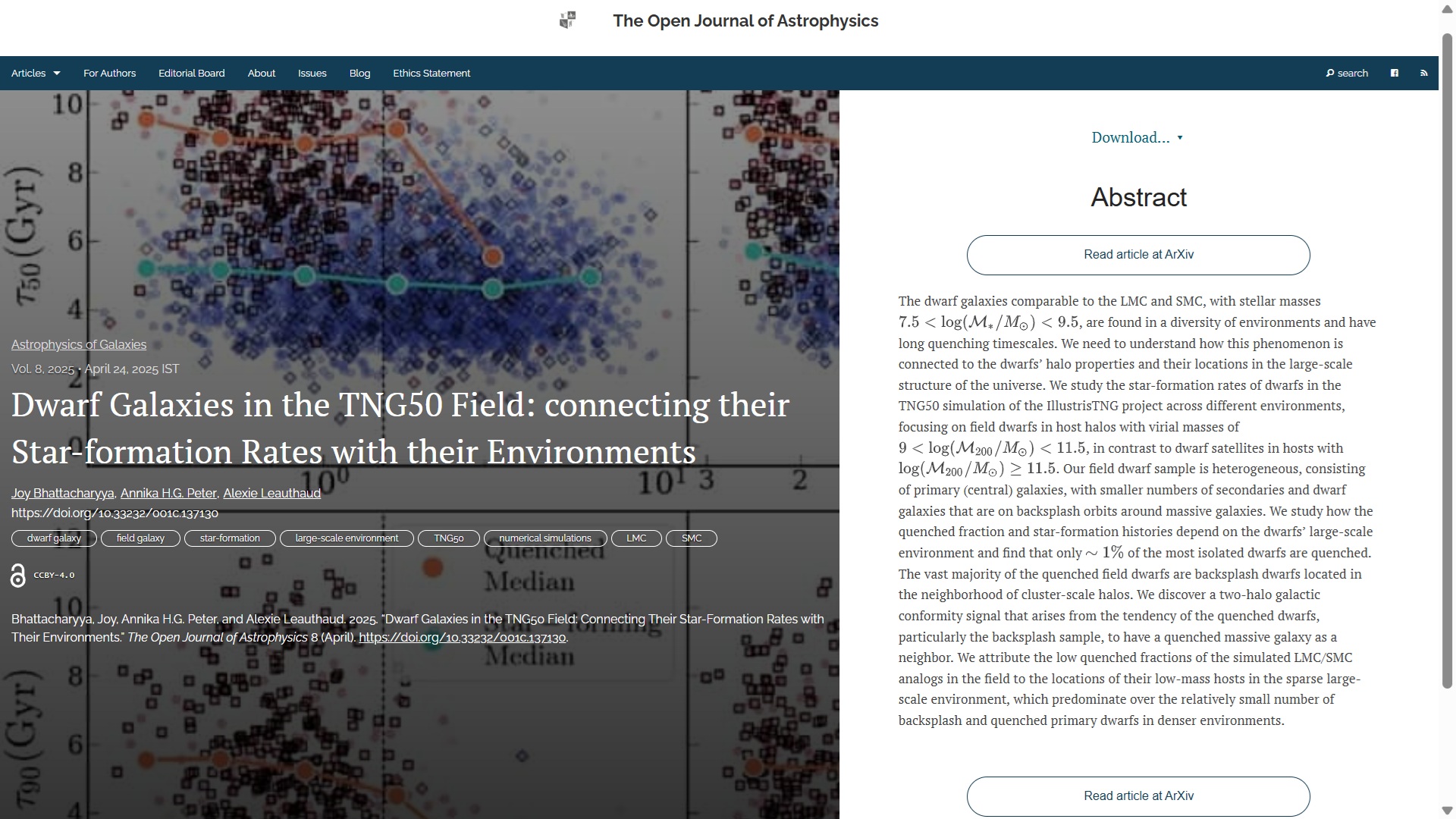
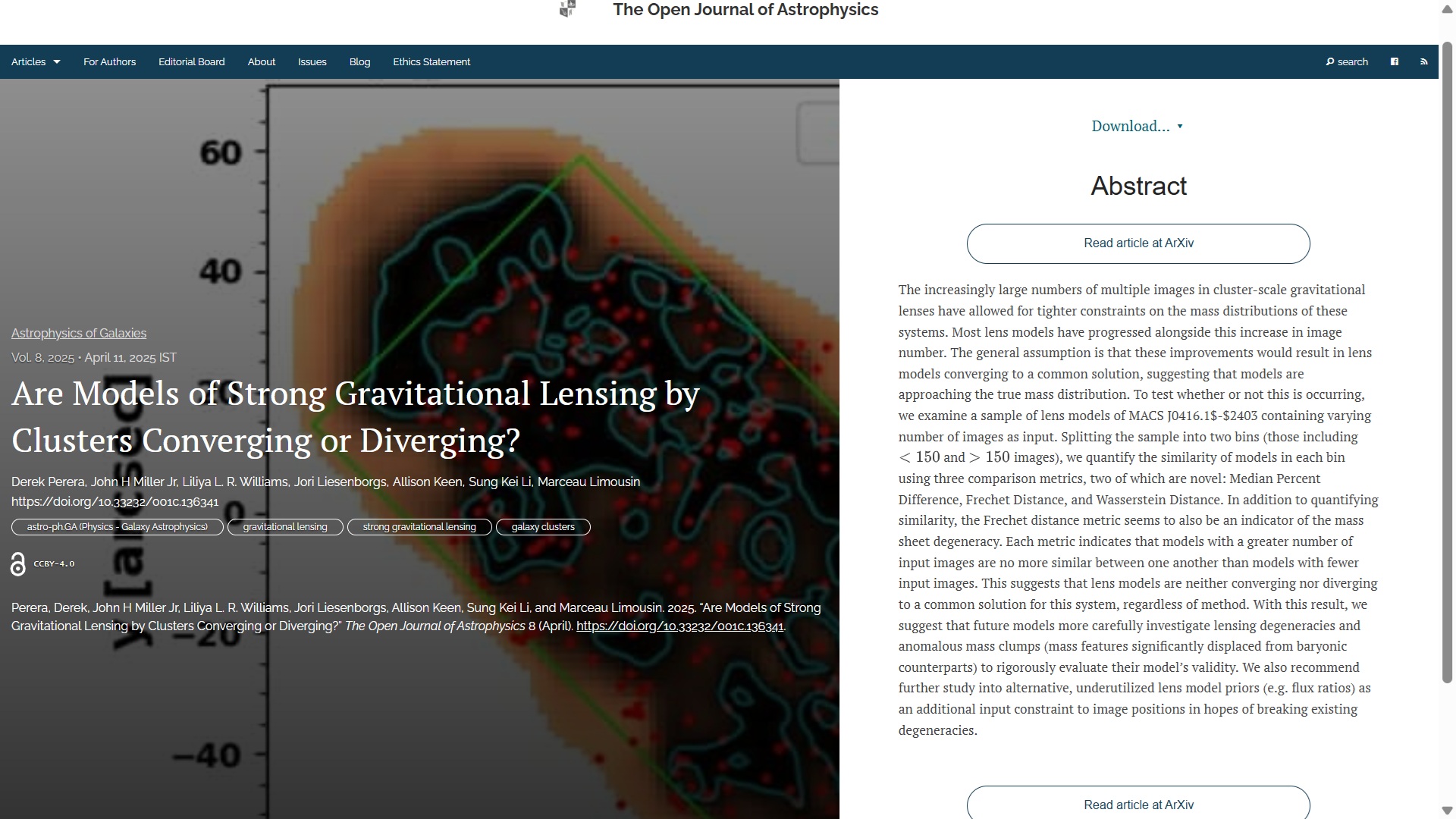
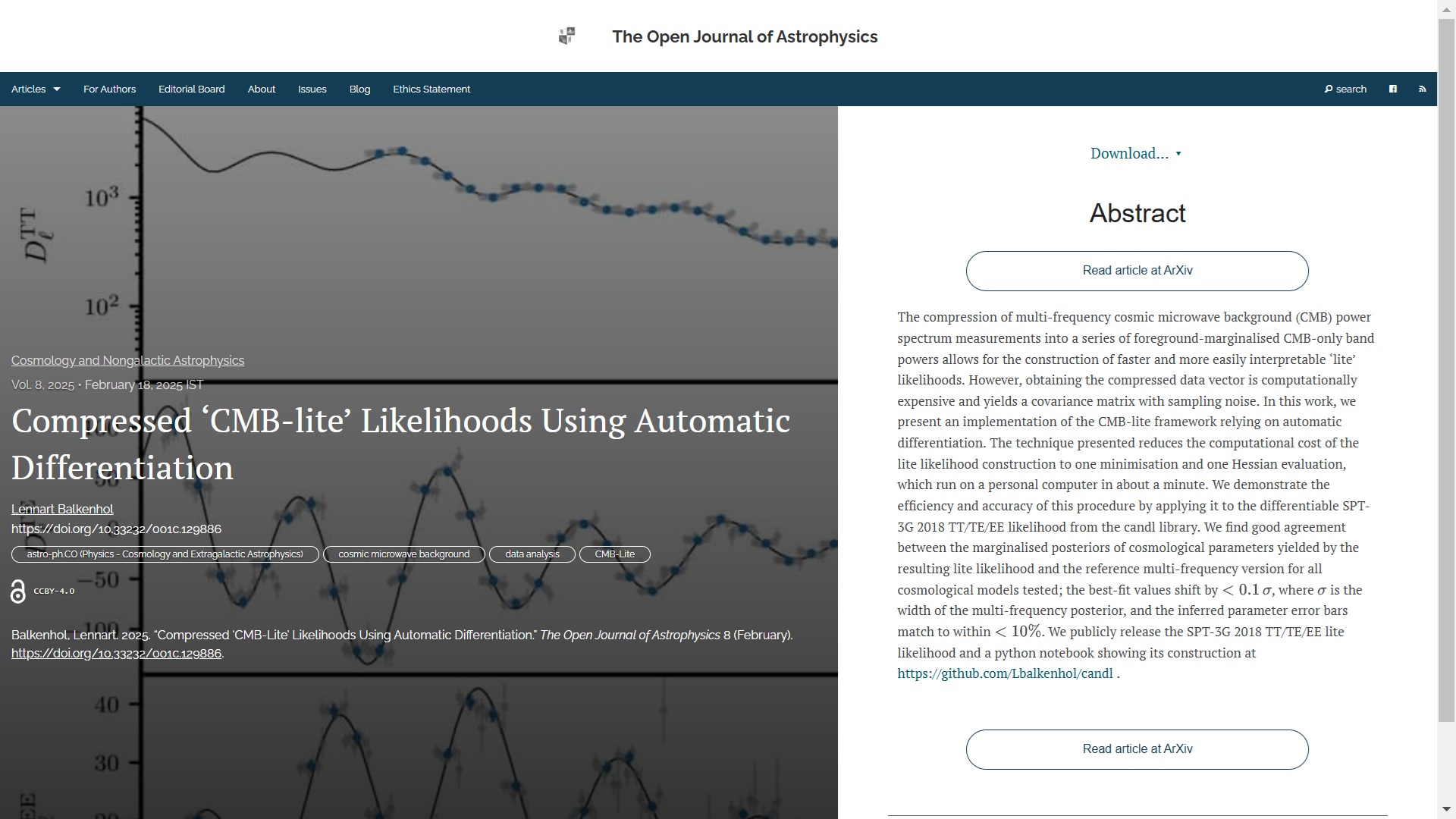
Anyway, the first paper of the most recent pair – published on January 30th – is “Capse.jl: efficient and auto-differentiable CMB power spectra emulation”, by Marco Bonici (INAF Milano, Italy & Waterloo, Canada), Federico Bianchini (Stanford, USA) and Jaime Ruiz-Zapatero (Oxford, UK). This paper presents an emulator for rapid and accurate prediction of Cosmic Microwave Background (CMB) temperature, polarization, and lensing angular power spectra, that works much faster than traditional methods. The code is written in Julia, in which language we are seeing an increasing number of submissions to OJAp.

Here is a screen grab of the overlay which includes the abstract:


You can click on the image of the overlay to make it larger should you wish to do so. You can find the officially accepted version of the paper on the arXiv here.

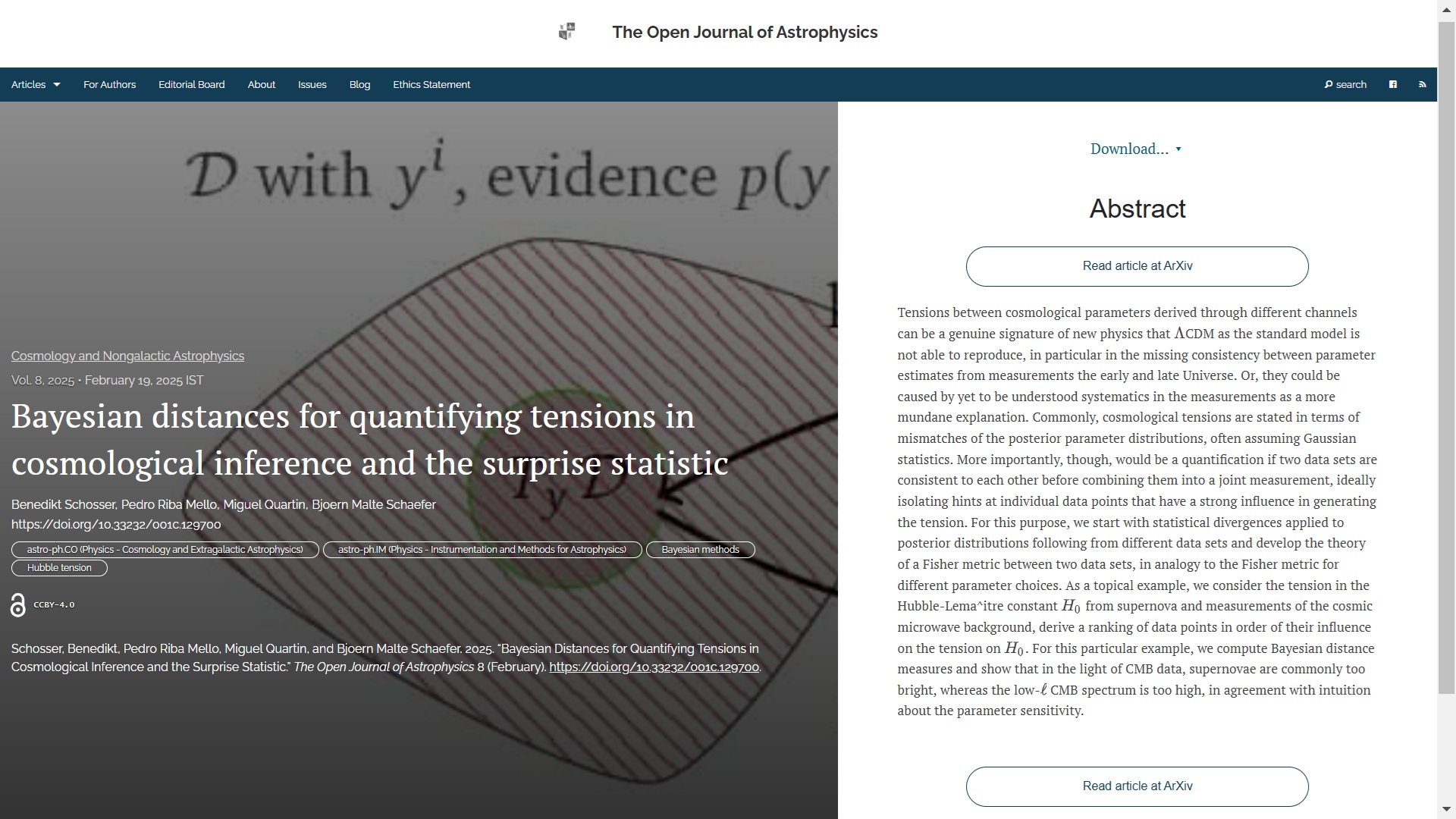
The second paper was published yesterday (31st January 2024) and has the title “Cosmological Inflation in N-Dimensional Gaussian Random Fields with Algorithmic Data Compression” which is a  study of inflationary models with Gaussian random potentials for multiple scalar fields, tracking the evolutionary trajectories numerically. The authors are Connor Painter and Emory Bunn, both the Physics Department at the University of Richmond, Virginia (USA). Ted Bunn (as he is usually known) is a longstanding member of the Editorial Board of the Open Journal of Astrophysics (and was thereby excluded from any involvement in the editorial process for this paper).

Here is a screen grab of the overlay which includes the abstract:


You can click on the image of the overlay to make it larger should you wish to do so. You can find the officially accepted version of the paper on the arXiv here.

Here Endeth the Update.

IOAP Diamond Open Access Awards 2024

Posted in Open Access with tags , , , , , , , , , , on January 17, 2024 by telescoper

A week or so before Christmas I posted about a new organization called Irish Open Access Publishers whose mission statement is as follows:

Irish Open Access Publishers (IOAP) is a community of practice driven by Irish open access publishers for Irish open access publishers.  The IOAP promotes engagement with the Diamond Open Access publishing model (free to publish and free to read) as well as indexing on the Directory of Open Access Journals and the Directory of Open Access Books. The aim of this dynamic community of practice is to promote publishing activity that is free of pay walls and publication embargoes to further the dissemination of high quality scholarly output to all in society.

These aims are laudable and I support them wholeheartedly. I should also mention that the Open Journal of Astrophysics is listed in the Directory of Open Access Journals here, where you will find details of all the papers we have published so far. This index is all part of the service. We have also been accepted for inclusion in Scopus, in case that matters to you.

Anyway, I thought I would remind readers of this blog (both of them) about the fact that the IOAP is offering a new set of awards, for which nominations are now open:

(Unfortunately the links in the above image are not clickable, but you can the award details here…)

Nominations for the first three categories are by self-nomination only. I will of course, on behalf of Maynooth Academic Publishing, the Editorial Board, the authors, and everyone who has helped behind the scenes, be nominating the Open Journal of Astrophysics.

Nominations for the final category, Outstanding Contribution to the OA Field are described thus:

Category 4 welcomes third party as well as self nominations from academics, students, librarians, research managers, academic leaders, publishers and other stakeholders across further and higher education for an individual who has made an outstanding contribution to open access publishing in Ireland. Nominations from scholarly societies and other scholarly organisations are also welcome. Nominations for individuals based in Northern Ireland are also invited.

Self nominations are restricted to individuals based in Ireland including Northern Ireland. Third party nominations are invited from individuals based in Ireland including Northern Ireland as well as individuals based overseas. All third party nominations must be for individuals practising in the field of open access publishing in Ireland including Northern Ireland solely.

Notice that nominations are not restricted to individuals based in Ireland. So, wherever you are, if you can think of any individual based in Ireland who has done enough to merit being described as having made an “outstanding contribution”, perhaps not only for being a long-term advocate of Diamond Open Access but also for setting up and being Managing Editor of a successful Diamond Open Access journal in the field of astrophysics, then please feel free to nominate me them. I hope you get the message. If you want subtle, you’ve come to the wrong place!

The nomination form is here. The closing date for nominations is 1st February 2024.

Here’s to a Diamond New Year…

Posted in Open Access with tags , , on January 1, 2024 by telescoper

I know it’s New Year’s Day but I am going to start 2024 the way I mean to continue it, i.e. by banging on about Diamond Open Access. In that vein I am delighted to share a link to a discussion document (by Pierre Mounier & Johan Rooryck) that echoes much of what I have been saying on the subject for quite a while (e.g. here). In my view the ratio of talk to action has been far too high in this context, and the good thing about this document is that it makes concrete practical proposals for a global infrastructure that could support the transition to Diamond Open Access worldwide:

The infrastructure will take the shape of a four-level federation, with  each level having its own responsibilities to achieve the shared goal of strengthening diamond open access as a leading scholarly communication model. These levels and their responsibilities are presented in this paper, initiating  a discussion with diamond OA communities and other stakeholders in the research landscape. We invite you to come forward and join this discussion.

You can read more here.

Here is a nice illustration:

A global system of federated diamond Open Access repositories would enable a truly innovative and equitable ecosystem for scholarly publication and realize the vision of research as a global public good, which is what it should be. I think Ireland is in a good position to play a leading role in this revolution, actually, as there is much going on in this respect (e.g. in the construction of a national peer review platform).

P.S. I think that a federated system of social media for public institutions is the way to go, too.

IOAP Diamond Open Access Awards 2024

Posted in Open Access with tags , , , , , , , , on December 18, 2023 by telescoper

Last week I found out about a new organization called Irish Open Access Publishers whose mission statement is as follows:

Irish Open Access Publishers (IOAP) is a community of practice driven by Irish open access publishers for Irish open access publishers.  The IOAP promotes engagement with the Diamond Open Access publishing model (free to publish and free to read) as well as indexing on the Directory of Open Access Journals and the Directory of Open Access Books. The aim of this dynamic community of practice is to promote publishing activity that is free of pay walls and publication embargoes to further the dissemination of high quality scholarly output to all in society.

These aims are laudable and I support them wholeheartedly. I should also mention that the Open Journal of Astrophysics is listed in the Directory of Open Access Journals here, where you will find details of all the papers we have published so far. This index is all part of the service.

The reason I found out about the existence of IOAP is that they are offering a new set of awards, for which nominations are now open:

(Unfortunately the links in the above image are not clickable, but you can the award details here…)

Nominations for the first three categories are by self-nomination only. I will of course, on behalf of Maynooth Academic Publishing, the Editorial Board, the authors, and everyone who has helped behind the scenes, be nominating the Open Journal of Astrophysics.

Nominations for the final category, Outstanding Contribution to the OA Field are described thus:

Category 4 welcomes third party as well as self nominations from academics, students, librarians, research managers, academic leaders, publishers and other stakeholders across further and higher education for an individual who has made an outstanding contribution to open access publishing in Ireland. Nominations from scholarly societies and other scholarly organisations are also welcome. Nominations for individuals based in Northern Ireland are also invited.

Self nominations are restricted to individuals based in Ireland including Northern Ireland. Third party nominations are invited from individuals based in Ireland including Northern Ireland as well as individuals based overseas. All third party nominations must be for individuals practising in the field of open access publishing in Ireland including Northern Ireland solely.

Notice that nominations are not restricted to individuals based in Ireland. So, wherever you are, if you can think of any individual based in Ireland who has done enough to merit being described as having made an “outstanding contribution”, perhaps not only for being a long-term advocate of Diamond Open Access but also for setting up and being Managing Editor of a successful Diamond Open Access journal in the field of astrophysics, then please feel free to nominate me them. I hope you get the message. If you want subtle, you’ve come to the wrong place!

The nomination form is here. The closing date for nominations is 1st February 2024.

Towards a New Ecosystem for Scientific Publication

Posted in Open Access with tags , , , on October 4, 2023 by telescoper

A few days ago I posted an item about how the current system of scientific publication is under such intolerable strain that it is no longer fit for purpose. This is something I’ve felt for a while. Some time ago I wrote a post musing about what should replace it. That article included this:

I know I’m not alone in thinking that the current publishing ecosystem is doomed and will die a natural death soon enough. In my view the replacement should be a worldwide network of institutional and/or subject-based repositories that share research literature freely for the common good.

https://telescoper.blog/2023/09/12/lets-make-no-pay-open-access-real/

The Open Journal of Astrophysics was set up to demonstrate a way of achieving this kind of change in the field of Astrophysics. With this in mind I was delighted to to see a paper in PLOS Biology by Richard Sever (published just yesterday) with the following abstract:

Academic journals have been publishing the results of biomedical research for more than 350 years. Reviewing their history reveals that the ways in which journals vet submissions have changed over time, culminating in the relatively recent appearance of the current peer-review process. Journal brand and Impact Factor have meanwhile become quality proxies that are widely used to filter articles and evaluate scientists in a hypercompetitive prestige economy. The Web created the potential for a more decoupled publishing system in which articles are initially disseminated by preprint servers and then undergo evaluation elsewhere. To build this future, we must first understand the roles journals currently play and consider what types of content screening and review are necessary and for which papers. A new, open ecosystem involving preprint servers, journals, independent content-vetting initiatives, and curation services could provide more multidimensional signals for papers and avoid the current conflation of trust, quality, and impact. Academia should strive to avoid the alternative scenario, however, in which stratified publisher silos lock in submissions and simply perpetuate this conflation.

https://doi.org/10.1371/journal.pbio.3002234

(I added the emphasis). In case you were not aware, Richard Sever is a cofounder of the preprint servers bioRxiv and medRxiv.

I’m very glad to see similar thoughts to those I expressed about astrophysics being echoed in the field of biomedicine. I hope that more disciplines follow this path. The way it is realized will no doubt be domain-specific, but the benefits of such a new ecosystem will be for all science.

Let’s Make “No pay” Open Access Real…

Posted in Open Access, Politics with tags , on September 12, 2023 by telescoper

I took the liberty of reblogging this short post by Olivier Pourret about “No Pay” Open Access to direct readers to it and to make a couple of points. One is that you have to realize that “publishing-industry representatives” have a vested interest in the much of the discussion is about possible models for what might happen in the future, some of us have been busy making “No Pay” Open Access real in the here and now.

For some background, the article refers to a Council of Europe a document (PDF) that calls for “transparent, equitable, and open access to scholarly publications”.  In its conclusions, the Council calls on the Commission and the member states to support policies towards a scholarly publishing model that is not-for-profit, open access and multi-format, with no costs for authors or readers. In other words, it calls for Diamond Open Access. The covering press release includes:

If we really believe in open science, we need to make sure that researchers can make their findings available and re-usable and that high-quality scientific articles are openly accessible to anyone that needs to read them. This should be particularly the case for research that benefits from public funding: what has been paid by all should be accessible to all.

Mats Persson, Swedish Minister for Education, Ministry of Education and Research

This is clearly how Open Access should be, though I am still worried that the sizeable publishing lobby will still try to persuade research agencies and institutions to pay the existing fees on behalf of authors, which does not solve the problem but merely hides it.

I know I’m not alone in thinking that the current publishing ecosystem is doomed and will die a natural death soon enough. In my view the replacement should be a worldwide network of institutional and/or subject-based repositories that share research literature freely for the common good. Universities and research centres should simply bypass the grotesque parasite that is the publishing industry. Indeed, I would be in favour of hastening the demise of the Academic Journal Racket by having institutions make it a disciplinary offence for any researcher to pay an APC to any journal.

We are lucky in physics and astronomy because arXiv has already done the hard work for us. With the existence of arXiv, old-style journals are no longer necessary. It is great that arXiv is being joined by similar ventures in other fields, such as BiorXiv and EarthArxiv. A list of existing repositories can be found here. I’m sure many more will follow. The future is Diamond.

What is needed is a global effort to link these repositories to each other and to peer review mechanisms. One way is through overlays, as demonstrated by the Open Journal of Astrophysics, there being no reason why the idea can’t be extended beyond arXiv. Other routes are possible, of course, and some of these are mentioned in the article I reposted. I would love to see different models developed, but that needs action, not words.