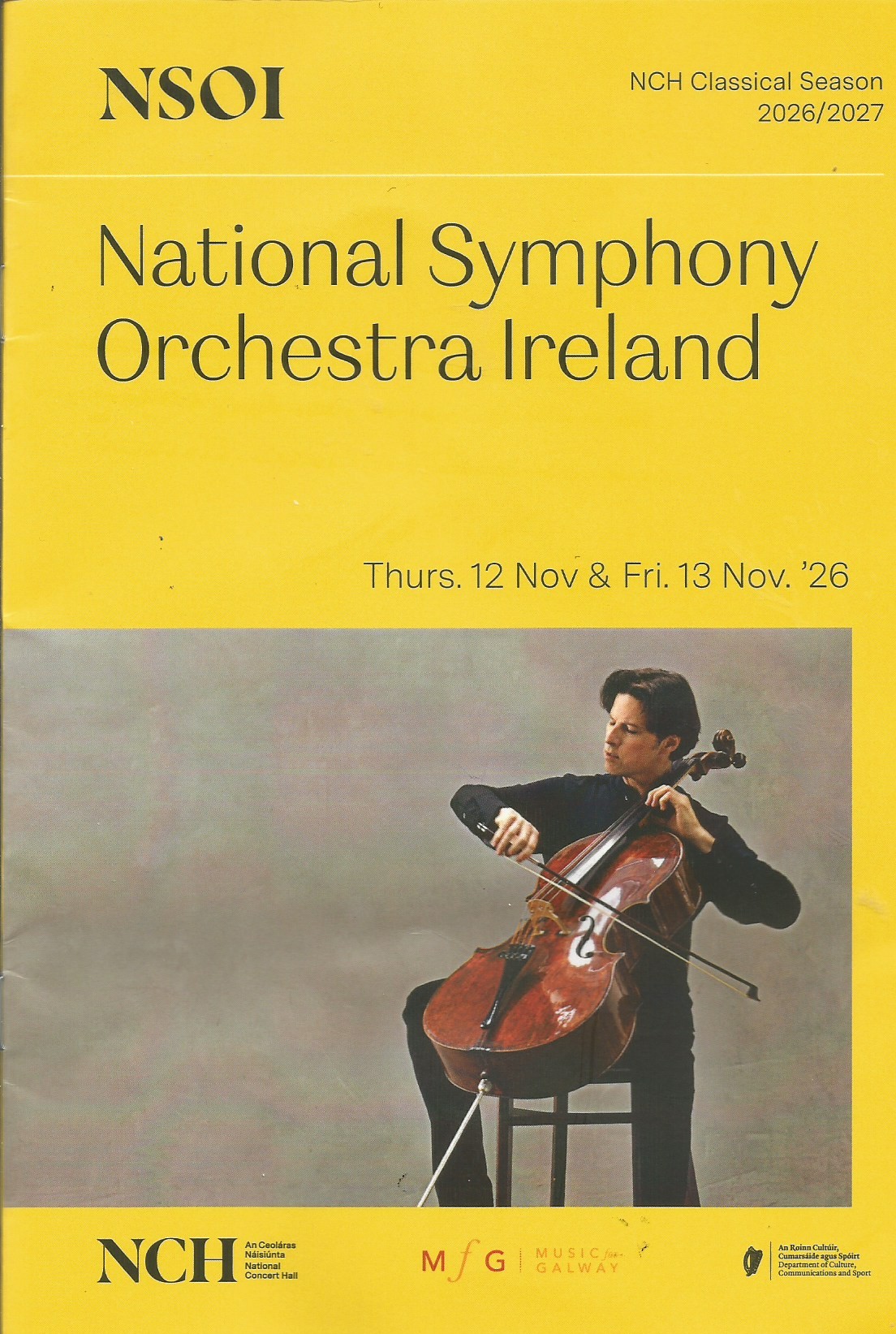
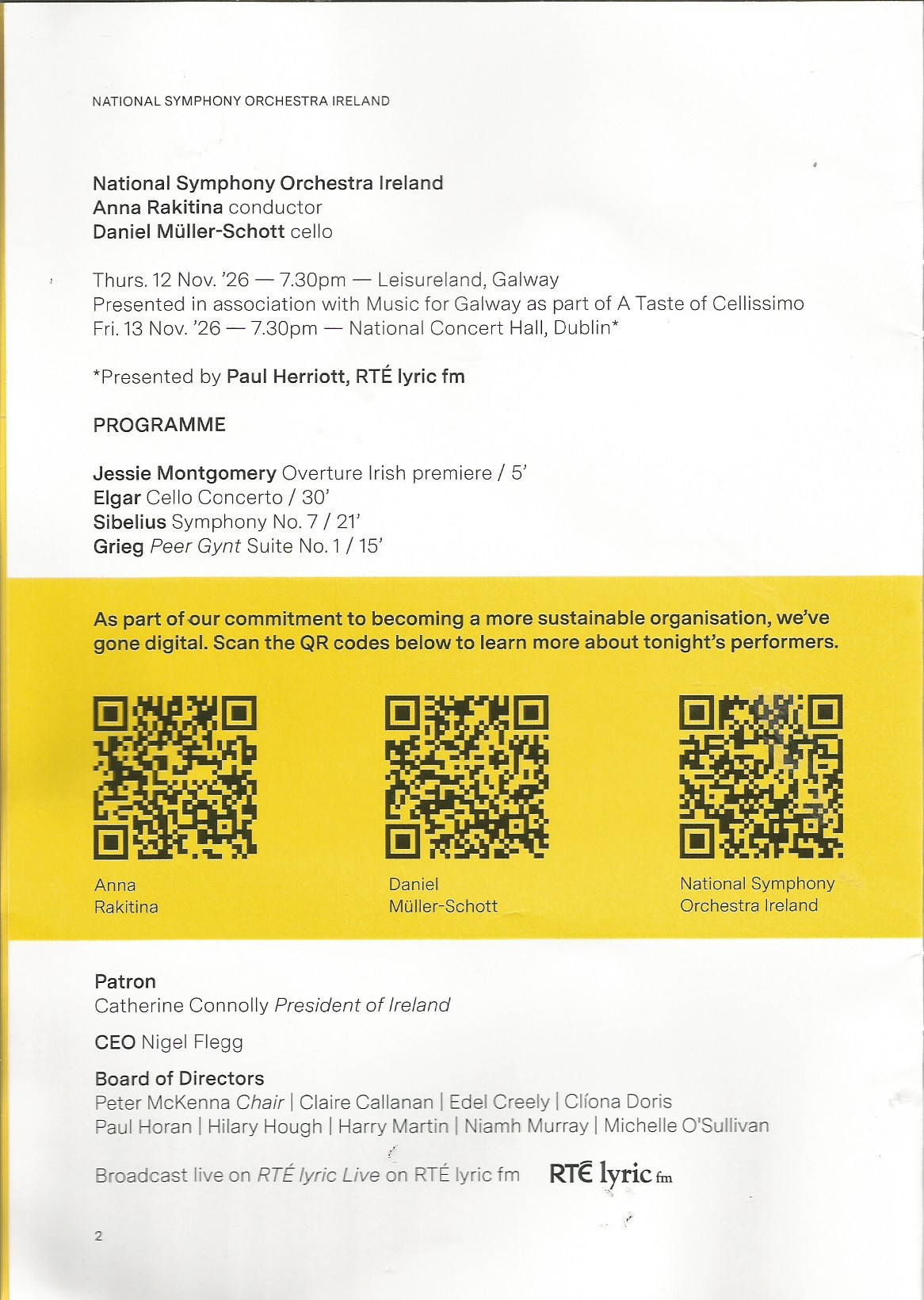
Yesterday evening I once again took the train into Dublin for a concert by National Symphony Orchestra Ireland at the National Concert Hall in Dublin. The guest conductor for this occasion was Anna Rakitina.
After an appetiser in the form of a short piece called Overture by American composer Jessie Montgomery (no, not the gay pornstar), the main item for the first half of the concert was the Cello Concerto in E Minor by Edward Elgar. This was completed in 1919 but didn’t really become a regular part of the concert repertoire until the 1960s, largely as a result of the landmark recording by Jacqueline du Pré. I’ve never really rated Elgar as a great composer but I do think that his cello concerto is a masterpiece. It certainly has a great emotional depth than any other work that I can think of, with the possible exception of the Dream of Gerontius. The melodic beauty of the first movement Adagio really pulls at the heartstrings, but thereafter charts a path through varied moods and soundscapes, ending rooted in its minor key when other works of this type often shift into a major tonality. Although it is, at times, agitated and edgy, the overall atmosphere is sombre and reflective.
Last night’s soloist was Daniel Müller-Schott who gave a very fine account of this much-loved work, and returned to the stage after a standing ovation to give us an encore in the form of the wonderful Gigue from the Cello Suite No. 3 in C Major by Johann Sebastian Bach. That reminded that I must listen to the Bach Cello Suites again, as it has been far too long.
After the wine break we returned for the Symphony No. 7 by Jean Sibelius. This is very short for a symphony – only about 20 minutes – and is in a single movement. It’s also in C Major which you might think is a rather “plain” key for Sibelius to have chosen, but the piece is highly original in construction and wonderful to listen to in live performance. I have various recordings of Sibelius Symponies 1-6, but don’t have any of this one. I’d be grateful for any recommendations.
To end the concert we had the Peer Gynt Suite No. 1 by Edvard Grieg. This comprises some of the incidental music that Grieg wrote for Henrik Ibsen‘s play Peer Gynt. There are four pieces in the Suite, all of them very well established in the popular classics genre. My favourite is perhaps the least known of the four: a poignant expression of grief, The Death of Åse depicts the death of Peer Gynt’s mother; I think its simplicity makes it all the more moving. The most famous part is probably Morning which evokes a Nordic pastoral sunrise, except the setting in the play is North Africa.
I have to say I found it a strange choice to end the concert with this suite. It’s not that I dislike it, just that I think I prefer to finish with a more substantial work. I suppose it was added in because the Sibelius symphony is so short – normally a symphony would fill the entire second half of such a concert. Nevertheless it did send me home wanting to listen to Duke Ellington’s version of Peer Gynt.
Incidentally, on the way to the NCH earlier in the evening, around 6.30pm, while I walked down the western side of Merrion Square, I noticed a Garda cordon. I didn’t think much about it as there had been restrictions in Dublin for a few days owing to various European summits and whatnot. It was only when I got home that I realised that an explosive device had been placed there and dealt with by the defence forces…


