Archive for ESA

Gearing up for Thursday’s Euclid News

Posted in Euclid, Maynooth, The Universe and Stuff with tags , , , , , , , on May 21, 2024 by telescoper

It’s a hectic time ahead of a Big Event on Thursday 23rd May, which will include the publication of five new Early Release Observations (EROs). I’m not at liberty to say what they are until after 12 noon (CEST) on Thursday except that they’re very pretty. You can watch the live stream here:

Including the five released on November 7th 2023 that will bring the total to ten. All the ERO pictures will be available on the ESA archive here.

Thursday will also see the release of ten scientific papers related to the EROs; they will appear on arXiv on Friday 24th May. These will be the first science results from the Euclid mission.

But that’s not all! Thursday will also see the publication of five papers from the Euclid Consortium (of which I am the sole member based in Ireland). These will be the principal technical reference papers aimed at the astronomical community about the Euclid mission, covering the instruments, cosmology and other astronomy science possibilities, as well as the cosmological simulations used to assist the analysis of the mission. One of these, the main overview paper for the mission, has over a thousand authors (one of whom is your truly).

Thursday’s announcements are likely to significant level of press interest. That’s not only due to the European Space Agency’s own social media feeds and the like, but also local activities in Ireland. For example, there’s this from Science Foundation Ireland using this, from the Little Book of Irish Research:

I have also written a piece for RTÉ Brainstorm, as a kind of update on the one I wrote last year on the occasion of the launch; this will go live after the embargo is lifted on Thursday.

Euclid on Ice

Posted in Euclid, The Universe and Stuff with tags , , , , , , on March 25, 2024 by telescoper

I thought it would be appropriate to add a little update about the European Space Agency’s Euclid mission. I’ll keep it brief here because you can read the full story on the official website here.

You may have seen in the news that the Euclid telescope has been having an issue with ice forming on surfaces in its optical systems, especially the VIS instrument. This is a common problem with telescopes in space, but the extent of it is not something that can be predicted very accurately in advance so a detailed strategy for dealing with it had to be developed on the go.

The layers of ice that form are very thin – just tens of nanometres thick – but that is enough to blur the images and also reduce the throughput of the instruments. Given that the objects we want Euclid to see are faint, and we need very sharp images then this is an issue that must be dealt with.

Soon after launch, the telescope was heated up for a while in order to evaporate as much ice as possible, but it was not known how quickly the ice would return and to what parts of the optical system. After months in the cold of space the instrument scientists now understand the behaviour of the pesky ice a lot better, and have devised a strategy for dealing with it.

The approach is fairly simple in principle: heat the affected instruments up every now and again, and then let them cool down again so they operate; repeat as necessary as ice forms again. This involves an interruption in observations, it is known to work pretty well, but exactly how frequently this de-icing cycle should be implemented and what parts of the optical system require this treatment are questions that need to be answered in practical experimentation. The hope is that after a number of operations of this kind, the amount of ice returning each time will gradually reduce. I am not an expert in these things but I gather from colleagues that the signs are encouraging.

For more details, see here.

UPDATE: The latest news is that the de-icing procedure has worked better than expected! There’s even a video about the result of the process here:

Euclid in the Media

Posted in Euclid, The Universe and Stuff with tags , , , , , on December 3, 2023 by telescoper

Yesterday came across the above “infographic” – as I’m told such things are called – showing the media traffic generated by last month’s Early Release Observations from the ESA Euclid mission. Some quite interesting facts emerge from it. The new observations were released n 7th November, hence the big spike in the left hand panel on that date.

I see that about 31% of the activity was on Twitter, which I am no longer on, with a slightly smaller amount on Facebook. Overall, social media account for about 60% of the “reach”, with mainstream media (including print, online, and TV/Radio) languishing far behind. Blogs (presumably including this one) account for a mere 1%.

The breakdown by country is interesting too; the table shows only EAS member states. The UK is way out in front, no doubt because BBC News ran a major item on the day of the release. France, Germany, Italy and Spain all have major scientific involvements in Euclid and correspondingly active public engagement activities.

I was pleasantly surprised at the significant amount of interest in Ireland, given that some bigger countries with far greater scientific involvement in Euclid (e.g. Denmark and The Netherlands) generated so little. As the only member of the Euclid Consortium in Ireland I could try to pretend that this was all down to me, but I rather think it’s more likely to be a result of the fact that many Irish people read the UK media so some of the Irish traffic could be spillover from the big UK spike. Still, I think one can interpret this as meaning that the Public in the Republic have an appetite for news about space, something that we have certainly noticed when organizing events in Maynooth.

I thought I’d mention another nice thing. Here is one of the PR images produced by ESA about the early release observations. The point about Euclid is that to achieve its science goals it has to have extremely good optical quality across a very wide field of view. The systems are currently being tested and fine-tuned to see how good their performance actually is, but so far it’s looking good.

The main thing that caught my eye, however, is the collection of little flags along the bottom. How nice it is to see Ireland’s among them!

Ireland, CERN and Science

Posted in Science Politics, The Universe and Stuff with tags , , , , , on November 15, 2023 by telescoper

And lo! it came to pass that Minister for Further and Higher Education, Research, Innovation and Science Simon Harris TD has today secured Government approval to submit Ireland’s formal application to join the European Organization for Nuclear Research (CERN) as an Associate Member.

I have posted about this before, for example here. Currently Ireland is in the anomalous position of not having any form of association agreement with CERN; the list of Full and Associate Member states can be found here.

There is an important point about CERN membership, however, which I hope is not sidelined. The case for joining CERN made at political levels is largely about the return in terms of the potential in contracts to technology companies based in Ireland from instrumentation and other infrastructure investments. This was also the case for Ireland’s membership of the European Southern Observatory, which Ireland joined about five years ago. The same thing is true for involvement in the European Space Agency, which Ireland joined in 1975. These benefits are of course real and valuable and it is entirely right that arguments should involve them.

Looking at CERN membership from a scientific point of view, however, the return to Ireland will be negligible unless there is a funding to support scientific exploitation of the facility. That would include funding for academic staff time, and for postgraduate and postdoctoral researchers to build up an active community as well as, e.g., computing facilities. This need not be expensive even relative to the modest cost of associate membership (approximately  €1.9M). I would estimate a figure of around half that would be needed to support CERN-based science.

The problem is that research funding for fundamental science (such as particle physics) in Ireland is so limited as to be virtually non-existent by a matter of policy at Science Foundation Ireland, which basically only funds applied research. Even if it were decided to target funding for CERN exploitation, unless there is extra funding that would just lead to the jam being spread even more thinly elsewhere.

As I have mentioned before, Ireland’s membership of ESO provides a cautionary tale. The Irish astronomical community was very happy about the decision to join ESO, but that decision was not accompanied by significant funding to exploit the telescopes. Few astronomers have therefore been able to benefit from ESO membership. While there are other benefits of course, the return to science has been extremely limited. The phrase “to spoil a ship for a ha’porth of tar” springs to mind.

Although Ireland joined ESA almost fifty years ago, the same issue applies there. ESA member countries pay into a mandatory science programme which includes, for example, Euclid. However, did not put any resources on the table to allow full participation in the Euclid Consortium. There is Irish involvement in other ESA projects (such as JWST) but this is somewhat piecemeal. There is no funding programme in Ireland dedicated to the scientific exploitation of ESA projects.

Under current arrangements the best bet in Ireland for funding for ESA, ESO or CERN exploitation is via the European Research Council but to get a grant from that one has to compete with much better developed communities in those areas.

A significant shake-up of research funding in Ireland is in view, with Science Foundation Ireland and the Irish Research Council set to merge into a single entity called Research Ireland. If I had any say in the new structure I would set up a pot of money specifically for the purposes I’ve described above. Funding applications would have to be competitive, of course, and I would argue for a panel with significant international representation to make the decisions. But for this to work the overall level of public sector research funding will have to increase dramatically from its current level, well below the OECD average. Ireland is currently running a huge Government surplus which is projected to continue growing until at least 2026. Only a small fraction of that surplus would be needed to build viable research communities not only in fundamental science but also across a much wider range of disciplines. Failure to invest now would be a wasted opportunity.

Research Matters

Posted in Science Politics, The Universe and Stuff with tags , , , , , on September 10, 2023 by telescoper

One of the things that happened last week while I was preoccupied with ITP2023 is that, finally, the UK Government has decided to re-join the European Union’s Horizon 2020 project. I’m very happy about this, and can’t understand why it has taken so long to reach an agreement. I know many researchers in the UK who will be mightily relieved too. Of course things won’t immediately get back to normal. It’s not just that the UK contributions will start in January 2024 so there will have to be some sort of transitional arrangement. More importantly it remains to be seen how long it takes to repair the damage done to goodwill by all the political shenanigans.

While I’m on about research I should also mention that there was a short talk at ITP2023 by a particle physicist by the name of Ronan McNulty who is based at University College Dublin. The topic of that talk was the history of Ireland’s non-membership of CERN; I have blogged about this before, for example here. Currently Ireland is in the anomalous position of not having any form of association agreement with CERN; the list of Full and Associate Member states can be found here. It does seem, however, that Ireland is at last about to lodge an application for Associate Membership, perhaps as early as January 2024.

Ronan made a particularly important point about membership, which I hope is not sidelined in the discussions. The case for joining CERN made at political levels is largely about the return in terms of the potential in contracts to technology companies based in Ireland from instrumentation and other infrastructure investments. This was also the case for Ireland’s membership of the European Southern Observatory, which Ireland joined about five years ago. The same thing is true for involvement in the European Space Agency, which Ireland joined in 1975. These benefits are of course real and valuable and it is entirely right that arguments should involve them.

Looking at CERN membership from a scientific point of view, however, the return to Ireland will be negligible unless there is a funding to support scientific exploitation of the facility. That would include funding for academic staff time, and for postgraduate and postdoctoral researchers to build up an active community as well as, e.g., computing facilities. This need not be expensive even relative to the modest cost of associate membership (approximately  €1.5M). I would estimate a figure of around half that would be needed to support CERN-based science.

The problem is that research funding for fundamental science (such as particle physics) in Ireland is so limited as to be virtually non-existent by a matter of policy at Science Foundation Ireland, which basically only funds applied research. Even if it were decided to target funding for CERN exploitation, unless there is extra funding that would just lead to the jam being spread even more thinly elsewhere.

As I have mentioned before, Ireland’s membership of ESO provides a cautionary tale. The Irish astronomical community was very happy about the decision to join ESO, but it was not accompanied by significant funding to exploit the telescopes. Few astronomers have therefore been able to benefit from ESO membership. While there are other benefits of course, the return to science has been extremely limited. The phrase “to spoil a ship for a ha’porth of tar” springs to mind.

Although Ireland joined ESA almost fifty years ago, the same issue applies there. ESA member countries pay into a mandatory science programme which includes, for example, Euclid. However, did not put any resources on the table to allow full participation in the Euclid Consortium. There is Irish involvement in other ESA projects (such as JWST) but this is somewhat piecemeal. There is no funding programme in Ireland dedicated to the scientific exploitation of ESA projects.

Under current arrangements the best bet in Ireland for funding for ESA, ESO or CERN exploitation is via the European Research Council but to get a grant from that one has to compete with much better developed communities in those areas.

A significant shake-up of research funding in Ireland is in view, with Science Foundation Ireland and the Irish Research Council set to merge into a single entity. If I had any say in the new structure I would set up a pot of money specifically for the purposes I’ve described above. Funding applications would have to be competitive, of course, and I would argue for a panel with significant international representation to make the decisions. But for this to work the overall level of public sector research funding will have to increase dramatically from its current level, well below the OECD average. Ireland is currently running a huge Government surplus which is projected to continue growing until at least 2026.

Only a small fraction of that surplus would be needed to build viable research communities not only in fundamental science but also across a much wider range of disciplines. Failure to invest now would be a wasted opportunity.

“First Light” Images from Euclid

Posted in Euclid, The Universe and Stuff with tags , , , , , on July 31, 2023 by telescoper

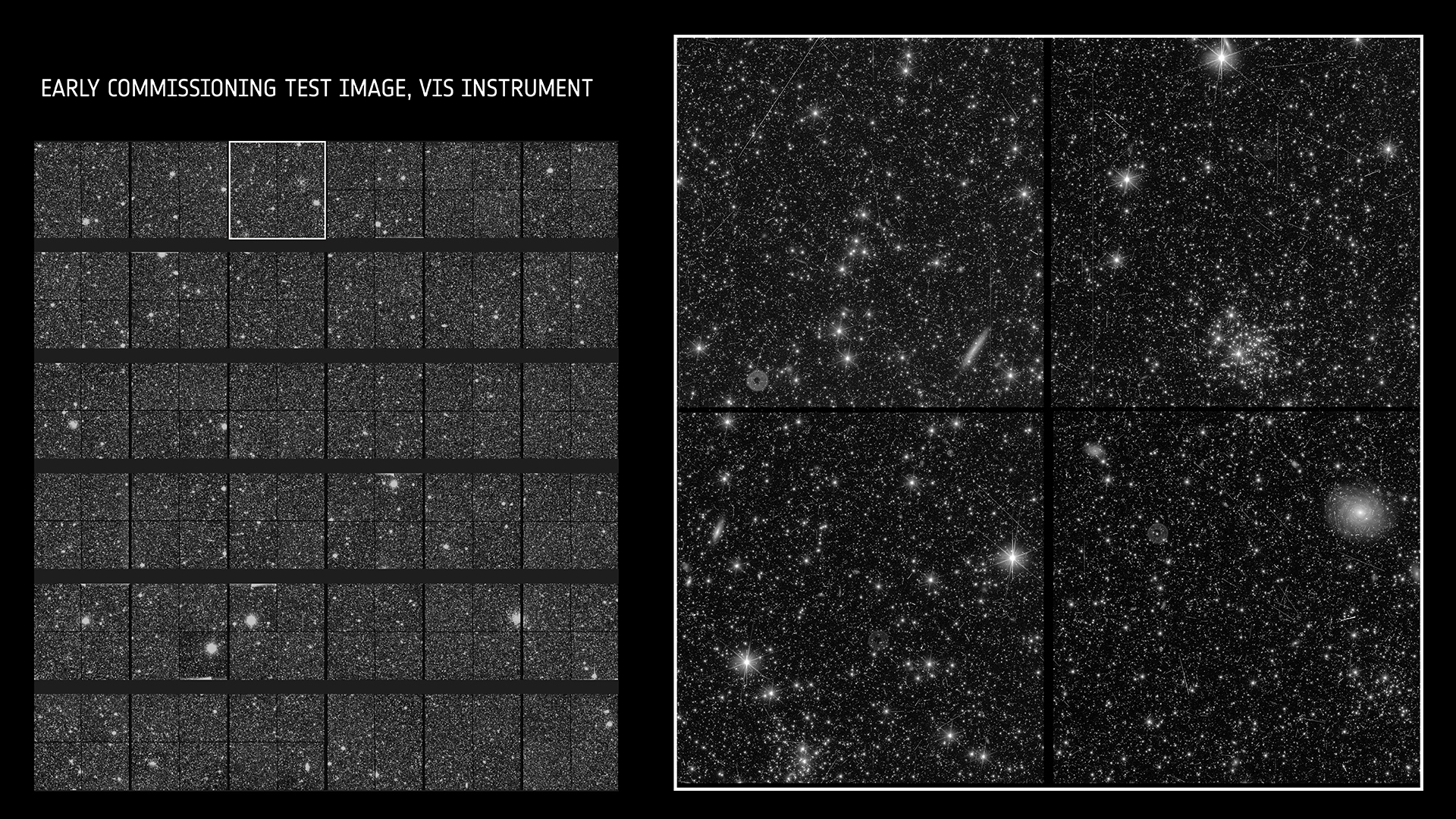
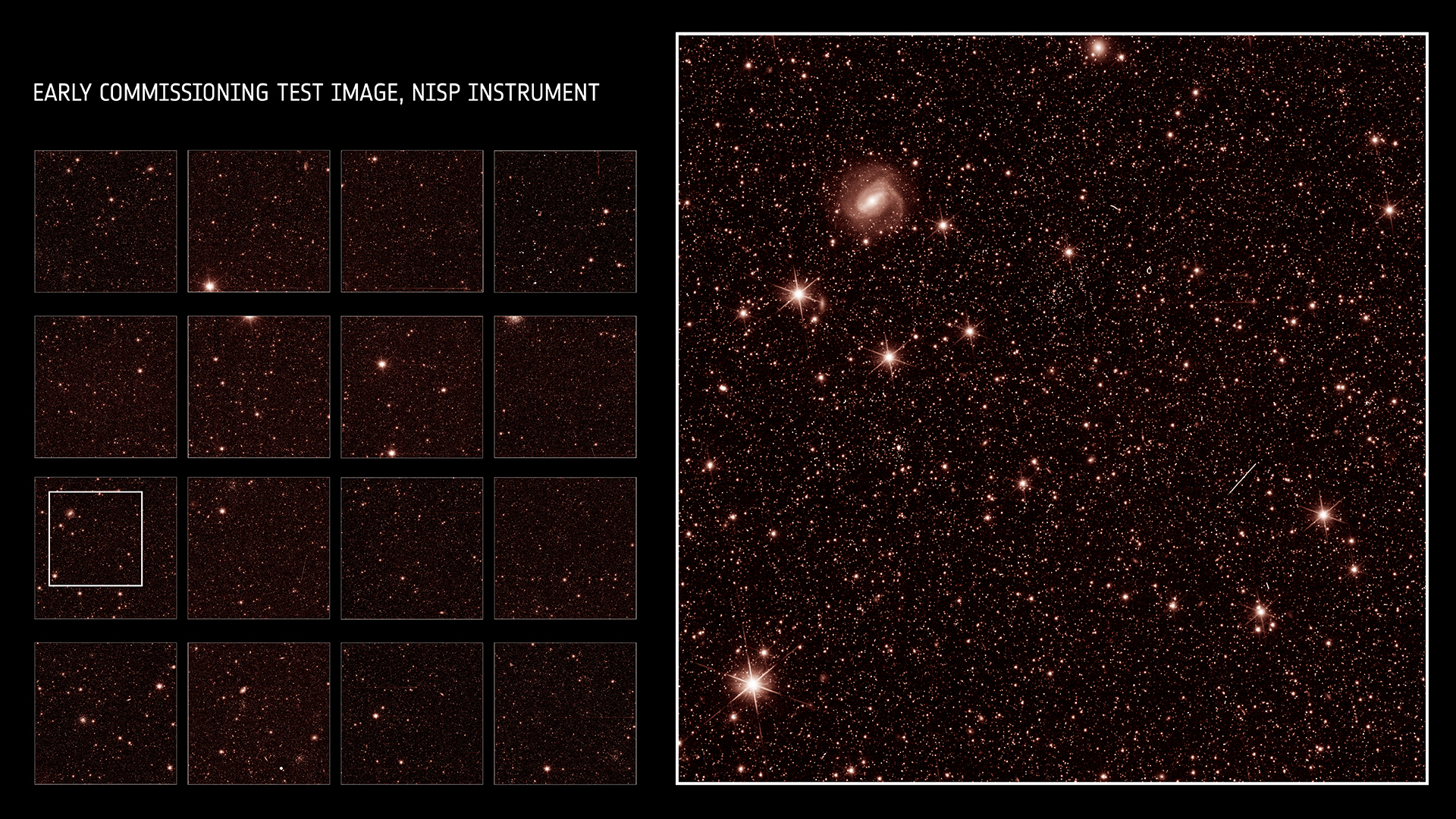
As I promised a couple of days ago, the “first light” images from the European Space Agency’s Euclid mission have now been released. You can find all the details here, but a summary is that these are “engineering” images, rather than part of the full survey to be undertaken by Euclid, and the commissioning of the instruments is not quite finished, but the telescope is now in focus and both instruments (the visual instrument, VIS, and the Near-Infrared Spectrometer & Photometer, NISP) are working well enough to show some preliminary results.

Anyway, here are the pictures released today, first from VIS:

Euclid early commissioning test images, showing an image by the VIS instrument (visible light). The full focal plane of VIS consisting of 36 detectors is shown on the left, and one detector in higher resolution on the right. Credits: © ESA/Euclid/Euclid Consortium/NASA, CC BY-SA 3.0 IGO

The next one is from NISP:

Euclid early commissioning test images, showing an image by the NISP instrument (near-infrared light). The full focal plane of NISP consisting of 16 detectors is shown on the left, and part of one detector in higher resolution on the right. Credits: © ESA/Euclid/Euclid Consortium/NASA, CC BY-SA 3.0 IGO

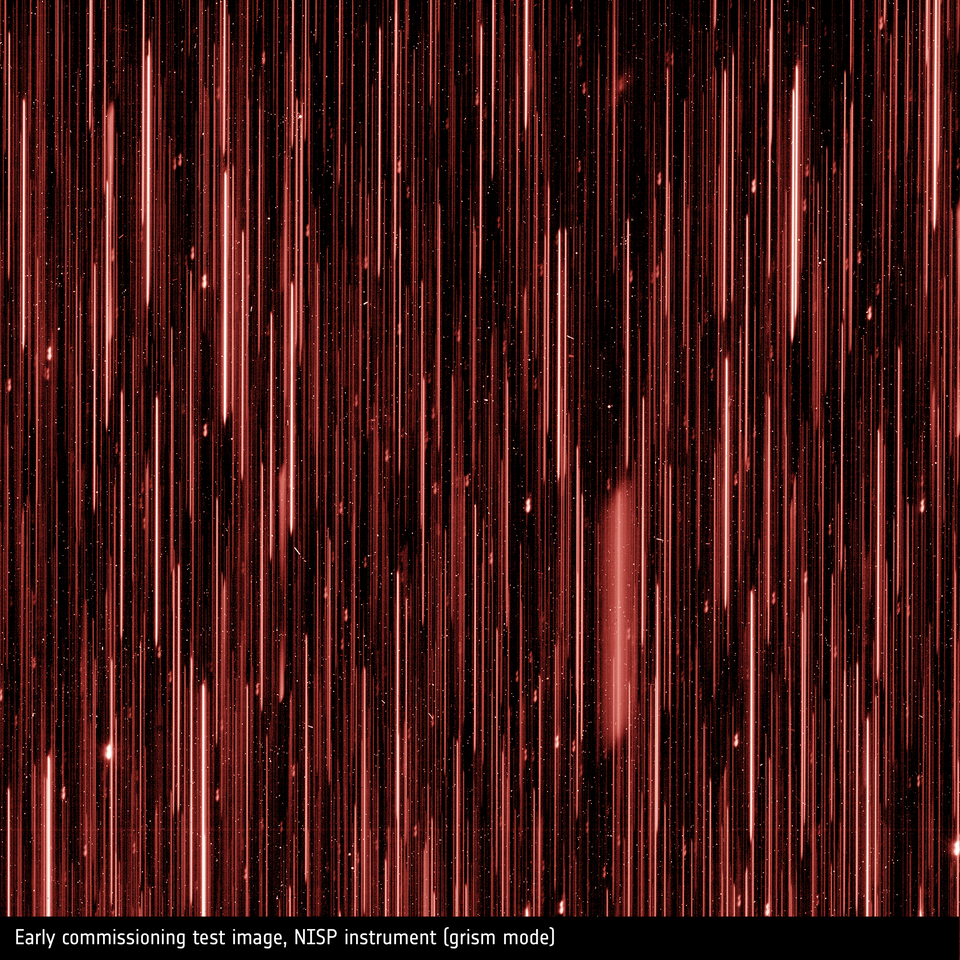
This final one, also from NISP, shows it working in grism mode, which allows the light from sources to be dispersed into a spectrum, enabling us to get much more information about the sources galaxies than a straightforward image would. The resulting images look a bit strange to the untrained eye – as the light from a point is spread out into a streak – but the result is wonderfully rich in information:

Euclid early commissioning test images, showing an image by the NISP instrument (near-infrared light), in its grism slitless spectroscopy mode. The full focal plane of NISP consists of 16 detectors, here a part of one detector is shown in full resolution. Credits: © ESA/Euclid/Euclid Consortium/NASA, CC BY-SA 3.0 IGO

For more information – and some higher-resolution images – see the official Euclid press release here.

For myself, I’d just say these images are absolutely amazing given that they were taken during the commissioning phase and the instruments aren’t fully tweaked yet. Over the next few weeks, there will be a performance verification phase which will tell us how good Euclid will be at meeting its science goals. But so far it’s all looking very good indeed. I’ve only ever seen simulations of what would come out and it’s very exciting to see what the real thing looks like!

Hats off to the brilliant instrumentation experts who not only designed and built the kit but who have been working so hard on the commissioning. They’ve done so much in the month that has passed since the launch!

P.S. You can find here a nice explainer of some of the instrumental artefacts you might have spotted in the images above.

How Euclid will scan the sky

Posted in The Universe and Stuff with tags , , , , , on February 7, 2023 by telescoper

A missive from Euclid High Command arrived yesterday confirming that ESA’s Euclid mission would be launched by SpaceX on a Falcon 9 rocket on a date between July 1st and July 30 (2023). It will soon be time to start getting nervous!

I also noticed that another video has appeared on the Euclid public website showing how the satellite will work. It’s not a traditional general-purpose observatory on which different users bid for time to observe different objects (as is the case for JWST, for example) but a dedicated mission that will compile a systematic survey with very specific science goals.

Euclid scans across the sky using a ‘step-and-stare’ method, combining separate measurements to form the largest cosmological survey ever conducted in the visible and near-infrared. Each time Euclid ‘stares’, its telescope points to a position in the sky, performing imaging and spectroscopic measurements on an area of approximately 0.5 deg² around this position. After each stare, the telescope steps to a new position.

This way the instruments will scan over a total of around 35% of the sky. This is the largest area over which one can guarantee a a complete detection of the galaxies necessary for Euclid’s cosmological studies. The rest of the sky is dominated by the high density of bright stars in our galaxy, and by the dust in the plane of our Solar System, both of which get in the way of the cosmology observations.

I hope this clarifies the situation.

In the Name of JWST

Posted in LGBTQ+, Politics, The Universe and Stuff with tags , , , , , on October 25, 2022 by telescoper

JWST – nice telescope, shame about the name

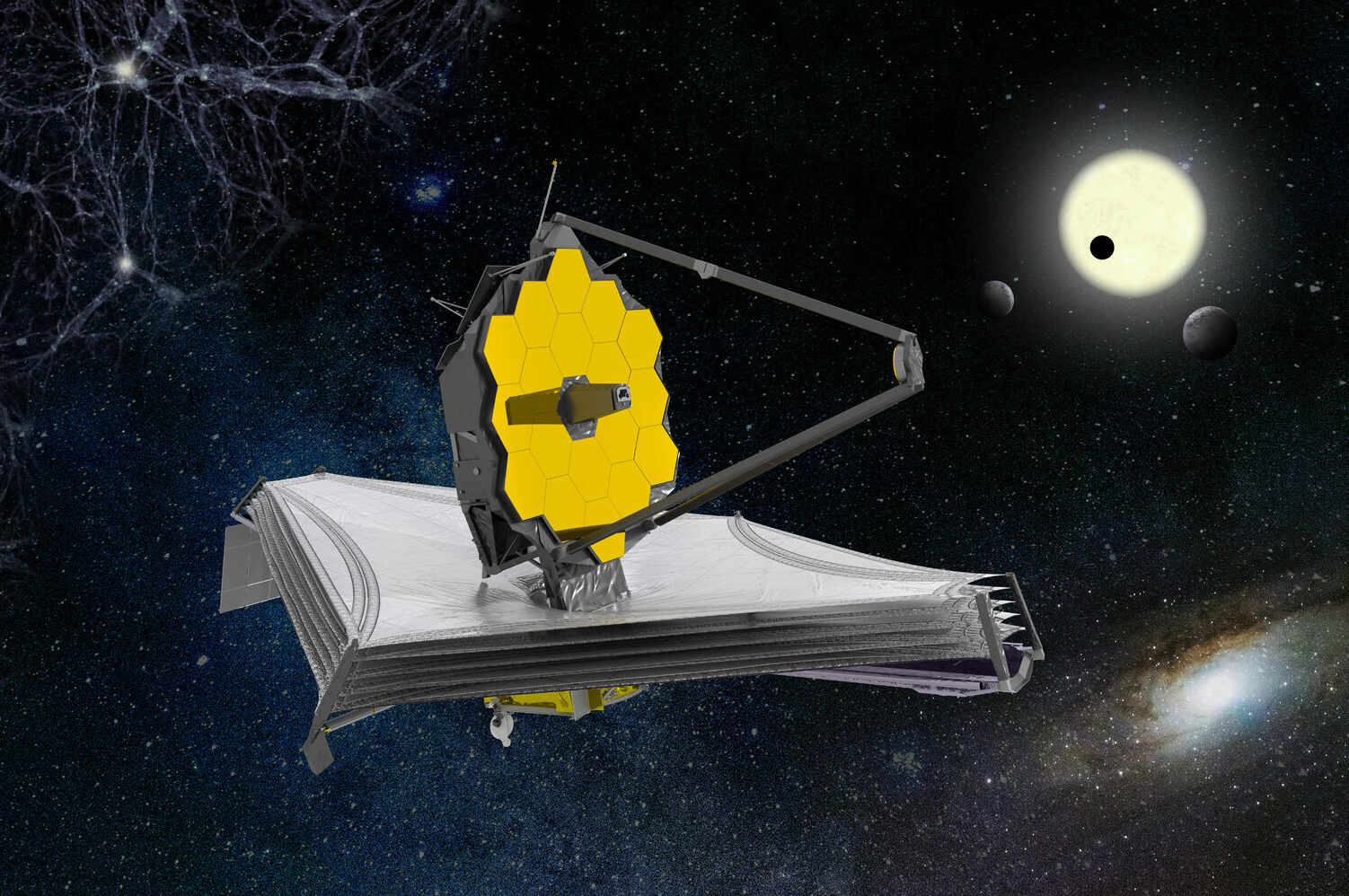
I’ve blogged before about the problematic naming of the James Webb Space Telescope. Its name was changed in 2002 from the Next Generation Space Telescope to the James Webb Space Telescope after James E. Webb, a civil servant who was NASA’s chief administrator from 1961 to 1968.

It’s not uncommon for scientific space missions like this to be named after people once the proposal has moved off the drawing board and into serious planning. That happened with the European Space Agency’s Planck and Herschel to give two examples. In any case Next General Space Telescope was clearly never anything but a working title. Yet naming this important mission after a Government official always seemed a strange decision to me. Then news emerged that James Webb had enthusiastically cooperated in a McCarthyite purge of LGBT+ people working in government institutions, part of a wider moral panic referred to by historians as the Lavender Scare. There have been high-profile protests (see, e.g., here) and a petition that received over a thousand signatures, but NASA has ruled out any change of name.

The main reason NASA give is that they found no evidence that Webb himself was personally involved in discrimination or persecution. I find that very unconvincing. He was in charge, so had responsibility for what went on in his organization. If he didn’t know then why didn’t he know? Oh, and by the way, he didn’t have anything to do with infrared astronomy either…

I still think it’s a shame that this fantastic telescope should have its image so tarnished by the adoption of an inappropriate name.

Anyway, yesterday I saw that the Royal Astronomical Society has issued a statement about this issue, which I encourage you to read in full. It begins

At its meeting in July the governing council of the Royal Astronomical Society (RAS) took a decision to write to the UK Space Agency, the European Space Agency (ESA) and NASA to express its concerns about the original JWST naming process, the apparent failure to investigate James Webb’s background and the dismissal of requests to rename the telescope.

Until that investigation takes place and the results are made public, the RAS now expects authors submitting scientific papers to its journals to use the JWST acronym rather than the full name of the observatory. In this case, the previous requirement for the acronym to be spelled out at first mention will not be observed. This change will also be reflected in our communications more generally.

This does at least acknowledge the problematic nature of the name and the message it sends to LGBT+ scientists around the world and it the statement as a whole is to be welcome.

I think I’ll continue to use the name James Webb Space Telescope on this blog, though, as a reminder that the name should just be changed. Even in shorthand it’s an insult.


SpaceX for Euclid

Posted in The Universe and Stuff with tags , , , , , , , on October 20, 2022 by telescoper

Aa few months ago I posted a piece about the European Space Agency’s Euclid Mission which had been due to be launched in 2023 on a Soyuz ST 2-1b rocket. That no longer being possible because of Russian’s invasion of Ukraine, it seemed there would be a lengthy delay in the launch of Euclid, with late 2024 seeming the earliest feasible date for launch on the obvious alternative, the new Ariane 6.

I ended that piece with this:

It seems to me that the best hope for a resolution of this problem would be for ESA to permit the launch of Euclid using something other than Ariane 6, which means using a vehicle supplied by an independent commercial operator. I sincerely hope ESA is able to come up with an imaginative solution to this very serious problem.

In the Dark, 17th June

Well I’ve just read official confirmation that a few hours ago ESA Council has approved the proposal to launch Euclid on a Falcon 9 rocket operated by SpaceX. If all goes well -specifically if the Euclid Consortium member states agree with this move – it might be possible to launch Euclid by the end of 2023. Although I don’t have any firm information about what date is being proposed I believe it could be as soon as July 2023.

Setting aside any personal opinions about Elon Musk, the Falcon 9 has proved to be very reliable, with the latest version having 110 out of 110 successful launches. Euclid will not be in an Earth orbit, like most of the satellites so far launched by SpaceX, but has to be delivered to the 2nd Lagrange Point, L2. That should not pose to much of a difficulty, however.

Can SpaceX save Euclid?

Posted in Euclid, The Universe and Stuff with tags , , , , , , , on July 23, 2022 by telescoper

A little over a month ago I posted a piece about the European Space Agency’s Euclid Mission which had been due to be launched in 2023 on a Soyuz ST 2-1b rocket. That no longer being possible because of Russian’s invasion of Ukraine, it seemed there would be a lengthy delay in the launch of Euclid, with late 2024 seeming the earliest feasible date for launch on the obvious alternative, the new Ariane 6.

I ended that piece with this:

It seems to me that the best hope for a resolution of this problem would be for ESA to permit the launch of Euclid using something other than Ariane 6, which means using a vehicle supplied by an independent commercial operator. I sincerely hope ESA is able to come up with an imaginative solution to this very serious problem.

In the Dark, 17th June

I have heard various rumours since then but yesterday I saw a piece by Paris-based astronomer Henry Joy McCracken (a famous name in Ireland) that reveals that a proposal is being actively investigated to launch Euclid on a Falcon 9 rocket operated by Elon Musk’s outfit SpaceX. If all goes well it might be possible to launch Euclid by the end of 2023, and at a fraction of the cost of the alternative Ariane 6-2.

Setting aside any personal opinions about Elon Musk, the Falcon 9 has proved to be very reliable, with the latest version having 110 out of 110 successful launches. Euclid will not be in an Earth orbit, like most of the satellites so far launched by SpaceX, but has to be delivered to the 2nd Lagrange Point, L2. That should not pose to much of a difficulty.

As far as I understand it the decision whether or not this is feasible will be taken later this year after extensive engineering tests, especially to see how Euclid can cope with the spectrum of vibrations generated by Falcon 9. There’s no guarantee this will work out but it might just save a lot of money and a lot of careers.