Archive for ESO

Virtually in Chile

Posted in Maynooth, Open Access, Talks and Reviews with tags , , , on November 4, 2025 by telescoper

Today has been a very busy day. I had a one-hour lecture on Partial Differential Equations from 11-12 this morning and a two-hour lecture on Ordinary Differential Equations from 2-4 this afternoon. In between those instead of having a lunch break, I was virtually in Chile giving a talk via Teams about the Open Journal of Astrophysics at LISA 10. That is not LISA as in the Laser Interferometric Space Antenna, but LISA as in Library and Information Services in Astronomy. I was invited to attend this in person, and would have gone, had it not clashed with teaching, as I have never set foot in Chile nor anywhere else in South America.

The talk went well and I had a number of questions and comments.

I got up early this morning to publish a paper taking our total so far to 399. By an unfortunate coincidence there was some problem with the integration between Crossref and our Scholastica platform so the publication didn’t go through properly. When I returned after my afternoon lectures, however, I found that whatever the problem was, it had sorted itself out; the paper is here.

The last talk I gave of this kind was May 2025, and the slides for that talk indicate that OJAp had published 293 papers so we have published over 100 papers in the 6 months since then. Unless there is another glitch tomorrow I expect we’ll reach 400 in the morning.

Ireland in CERN!

Posted in Science Politics, The Universe and Stuff with tags , , , , , , , , on October 22, 2025 by telescoper
Photo by Pietro Battistoni on Pexels.com

I saw the news today that the Republic of Ireland is now officially an associate member state of the Conseil Européen pour la Recherche Nucléaire, better known as CERN. This has been in the pipeline for a while: I blogged about it here, for example. But today’s the day that Ireland formally joined.

I think this is a very good move for Irish physics, and indeed for Ireland generally. I will, however, repeat a worry that I have expressed previously. There is an important point about CERN membership, however, which I hope is not sidelined. The case for joining CERN made at political levels was largely about the return in terms of the potential in contracts to technology companies based in Ireland from instrumentation and other infrastructure investments. This was also the case for Ireland’s membership of the European Southern Observatory (ESO), which Ireland joined 7 years ago. The same thing is true for involvement in the European Space Agency, which Ireland joined in 1975. These benefits are of course real and valuable and it is entirely right that arguments should involve them.

Looking at CERN membership from a purely scientific point of view, however, the return to Ireland will be negligible unless there is a funding to support scientific exploitation of the facility. That would include funding for academic staff time, and for postgraduate and postdoctoral researchers to build up an active community as well as, e.g., computing facilities. This need not be expensive even relative to the modest cost of associate membership (approximately  €1.9M). I would estimate a figure of around half that would be needed to support CERN-based science. I am given to understand that some funds have been made available as part of the joining arrangements, but I don’t know the details.

As I have mentioned before, Ireland’s membership of ESO provides a cautionary tale. The Irish astronomical community was very happy about the decision to join ESO, but that decision was not accompanied by significant funding to exploit the telescopes. Few astronomers have therefore been able to benefit from ESO membership. While there are other benefits of course, the return to science has been extremely limited. The phrase “to spoil a ship for a ha’porth of tar” springs to mind.

Although Ireland joined ESA almost fifty years ago, the same issue applies there. ESA member countries pay into a mandatory science programme which includes, for example, Euclid. However, the Irish Government did not put any resources on the table to allow full participation in the Euclid Consortium. There is Irish involvement in other ESA projects (such as JWST) but this is somewhat piecemeal. There is no funding programme in Ireland dedicated to the scientific exploitation of ESA projects.

Under current arrangements the best bet in Ireland for funding for ESA, ESO or CERN exploitation is via the European Research Council, but to get a grant from that one has to compete with much better developed communities in those areas.

The recent merger of Science Foundation Ireland and the Irish Research Council to form a single entity called Research Ireland could provide an opportunity to correct this shortfall in funding for science exploitation. The reorganization won’t do anything on its own, however: the overall level of public sector research funding will have to increase dramatically from its current level, well below the OECD average. The recent Budget in Ireland for 2026 does include an allocation of €426 million for research under the National Development Plan, but how much of this will find its way into basic research generally and CERN science in particular?

Ireland Joining CERN

Posted in Science Politics, The Universe and Stuff with tags , , , , , , on February 20, 2025 by telescoper

The big news in Irish physics this week was the announcement that Ireland’s application to join the European Organisation for Nuclear Research (CERN) has been accepted in principle, and the country is expected to become an associate member in 2026. The formal process to join began in late 2023, as described here. Maynooth University responded to the news in positive fashion here, including the statement that

This important decision represents a transformative step for Irish science, research, and innovation, unlocking unparalleled opportunities for students, researchers, and industry.

I think this is a very good move for Irish physics, and indeed for Ireland generally. I will, however, repeat a worry that I have expressed previously. There is an important point about CERN membership, however, which I hope is not sidelined. The case for joining CERN made at political levels is largely about the return in terms of the potential in contracts to technology companies based in Ireland from instrumentation and other infrastructure investments. This was also the case for Ireland’s membership of the European Southern Observatory, which Ireland joined almost 7 years ago. The same thing is true for involvement in the European Space Agency, which Ireland joined in 1975. These benefits are of course real and valuable and it is entirely right that arguments should involve them.

Looking at CERN membership from a purely scientific point of view, however, the return to Ireland will be negligible unless there is a funding to support scientific exploitation of the facility. That would include funding for academic staff time, and for postgraduate and postdoctoral researchers to build up an active community as well as, e.g., computing facilities. This need not be expensive even relative to the modest cost of associate membership (approximately  €1.9M). I would estimate a figure of around half that would be needed to support CERN-based science.

The problem is that research funding for fundamental science (such as particle physics) in Ireland has been so limited as to be virtually non-existent by a matter of policy at Science Foundation Ireland, which basically only funded applied research. Even if it were decided to target funding for CERN exploitation, unless there is extra funding that would just lead to the jam being spread even more thinly elsewhere.

As I have mentioned before, Ireland’s membership of ESO provides a cautionary tale. The Irish astronomical community was very happy about the decision to join ESO, but that decision was not accompanied by significant funding to exploit the telescopes. Few astronomers have therefore been able to benefit from ESO membership. While there are other benefits of course, the return to science has been extremely limited. The phrase “to spoil a ship for a ha’porth of tar” springs to mind.

Although Ireland joined ESA almost fifty years ago, the same issue applies there. ESA member countries pay into a mandatory science programme which includes, for example, Euclid. However, did not put any resources on the table to allow full participation in the Euclid Consortium. There is Irish involvement in other ESA projects (such as JWST) but this is somewhat piecemeal. There is no funding programme in Ireland dedicated to the scientific exploitation of ESA projects.

Under current arrangements the best bet in Ireland for funding for ESA, ESO or CERN exploitation is via the European Research Council, but to get a grant from that one has to compete with much better developed communities in those areas.

The recent merger of Science Foundation Ireland and the Irish Research Council to form a single entity called Research Ireland perhaps provides an opportunity to correct this shortfall. If I had any say in the new structure I would set up a pot of money specifically for the purposes I’ve described above. Funding applications would have to be competitive, of course, and I would argue for a panel with significant international representation to make the decisions. But for this to work the overall level of public sector research funding will have to increase dramatically from its current level, well below the OECD average. Ireland is currently running a huge Government surplus which is projected to continue growing until at least 2026. Only a small fraction of that surplus would be needed to build viable research communities not only in fundamental science but also across a much wider range of disciplines. Failure to invest now would be a wasted opportunity. There is currently no evidence of the required uplift in research spending despite the better-than-healthy state of Government finances.

Taighde Éireann

Posted in Maynooth, Open Access, Science Politics with tags , , , , , , , , , , on July 31, 2024 by telescoper

On 1st August 2024, i.e. tomorrow, a new funding organization comes into existence in Ireland, formed by the merger of SFI with the Irish Research Council. The new outfit is called Taighde ÉireannResearch Ireland and many of us working in Irish academia were optimistic that it might improve the funding environment in Ireland, especially with regard to basic research.

Taighde Éireann has not got off to a very promising start. In particular, the long-running saga of who would be Chief Executive Officer of the new organization does not inspire confidence. Professor Philip Nolan, former Director-General of Science Foundation Ireland was originally intended to take the helm, but then he was dismissed from his position at SFI which made the prospect of him taking over the new organization seem less likely. Indeed, more recently, it was announced that a new temporary CEO would be appointed “pending the recruitment of a new CEO on a permanent basis”.

Starting with a caretaker manager is far from ideal, although it probably just means that the interim CEO will just look after transferring activity from IRC and SFI to the new organization without actually changing much. I just hope that in the long run a person is appointed who actually understands research rather than a generic management type. Otherwise the only change that will actually happen will be purely administrative rather than the systemic overhaul of attitudes and culture that Ireland really needs. As an outsider, one way of reading the controversy of the CEO the current SFI establishment resisting any possibility of change.

From my own perspective, the fundamental problem is that research funding for fundamental science in Ireland is so limited as to be virtually non-existent by a matter of policy at Science Foundation Ireland, which basically only funds applied research. This is a short-sighted and damaging policy that is causing, among other things, a significant exodus of talented young researchers to opportunities elsewhere (especially in the EU).

I know there will be many competing calls for changes in practice for the new Council but I thought I would add a few suggestions that will probably be ignored but which I’ll make anyway.

  1. A funding stream should be set up to enable scientific exploitation of Ireland’s current memberships of the European Southern Observatory (ESO), European Space Agency (ESA) and future membership of CERN. Ireland’s membership of ESO provides a cautionary tale. The Irish astronomical community was very happy about the decision to join ESO, but that decision was not accompanied by significant funding to exploit the telescopes. Few astronomers have therefore been able to benefit from ESO membership. While there are other benefits of course, the return to science has been extremely limited. The phrase “to spoil a ship for a ha’porth of tar” springs to mind. Even a few PDRA and PhD positions would provide an enormous boost.
  2. There should be far less emphasis on top-down funding ventures, such as the research “Centres”. These lock up a huge amount of money which makes it much more difficult to provide support to exciting curiosity-driven research, which is often where real innovation occurs. Let’s have much more responsive-modem grants, including areas of basic research currently excluded by SFI policy. This could be done by simply expanding the remit of the SFI Frontiers programme.
  3. The current IRC Laureate programme is inadequate. This currently has one call every four years. It should be annual, even if fewer positions are funded in each round, to allow it to be more responsive.
  4. Ban the use of any funds from the new organization being wasted on Gold Open Access, but invest in Diamond Open Access activities across all disciplines (i.e. Arts and Humanities as well as Science).
  5. Work with Government to provide a much more coherent system of funding research infrastructure, including if necessary requiring HEIs to commit a share of their surpluses to capital projects. In the UK, for example, capital projects funded by research councils usually require 50% institutional contribution.

That’s just five off the top of my head. I’m sure others will have suggestions. If so, please feel free to make suggestions through the comments box below.

Can you help find Tom Marsh?

Posted in Uncategorized with tags , , on September 23, 2022 by telescoper

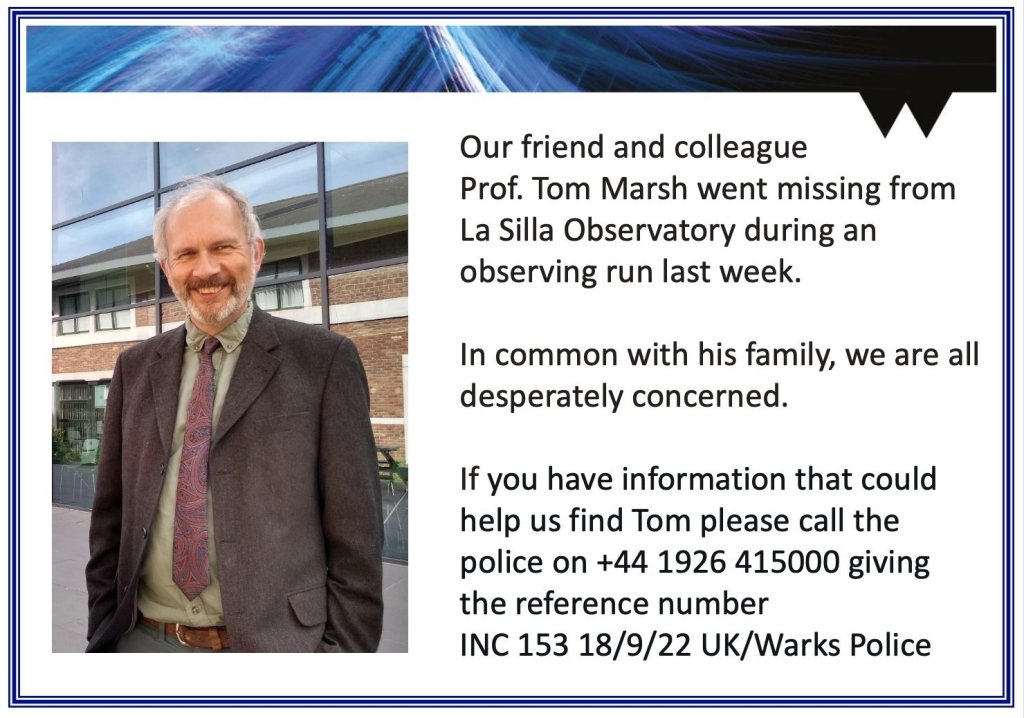
Yesterday I heard the worrying news that astronomer Professor Tom Marsh of Warwick University (UK) went missing on 16th September 2022 while on an observing trip at the European Southern Observatory facility in La Silla, Chile. Despite extensive searches over the last week he has not yet been found.

I know it’s a long shot but I’m posting this here in the hope that somebody somewhere might have information about his whereabouts.

There is also a statement from ESO here with further details

Marsh is described as white, about 192 cm in height, with balding grey hair and a beard. He is likely to be wearing a blue rain jacket, walking boots and a grey woollen hat. 

Please forward this as widely as possible!

UPDATE: 11/11/2022. Sadly, almost two months after being reported missing, the body of Tom Marsh has now been found. The cause of death has not yet been announced.

Astronomical Heads Up

Posted in The Universe and Stuff with tags , , , , on May 3, 2022 by telescoper

You may recall a great deal of excitement about three years ago concerning the imaging of the “shadow” of the event horizon of the black hole in the centre of the galaxy M87. There was so much interest in this measurement that you could hardly move without seeing this picture somewhere or other:

The question I was asked most frequently back then is that there’s a much closer black hole in the centre of our own Galaxy, the Milky Way, so why wasn’t that imaged first? The answer is that the black hole in the centre of M87 is about 1000 times further away from us than the black hole in the centre of the Milky Way – known to its friends as Sagittarius A* or SgrA* for short – but is also about 1000 times more massive, so its Schwarzschild radius is 1000 times larger. In terms of angular resolution, therfore, the observational challenge of imaging the event horizon is similar in the two cases.

I mention this because the Event Horizon Telescope team who made the above image are holding a press conference next week at ESO on “groundbreaking Milky Way results from the Event Horizon Telescope Collaboration”.

I wonder what these “groundbreaking results” might be?

On LinkedIn

Posted in Science Politics, The Universe and Stuff with tags , , , , on July 4, 2021 by telescoper

A former colleague recently contacted me with a request to join my “network” on LinkedIn.  That was quite hard to do as (at least until this morning) I was not on LinkedIn. That reminded me of a talk at INAM2019 a couple of years ago about the Astronomical Society of Ireland  which was about to be re-launched with a new website. One of the main reasons for doing this is that Ireland recently joined the European Southern Observatory and in order to capitalize on its involvement it is important to persuade the Irish government to invest in the resources needed (especially postdocs, etc) to do as much science as possible using ESO facilities. The idea was to improve the lobbying power for astronomy in Ireland. One of the suggestions made yesterday was that astronomers in Ireland should join LinkedIn in order to raise their profile individually and collectively.

I was not on LinkedIn at the time and didn’t get around to joining it mainly because I’ve always thought it was more for businessy types than academics. Anyway, in the light of recent events I decided it couldn’t do any harm to bite the bullet and set up a LinkedIn profile, which you can find here. It’s really a rather basic profile but I think I’ve set it up so that posts from here will be posted to LinkedIn too, so if you’re on it yourself you might want to add me. Or not. It’s up to you!

P.S. The only thing I have put under “Awards and Honours” is Winner of Beard of Ireland 2020.

Page Charges at A&A…

Posted in Open Access, The Universe and Stuff with tags , , , , on May 27, 2020 by telescoper


It was recently drawn to my attention that UK-based astronomers and astrophysicists now have to pay a charge of €100 per page (!) to publish in the journal Astronomy & Astrophysics (usually known as A&A for short). See their page charges information for details.

Contrary to popular belief, A&A only waives page charges for authors from countries who are sponsors of A&A, not all countries who are members of the European Southern Observatory (ESO) project. Although the United Kingdom is a member of ESO, it is not and never has been a sponsor of A&A: see the list of sponsoring countries and their representatives here .

Until recently, however, UK authors did have their page charges waived on what seems to have been an ex gratia basis. For some reason, that exception has now apparently been removed.

UPDATE 1: It should have occurred to me that that this also applies to authors from Ireland.

UPDATE 2: Apparently the liability for page charges is determined by the nationality of the first author. I had previously thought that if any of the authors belonged to a sponsoring country then charges would be waived.

Meanwhile, the Open Journal of Astrophysics publishes entirely for free and we are committed to continuing that way. You know what to do.

The Case for Irish Membership of CERN

Posted in Politics, The Universe and Stuff with tags , , , , on November 16, 2019 by telescoper

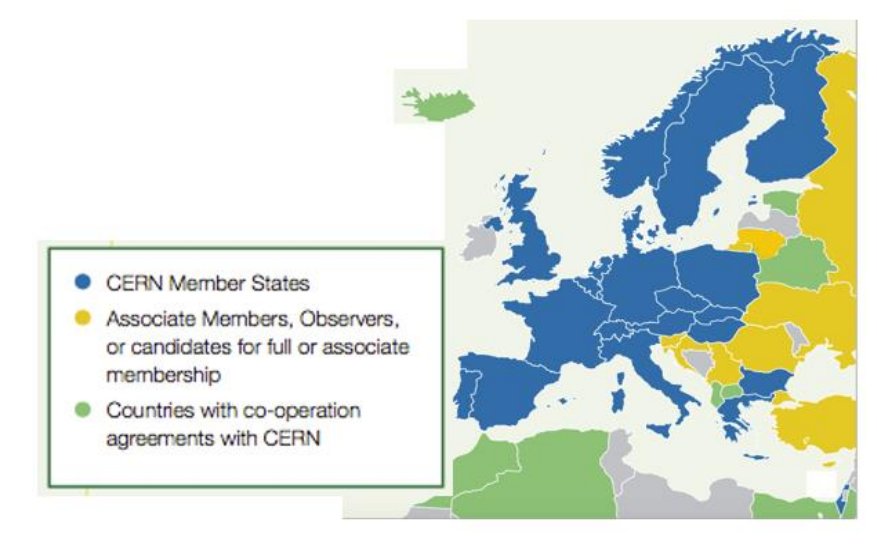
In the news here in Ireland this week is a new report from a Committee of the Houses of the Oireachtas making the case for Ireland to join CERN. You can download the report here (PDF) and you’ll find this rather striking graphic therein:

You will see that there are only three European countries that don’t have any form of membership or other agreement with CERN: Latvia, Bosnia-Herzegovina and Ireland. The fact that almost everyone else is in is not in itself necessarily a good argument for Ireland to join, but it does make one wonder why so many other countries have found it to join or have an agreement with CERN while Ireland has not.

As the document explains, if the Irish government  were to decide to take Ireland into CERN then  it would first have to become an Associate Member, which would cost around €1.2 million per year. That’s small potatoes really, and  the financial returns to Irish industry and universities are likely to far exceed that, so the report strongly recommends this step be taken. This Associate member stage would last up to 5 years, and then to acquire full membership a joining fee of around €15.6 million would have to be paid, which is obviously a much greater commitment but in my view still worthwhile.

While I strongly support the idea of Ireland joining CERN I do have a couple of concerns.

One is that I’m very sad that the actual science done at CERN is downplayed in the Oireachtas report. Most of it is about return to industry, training opportunities, etc. These are important, of course, but it must not be forgotten that big science projects like those carried out at CERN are above all else science projects. The quest for knowledge does have collateral benefits, but it a worthy activity in its own right and we shouldn’t lose sight of that.

My other (related) concern is that joining CERN is one thing, but in order to reap the scientific reward the government has to invest in the resources needed to exploit the access to facilities membership would provide. Without a related increase in research grant funding for basic science the opportunity to raise the level of scientific activity in Ireland would be lost.

Ireland recently joined the European Southern Observatory (ESO), a decision which gave Irish astronomers access to some amazing telescopes. However, there is no sign at all of Irish funding agencies responding to this opportunity by increasing funding for academic time, postdocs and graduate students needed to do the actual science.

Although astronomy is clearly much more interesting than particle physics (😉) in one respect the case of ESO is very like the case of CERN – the facilities do not themselves do the science. We need people to do that.

Who uses LinkedIn?

Posted in Science Politics, The Universe and Stuff with tags , , , , on September 5, 2019 by telescoper

We had a talk at INAM2019 yesterday about the Astronomical Science Group of Ireland which is about to be re-launched with a new website. One of the main reasons for doing this is that Ireland recently joined the European Southern Observatory and in order to capitalize on its involvement it is important to persuade the Irish government to invest in the resources needed (especially postdocs, etc) to do as much science as possible using ESO facilities. At the moment there isn’t a very well organized lobby for astronomy in Ireland.

One of the suggestions made yesterday was that astronomers in Ireland should join LinkedIn in order to raise their profile individually and collectively.

I am not, and have never been, on LinkedIn and this is the first time I’ve ever even thought of joining it (though I do from time to time receive emails from people I don’t know asking me to). I’ve always thought it was for more businessy types. I don’t know of any astronomers (or scientists generally) who use it either, but that may be just because I’m not on it and wouldn’t know either way.

I just thought therefore, that I might invite any readers of this blog – whether astronomers or not – if they use LinkedIn to please comment on its usefulness or otherwise using the box below. Please also comment on whether you think it would help astronomers in Ireland organize in the manner envisaged.