Today (15th October 2024) saw the release of a sneak preview of the main survey of the European Space Agency’s Euclid survey at the International Astronautical Congress in Milan. Here’s the key image.
This image is not at full science resolution of the Euclid survey and is meant primarily as an appetizer. The resolution is11Kx4K, and is processed by the same pipeline that produced the Euclid Early Release Observations featured here and here. You can find more detail about these images here and here. I have taken this from the latter article:
Euclid has been surveying the sky since 14 February 2024 and data processing is in full swing – the first public release of 53 deg² of science-grade Wide Survey data will take place in March next year. But how much data has Euclid already observed and how can we possibly visualize this? At a rate of 10 deg² per day, the Euclid Wide Survey has already surpassed 1000 deg², that is 5000x the apparent size of the Moon in the sky! Now ESA has put out a first set of images that allow to grasp how much data Euclid is and will be producing.
There’s also this explanatory video:
This is just taster. The main survey will take many years to complete. But it’s a start…
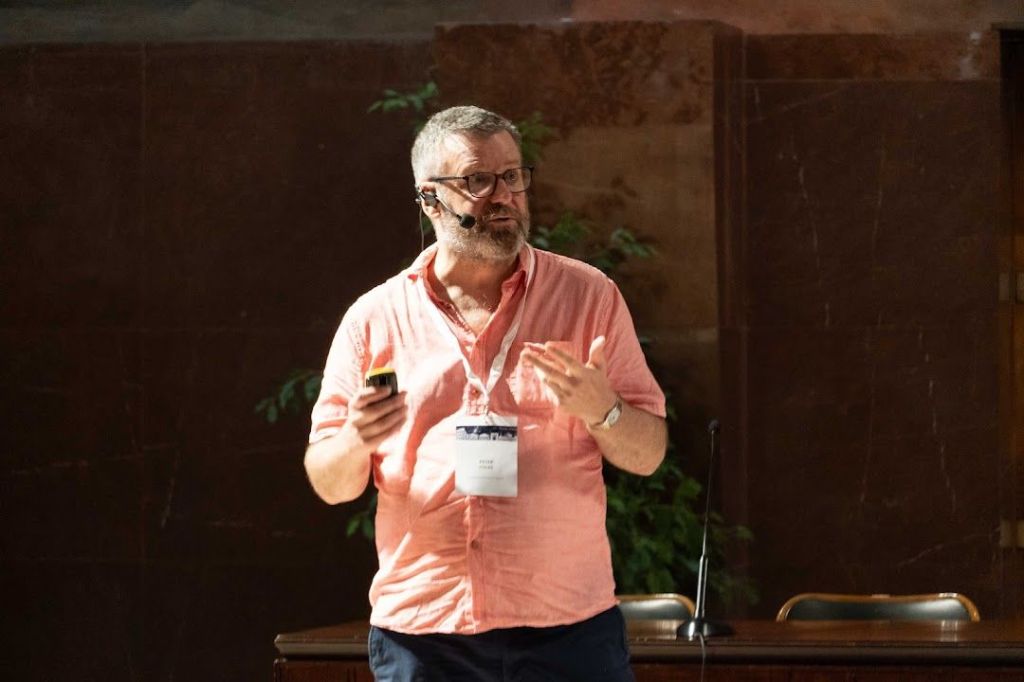
I had a very busy day yesterday culminating in the Space Week event I blogged about a few weeks ago. There was a good attendance – lots of young kids as well as adults – and the lecture room was very full. We could probably have filled a much bigger room, actually, but had been moved to a smaller venue and had to close registrations very early to avoid having too many people. I’d guess we had about 350. My talk was the last one, and didn’t finish until 8.30 by which time I was definitely ready for a pint.
You can find the slides I used for my presentation, The Universe according to Euclid, here.
There was an official photographer there who took quite a few pictures but I haven’t seen any of them yet. I’ll post a selection if and when I get them.
The Euclid Consortium is celebrating the first year of the journey of the European Space Agency’s Euclid Mission into space! Over the past 52 weeks, Euclid has been scanning the cosmos, uncovering new insights into dark matter, dark energy, and the structure of the universe. The Euclid Consortium has produced a slideshow, showcasing the key moments and discoveries from the first year in space.
The slideshow can be seen on YouTube here:
Here is a poster:
This can also found in interactive form here where you can click on each of the 52 images to see what it’s about.
P.S. The subtitle of the poster is “first year of a big journey to new physics”. There’s no guarantee that Euclid will find any new physics, rather than confirming our existing ideas, but it might.
I haven’t posted anything about the European Space Agency’s Euclid mission recently but I can remedy that today by sharing a new video that describes one of the methods that Euclid will use to map the dark Universe. Here’s the video:
ESA’s Euclid mission is surveying the sky to explore the composition and evolution of the dark Universe. But how can Euclid see the invisible? Watch this video to learn about the light-bending effect that enables scientists to trace how dark matter is distributed in the Universe.
By making use of Euclid’s flagship simulation, the video illustrates how dark-matter filaments subtly alter the shape of galaxies. Light travelling to us from vastly distant galaxies is bent and distorted by concentrations of matter along its way. The effect is called gravitational lensing because matter (both ‘normal’ and dark matter) acts as a kind of magnifying glass.
Scientists distinguish between strong and weak gravitational lensing. In strong gravitational lensing distortions of background galaxies or other light sources are very apparent, resulting in arcs, multiple images or so-called Einstein rings. In weak lensing, background sources appear only mildly stretched or displaced. This means we can only detect this effect by analysing large numbers of sources in a statistical way.
The further we look, the more prominent the distortions from weak gravitational lensing are, because there are more dark-matter structures acting as lenses between us and the light sources.
Euclid will measure the distorted shapes of billions of galaxies over 10 billion years of cosmic history, providing a 3D view of the dark matter distribution in our Universe. This will shed light on the nature of this mysterious component.
The map of the distribution of galaxies over cosmic time will also teach us about dark energy, which affects how quickly the Universe expands. By charting the Universe’s large-scale structure in unprecedented detail, Euclid will enable scientists to trace how the expansion has changed over time.
Today sees the launch of a new initiative between Galaxy Zoo (part of the Zooniverse conglomerate) and the Euclid Consortium which I am delighted to be able to promote on this blog. What follows the graphic is the text of the announcement which is being promoted across social media today. I’ll start with a little factoid which might surprise you: already in November 2023, before science operations even began, Euclid had sent back to Earth more data than the Hubble Space Telescope has done in in its entire lifetime.
Thanks to a new Galaxy Zoo project launched today, you can help identify the shapes of thousands of galaxies in images taken by ESA’s Euclid space telescope. These classifications will help scientists answer questions about how the shapes of galaxies have changed over time, and what caused these changes and why.
In its mission to map out the Universe, Euclid will image hundreds of thousands of distant galaxies. In November 2023 and May 2024, the world got its first glimpse at the quality of Euclid’s images, which included a variety of sources, from nearby nebulas to distant clusters of galaxies. In the background of each of these images are hundreds of thousands of distant galaxies.
This square astronomical image shows thousands of galaxies across the black expanse of space. The closest thousand or so galaxies belong to the Perseus Cluster.
For the next six years, the spacecraft is expected to send around 100 GB of data back to Earth every day. That’s a lot of data, and labelling that through human effort alone is incredibly difficult.
That’s why ESA and Euclid consortium scientists have partnered with Galaxy Zoo. This is a citizen science project on the Zooniverse platform, where members of the public can help classify the shapes of galaxies.
Euclid will release its first catalogues of data to the scientific community starting in 2025, but in the meantime any volunteer on the Galaxy Zoo project can have a glimpse at previously unseen images from the telescope.
You could be the first person to lay eyes on a galaxy
The first set of data, which contains tens of thousands of galaxies selected from more than 800 000 images, has been made available on the platform, and is waiting for you to help classify them.
If you partake in the project, you could be the first to lay eyes on Euclid’s latest images. Not only that, you could also be the first human ever to see the galaxy in the image.
The Galaxy Zoo project was first launched in 2007, and asked members of the public to help classify the shapes of a million galaxies from images taken by the Sloan Digital Sky Survey. In the past 17 years, Galaxy Zoo has remained operational, with more than 400 000 people classifying the shapes of galaxies from other projects and telescopes, including the the NASA/ESA Hubble Space Telescope and the NASA/ESA/CSA James Webb Space Telescope.
Humans and AI working together
These classifications are not only useful for their immediate scientific potential, but also as a training set for Artificial Intelligence (AI) algorithms. Without being taught what to look for by humans, AI algorithms struggle to classify galaxies. But together, humans and AI can accurately classify limitless numbers of galaxies.
At Zooniverse, the team has developed an AI algorithm called ZooBot, which will sift through the Euclid images first and label the ‘easier ones’ of which a lot of examples already exist in previous galaxy surveys. When ZooBot is not confident on the classification of a galaxy, perhaps due to complex or faint structures, it will show it to users on Galaxy Zoo to get their human classifications, which will then help ZooBot to learn more.
On the platform, volunteers will be presented with images of galaxies and will then be asked several questions, such as “Is the galaxy round?”, or “Are there signs of spiral arms?”.
After being trained on these human classifications, ZooBot will be integrated in the Euclid catalogues to provide detailed classifications for hundreds of millions of galaxies, making it the largest scientific catalogue to date, and enabling groundbreaking new science.
This project makes use of the ESA Datalabs digital platform to generate a large number of cutouts of galaxies imaged by Euclid.
Thanks to a new Galaxy Zoo project launched today, you can help identify the shapes of thousands of galaxies in images taken by ESA’s Euclid space telescope. These classifications will help scientists answer questions about how the shapes of galaxies have changed over time, and what caused these changes and why.
The first set of data, which contains tens of thousands of galaxies selected from more than 800 000 images, has been made available on the platform, and is waiting for you to help classify them.
Examples of Euclid galaxies to classify are shown in this image.
Euclid Galaxy Zoo galaxies to classify. Forty galaxies are shown against a black background. The galaxies are all different in shape, some look like spirals, some look barred, or smooth. Image credit: ESA/Euclid/Euclid Consortium/NASA, CC BY-SA 3.0 IGO or ESA Standard Licence
Euclid is a European mission, built and operated by ESA, with contributions from NASA. The Euclid Consortium – consisting of more than 2000 scientists from 300 institutes in 15 European countries, the USA, Canada and Japan – is responsible for providing the scientific instruments and scientific data analysis. ESA selected Thales Alenia Space as prime contractor for the construction of the satellite and its service module, with Airbus Defence and Space chosen to develop the payload module, including the telescope. NASA provided the detectors of the Near-Infrared Spectrometer and Photometer, NISP. Euclid is a medium-class mission in ESA’s Cosmic Vision Programme.
It was officially announced at last year’s Euclid Consortium Meeting in Copenhagen that I had been appointed to the role of Chair of the Euclid Consortium Diversity Committee (ECDC). Following the tradition, a similar announcement was made at the Rome meeting this year that from 1st July there would be a new Chair in the form of Helmut Dannerbauer, who is based at the Instituto de Astrofísicas de Canarias on Tenerife. There are still a few loose ends to tie up, not helped by my computer problems, but I’m gradually winding up my activity on the ECDC and handing things over to Helmut.
As I pointed out in my post last year, I was in the final year of my stint on the ECDC when I was made Chair so it was always envisaged that I would serve for only one year. I only agreed to do it, in fact, because I had my sabbatical coming up. I definitely wouldn’t have been able to do the job alongside a full teaching and other workload and didn’t even consider continuing after my sabbatical was over.
Instead of trying to describe the role and activities of the ECDC generally, I will direct you to the information given on the brand new Euclid Consortium website which is a one-stop shop for everything to do with Euclid. You can find specific information about Equity, Diversity and Conduct there and/or on the ECDC’s own public website here from which I’ve taken a screengrab of the nice banner:
Just for information, the Euclid Consortium has about 2600 members so it really is a very large organization. It is also very international, with many people working in countries they were not born in and whose language is not their first. It is the aim of the ECDC to encourage a positive and inclusive environment within it for the benefit of everyone in it. The diversity in Euclid has many dimensions, including gender, nationality, ethnicity, and career stage as well as type of work; Euclid comprises specialists in instrumentation, software engineering, observational astronomy and theory to name but a few. The aim of the ECDC is to try to make sure everyone can work together in an inclusive environment.
It has been good to see over the few years some policies have been implemented to allow a greater diversity among leadership roles in the Euclid Consortium, especially by having a planned programme of rotating chairs and coordinators. I think this and other inititiatives are making a difference.
Euclid was launched a year ago yesterday, and the past twelve months have involved a huge amount of hard work by everyone concerned and not a little tension in some parts. The stress will continue as we head towards DR1, the first main Data Release, in 2026. The Euclid Consortium has a Code of Conduct to remind members to behave professionally towards their fellow workers at all times.
I’d like to wish all the new members of the ECDC, and those continuing, all the best in the future. I’d also like to extend personal thanks to those members who are leaving this year, especially Marc, Florence and Chiara. We have had regular telecons virtually every fortnight for the last year and I’ve enjoyed everyone’s contribution to the discussions.
I’ve been a bit busy catching up on things since my departure from Barcelona with the result that I almost forgot to post anything today. Fortunately there are two more Euclid Early Release Observations I can share to fill the gap. They’re about 4 minutes apiece, so there’ll be plenty time to watch them while waiting for the VAR operators to make an offside decision during the next European Championship match…
The first is entitled Measuring Luminosity Function for the Perseus Cluster of Galaxies using Euclid ERO data:
The article describing this work can be found on arXiv here; it perhaps makes up for the missing article in the title of the video.
The second one is this, about gravitational lensing and the search for high-redshift galaxies:
The paper for this one can be found on arXiv here.
Until I can get my laptop fixed and/or get a new one, my ability to write blog posts is a bit limited. At least there is a sizeable collection of things to share, including a steady supply of new videos from the Euclid Consortium like this one:
Among the various items of Euclid Merch in the goody bag given to attendees at the annual Euclid Consortium Meeting in Rome are a nice bag, a cap, a notebook, and a mystery object:
This morning, I took a short (~ 90 minute) flight from the pleasantly warm (23°C) Barcelona to the swelteringly hot (31°C) city of Rome. It’s actually forecast to be 39°C on Thursday and 40°C on Friday. Fortunately, I’m not staying that long!
The occasion for this trip is the annual Euclid Consortium Meeting, which is being held at the Università degli Studi di Roma “La Sapienza“. The main sessions are in the splendid Aula Maxima thereof, with its imposing mural:
I’m giving a talk there in the first plenary session tomorrow…
The views presented here are personal and not necessarily those of my employer (or anyone else for that matter).
Feel free to comment on any of the posts on this blog but comments may be moderated; anonymous comments and any considered by me to be vexatious and/or abusive and/or defamatory will not be accepted. I do not necessarily endorse, support, sanction, encourage, verify or agree with the opinions or statements of any information or other content in the comments on this site and do not in any way guarantee their accuracy or reliability.