Time for a quick update on the European Space Agency’s Euclid mission. For full details about what follows you can see here. Everything I mention here is already in the public domain, so I am not disclosing any secrets!
The last update I posted mentioned that Euclid had moved into what is called the Performance Verification phase of its mission. That has now been put on hold in order to troubleshoot an intermittent problem with the Fine Guidance Sensor (FGS) which helps to maintain correct pointing of the telescope. This issue can probably be fixed by software updates, but these will have to be tested, hence the pause. This is rather irksome, but the instrument teams are confident they can find a solution soon.
Anyway, while we’re waiting, here is a video from Launch Pad Astronomy explaining about the mission. It was actually released about six days ago but I didn’t have time to post it until now. About 15 minutes long, it’s a big longer than previous official Euclid videos I’ve posted, but I think it’s very informative:
Oh, I almost forgot to mention that I’ll be talking a little bit about Euclid among other things at this event on 6th September.
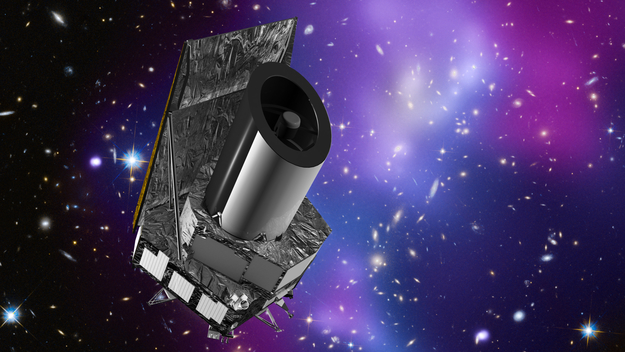
ESA/Euclid/Euclid Consortium/NASA. Background galaxies: NASA, ESA, and S. Beckwith (STScI) and the HUDF Team.
Since I’ve been working today on stuff related to ESA’s Euclid mission, I thought I would post a brief update on the mission status before I go home. The official channel to which I refer you for full updates is here.
A message was sent out on Saturday to member of the Euclid Consortium indicating that the commissioning phase of the Euclid satellite was essentially completed, although with some issues still to be fixed. In particular, as has previously been reported, there is an issue with stray light in the VIS instrument, which will have to be coped with. To prevent stray sunlight getting onto VIS detectors, Euclid will be configured to operate at a range of specific angles with respect to the Sun. This means that the survey strategy will have to be adapted in order to be as optimal as possible with this new constraint.
The next phase after the commissioning phase is called performance verification, for which control switches over to the science ground segment. The operations team will then operate the spacecraft in the same way as required for the full survey in order to assess the performance of the instruments and obtain calibration data ahead of the start of the full survey.
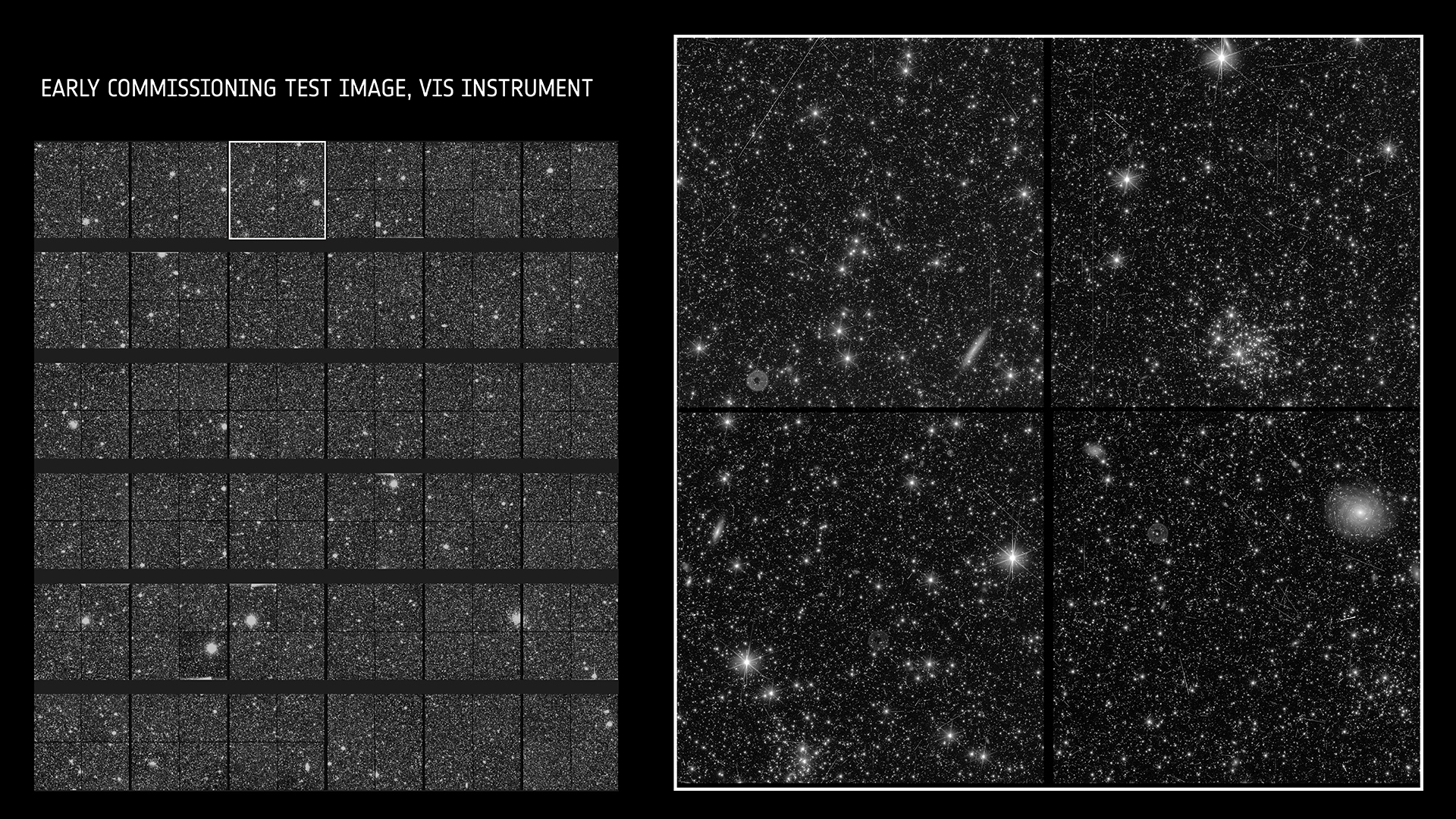
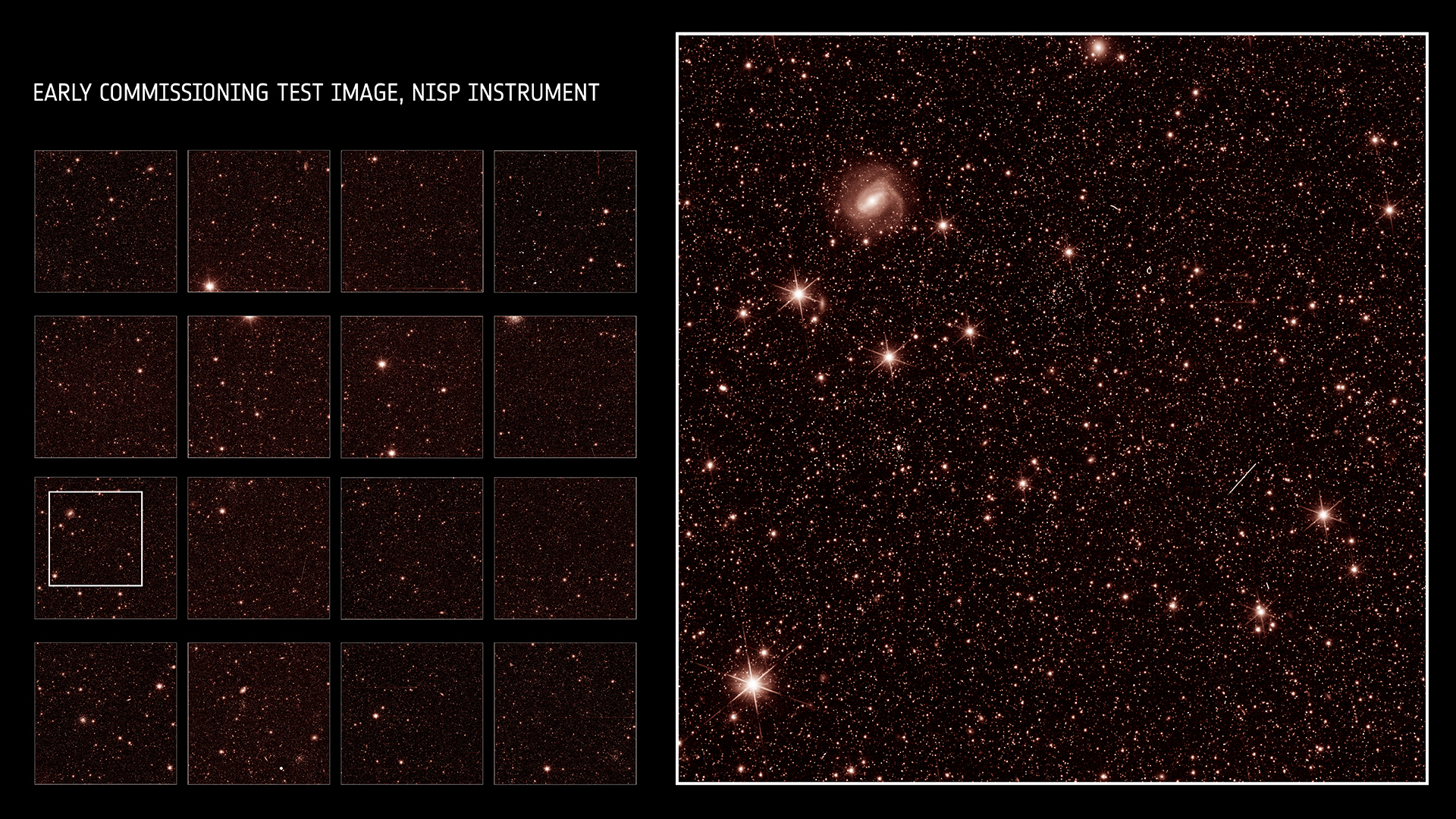
As I promised a couple of days ago, the “first light” images from the European Space Agency’s Euclid mission have now been released. You can find all the details here, but a summary is that these are “engineering” images, rather than part of the full survey to be undertaken by Euclid, and the commissioning of the instruments is not quite finished, but the telescope is now in focus and both instruments (the visual instrument, VIS, and the Near-Infrared Spectrometer & Photometer, NISP) are working well enough to show some preliminary results.
Anyway, here are the pictures released today, first from VIS:
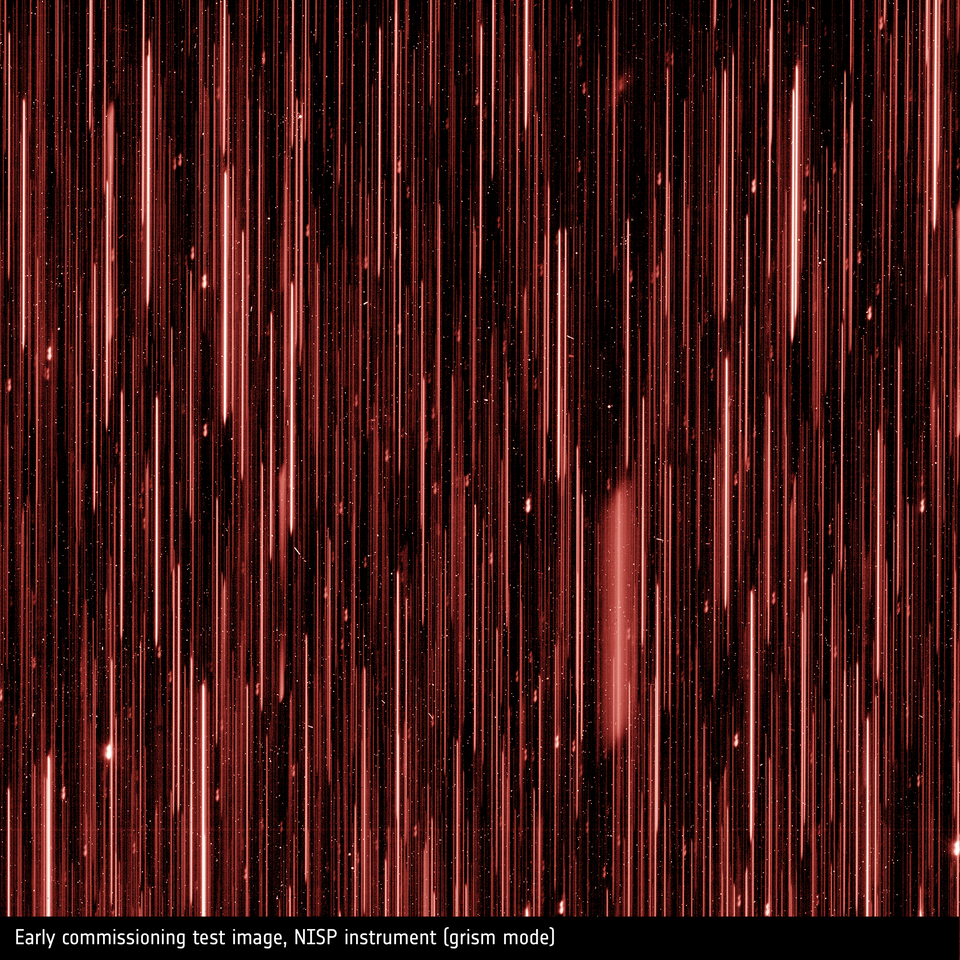
This final one, also from NISP, shows it working in grism mode, which allows the light from sources to be dispersed into a spectrum, enabling us to get much more information about the sources galaxies than a straightforward image would. The resulting images look a bit strange to the untrained eye – as the light from a point is spread out into a streak – but the result is wonderfully rich in information:
For more information – and some higher-resolution images – see the official Euclid press release here.
For myself, I’d just say these images are absolutely amazing given that they were taken during the commissioning phase and the instruments aren’t fully tweaked yet. Over the next few weeks, there will be a performance verification phase which will tell us how good Euclid will be at meeting its science goals. But so far it’s all looking very good indeed. I’ve only ever seen simulations of what would come out and it’s very exciting to see what the real thing looks like!
Hats off to the brilliant instrumentation experts who not only designed and built the kit but who have been working so hard on the commissioning. They’ve done so much in the month that has passed since the launch!
P.S. You can find here a nice explainer of some of the instrumental artefacts you might have spotted in the images above.
Here’s a little video update to accompany the news that, as of yesterday (28th July), the European Space Agency’s Euclid spacecraft has reached its orbit around L2, the second Lagrange Point of the Earth-Sun system:
More news is on the way. Commissioning of the instruments is now complete and the telescope is in focus. On Monday 31st July, ESA will release the first actual images from the Euclid telescope!
ESA’s Euclid mission is designed to explore the composition and evolution of the dark Universe. The space telescope will create a great map of the large-scale structure of the Universe across space and time by observing billions of galaxies out to 10 billion light-years, across more than a third of the sky. Euclid will explore how the Universe has expanded and how structure has formed over cosmic history, revealing more about the role of gravity and the nature of dark energy and dark matter.
Euclid is a fully European mission, built and operated by ESA, with contributions from NASA. The Euclid Consortium – consisting of more than 2000 scientists from 300 institutes in 13 European countries, the US, Canada and Japan – provided the scientific instruments and scientific data analysis. ESA selected Thales Alenia Space as prime contractor for the construction of the satellite and its Service Module, with Airbus Defence and Space chosen to develop the Payload Module, including the telescope. NASA provided the near-infrared detectors of the NISP instrument.
As a fully paid-up member of the Campaign for the Rejection of Acronymic Practices I was pleased to see the top brass in the Euclid Consortium issue instructions that encourage authors to limit their use of acronyms in official technical documents. Acronyms are widely used in the names of astronomical instruments and surveys. Take BOOMERanG (Balloon Observations Of Millimetric Extragalactic Radiation And Geophysics) and HIPPARCOS (HIgh Precision PARallax COllecting Satellite) to name just two. A much longer list can be found here.
I’m very pleased that the name of the European Space Agency’s Euclid mission is not an acronym. It is actually named after Euclid the Greek mathematician widely regarded as the father of geometry. Quite a few people who have asked me have been surprised that Euclid is not an acronym so I thought it might be fun to challenge my readers – both of them – to construct an appropriate backronym i.e. an acronym formed by expanding the name Euclid into the words of a phrase describing the Euclid mission. The best I’ve seen so far is:
Exploring the Universe with Cosmic Lensing to Identify Dark energy
But Euclid doesn’t just use Cosmic Lensing so I don’t think it’s entirely satisfactory. Anyway, your suggestions are welcome via the box below.
Euclid alone has looked on Beauty bare.
Let all who prate of Beauty hold their peace,
And lay them prone upon the earth and cease
To ponder on themselves, the while they stare
At nothing, intricately drawn nowhere
In shapes of shifting lineage...
A missive from Euclid High Command arrived yesterday confirming that ESA’s Euclid mission would be launched by SpaceX on a Falcon 9 rocket on a date between July 1st and July 30 (2023). It will soon be time to start getting nervous!
I also noticed that another video has appeared on the Euclid public website showing how the satellite will work. It’s not a traditional general-purpose observatory on which different users bid for time to observe different objects (as is the case for JWST, for example) but a dedicated mission that will compile a systematic survey with very specific science goals.
Euclid scans across the sky using a ‘step-and-stare’ method, combining separate measurements to form the largest cosmological survey ever conducted in the visible and near-infrared. Each time Euclid ‘stares’, its telescope points to a position in the sky, performing imaging and spectroscopic measurements on an area of approximately 0.5 deg² around this position. After each stare, the telescope steps to a new position.
This way the instruments will scan over a total of around 35% of the sky. This is the largest area over which one can guarantee a a complete detection of the galaxies necessary for Euclid’s cosmological studies. The rest of the sky is dominated by the high density of bright stars in our galaxy, and by the dust in the plane of our Solar System, both of which get in the way of the cosmology observations.
ESA’s Euclid mission is designed to explore the composition and evolution of the dark Universe. The space telescope will create a great map of the large-scale structure of the Universe across space and time by observing billions of galaxies out to 10 billion light-years, across more than a third of the sky. Euclid will explore how the Universe has expanded and how structure has formed over cosmic history, revealing more about the role of gravity and the nature of dark energy and dark matter.
The public website is can be found here. Check it out. Many more stories, pictures and videos will be added over the forthcoming weeks but in the mean time here is a taster animated movie that shows various elements of the Euclid spacecraft, including the telescope, payload module and solar panels.
Even more information about the science to be done with Euclid can be found on the Euclid Consortium website, which is being revamped ahead of the launch.
Aa few months ago I posted a piece about the European Space Agency’s Euclid Mission which had been due to be launched in 2023 on a Soyuz ST 2-1b rocket. That no longer being possible because of Russian’s invasion of Ukraine, it seemed there would be a lengthy delay in the launch of Euclid, with late 2024 seeming the earliest feasible date for launch on the obvious alternative, the new Ariane 6.
I ended that piece with this:
It seems to me that the best hope for a resolution of this problem would be for ESA to permit the launch of Euclid using something other than Ariane 6, which means using a vehicle supplied by an independent commercial operator. I sincerely hope ESA is able to come up with an imaginative solution to this very serious problem.
In the Dark, 17th June
Well I’ve just read official confirmation that a few hours ago ESA Council has approved the proposal to launch Euclid on a Falcon 9 rocket operated by SpaceX. If all goes well -specifically if the Euclid Consortium member states agree with this move – it might be possible to launch Euclid by the end of 2023. Although I don’t have any firm information about what date is being proposed I believe it could be as soon as July 2023.
Setting aside any personal opinions about Elon Musk, the Falcon 9 has proved to be very reliable, with the latest version having 110 out of 110 successful launches. Euclid will not be in an Earth orbit, like most of the satellites so far launched by SpaceX, but has to be delivered to the 2nd Lagrange Point, L2. That should not pose to much of a difficulty, however.
A little over a month ago I posted a piece about the European Space Agency’s Euclid Mission which had been due to be launched in 2023 on a Soyuz ST 2-1b rocket. That no longer being possible because of Russian’s invasion of Ukraine, it seemed there would be a lengthy delay in the launch of Euclid, with late 2024 seeming the earliest feasible date for launch on the obvious alternative, the new Ariane 6.
I ended that piece with this:
It seems to me that the best hope for a resolution of this problem would be for ESA to permit the launch of Euclid using something other than Ariane 6, which means using a vehicle supplied by an independent commercial operator. I sincerely hope ESA is able to come up with an imaginative solution to this very serious problem.
In the Dark, 17th June
I have heard various rumours since then but yesterday I saw a piece by Paris-based astronomer Henry Joy McCracken (a famous name in Ireland) that reveals that a proposal is being actively investigated to launch Euclid on a Falcon 9 rocket operated by Elon Musk’s outfit SpaceX. If all goes well it might be possible to launch Euclid by the end of 2023, and at a fraction of the cost of the alternative Ariane 6-2.
Setting aside any personal opinions about Elon Musk, the Falcon 9 has proved to be very reliable, with the latest version having 110 out of 110 successful launches. Euclid will not be in an Earth orbit, like most of the satellites so far launched by SpaceX, but has to be delivered to the 2nd Lagrange Point, L2. That should not pose to much of a difficulty.
As far as I understand it the decision whether or not this is feasible will be taken later this year after extensive engineering tests, especially to see how Euclid can cope with the spectrum of vibrations generated by Falcon 9. There’s no guarantee this will work out but it might just save a lot of money and a lot of careers.
The views presented here are personal and not necessarily those of my employer (or anyone else for that matter).
Feel free to comment on any of the posts on this blog but comments may be moderated; anonymous comments and any considered by me to be vexatious and/or abusive and/or defamatory will not be accepted. I do not necessarily endorse, support, sanction, encourage, verify or agree with the opinions or statements of any information or other content in the comments on this site and do not in any way guarantee their accuracy or reliability.