Archive for Gaia DR3

Weekly Update from the Open Journal of Astrophysics – 18/10/2025

Posted in OJAp Papers, Open Access, The Universe and Stuff with tags , , , , , , , , , , , , , , , , , , , , on October 18, 2025 by telescoper

It’s time once again for the usual Saturday update of the week’s new papers at the Open Journal of Astrophysics. Since the last update we have published four  more papers, which brings the number in Volume 8 (2025) up to 156, and the total so far published by OJAp up to 391.

I’d like to encourage people to follow our feed on the Fediverse via Mastodon (where I announce papers as they are published, including the all-important DOI) so this week I’ll include links to each announcement there.

The first paper to report is “Shot noise in clustering power spectra” by Nicolas Tessore (University College London, UK) and Alex Hall (University of Edinburgh, UK). This was published in the folder Cosmology and NonGalactic Astrophysics on Tuesday October 14th 2025. This presents a discussion of the effects of ‘shot noise’, an additive contribution due to degenerate pairs of points, in angular galaxy clustering power spectra. Here is a screen grab of the overlay:

You can find the officially accepted version of the paper here. The Mastodon announcement is here:

Open Journal of Astrophysics

New Publication at the Open Journal of Astrophysics: "Shot noise in clustering power spectra" by Nicolas Tessore (University College London, UK) and Alex Hall (University of Edinburgh, UK)

doi.org/10.33232/001c.145919

October 14, 2025, 7:07 am 2 boosts 0 favorites

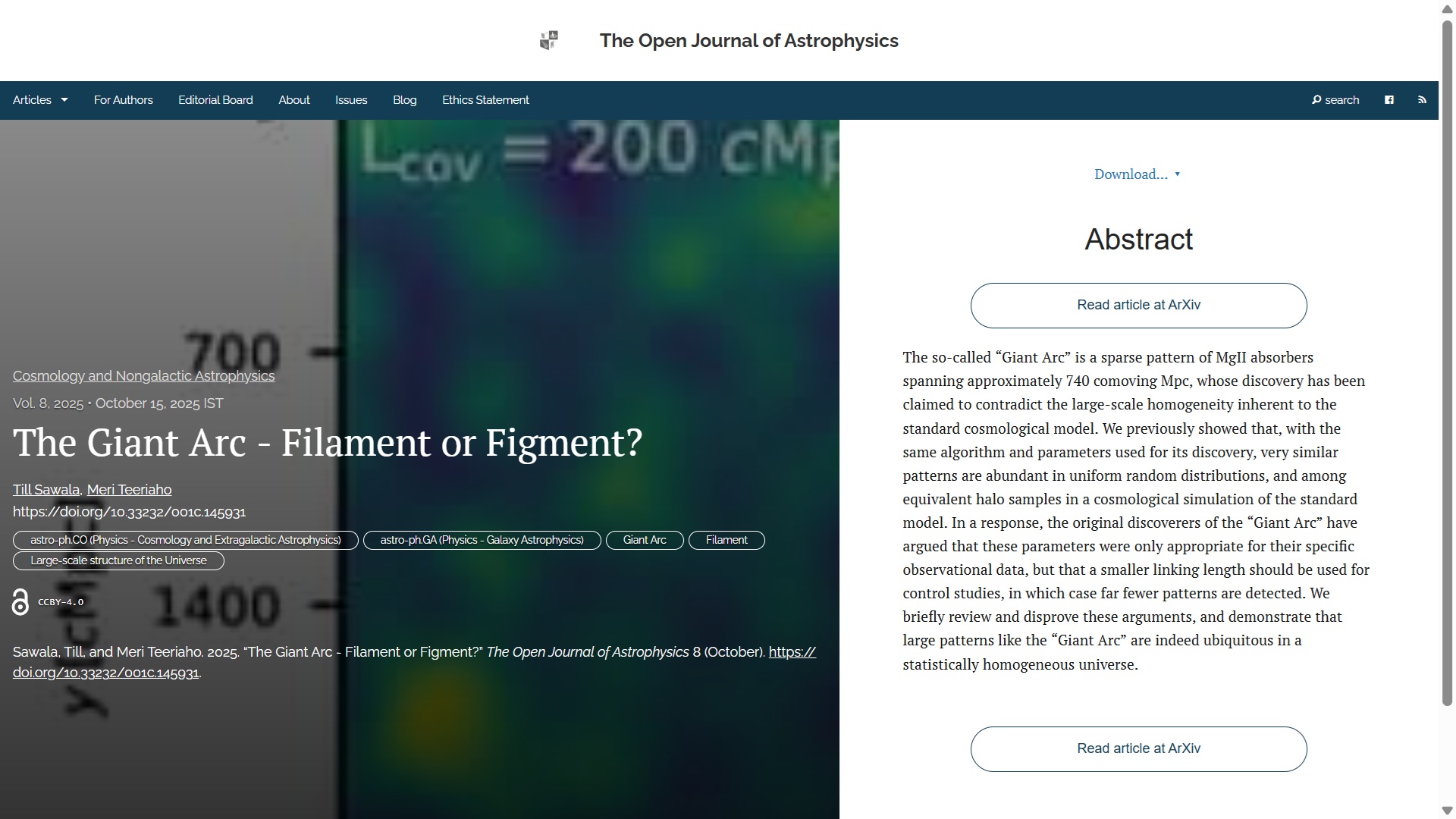
Next one up is “The Giant Arc – Filament or Figment?” by Till Sawala and Meri Teeriaho (University of Helsinki, Finland). This paper discusses the abundance of large arc-like structures formed in the standard cosmological model, with reference to the “Giant Arc” identified in MgII absorption systems. It was published on Wednesday October 15th in the folder Cosmology and NonGalactic Astrophysics. The overlay is here:

The officially accepted version of this paper can be found on the arXiv here and the Mastodon announcement is here:

Open Journal of Astrophysics

New Publication at the Open Journal of Astrophysics: "The Giant Arc – Filament or Figment?" by Till Sawala and Meri Teeriaho (University of Helsinki, Finland)

doi.org/10.33232/001c.145931

October 15, 2025, 6:33 am 2 boosts 3 favorites


The third paper this week,  published on Monday 6th October, is “Detecting wide binaries using machine learning algorithms” by Amoy Ashesh, Harsimran Kaur and Sandeep Aashish (Indian Institute of Technology, Patna, India). This was published on Friday 17th October (yesterday) in the folder Astrophysics of Galaxies. It presents a method for detecting wide binary systems in Gaia data using machine learning algorithms.

The overlay is here:


You can find the officially accepted version of this paper on arXiv here. The announcement on Mastodon is here:

Open Journal of Astrophysics

New Publication at the Open Journal of Astrophysics: "Detecting wide binaries using machine learning algorithms" by Amoy Ashesh, Harsimran Kaur and Sandeep Aashish (Indian Institute of Technology, Patna, India)

doi.org/10.33232/001c.146027

October 17, 2025, 6:55 am 0 boosts 0 favorites

The last one this week is “Learned harmonic mean estimation of the Bayesian evidence with normalizing flows” by Alicja Polanska & Matthew A. Price (University College London, UK), Davide Piras (Université de Genève, CH), Alessio Spurio Mancini (Royal Holloway, London, UK) and Jason D. McEwen (University College London). This one was also published on Friday 17th October, but in the folder Instrumentation and Methods for Astrophysics; it presents a new method for estimating Bayesian evidence for use in model comparison, illustrated with a cosmological example.

The corresponding overlay is here:


You can find the officially accepted version on arXiv here. The Mastodon announcement is here:

Open Journal of Astrophysics

New Publication at the Open Journal of Astrophysics: "Learned harmonic mean estimation of the Bayesian evidence with normalizing flows" by Alicja Polanska & Matthew A. Price (University College London, UK), Davide Piras (Université de Genève, CH), Alessio Spurio Mancini (Royal Holloway, London, UK) and Jason D. McEwen (University College London)

doi.org/10.33232/001c.146026

October 17, 2025, 7:06 am 0 boosts 0 favorites

That concludes the papers for this week. With two weeks to go I think we might reach the 400 total by the end of October.

Weekly Update from the Open Journal of Astrophysics – 23/08/2025

Posted in OJAp Papers, Open Access, The Universe and Stuff with tags , , , , , , , , , , , , , , , , , , , , , , , , , on August 23, 2025 by telescoper

So it’s Saturday again, so it’s time for the usual update of papers published at the Open Journal of Astrophysics which I do every Saturday. Since the last update we have published six new papers, which brings the number in Volume 8 (2025) up to 122, and the total so far published by OJAp up to 357. As I mentioned here we have overtaken the total of 120 published in Volume 7 (2024) and are on track for in excess of 180 publications in 2025.

The first paper to report this week is “Mass-feeding of jet-launching white dwarfs in grazing and common envelope evolution” by Noam Soker (Technion, Haifa, Israel). This was published on Tuesday 19th August in the folder Solar and Stellar Astrophysics. It proposes a theoretical suggestion about the production of jets in common-envelope evolution with massive stars.

The overlay is here:

You can make this larger by clicking on it, as you can with all the overlays below. The officially accepted version of this paper can be found on the arXiv here.

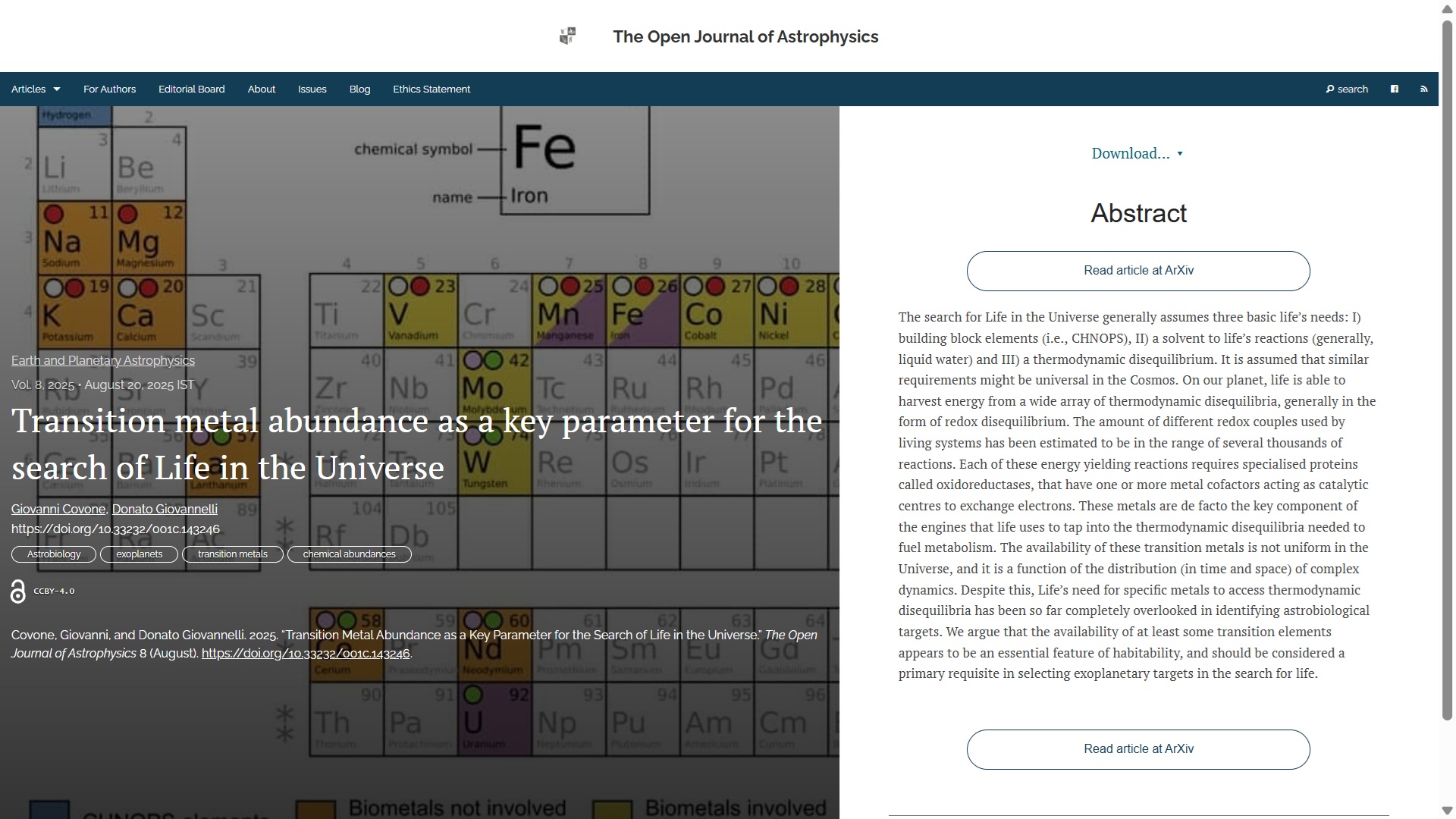
The second paper this week, published on Wednesday 20th August in the folder Earth and Planetary Astrophysics, is “Transition metal abundance as a key parameter for the search of Life in the Universe” by Giovanni Covone and Donato Giovannelli (University of Naples, Italy). This paper presents an argument that the availability of transition elements is an essential feature of habitability, and should be considered as such in selecting exoplanetary targets in the search for life.

The overlay is here:

You can find the officially accepted version of the paper on arXiv here.

The third paper this week, also published on 20th August 2025 in the folder Earth and Planetary Astrophysics, is “Discrete element simulations of self-gravitating rubble pile collisions: the effects of non-uniform particle size and rotation” by Job Guidos, Lucas Kolanz and Davide Lazzati (Oregon State University, USA).  This presents a new computer code for simulating the growth of granular masses through collisions of smaller particles and discusses results generated by it.

The overlay for this one is here:

You can find the officially accepted version on arXiv here.

The next paper, the fourth this week, is “Seeing the Outer Edge of the Infant Type Ia Supernova 2024epr in the Optical and Near Infrared” by W.B. Hoogendam (University of Hawaii, USA) and 32 others – too numerous to list by name – based in various institutes in the USA, Australia, UK, Denmark, Taiwan and China. This paper was also published on Wednesday 20th August 2025, but in the folder High-Energy Astrophysical Phenomena.  The article reports on the results of optical-to-near-infrared photometry and spectroscopy of the Type Ia supernova (SN Ia) 2024epr and a discusses how these challenge models for this sort of supernova.

The overlay is here:

You can find the officially accepted version on arXiv here.

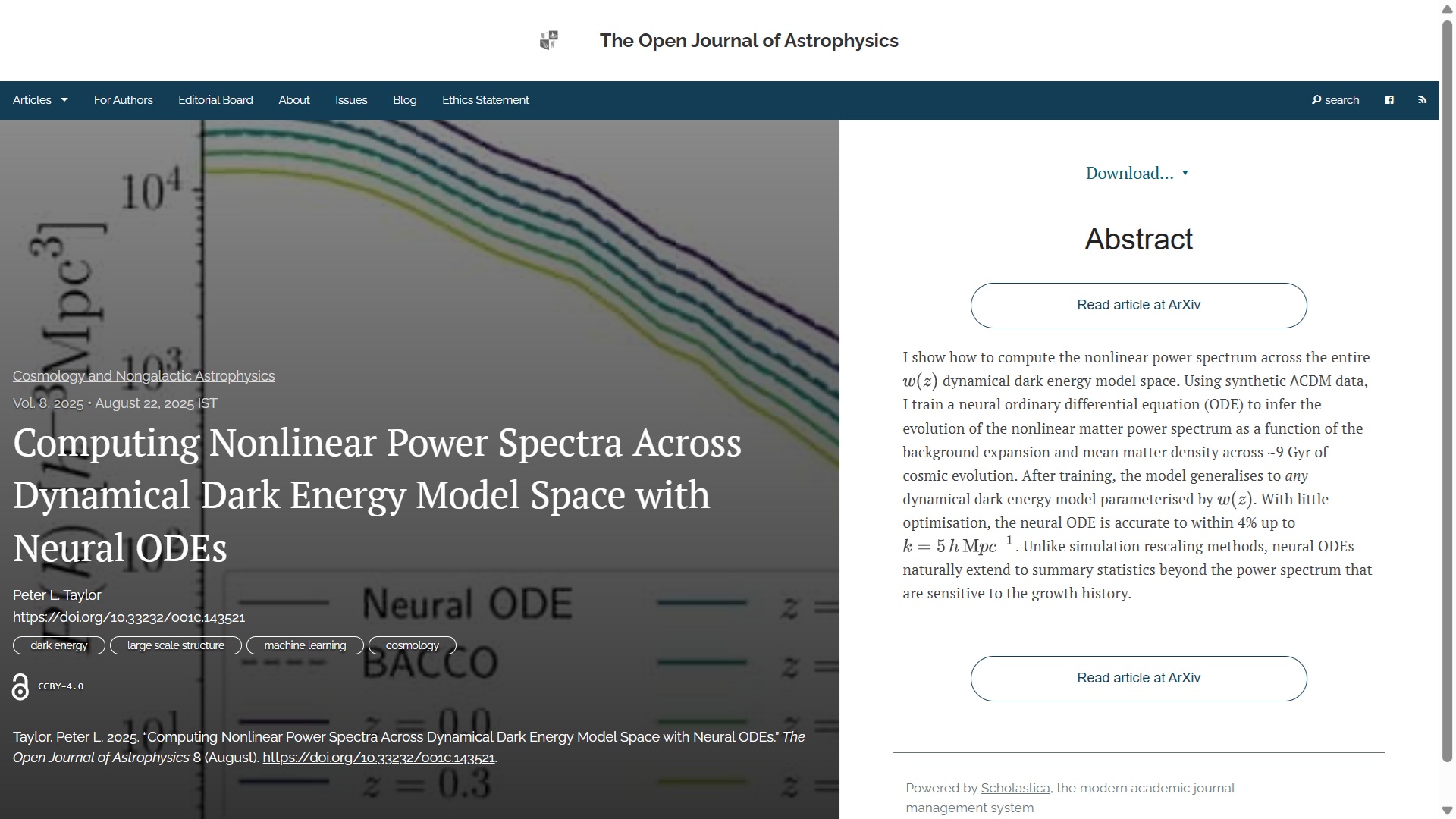
The fifth paper this week is “Computing Nonlinear Power Spectra Across Dynamical Dark Energy Model Space with Neural ODEs” by Peter L. Taylor of Ohio State University (USA).  This one shows how to compute the evolution of cosmological power spectra into the non-linear regime via neural differential equations. It was published on Friday 22nd August 2025 in the folder Cosmology and NonGalactic Astrophysics. The overlay is here:

You can find the officially accepted version on arXiv here.

And finally for this week we have “Symbiotic star candidates in Gaia Data Release 3” by Samantha E. Ball & Benjamin C Bromley (University of Utah, USA) and Scott J. Kenyon (Smithsonian Observatory, USA). This paper was published on Friday 22nd August in the folder Solar and Stellar Astrophysics. It describes a new search for symbiotic star candidates in Gaia Data Release 3 (GDR3), based on astrometric, photometric, and spectroscopic information. The overlay is here:

You can find the officially accepted version of this one on arXiv here.

And that’s all the papers for this week. I suppose there will come a time when we publish a paper on every day of the week and each week’s summary will contain a paper in each of the astro-ph categories on arXiv, but we haven’t done that yet. This week we published on every day but Monday 18th August, and have papers in four of the six categories.

The Decline of the Milky Way’s Rotation

Posted in The Universe and Stuff with tags , , , , on September 28, 2023 by telescoper

I just noticed an interesting item on the ESA website about results described in a paper by Jiao et al. (on the arXiv here) relating to the rotation of the Milky Way as determined by Gaia’s Data Release 3.

The key result in the paper is summarized in this diagram:

A galaxy rotation curve like this is a diagnostic of the radial distribution of mass. If all the mass were concentrated at the centre, the galaxy would behave like the Solar System (in which most of the mass is contained within the Sun). In such a Keplerian profile the rotation speed falls off with distance, just as the outer planets move more slowly in their orbits than the inner ones. According to modern cosmology, however, there is dark matter not concentrated in the centre, in which case the rotation curve does not decline with distance and may even rise. According to theory, at large distances, the rotation curve of a spiral galaxy should be roughly flat.

The new results seem to contract this notion. The Figure shows a rotation curve that declines for distances about 15 kpc from the Galactic Centre; for reference the Sun orbits at a radius of about 10 kpc.

One of the problems in constructing a rotation curve of our own Galaxy is that we are inside it so it isn’t possible to make measurements across the entire system like we can with other galaxies. Using the Gaia measurements and a plausible model, however, the authors find much less dark matter than anticipated.

With a bit of extrapolation using a model, this measurement leeds to a reduction in the estimated total mass of the Milky Way. The value usually bandied about is around 1012 Solar Masses, while the new measurements imply a much lower mass of about 2 × 10¹¹ Solar Masses.

A factor of five reduction is quite a dramatic change and I’m sure this result will be challenged by those of an orthodox persuasion while also providing encouragement to dark matter sceptics. We’ll just have to wait and see how this pans out.

Gaia’s Third Data Release!

Posted in The Universe and Stuff with tags , , on June 13, 2022 by telescoper

It seems like only yesterday that I blogged about the second release of data from the European Space Agency’s Gaia mission but today sees the release of the third data set, known to its friends as DR3. This completes the set after some initial data were released early as EDR3 back in 2020.

Gaia on the Launchpad at Kourou, French Guyana, on 13th December 2013

In case you weren’t aware, Gaia, launched way back in 2013, is an ambitious space mission to chart a three-dimensional map of our Galaxy, the Milky Way, in the process revealing the composition, formation and evolution of the Galaxy. Gaia will provide unprecedented positional and radial velocity measurements with the accuracy needed to produce a stereoscopic and kinematic census of about one billion stars in our Galaxy and throughout the Local Group. This amounts to about 1 per cent of the Galactic stellar population.

Gaia is likely to operate until round about November 2024, so there’s a lot of data yet to come.

You can find a complete list of what is in DR3 here and if you want to go straight into the papers based on this dataset, go here. There is a nice promotional video here:

Our Solar Neighbourhood

Posted in The Universe and Stuff with tags , , , on December 3, 2020 by telescoper

Here’s a very nice movie showing the stars in the Solar neighbourhood (defined to be within 100 parsecs of the Sun) with positions and colours mapped by the European Space Agency’s Gaia mission.

P.S. The video is timed to coincide with Gaia’s third data release: for more information about DR3 see here.