Archive for galaxies

New Publication at the Open Journal of Astrophysics

Posted in Maynooth, OJAp Papers, Open Access, The Universe and Stuff with tags , , , , , on November 30, 2024 by telescoper

It’s Saturday morning once again so it’s time for the usual weekly update of publications at the Open Journal of Astrophysics. This week’s report will be short because, like last week, there is only one paper to report this week, being  the 106th paper in Volume 7 (2024)  and the 221st  altogether. It was published on Thursday 28th November 2024. We have some more papers in the publishing pipeline, which I thought might appear, but they didn’t come out this week possibily because of the Thanksgiving holiday in the USA.

Anyway, The title of the latest paper is “Growth of Light-Seed Black Holes in Gas-Rich Galaxies at High Redshift” by Daxal Mehta, John Regan and Lewis Prole (all of the National University of Ireland, Maynooth*. This paper presents a discussion of the rate of growth of black holes in the early Universe on the basis of simulations run using the Arepo code.

Here is the overlay of the paper containing the abstract:


You can click on the image of the overlay to make it larger should you wish to do so. You can also find the officially accepted version of the paper on the arXiv here.

That’s all for this week – tune in next Saturday for next week’s update!

*The authors being from Maynooth, I of course recused myself from the editorial process for this article.

Four New Publications at the Open Journal of Astrophysics

Posted in OJAp Papers, Open Access, The Universe and Stuff with tags , , , , , , , , , , , , , , , , , , , on September 14, 2024 by telescoper

Once again, it’s time for a quick update of activity at the Open Journal of Astrophysics. This week we have published another batch of four papers which takes the count in Volume 7 (2024) up to 77 and the total published altogether by OJAp up to 192. Things are picking up again after the summer lull, and we’re moving towards a double century. If we keep up a steady average of four per week we’ll be at 200 per year.

In chronological order, the four papers published this week, with their overlays, are as follows. You can click on the images of the overlays to make them larger should you wish to do so.

First one up is “Quasi-two-dimensionality of three-dimensional, magnetically dominated, decaying turbulence” by Shreya Dwivedi, Chandranathan Anandavijayan, and Pallavi Bhat of TIFR, Bangalore, India. The paper presents an analysis of numerical simulations of MHD turbulence using Minkowski Functionals, with implications for local anisotropies revealed therein. It was published on 9th September 2024 and is in the folder marked High-Energy Astrophysical Phenomena.

Here is a screen grab of the overlay, which includes the abstract:


You can find the officially accepted version of the paper on the arXiv here.

The second paper to announce, also published on 9th September 2024, is “mochi_class: Modelling Optimisation to Compute Horndeski In class” by  Matteo Cataneo (Universität Bonn, Germany) and Emilio Bellini (SISSA, Trieste, Italy). This article presents a cosmological Einstein-Boltzmann solver adapted to work with Horndeski gravity, together with validation tests. It is in the folder Cosmology and NonGalactic Astrophysics.

You can see the overlay here:


The accepted version of this paper can be found on the arXiv here.

The third paper, published on 11th September 2024 in the folder marked High-Energy Astrophysical Phenomena, is by Jonathan Katz of Washington University, St Louis, USA. The title is “The Sources of Fast Radio Bursts” and it presents a discussion of the possible physical origin of Fast Radio Bursts, arguing that they fall into two distinct groups.
 

The final version accepted on arXiv is here.

Last in this batch, but by no means least, is “RMS asymmetry: a robust metric of galaxy shapes in images with varied depth and resolution” by Elizaveta Sazonova (U. Waterloo, Canada) with 15 other authors spread around the world (in Canada, USA, Australia, Italy, Chile, UK, Poland, Mexico, Germany, and Spain). This paper presents a method of quantifying distortion of galaxy images connected with mergers or other instabilities. It is in the folder marked Astrophysics of Galaxies and was published on September 12th 2024 with this overlay:
 

You can find the official accepted version on the arXiv here.

That’s all for now. I will post another update in a week.

PHANGS for the galaxies…

Posted in The Universe and Stuff with tags , , , , , , , on January 31, 2024 by telescoper

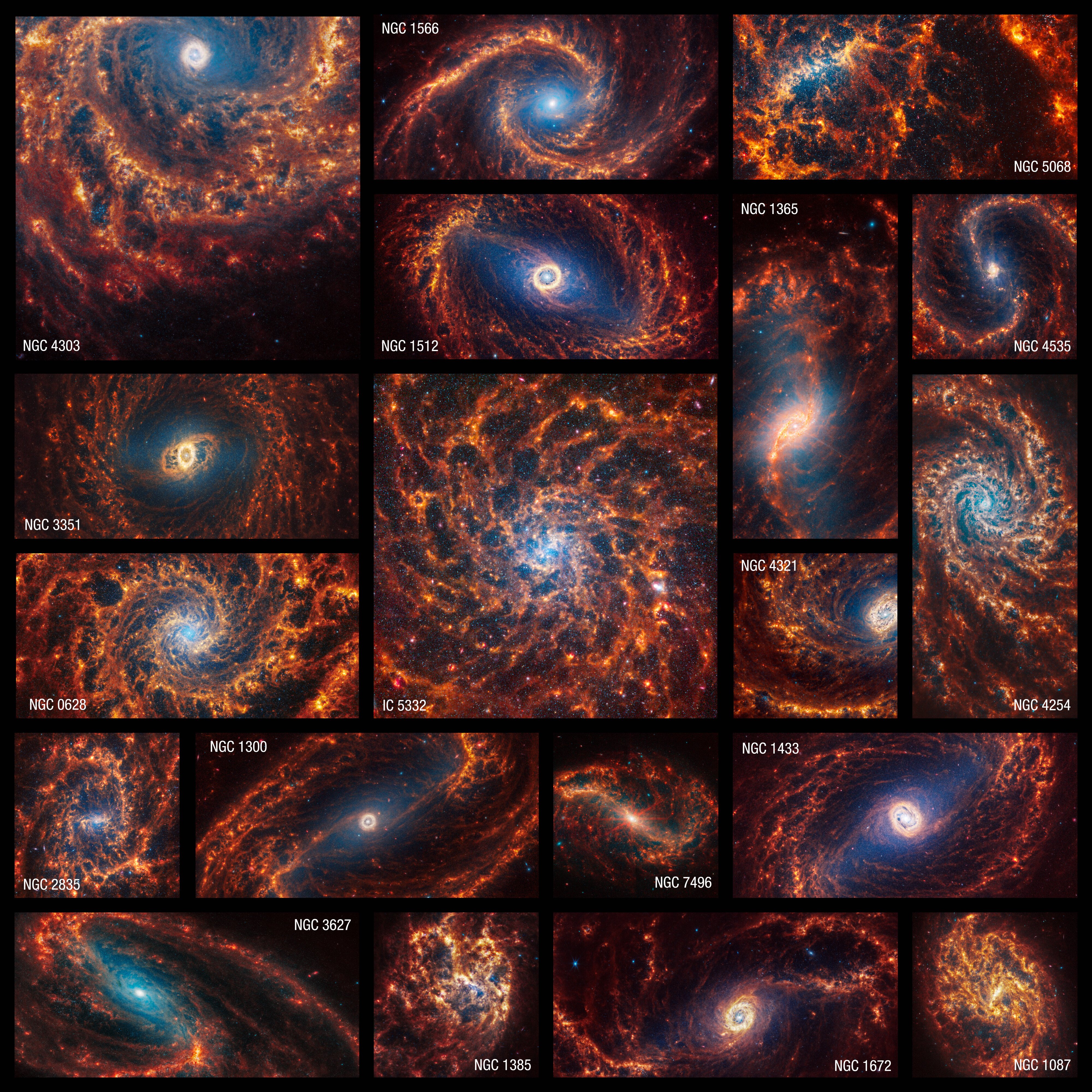
I couldn’t resist sharing this wonderful set of images from JWST courtesy of the PHANGS* team showing exquisite details of 19 face-on spiral galaxies as seen in the infra-red:

More information about the remarkable structures seen in these images, as well as higher resolution versions of the images themselves, can be found on the European Space Agency website here.

*For those of you not in the know, PHANGS stands for Particularly Horrible Acronym Not Generated Sensibly Physics at High Angular resolution in Nearby GalaxieS.

Yet more high-z galaxies from JWST…

Posted in The Universe and Stuff with tags , , , , , , , on December 19, 2023 by telescoper

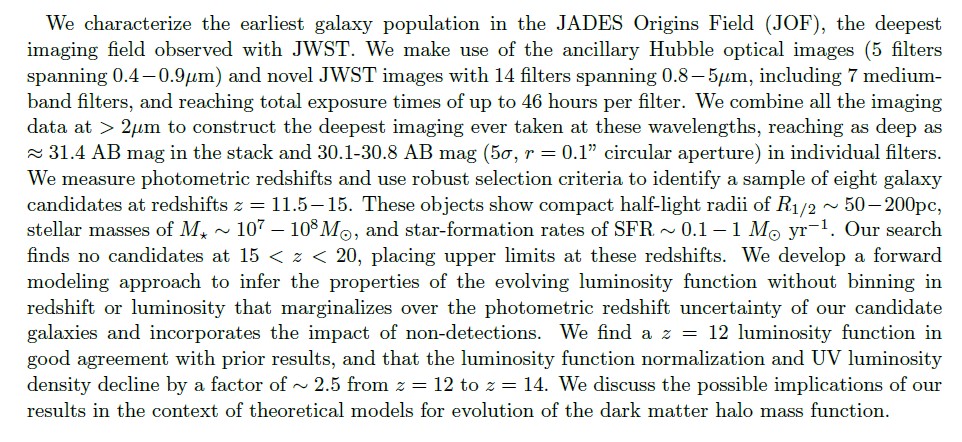
I noticed a paper on arXiv yesterday, by Robertson et al., with the abstract:

You can click on this to make it larger if you find it difficult to read.

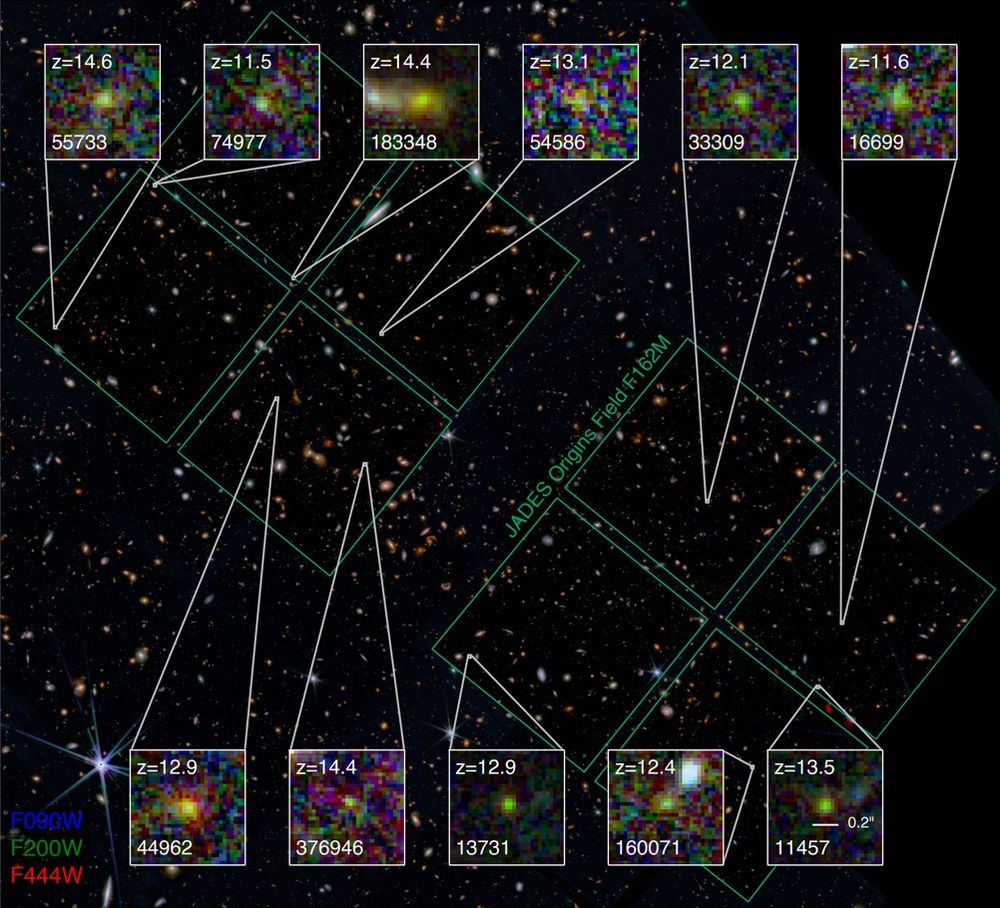
This is the latest in a number of studies by the JWST Advanced Deep Extragalactic Survey (JADES), which is aiming to detect galaxies that formed in the very early Universe; for a previous example see here. The latest batch can be seen in this figure:

There is an important caveat here, which is that these are photometric redshifts, based on the overall shape of the spectrum of the galaxy rather than on spectral lines which give a more accurate result. Follow-up spectroscopy is needed to firmly identify the redshift of the sources. Past experience suggests that some of these candidates may not actually be at as high a redshift as is claimed. If confirmed, however, the existence of large galaxies at redshifts of order 15 will put greater pressure on models of galaxy formation. A recent OJAp publication has shown that galaxies at redshift 10 are consistent with current theoretical ideas, but much larger will increase the tension on theorists. I can imagine quite a few people around the world replotting their graphs right now!

New Publication at the Open Journal of Astrophysics

Posted in OJAp Papers, Open Access, The Universe and Stuff with tags , , , , on December 12, 2023 by telescoper

I was doing some work on the Open Journal of Astrophysics site and realized that there is a paper we published last week that I haven’t advertised on here yet, so I’m remedying that now.

The paper in question is the 47th so far in Volume 6 (2023)  and it’s the 112th altogether. This one was actually published on Tuesday December 5th. Two further papers are imminent; I’m just waiting for their metadata to be registered with Crossref.

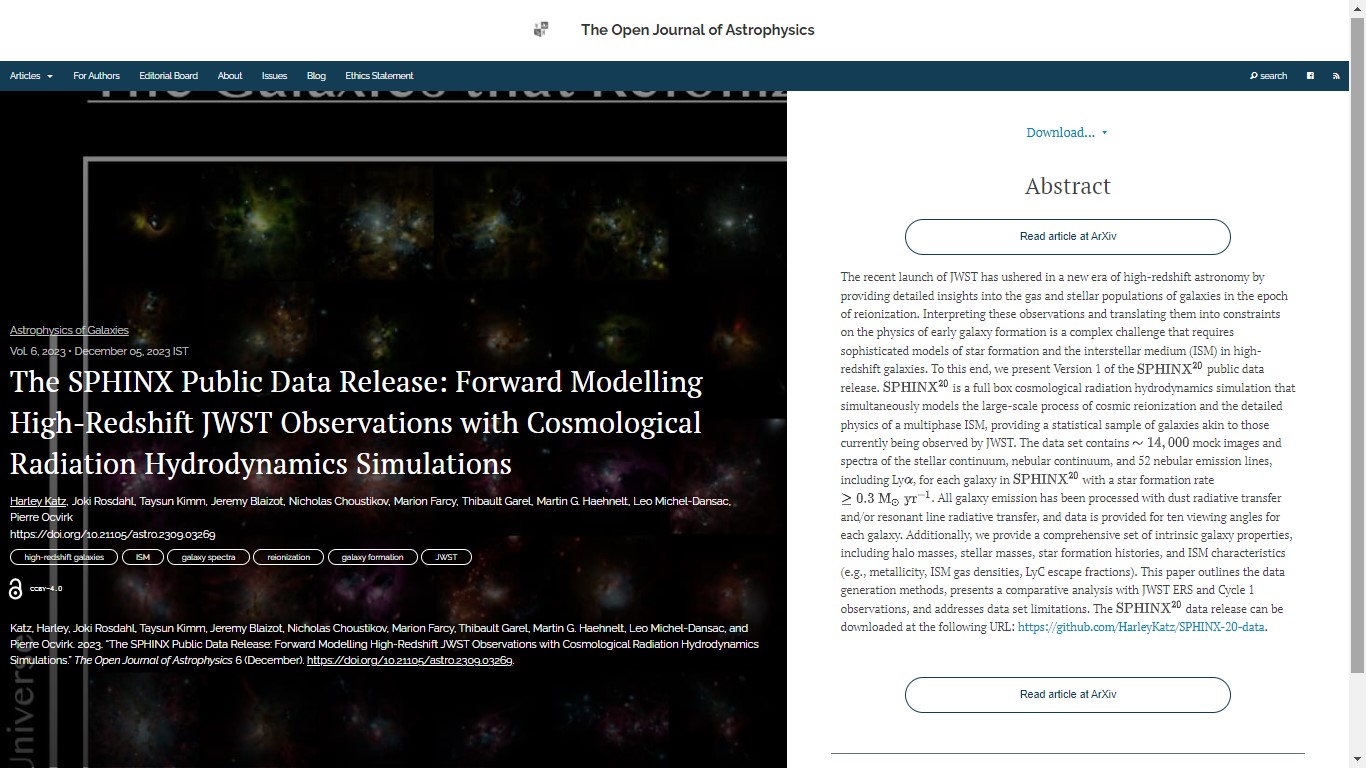
The title of this one is “The SPHINX Public Data Release: Forward Modelling High-Redshift JWST Observations with Cosmological Radiation Hydrodynamics Simulations” and it represents  public data release of Sphinx20, a full box cosmological radiation-hydrodynamics simulation that provides a statistical sample of galaxies for comparison with those observed by JWST. It is in the folder marked Astrophysics of Galaxies.

There are 10 authors: Harley Katz (Oxford, UK); Joki Rosdahl (Lyon, France); Taysun Kimm (Seoul, Korea); Jeremy Blaizot (Lyon, France);  Nicholas Choustikov (Oxford, UK); Marion Farcy  and Thibault Garel (Geneva, Switzerland);  Martin G. Haehnelt (Cambridge, UK); Leo Michel-Dansac (Lyon, France); and Pierre Ocvirk (Strasbourg, France).

Here is the overlay of the paper containing the abstract:


You can click on the image of the overlay to make it larger should you wish to do so. You can find the officially accepted version of the paper on the arXiv here.

New Publication at the Open Journal of Astrophysics

Posted in OJAp Papers, The Universe and Stuff with tags , , , , on April 28, 2023 by telescoper

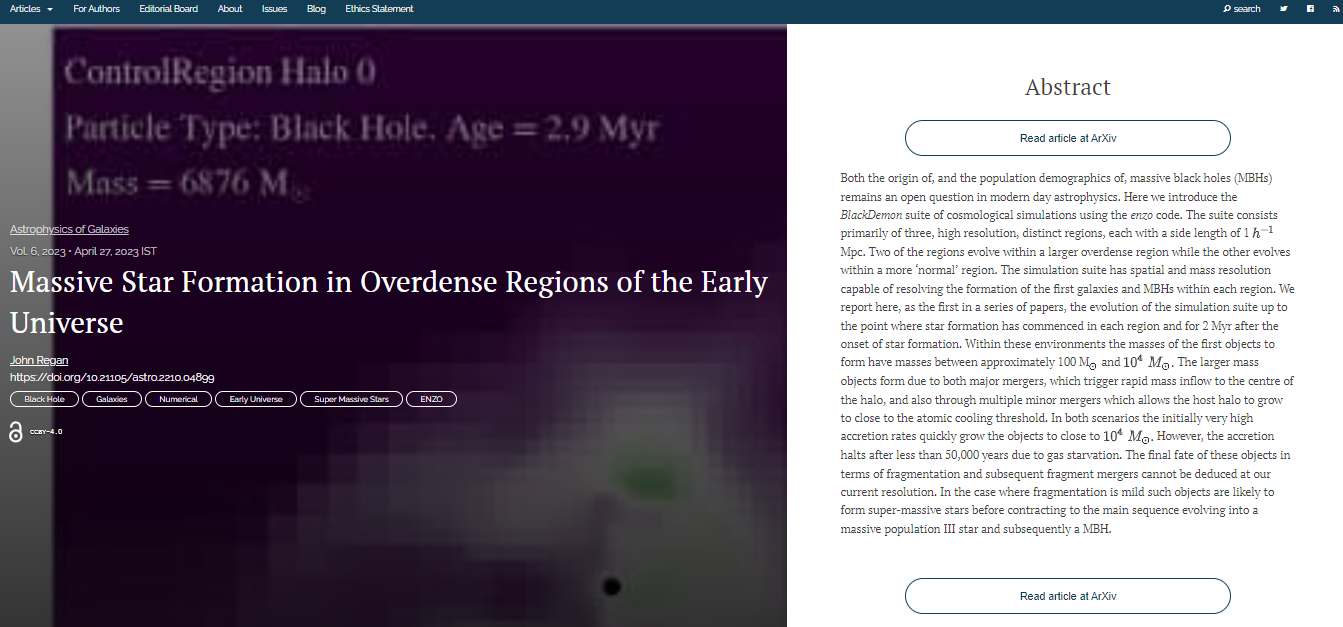
Time for the announcement of yet another new paper at the Open Journal of Astrophysics. The latest paper is the 14th paper so far in Volume 6 (2023) and the 79th in all. This one is in the folder marked Astrophysics of Galaxies and its title is “Massive Star Formation in Overdense Regions of the Early Universe”. The early Universe aspect does of course imply considerable overlap with cosmology.

The (sole) author is our very own John Regan of the Department of Theoretical Physics at Maynooth University.

Here is a screen grab of the overlay which includes the  abstract:

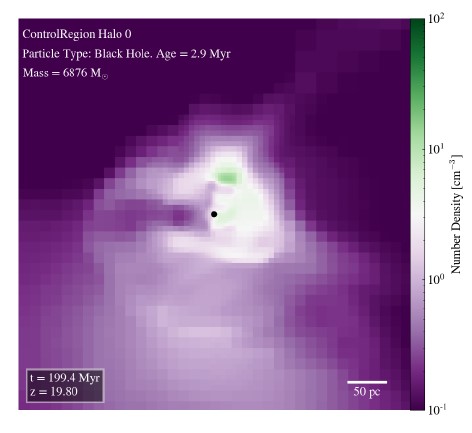
Here’s a bigger version of the image I chose for the overlay:


You can click on the image of the overlay to make it larger should you wish to do so. You can find the officially accepted version of the paper on the arXiv here.

Recalibration of Ultra-High-Redshift Galaxies

Posted in Astrohype, The Universe and Stuff with tags , , , , on August 10, 2022 by telescoper

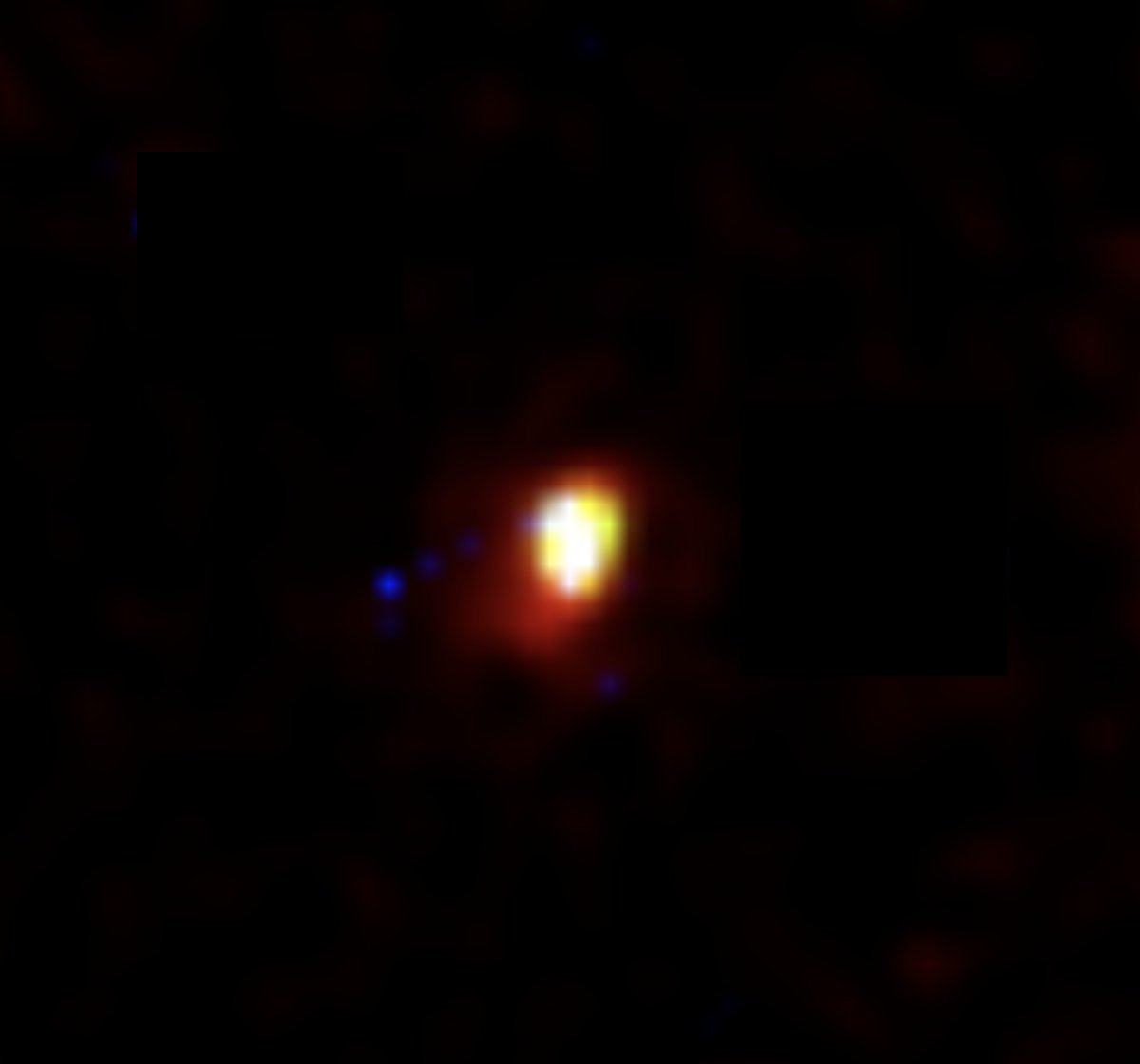
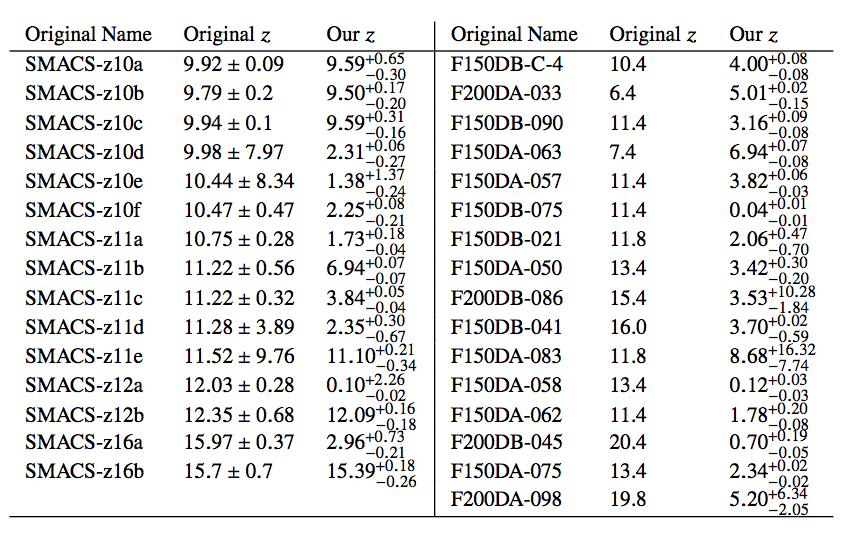
Remember all the recent excitement about the extremely high redshift galaxies (such as this and this; the two examples shown above) “identified” in early-release JWST observations? Well, a new paper on the arXiv by Adams et al using post-launch calibration of the JWST photometry suggests that we should be cautious about the interpretation of these objects. The key message of this study is that the preliminary calibration that has been in widespread use for these studies is wrong by up to 30% and that can have a huge impact on inferred redshifts.

The new study does indeed identify some good candidates for ultra-high-redshift galaxies, but it also casts doubt on many of the previous claims. Here is a table of some previous estimates alongside those using the newly recalibrated data:

You will see that in most – but not all – cases the recalibration results in a substantial lowering of the estimated redshift; one example decreases from z>20 to 0.7! The two candidates mentioned at the start of this post are not included in this table but one should probably reserve judgement on them too.

The conclusive measurements for these objects will however include spectroscopy, and the identification of spectral lines, rather than photometry and model fits to the spectra energy distribution. Only with such data will we really know how many of these sources are actually at very high redshift. As the philosopher Hegel famously remarked

The Owl of Minerva only spreads its wings with the coming of spectroscopy.

New Publication at the Open Journal of Astrophysics

Posted in OJAp Papers, Open Access, The Universe and Stuff with tags , , , , , , , on July 5, 2022 by telescoper

Time to announce another new publication in the Open Journal of Astrophysics! This one, published on Sunday, is the 8th paper in Volume 5 (2022) and the 56th in all.

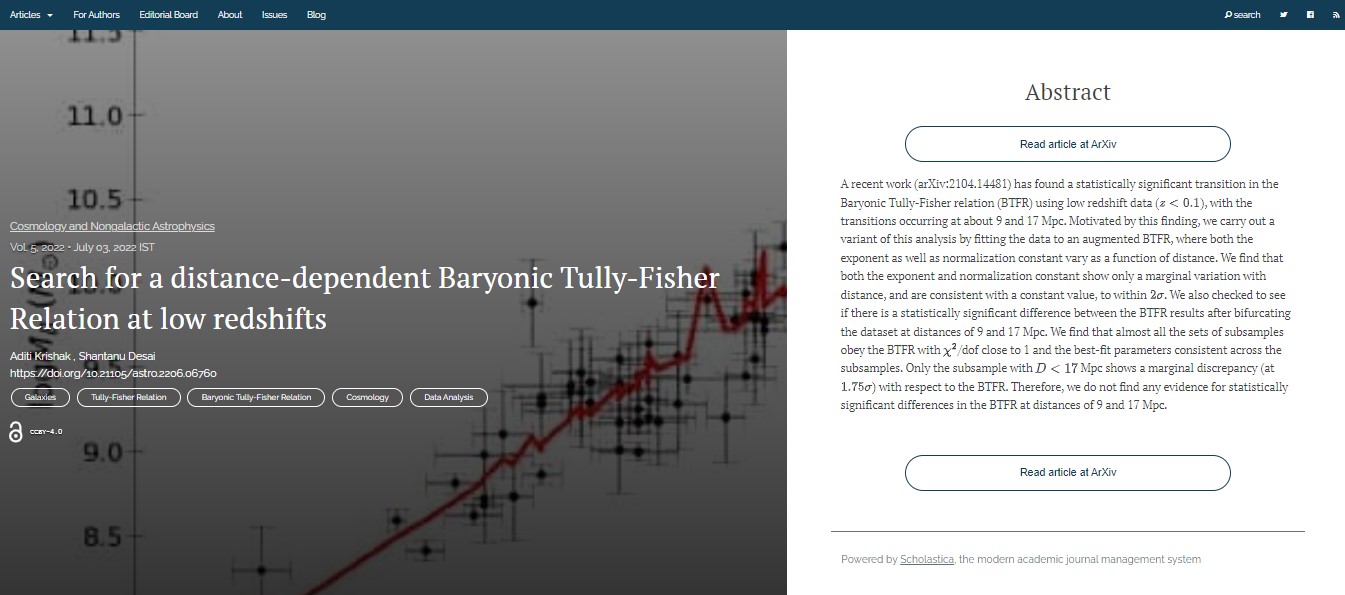
The latest publication is entitled “Search for a distance-dependent Baryonic Tully-Fisher Relation at low redshifts” and is written by by Aditi Krishak (IISER-Bhopal, India) and Shantanu Desai (IIT Hyderabad, India).

This paper is in the Cosmology and Nongalactic Astrophysics folder.

Here is a screen grab of the overlay which includes the abstract:


You can click on the image to make it larger should you wish to do so. You can find the arXiv version of the paper here.

Watch “Why the Universe is quite disappointing really – Episode 5” on YouTube

Posted in The Universe and Stuff, YouTube with tags , , , on May 21, 2020 by telescoper

Episode 5, in which I explain using a golf ball just how empty the Universe is. It is so empty, in fact, that even the crowded places are very empty. And as for the empty places, they’re practically nothing.

Watch “Why the Universe is quite disappointing, really – Episode 4” on YouTube

Posted in The Universe and Stuff, YouTube with tags , , , , on May 19, 2020 by telescoper

Episode 4, in which I show that spiral galaxies are very grubby – they contain huge amounts of dust. And not only galaxies – astronomical dust is everywhere we look. The Universe may be big, but it sure is dirty..