Archive for generative AI

A month to go

Posted in Artificial Intelligence, Biographical, Education, mathematics, Maynooth with tags , , , , , on November 25, 2025 by telescoper

I’ve been a bit preoccupied these recent weeks so it was with a shock that I realised that we’re into Week 9, which means just four weeks (including this one) until the end of term and just a month before Christmas. Teaching finishes here in Maynooth on Friday 19th December, but I don’t have any lectures on Fridays so in my case it will finish the day before (with a tutorial). I don’t know how many students will be there, but the module concerned is my 4th year Mathematical Physics module and the students are very hard-working, so I think most will attend. After such a busy term I’m sure that they will need a break as much as I will.

I had to rejig the schedule for both modules I am teaching this semester to accommodate the introduction of in-class tests to replace take-home assignments (for reasons I outlined here). I’ve also been handing out voluntary exercises for practice, not counting towards the module mark but for formative reasons. Both modules are mathematical in nature, and I think the best way to learn mathematics is by doing it…

Despite the changes with respect to last year, I am still roughly on track. In my Engineering Mathematics module I’ve just finished Laplace transforms, and will start Fourier methods tomorrow. With the mathematical physicists, I am in the middle of complex analysis, having done complex differentiation and conformal mappings and starting complex integration next week.

I still have a couple more class tests to get through. On the positive side, the students are turning up for them and have expressed approval for the fact that they don’t have compulsory homework to do off-campus. This form of assessment is undoubtedly harder work for the students, it’s also better preparation for the examination that take-home assignments.

We’ve just received the draft examination timetable for January, and I’m pleased that both of the examinations for which I am responsible will take place quite early in the examination period (on 12th and 15th January, respectively) so I should be able to get them corrected in time to have a break for some research before teaching resumes at the start of February.

Testing Times

Posted in Artificial Intelligence, Education, mathematics, Maynooth with tags , , , , on October 17, 2025 by telescoper

As it was foretold, I conducted my first set of my new-style in-class tests this week. These tests, as I mentioned a while ago,  were introduced because of concerns about the integrity of the coursework element of my modules in the light of improvements in Generative AI.

The main events – one for each of my modules – were both yesterday, but one student couldn’t make it at the scheduled time (for good reasons) so I set a special test this morning, which is now over. Because access to the internet is not allowed these tests are invigilated.

It’s been quite a while since I was last required to invigilate a full examination. I think it was back in Nottingham days, actually. I never enjoyed this task even though I took work to do it wasn’t really possible to do much as one had to keep one’s eyes on the students. Crosswords could be done; these are good in this situation because you can solve a few clues at a time. It was disappointing if I happened to take one that was easy enough to do quickly, as there was little to stave off the boredom after completing it. Other things I used to do included counting the number of right-handed and left-handed students, though I never did any detailed statistical analysis of the results.

Anyway, my recent class tests were a bit different. Designed to fit in a lecture slot of 50 minutes duration, they were much shorter than traditional end-of-year exams. They were also “open-book” style, so students could bring anything on paper that they wanted. Phones and laptops were, however, forbidden. During these tests I just sat quietly with my laptop getting some work done, with an occasional glance at the students. It was actually nice to be locked away like this with no disturbance. Time passed very quickly, actually, though perhaps not as quickly as it did for the students taking the tests.

When I first told the students that the tests would be “open-book”, I think they all assumed that would make them easy. I don’t think that was the case, however, as the questions are designed so that the answers can’t be obtained immediately by looking them up in a textbook. Also, having things on paper rather than in your head does slow you down. I’ve never seen much point in examinations as speed tests. I designed this week’s tests so that the questions could be done in about 30 minutes, but the formal duration was 50 minutes. I encouraged students who finished early to use the remaining time to check their work, but some did leave early.

This new regime also meant I had number of teaching sessions without the exertion of having to do any actual teaching, which was nice. The downside is, of course, that I now have stacks of class tests to correct. That will be payback time.

I won’t know how well the students have coped until I have got their grades, but informal feedback was that they seemed reasonably content with the new method of assessment. I’ll be doing the next ones in about three weeks.

Quarter-Term – Testing Time

Posted in Education, mathematics, Maynooth with tags , , , on October 13, 2025 by telescoper

I’ve just noticed that three teaching weeks have passed and we’re already into the fourth. Tempus fugit. Both the modules I am lecturing this semester are divided into four chunks of approximately equal size. For example, MP469 Differential Equations and Complex Analysis splits into: Ordinary Differential Equations; Partial Differential Equations; Complex Functions and Derivatives; and Complex Integration. Though technically not on the syllabus, I also do couple of lectures on Conformal Mappings because I think they’re cool.

As I mentioned a while ago,  I am concerned about the integrity of the coursework element of these modules in the light of improvements in Generative AI. Only a couple of years ago GenAI could not solve the sort of problems I set for homework, but now it generally can. I don’t altogether object to people applying artificial intelligence to solve mathematical problems, but the main issue is that it does make mistakes. Moreover, instead of saying “sorry I can’t solve that problem” it will generally present a superficially plausible but incorrect solution. Although students will probably use GenAI for problem-solving, I think it is important that they learn to do such problems themselves, otherwise they won’t know whether the solution coughed up by the algorithm is correct or not.

The only way to learn mathematics is by doing it. If students get GenAI to do the mathematics for them, then they won’t learn it. In the past we have given marks for coursework (usually 20% of the module mark) mainly to encourage students to do them. Students who don’t bother to do these exercises generally do badly in the final exam (80%).

For these reasons I am moving the assessment from weekly homework sheets – which could be tackled with AI – to supervised in-class tests for which students can use notes on paper, but not laptops or phones. I will of course give examples for the students to have a go at themselves, and I will give feedback on their attempts, but they will not contribute to the module score. Another advantage of this approach is that students won’t have to do so much work against deadlines outside of class.

What I’ve decided to do is have one class test for each of the four sections of each module. Given that we’re about a quarter of the way through the term, it’s time for the first ones. This week there will be a class test on Ordinary Differential Equations. I’ve never been enthusiastic about examinations being speed tests, so I’ve decided to set problems to be done in a 50-minute session which would be expected to take about 30 minutes in a formal end-of-term examination.

I have to make a short work-related trip that will keep me away on Wednesday, but I’ve already written the test questions, and will make arrangements for someone to supervise the tests if for some reason I don’t make it back to Maynooth on time…

Anyway, although we’ve been teaching for three weeks I still have to check my calendar to remember which room I’m supposed to go to before every lecture. Perhaps by Christmas I will have learned them off by heart…

When will the AI Bubble burst?

Posted in Artificial Intelligence, Finance, mathematics with tags , , , , on October 12, 2025 by telescoper

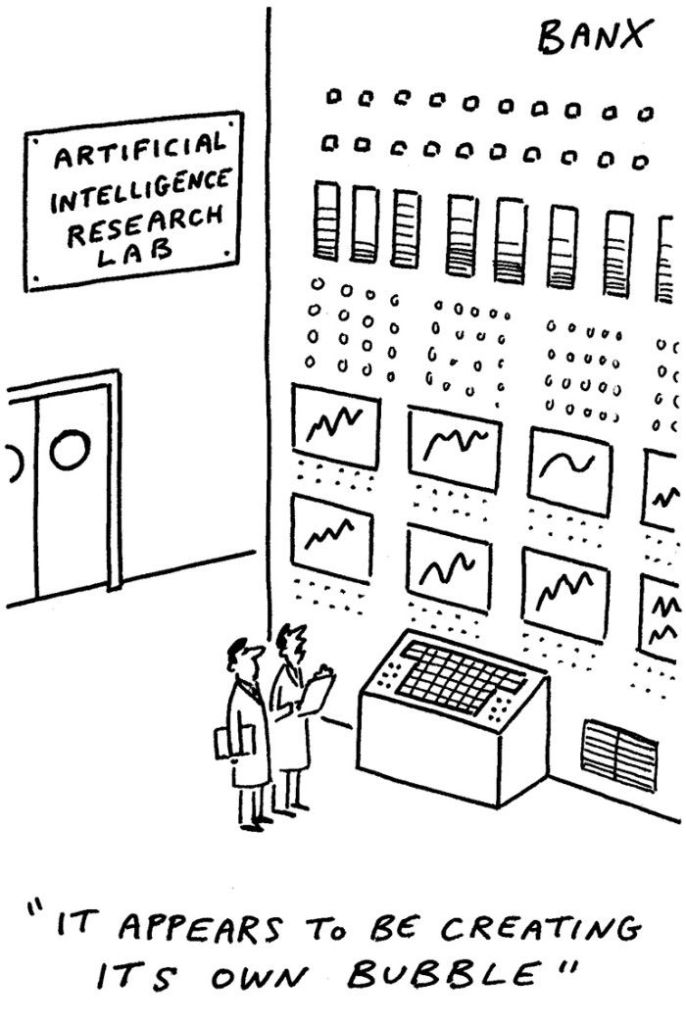
I’m not a financial expert, but I have noticed a significant number of articles in the media suggesting that the Generative AI industry is a bubble waiting to burst. There are recent pieces here on the BBC website, here in the Financial Times (from which I stole the cartoon), and here in the Irish Times, to name but a few.

These stories are based on reports by the Bank of England and the International Monetary Fund, warning of a stock market crash far worse than the dotcom boom-and-bust of 2000 and even the banking crisis of 2008. Over 30% of the valuation of the US stock market, for example, lies in five big technology companies that are investing heavily in the enormous infrastructure required for AI. Their extravagant capital expenditure is underpinned by a complex series of financial arrangements which could unravel very quickly if the investors get cold feet and consider it unlikely they will see a return on their money. It does look very much like a bubble to me.

My own view is that the claims made about the capabilities of AI by tech gurus are grossly overstated. Only the irredeemably gullible could think otherwise. I think a correction is inevitable. It’s not a question of “if” but “when” and “how much”. I am not competent to answer those questions.

P.S. Now there’s an RTÉ Brainstorm piece along the same lines…

Back to Teaching and Coping with GenAI

Posted in Artificial Intelligence, Education, mathematics, Maynooth with tags , , , , on September 21, 2025 by telescoper

Summer is well and truly over: it’s a chilly day in Maynooth; the Autumnal Equinox takes place tomorrow; and tomorrow I return to teaching at Maynooth University. So begins my antepenultimate academic year as a university teacher.

I’ve often remarked how the academic year at Maynooth is largely defined by the astronomical phenomena of the equinoxes and solstices. This year demonstrates this perfectly: Semester 1 lectures for undergraduates begin tomorrow (22nd September), the day of the Autumnal equinox; they end on Friday 19th December with the Winter Solstice on 21st. The half-term study break coincides with Samhain, a cross-quarter day. It’s all refreshingly pagan.

This time last year, having been away on sabbatical the year before, I was preparing to teach two new modules. I have those two again this year so this year should be a bit easiest than last year. I still have to get everything sorted out, though, including setting up my Moodle pages and preparing the materials, which is what I’ve been doing today.

The timetable for my Engineering Mathematics (EE206 Differential Equations and Transform Methods) module has not changed, so my first lectures on that (a double session) are not until Tuesday. I’m also doing MP469 Differential Equations and Complex Analysis for 4th Year Mathematical Physics students again, but the lecture times for that have changed. That is because, as a consequence of the merger of the Departments of Theoretical Physics and Experimental Physics to form a single Department of Physics, times have been coordinated as far as possible to ensure that Physics students can have flexibility in their choice of theoretical or experimental-based modules. The Engineering Mathematics module has not changed because the times for those lectures are such as to fit with the needs of the Department of Engineering, rather than Physics.

The upshot of all this is that my first lecture of the new term is for MP469, tomorrow afternoon at 2pm and my second is also MP469, at 11am on Tuesday. This means that I have three hours of lectures on Tuesdays this term, but at least that makes it possible to have a day without teaching (Wednesday).

You will notice that both the modules I am teaching this term are mathematical in nature. I have been concerned about the integrity of the coursework element of these modules in the light of improvements in Generative AI. Only a couple of years ago GenAI could not solve the sort of problems I set for homework, but now it generally can – especially for EE206. I don’t altogether object to people applying artificial intelligence to solve mathematical problems, but the issue is that it does make mistakes. Moreover, instead of saying “sorry I can’t solve that problem” it will generally present a superficially plausible but incorrect solution. Although students will probably use GenAI for problem-solving, I think it is important that they learn to do such problems themselves, otherwise they won’t know whether the solution coughed up by the algorithm is correct or not. That way lies disaster.

The only way to learn mathematics is by doing it. If students get GenAI to do the mathematics for them, then they won’t learn it. In the past we have given marks for coursework (usually 20% of the module mark) mainly to encourage students to do them. Students who don’t bother to do these exercises generally do badly in the final exam (80%).

For these reasons I am moving the assessment from weekly homework sheets – which could be tackled with AI – to supervised in-class tests for which students can use notes on paper, but not laptops or phones, just like they would in the final examination. I will of course give examples for the students to have a go at themselves, and I will give feedback on their attempts, but they will not contribute to the module score. Another advantage of this approach is that students won’t have to do so much work against deadlines outside of class.

Anyway, that’s the approach I am going to try. I’d be interested to hear what others are doing to deal with GenAI. The Comments Box is at your disposal.

P.S. There is a rumour circulating that The Rapture will occur on Tuesday 23rd September, but it is as yet unclear whether this will happen before, during, or after the lectures I am due to give on that day.

Generative AI in Physics?

Posted in Artificial Intelligence, Education, mathematics, Maynooth with tags , , , , , , , , , on August 11, 2025 by telescoper

As a new academic year approaches we are thinking about updating our rules for the use of Generative AI by physics students. The use of GenAI for writing essays, etc, has been a preoccupation for many academic teachers. Of course in Physics we ask our students to write reports and dissertations, but my interest in what we should do about the more mathematical and/or computational types of work. A few years ago I looked at how well ChatGPT could do our coursework assignments, especially Computational Physics, and it was hopeless. Now it’s much better, though still by no means flawless, and now there are also many other variants on the table.

The basic issue here relates to something that I have mentioned many times on this blog, which is the fact that modern universities place too much emphasis on assessment and not enough on genuine learning. Students may use GenAI to pass assessments, but if they do so they don’t learn as much as they would had they done the working out for themselves. In the jargon, the assessments are meant to be formative rather than purely summative.

There is a school of thought that has the opinion that formative assessments should not gain credit at all in the era of GenAI since “cheating” is likely to be widespread. The only secure method of assessment is through invigilated written examinations. Students will be up in arms if we cancel all the continuous assessment (CA), but a system based on 100% written examinations is one with which those of us of a certain age are very familiar.

Currently, most of our modules in theoretical physics in Maynooth involve 20% coursework and 80% unseen written examination. That is enough credit to ensure most students actually do the assignments, but the real purpose is that the students learn how to solve the sort of problems that might come up in the examination. A student who gets ChatGPT to do their coursework for them might get 20%, but they won’t know enough to pass the examination. More importantly they won’t have learnt anything. The learning is in the doing. It is the same for mathematical work as it is in a writing task; the student is supposed to think about the subject not just produce an essay.

Another set of issues arises with computational and numerical work. I’m currently teaching Computational Physics, so am particularly interested in what rules we might adopt for that subject. A default position favoured by some is that students should not use GenAI at all. I think that would be silly. Graduates will definitely be using CoPilot or equivalent if they write code in the world outside university so we should teach them how to use it properly and effectively.

In particular, such methods usually produce a plausible answer, but how can a student be sure it is correct? It seems to me that we should place an emphasis on what steps a student has taken to check an answer, which of course they should do whether they used GenAI or did it themselves. If it’s a piece of code to do a numerical integration of a differential equation, for example, the student should test it using known analytic solutions to check it gets them right. If it’s the answer to a mathematical problem, one can check whether it does indeed solve the original equation (with the appropriate boundary conditions).

Anyway, my reason for writing this piece is to see if anyone out there reading this blog has any advice to share, or even a link to their own Department’s policy on the use of GenAI in physics for me to copy adapt for use in Maynooth! My backup plan is to ask ChatGPT to generate an appropriate policy…

Weekly Update from the Open Journal of Astrophysics – 26/07/2025

Posted in OJAp Papers, Open Access, The Universe and Stuff with tags , , , , , , , , , , , , , , , , , , , , , on July 26, 2025 by telescoper

It’s Saturday morning again, so it’s time again for an update of papers published at the Open Journal of Astrophysics. Since the last update we have published seven new papers, which brings the number in Volume 8 (2025) up to 105, and the total so far published by OJAp up to 340. I expect we’ll pass the century for this year sometime next week. I had expected a bit of a slowdown in July, but that doesn’t seem to have happened. Anyway, with the century for the year having been achieved, the next target is 120 (the total number we published last year). At the current rate I expect us to reach that sometime in August.

The papers published this week, with their overlays, are as follows. You can click on the images of the overlays to make them larger should you wish to do so.

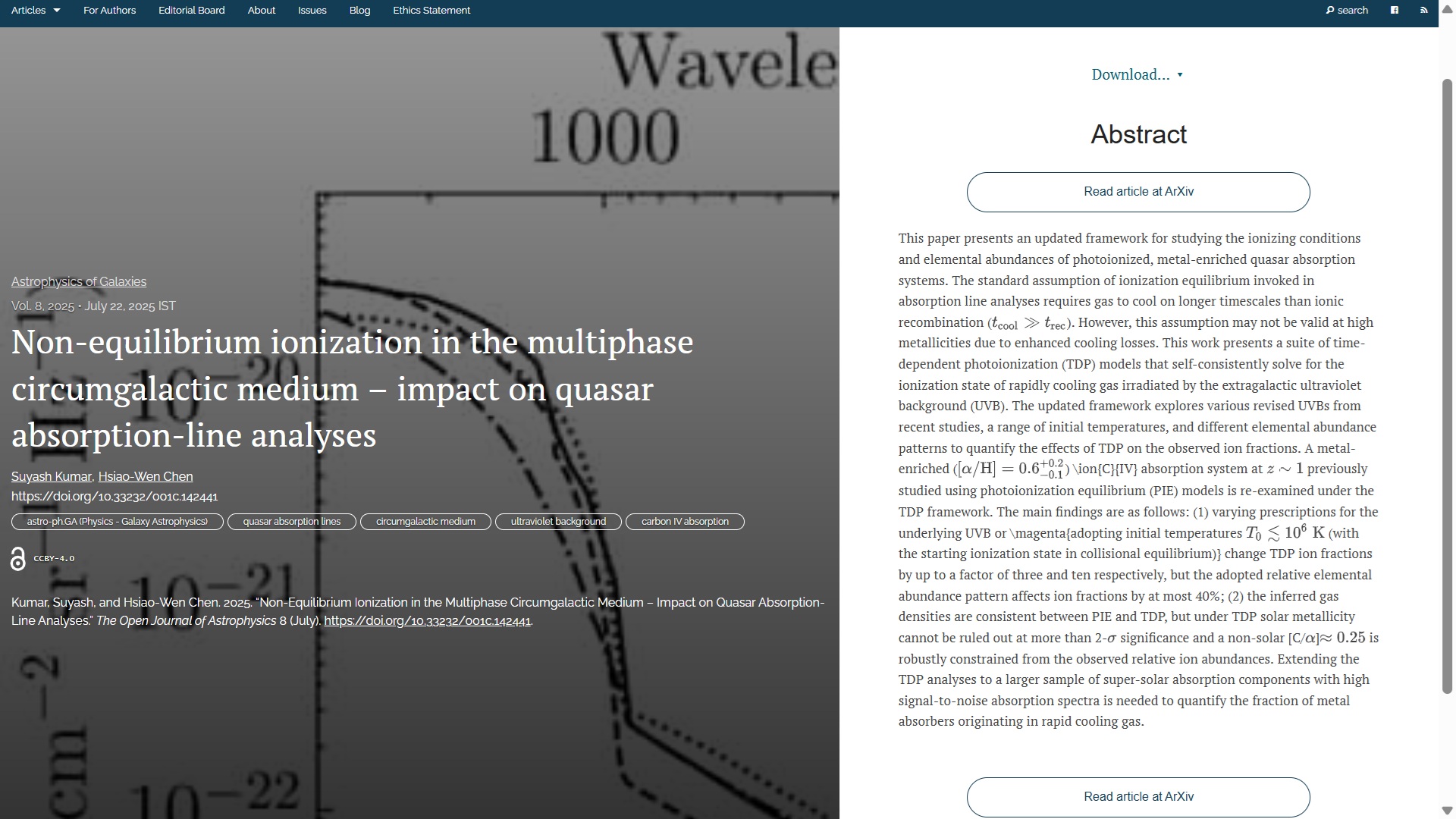
The first paper to report is “Non-equilibrium ionization in the multiphase circumgalactic medium – impact on quasar absorption-line analyses” by Suyash Kumar and Hsiao-Wen Chen (University of Chicago, USA). This was published on Tuesday 22nd July 2025 in the folder Astrophysics of Galaxies. It discusses time-dependent photoionization (TDP) models that self-consistently solve for the ionization state of rapidly cooling gas irradiated by the extragalactic ultraviolet background (UVB) and the application thereof to observed systems.

The overlay is here:

The officially-accepted version can be found on arXiv here.

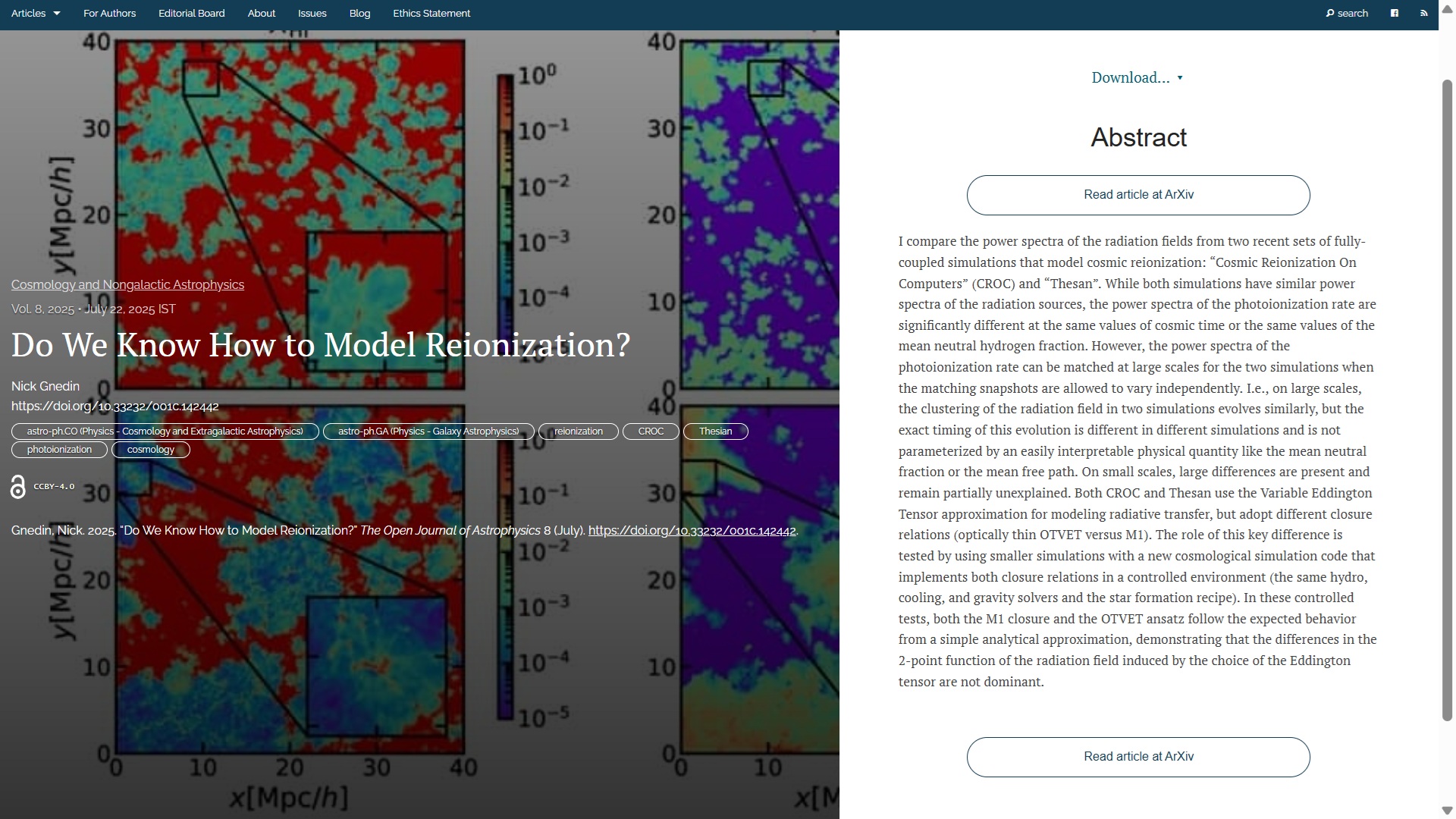
The second paper of the week, also published on Tuesday 22nd July but in the folder Cosmology and Nongalactic Astrophysics, is “Do We Know How to Model Reionization?” by Nick Gnedin (University of Chicago, USA). This paper discusses the similarities and differences between the radiation fields produced by different numerical simulations of cosmic reionization. The overlay is here:

You can find the officially accepted version of the paper on arXiv here.

The third paper of the week is “The effects of projection on measuring the splashback feature” by Xiaoqing Sun (MIT), Stephanie O’Neil (U. Penn.), Xuejian Shen (MIT) and Mark Vogelsberger (MIT), all based in the USA. This paper describes an investigation whether projection effects could lead to any systematic bias in determining the position of the boundary between infalling and accreting matter around haloes. It was published on Wednesday 23rd July in the folder Astrophysics of Galaxies. The overlay is here:

The officially-accepted version can be found on arXiv here.

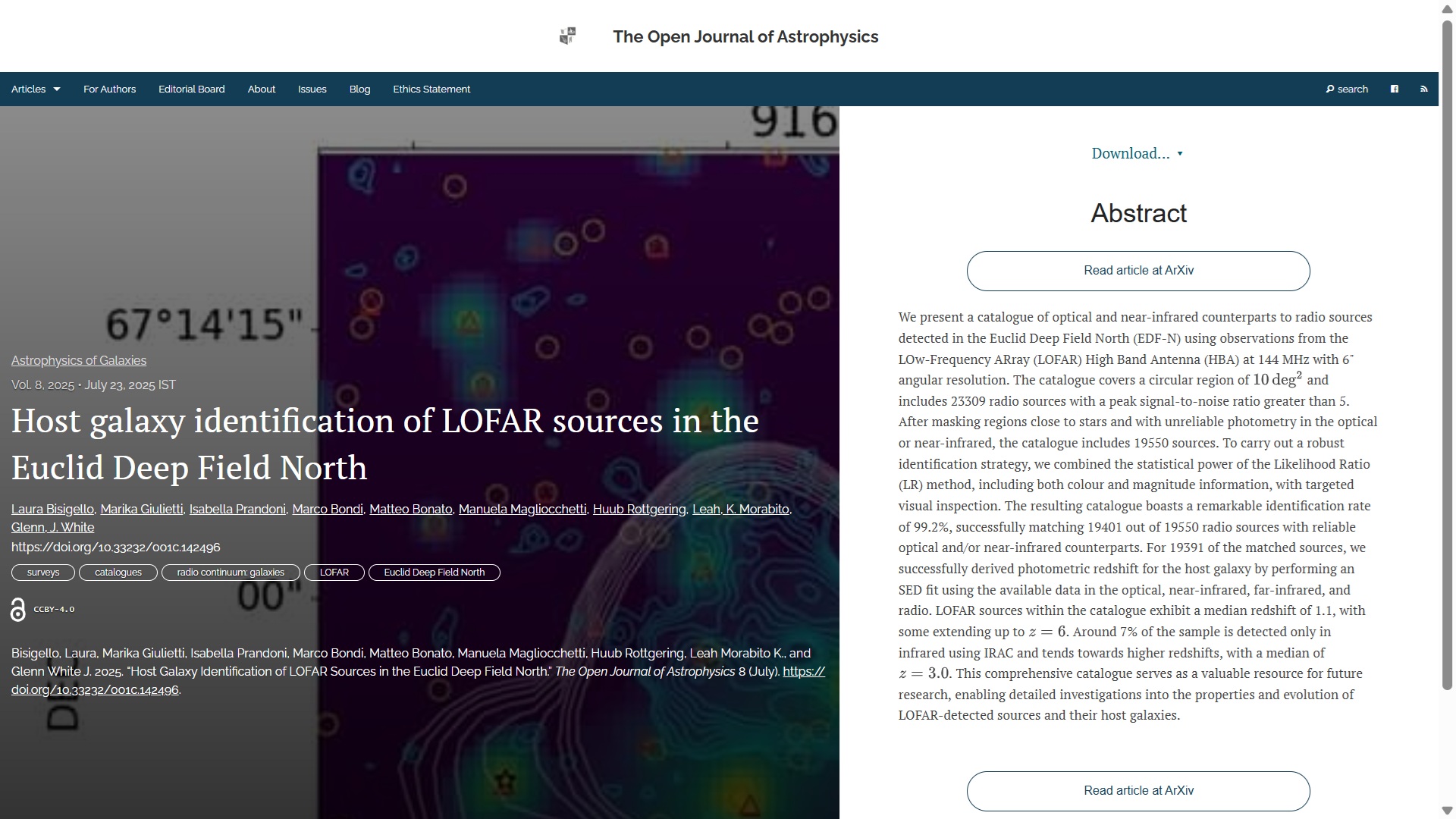
The fourth paper of the week, also published on Wednesday 22nd July in the folder Astrophysics of Galaxies, is “Host galaxy identification of LOFAR sources in the Euclid Deep Field North” by Laura Bisigello, Marika Giulietti, Isabella Prandoni, Marco Bondi, & Matteo Bonato (INAF, Bologna, Italy), Manuela Magliocchetti (INAF-IAPS Roma, Italy), Huub Rottgering (Leiden Observatory, Netherlands), Leah, K. Morabito (Durham University, UK) and Glenn, J. White (Open Universirty, UK). This presents a catalogue of optical and near-infrared counterparts to radio sources detected in the Euclid Deep Field North using observations from the LOw-Frequency ARray (LOFAR). The overlay is here:

The final, accepted version of the paper is on arXiv here.

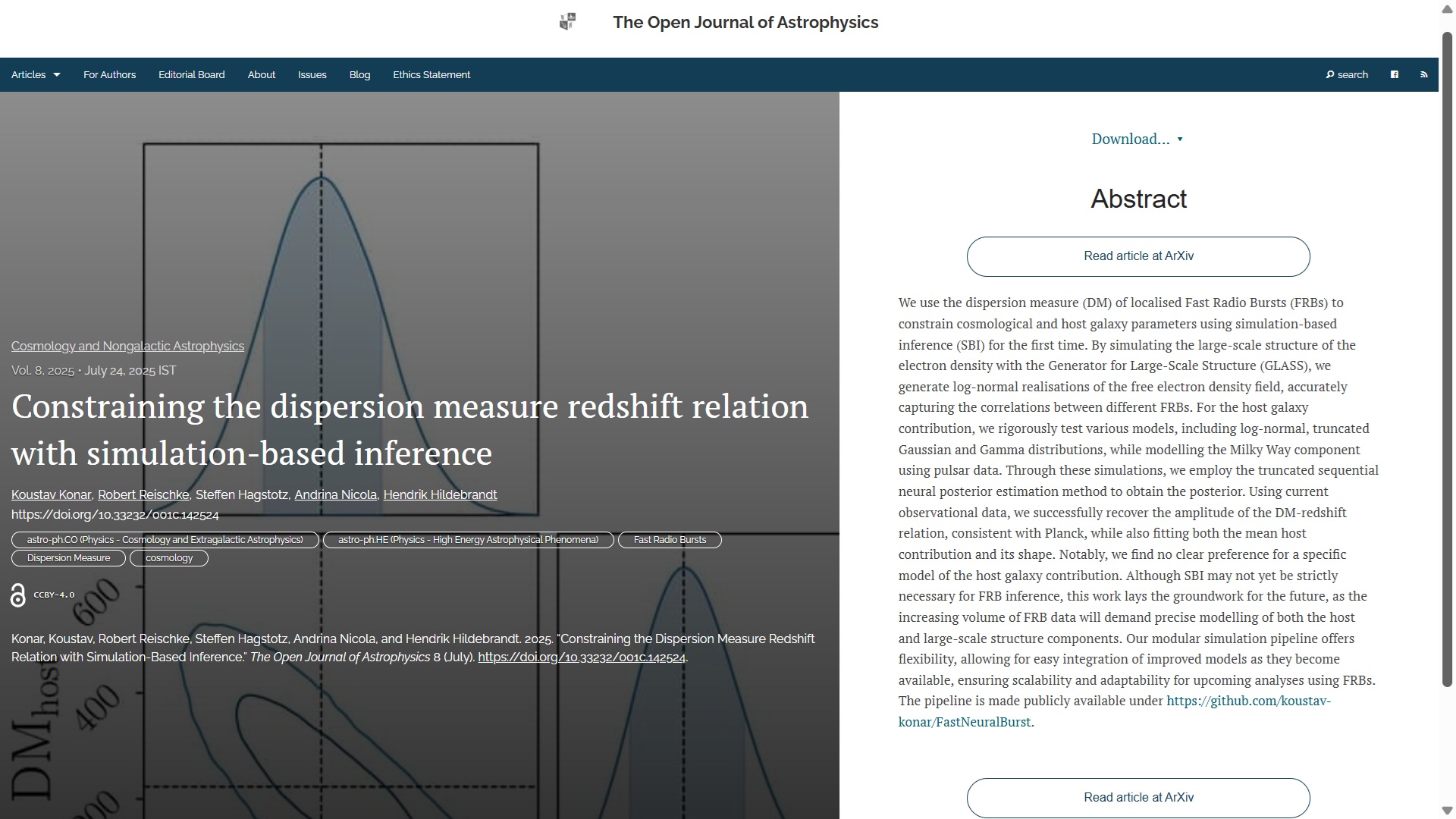
Fifth one up is “Constraining the dispersion measure redshift relation with simulation-based inference” by Koustav Konar (Ruhr University Bochum), Robert Reischke (Universität Bonn), Steffen Hagstotz (Ludwig-Maximilians Universität München), Andrina Nicola (Bonn) and Hendrik Hildebrandt (Bochum); all authors based in Germany. This was published on Thursday 24th July in the folder Cosmology and NonGalactic Astrophysics. It discusses using simulations to develop the use of Dispersion Measures of Fast Radio Bursts as cosmological probes. The overlay is here:

You can find the officially accepted version on arXiv here.

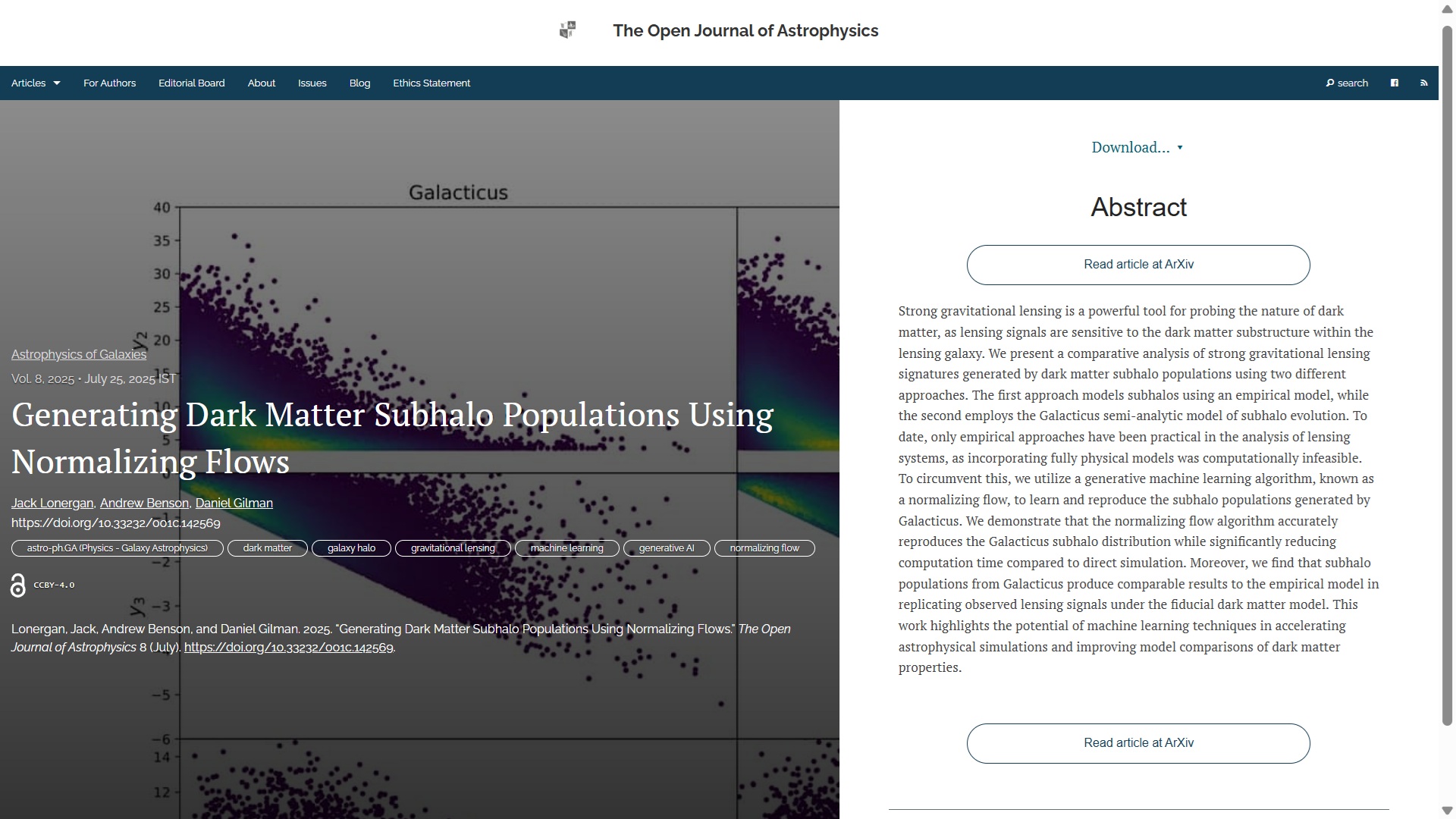
The penultimate (sixth) article published this week is “Generating Dark Matter Subhalo Populations Using Normalizing Flows” by Jack Lonergan (University of Southern California), Andrew Benson (Carnegie Observatories) and Daniel Gilman (University of Chicago), all based in the USA. This paper describes a generative AI approach to subhalo populations, trained using the semi-analytical model Galacticus. This paper was published yesterday (i.e. on Friday 25th July) in the folder Astrophysics of Galaxies.

You can find the final version on arXiv here.

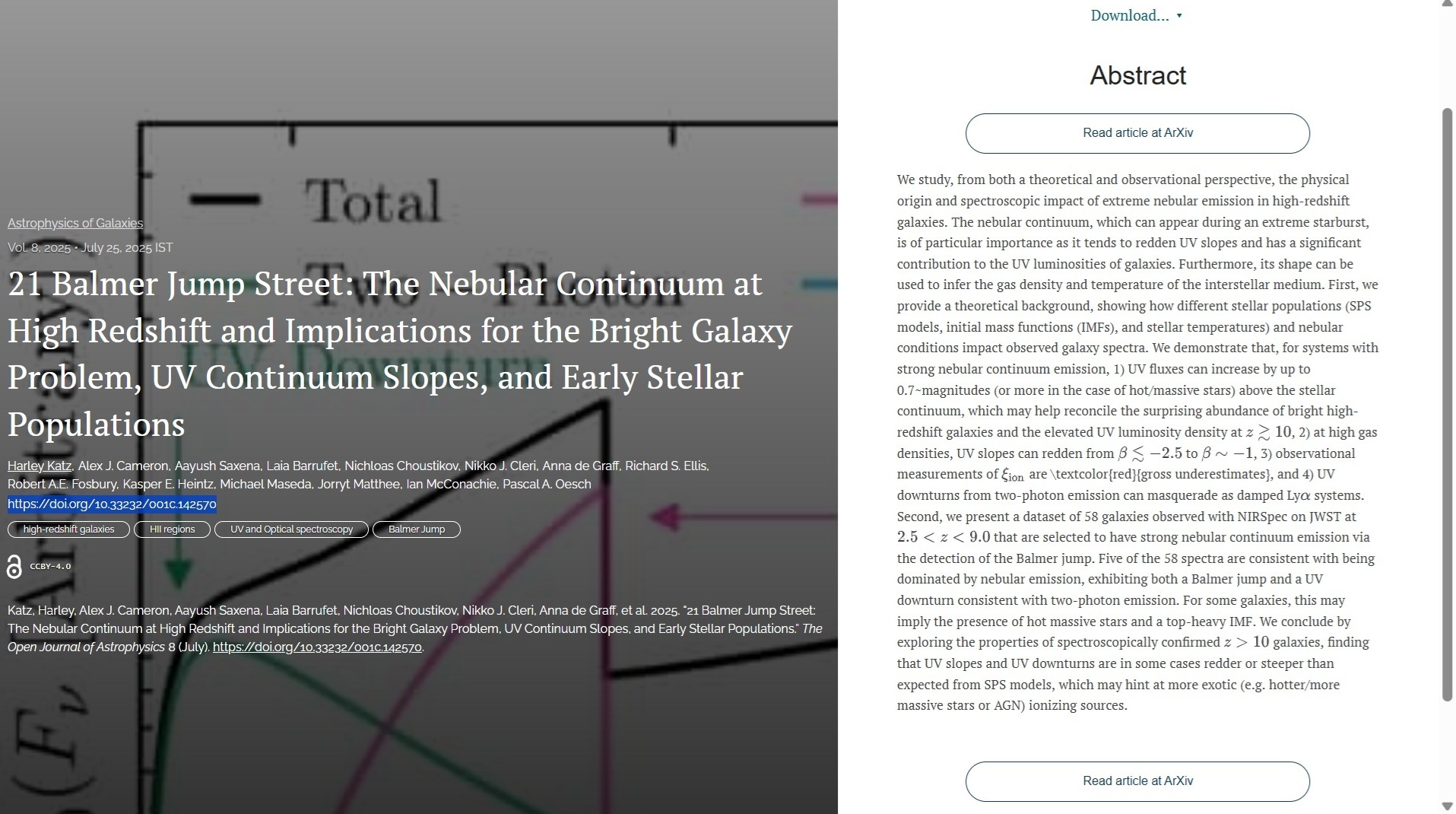
The last article published this week is “21 Balmer Jump Street: The Nebular Continuum at High Redshift and Implications for the Bright Galaxy Problem, UV Continuum Slopes, and Early Stellar Populations” by Harley Katz of the University of Chicago, and 13 others based in the USA, UK, Germany, Denmark and Austria. This discusses the implications of extreme nebular emission for the spectroscopic properties of galaxies, especially at high redshift. It was published on Friday 25th July in the folder Astrophysics of Galaxies.

The overlay is here:

You can find the officially-accepted version on arXiv here.

And that’s all the papers for this week. I’ll do another update next Saturday, when we’ll be into August.

Weekly Update from the Open Journal of Astrophysics – 19/07/2025

Posted in OJAp Papers, Open Access, The Universe and Stuff with tags , , , , , , , , , , , , , , , , , , , , , , , , , , on July 19, 2025 by telescoper

It’s Saturday morning again, so it’s time again for an update of papers published at the Open Journal of Astrophysics. Since the last update we have published six new papers, which brings the number in Volume 8 (2025) up to 98, and the total so far published by OJAp  up to 333. I expect we’ll pass the century for this year sometime next week.

The papers published this week, with their overlays, are as follows.  You can click on the images of the overlays to make them larger should you wish to do so.

The first paper to report is “Reconstructing Galaxy Cluster Mass Maps using Score-based Generative Modeling” by Alan Hsu (Harvard), Matthew Ho (CMU), Joyce Lin (U. Wisconsin-Madison), Carleen Markey (CMU), Michelle Ntampaka (STScI), Hy Trac (CMU) & Barnabás Póczos (CMU), all based in the USA. This paper was published on 14th July 2025 in the folder Cosmology and NonGalactic Astrophysics. It presents a diffusion-based generativbe AI model for reconstructing density profiles for galaxy clusters from observational data.

The overlay is here:

The officially-accepted version can be found on arXiv here.

The second and third papers are related. They were both published on 14th July in the folder Cosmology and NonGalactic Astrophysics.

The first of the pair is “J-PLUS: Tomographic analysis of galaxy angular density and redshift fluctuations in Data Release 3. Constraints on photo-z errors, linear bias, and peculiar velocities” by Carlos Hernández-Monteagudo (IAC, Tenerife, Spain) and 21 others. This presents an analysis of the Javalambre Photometric Local Universe Survey (J-PLUS) in redshift slices with a discussion of prospects for extracting cosmological information. The overlay is here:


You can find the final version of the manuscript on arXiv here.

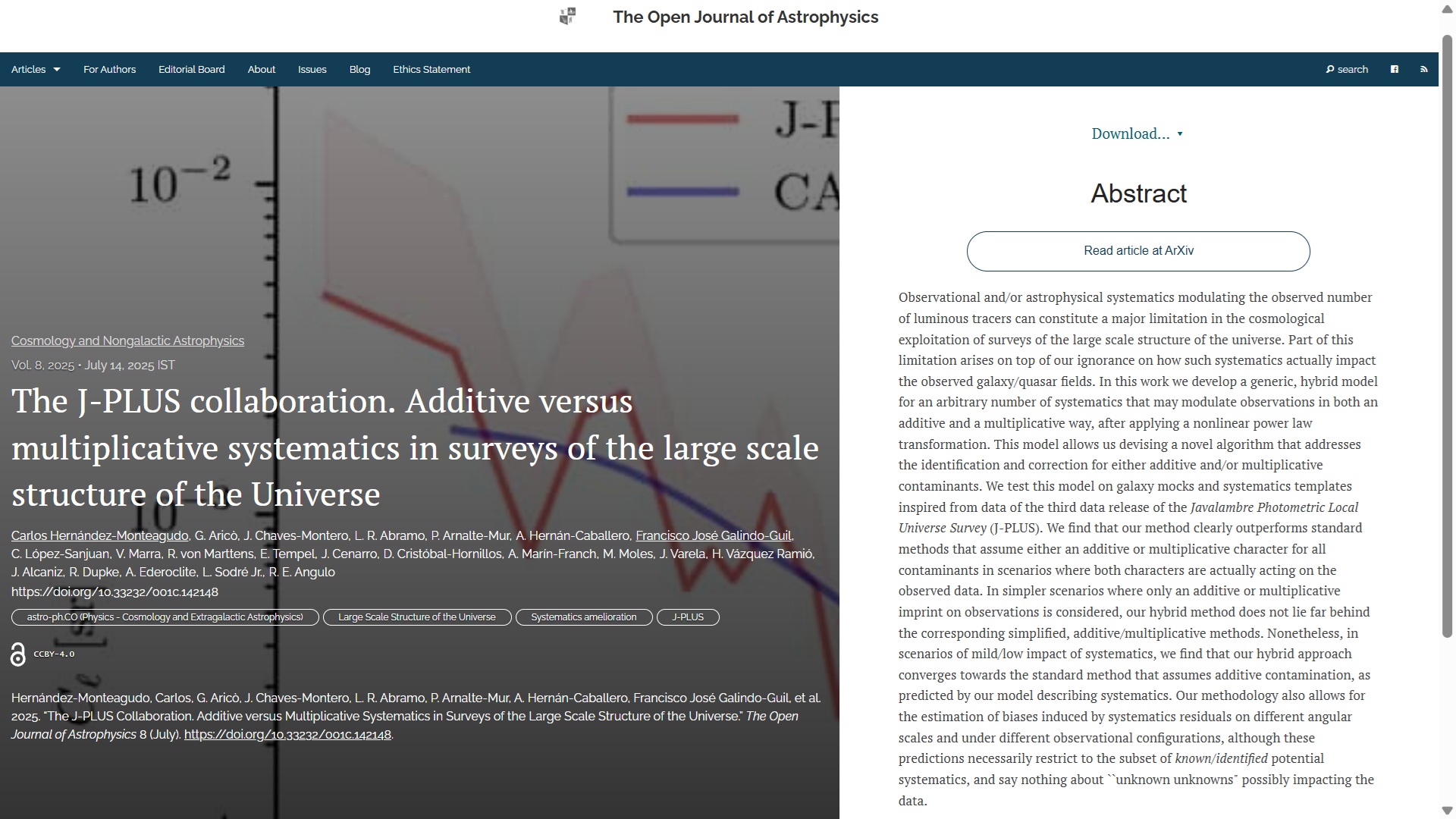
The second of this pair is “The J-PLUS collaboration. Additive versus multiplicative systematics in surveys of the large scale structure of the Universe” by Carlos Hernández-Monteagudo (IAC) and 21 others (the same authors as the previous paper).  This paper presents an analysis of systematic effects in the Javalambre Photometric Local Universe Survey (J-PLUS), and a new model for handling such errors in this and other cosmological surveys. The overlay for this paper is here:

You can find the officially accepted version of this paper on arXiv here.

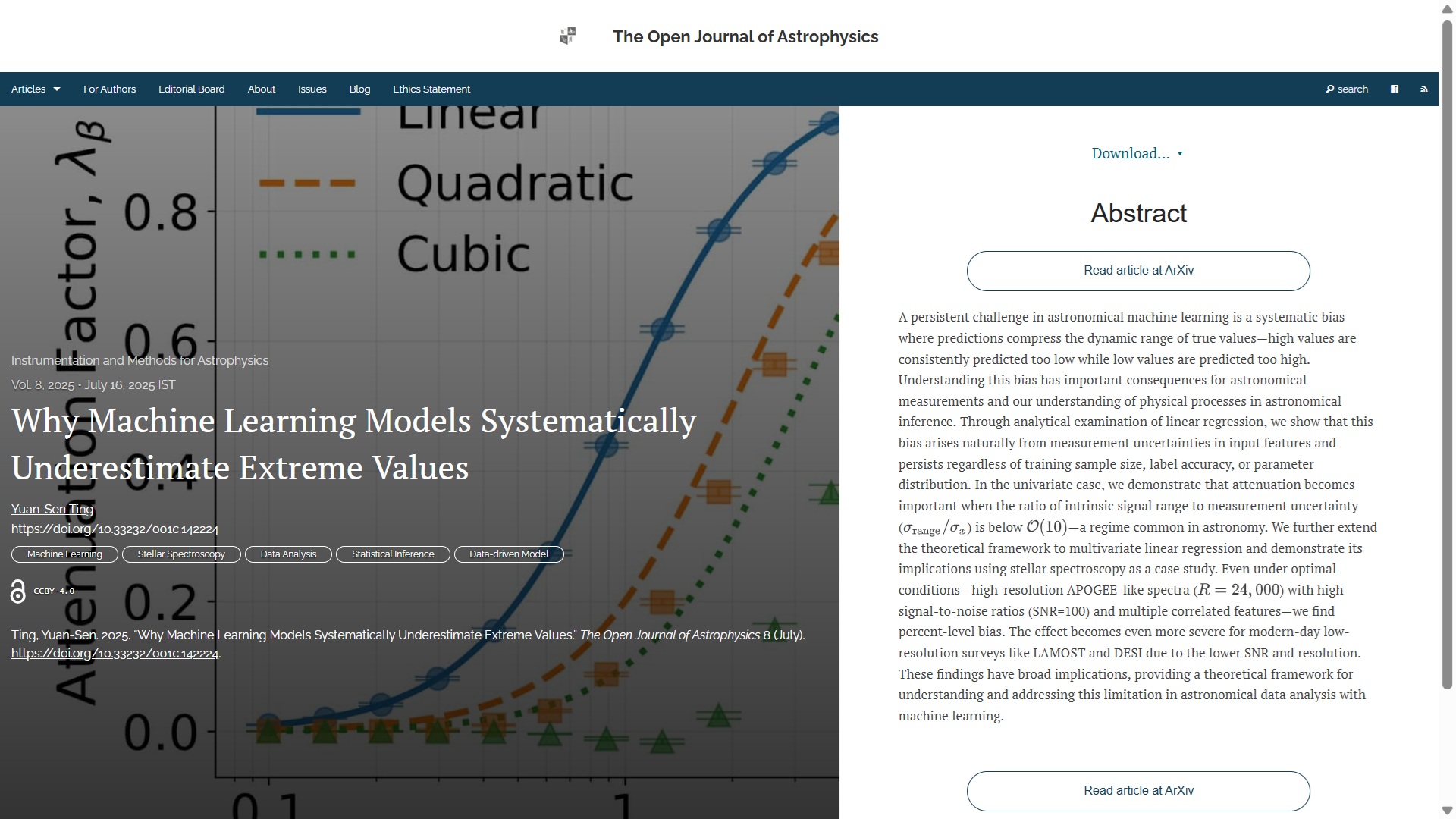
The fourth paper this week is “Why Machine Learning Models Systematically Underestimate Extreme Values” by Yuan-Sen Ting (Ohio State University). This one was published on July 16th in the folder marked Instrumentation and Methods for Astrophysics.  This paper presents a theoretical framework for understanding and addressing a bias that suppresses the dynamic range of variables in applications of machine learning to astronomical data analysis. Here is the overlay:

You can find the officially accepted version of this paper on arXiv here.

The penultimate article for this week is “Bridging Machine Learning and Cosmological Simulations: Using Neural Operators to emulate Chemical Evolution” by Pelle van de Bor, John Brennan & John A. Regan (Maynooth University) and Jonathan Mackey (Dublin Institute for Advanced Studies), all based in Ireland. This paper uses machine learning, in the form of neural operators, to emulate the Grackle method of solving non-equilibrium chemistry equations in cosmological hydrodynamic simulations and was published on 16th July also in the folder Instrumentation and Methods for Astrophysics. The overlay is here:

The final, accepted version of the paper is on arXiv here.

The last article published this week is “Astronomical Cardiology: A Search For Heartbeat Stars Using Gaia and TESS” by Jowen Callahan, D. M. Rowan, C. S. Kochanek and K. Z. Stanek (all of Ohio State University, USA). This paper presents a study of a sample of 112 new spectroscopic binaries called hearbeat stars (because their light curves resemble electrocardiagrams). It was published on 16th July 2025 in the folder marked Solar and Stellar Astrophysics. The overlay is here:

You can find the officially-accepted version on arXiv here.

And that’s all the papers for this week. I’ll do another update next Saturday.

What should it mean to be an author of a scientific paper?

Posted in Open Access, The Universe and Stuff with tags , , , on February 12, 2023 by telescoper

The implementation of artificial intelligence techniques in tools for generating text (such as ChatGPT) has caused a lot of head-scratching recently as organizations try to cope with the implications. For instance, I noticed that the arXiv recently adopted a new policy on the use of generative AI in submissions. One obvious question is whether ChatGPT can be listed as an author. This has an equally obvious answer: “no”. Authors are required to acknowledge the use of such tools when they have used them in writing a paper.

One particular piece of the new policy statement caught my eye:

…by signing their name as an author of a paper, they each individually take full responsibility for all its contents, irrespective of how the contents were generated. If generative AI language tools generate inappropriate language, plagiarized content, biased content, errors, mistakes, incorrect references, or misleading content, and that output is included in scientific works, it is the responsibility of the author(s).

The first sentence of this quote states an obvious principle, but there are situations in which I don’t think it is applied in practice. One example relates to papers emanating from large collaborations or consortia, where the author lists are often very long indeed, sometimes numbering in the thousands. Not all the “authors” of such papers will have even read the paper, so do they “each individually take full responsibility”? I don’t think so. And how can this principle be enforced as policy?

All large consortia have methods for assigning authorship rights as a way of assigning credit for contributions made. But why does “credit” have to mean “authorship”? Papers just don’t have thousands of authors, in the meaningful sense of the term. It’s only ever a handful of people who actually do any writing. That doesn’t mean that the others didn’t do any work. The project would probably not have been possible without them. It does mean, however, that pretending that they participated in writing the article that describes the work isn’t be the right way to acknowledge their contribution. How are young scientists supposed to carve out a reputation if their name is always buried in immensely long author lists? The very system that attempts to give them credit at the same renders that credit worthless.

As science evolves it is extremely important that the methods for disseminating scientific results evolve too. The trouble is that they aren’t. We remain obsessed with archaic modes of publication, partly because of innate conservatism and partly because the lucrative publishing industry benefits from the status quo. The system is clearly broken, but the scientific community carries on regardless. When there are so many brilliant minds engaged in this sort of research, why are so few willing to challenge an orthodoxy that has long outlived its usefulness.

In my view the real problem is not so much the question of authorship but the very idea of the paper. It seems quite clear to me that the academic journal is an anachronism. Digital technology enables us to communicate ideas far more rapidly than in the past and allows much greater levels of interaction between researchers. The future for many fields will be defined not in terms of “papers” which purport to represent “final” research outcomes, but by living documents continuously updated in response to open scrutiny by the community of researchers. I’ve long argued that the modern academic publishing industry is not facilitating but hindering the communication of research. The arXiv has already made academic journals redundant in many of branches of  physics and astronomy; other disciplines will inevitably follow. The age of the academic journal is drawing to a close. Now to rethink the concept of “the paper”.

In the meantime I urge all scientists to remember that by signing their name as an author of a paper, they individually take full responsibility for all its contents. That means to me that at the very least you should have read the paper you’re claiming to have written.