Archive for Henry VIII

Thomas Cromwell and his Prayer-Book

Posted in Art, History with tags , , , , , , on April 1, 2024 by telescoper
(1532-1533, Oil on Panel, 78.1 cm × 64.1 cm) by Hans Holbein the Younger – The Frick Collection, Public Domain, https://commons.wikimedia.org/w/index.php?curid=207764

The famous portrait of Thomas Cromwell by Hans Holbein the Younger shown above is in fact a copy; the original is lost. There is another copy in the National Portrait Gallery in London, but it’s not as good. The original was painted around 1533, during the period covered by the novel Wolf Hall (which I reviewed yesterday) and is mentioned in the book. Holbein is known for having sometimes painted excessively flattering portraits – most notably of Anne of Cleves – but he doesn’t seem to have done that here. Cromwell is portrayed as dour, stern-faced and more than a little scary. He probably wanted people to fear him, so wouldn’t have minded this.

As well as the nature of the likeness, the composition is interesting. The subject seems to be squashed into the frame, and hemmed in by the table that juts out towards the viewer. He is also looking out towards the viewer’s left, though not simply staring into space; his eyes are definitely focussed on something. I’m not sure what all this is intended to convey, except that the table carries an ornate prayer-book (the Book of Hours) as if to say “look, here’s a symbol of how devout this man is”.

Interesting, just last year scholars published research that argues that the copy of the Hardouyn Hours which can be found in the Library at Trinity College, Cambridge, is precisely the book depicted on the table. If so, it’s a rare and perhaps unique example of an artefact seen in a Tudor painting that survives to this day.

Wolf Hall by Hilary Mantel

Posted in History, Literature, Uncategorized with tags , , , , , , , on March 31, 2024 by telescoper

Still trying to use the spare time during my sabbatical to catch up on long-neglected reading, this Easter weekend – helped by the rainy weather – I finished Wolf Hall by Hilary Mantel, the first of her novels that I’ve read. This “historical novel” won the Booker Prize in 2009 and I understand was made into a play and a TV series, neither of which I have seen.

The novel is set in Tudor England in the reign of Henry VIII and revolves around Thomas Cromwell, who rose from lowly beginnings in Putney to be one of the powerful men in the country. Cromwell gets a surprisingly sympathetic treatment, at odds with most of the historical record which treats him largely as a cruel and unscrupulous character, undoubtedly clever but given to threats and torture if appeals to reason failed. From a 21st century perspective, it’s hard to find redeeming features in Cromwell. Or anyone else in this story, to be honest.

The historical events of the period covered by the book are dominated by Henry’s attempts to have his marriage of 24 years to Catherine of Aragon annulled so he could marry Anne Boleyn, along the way having himself declared the Supreme Governor of the Church in England, causing a split with Rome. Henry does marry Anne, and she bears him a daughter, destined to become Elizabeth I, though her second pregnancy ends in a miscarriage. The book ends in 1535 just after the execution of Thomas More, beheaded for refusing to swear the Oath of Supremacy.

(More was portrayed sympathetically in the play and film A Man For All Seasons though he was much disposed to persecution of alleged heretics, many of whom he caused to be burned at the stake for such terrible crimes as distributing copies of the Bible printed in English. Significant chunks of the penultimate chapter are lifted from the script of A Man For All Seasons but given a very different spin.)

Henry VIII is also portrayed in a somewhat flattering light; Anne Boleyn rather less so. Mary Tudor, Henry’s eldest daughter by Catherine of Aragon, cuts an unsurprisingly forlorn and intransigent. There are also significant appearances from other figures familiar from schoolboy history: Hugh Latimer, Cardinal Wolsey, and Thomas Cranmer; as well as those whose story is not often told, such as Mary Boleyn (Anne’s older sister). I have a feeling that Hilary Mantel was being deliberately courting controversy with her heterodox approach to characterization. She probably succeeded, as many professional historians are on record as hating Wolf Hall as much of it is of questionable accuracy and some is outright fiction.

Incidentally, one of the most negative reactions to this book that I’ve seen is from Eamon Duffy who is on record as detesting the historical figure of Thomas Cromwell and was “mystified by his makeover in Hilary Mantel’s Wolf Hall from a thuggish ruthless commoner to a thoughtful sensitive figure”. I mention this particularly because Eamon Duffy, an ecclesiastical historian, was my tutor when I was an undergraduate at Magdalene College, Cambridge.

On the other hand, Wolf Hall not meant to be a work of scholarly history: it is a novel and I think you have to judge it by the standards of whether it succeeds as a work of fiction. I would say that it does. Although rather long-winded in places – it’s about 640 pages long – it is vividly written and does bring this period to life with colour and energy, and a great deal of humour, while not shying away from the brutality of the time; the execution scenes are unflinchingly gruesome. The book may not be accurate in terms of actual history, but it certainly creates a credible alternative vision of the time.

It’s interesting that the title of this book is Wolf Hall when that particular place – the seat of the Seymour family – hardly figures in the book. However, one character does make a few appearances, Jane Seymour, who just a year after the ending of this book would become the third wife of Henry VIII. It also happened that Thomas Cromwell’s son, Gregory, married Jane’s sister, Elizabeth. I suppose I will have to read the next book in the trilogy, Bring Up The Bodies, to hear Mantel’s version of those events…

The Oldest Tree in Ireland

Posted in Biographical, History, Maynooth with tags , , , , , , on April 15, 2020 by telescoper

Regular readers of this blog – both of them – will know that I’ve developed a habit during the current lockdown of talking walks around the South Campus of Maynooth University in order to get a bit of exercise.

I’ve noticed a bit of a side effect of strolling around the environs of the old College, though, which is that I always return home sneezing. I’ve never really been susceptible to hay-fever before, but I reckon this is a reaction to tree pollen. It’s the right season for that, and there are many trees about.

Last night I was idly googling around in an attempt to identify the types of tree I would encounter on my wanderings and during the course of that I accidentally came across something fascinating.

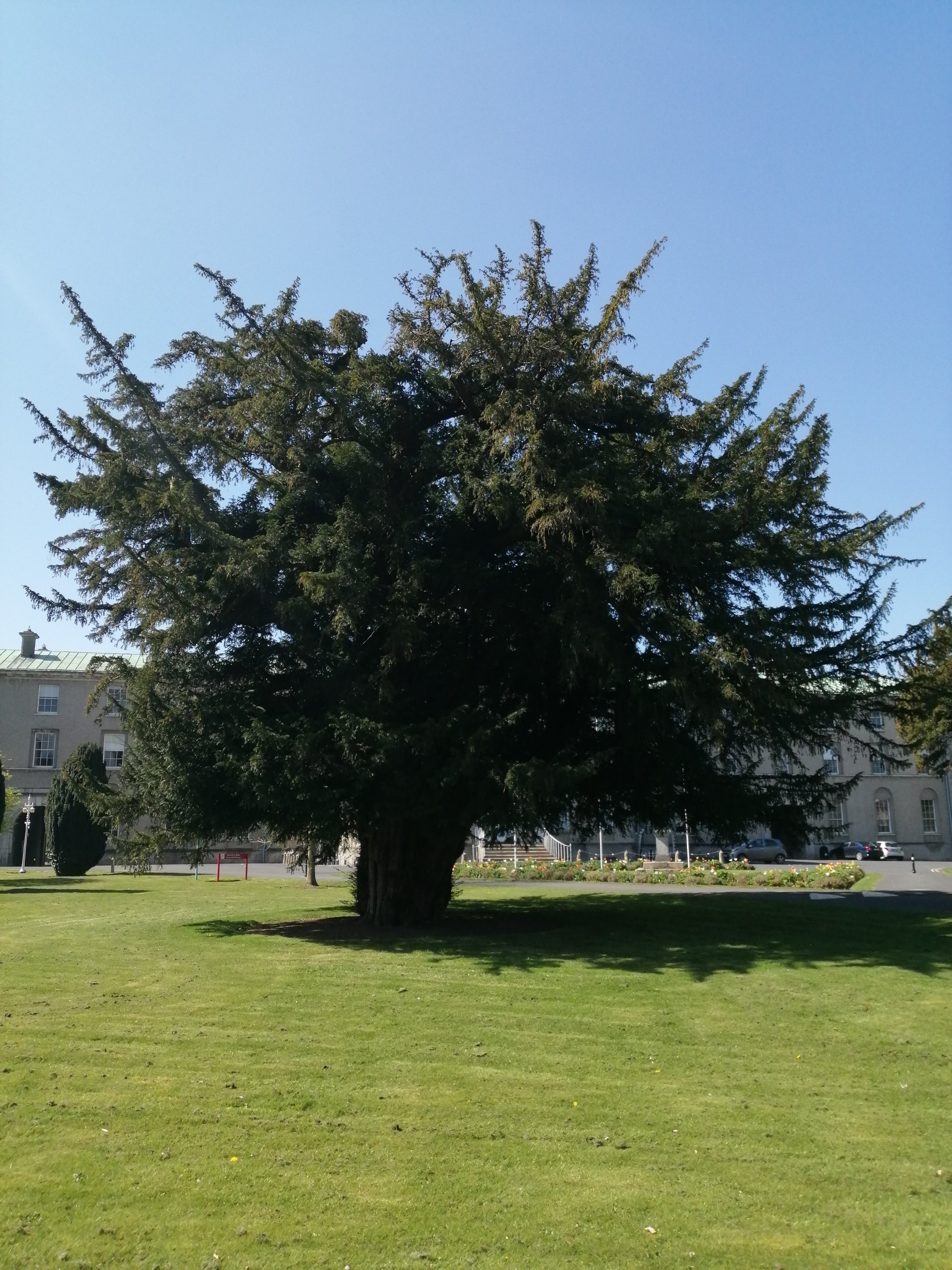
This Yew tree stands near the main entrance to Maynooth University campus.

It’s not a particularly tall specimen and I’ve walked past it hundreds of times without paying attention to it. It is however generally believed to be the oldest tree in the Republic of Ireland (there is one tree, another Yew, possibly older, in County Fermanagh.) The tree in Maynooth germinated (or was planted) around the year 1267 ± 50, which makes it around 753 ± 50 years old.

The timing is interesting because it means that the tree is roughly the same age as Maynooth Castle and the old church. In this picture you can see the Yew tree on the left, with the church on the right and the remains of the Castle in the background:

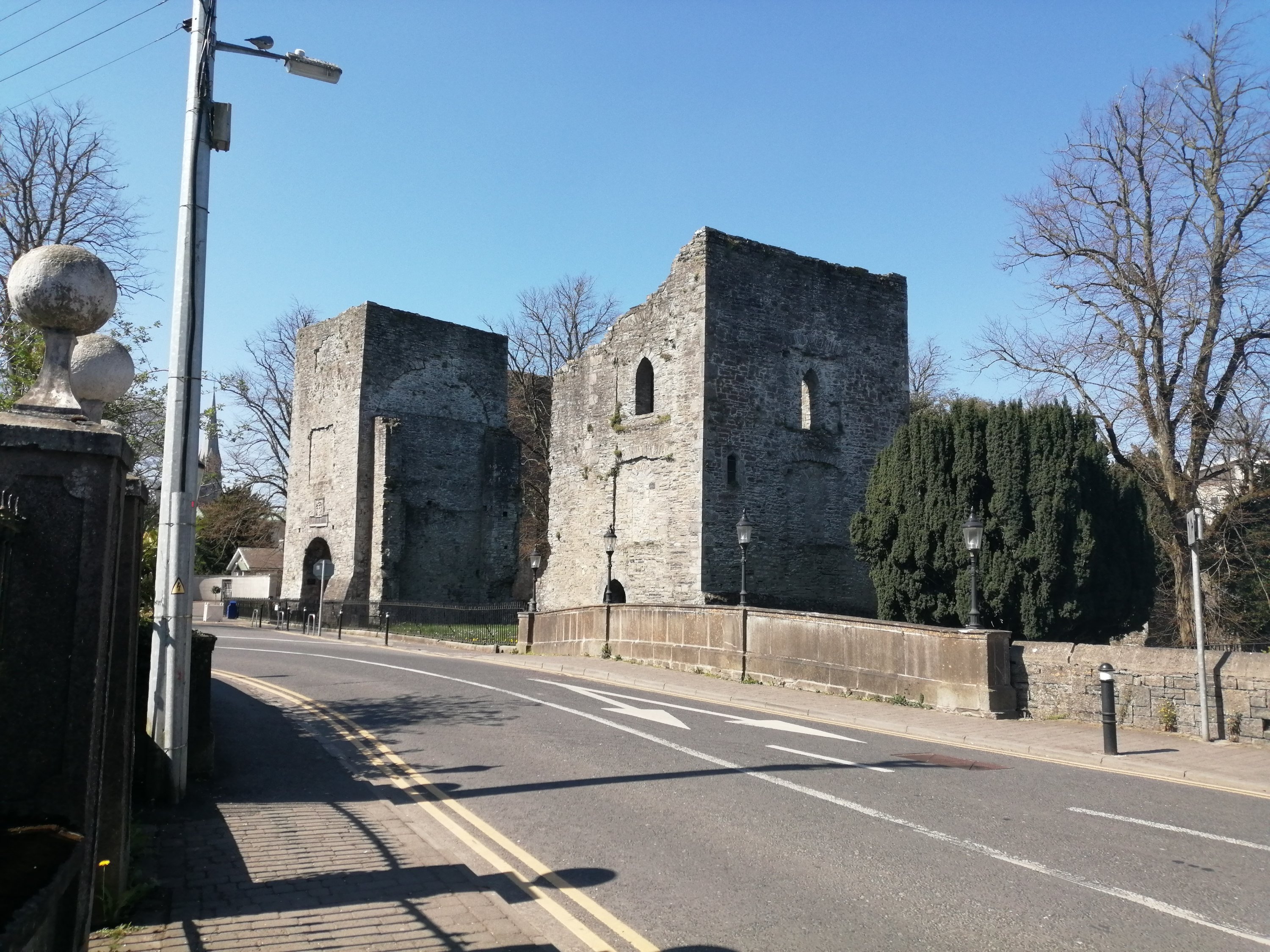
Here’s a better picture of the Castle from another direction. Only a few bits of wall, the gatehouse and solar tower remain. The Castle was damaged and subsequently surrendered after a siege in 1535 (see below) then reoccupied only to be largely dismantled in 1647, whereafter it fell into ruin.

The tree is often called the “Silken Thomas Tree” after Thomas Fitzgerald, the 10th Earl of Kildare, who led a rebellion against the English authorities during the time of Henry VIII. He acquired the nickname “Silken Thomas” because of the ribbons of silk worn by his supporters. Needless to say, the rebellion failed and his family castle was destroyed. Thomas surrendered, throwing himself on the mercy of the King. That went exactly as well as you might have expected: Thomas was executed, along with several members of his family, in 1537.

The tree, of course, pre-dates Silken Thomas by three centuries, but legend has it that he played a lute under the boughs of the tree the night before he surrendered to King Henry VIII.

All that is quite interesting but doesn’t answer the question of which trees make me sneeze…