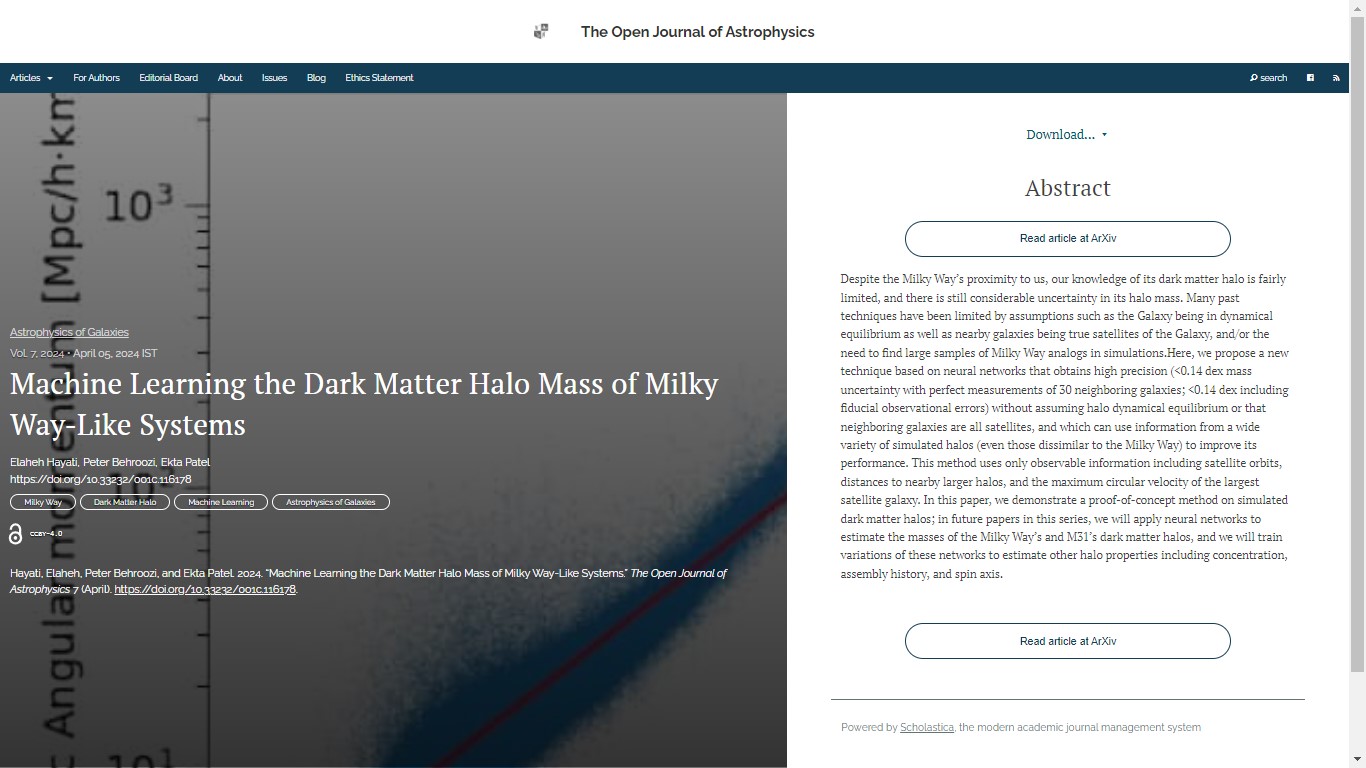
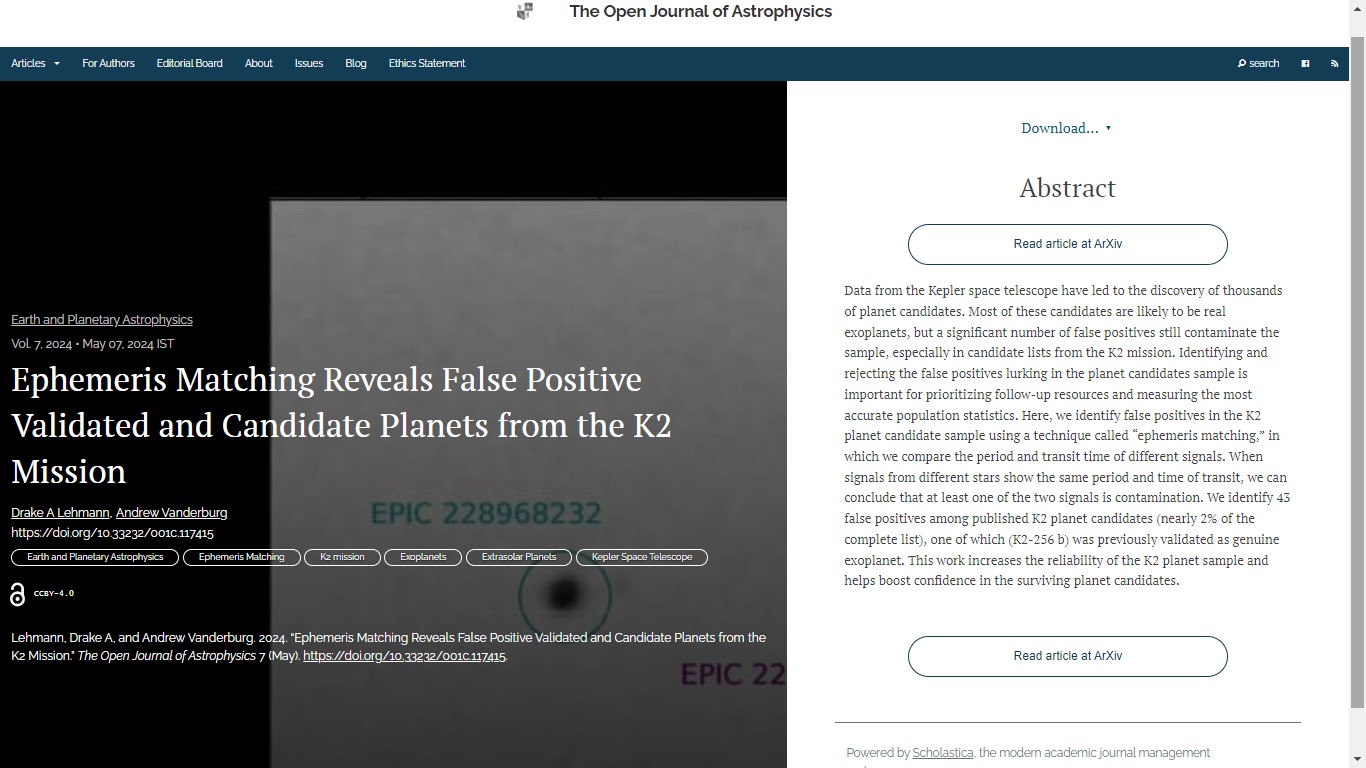
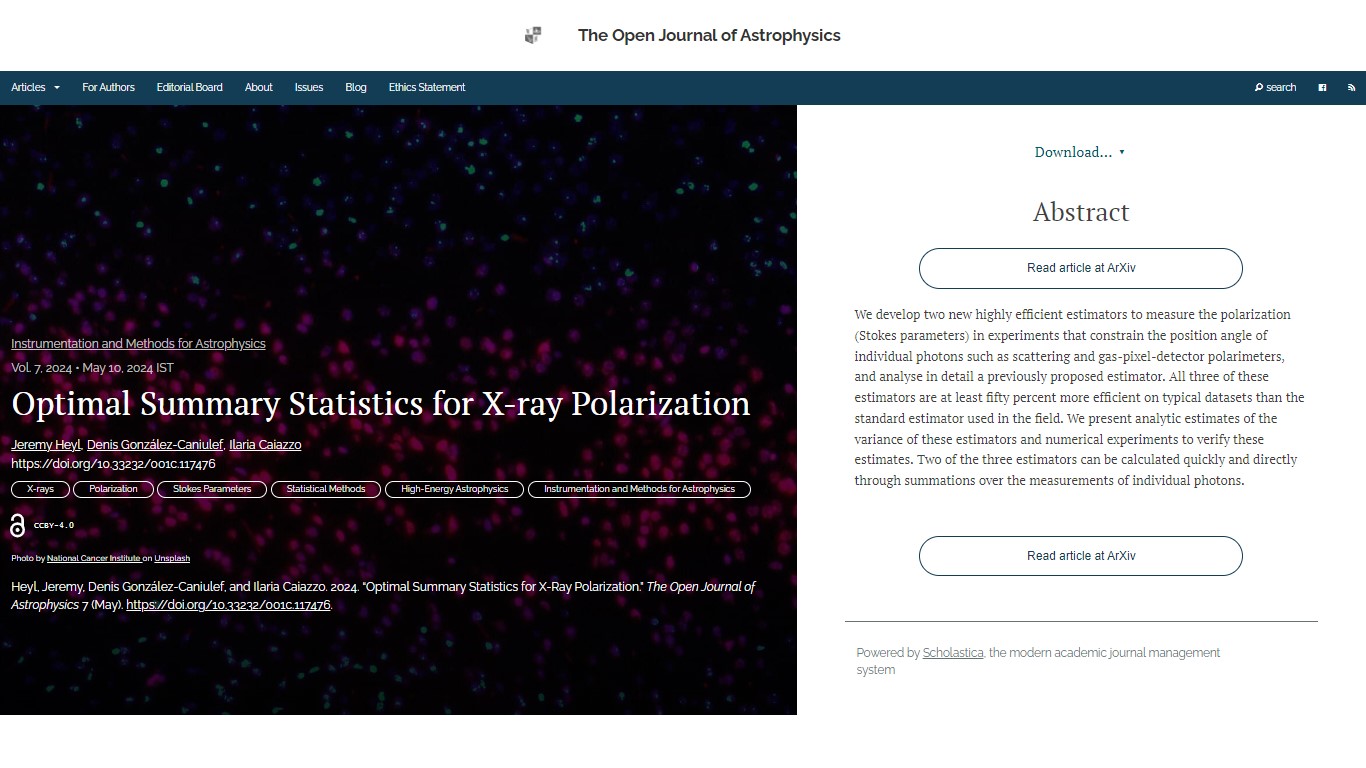
Saturday morning once again, and time for another update of papers published at the Open Journal of Astrophysics. It’s been a recording-breaking week: since the last update we have published no fewer than ten papers, which brings the number in Volume 8 (2025) up to 54 and the total so far published by OJAp up to 289.
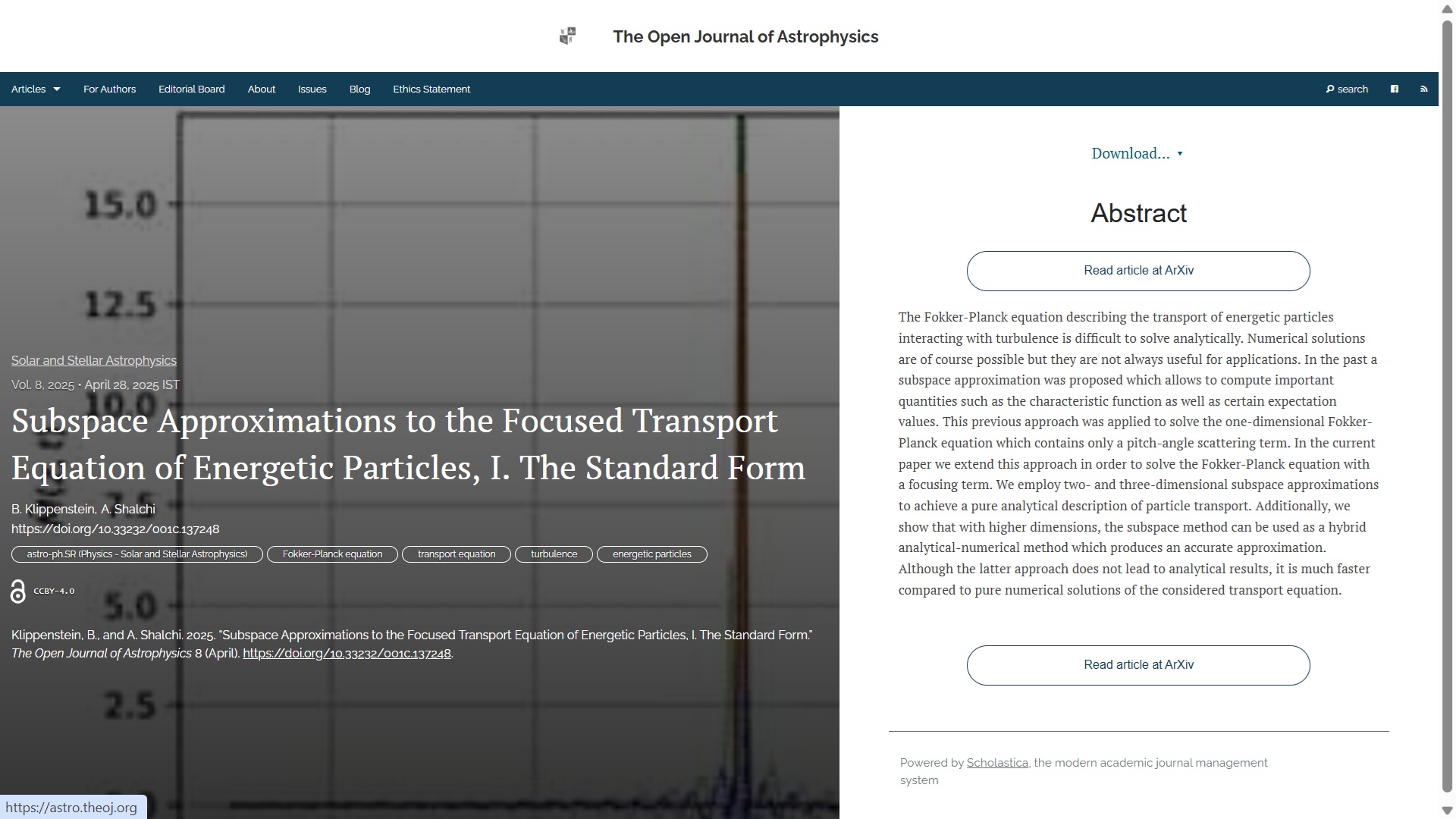
The first paper to report is “Subspace Approximations to the Focused Transport Equation of Energetic Particles, I. The Standard Form” by B. Kippenstein & A. Shalchi (U. Manitoba, Canada). This paper, which was published on Monday 28th April 2025, presents a hybrid analytical-numerical method to solve the Fokker-Planck equation for the transport of energetic particles. It is published in the folder Solar and Stellar Astrophysics.
The overlay is here:
You can find the officially accepted version on arXiv here.
Next is “The Importance of Subtleties in the Scaling of the ‘Terminal Momentum’ For Galaxy Formation Simulations” by Philip F. Hopkins (Caltech, USA). This presents a technical discussion of issues surrounding the proper modelling of supernova blast waves and their effects in numerical simulations of galaxy formation. It was published on Tuesday 29th April 2025 in the folder Astrophysics of Galaxies. The overlay is here:

The final version can be found on arXic here.
Next one up is “Local variations of the radial metallicity gradient in a simulated NIHAO-UHD Milky Way analogue and their implications for (extra-)galactic studies” by Sven Buder (ANU, Australia), Tobias Buck (U. Heidelberg, Germany), Qian-Hui Chen (ANU) and Kathryn Grasha (ANU). This one was also published on Tuesday 29th April 2025 in the folder Astrophysics of Galaxies. It describes a numerical study of the variation of chemical abundance with radial position in galaxies and the implications of this for galaxy formation. Here is the overlay:

and you can find the final accepted version on arXiv here.
The fourth paper this week is “Zooming In On The Multi-Phase Structure of Magnetically-Dominated Quasar Disks: Radiation From Torus to ISCO Across Accretion Rates” by Philip F. Hopkins (Caltech, USA) and 14 others based in the USA and Canada. This was also published on Tuesday 29th April 2025 in the folder Astrophysics of Galaxies. It presents very detailed numerical study of the structure of magnetized quasar accretion disks. The overlay is here:

You can find the official final version on arXiv here.
Next is “Tomographic halo model of the unWISE-Blue galaxies using cross-correlations with BOSS CMASS galaxies” by Alex Krolewski, Jensen Lawrence, and Will J. Percival (U. Waterloo, Canada). This one was also published on 29th April 2025, which was a busy day(!), but in the folder Cosmology and NonGalactic Astrophysics. This paper describes using the halo model to create mock samples unWISE-Blue galaxies, applicable to other tomographic cross-correlations between photometric samples and narrowly-binned spectroscopic samples. The overlay is here:
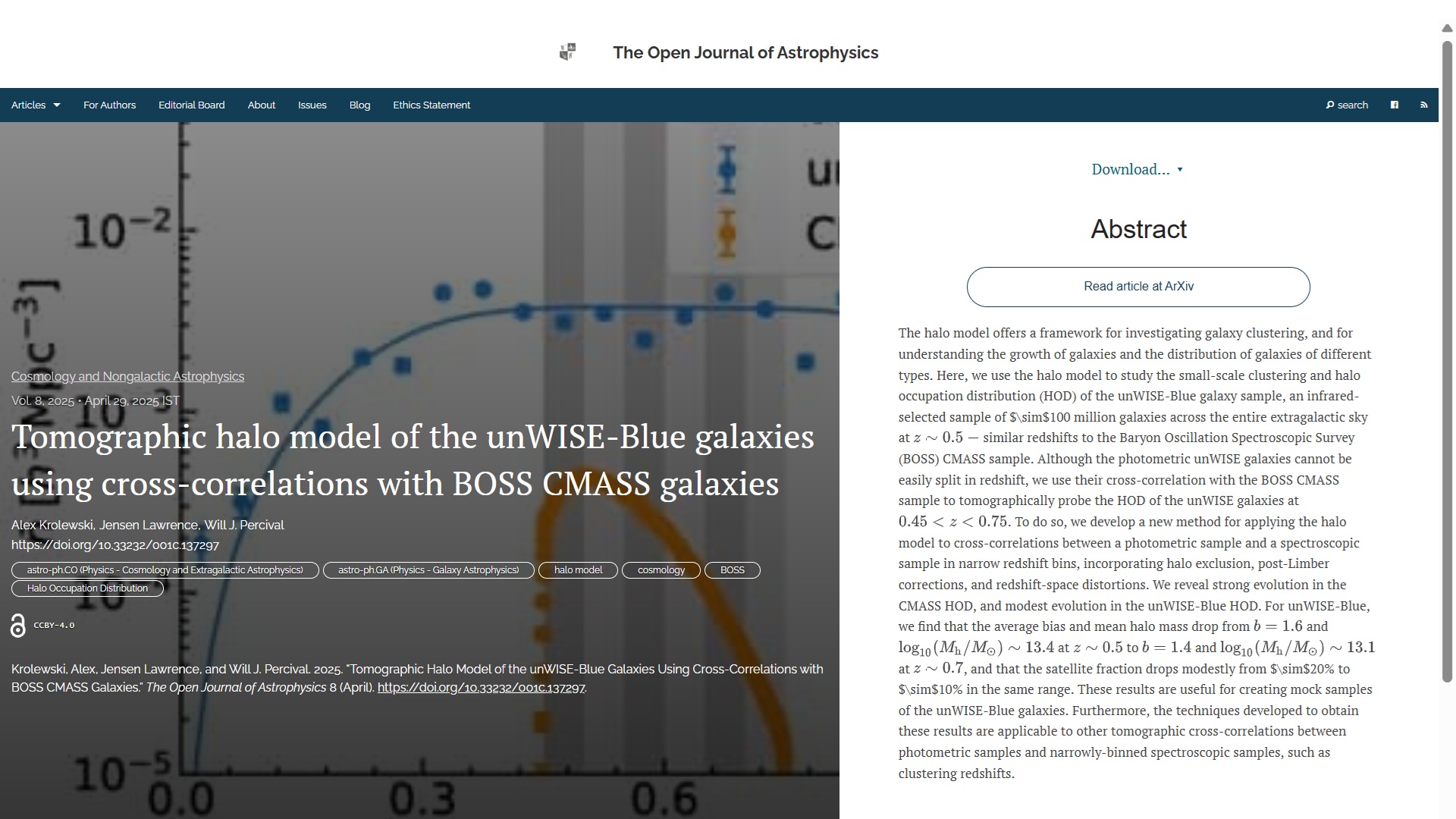
The final version of this one can be found on the arXiv here.
Number six for this week is “StratLearn-z: Improved photo-estimation from spectroscopic data subject to selection effects” by Chiara Moretti (SISSA, Trieste, Italy), Maximilian Autenrieth (Imperial College, UK), Riccardo Serra (SISSA), Roberto Trotta (SISSA), David A. van Dyk (Imperial) and Andrei Mesinger (SNS Pisa, Italy). This was published on Thursday 1st May 2025 in the folder Cosmology and NonGalactic Astrophysics. This one is about estimating photometric redshifts using an approach that relies on splitting the source and target datasets into strata based on estimated propensity score. The overlay is here:

The official version can be found on arXiv here.
Next is “The Impact of Galaxy-halo Size Relations on Galaxy Clustering Signals” by Joshua B. Hill and Yao-Yuan Mao (U. Utah, USA). This one was also published on May 2nd 2025 and is in the folder Astrophysics of Galaxies. It discusses the challenge of identifying a specific galaxy halo property that controls galaxy sizes through constraints from galaxy clustering alone. The overlay is here:
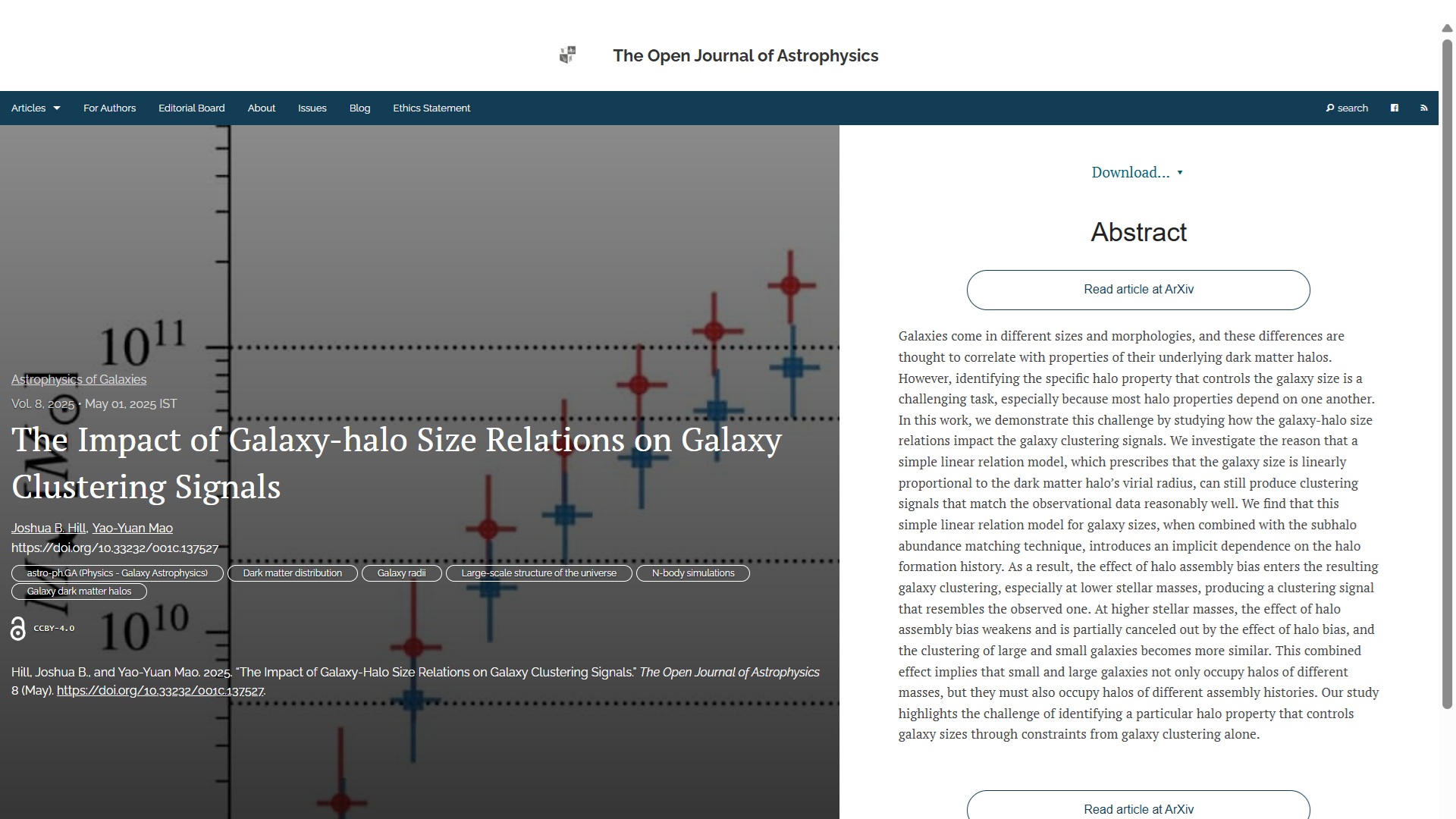
You can find the official version of the paper on arXiv here.
The next paper is “Detection of Thermal Emission at Millimeter Wavelengths from Low-Earth Orbit Satellites” by Allen Foster (Princeton, USA) and an international cast of 90 others, which is too many to list individually. This one was also published on Thursday May 1st but is in the folder Instrumentation and Methods for Astrophysics. The paper discusses the experimental detection of thermal emission from satellites and a discussion of the implications for astrophysical observations, especially time-domain astronomy. The overlay is here:
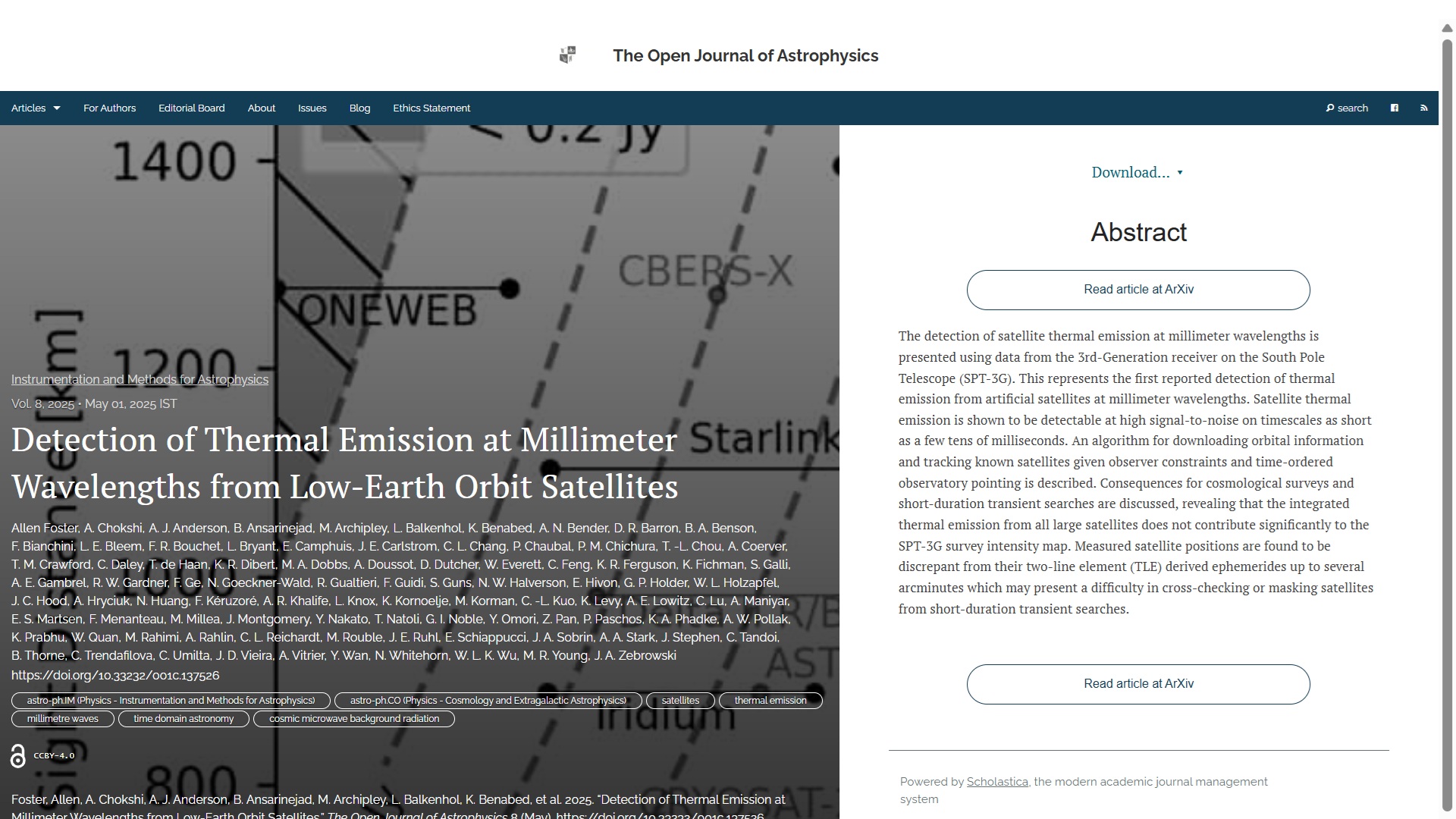
You can find the final version of the paper on arXiv here.
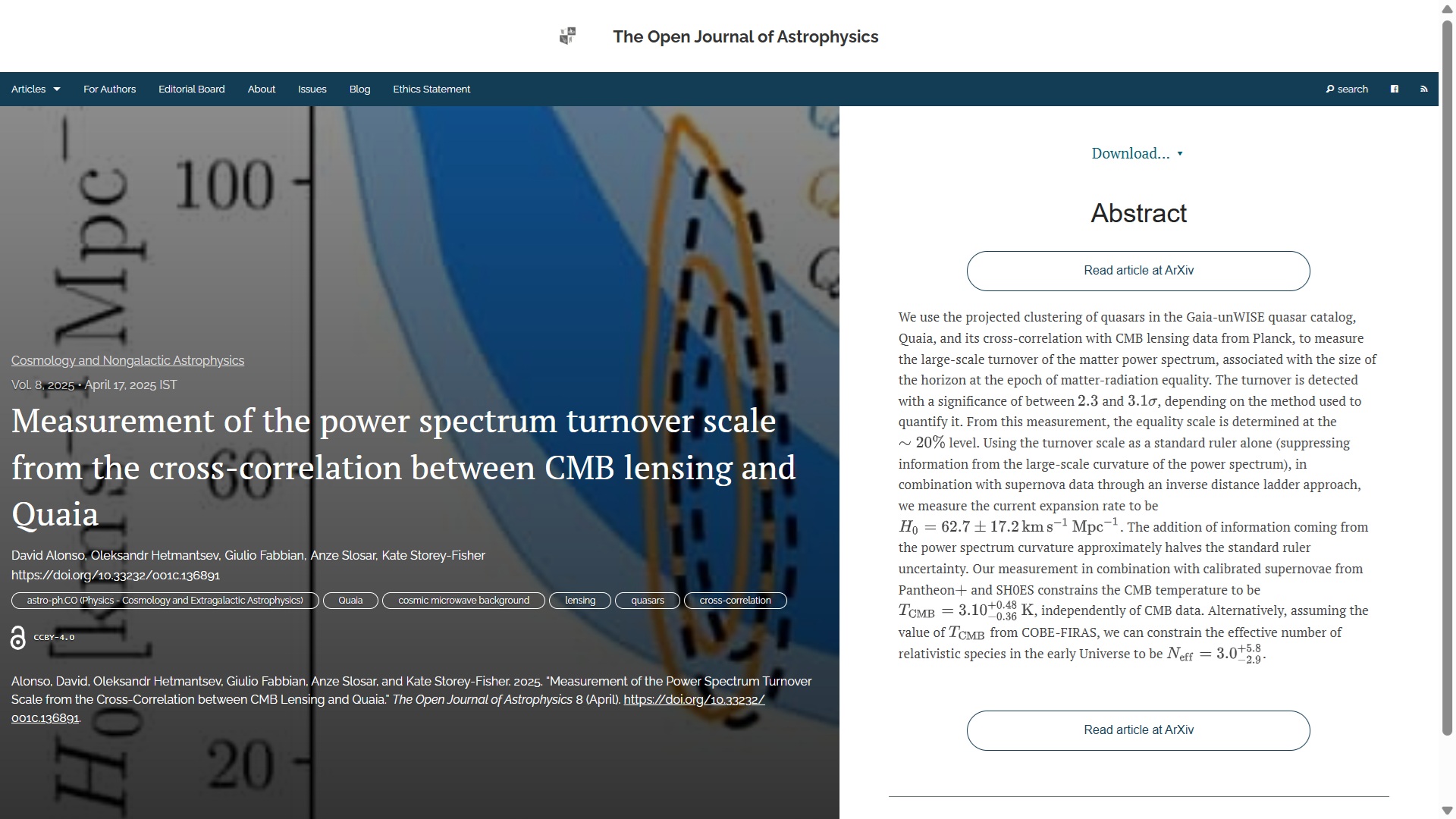
The penultimate paper of this week is “Pseudo-Cls for spin-s fields with component-wise weighting” by David Alonso (U. Oxford, UK). This one was published yesterday (Friday 2nd May 2025). The paper presents an approach to power spectrum estimation appropriate for data with anisotropic noise properties or for which complicated masks are required. It can be found in the folder Cosmology and NonGalactic Astrophysics. The overlay is here:

The final version of this paper is on arXiv here.
The last paper this week is “The past, present and future of observations of externally irradiated disks” by Planet formation environments collaboration: Megan Allen (U. Sheffield, UK) and 52 others. This paper was published on Friday 2nd May in the folder Solar and Stellar Astrophysics. It presents a review of research on the effects of the ultraviolet radiation environment on protoplanetary disc evolution and planet formation. The overlay is here:
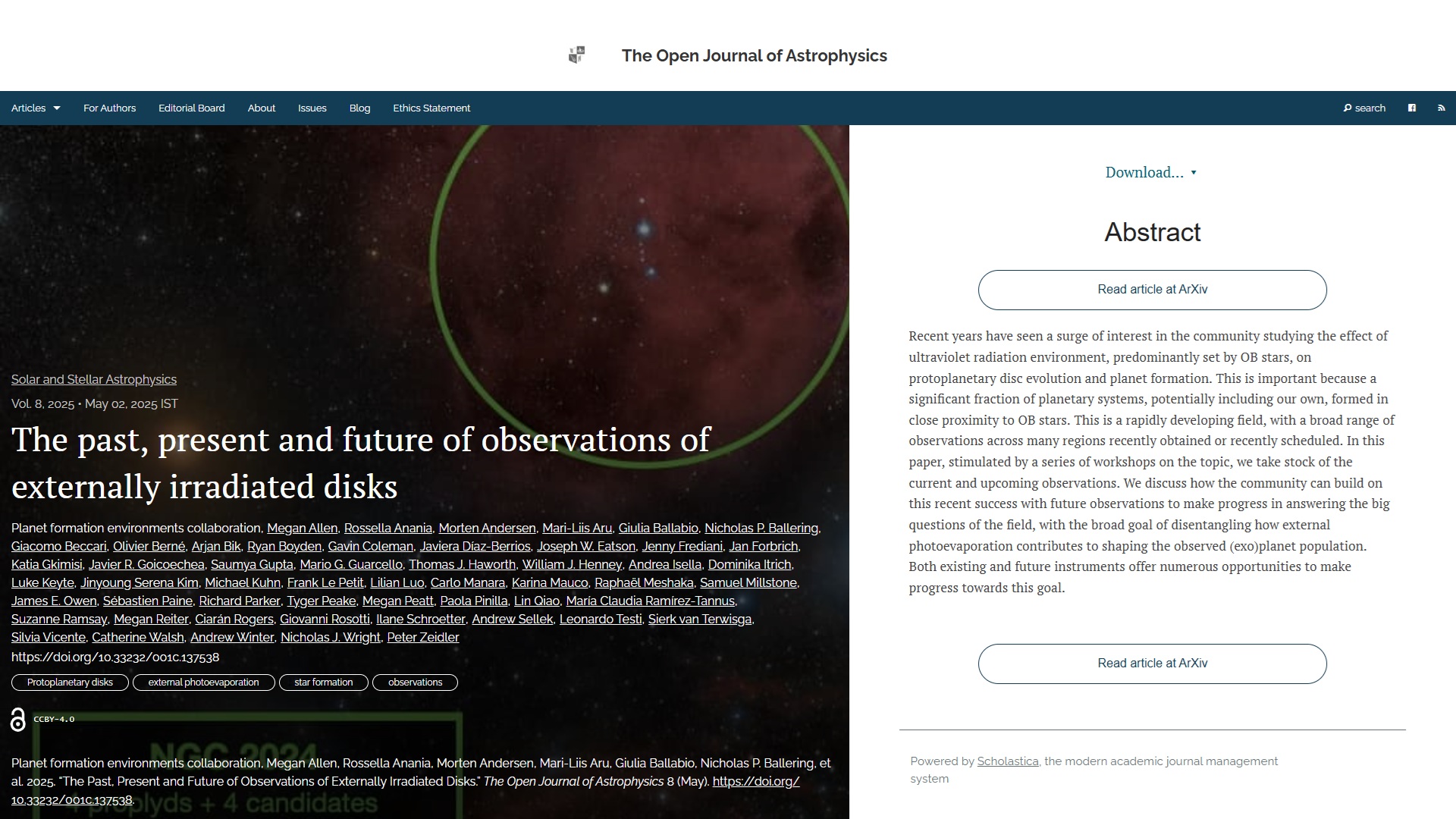
You can find the final version on arXiv here.
That’s all the papers for this week. I’ll just add that there were quite a few gremlins at Crossref this week, particularly yesterday. I usually do the publishing first thing in the morning but yesterday’s papers were held in a queue for most of the day pending registration. Usually it just takes a few minutes, but for these I had to wait several hours but we got there in the end. Although ten papers is more than we have ever published in a week, we still haven’t had a week in which we’ve published on every working day!
Anyway, that’s all for this week. I’ll post another update next Saturday.