Just got back from the St Patrick’s parade in Maynooth to find that I won the Beard of Ireland poll!
Thanks to everyone who voted for me! I’m going to celebrate this evening with a traditional Irish dinner of bacon and cabbage, with a parsley sauce.
Just got back from the St Patrick’s parade in Maynooth to find that I won the Beard of Ireland poll!
Thanks to everyone who voted for me! I’m going to celebrate this evening with a traditional Irish dinner of bacon and cabbage, with a parsley sauce.
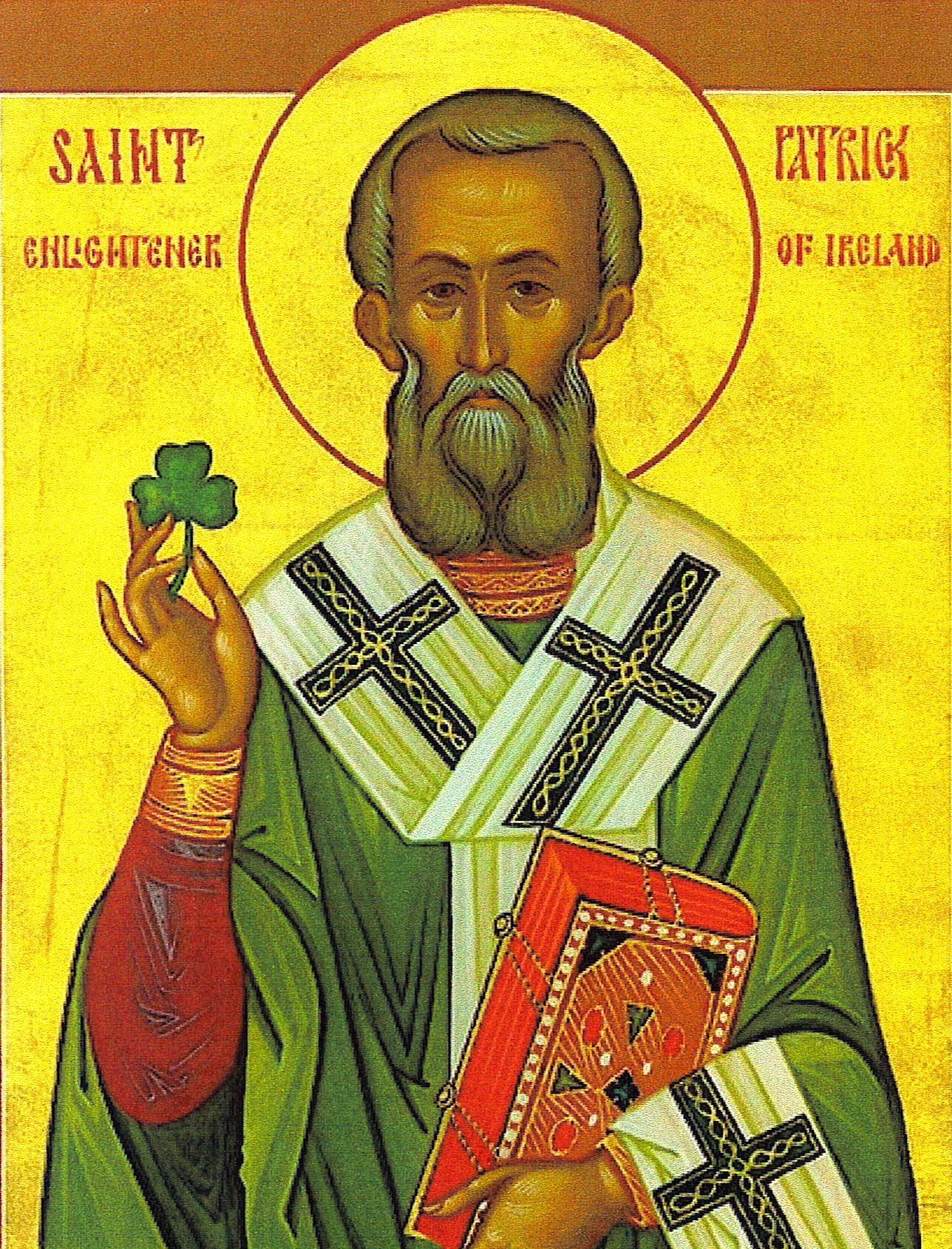
Well, it’s St Patrick’s Day, which means I’m on holiday. I’ll soon be toddling off to watch the parade in Maynooth, which passes quite close to my house. In accord with tradition, it’s very cold today – and not a little windy – but at least it’s not raining.
Not many facts are known about the life of St Patrick, but it seems he was born in Britain, probably in the late 4th Century AD, probably somewhere around the Severn Estuary and possibly in Wales. It also appears that he didn’t know any Latin. When a young man, it seems he was captured by Celtic marauders coming up the River Severn and taken as a slave to Ireland. He eventually escaped back to Britain, but returned to Ireland as a missionary and succeeded somehow in converting the Irish people to Christianity.
Or did he? This interesting piece suggests his role was of lesser importance than many think. On the other hand, if even a fraction of what is said about him is true, then he must have been a very remarkable man.
However it happened, Ireland was the first country to be converted to Christianity that had never been part of the Roman Empire. That made a big difference to the form of the early Irish Church. The local Celtic culture was very loose and decentralized. There were no cities, large buildings, roads or other infrastructure. Life revolved around small settlements and farms. When wars were fought they were generally over livestock or grazing land. The church that grew in this environment was quite different from that of continental Europe. It was not centralized, revolved around small churches and monasteries, and lacked the hierarchical structure of the Roman Church. Despite these differences, Ireland was well connected with the rest of the Christian world.
Irish monks – and the wonderful illuminated manuscripts they created – spread across the continent, starting with Scotland and Britain. Thanks to the attentions of the Vikings few of these works survive but the wonderful Lindisfarne Gospels, dating from somewhere in the 8th Century were almost certainly created by Irish monks. The Book of Kells was probably created in Scotland by Irish Monks.
The traffic wasn’t entirely one-way however. A while ago I saw a fascinating documentary about the Fadden More Psalter. This is a leather-bound book of Psalms found in a peat bog in 2006, which is of similar age to the Lindisfarne Gospels. It took years of painstaking restoration work to recover at least part of the text (much of which was badly degraded), but the leather binding turned out to hold a particularly fascinating secret: it was lined with papyrus. The only other books from the same period with the same structure that are known are from the Coptic Church in Egypt. That doesn’t mean that whoever owned the Fadden More Psalter had actually been to Egypt, of course. It is much more this book made its way to Ireland via a sort of relay race. On the other hand, it does demonstrate that international connections were probably more extensive than you might have thought.
Anyway, back to St Patrick’s Day.
Saint Patrick’s Day is celebrated on March 17th, the reputed date of his death in 461 AD. Nobody really knows where St Patrick was born,, and the when of his birth isn’t known either.
In any case, it wasn’t until the 17th Century that Saint Patrick’s feast day was placed on the universal liturgical calendar in the Catholic Church. Indeed, St Patrick has never been formally canonized. In the thousand years that passed any memory of the actual date of his birth was probably lost, so the choice of date was probably influenced by other factors, specifically the proximity of the Spring Equinox (which is this year on Saturday March 20th).
The early Christian church in Ireland incorporated many pre-Christian traditions that survived until roughly the 12th century, including the ancient festival of Ēostre (or Ostara), the goddess of spring associated with the spring equinox after whom Easter is named. During this festival, eggs were used a symbol of rebirth and the beginning of new life and a hare or rabbit was the symbol of the goddess and fertility. In turn the Celtic people of Ireland probably adapted their own beliefs to absorb much older influences dating back to the stone age. St Patrick’s Day and Easter therefore probably both have their roots in prehistoric traditions around the Spring Equinox, although the direct connection has long been lost.
Lá Fhéile Pádraig sona daoibh go léir!
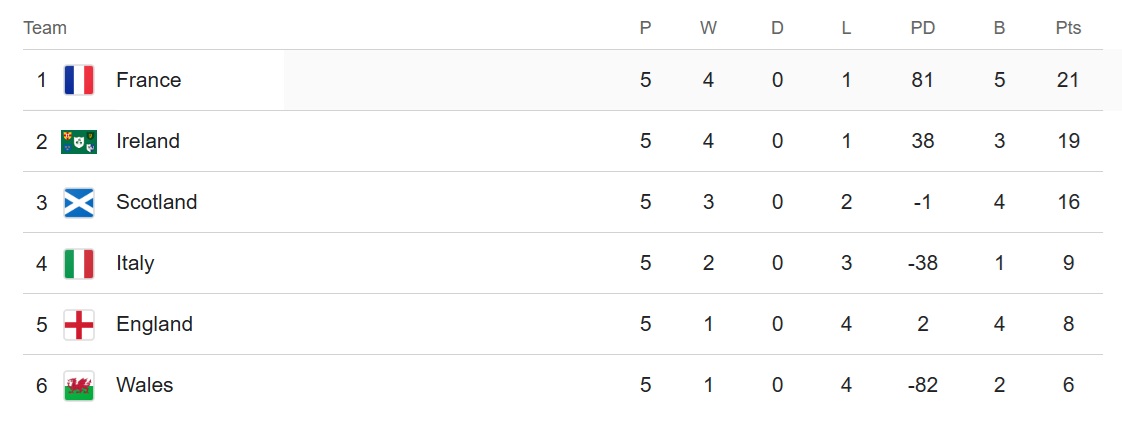
So the Six Nations is over for another year. This year’s competition has been remarkable, with many superb games on view not least the final match last night in which France beat England 48:46 with the last kick of the game, a penalty taken by Thomas Ramos. I recall a similar ending two years ago, when Ramos kicked France to a 31:30 victory. That victory gave France the Championship. Congratulations to them for winning a cracking tournament.
At the start of the competition the talk was of a French Grand Slam, but that dream was ended in comprehensive fashion by Scotland’s victory over them last week. Scotland visited Lansdowne Road in Dublin yesterday for the afternoon game and must have been high in confidence but were outplayed. After that match Ireland were top of the table, but would be caught by France if France beat England. Ireland rugby fans found themselves in the unusual position of wanting England to win. England certainly gave it a heck of a good go, playing at a much higher tempo than they had managed in any other match, but fell just short, so Ireland had to settle for second place. The result confirmed the view of many in Ireland that one should never rely on the English.
It was a great game to watch, except for the bizarre choice of team colours. Who decided to allow a team in very pale blue shirts with white shorts and socks to play against a team in white shirts, white shorts and white socks? Watching on TV, it was at times impossible to tell the teams apart!
Anyway, coming second was a good end result for Ireland, considering their heavy defeat by France in the opening match of the tournament. Andy Farrell demonstrated his coaching skills by picking his team up after that, especially huge performances against England at Twickenham and Scotland at Landsdowne Road. Though they did not win the Six Nations, at least they took the Triple Crown.
(The intransitive nature of sport was well illustrated in this competition: France beat Ireland, Scotland beat France and Ireland beat Scotland, etc…)
The other match yesterday was between Wales and Italy. I was happy to see a Wales victory at last, as they had no luck at all in this competition. They were particularly unlucky to lose to Scotland. James Botham dropped a clanger that led to the try that let Scotland back into a game Wales were leading, which was unfortunate, but I think the next and winning try for Scotland should have stood – there was an infringement at the ruck preceding it. Anyway, yesterday they didn’t really need luck: they started out like they meant business and raced to a 21-0 lead at half-time against an Italian side that looked very tired after its efforts last week in beating England. Italy recovered somewhat in the second half, and had chances to really get back into contention, but Wales ran out convincing winners 31-17.
Despite their victory yesterday – their first in three years in the Six Nations – Wales finished last. I am reliably informed that “wooden spoon” in Welsh is “llwy bren”. Still, they did produce the moment of the tournament with Rhys Carré (“The Fastest Prop in the West”) scoring a stunning try against Ireland.
I think many people thought France would win this year, and that Wales would be last, but how many would have predicted that England would finish 5th?
Reflecting on this year’s Championship I realised why I love it so much. Since the Six Nations involves a relatively small number of games – five for each team – there is real jeopardy in each fixture. That makes it different from longer league competitions in which there is more time to recover from a defeat and gives an edge-of-the-seat feeling to many matches. That is even more so when all the teams are strong. It is great for the competition to see Scotland playing as well as they did against France and England and Italy proving themselves much more resilient than in previous seasons. We just need Wales to emerge from the doldrums to make it a genuine six-way contest.
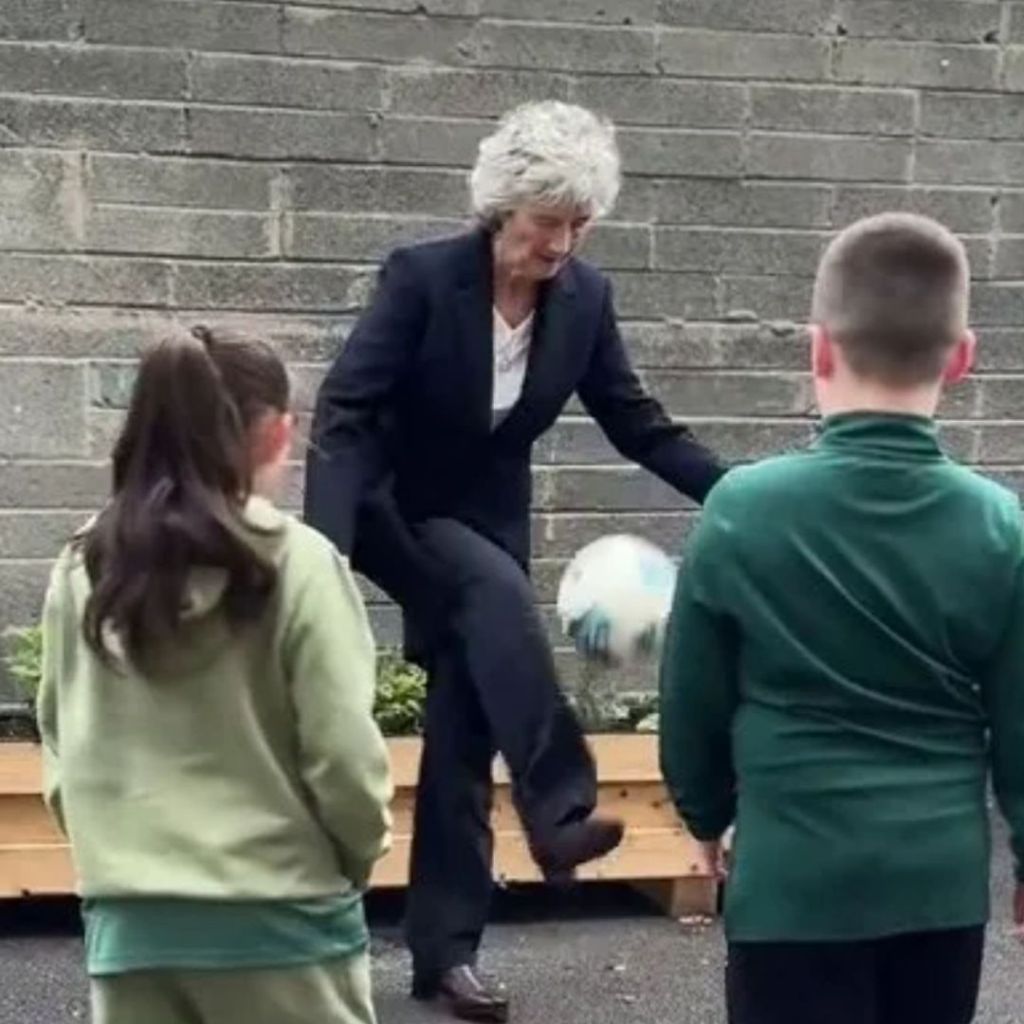
After a run of disappointing results, Ireland’s footballers last night scored a memorable victory, beating Portugal 2-0 in a World Cup Qualifying match. I attribute the result to the new Head Coach, pictured below…
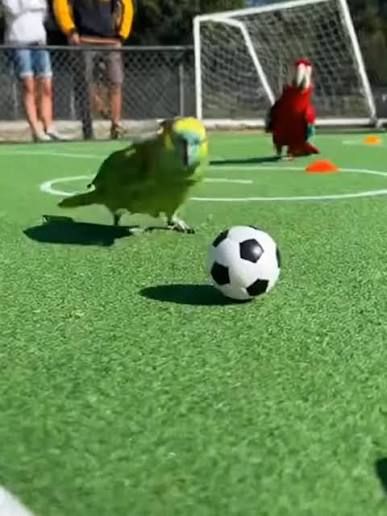
And here is a photo of Ireland’s two-goal hero, Troy Parrot, in action.
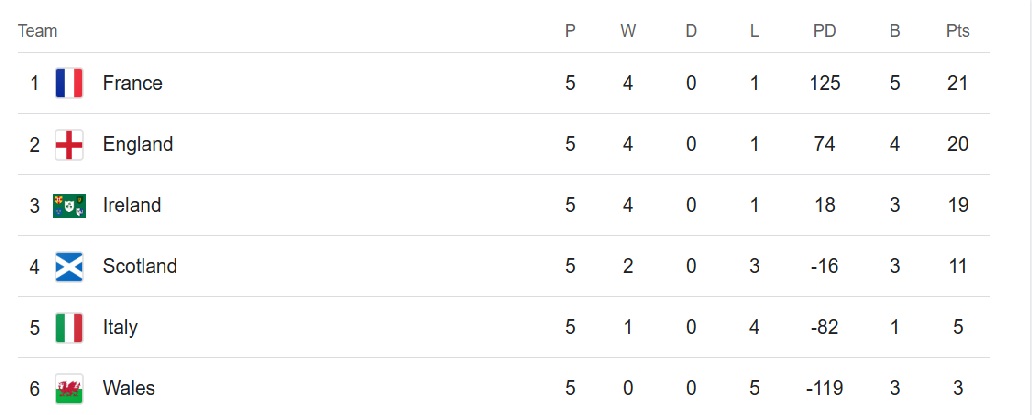
Yesterday I watched the last round of matches in this years Six Nations rugby Championship so, as I did last year, I thought I would do a quick summary of the games and the competition as a whole.
In the first game yesterday, thanks largely to their own errors, Ireland struggled to beat a spirited Italian side in Rome 17-22. That put them briefly top of the table, but with fewer bonus points and a worse points difference than either England or France so needed both those teams to lose in order to win the Championship. Hope of that happening vanished quickly when England scored a try about 2 minutes into their game against Wales in Cardiff, quickly followed by another. England thereafter ran riot and won 68-14 taking them to the top. England did play well, but Wales were very poor. To be honest, I found the game a bit painful to watch. If it had been boxing the referee would have stopped the fight. Memories of the great Welsh teams of the past are very distant nowadays. It’s hard to see where they go from here, with their second successive Wooden Spoon.
Then it was time for the finale, France versus Scotland. I did think that France would win easily but Scotland gave it a good go, and were unlucky not to take a lead into half-time. They wilted in the second half, however, and France duly picked up a bonus point win and the Championship. They are worthy winners, and all credit to them.
(The atmosphere at the Stade de France last night was so raucous that I had difficulty hearing the commentators over the crowd noise. I find commentators rarely add much to the experience, so this isn’t a complaint. In fact, I think it would be good if TV broadcasts allowed the viewer to turn off the commentary but keep the sounds from the stadium.)
The only game France lost was against England on a rainy day at Twickenham on 8th February, a game I watched. France should really have won that game but made a ludicrous number of mistakes and lost by a single point at the death. But for that Les Bleus would have had a Grand Slam. Fair play to England for hanging on and showing great resilience. After an unconvincing start as the competition went on they got better and better, though they needed a slice of luck to beat Scotland 16-15 as Finn Russell missed a conversion that would have won the game.
Up until last week the only team able to do a Grand Slam was Ireland, but they were outplayed in Dublin by France who won 42-27. Sports journalists have a habit of seeing everything as either a triumph or a disaster, and the Irish media portrayed that as the latter. The way I see it is that Ireland’s rugby team reached a high-water mark with their Grand Slam two years ago since when a number of important players have retired. It’s been a time for reconstruction and rebuilding. This is the way of things. I remember Ireland beating France comfortably last season, but France came back strongly this year. At least Ireland collected another Triple Crown, beating England, Wales and Scotland.
After last night’s game I was reflecting on why I enjoy the Six Nations so much. I think it’s mainly because there are relatively few games so each one takes on a significance, either in the context of the Championship or because it represents a longstanding rivalry (e.g. the Calcutta Cup). The point is that there is real jeopardy attached to many of the games. Contrast this with the United Rugby Championship. The games featuring the Irish teams in this competition (Leinster, Munster, Connacht and Ulster) are broadcast free-to-air on television here and I watch quite a few of them. There are 16 teams in this competition, divided into four pools of four: each side plays the 15 others once, and an additional game against the other three in their pool, meaning 18 games per team. After 18 rounds, all that happens is that the bottom eight in the league table are eliminated and the top eight go into the knockout stage. Eighteen games is a long slog when all it does is eliminate half the teams, and it means that there’s much less at stake in individual matches. Still, now the Six Nations is over I’ll be watching the URC for the rest of the season, starting next weekend.
The big news in Irish physics this week was the announcement that Ireland’s application to join the European Organisation for Nuclear Research (CERN) has been accepted in principle, and the country is expected to become an associate member in 2026. The formal process to join began in late 2023, as described here. Maynooth University responded to the news in positive fashion here, including the statement that
This important decision represents a transformative step for Irish science, research, and innovation, unlocking unparalleled opportunities for students, researchers, and industry.
I think this is a very good move for Irish physics, and indeed for Ireland generally. I will, however, repeat a worry that I have expressed previously. There is an important point about CERN membership, however, which I hope is not sidelined. The case for joining CERN made at political levels is largely about the return in terms of the potential in contracts to technology companies based in Ireland from instrumentation and other infrastructure investments. This was also the case for Ireland’s membership of the European Southern Observatory, which Ireland joined almost 7 years ago. The same thing is true for involvement in the European Space Agency, which Ireland joined in 1975. These benefits are of course real and valuable and it is entirely right that arguments should involve them.
Looking at CERN membership from a purely scientific point of view, however, the return to Ireland will be negligible unless there is a funding to support scientific exploitation of the facility. That would include funding for academic staff time, and for postgraduate and postdoctoral researchers to build up an active community as well as, e.g., computing facilities. This need not be expensive even relative to the modest cost of associate membership (approximately €1.9M). I would estimate a figure of around half that would be needed to support CERN-based science.
The problem is that research funding for fundamental science (such as particle physics) in Ireland has been so limited as to be virtually non-existent by a matter of policy at Science Foundation Ireland, which basically only funded applied research. Even if it were decided to target funding for CERN exploitation, unless there is extra funding that would just lead to the jam being spread even more thinly elsewhere.
As I have mentioned before, Ireland’s membership of ESO provides a cautionary tale. The Irish astronomical community was very happy about the decision to join ESO, but that decision was not accompanied by significant funding to exploit the telescopes. Few astronomers have therefore been able to benefit from ESO membership. While there are other benefits of course, the return to science has been extremely limited. The phrase “to spoil a ship for a ha’porth of tar” springs to mind.
Although Ireland joined ESA almost fifty years ago, the same issue applies there. ESA member countries pay into a mandatory science programme which includes, for example, Euclid. However, did not put any resources on the table to allow full participation in the Euclid Consortium. There is Irish involvement in other ESA projects (such as JWST) but this is somewhat piecemeal. There is no funding programme in Ireland dedicated to the scientific exploitation of ESA projects.
Under current arrangements the best bet in Ireland for funding for ESA, ESO or CERN exploitation is via the European Research Council, but to get a grant from that one has to compete with much better developed communities in those areas.
The recent merger of Science Foundation Ireland and the Irish Research Council to form a single entity called Research Ireland perhaps provides an opportunity to correct this shortfall. If I had any say in the new structure I would set up a pot of money specifically for the purposes I’ve described above. Funding applications would have to be competitive, of course, and I would argue for a panel with significant international representation to make the decisions. But for this to work the overall level of public sector research funding will have to increase dramatically from its current level, well below the OECD average. Ireland is currently running a huge Government surplus which is projected to continue growing until at least 2026. Only a small fraction of that surplus would be needed to build viable research communities not only in fundamental science but also across a much wider range of disciplines. Failure to invest now would be a wasted opportunity. There is currently no evidence of the required uplift in research spending despite the better-than-healthy state of Government finances.
The dust is now settling on the 2024 General Election which took place on Friday. Counting didn’t start anywhere until the following morning, so in the absence of any actual results the Saturday newspapers were full of articles by Phil Space, most of them based on an exit poll that turned out not to be very accurate. It soon become clear what was going to happen. The Single Transferable Vote system does mean that counting takes a while – one constituency (Cavan-Monaghan) is yet to declare as I write this – but it is much fairer than the system used in the UK and the process is fascinating to follow. Since moving to Ireland 7 years ago, I think my two favourite spectator sports are hurling and election counts, though the former happens at a considerably faster pace than the latter!
I’ll begin with my own constituency, Kildare North, which returned 5 TDs. The chosen five are James Lawless (FF), Réada Cronin (SF), Aidan Farrelly (SD), Naoise Ó Cearúil (FF) and Joe Neville (FG). The big surprise was that Fine Gael grandee Bernard Durkan lost his seat to a younger colleague, the strategy of fielding three candidates backfired on him. At one stage it even looked like all three might be eliminated, which would have been very amusing, but it was not to be.
A surprise at least to me, though a lesser one than the defeat of Bernard Durkan, is that Aidan Farrelly won for the Social Democrats. Catherine Murphy (SD) was top of the poll last time but has now retired. There was no guarantee that Aidan Farrrelly would hold onto Catherine Murphy’s personal following, especially since a former Social Democrat turned Independent stood against him. In the end, however, Farrelly was elected quite comfortably, although with a smaller share of the vote than Catherine Murphy had achieved.
Of the two FF candidates elected, James Lawless and Naoise Ó Cearúil, the fomer is more familiar; the latter was elected to the County Council this summer and will be a new arrival in the Dáil. The Kildare North constituency has one extra TD this time because of population growth, and it went to FF who ended up with the most TDs nationally.
The successful Sinn Féin candidate was the incumbent Réada Cronin.
The wooden spoon for Kildare North went to Sean Gill of the Centre Party of Ireland, an ironic name for what is far-right splinter group of FG previously known as Renua. He received a majestic 67 votes and was eliminated on the first round. In fact, far-right candidates did very poorly not only in Kildare North but nationally. That’s a relief.
One of the fascinating things about the coverage of the election has been to see how people use their preferences. Voting is a much more nuanced thing here that it has ever been allowed to be in the UK by the electoral system there. Some of the transfers are very hard to fathom. I noticed in Kildare North, for example, that some voters put the left-wing People Before Profit first then Fine Gael second, skipping over the whole spectrum in between. I don’t understand that choice, but then I don’t have to. Folk are perfectly entitled to use their vote whichever way they wish. That’s how it works. It’s called democracy.
The big three parties look set to finish on FF 48, SF 39 and FG 38. This means that FG+FF add up to 86, which is two short of a majority. The overall outcome of the election will therefore be the Same Old Same Old government, a coalition of the two right wings of the Property Party, possibly with a smaller party to make up the numbers and to be contemptuously discarded at the next election. That fate befell the Green Party, part of the outgoing coalition, which lost 11 of its 12 TDs this time round. Labour and the Social Democrats are both on 11 TDs. Will one of them walk into the trap, or will some Independents be enough?
Incidentally, the only prediction I made in my earlier post about this election, turned out to be incorrect. I was confident that there would be more Independent TDs than last time. In fact there are fewer (16 versus 20). Though the predominantly rural, right-wing Independent Ireland won 4 seats, it is a party so its TDs are not Independent, if you see what I mean.

Sinn Féin once again failed to break the deadlock of FFG government. They have done reasonably well in terms of seats, but their share of the vote fell by about 5% since the 2020 Election but in between then and now had risen to over 30%. only to fall back recently. I suspect the party leaders will be privately relieved at where they ended up, given that a few weeks ago things looked likely to be much worse for them.
Whatever the complexion of the final coalition, it seems clear to me that we’re in for five more years of housing crisis, crumbling infrastructure, under-investment in education and public services. I don’t know what it will take for a change of government to take place. Perhaps the next (inevitable) financial crash? Or perhaps not even that. Ireland is very set in its ways, politically speaking.
It has been remarked that this election has bucked two global trends. One is the rise of the far-right, whose failure is something I am very happy about. The other is anti-incumbent feeling. I’m much more ambivalent about that because in my opinion change is long overdue. Apparently the electorate were unconvinced that change of government would really make things better here.
P.S. The turnout – just under 60% – was the lowest it has been in a General Election in Ireland since 1923. I find it saddening that 40% of those eligible did not even bother to vote.
The arrival of my polling card yesterday indicates that the general election in Ireland on Friday 29th November is approaching rapidly, so I thought I’d give a rundown of the 16 candidates who will appear on the ballot paper for my constituency, Kildare North.
Kildare North will return 5 TDs (Teachta Dála, or Deputies), one more than last time because of the population growth in the area. The current TDs are Réada Cronin (SF; Sinn Féin), Bernard Durkan (FG; Fine Gael), James Lawless (FF; Fianna Fáil) and Catherine Murphy (SD; Social Democrats). The latter is retiring so will not be standing at this election. The current government is a coalition of FG, FF and Green Party TDs.
The Single Transferable Vote system is used, meaning that voters have a single ballot paper on which they rank the candidates in order of preference. The candidate with the lowest number of first-preference votes is eliminated and their second preference votes redistributed. Candidates are thus progressively eliminated until the requisite number of TDs is selected.
There are three FG candidates: Bernard Durkan, Joe Neville and Evie Sammon). They are based in Maynooth, Leixlip and Celbridge respectively so are presumably hoping that local voting will work out in their favour. The idea presumably is that Bernard Durkan would be first choice in Maynooth, etc. However, I’ve already had canvassers arguing that I should put Joe Neville first. I won’t be voting for any of the candidates anyway, but I would be very amused if their decision to put three candidates forward backfired. Incidentally, Bernard Durkan is 79 and has been a TD since 1982. The leaflet I got from him promised “New Energy” for Kildare North. Yeah, right…
There are two FF candidates, James Lawless and Naoise Ó Cearúil; the latter was elected to the County Council this summer. I find FF indistinguishable from FG. Together or separately these two parties have governed the Republic since its creation and a change is long overdue.
The two Sinn Féin candidates are the incumbent Réada Cronin and Caroline Hogan. I haven’t seen any posters for Réada Cronin up in Maynooth, so I assume the campaign team is saving their resources for elsewhere. Maynooth is not traditionally an SF stronghold.
With Catherine Murphy not standing, the Social Democrats ran a process to select a replacement candidate, which was won by Aidan Farrelly (who actually works at Maynooth University) who is the official SD candidate. That doesn’t end the story, however. Former SD member Bill Clear is standing as an Independent because he didn’t get selected. Adding to the fact that Catherine Murphy had a considerable personal following, this looks like a bit of a mess for the Social Democrats whose vote will probaboly be reduced and split. It may be in order to capitalize on this that SF added a candidate; they only fielded one last time round.
Now we’re into the (probable) also-rans. Angela Feeney is standing for Labour. She is an active member of the Council, representing Maynooth, but it’s not clear whether she has reach over the rest of the constituency. Vincent Martin represents the Greens who haven’t previously been strong here. The Green Party in Ireland is nowhere near as left-wing as corresponding parties in the UK and elsewere. It often seems like the bicycle division of Fine Gael. Leah Whelan is standing for People Before Profit – Solidarity, the only really left-wing party standing in Kildare North.
Then we have we have a number of generally disagreeable (to me) fringe party candidates: Una O’Connor is standing for Aontú, a reactionary splinter group of people previously in Sinn Féin and Sean Gill for the Centre Party of Ireland, an ironic name for what is far-right splinter group of FG previously known as Renua. Gerry Waters is standing from the Irish Freedom Party. He was struck off the medical register for refusing to administer vaccines and has unsupportable far-right opinions on other issues. Last and by all means least is Avril Corcoran who is candidate for The Irish People, a far-right nationalist party which is part of the National Alliance of like-minded bigots.
It’s probably obvious which 11 candidates I’m not going to be voting for, but I’ll leave you to guess in what order I will rank the other 5!
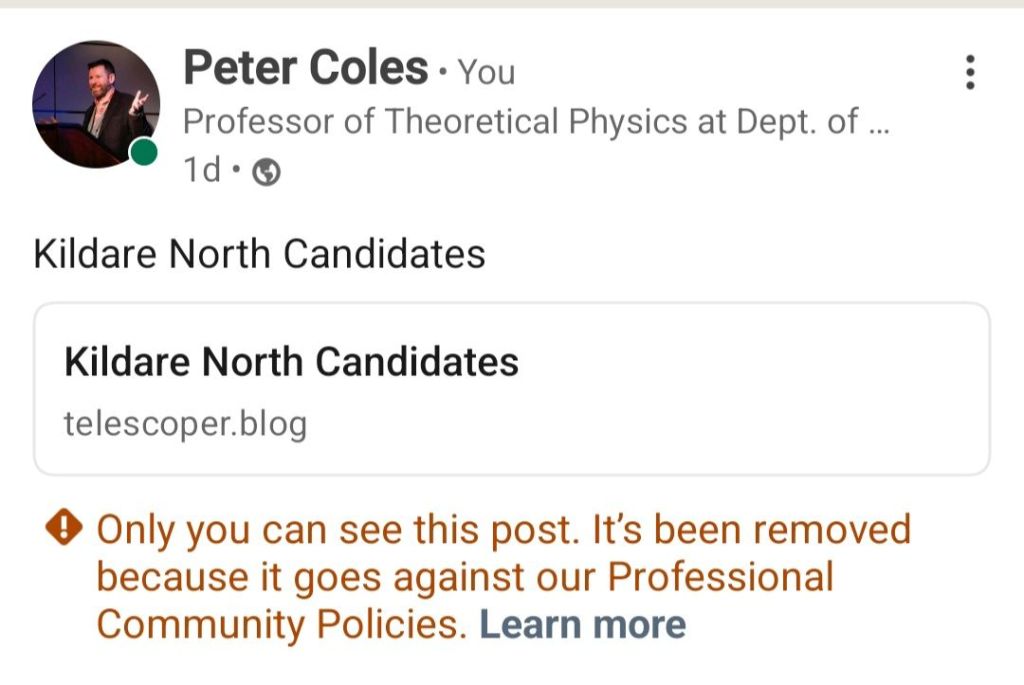
P.S. LinkedIn didn’t like this post:

On Friday 8th November Taoiseach Simon Harris (left) inspired Ireland’s rugby team to a very disappointing home defeat by New Zealand. Earlier on that day he had visited the President to request a dissolution of the 33rd Dáil and to call a General Election on November 29th 2024.
The Saturday newspapers were full of nonsense about how the “General Election campaign starts now” when in fact I’ve had canvassers knocking at my door for at least a fortnight already. Two of them were for Fine GaeI – far scarier than trick-or-treat! I made it abundantly clear that I wouldn’t be voting for their party and hoped that they wouldn’t bother me again.
Fine Gael’s opening gambit was to announce that if elected they would reduce VAT on the hospitality sector to 11%. There was a budget just a few weeks ago in which they could have announced such a reduction had they really wanted it to happen. If re-elected no doubt they will find an excuse for not doing it. If you believe what they say I have a 340k bike shed to sell you.
Talking about the budget, Ireland’s government is in a very different position from the UK, with a large fiscal surplus thanks to buoyant tax receipts. This year presented a great opportunity to use that cash for much-needed investment in public housing, transport, education, the health service, etc. Instead the Government decided to tinker here and there with allowances and bung some cash to middle-income families in order to buy votes. Simon Harris has the air of a man who would sell his Grandmother if he could buy votes with the proceeds. The FG approach may well work but, if it does, we’re in for many years more of decaying public services, homelessness and high rents. As the Landlord Party in all but name, this will suit Fine Gael very well.
My constituency is Kildare North which in 2020 elected four TDs: 1 Social Democrat, 1 Fianna Fáil, 1 Fine Gael, and 1 Sinn Féin. This time, owing to population growth in the area, the seat will return five TDs. Fine Gael is standing three. I won’t say anything about Fianna Fáil. To all intents and purposes they are indistinguishable from Fine Gael and I won’t be voting for either of them. For me “more of the same” is not an option. I hope it goes without saying that I won’t be voting for any neofascists who get onto the ballot paper either.
Catherine Murphy (SD) is not standing and since she had a strong personal following the SDs will struggle to keep that seat. Angela Feeney, who is very active on the Local Council, is standing for Labour and Réada Cronin for Sinn Féin will be trying to hold onto her seat. Nominations of candidates continue for another week, so I don’t know the final list of candidates. I’ll wait until then before deciding on my order of preferences.
Not that long ago Sinn Féin were riding high in the polls, but a series of missteps have left them trailing Fine Gael. They also did poorly in the local and European elections earlier this year, seeming to have lost supporters of the more extreme nationalist type to overtly right-wing candidates.
The only prediction I am willing to make at this stage is that, owing to disaffection with the mainstream political parties, the number of independent TDs is likely to increase considerably from the 20 last time. This will make the task of forming a government even more complicated than before.

Storm season has arrived in Ireland!
Storm Ashley has been battering the West of the country today. It’s not been as bad here in the sheltered environs of Maynooth, though we have had gusts up to 80 km/h which has left my garden in disarray with leaves and twigs all over the place.

 In the Dark