Archive for Minkowski Functionals

Four New Publications at the Open Journal of Astrophysics

Posted in OJAp Papers, Open Access, The Universe and Stuff with tags , , , , , , , , , , , , , , , , , , , on September 14, 2024 by telescoper

Once again, it’s time for a quick update of activity at the Open Journal of Astrophysics. This week we have published another batch of four papers which takes the count in Volume 7 (2024) up to 77 and the total published altogether by OJAp up to 192. Things are picking up again after the summer lull, and we’re moving towards a double century. If we keep up a steady average of four per week we’ll be at 200 per year.

In chronological order, the four papers published this week, with their overlays, are as follows. You can click on the images of the overlays to make them larger should you wish to do so.

First one up is “Quasi-two-dimensionality of three-dimensional, magnetically dominated, decaying turbulence” by Shreya Dwivedi, Chandranathan Anandavijayan, and Pallavi Bhat of TIFR, Bangalore, India. The paper presents an analysis of numerical simulations of MHD turbulence using Minkowski Functionals, with implications for local anisotropies revealed therein. It was published on 9th September 2024 and is in the folder marked High-Energy Astrophysical Phenomena.

Here is a screen grab of the overlay, which includes the abstract:


You can find the officially accepted version of the paper on the arXiv here.

The second paper to announce, also published on 9th September 2024, is “mochi_class: Modelling Optimisation to Compute Horndeski In class” by  Matteo Cataneo (Universität Bonn, Germany) and Emilio Bellini (SISSA, Trieste, Italy). This article presents a cosmological Einstein-Boltzmann solver adapted to work with Horndeski gravity, together with validation tests. It is in the folder Cosmology and NonGalactic Astrophysics.

You can see the overlay here:


The accepted version of this paper can be found on the arXiv here.

The third paper, published on 11th September 2024 in the folder marked High-Energy Astrophysical Phenomena, is by Jonathan Katz of Washington University, St Louis, USA. The title is “The Sources of Fast Radio Bursts” and it presents a discussion of the possible physical origin of Fast Radio Bursts, arguing that they fall into two distinct groups.


The final version accepted on arXiv is here.

Last in this batch, but by no means least, is “RMS asymmetry: a robust metric of galaxy shapes in images with varied depth and resolution” by Elizaveta Sazonova (U. Waterloo, Canada) with 15 other authors spread around the world (in Canada, USA, Australia, Italy, Chile, UK, Poland, Mexico, Germany, and Spain). This paper presents a method of quantifying distortion of galaxy images connected with mergers or other instabilities. It is in the folder marked Astrophysics of Galaxies and was published on September 12th 2024 with this overlay:


You can find the official accepted version on the arXiv here.

That’s all for now. I will post another update in a week.

New Publication at the Open Journal of Astrophysics

Posted in OJAp Papers, Open Access, The Universe and Stuff with tags , , , , , on June 29, 2024 by telescoper

It’s a rainy Saturday morning here in Barcelona, and here’s the last update from the Open Journal of Astrophysics before I depart these shores. In fact there is only one paper to report this week, being  the 52nd paper in Volume 7 (2024)  and the 167th altogether. It was published on June 24th 2024. With six months of the year now over, I predict we will have published about 52×12/6=104 papers by the end of the year.

The title is “Comparing Mass Mapping Reconstruction Methods with Minkowski Functionals” and it  is in the folder marked Cosmology and NonGalactic Astrophysics. The authors are: Nisha Grewal (U. Edinburgh, UK), Joe Zuntz (U. Edinburgh, UK) and Tilman Tröster (ETH Zurich, Switzerland);  the paper is about quantifying the accuracy, precision and efficiency of lensing reconstruction methods using topological characteristics known as Minkowski Fuctionals.

Here is the overlay of the paper containing the abstract:


You can click on the image of the overlay to make it larger should you wish to do so. You can also find the officially accepted version of the paper on the arXiv here.

P.S. Since I only had the one paper to publicize this week I took a few minutes to add the overlays to last week’s post, which I couldn’t do at the time because of computer problems.

Sizes, Shapes and Minkowski Functionals

Posted in mathematics, The Universe and Stuff with tags , , , , on August 27, 2022 by telescoper

Before I forget I thought I would do a brief post on the subject of Minkowski Functionals, as used in the paper we recently published in the Open Journal of Astrophysics. As as has been pointed out, the Wikipedia page on Minkowski Functionals is somewhat abstract and impenetrable so here is a much simplified summary of their application in a cosmological setting.

One of things we want to do with a cosmological data set to characterize its statistical properties to compare theoretical predictions with observations. One interesting way of doing this is to study the morphology of the patterns involved using quantitative measures based on topology.

The approach normally used deals with Excursion Sets, i.e. regions where a field exceeds a certain level usually given in terms of the rms fluctuation or defined by the fraction of space above the threshold. The field could, for example, be the temperature field on the CMB Sky or the density field traced by galaxies. In general the excursion set will consist of a number of disjoint pieces which may be simply or multiply connected. As the threshold is raised, the connectivity of the excursion set will shrink but also its connectivity will change, so we need to study everything as a function of threshold to get a full description.

One can think of lots of ways of defining measures related to an excursion set. The Minkowski Functionals are the topological invariants that satisfy four properties:

  1. Additivity
  2. Continuity
  3. Rotation Invariance
  4. Translation Invariance

In D dimensions there are (D+1) invariants so defined. In cosmology we usually deal with D=2 or D=3. In 2D, two of the characteristics are obvious: the total area of the excursion set and the total length of its boundary (perimeter). These are clearly additive.

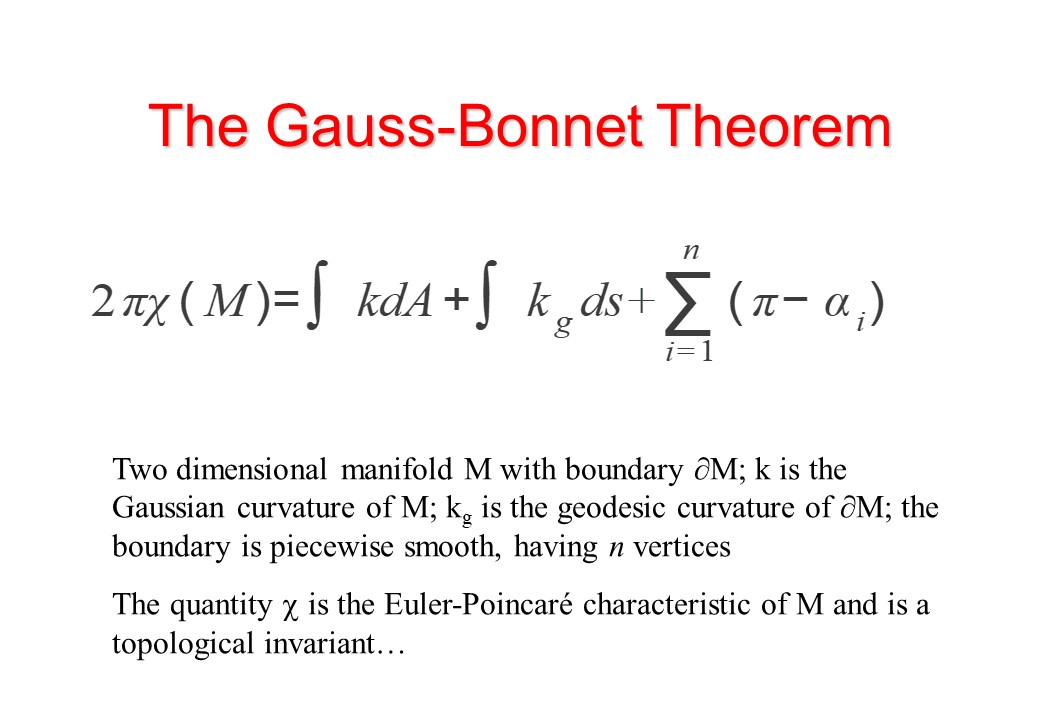
In order to understand the third invariant we need to invoke the Gauss-Bonnet theorem, shown in this graphic:

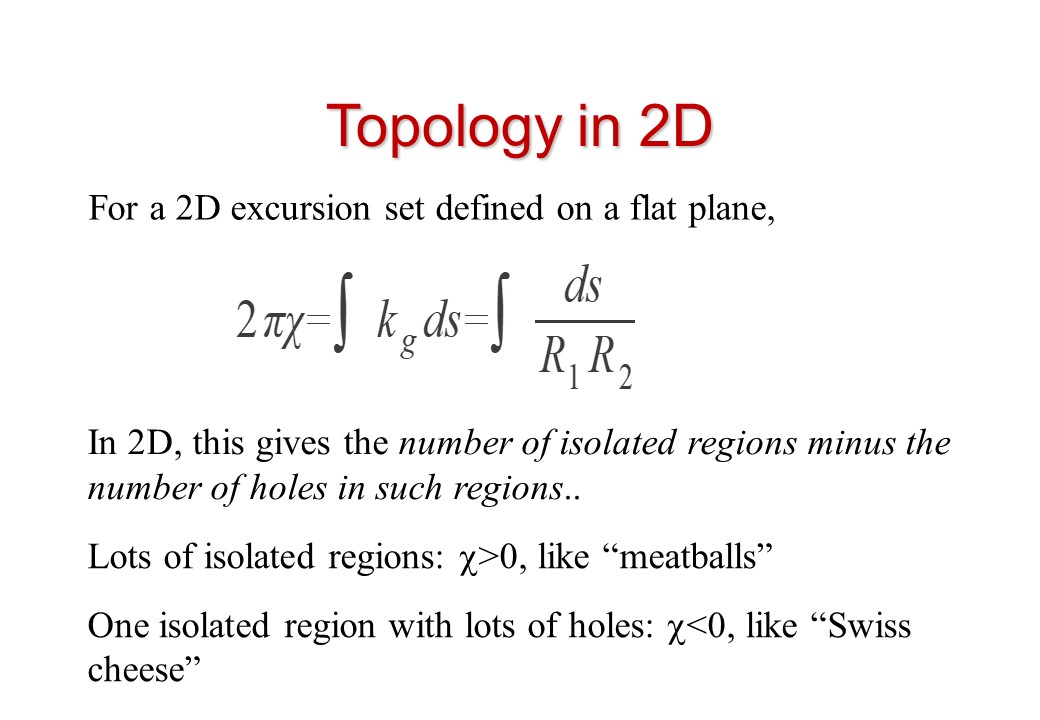
The Euler-Poincare characteristic (χ) is our third invariant. The definition here allows one to take into account whether or not the data are defined on a plane or curved surface such as the celestial sphere. In the simplest case of a plane we get:

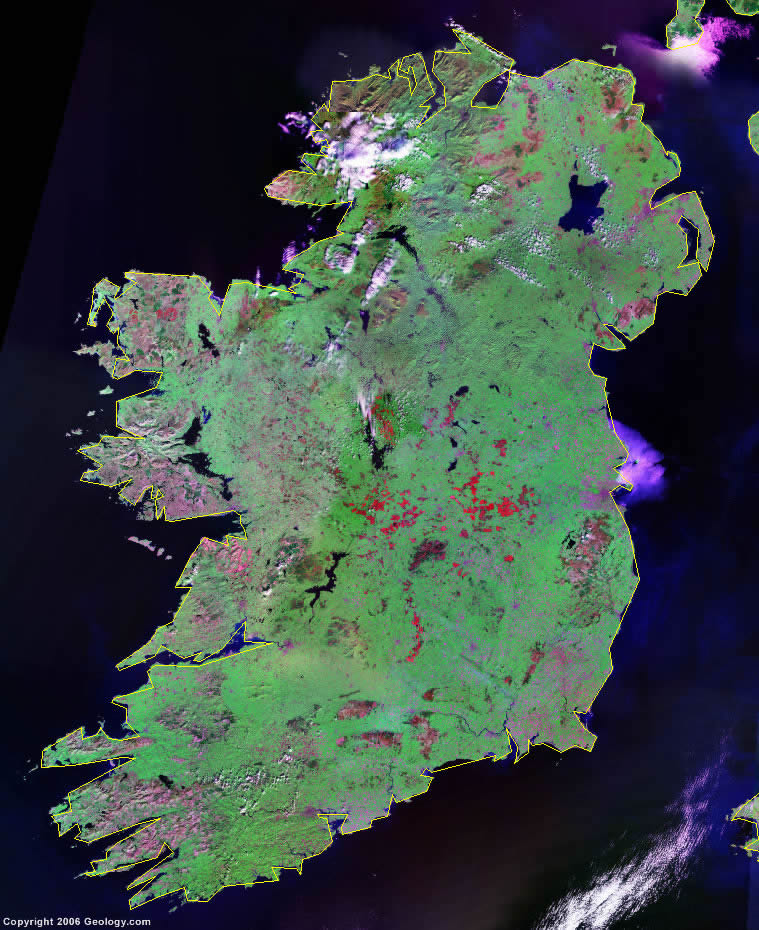
As an illustrative example consider this familiar structure:

Instead of using a height threshold let’s just consider the structure defined by land versus water. There is one obvious island but in fact there are around 80 smaller islands surrounding it. That illustrates the need to define a resolution scale: structures smaller than the resolution scale do not count. The same goes with lakes. If we take a coarse resolution scale of 100 km2 then there are five large lakes (Lough Neagh, Lough Corrib, Lough Derg, Lough Ree and Lower Lough Erne) and no islands. At this resolution, the set consists of one region with 5 holes in it: its Euler-Poincaré characteristic is therefore χ=-4. The change of χ with scale in cosmological data sets is of great interest. Note also that the area and length of perimeter will change with resolution too.

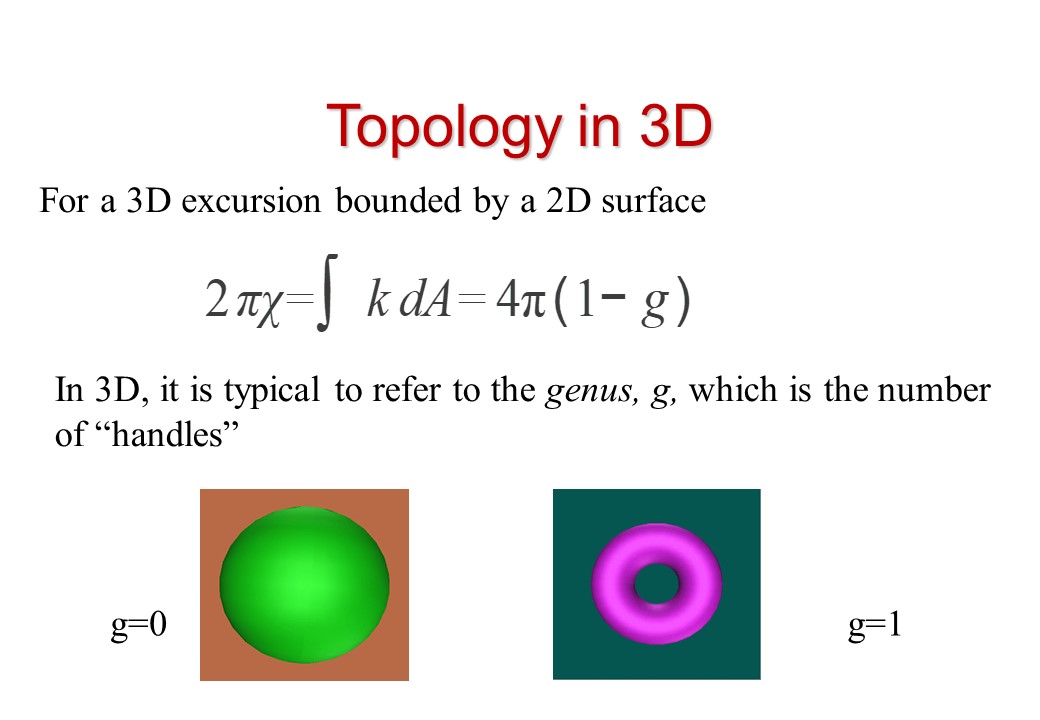
One can use the Gauss-Bonnet theorem to extend these considerations to 3D by applying to the surfaces bounding the pieces of the excursion set and consequently defining their corresponding Euler-Poincaré. characteristics, though for historical reasons many in cosmology refer not to χ but the genus g.

A sphere has zero genus (χ=1) and torus has g=1 (χ=0).

In 3D the four Minkowski Functionals are: the volume of the excursion set; the surface area of the boundary of the excursion set; the mean curvature of the boundary; and χ (or g).

Great advantage of these measures is that they are quite straightforward to extract from data (after suitable smoothing) and their mean values are calculable analytically for the cosmologically-relevant case of a Gaussian random field.

Here endeth the lesson.

New Publication at the Open Journal of Astrophysics

Posted in OJAp Papers, Open Access, The Universe and Stuff with tags , , , , , , , , , on August 24, 2022 by telescoper

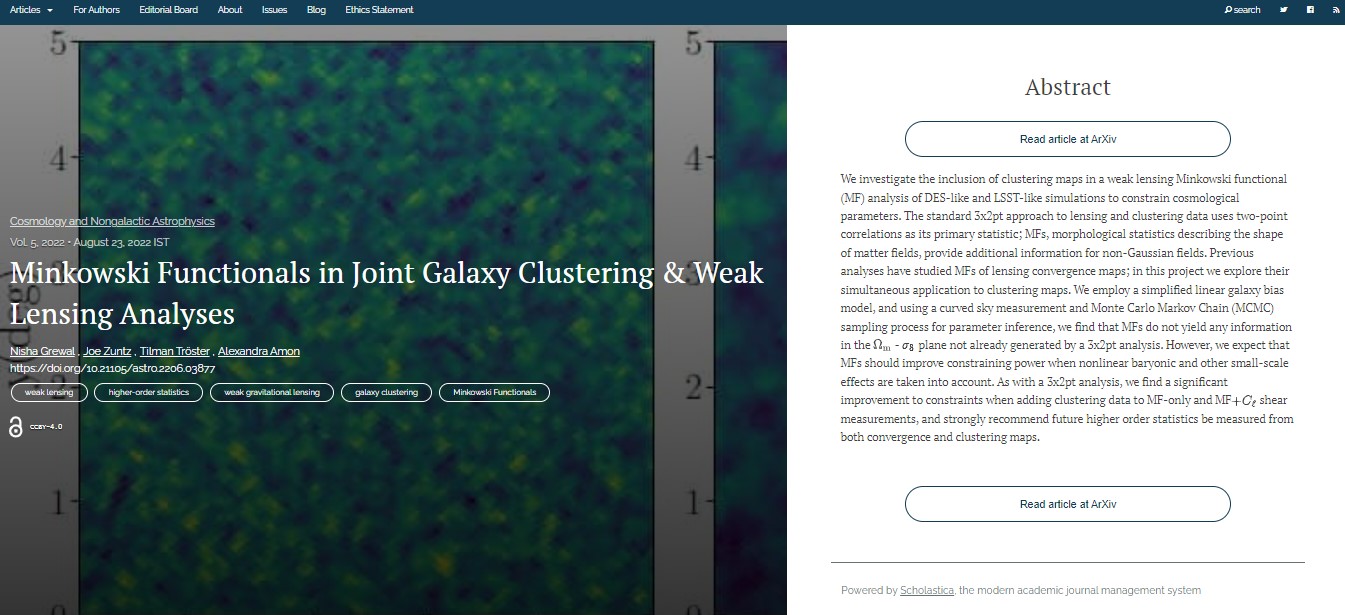
It’s time once again for me to announce another new paper at the Open Journal of Astrophysics. The new paper, published yesterday, is the 12th paper in Volume 5 (2022) and the 60th in all. The latest publication is entitled “Minkowski Functionals in Joint Galaxy Clustering & Weak Lensing Analyses” and the authors are Nisha Grewal, Joe Zuntz and Tilman Tröster of the Institute for Astronomy in Edinburgh and Alexandra Amon of the Institute of Astronomy in Cambridge. The paper is in the folder marked Cosmology and Non-Galactic Astrophysics.

Incidentally, Dr Alexandra Amon is the winner of this year’s Caroline Herschel Lectureship in Astronomy, so congratulations to her for that too!

The new paper is about the application of topological characteristics known as Minkowski Functionals to cosmological data. This approach has been used in the past to study the pattern cosmic microwave background temperature fluctuations; see e.g. here for one of my forays into this way back in 2008. Now there are more high-quality datasets besides the CMB so there are more opportunities to use this elegant approach. Perhaps I should do a blog post about Minkowski Functionals? Somewhat to my surprise I can’t find anything on that topic in my back catalogue here In The Dark

Anyway, here is a screen grab of the overlay which includes the  abstract:


You can click on the image to make it larger should you wish to do so. You can find the accepted version of the paper on the arXiv here.

Blog Paper

Posted in Biographical, The Universe and Stuff with tags , , on April 12, 2016 by telescoper

I don’t often blog about my own research. To be honest that’s partly because I don’t get much time to do any. Fortunately, however, I have an excellent postdoctoral research assistant (Dipak) and some excellent collaborators. Anyway, I just heard yesterday that the following paper has been accepted for publication in the Journal of Cosmology and Astroparticle Physics (JCAP):

Munshi

It’s not exactly a light read – it’s 32 pages long – but at least it gives the non-cosmology readers of this blog an idea of my research interests. Hopefully it won’t be too long before we can apply techniques such as those described in the above paper to real data!

Hopefully also in future I’ll be able to persuade my co-authors to submit to the Open Journal of Astrophysics!