Archive for Open Access Publishing

Open Access in Ecology

Posted in Open Access with tags , , , , on May 6, 2024 by telescoper

My attention was drawn yesterday to the following blog post about Open Access in the field of ecology. I recommend you read it (and the comments, some of which are excellent).

I will add a few comments of my own here.

First, whenever I read an article like this from a discipline different from my own it makes me not only feel grateful that we have arXiv but also wonder why so many fields don’t have the equivalent. On the other hand, there is EarthArxiv, but it doesn’t seem to have very many papers on it.

Second, I agree with the author of the post that far too many papers are being published. That is driven by the absurdity of a system that no longer regards the journal article as a means of disseminating scientific results but instead as a kind of epaulette to give status to the author. I also agree that scientists have largely got themselves to blame for this ridiculous situation.

Third, I disagree most strongly with this statement:

First, pipe dreaming academics who believed in the mirage of “Diamond OA” (nobody pays and it is free to publish). Guess what – publishing a paper costs money – $500-$2000 depending on how much it is subsidized by volunteer scientists. 

This is nonsense. It does not cost anything like $500-$2000 dollars to publish a paper. Of course it does cost something, but the true amount is trivial – tens of dollars, rather than hundreds or thousands – and can easily be absorbed. The entire annual running costs of OJAp are less than the typical Article Processing Charge for a single paper in a “prestigious” journal. Most money being paid in the form of APC goes directly into profit for the publishers, and the rest is largely wasted on administrative overhead. The Open Journal of Astrophysics is a Diamond Open Access journal, not a mirage. It may be a no-frills service, but it’s a reality. Why doesn’t someone set up an overlay journal on EarthArXiv?

The author of this blog post also spectacularly misses the point with “depending on how much it is subsidized by volunteer scientists”. Volunteer scientists are already subsidizing the profits of profit-making publishers! One of the commenters on the blog post has it right:

On Diamond OA and who pays; we’re already paying the big publishers with both our time and our money to publish in / review for / edit for their journals. Perhaps if we redirected that time to Diamond OA titles things would be somewhat different.

A final comment, only tangentially related to this post, is that I have been (pleasantly) surprised by the extent to which early career researchers have embraced the concept of the Open Journal of Astrophysics when you might have thought that they had more to lose by not publishing in mainstream journals rather than us oldies who don’t care any more. The explanation seems to be that younger people seem to see the absurdity and obvious unsustainability of the current publishing environment more easily than those who have put up with it for decades already.

Three New Publications at the Open Journal of Astrophysics

Posted in OJAp Papers, Open Access, The Universe and Stuff with tags , , , , , , , , , , , , , on April 27, 2024 by telescoper

It’s time for the usual  Saturday roundup of business at the  Open Journal of Astrophysics. The latest batch of publications consists of three papers, taking the count in Volume 7 (2024) up to 30 and the total published by OJAp up to 145.

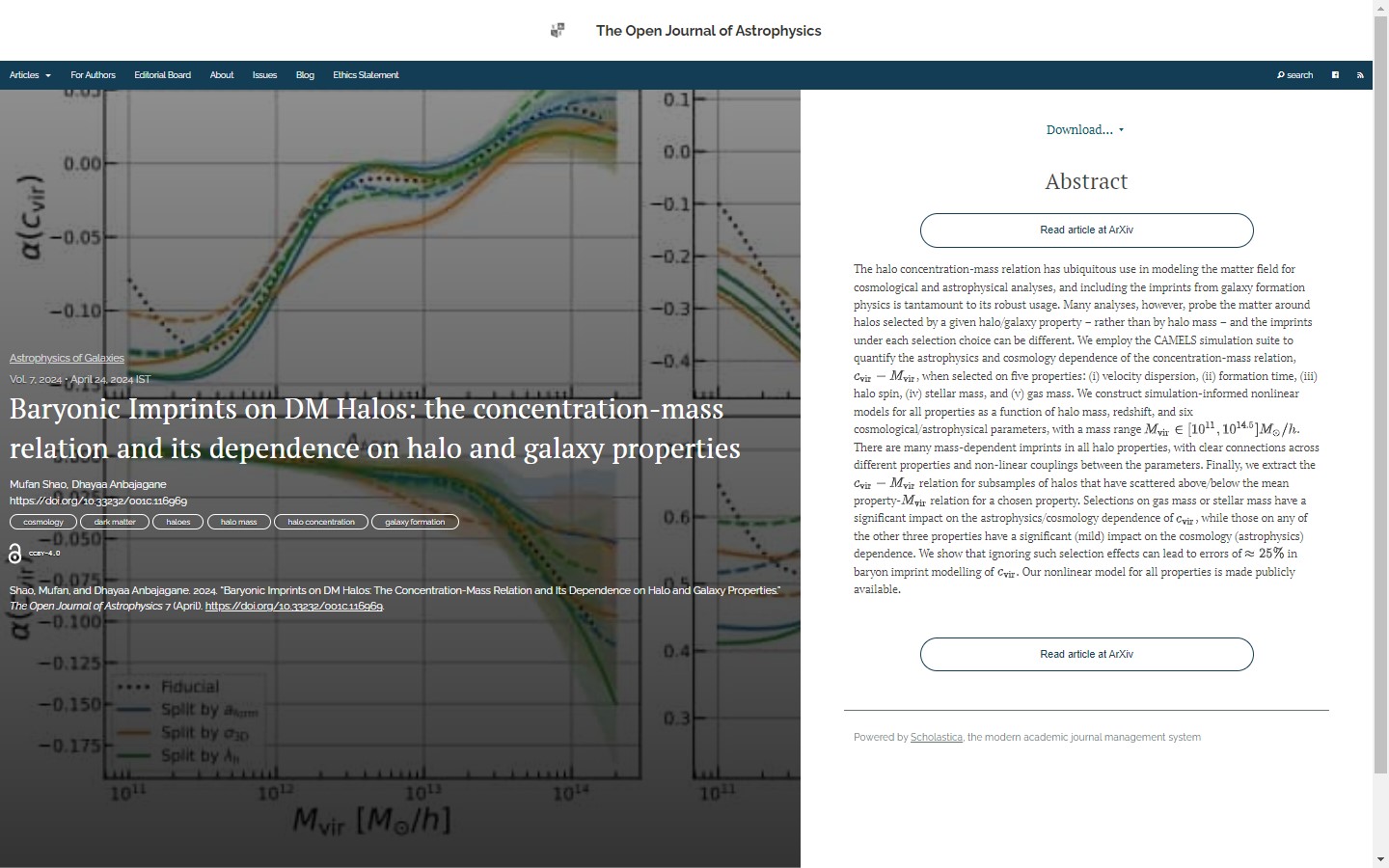
First one up is “Baryonic Imprints on DM Halos: the concentration-mass relation and its dependence on halo and galaxy properties” .  The authors, Mufan Shao and Dhayaa Anbajagane of the University of Chicago, USA, use  a non-linear model informed by simulations to study the imprint of galaxy formation physics on the concentration-mass relationship using various different choices of halo selection criteria. This one is in the folder marked Astrophysics of Galaxies and was published on 24th April 2024.

Here is a screen grab of the overlay, which includes the abstract:


You can read the paper directly on arXiv here.

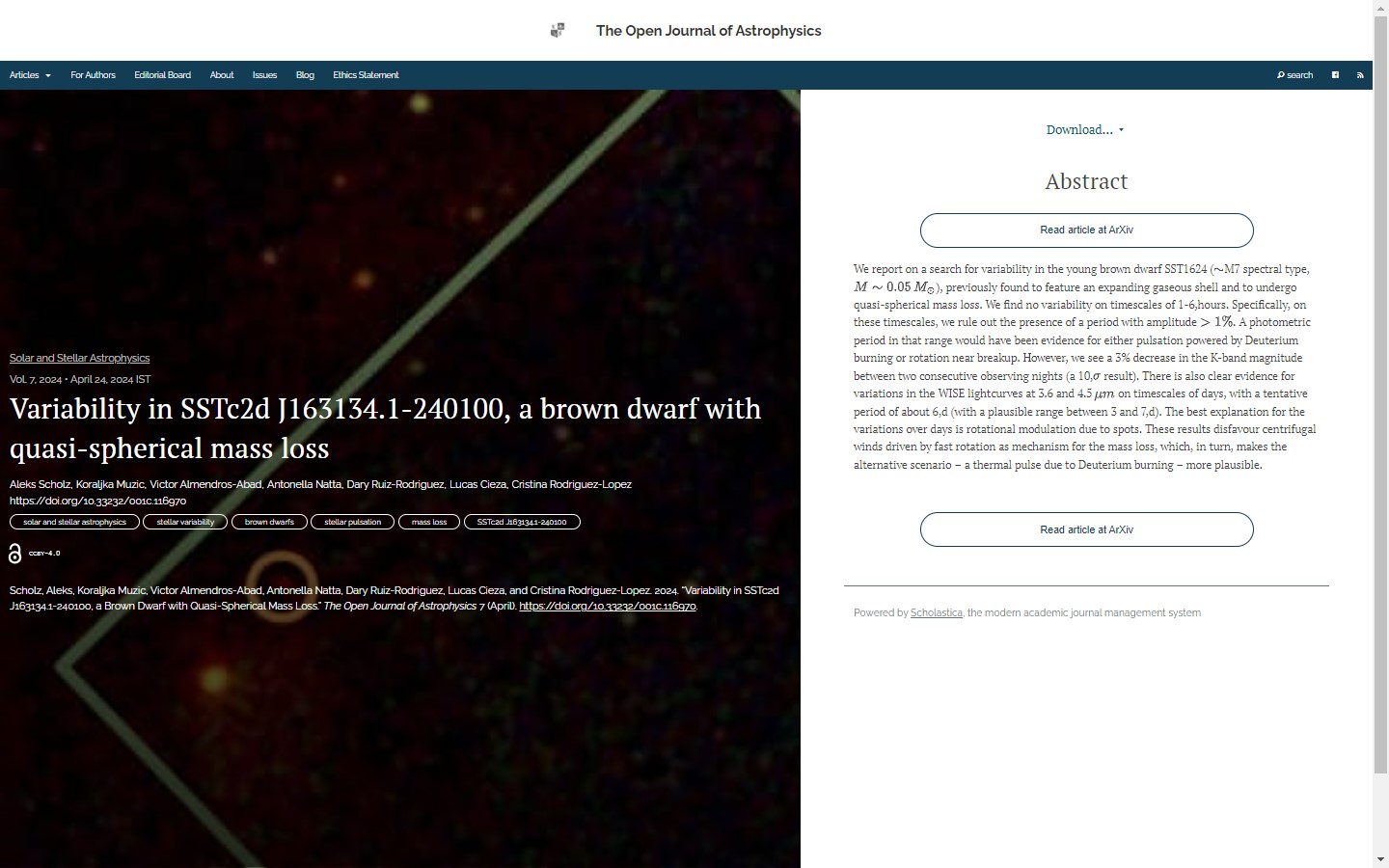
The second paper to announce is “Variability in SSTc2d J163134.1-240100, a brown dwarf with quasi-spherical mass loss” which describes a search for variability in a brown dwarf star known to be losing mass and the implications of the lack thereof for the reason for the outflow therefrom. The authors are Aleks Scholz (St Andrews, UK),  Koraljka Muzic (Lisbon, Portugal), Victor Almendros-Abad (Palermo, Italy), Antonella Natta (DIAS, Ireland), Dary Ruiz-Rodriguez (NRAO, USA), Lucas Cieza (Uni. Diego Portales, Chile), Cristina Rodriguez-Lopez (IAA-CSIC, Granada, Spain)

This one is in the folder Solar and Stellar Astrophysics and was also published on 24th April 2024. The overlay looks like this:


You can read this paper directly on the arXiv here.

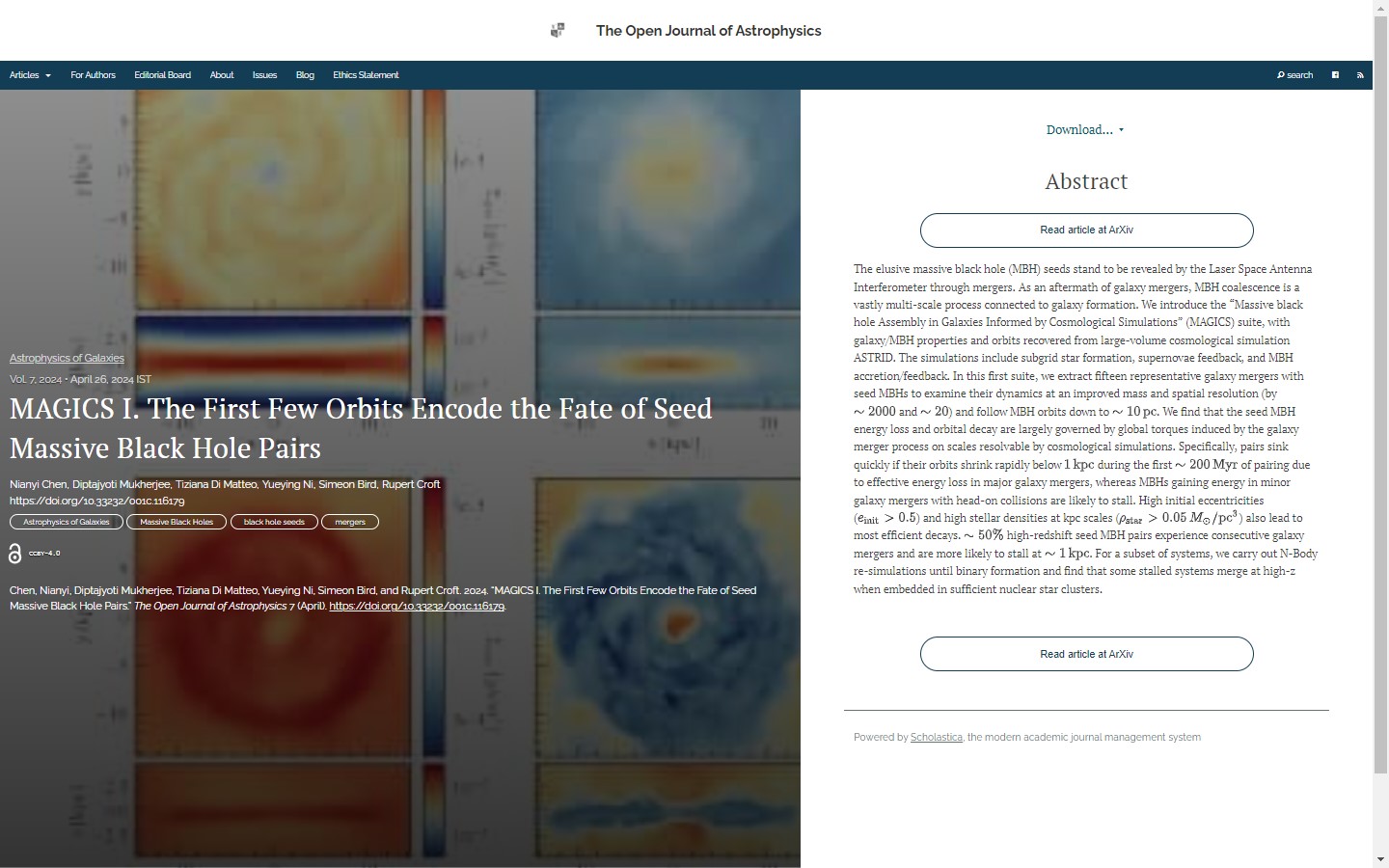
The last paper of this batch, also in the folder marked Astrophysics of Galaxies, is  entitled “MAGICS I. The First Few Orbits Encode the Fate of Seed Massive Black Hole Pairs”  and is a computational study of the process by which massive black holes are formed by merging smaller seed black holes. It was published on April 26th 2024 (i.e. yesterday). The authors are: Nianyi Chen, Diptajyoti Mukherjee and Tiziana Di Matteo (all Carnegie Mellon University); Yueying Ni (Harvard); Simeon Bird (University of California, Riverside); and Rupert Croft (Carnegie Mellon University). All authors are based in the USA.

Here is a screengrab of the overlay:


To read the accepted version of this on the arXiv please go here.
That’s all for now. More news in a week or so!


Scopus Update

Posted in Open Access with tags , , on March 15, 2024 by telescoper

A couple of months ago I blogged about how the Open Journal of Astrophysics had been accepted for listing on Scopus. The process has turned out to be much slower than I was led to believe and the “technical team” responsible for the indexing required much more help than I’d imagined, so we’re not fully there yet. However, I can confirm that we are in the process. This is an excerpt from the accepted titles list which you can find here:

The Scopus indexation process seems to involve processing every article manually, so it’s possible that there will be some errors. Here is a verbatim excerpt from a recent email from the Scopus team that perhaps illustrates why I lack confidence in the process:

We have activated your journal for Scopus indexation and you will be able to find the content indexed online shortly. The title, however, will take some time to have a source page and you will not be able to view it on source list. If the articles indexed on Scopus exceeds 15, Source Page for your title will be automatically created during Scopus browser update. Post which the title will be discoverable on Scopus source list as well.

I hope this clarifies the situation.

Western Sydney

Posted in Biographical, Open Access with tags , , , , , , on February 26, 2024 by telescoper

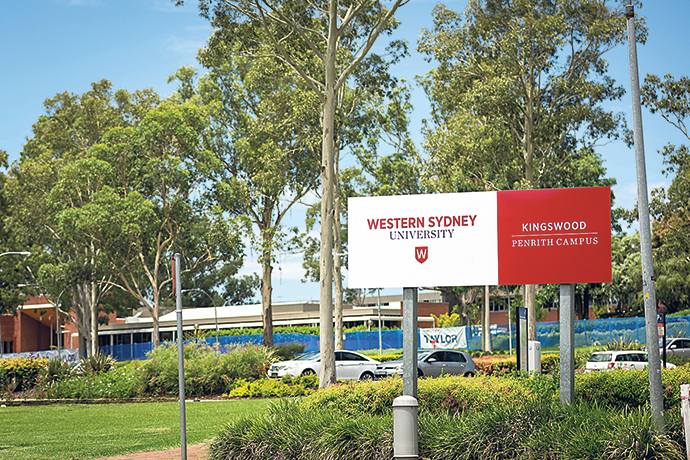
Today I made a journey by train to Kingswood, a suburb of Sydney which is the location of one of the campuses of Western Sydney University (WSU). The journey of about 50 km takes about an hour on the stopping train (T1) from Sydney Central Station. I was intrigued that the final destination for the train I got was Emu Plains; I had visions of vast herds of Emus gathered there, but I had to get off the stop before the terminus so never saw them. There’s about a 20-minute walk to the campus from Kingswood Station. It was quite warm so I was grateful when one of my hosts offered me a lift back to Kingswood Station at the end of my visit.

The reason for my visit was set another seminar about Open Access Publishing in Astrophysics. Here are the slides:

Although I’ve given a talk based on more-or-less the same slides recently, it always comes out slightly different. There was a bigger audience than I expected in the room, supplemented by even more on Zoom. The topic of Open Access Publishing does seem to be pretty hot these days in Australia and there was quite a lively discussion. I have a feeling we might have a manuscript or two submitted from WSU before too long.

Kingswood is a far less affluent area than where I am staying in Ultimo, and WSU is an institution that’s very different from the University of Sydney itself, but it was good to see another side of the city, geographically as well as socially. Thank you to everyone who attended and, especially, to Luke Barnes for inviting me and for lunch and coffee!

On the train back into Sydney I noticed that trains going in the opposite direction where crammed full, with (mostly) teenage girls heading to Olympic Park for a Taylor Swift concert. My train, heading into Sydney was fairly empty by contrast and the journey back pleasant enough.

Open Access Talk at UNSW

Posted in Biographical, Open Access, The Universe and Stuff with tags , , , on February 21, 2024 by telescoper

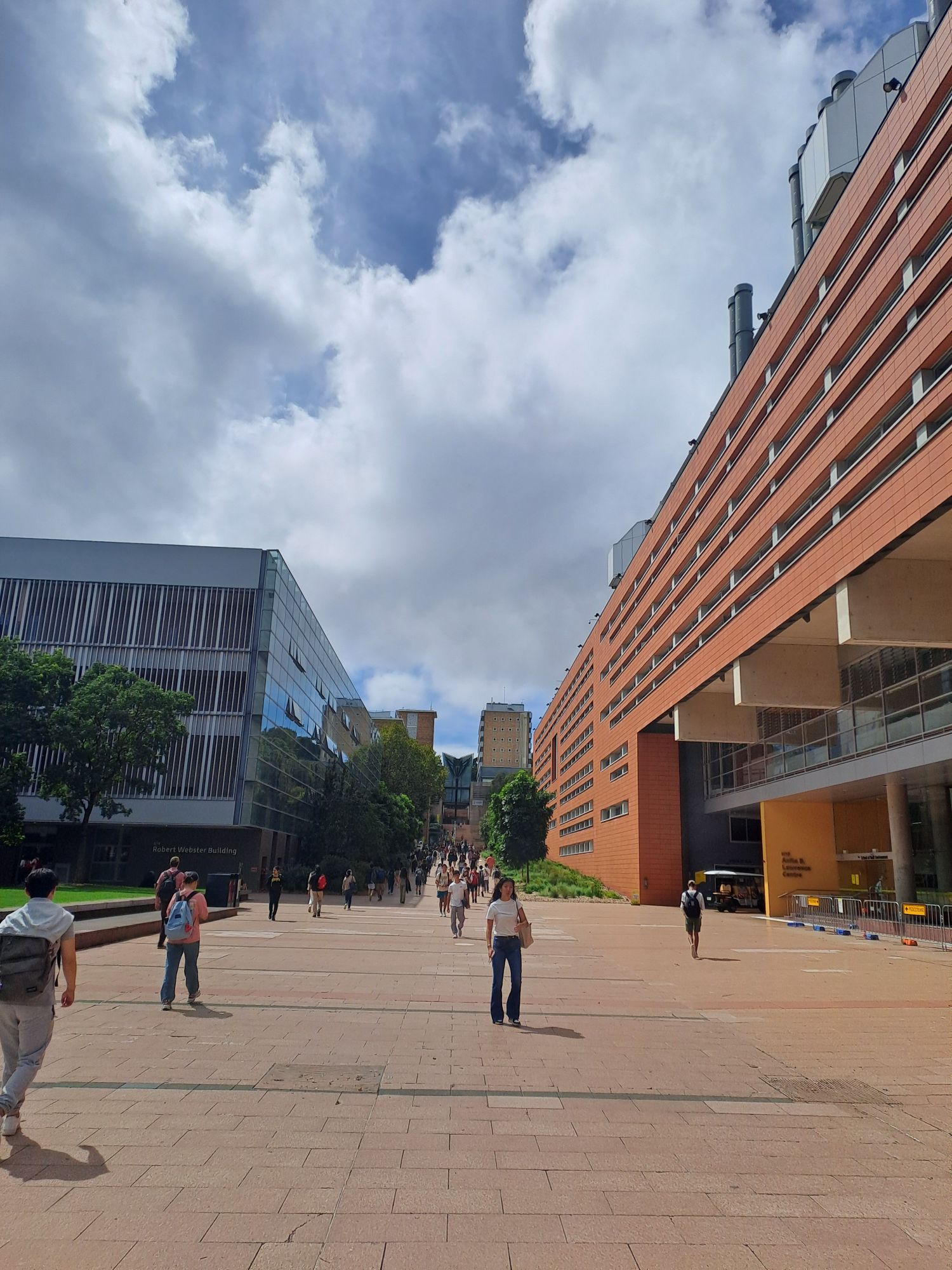
After an exciting start to the day involving a fire alarm and consequent evacuation of my hotel, I today ventured into the suburbs of Sydney via the Light Rail system (i.e. the tram) to the University of New South Wales. The tram ride took about 20 minutes from Central and, incidentally, took me right past the Sydney Cricket Ground. Anyway, the UNSW campus at Kensington is very impressive:

After a few gremlins with the WIFI connection, the talk I gave was a longer version of the one I did at the University of Sydney on Monday. In discussions with the Astrophysics group at UNSW, I found they were particularly unhappy about the decision of Monthly Notices of the Royal Astronomical Society to charge a high level of APC (Article Processing Artificial Profit Charge) so is looking at alternative journals that aren’t so exploitative. A journal has no right to call itself “open access” if it excludes researchers on grounds of cost. The problem with the Open Journal of Astrophysics in this case is that they need their publications to be in “high impact journals” for research assessment purposes, and OJAp doesn’t have an “official” journal impact factor yet. The fascination of bureaucrats with the obviously flawed journal impact factor disturbs me greatly but I hope we will have one soon so we may be able to help them out before too long.

Anyway, here are the slides from today’s talk:

Talking Down Under

Posted in OJAp Papers, Open Access, The Universe and Stuff with tags , , , on February 19, 2024 by telescoper

This morning I gave a short talk at the “Astronomy Tea” at the Sydney Institute for Astronomy. No prizes for guessing what I talked about. The talk was followed by questions and then by a huge thunderstorm.

Here are the slides:

P.S. Today was the first day of teaching of the new academic year at the University of Sydney, so the campus was much busier today than it has been.

Open Peer Review Analytics

Posted in OJAp Papers, Open Access with tags , , , , on October 18, 2023 by telescoper
A Peer, Reviewing. Photo from Pexels.com

Quite a few people have contacted me to ask about the Peer Review Process at the Open Journal of Astrophysics so I thought I’d do a quick post here to explain a bit about it here.

When a paper is submitted it is up to the Editor-in-Chief – that’s me! – to assign it to a member of the Editorial Board. Who that is depends on the topic of the paper and on the current availability due to workload. I of course take on some papers myself. I also reject some papers without further Peer Review if they clearer don’t meet  the journal’s criteria of scientific quality, originality, relevance and comprehensibility. I usually run such papers past the Editorial Board before doing such a ‘Desk Reject’.

Once the paper has been assigned, the Editor takes control of the process, inviting referees (usually two) to comment and make recommendations. This is the rate-determining step, as potential referees are often busy. It can take as many as ten declined invitations before we get a referee to agree. Once accepted, a referee is asked to provide a report within three weeks. Sometimes they are quicker than that, sometimes they take longer. It depends on many factors, including the length of the manuscript.

Once all the referee reports are in the Editor can make a decision. Some papers are rejected upon refereeing, and some are accepted with only tiny changes. The most frequent decision is “Revise and Resubmit” – authors are requested to make changes in response to the referee comments. Sometimes these are minor, sometimes they are substantial. We never give a deadline for resubmission.

A resubmitted paper is usually sent to the same referee(s) who reviewed the original. The referees may be satisfied and recommend acceptance, or we go around again.

Once a paper is accepted, the authors are instructed to upload the final, accepted, version to arXiv. It normally takes a day or two to be announced. The article is then passed over from the Peer Review process to the Publication process. As Managing Editor, I make the overlay and prepare the metadata for the final version. This is usually done the same day as the final version appears on arXiv, but sometimes it takes a bit longer to put everything in order. It’s never more than a few days though.

Anyway, here are some “analytics” – it’s weird how anything that includes any quantitative information is called analytics these days to make it sound more sophisticated than it actually is – provided by the Scholastica platform:

These numbers need a little explanation.

The “average days to a decision” figure includes desk rejects as well as all submissions and resubmissions. Suppose a paper is submitted and it then takes 4 weeks to get referee reports and for the Editor to make a “Revise and Resubmit” request. That would count as 28 days. It might take the authors three months to make their revisions and resubmit the paper, but that does not count in the calculation of the “average days to decision” as during that period the manuscript is deemed to be inactive. If the revised version is accepted almost immediately, say after 2 days, then the average days to decision would be (28+2)/2 = 15 days. Also, being an average there are some shorter than 14 days and some much longer.

The acceptance rate is the percentage of papers eventually accepted (even after revision). The figure for ‘total submissions’ includes resubmissions, so the hypothetical paper in the preceding paragraph would add 2 to this total. That accounts for why the total number of papers accepted is not 50% of 388, which is 194; the actual figure is lower, at 105.

Finally, the number of manuscripts “in progress” is currently 23. That includes papers currently going through the peer review process. It does not include papers which are back with the authors for revisions (although it would be reasonable to count those as in progress in some sense).

There we are. I hope this clarifies the situation.

Towards a New Ecosystem for Scientific Publication

Posted in Open Access with tags , , , on October 4, 2023 by telescoper

A few days ago I posted an item about how the current system of scientific publication is under such intolerable strain that it is no longer fit for purpose. This is something I’ve felt for a while. Some time ago I wrote a post musing about what should replace it. That article included this:

I know I’m not alone in thinking that the current publishing ecosystem is doomed and will die a natural death soon enough. In my view the replacement should be a worldwide network of institutional and/or subject-based repositories that share research literature freely for the common good.

https://telescoper.blog/2023/09/12/lets-make-no-pay-open-access-real/

The Open Journal of Astrophysics was set up to demonstrate a way of achieving this kind of change in the field of Astrophysics. With this in mind I was delighted to to see a paper in PLOS Biology by Richard Sever (published just yesterday) with the following abstract:

Academic journals have been publishing the results of biomedical research for more than 350 years. Reviewing their history reveals that the ways in which journals vet submissions have changed over time, culminating in the relatively recent appearance of the current peer-review process. Journal brand and Impact Factor have meanwhile become quality proxies that are widely used to filter articles and evaluate scientists in a hypercompetitive prestige economy. The Web created the potential for a more decoupled publishing system in which articles are initially disseminated by preprint servers and then undergo evaluation elsewhere. To build this future, we must first understand the roles journals currently play and consider what types of content screening and review are necessary and for which papers. A new, open ecosystem involving preprint servers, journals, independent content-vetting initiatives, and curation services could provide more multidimensional signals for papers and avoid the current conflation of trust, quality, and impact. Academia should strive to avoid the alternative scenario, however, in which stratified publisher silos lock in submissions and simply perpetuate this conflation.

https://doi.org/10.1371/journal.pbio.3002234

(I added the emphasis). In case you were not aware, Richard Sever is a cofounder of the preprint servers bioRxiv and medRxiv.

I’m very glad to see similar thoughts to those I expressed about astrophysics being echoed in the field of biomedicine. I hope that more disciplines follow this path. The way it is realized will no doubt be domain-specific, but the benefits of such a new ecosystem will be for all science.

On SciPost…

Posted in Maynooth, Open Access with tags , , , on April 24, 2023 by telescoper

On of my colleagues this morning passed on details of a recent publication to put on the Twitter feed of the Department of Theoretical Physics at Maynooth. As far as I’m aware this is the first paper authored by a member of the Department to be published on SciPost, a Diamond Open Access journal.

I’ve known about SciPost for quite a while, but have been preoccupied with the Open Journal of Astrophysics (OJAp) and have not tracked its progress very closely, but I’m glad to see it going well. Its business model is very different from the Open Journal of Astrophysics but its commitment to publishing high-quality scientific papers free of charge for authors and readers alike is most commendable. Looking at the physics section I see that there are quite a few highly-cited papers among them, over a wide spread of topics, including high-energy physics. There are only a few papers in Astronomy, however- only three when I looked.

I’ve heard it said that one of the advantages of SciPost is that, because it allows authors to keep the copyright on their publications, they can post articles freely on arXiv for wider distribution without embargo or other restriction. That is true and laudable. The logic of the Open Journal of Astrophysics, however, is that most astrophysicists use arXiv as their primary source of research literature, so if you’re going to read it on arXiv why not dispense with the separate journal and just use an overlay?

Not all research areas are so wedded to the arXiv, however, and it is great that there’s a free alternative. I’m a little surprised that nobody has set up a particle physics overlay journal (yet), as the HEP community seems to use arXiv a lot. When I asked a particle physicist about this they said it had been discussed, but they decided that they were happy enough with SciPost as an OA platform. Fair enough. The important thing to me is to avoid the excessive Article Processing Charges (APCs) imposed by mainstream journals for OA publishing.

I note that the HEP community has SCOAP3, which pays for articles to appear in Open Access form in traditional journals. In other words it hides the cost from the scientists and effectively subsidizes the academic publishing industry. It is important that there are alternatives to traditional journals so that authors to have a choice whether to adopt the SCOAP3 route.

One final comment. On the Finance page for SciPost it states that the estimated average cost per paper published is €400. That’s at 2019 rates. It’s probably higher now. That cost is a lot less than a typical APC but is still about a factor of ten higher than the cost per paper for OJAp. SciPost has a large network of sponsors so it can cover this cost. The overlay model used by arXiv is much cheaper to run.

Open Access Week and the arXiv

Posted in Open Access with tags , , on October 17, 2022 by telescoper

Just time for a quick post to advertise the fact that next week (commencing October 24th 2022) is International Open Access Week.

I’ll be participating in one of the events – a panel discussion – organized by arXiv as part of Open Access Week. This event is entitled Trends in Peer Review of Open Access Preprints and the description is:

Speed of research is a major feature of open access preprint platforms like arXiv – formal peer review can follow later after rapid distribution of results. However, as submissions to arXiv and other preprint servers have grown, many researchers are seeking new avenues for community feedback and peer review. At this panel discussion, leaders in preprints and peer review will discuss current trends in virtual overlay journals, open peer reviews, and more. (Video recording will be available to registrants after the event)

Panelists:

  • Peter Coles, PhD, Theoretical Cosmologist at Maynooth University in Ireland and Managing Editor of The Open Journal of Astrophysics
  • Jessica Polka, PhD, Executive Director of ASAPbio
  • Antti Mikael Rousi, PhD, Senior Advisor, Research Services at Aalto University, Finland
  • Steinn Sigurdsson, PhD, Professor of Astronomy at Penn State University and arXiv Scientific Director

The event is at on Wednesday, October 26, 2022 at 15:00 UTC /11:00 EDT; that’s 16:00 Irish Time. It’s on Zoom (unless you are at Cornell and can attend in person). You need to register here.