Archive for Open Journal of Astrophysics

Yet another problem with Journal Impact Factors

Posted in Open Access with tags , , , on November 9, 2023 by telescoper

I was at a meeting this morning in which the vexed issue of the journal Impact Factor (IF) came up. That reminded me of something that struck me when I was checking the NASA/ADS entry for a paper recently published by the Open Journal of Astrophysics, and I thought it would be worth sharing it here. First of all, here’s a handy slide showing how the Impact Factor (IF) for a journal is calculated for a given year:

It’s a fairly straightforward piece of information to calculate, which is one of its few virtues.

Now consider this paper we recently published in the Open Journal of Astrophysics:

As of today, according to the wonderful NASA/ADS system, this paper has 36 citations. That’s no bad considering that it was published less than a month ago. It’s obviously already quite an impactful paper. The problem is that if you look at the recipe given above you will see that none of those 36 citations – nor any more that this paper receives this year – will ever be included in the calculation of the Impact Factor for the Open Journal of Astrophysics. Only citations to this paper garnered in 2024 and 2025 will count to the impact factors (for 2025 and 2026 respectively). There’s every reason to think this paper will get plenty of citations over the next two years, but I think this demonstrates another bit of silliness to add to the already long list of silly things about the IF as a measure of citation impact.

My view of citation numbers is that they do contain some (limited) information about an article’s impact, but if you want to use them you should just use the citations for the article itself, not a peculiar and arbitrarily-constructed proxy like the IF. It is so easy to get article-level citation data that there is simply no need to use a journal-level metric for anything at all.
Two New Publications at the Open Journal of Astrophysics

Posted in OJAp Papers, Open Access, The Universe and Stuff with tags , , , , , , , , on October 20, 2023 by telescoper

It’s Friday so it’s a good time to catch up with the week’s action at the Open Journal of Astrophysics, where there have been two new publications so far this week. These papers take us up to a total of 40  in Volume 6 (2023) and 105 in total since we started publishing.

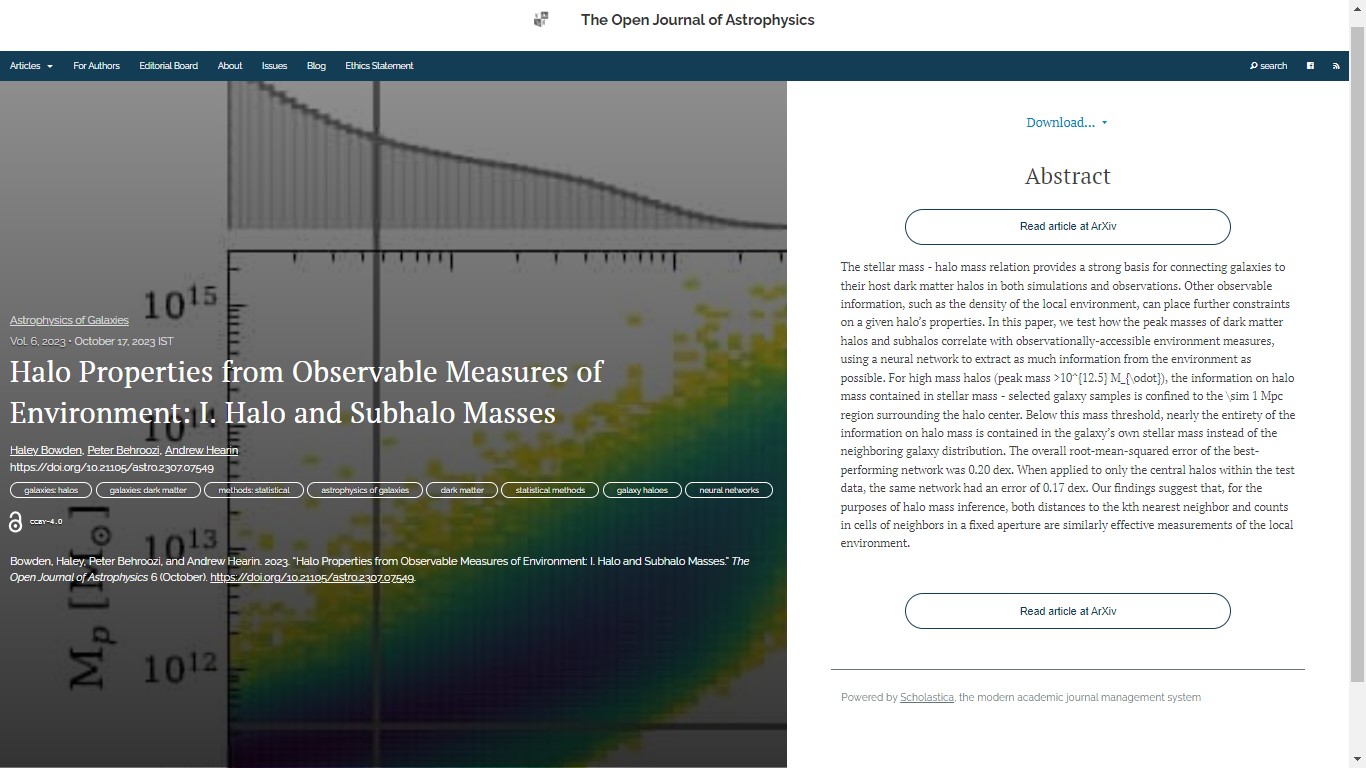
The title of the first paper is “Halo Properties from Observable Measures of Environment: I. Halo and Subhalo Masses” and its primary classification is Astrophysics of Galaxies. it is an exploration using neural networks of how the peak masses of dark matter halos and subhaloes correlate with observationally-accessible measures of their dependence on environment.

The authors based in the United States of America: Haley Bowden and Peter Behroozi of the University of Arizona, and Andrew Hearin of the Argonne National Laboratory

Here is a screen grab of the overlay which includes the abstract:


You can click on the image of the overlay to make it larger should you wish to do so. You can find the officially accepted version of the paper on the arXiv here.

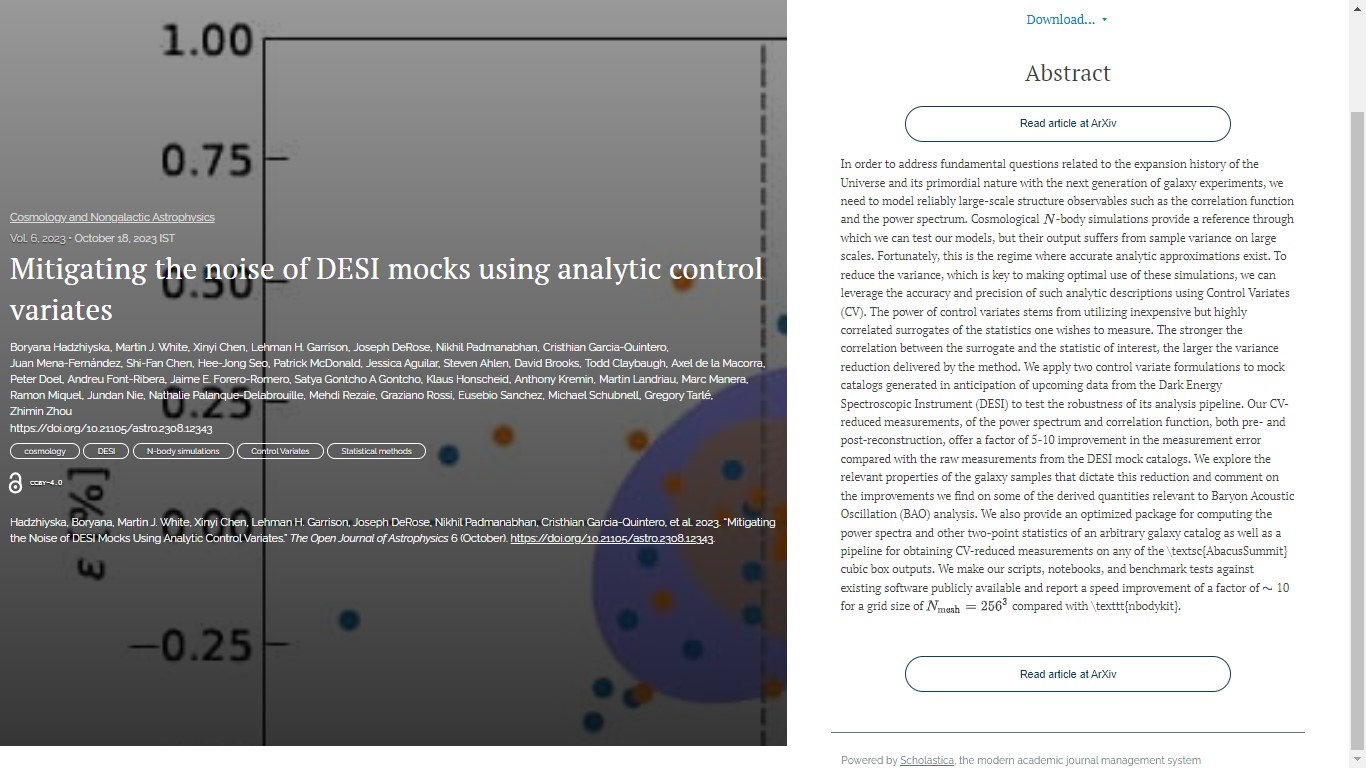
The second paper was published on 18th October 2023.  The primary classification for this one is Cosmology and Nongalactic Astrophysics and is “Mitigating the noise of DESI mocks using analytic control variates”. For those of you not up with the lingo, DESI stands for the Dark Energy Spectroscopic Instrument and you can read more about it here.

The lead author for this one is Boryana Hadzhiyska of the Lawrence Berkeley Laboratory and the University of California, Berkeley (USA) and there are 32 other authors. This paper presents a method for reducing the effects of sample variance on cosmological simulations using analytical approximations and tests it using DESI data.

Here is a screen grab of the overlay which includes the abstract:


You can click on the image of the overlay to make it larger should you wish to do so. You can find the officially accepted version of the paper on the arXiv here.

Three New Publications at the Open Journal of Astrophysics

Posted in OJAp Papers, Open Access, The Universe and Stuff with tags , , , , , , , on August 30, 2023 by telescoper

Not unexpectedly because of holidays, August has been rather a quiet month at the Open Journal of Astrophysics, but with people returning to work this week business has picked up again and it’s time to announce the last batch (all published this week).

In fact, this week we have published three papers, which I now present to you here. These take the count in Volume 6 (2023) up to 34 and the total published by OJAp up to 99. Who will be the author(s) of the 100th? We will just have to wait and see! I’ll do a special post for whichever paper wins that honour.

In chronological order, the three papers published this week, with their overlays, are as follows. You can click on the images of the overlays to make them larger should you wish to do so.

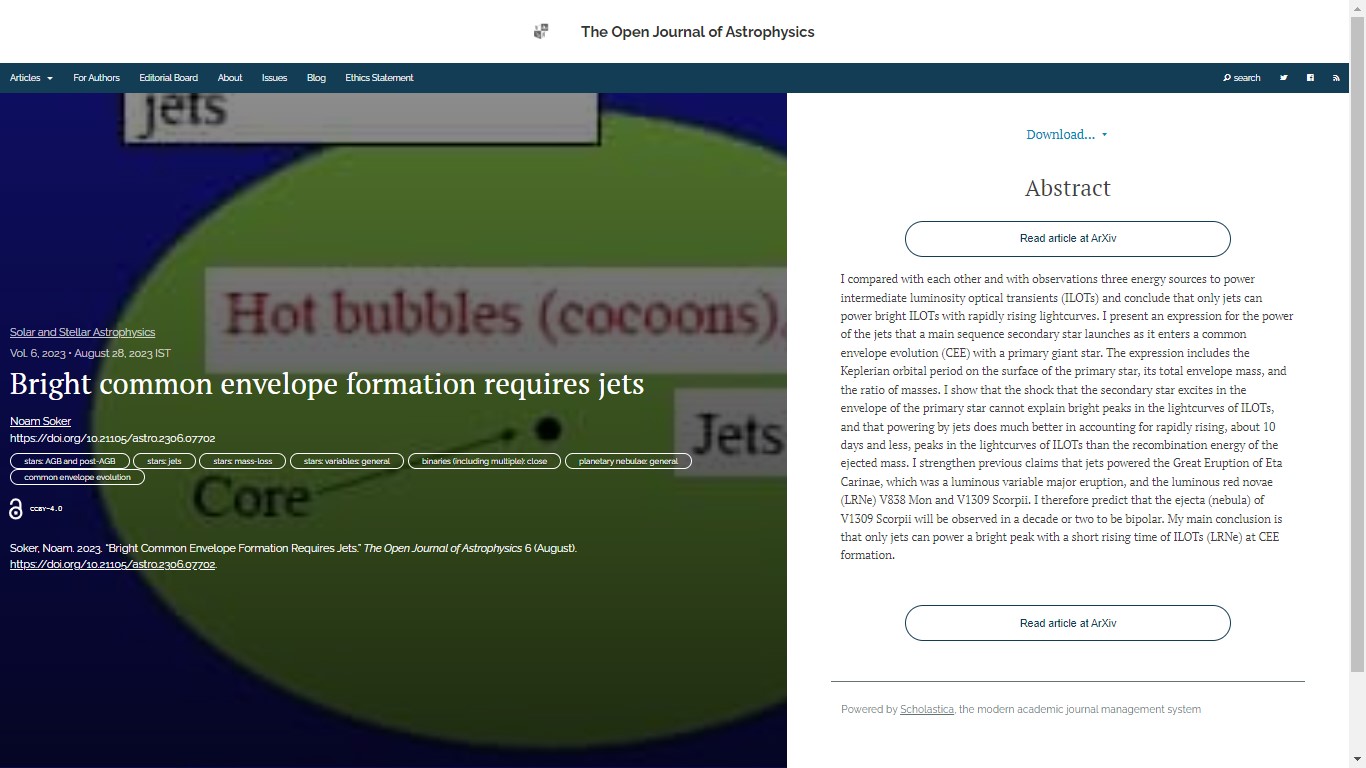
First one up is “Bright common envelope evolution requires jets” by Noam Soker of Technion, Haifa in Israel. This is a discussion of the role of jets that a main sequence secondary star launches as it enters a common envelope evolution (CEE) with a primary giant star. The paper was published on 28th August, is just the fifth item in the folder marked Solar and Stellar Astrophysics and can be found here.

Here is a screen grab of the overlay, which includes the abstract:


You can find the officially accepted version of the paper on the arXiv here.

The second paper to announce is “Almanac: MCMC-based signal extraction of power spectra and maps on the sphere” by Elena Sellentin (Leiden), Arthur Loureiro (Stockholm); Lorne Whiteway (UCL); Javier Lafaurie (Leiden); Sreekumar Balan (UCL); Malak Olamaie (York); and Andrew Jaffe & Alan Heavens (Imperial).  This presents a new software tool called Almanac , which uses Hamiltonian Monte Carlo sampling to infer the underlying all-sky noiseless maps of cosmic structures, together with their auto- and cross-power spectra.

This one is  in the folder marked Cosmology and Nongalactic Astrophysics. The paper was also published on 28th August 2023 and you can see the overlay here:


The accepted version of this paper can be found on the arXiv here.

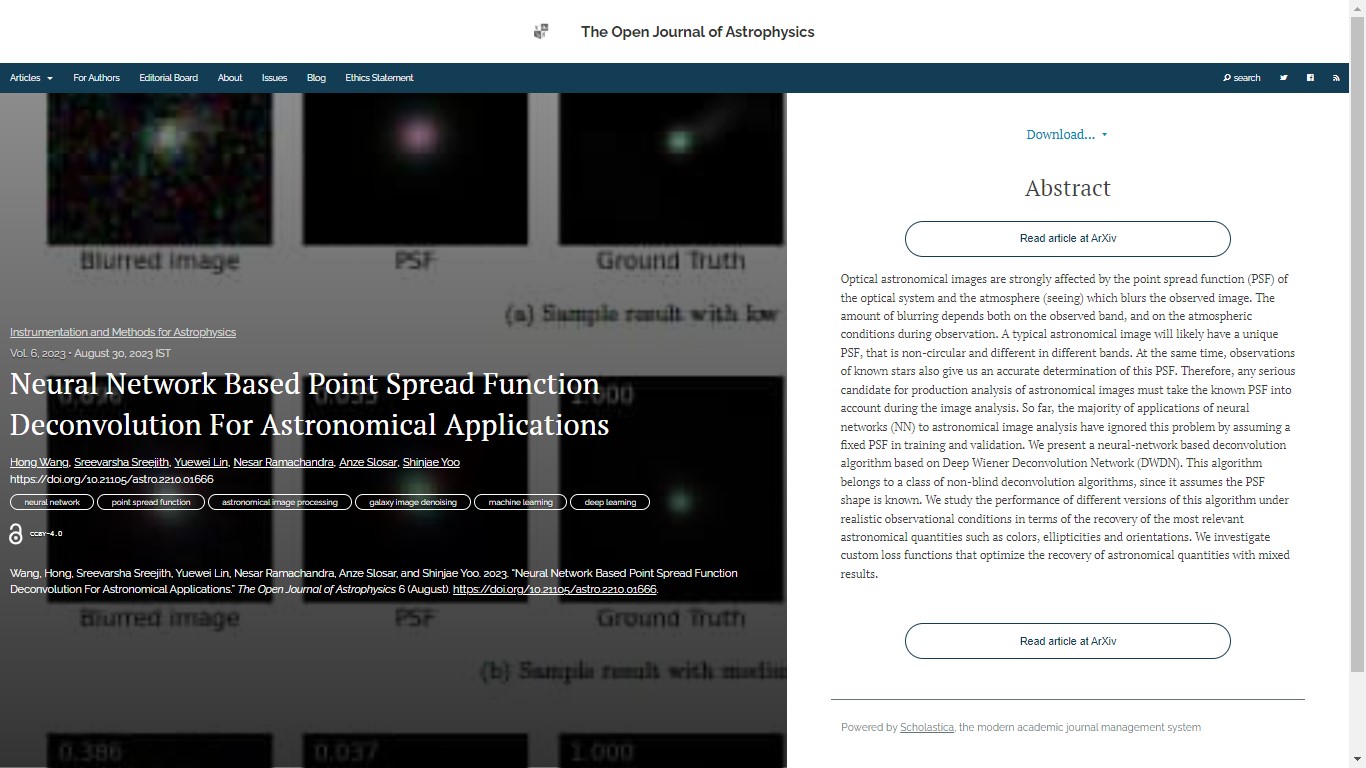
The last paper of this batch paper is in the Instrumentation and Methods for Astrophysics folder. It is entitled “Neural Network Based Point Spread Function Deconvolution For Astronomical Applications” and the authors are: Hong Wang, Sreevarsha Sreejith, Yuewin, Nesar Ramachandra*, Anze Slosar & Shinjae Yoo, all of the Brookhaven National Laboratory (NY) except * who is at the Argonne National Laboratory (IL), all based in the USA. This paper discusses a neural-network based deconvolution algorithm based on Deep Wiener Deconvolution Network (DWDN) and its performance in an astronomical context.

Here is the overlay:


You can find the full text for this one on the arXiv here.

From OJAp to AI

Posted in OJAp Papers with tags , on July 30, 2023 by telescoper

I was messing around with an AI “Art” generator and decided to use it to generate images to go with the latest four papers published at the Open Journal of Astrophysics, using the titles of these papers as prompts. The results are a mixture of strange and hilarious. I was only using the free version of the software which only allows 10 generations per day and there are lots of possible styles. I’m sure with more attempts one could get even more interesting outputs!

Anyway, if you click on each of the images below it should take you to an image of the overlay of the paper it is supposed to represent….

(This is a guest post by our Artificial Intelligence correspondent, A.I. Addio.)

Four New Publications at the Open Journal of Astrophysics

Posted in OJAp Papers, Open Access, The Universe and Stuff with tags , , , , , , , , , , , , , , , , on July 29, 2023 by telescoper

The rate of publication at the Open Journal of Astrophysics has now reached the point at which I think I’ll have to limit myself to weekly updates here rather than announcing every paper as it appears. We still announce individual papers on social media of course, meaning Mastodon, Facebook and the platform formerly known as Twitter…

This week we have published four papers which I now present to you here. These four take the count in Volume 6 (2023) up to 31 and the total published by OJAp up to 96. I speculated earlier this year that we might reach 100 before the end of 2023, now it looks certain we will reach the century mark as early as August! It is gratifying to see the range of papers published increasing, with all four of these in different categories.

In chronological order, the four papers published this week, with their overlays, are as follows. You can click on the images of the overlays to make them larger should you wish to do so.

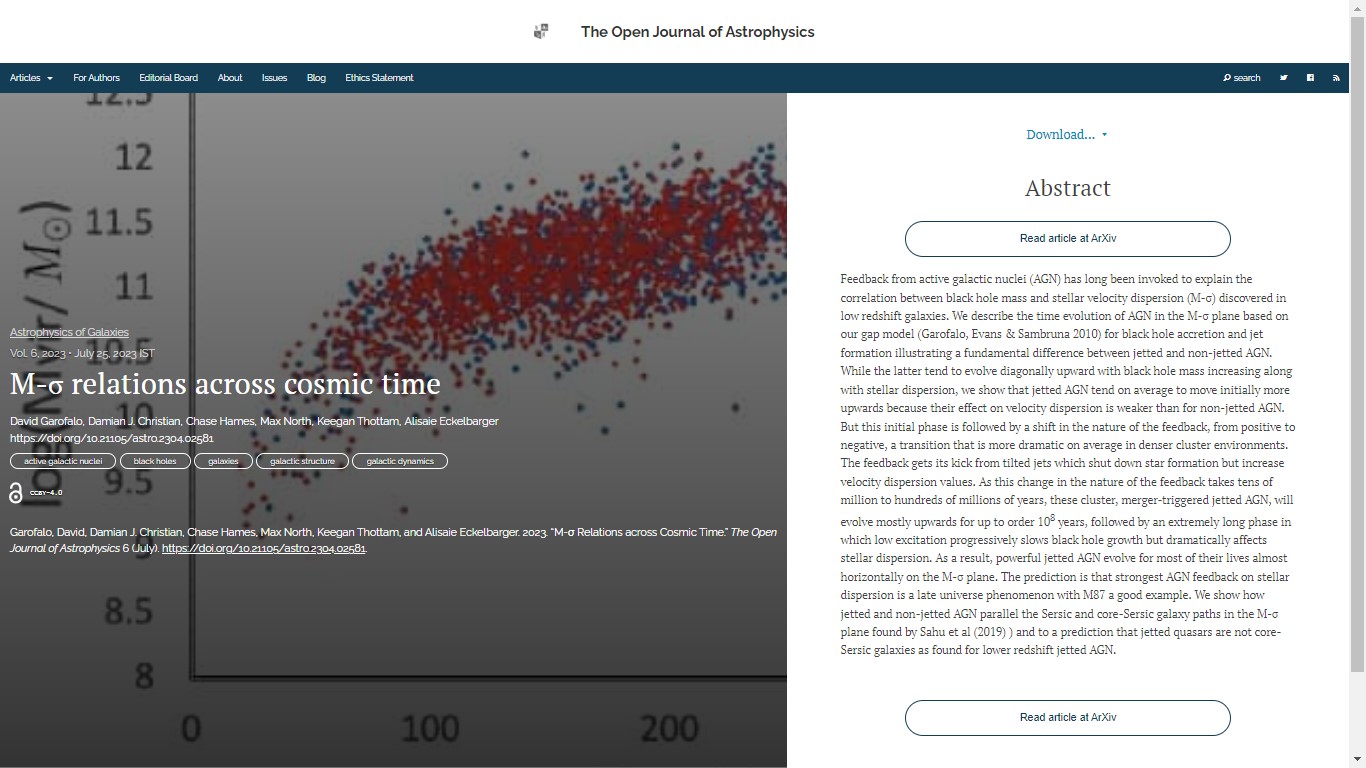
First one up is “M-σ relations across cosmic time” by David Garofalo (1), Damian J. Christian (2), Chase Hames (1), Max North (3), Keegan Thottam (1) & Alisaie Eckelbarger (1). The author affiliations are: (1) Department of Physics, Kennesaw State University, USA; (2) Department of Physics and Astronomy, California State University, Northridge, USA; (3) Department of Information Systems, Kennesaw State University, USA. This is a discussion of the relationship between black hole mass and stellar velocity dispersion discovered in low redshift galaxies and its evolution with cosmic time. The paper was published on 25th July, is in the folder marked Astrophysics of Galaxies and can be found here.

Here is a screen grab of the overlay, which includes the abstract:

You can find the officially accepted version of the paper on the arXiv here.

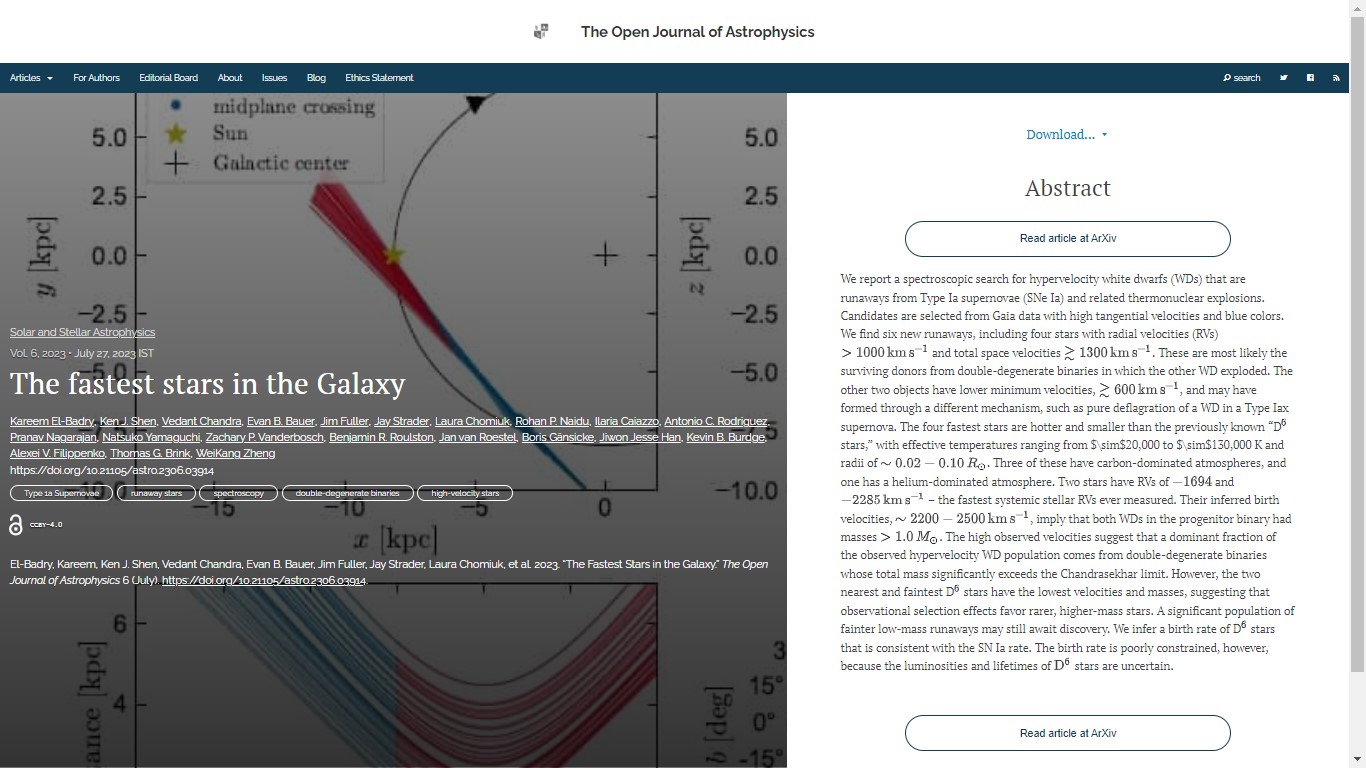
The second paper to announce is “The fastest stars in the Galaxy” by Kareem El-Badry et al. (21 authors. This one is the fourth item in the folder marked Solar and Stellar Astrophysics and it reports the spectroscopic discovery of 6 new “runaway” stars, probably the surviving members of binary star systems in which one star exploded in a Type 1a supernova. The paper was published on 27th July 2023 and you can see the overlay here:

The accepted version of this paper can be found on the arXiv here.

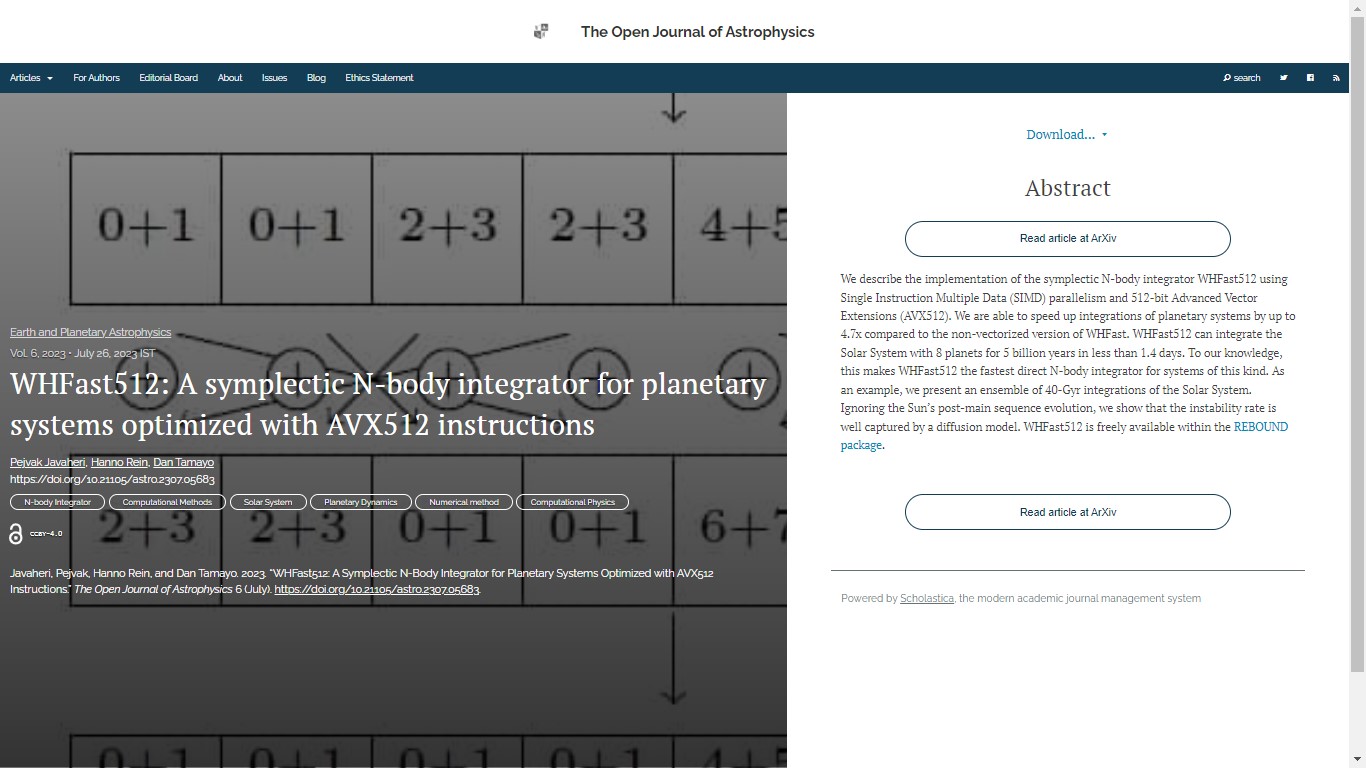
The next paper is in the Earth and Planetary Astrophysics folder. It is in fact only the second paper we have published in that area. It is entitled “WHFast512: A symplectic N-body integrator for planetary systems optimized with AVX512 instructions” by Pejvak Javaheri & Hanno Rein (University of Toronto, Canada) and Daniel Tamayo (Harvey Mudd College, USA). This paper presents a fast direct N-body integrator for gravitational systems, and demonstrates it using a 40 Gyr integration of the Solar System.

Here is the overlay:


You can find the full text for this one on the arXiv here.

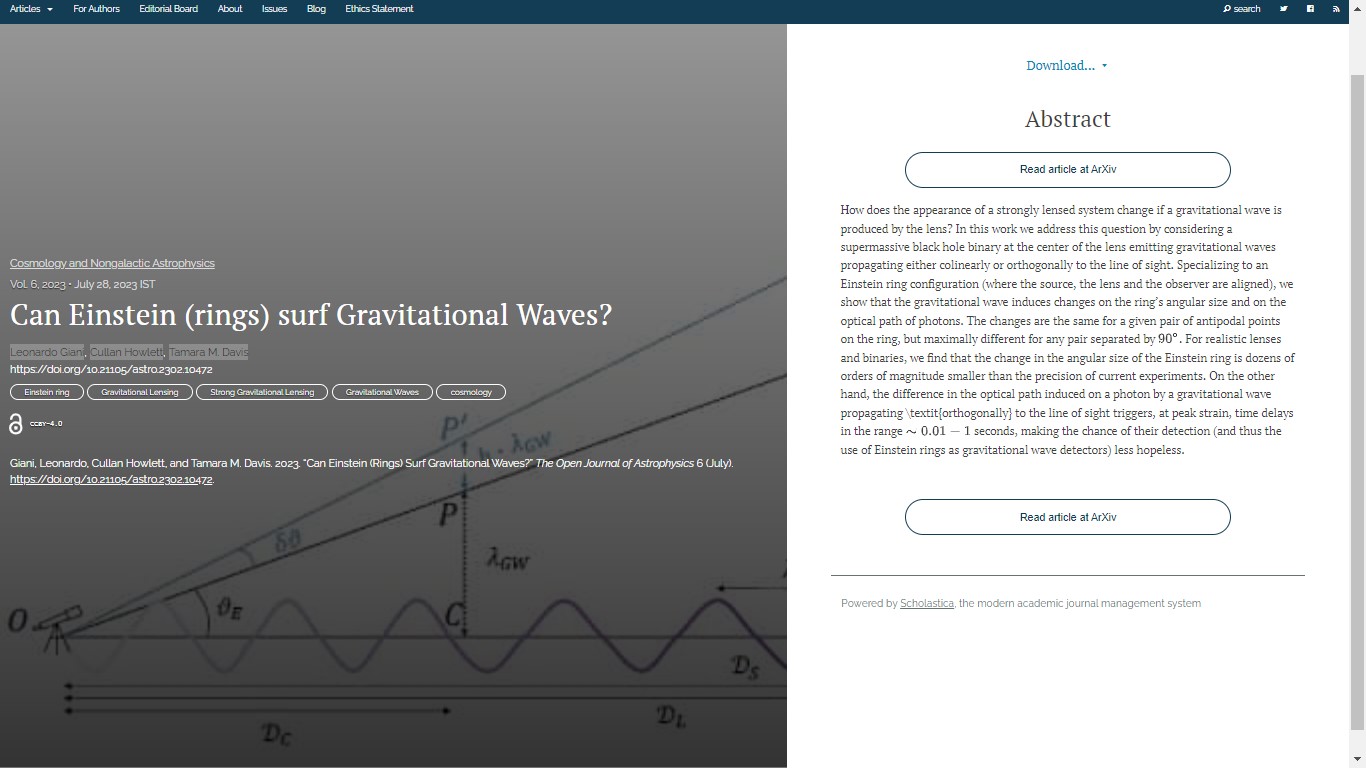
Last but by no means least, published yesterday (29th July), we have a paper that asks the question “Can Einstein (rings) surf Gravitational Waves?” by Leonardo Giani, Cullan Howlett and Tamara M. Davis of the University of Queensland, Australia. The primary classification for this one is Cosmology and Nongalactic Astrophysics and it discusses the possible effect(s) of gravitational waves on gravitational lensing observations.


You can click on the image of the overlay to make it larger should you wish to do so. You can find the officially accepted version of the paper on the arXiv here.

New Publication at the Open Journal of Astrophysics

Posted in OJAp Papers, Open Access, The Universe and Stuff with tags , , , , , , on July 22, 2023 by telescoper

Time to announce yet another new paper at the Open Journal of Astrophysics. This one was published yesterday, on 21st July 2023.

The latest paper is the 27th  so far in Volume 6 (2023) and the 92nd in all. The authors are Sohan Ghodla, Richard Easther, M.M. Briel and J.J. Eldridge, all of the University of Auckland in New Zealand.

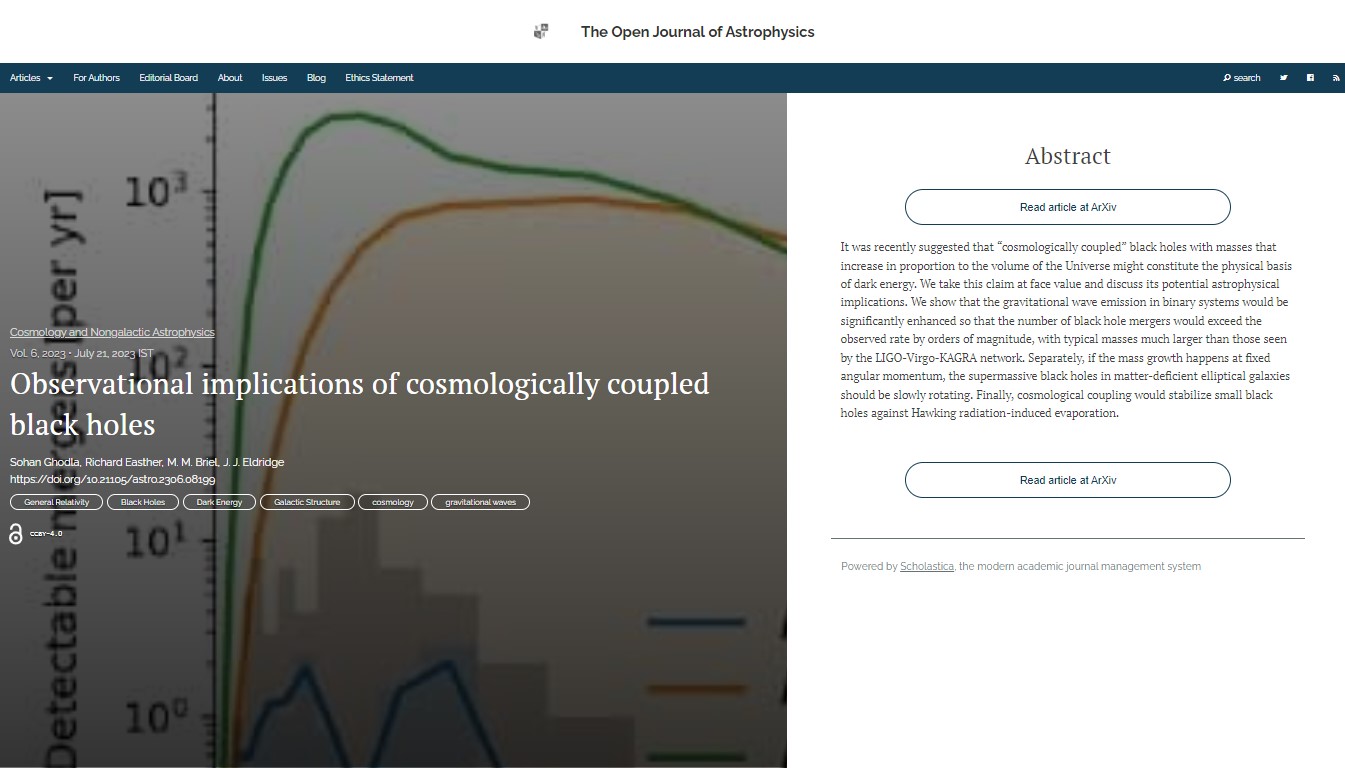
The primary classification for this paper is Cosmology and Nongalactic Astrophysics and its title is “Observational implications of cosmologically coupled black holes”.  The paper elucidates some of the consequences of a suggestion that the interaction between black holes and the global properties of space-time underlying explanation for dark energy. The key result is that the existence of cosmologically-coupled black holes implies a much larger rate of black-hole merger events than is observed.

The papers to which this is a response are mentioned here. For reference ,these earlier works were published in The Astrophysical Journal and The Astrophysical Journal Letters. There is also a detailed twitter thread about this paper by Richard Easter, posted when it was submitted as a preprint to the arXiv last month:


Anyway, here is a screen grab of the overlay of the published version which includes the  abstract:


You can click on the image of the overlay to make it larger should you wish to do so. You can find the officially accepted version of the paper on the arXiv here.

Four New Publications at the Open Journal of Astrophysics

Posted in OJAp Papers, Open Access, The Universe and Stuff with tags , , , , , , , on July 19, 2023 by telescoper

Time for an update at the Open Journal of Astrophysics. Owing to a well-deserved holiday by a member of the OJAp team, we were unable to register DOIs and associated metadata for a couple of weeks so refrained from announcing new papers during this period while other functions of the journal continued. Anyway, this week we have caught up with the backlog of four papers, which I now present to you here, all published on 17th July 2023. These four take the count in Volume 6 (2023) up to 26 and the total published by OJAp up to 91.

In no particular order, the four papers published this week, with their overlays, are as follows. You can click on the images of the overlays to make them larger should you wish to do so.

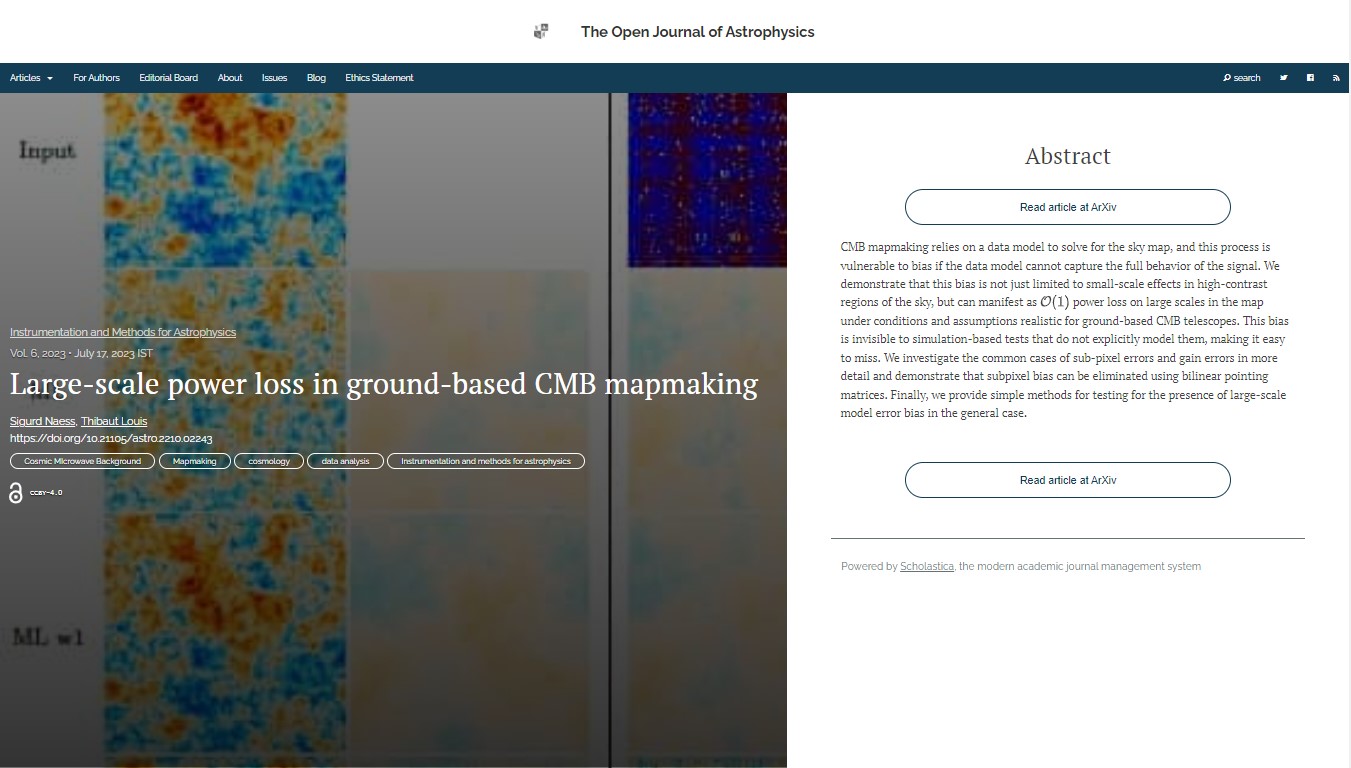
“Large-scale power loss in ground-based CMB mapmaking” by Sigurd Naess (Oslo, Norway) and Thibaut Louis (Saclay, France). This one is a discussion of the possible biases introduced by using a data model to create sky maps of CMB temperature fluctuations and is in the folder marked Instrumentation and Methods for Astrophysics.

Here is a screen grab of the overlay, which includes the abstract:


You can find the officially accepted version of the paper on the arXiv here.

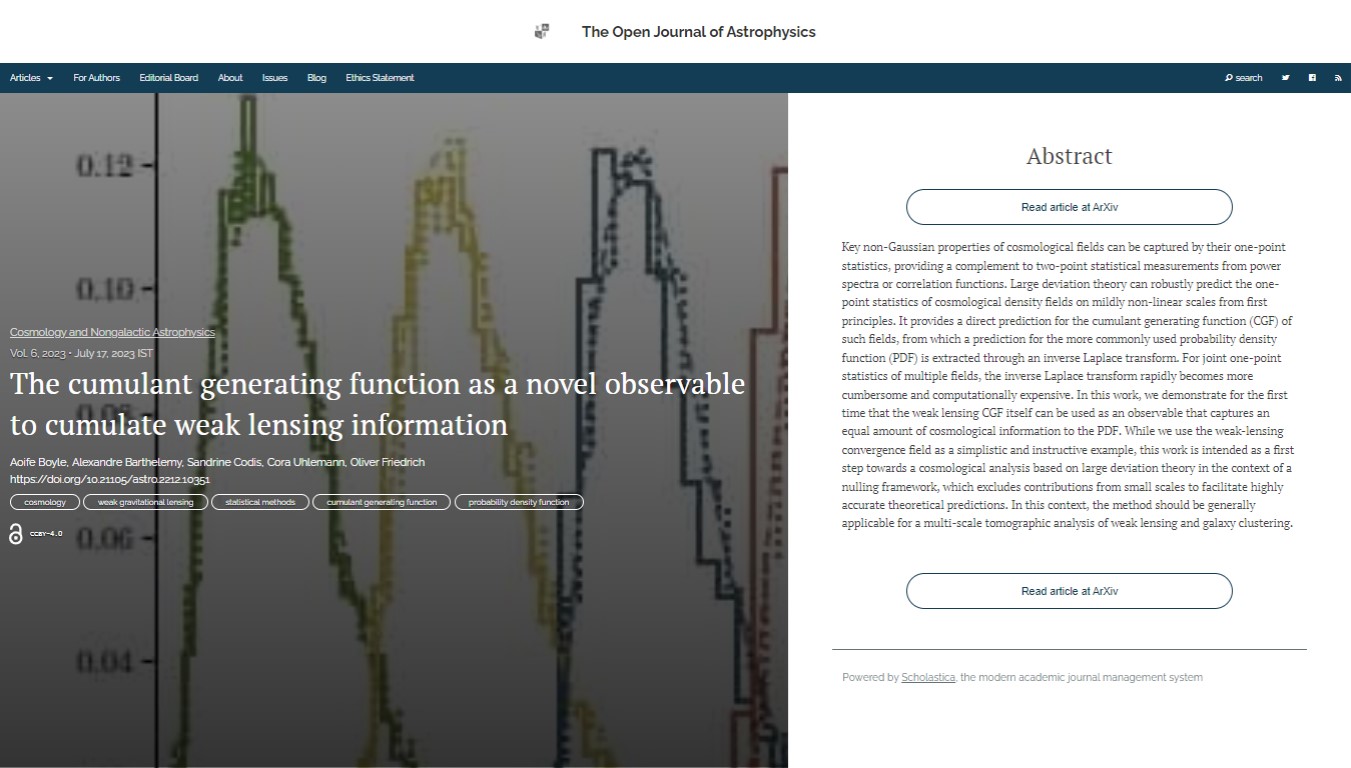
The primary classification for the next paper paper is Cosmology and Nongalactic Astrophysics and its title is “”The cumulant generating function as a novel observable to cumulate weak lensing information”. The authors are Aoife Boyle (Saclay, France), Alexandre Barthelemy (LMU, Germany), Sandrine Codis (Saclay, France), Cora Uhlemann (Newcastle, UK) & Oliver Friedrich (LMU, Germany). The paper explores the use of the cumulant generating function (CGF), from which the probability density function (PDF) can be obtained, in the context of weak gravitational lensing information.

You can click on the image of the overlay to make it larger should you wish to do so. You can find the officially accepted version of the paper on the arXiv here.

Also in the folder marked Cosmology and Nongalactic Astrophysics is the third paper “Cosmology with 6 parameters in the Stage-IV era: efficient marginalisation over nuisance parameters” by B. Hadzhiyska (Berkeley, USA), K. Wolz (Trieste, Italy), S. Azzoni (Oxford, UK; Tokyo, Japan), D. Alonso (Oxford, UK), C. García-García (Oxford, UK), J. Ruiz-Zapatero (Oxford, UK) and A. Slosar (Tokyo, Japan). This presents an efficient analytical method to speed up marginalization over nuisance parameters introduced to model systematic effects in large-scale structure data.

Here is a screen grab of the overlay which includes the abstract:


You can find the officially accepted version of the paper on the arXiv here.

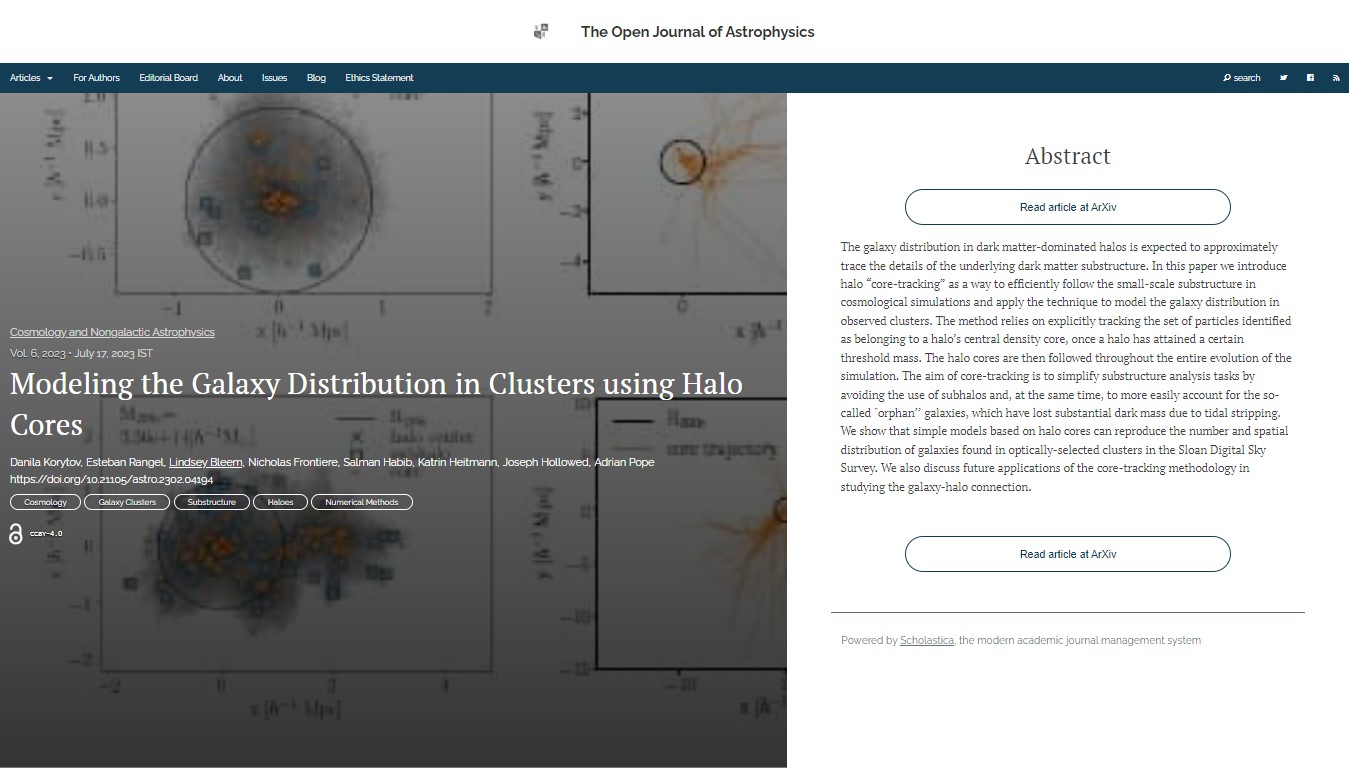
The final paper in this quartet, also in Cosmology and Nongalactic Astrophysics, is “Modeling the Galaxy Distribution in Clusters using Halo Cores” by D. Korytov, E. Rangel, L. Bleem, N. Frontiere, S. Habib, K. Heitmann, J. Hollowed, and A. Pope (all of the Argonne National Laboratory, USA). This presents a new method to speed up numerical simulations using a method of simplifying the handling of substructure in galaxy clusters using halo ‘core-tracking’.

The overlay of this one is here:


You can find the officially accepted version of the paper on the arXiv here.

New Publication at the Open Journal of Astrophysics

Posted in OJAp Papers, Open Access, The Universe and Stuff with tags , , , , on June 13, 2023 by telescoper

It’s time to announce yet another new paper at the Open Journal of Astrophysics. This one was published on Friday 9th June.

The latest paper is the 19th paper so far in Volume 6 (2023) and the 84th in all,  so with more than half of 2023 remaining and many papers still in the pipeline we’re on track to reach a total of 100 papers by the end of 2023!

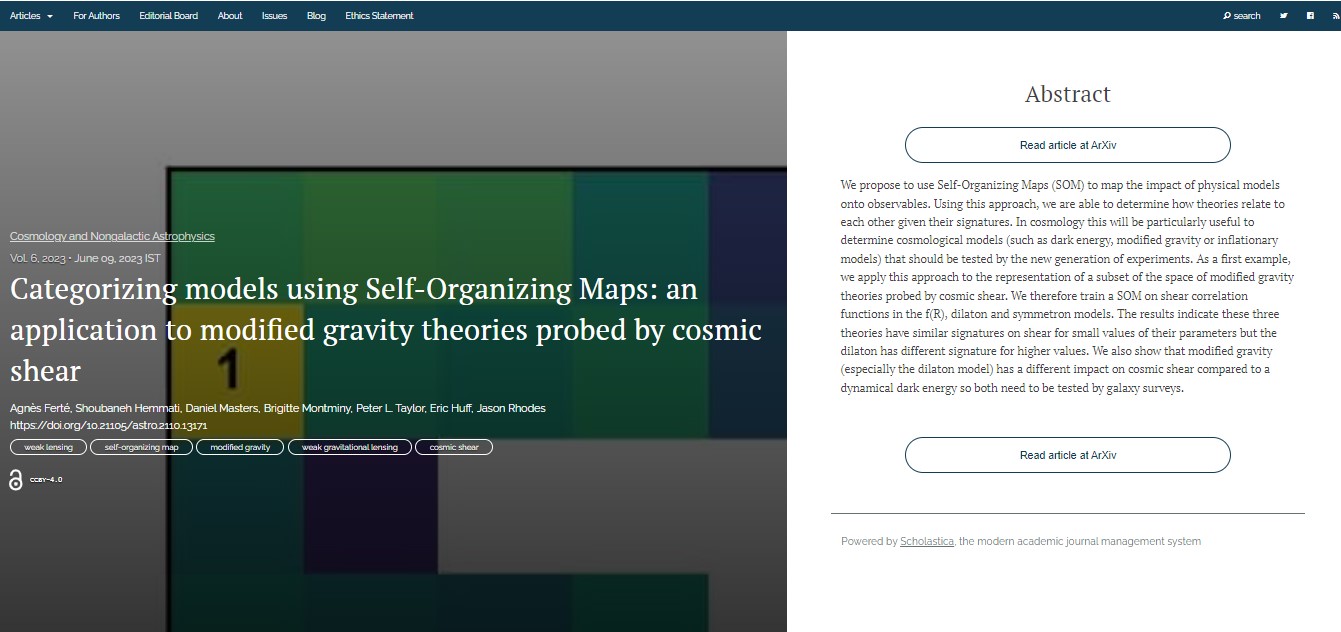
The primary classification for this paper is Cosmology and Nongalactic Astrophysics and its title is “Categorizing models using Self-Organizing Maps: an application to modified gravity theories probed by cosmic shear”. For the uninitiated, a Self-Organizing Map is a machine-learning technique that makes large-dimensional data sets easier to analyze. This paper is yet another one about weak gravitational lensing (cosmic shear), which is obviously what the cool kids do these days.

The authors are: Agnès Ferté (JPL); Shoubaneh Hemmati (IPAC); Daniel Masters (IPAC); Brigitte Montminy (JPL); Peter L. Taylor (JPL); Eric Huff (JPL);  and Jason Rhodes (JPL).

(JPL=Jet Propulsion Laboratory, IPAC= Infrared Processing & Analysis Center, both associated with California Institute of Technology, Pasadena, USA)

Here is a screen grab of the overlay which includes the  abstract:


You can click on the image of the overlay to make it larger should you wish to do so. You can find the officially accepted version of the paper on the arXiv here.

P.S. The first author tweeted about this paper:


MOND: Open to Debate

Posted in OJAp Papers, The Universe and Stuff with tags , , on June 8, 2023 by telescoper

I didn’t know until today that there is a meeting going on this week at the University of St Andrews with the title 40 Years of MOND (Modified Newtonian Dynamics). Here’s a description of the conference.

The source of the gravitational field in objects ranging from individual galaxies to the largest scales in the universe is one of the biggest unanswered questions of modern physics. It is generally assumed that the gravitational field in extragalactic systems is dominated by dark matter particles occupying a dark sector that represents new physics beyond the stubbornly successful Standard Model of particle physics. So far, candidates for these particles have evaded detection in remarkably sensitive laboratory experiments: the evidence for missing mass remains entirely astrophysical in nature.

Forty years ago, Weizmann-Institute professor Mordehai Milgrom published a series of three articles in The Astrophysical Journal in which he proposed that the dark matter phenomenon is not due to unknown particles, but to a departure from the known laws of dynamics when the acceleration is about eleven orders of magnitude smaller than that on Earth’s surface (Milgrom 1983). Only one year later, in 1984, Jacob Bekenstein and Mordehai Milgrom developed this Modified Newtonian Dynamics (or Milgromian Dynamics, MOND) into a non-relativistic Lagrangian theory (Bekenstein & Milgrom 1984). During the ensuing decades, MOND has developed into a multifaceted paradigm that includes several non-relativistic and relativistic theory proposals, as well as possible connections with quantum gravity theories. Most remarkably, MOND has successfully made many striking and unique a priori predictions.

This conference will commemorate the last 40 years of this modern gravitational paradigm, of its predictive successes as well as its outstanding challenges, and will look to the road ahead.

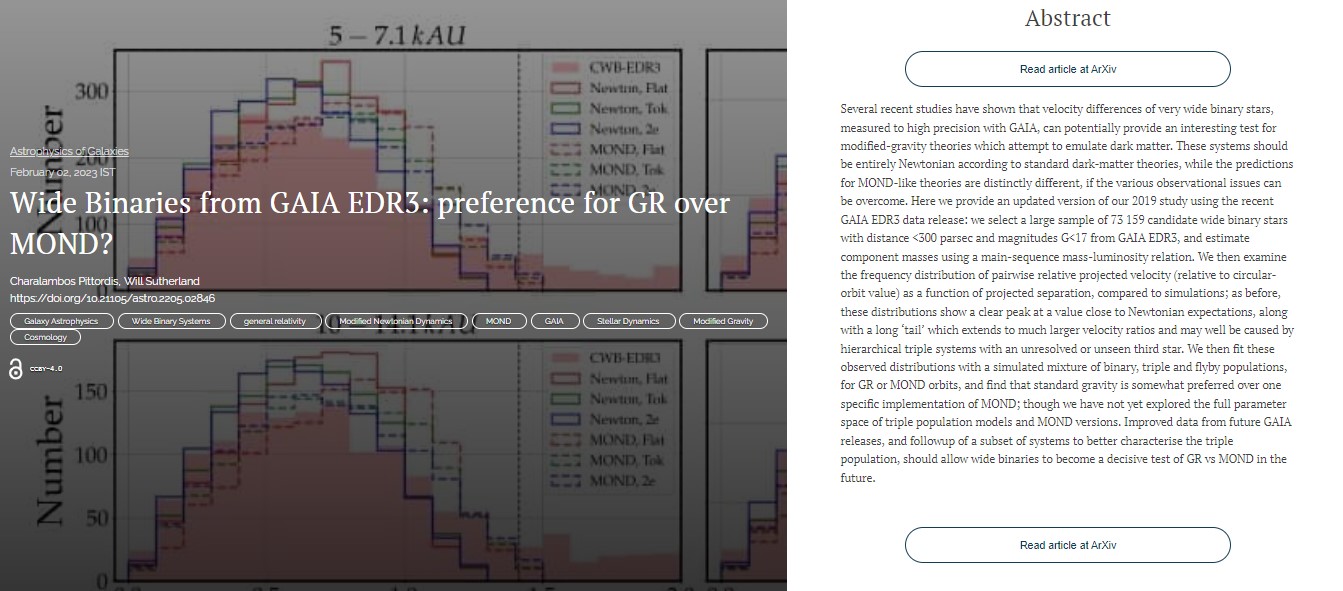
It looks like an interesting meeting but what caught my eye in particular about it was this pic I found on Twitter today taken at the start of one of the talks:

The work presented apparently has been the focus of quite a lot of debate and several follow-up studies. I just thought I’d mention that it was published earlier this year in the Open Journal of Astrophysics:

It’s good to see work appearing in one of our publications attracting attention at an international conference!

Two New Publications at the Open Journal of Astrophysics

Posted in OJAp Papers, The Universe and Stuff with tags , , , , , , , , on March 26, 2023 by telescoper

I just realized that I forgot to advertise on here a couple of recent publications at the Open Journal of Astrophysics – the papers are coming in at quite a rate now – so I’ll catch up with them both in one post.

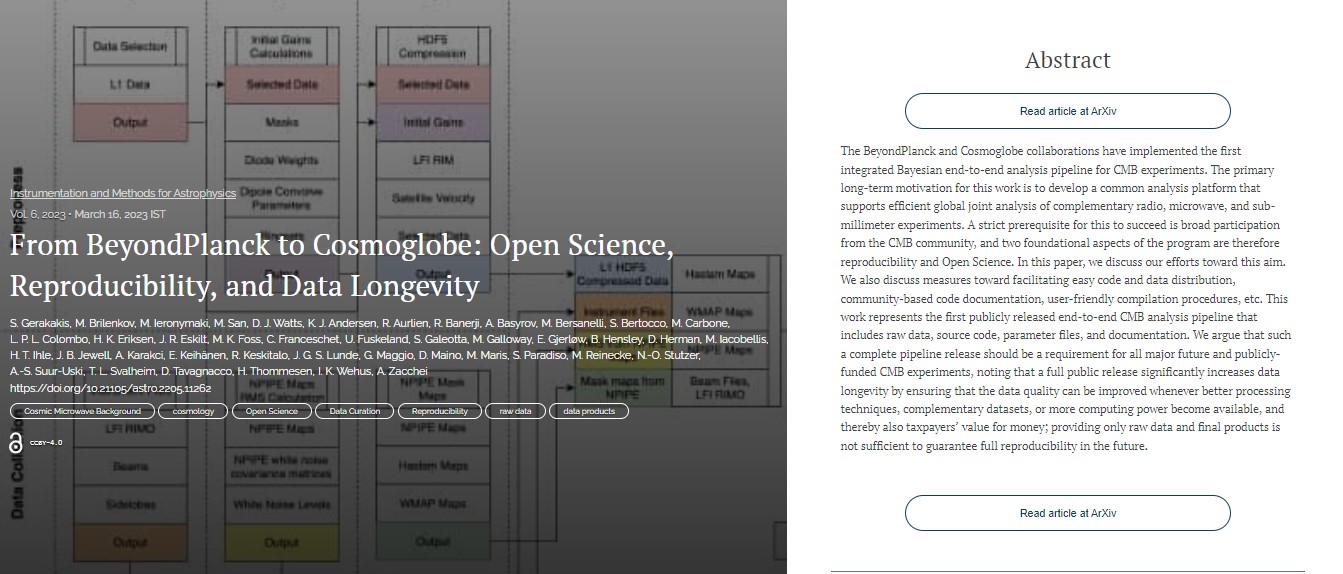
The first paper of the two is the 10th paper in Volume 6 (2023) and the 75th in all; it was published on 16th March 2023. This one is  in the folder marked Instrumentation and Methods for Astrophysics. The title is “From BeyondPlanck to Cosmoglobe: Open Science, Reproducibility, and Data Longevity” and it is a discussion of the importance of reproducibility and Open Science in CMB science including measures toward facilitating easy code and data distribution, community-based code documentation, user-friendly compilation procedures, etc.  You can find out more about the BeyondPlanck collaboration here and about Cosmoglobe here.

The first author is S. Gerakakis and there are 42 authors in all. This is too many to list individually here but they come from Greece, Norway, Finland, Germany, Italy, and the USA.

Here is a screen grab of the overlay which includes the  abstract:

You can click on the image of the overlay to make it larger should you wish to do so. You can find the officially accepted version of the paper on the arXiv here.

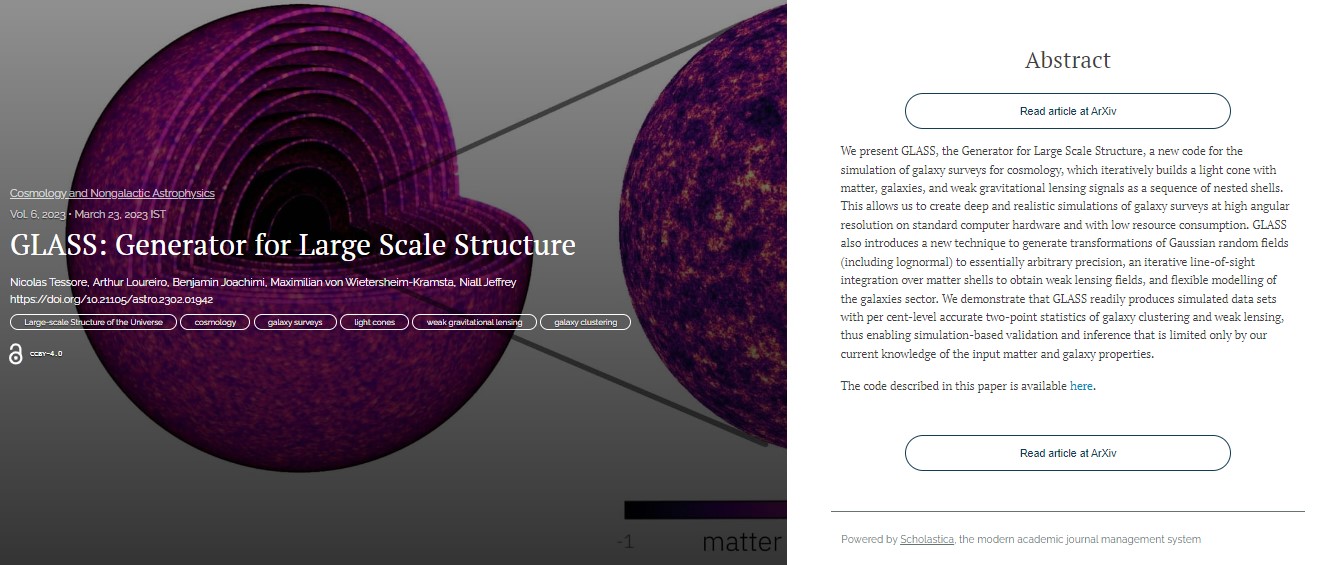
The second paper is the 11th paper in Volume 6 (2023) as well as the 76th in all; this one was published last Thursday (23rd March). This is another for the folder marked Cosmology and Nongalactic Astrophysics. The title is “GLASS: Generator for Large Scale Structure” and the paper is about a new code for the simulation of cosmological observables obtainable from galaxy surveys in a realistic yet computationally inexpensive manner. The code can be downloaded here. This is an interesting approach that contrasts with the “brute force” of full numerical simulations like those I discussed a few days ago.

The authors are Nicolas Tessore (University College London), Arthur Loureiro (UCL, Edinburgh and Imperial College), Benjamin Joachimi (UCL), Maximilian von Wiestersheim-Kramsta (UCL) and Niall Jeffrey (UCL).

Here is a screen grab of the overlay which includes the  abstract:


You can click on the image of the overlay to make it larger should you wish to do so. You can find the officially accepted version of the paper on the arXiv here.