Archive for Open Journal of Astrophysics

The Future of Diamond Open Access in Astrophysics

Posted in Biographical, Open Access with tags , , , , , , on November 17, 2024 by telescoper

The Open Journal of Astrophysics is now reasonably well established as a Diamond Open Access journal for the astrophysics community. We have published over a hundred articles so far this year at such a low cost that we can make our publications free to read and to publish. Thanks for all this is due to the volunteers on our Editorial Board, the excellent team at Maynooth University library, who have supported this project for 6 years, to the arXiv, as well of course to the authors who have chosen to publish with us.

Although we have established a good base, we’re still much smaller than the mainstream journals publishing just a few percent of their output. There is no sign of a slowdown at OJAp. Indeed there are signs that pace will pick up. I heard last week, for example, that Oxford University Press (the publisher of Monthly Notices of the Royal Astronomical Society) has decided to cancel the ‘Read-and-Publish’ agreement that allowed authors from Australian institutions to avoid APCs. I imagine we’ll get quite a few more submissions from Down Under thanks to that decision.

Nevertheless, we’ve a long way to go to catch up with the likes of A&A, MNRAS and ApJ in terms of numbers. If activity continues to grow then we will incur greater costs – our provider, Scholastica, charges us per paper. Those costs will still be smaller than regular journals, but I think it’s unfair that the expense of running a journal that serves the global astrophysics community should fall entirely on one small University in Ireland.

Expense is only one issue. I never envisaged that OJAp would be unique. It was more intended to be a proof of concept. I would like to see a range of Diamond Open Access journals offering a choice for authors and serving different sub-disciplines. Most universities nowadays have publishing operations so there could be network of federated journals, some based on arXiv and some based on other repositories. Perhaps institutions are worried about the expense but, as we have shown the actual cost, is far less than they are wasting on Article Processing Charges. I rather think it’s not the money that is the issue, just the unimaginatively risk-averse thinking in what passes these days for university management.

There are two simple – but not mutually exclusive – possibilities.

One is that astrophysics institutions club together and donate funds not only to keep OJAp going, but also to allow us to invest in improvements. A donation equivalent to the cost of just one APC for a typical journal would help us enormously. We do actually get some donations already, but more would always be welcome. In the long run, an investment in Diamond Open Access would pay back many times in savings; OJAp has already saved the worldwide community over £500,000.

The other is that other members of the community follow the lead of OJAp and set up their own journals. I wouldn’t see others as much as competitors, more as allies with community-led federated system. In the light of the OUP decision mentioned above, why don’t Australian research institutions set up their own version of OJAp? I’d be happy to discuss how to start up such a journal with anyone interested.

If you would like to discuss either of these possibilities please use the comment box below or email me here.

P.S. There is another issue concerning the future of OJAp, which is that I will be retiring in a few years, but now isn’t the time to discuss that one!

Two New Publications at the Open Journal of Astrophysics

Posted in OJAp Papers, Open Access, The Universe and Stuff with tags , , , , , , , , on November 16, 2024 by telescoper

Once again it’s time for a Saturday morning update on activity at the  Open Journal of Astrophysics.  Since the last update we have published two more papers, taking  the count in Volume 7 (2024) up to 104 and the total published by OJAp up to 219.

The first paper of the most recent pair, published on November 13 2024,  in the folder Cosmology and NonGalactic Astrophysics, is “Stochastic Super-resolution of Cosmological Simulations with Denoising Diffusion Models” by Andreas Schanz, Florian List and Oliver Hahn (all based in the University of Vienna, Austria). It presents a  discussion of denoising diffusion in generative models for achieving super-resolution in simulations of cosmic large-scale structure.

Here is a screen grab of the overlay which includes the abstract:


You can click on the image of the overlay to make it larger should you wish to do so.  You can find the officially accepted version of this paper on the arXiv here.

The second paper to be published this week is also in the folder marked Cosmology and NonGalactic Astrophysics. It was published on November 14 and has the title “Halo mass functions at high redshift” by Hannah O’Brennan, John A. Regan, Chris Power (*), Saoirse Ward, John Brennan, and Joe McCaffrey. Five of the six authors are colleagues of mine from the National University of Ireland, Maynooth; Chris Power (marked with a *) is from the University of Western Australia.

Here is a screen grab of the overlay which includes the abstract:


You can click on the image of the overlay to make it larger should you wish to do so. You can find the officially accepted version of the paper on the arXiv here.

That concludes this week’s update. More  next week!

Failures of Scopus

Posted in Maynooth, Open Access with tags , , , , , on October 14, 2024 by telescoper

I think it’s time to provide an update on the continuing (lack of) progress getting The Open Journal of Astrophysics properly indexed in Scopus (which markets itself as a purveyor of “metrics you can trust”). You might recall back in June that I reported that OJAp had been included in the index, but unfortunately the Scopus team messed up very badly by omitting about one-third of our papers and most of our citations. I reported a month ago that Scopus had committed to fixing the issue within two weeks. Now almost FIVE WEEKS later they haven’t done a thing.

Here’s the problem:

In the column marked Documents 2020-23  you will see the number 67. In fact we published 99 articles between 2020 and 2023, not 67. This is easily established here. The number 67 relates to the period 2022-23 only. Accidentally or deliberately, Scopus has omitted a third of our papers from its database. But the error doesn’t end there. Papers published in OJAp between 2020 and 2023 have actually been cited 959 times, not 137. If you restrict the count to papers published in 2022-23 there are 526 citations. It’s no wonder that OJAp has such a low CiteScore, and consequently appears so far down the rankings, when the citation information is so woefully inaccurate.

“Metrics you can trust?” My arse!

If you want accurate bibliometric information about the papers published in the two years that Scopus has chosen to ignore you can look here.

This all merely demonstrates the folly that so many institutions place so much trust in Scopus. Unfortunately the powers that be have decided that Scopus listing is such a reliable indicator of quality that any article not published in a Scopus journal is worthless. Knowing that it has a monopoly, Scopus has no incentive to put any effort into its own quality assurance. It can peddle any error-ridden tripe to its subscribers, most of them paying for the product with taxpayers’ money. Unfortunately the bean-counters at Maynooth University are as credulous as any, mindlessly parroting spurious announcements based on the Scopus database.

Maynooth University is proud to offer undergraduates a course in Critical Skills. I suggest it that the gullible members of its management team would do well to take it.

Six New Publications at the Open Journal of Astrophysics

Posted in OJAp Papers, Open Access, The Universe and Stuff with tags , , , , , , , , , , , , , , , , , , , , , , , , , on October 12, 2024 by telescoper

Regular readers of this blog (both of them) will have noticed that I didn’t post an update of activity at the Open Journal of Astrophysics last weekend. Despite having accepted several papers for publication in the preceding week, no final versions had made it onto the arXiv. We can’t published a paper until the authors post the final version, so that meant a bit of a backlog developed. This week included one day with no arXiv update (owing to a US holiday on Tuesday 8th October) and a major glitch on Crossref on Thursday which delayed a couple, but even so we’ve published six papers which is the most we’ve ever managed in a week. This week saw the publication of our 200th article; the total as of today is 202.  The count in Volume 7 (2024) is now up to 87; we have four papers in the queue for publication so we should pass 90 next week if all goes well.

In chronological order, the six papers published this week, with their overlays, are as follows. You can click on the images of the overlays to make them larger should you wish to do so.

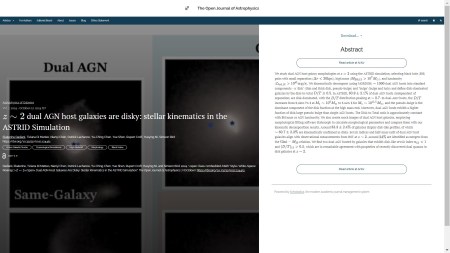
First one up, published on Monday 7th October 2024 is “z~2 dual AGN host galaxies are disky: stellar kinematics in the ASTRID Simulation” by Ekaterina Dadiani (CMU; Carnegie Mellon U.) Tiziana di Matteo (CMU), Nianyi Chen (CMU), Patrick Lachance (CMU), Yue Shen (U. Illinois at Urbana-Champaign), Yu-Ching Chen (Johns Hopkins U.), Rupert Croft (CMU), Yueying Ni (CfA Harvard) and Simeon Bird (U. California Riverside) – all based in the USA. The paper, which is in the folder marked Astrophysics of Galaxies describes a numerical study of the morphology of AGN host galaxies containing close pairs of black holes.

Here is a screen grab of the overlay, which includes the abstract:
 

You can find the officially accepted version of the paper on the arXiv here.

The second paper to announce, published on 8th October 2024, is “Origin of LAMOST J1010+2358 Revisited” by S.K. Jeena and Projjwal Banerjee of the Indian Institute of Technology Palakkad, Kerala, India. This paper discusses  the possible formation mechanisms for Very Metal Poor (VMP) stars and the implications for the origin of LAMOST J1010+2358 and is in the folder marked Solar and Stellar Astrophysics.

You can see the overlay here:

The accepted version of this paper can be found on the arXiv here.

The third paper is very different in both style and content: “Assessing your Observatory’s Impact: Best Practices in Establishing and Maintaining Observatory Bibliographies” by Raffaele D’Abrusco (Harvard CfA and 14 others; the Observatory Bibliographers Collaboration) and is in the folder marked Instrumentation and Methods for Astrophysics. It presents discussion of the methods used by astronomical observatories to construct and analyze bibliographic databases. The overlay is here:

(This one gave me a rare opportunity to use the library of stock images that comes with the Scholastica platform!) The officially accepted version can be found on arXiv here.

The fourth paper, also published on 8th October 2024, and our 200th publication, is in the folder marked Cosmology and NonGalactic Astrophysics, and is called “CombineHarvesterFlow: Joint Probe Analysis Made Easy with Normalizing Flows“. The authors are Peter L. Taylor, Andrei Cuceu, Chun-Hao To, and Erik A. Zaborowski of Ohio State University, USA. The article presents a new method that speeds up the sampling of joint posterior distributions in the context of inference using combinations of data sets. The overlay is here

You can find the officially accepted version of this paper here.

The fifth paper in this batch is “Estimating Exoplanet Mass using Machine Learning on Incomplete Datasets” by Florian Lalande (Okinawa Institute of Science and Technology), Elizabeth Tasker (Institute of Space and Astronautical Science, Kanagawa) and Kenji Doya (Okinawa); all based in Japan. This one was published on 10th October 2024 in the folder marked Earth and Planetary Astrophysics. It compares different methods for inferring exoplanet masses in catalogues with missing data


You can find the official accepted version on the arXiv here.

Finally for this week we have “Forecasting the accuracy of velocity-field reconstruction” by Chris Blake and Ryan Turner of Swinburne University of Technology, Melbourne, Australia. This was also published on 10th October 2024 and is in the folder marked Cosmology and NonGalactic Astrophysics. The paper describes a numerical study of the reliability and precision of different methods of velocity-density reconstruction. The overlay is here

You can find the officially-accepted version on arXiv here.

That’s it for now. We have published six papers, with a very wide geographical spread of authors, and in five of the six astro-ph categories we cover. I think it’s been a good week!

Predicting the Future of Publishing from the Past

Posted in Open Access, The Universe and Stuff with tags , , , , on October 11, 2024 by telescoper

I was intrigued by an editorial piece from 20 years ago that was sent to me by Prof. Peter Schneider (who, among many other things, is Chair of the Euclid Consortium Editorial Board) who happens to be one of the authors. The article gives an interesting insight into the processes involved in being an Editor for the journal Astronomy and Astrophysics (A&A) at the time, and is worth reading all the way through, but I was particularly struck by Section 6.2, which makes some predictions about the future.

Here’s an excerpt:

We can even go a step further and ask the provocative question of whether we will need a peer-reviewed journal like A&A in the future. After all, in some communities, astro-ph has taken over the role of communicating new results. Is astro-ph not sufficient? A few aspects of a potentially very long answer to that question are as follows: many authors submit their manuscript to astro-ph, but only after it has been peer-reviewed, which shows that most researchers consider the peer-reviewing essential. People’s achievements are often judged by their refereed papers. Certainly at present, peer-reviewing is seen as a kind of quality stamp on manuscripts, and we are here to witness that papers are improved in the course of the refereeing process.


But what if astro-ph is supplemented by a refereeing process, essentially in the same way as the major journals do today, so that a manuscript gets a “green tick-mark” after successfully passing the reviewing stage and being “frozen”, i.e., cannot be replaced with an updated version anymore. We suspect that this is possible, although it would require a fairly large board of Editors to cope with the numbers of submissions to astro-ph, accompanied by costs that would have to be covered by someone. If this system were to replace the current journals, then one would end up with a single electronic-only astronomy journal and preprint service system. What if a paper is not passing through the refereeing stage? At present, a paper rejected by one journal can still be submitted to a second one, thus getting another chance to be published. We consider this second-chance opportunity a necessary feature for a fair peer-reviewed information flow. Hence, we would need more than one “astro-ph”-like system with different boards of editors, and this brings us back closely to a system of several electronic-only journals.

This is basically the idea behind the Open Journal of Astrophysics, which I didn’t really start thinking about until about 2010. In fact, when we were talking about setting up OJAp – about a decade after this paper was written – we did discuss the possibility of just having a “green tick-mark” on the arXiv entry. We rejected this idea in favour of the overlay concept primarily because of security concerns about who writes the tick mark into the arXiv field. I do agree with the point about having multiple platforms for such publications, however, and I have frequently argued that there should be alternatives to OJAp.

Here is another extract, from the very end of the paper:

We have taken here the role of devil’s advocate to demonstrate that issues in going electronic-only are far from being as simple and clear-cut as some open-access gurus would like us to believe. Obviously, electronic publishing is a timely and controversial issue that we will continue to consider in the coming years. The future of publication will be decided less by Boards of Directors and Editors, or by publishers, than by the community at large. With the availability of electronic-only journals, authors make their own decision on where to submit a manuscript. At present, this vote is clearly in favor of traditional journals, but as that may change we will remain open and ready to adapt.

I would hesitate to call myself a “guru” but I do think that the issues are clearer now than perhaps they were in 2004. Twenty years on, the balance is still in favour of traditional journals at least in terms of numbers of papers being published. Judging by the activity at OJAp, it may be that things may be changing…

The 200th Publication at the Open Journal of Astrophysics

Posted in OJAp Papers, Open Access, The Universe and Stuff with tags , , on October 8, 2024 by telescoper

It was on September 11th last year that we published the 100th paper at the Open Journal of Astrophysics. Today, on 8th October 2024, just over a year later we have reached the 200 mark with this paper:

In fact this looks like being a record-breaking week for OJAp as we have published four papers already and its only Tuesday. To be fair, most of these were accepted last week but were slow appearing on the arXiv – I think partly due to glitches on arXiv – but still it’s nice to be this active. I’ll do a regular post at the weekend with details of how many we published in total by then. I’m very confident that we will reach 100 for the calendar year.

Four New Publications at the Open Journal of Astrophysics

Posted in OJAp Papers, Open Access, The Universe and Stuff with tags , , , , , , , , , , , , on September 29, 2024 by telescoper

A day later than has been usual for such things, it’s now time for a quick update of activity at the Open Journal of Astrophysics. This week we have published another batch of four papers which takes the count in Volume 7 (2024) up to 81 and the total published altogether by OJAp up to 196. I think there may come a week in we publish papers on every day of that week, but it was not this week…

In chronological order, the four papers published this week, with their overlays, are as follows. You can click on the images of the overlays to make them larger should you wish to do so.

First one up is “Finding the unusual red giant remnants of cataclysmic variable mergers” by Nicholas Z. Rui and Jim Fuller of California Institute of Technology (Caltech), USA. It presents a discussion of the possible photometric, astroseismological, and surface abundance signatures of red giants formed by mergers of cataclysmic variable stars. It was published on 23rd September 2024 and is in the folder marked Solar and Stellar Astrophysics.

Here is a screen grab of the overlay, which includes the abstract:


You can find the officially accepted version of the paper on the arXiv here.

The second paper to announce, also published on 23rd September 2024, is “Notes on the Practical Application of Nested Sampling: MultiNest, (Non)convergence, and Rectification” by Alexander Dittmann (U. Maryland, USA). A critical analysis of the MultiNest algorithm together with suggestions for approving its applicability. It is in the folder Instrumentation and Methods for Astrophysics.

You can see the overlay here:


The accepted version of this paper can be found on the arXiv here.

The third paper, published on 24th September 2024 in the folder marked High-Energy Astrophysical Phenomena, is called  “Merger Precursor: Year-long Transients Preceding Mergers of Low-mass Stripped Stars with Compact Objects” and is by Daichi Tsuna, Samantha Wu & Jim Fuller (Caltech), Yize Dong (UCLA) and Anthony Piro (Carnegie Observatories), all based in the USA.

Here is the overlay


The final version accepted on arXiv is here.

Last in this batch is “Spectroscopic Observations of the GALEX Nearby Young Star Survey Sample. I. Nearby Moving Group Candidates” by Navya Nagananda (Rochester, NY, USA), Laura Vican (UCLA), Ben Zuckerman (UCLA), David Rodriguez (STScI), Alexander Binks (Tübingen, Germany) & Joel Kastner (Rochester). It describes investigations of the spectra of the GALNYSS sample of over 2000 young stars and the assignment of these stars into moving groups. It is is in the folder marked Solar and Stellar Astrophysics, and was published on 25th September 2024 with this overlay:


You can find the official accepted version on the arXiv here.

That’s all for now. I will post another update in a week.

Four New Publications at the Open Journal of Astrophysics

Posted in OJAp Papers, Open Access, The Universe and Stuff with tags , , , , , , , , , , , , , , , , , , , on September 14, 2024 by telescoper

Once again, it’s time for a quick update of activity at the Open Journal of Astrophysics. This week we have published another batch of four papers which takes the count in Volume 7 (2024) up to 77 and the total published altogether by OJAp up to 192. Things are picking up again after the summer lull, and we’re moving towards a double century. If we keep up a steady average of four per week we’ll be at 200 per year.

In chronological order, the four papers published this week, with their overlays, are as follows. You can click on the images of the overlays to make them larger should you wish to do so.

First one up is “Quasi-two-dimensionality of three-dimensional, magnetically dominated, decaying turbulence” by Shreya Dwivedi, Chandranathan Anandavijayan, and Pallavi Bhat of TIFR, Bangalore, India. The paper presents an analysis of numerical simulations of MHD turbulence using Minkowski Functionals, with implications for local anisotropies revealed therein. It was published on 9th September 2024 and is in the folder marked High-Energy Astrophysical Phenomena.

Here is a screen grab of the overlay, which includes the abstract:


You can find the officially accepted version of the paper on the arXiv here.

The second paper to announce, also published on 9th September 2024, is “mochi_class: Modelling Optimisation to Compute Horndeski In class” by  Matteo Cataneo (Universität Bonn, Germany) and Emilio Bellini (SISSA, Trieste, Italy). This article presents a cosmological Einstein-Boltzmann solver adapted to work with Horndeski gravity, together with validation tests. It is in the folder Cosmology and NonGalactic Astrophysics.

You can see the overlay here:


The accepted version of this paper can be found on the arXiv here.

The third paper, published on 11th September 2024 in the folder marked High-Energy Astrophysical Phenomena, is by Jonathan Katz of Washington University, St Louis, USA. The title is “The Sources of Fast Radio Bursts” and it presents a discussion of the possible physical origin of Fast Radio Bursts, arguing that they fall into two distinct groups.


The final version accepted on arXiv is here.

Last in this batch, but by no means least, is “RMS asymmetry: a robust metric of galaxy shapes in images with varied depth and resolution” by Elizaveta Sazonova (U. Waterloo, Canada) with 15 other authors spread around the world (in Canada, USA, Australia, Italy, Chile, UK, Poland, Mexico, Germany, and Spain). This paper presents a method of quantifying distortion of galaxy images connected with mergers or other instabilities. It is in the folder marked Astrophysics of Galaxies and was published on September 12th 2024 with this overlay:


You can find the official accepted version on the arXiv here.

That’s all for now. I will post another update in a week.

Two New Publications at the Open Journal of Astrophysics

Posted in OJAp Papers, Open Access, The Universe and Stuff with tags , , , , , , , , , on September 7, 2024 by telescoper

It’s Saturday morning again so here’s another report on activity at the  Open Journal of Astrophysics.  Since the last update we have published two more papers, taking  the count in Volume 7 (2024) up to 73 and the total published by OJAp up to 188.  We’ve still got a few in the pipeline waiting for the final versions to appear on arXiv so I expect we’ll reach the 200 mark fairly soon.

The first paper of the most recent pair, published on September 4th 2024,  and in the folder marked Astrophysics of Galaxies, is “Massive Black Hole Seeds”  by John Regan of the Department of Theoretical Physics at Maynooth University and Marta Volonteri (Sorbonne Université, Paris, France). This article presents a discussion of the pathways to the formation of massive black holes, including both light and heavy initial seeds.

Here is a screen grab of the overlay which includes the abstract:


You can click on the image of the overlay to make it larger should you wish to do so. Those of you who are paying attention will see that there is a bit of a glitch on the left hand side where software has thrown a line break in between the two author names. I have no idea what caused this so I raised a ticket with Scholastica and no doubt it will soon be fixed.  (Update: it is now fixed, 12th September 2024). You can find the officially accepted version of this paper on the arXiv here.

The second paper has the title “The future of cosmological likelihood-based inference: accelerated high-dimensional parameter estimation and model comparison” and was published on 5th September 2024. The authors are Davide Piras (Université de Genève), Alicja Polanska (MSSL) , Alessio Spurio Mancini (Royal Holloway, London), Matthew A. Price(UCL) & Jason D. McEwen (UCL); the latter four are all based in the UK. This paper, which is in  the folder marked Cosmology and NonGalactic Astrophysics, describes an accelerated approach to Bayesian inference in higher-dimensional settings, as required for cosmology, based on recent developments in machine learning and its underlying technology.

Here is a screen grab of the overlay which includes the abstract:


You can click on the image of the overlay to make it larger should you wish to do so. You can find the officially accepted version of the paper on the arXiv here.

That concludes this week’s update. More  next week!

The Editorial Board of the Open Journal of Astrophysics

Posted in Open Access, The Universe and Stuff with tags , , on September 6, 2024 by telescoper

A couple of months ago, I issued a call for new Editors of the Open Journal of Astrophysics. That was very successful and we added a number of new Editors. The complete list (of 20 members) follows:

Peter Coles* (Department of Theoretical Physics, Maynooth University, Ireland). Cosmology, astrophysics, statistics and methodology.

Thierry Appourchaux (CNRS, Institut d’Astrophysique Spatiale, Orsay, France). Space instrumentation, astroseismology, helioseismology, statistics and methodology.

Emory (Ted) Bunn (Department of Physics, University of Richmond, USA). Relativity, cosmology.

Walter Dehnen (Astronomisches Rechen-Institut, University of Heidelberg, Germany). Stellar dynamics, galaxy dynamics, galaxies, bars, Milky-Way dynamics, Gaia, numerical methods, N-body techniques, smooth particle hydrodynamics (SPH).

Philipp Edelmann (Los Alamos National Laboratory, New Mexico, USA). Stellar astrophysics, hydrodynamics, high-performance computing, supernovae, internal waves, stellar evolution, numerical methods.

Pedro Ferreira (Department of Physics, University of Oxford, UK). Large-scale structure, general relativity, cosmic microwave background, early universe, cosmology.

Andrew Jaffe (Department of Physics, Imperial College, London, UK). Astrophysics, statistics and methodology, cosmology.

Harley Katz (Department of Astronomy and Astrophysics, University of Chicago, USA). Galaxy formation and evolution, numerical simulations

Lucyna Kedziora-Chudczer (School of Physics, University of New South Wales, Sydney, Australia). Active galactic nuclei, polarimetry, atmospheres of planets, exoplanets, solar system planets.

Julien Larena (Laboratoire Univers et Particules de Montpellier, Université de Montpellier, France). Cosmology, gravitation, lensing, large-scale structure, general relativity.

Manuela Magliocchetti (National Institute of Astrophysics, Rome, Italy). Cosmology, galaxies, active galactic nuclei (AGN).

Sean McGee (Department of Physics & Astronomy, University of Birmingham, UK). Galaxy formation, galaxy clusters, galaxy surveys.

Manolis Plionis (Department of Physics, Aristotle University of Thessaloniki, Greece). Observational cosmology, extragalactic astrophysics, large-scale structure, active galactic nuclei.

Alkistis Pourtsidou (Higgs Centre & Institute for Astronomy, Edinburgh, UK). Cosmology, large-scale structure of the Universe, radio astronomy, galaxy surveys.

Justin Read (School of Mathematics and Physics, University of Surrey, UK). Dark matter, cosmology, galaxy formation and evolution, dwarf galaxies, milky way, galactic dynamics, galactic archaeology, computational modeling.

Hanno Rein (Department of Physics and Environmental Sciences, University of Toronto at Scarborough, Canada). Numerical methods, in particular N-body codes and integration methods for planetary systems, planet formation, stochastic processes, planet migration, celestial mechanics, and Saturn’s rings.

Aleks Scholz (School of Physics & Astronomy, University of St Andrews, UK). Exoplanets, brown dwarfs, protoplanetary disks, stellar evolution, star formation.

Elena Sellentin (Sterrewacht Leiden, Leiden University, The Netherlands). Applied Mathematics, Cosmology, Statistics, Statistical Inference.

Elena Terlevich (Instituto Nacional de Astrofísica, Óptica y Electrónica, Puebla, Mexico). Stellar populations in galaxies, observational cosmology, violent star formation, element abundances, dynamics of stellar systems.

Bingbing Wang (Center for Space Plasma and Aeronomic Research, University of Alabama in Huntsville, USA.) Particle astrophysics, MHD turbulence, cosmic rays acceleration, cosmic ray propagation in the Galaxy and heliosphere.

Apologies to anyone who volunteered but has not yet received a reply from me. I’ve been a bit preoccupied these last weeks! The call is still open, though. Here are the areas of arXiv covered by the journal:

  1. astro-ph.GA – Astrophysics of Galaxies. Phenomena pertaining to galaxies or the Milky Way. Star clusters, HII regions and planetary nebulae, the interstellar medium, atomic and molecular clouds, dust. Stellar populations. Galactic structure, formation, dynamics. Galactic nuclei, bulges, disks, halo. Active Galactic Nuclei, supermassive black holes, quasars. Gravitational lens systems. The Milky Way and its contents
  2. astro-ph.CO – Cosmology and Nongalactic Astrophysics. Phenomenology of early universe, cosmic microwave background, cosmological parameters, primordial element abundances, extragalactic distance scale, large-scale structure of the universe. Groups, superclusters, voids, intergalactic medium. Particle astrophysics: dark energy, dark matter, baryogenesis, leptogenesis, inflationary models, reheating, monopoles, WIMPs, cosmic strings, primordial black holes, cosmological gravitational radiation
  3. astro-ph.EP – Earth and Planetary Astrophysics. Interplanetary medium, planetary physics, planetary astrobiology, extrasolar planets, comets, asteroids, meteorites. Structure and formation of the solar system
  4. astro-ph.HE – High Energy Astrophysical Phenomena. Cosmic ray production, acceleration, propagation, detection. Gamma ray astronomy and bursts, X-rays, charged particles, supernovae and other explosive phenomena, stellar remnants and accretion systems, jets, microquasars, neutron stars, pulsars, black holes
  5. astro-ph.IM – Instrumentation and Methods for Astrophysics. Detector and telescope design, experiment proposals. Laboratory Astrophysics. Methods for data analysis, statistical methods. Software, database design
  6. astro-ph.SR – Solar and Stellar Astrophysics. White dwarfs, brown dwarfs, cataclysmic variables. Star formation and protostellar systems, stellar astrobiology, binary and multiple systems of stars, stellar evolution and structure, coronas. Central stars of planetary nebulae. Helioseismology, solar neutrinos, production and detection of gravitational radiation from stellar systems.

We are looking for experienced scientists in any of these areas, and it would indeed be useful to have people who can cover a range of subjects (as some of our existing editors do), but there I think we’re still a bit short on High-Energy Astrophysics, Solar and Stellar Physics, and Galactic Astrophysics. I’d also like to see a better gender balance so applications from female scientists are particularly welcomed, as are astrophysicists from geographical areas not currently covered. The Open Journal of Astrophysics is intended to be a global enterprise!

Please follow the instructions here if you would like to volunteer!