Archive for peculiar motions

Weekly Update from the Open Journal of Astrophysics – 13/12/2025

Posted in OJAp Papers, Open Access, The Universe and Stuff with tags , , , , , , , , , , , , , , , , , , , , , , , , , , on December 13, 2025 by telescoper

It’s time once again for the usual Saturday morning update of the week’s new papers at the Open Journal of Astrophysics. Since the last update we have published a further five papers, which brings the number in Volume 8 (2025) up to 195, and the total so far published by OJAp up to 430.

The first paper this week is “Cosmic Rays Masquerading as Cool Cores: An Inverse-Compton Origin for Cool Core Cluster Emission” by Philip F. Hopkins (Caltech), Eliot Quataert (Princeton), Emily M. Silich, Jack Sayers, Sam B. Ponnada and Isabel S. Sands (Caltech).  This was published on Tuesday 9th December 2025 in the folder marked High-Energy Astrophysical Phenomena. It presents an argument  that cosmic-ray inverse-compton emission could contribute significantly to the X-ray surface brightness (SB) in cool-corre clusters, implying that gas densities may have been overestimated therein.

The overlay is here:

You can find the officially accepted version on arXiv here and the Fediverse announcement is here:

Open Journal of Astrophysics

New Publication at the Open Journal of Astrophysics: "Cosmic Rays Masquerading as Cool Cores: An Inverse-Compton Origin for Cool Core Cluster Emission" by

Philip F. Hopkins (Caltech), Eliot Quataert (Princeton), Emily M. Silich, Jack Sayers, Sam B. Ponnada and Isabel S. Sands (Caltech)

doi.org/10.33232/001c.154053

December 9, 2025, 7:22 am 1 boosts 0 favorites

The second paper of the week is “Detecting False Positives With Derived Planetary Parameters: Experimenting with the KEPLER Dataset” by Ayan Bin Rafaih (Aitchison College, Lahore, Pakistan) and Zachary Murray (Université Côte d’Azur, France). This one was published on 9th December 2025 in the folder Earth and Planetary Astrophysics. It is an investigation into the performance of a range of machine-learning algorithms on the KEPLER dataset, using precision-recall trade-off and accuracy metrics.

The overlay is here:
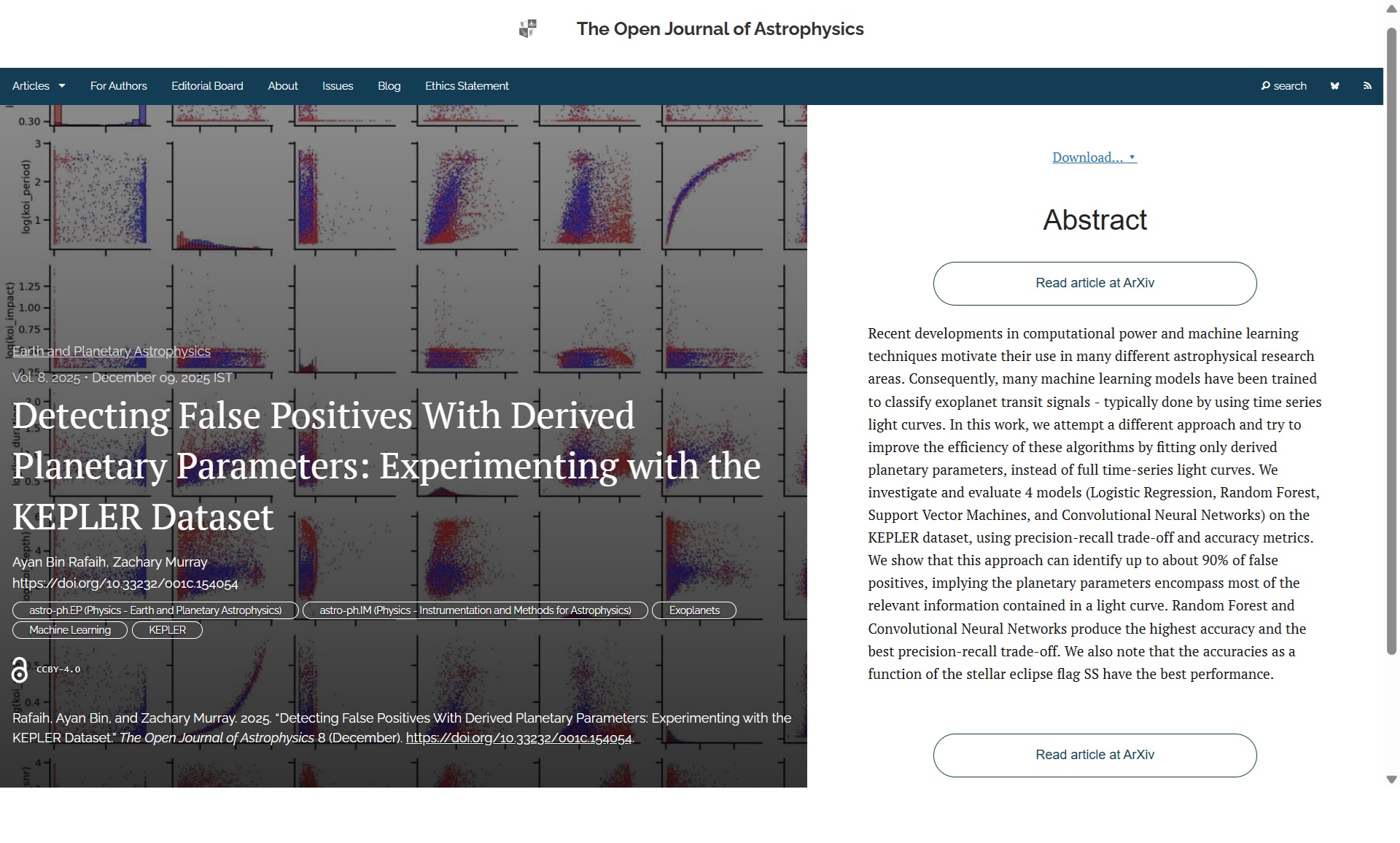
You can find the official version of this one on arXiv here. The federated announcement on Mastodon is here:

Open Journal of Astrophysics

New Publication at the Open Journal of Astrophysics: "Detecting False Positives With Derived Planetary Parameters: Experimenting with the KEPLER Dataset" by Ayan Bin Rafaih (Aitchison College, Lahore, Pakistan) and Zachary Murray (Université Côte d’Azur, France)

doi.org/10.33232/001c.154054

December 9, 2025, 7:34 am 1 boosts 0 favorites

Next one up is “The role of peculiar velocity uncertainties in standard siren cosmology” by Chris Blake and Ryan J. Turner (Swinburne, Australia). This paper discusses the impact of peculiar velocities on the error in H0 determinations from local distance indicators with observed redshifts, incorporating the effect of bulk flows. It was published on Tuesday 9th December in the folder Cosmology and Nongalactic Astrophysics.

The overlay is here:
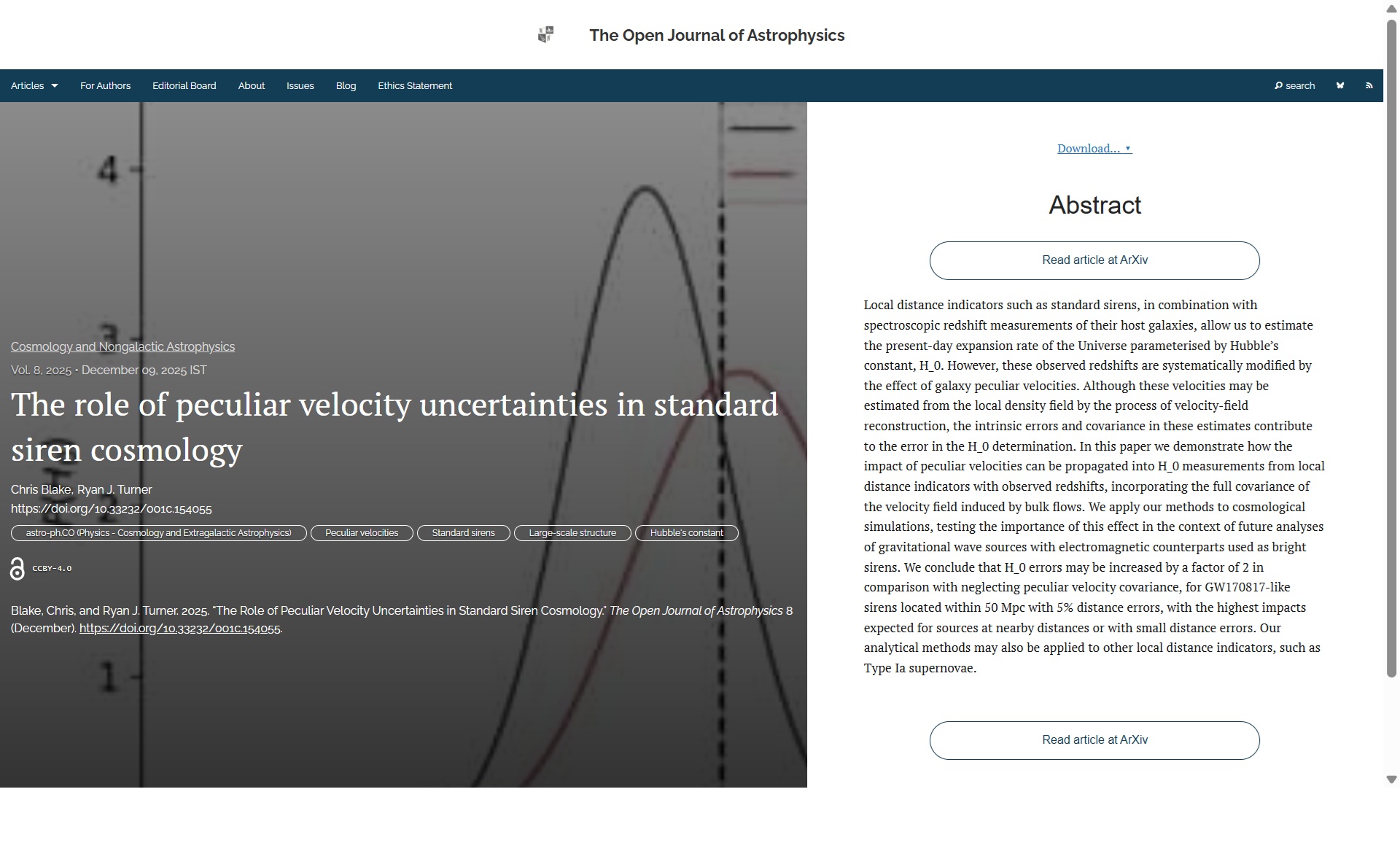
You can find the official accepted version on arXiv here. The fediverse announcement is here:

Open Journal of Astrophysics

New Publication at the Open Journal of Astrophysics: "The role of peculiar velocity uncertainties in standard siren cosmology" by Chris Blake and Ryan J. Turner (Swinburne, Australia)

doi.org/10.33232/001c.154055

December 9, 2025, 7:47 am 1 boosts 0 favorites

The fourth article of the week is “Transient QPOs of Fermi-LAT blazars with Linearly Multiplicative Oscillations” by P. Penil (Clemson University, USA) and 7 others based in the USA, Italy and Germany. This was published on Thursday 10th December in the folder High-Energy Astrophysical Phenomena. This paper presents an investigation of patterns of quasi-periodic oscillations in observed blazar systems characterized by periodic multiplicative amplitudes including both the periodicities and long-term variations.  The overlay is here:
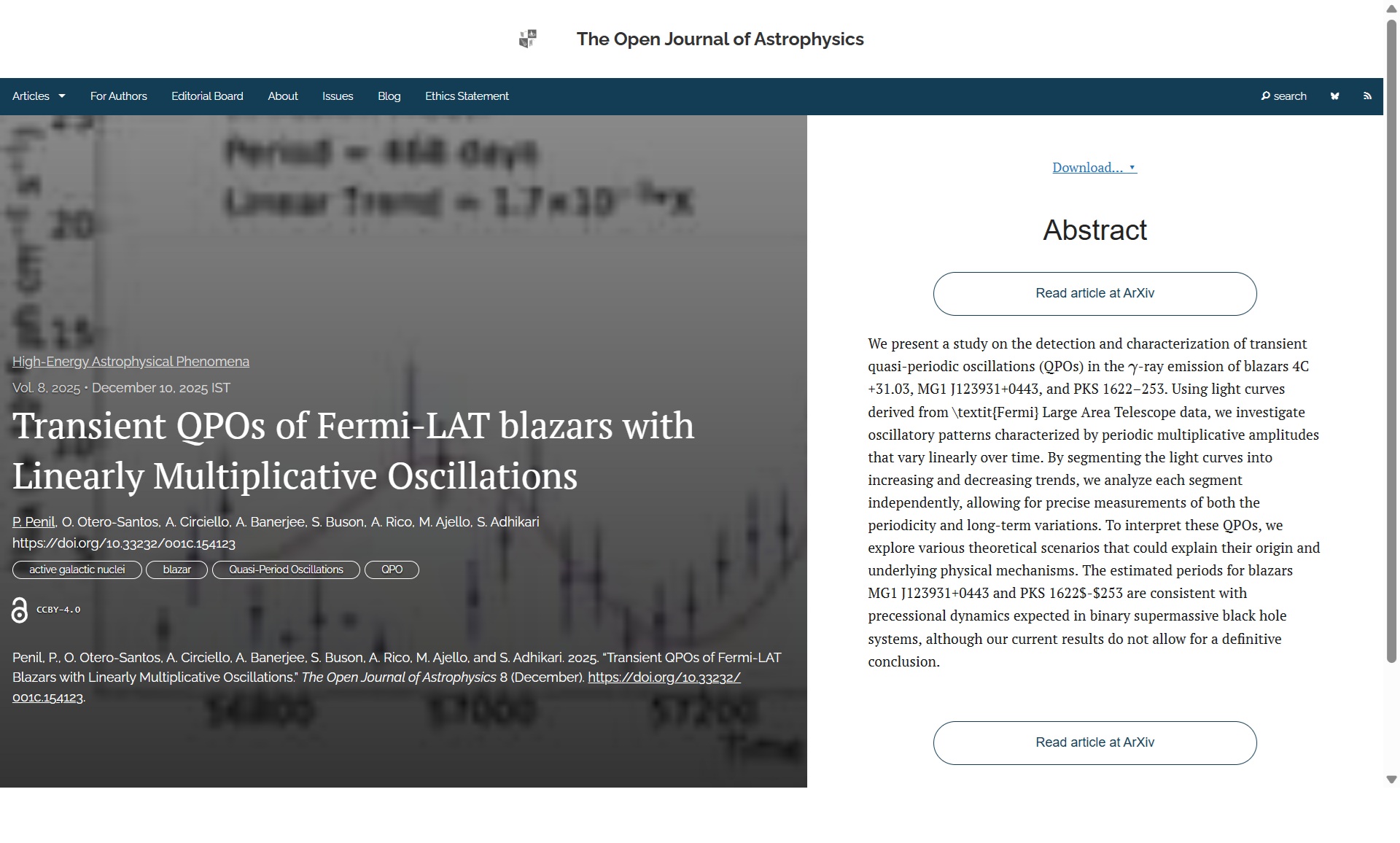
You can find the official published version on arXiv here. The Fediverse announcement follows:

Open Journal of Astrophysics

New Publication at the Open Journal of Astrophysics: "Transient QPOs of Fermi-LAT blazars with Linearly Multiplicative Oscillations" by P. Penil (Clemson University, USA) and 7 others based in the USA, Italy and Germany

doi.org/10.33232/001c.154123

December 10, 2025, 12:22 pm 0 boosts 1 favorites

The last paper for this week is “Tidally Delayed Spin-Down of Very Low Mass Stars” by Ketevan Kotorashvili and Eric G. Blackman (U. Rochester, USA). This was published on Friday 12th December (yesterday) in the folder Solar and Stellar Astrophysics. It discusses the effect of tides from sub-stellar companions on rotational evolution of very low-mass stars, suggesting that these may explain the dearth of field, late-type M dwarfs with intermediate rotation periods.

The overlay is here:
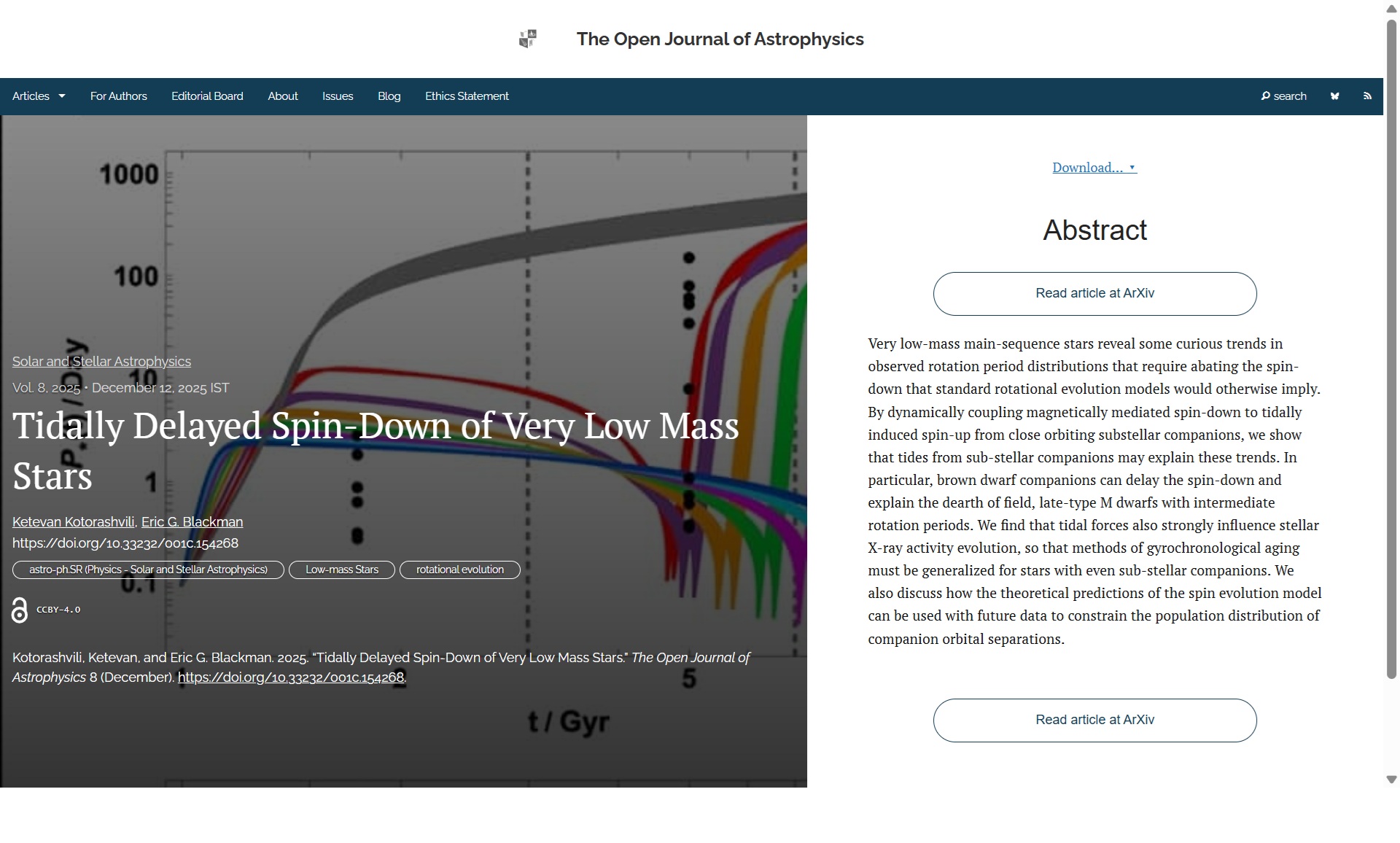
 

You can find the officially-accepted version on arXiv here, and the Mastodon announcement is here:

Open Journal of Astrophysics

New Publication at the Open Journal of Astrophysics: "Tidally Delayed Spin-Down of Very Low Mass Stars" by Ketevan Kotorashvili and Eric G. Blackman (U. Rochester, USA)

doi.org/10.33232/001c.154268

December 12, 2025, 10:31 am 1 boosts 0 favorites


And that concludes the update for this week. I will do another of these regular announcements next Saturday, which will be the last such update for 2025. Will we make it past 200 for the year? Tune in next week to find out!
The Bull’s-Eye Effect

Posted in The Universe and Stuff with tags , , , , on February 10, 2011 by telescoper

What a day.

For a start we had another manic UCAS admissions event. Applications to study physics here have rocketed, by more than 50% compared to last year, so it’s all hands on deck on days like this. Next weekend we have our first Saturday event of the year, and that promises to be even more popular. Still, it’s good to be busy. Without the students, we’d all be on Her Majesty’s Dole. At least some of our advertising is hitting the target.

After that it was back to the business of handing out 1st Semester examination results to my tutees – the Exam Board met yesterday but I skived off because I wasn’t involved in any exams last semester. Then a couple of undergraduate project meetings and a few matters related to postgraduate admissions that needed sorting out.

Finally, being a member of our esteemed Course Committee, I spent a little bit of time trying to assemble some new syllabuses. All our Physics (and Astrophysics) courses are changing next year, so this is a good chance to update the content and generally freshen up some of the material we teach.

In the course of thinking about this, I dug about among some of my old course notes from here there and everywhere, some of which I’ve kept on an old laptop. I chanced upon this cute little graphic, which I don’t think I’ve ever used in a lecture, but I thought I’d put it up here because it’s pretty. Sort of.

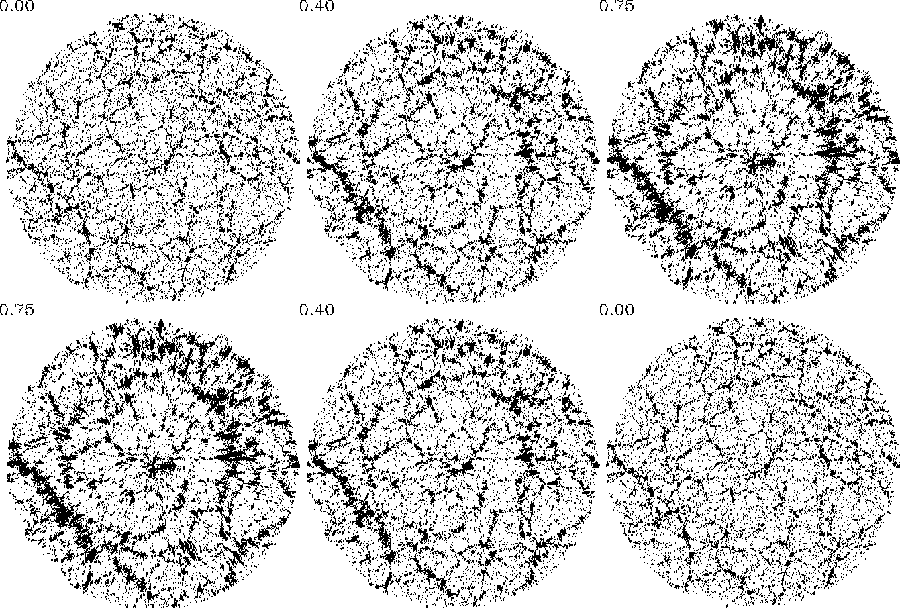
What it shows is a simulation of the large-scale structure of the Universe as might be mapped out using a galaxy redshift survey. The observer is in the centre of the picture (which a two-dimensional section through the Universe); the position of each galaxy is plotted by assuming that the apparent recession velocity (which is what a redshift survey measures) is related to the distance from the observer by Hubble’s Law:

V\simeq cz =H_0 R

where V  is the recession velocity, z  is the redshift, H_0 is Hubble’s constant  and R is the radial distance of the galaxy. However, this only applies exactly in a completely homogeneous Universe. In reality the various inhomogeneities (galaxies, clusters and superclusters) introduce distortions into the Hubble Law by generating peculiar velocities

V=H_0 R+ V_p

These distort the pattern seen in redshift space compared to real space. In real space the pattern is statistically isotropic, but in redshift space things look different along the line of sight from the observer compared to the directions at right angles as described quite nicely by this slide from a nice web page on redshift-space distortions.

There are two effects. One is that galaxies in tightly bound clusters have high-speed disordered motions. This means that each cluster is smeared out along the line of sight in redshift space, producing artefacts sometimes called “Fingers of God” – elongated structures that always point ominously at the observer. The other effect caused by large-scale coherent motions as matter flows into structures that are just forming, which squashes large-scale features in the redshift direction more-or-less opposite to the first.

These distortions don’t simply screw up our attempts to map the Universe. In fact they help us figure out how much matter might pulling the galaxies about. The number in the upper left of the first (animated) figure is the density parameter, \Omega. The higher this number is, the more matter there is to generate peculiar motions so the more pronounced the alteration; in a low density universe, real and redshift space look rather similar.

Notice that in the high-density universe the wall-like structures look thicker (owing to the large peculiar velocities within them) but that they are also larger than in the low-density universe. In a paper a while ago, together with Adrian Melott and others, we investigated  the dynamical origin of this phenomenon, which we called the Bull’s-Eye Effect because it forms prominent rings around the central point. It turns out to be Quite Interesting, because the merging of structures in redshift-space to create larger ones is entirely analogous the growth of structure by hierarchical merging in real space, and can be described by the same techniques. In effect, looking in redshift space gives you a sneak preview of how the stucture will subsequently evolve in real space…


Share/Bookmark