I’ve been a bit busy catching up on things since my departure from Barcelona with the result that I almost forgot to post anything today. Fortunately there are two more Euclid Early Release Observations I can share to fill the gap. They’re about 4 minutes apiece, so there’ll be plenty time to watch them while waiting for the VAR operators to make an offside decision during the next European Championship match…
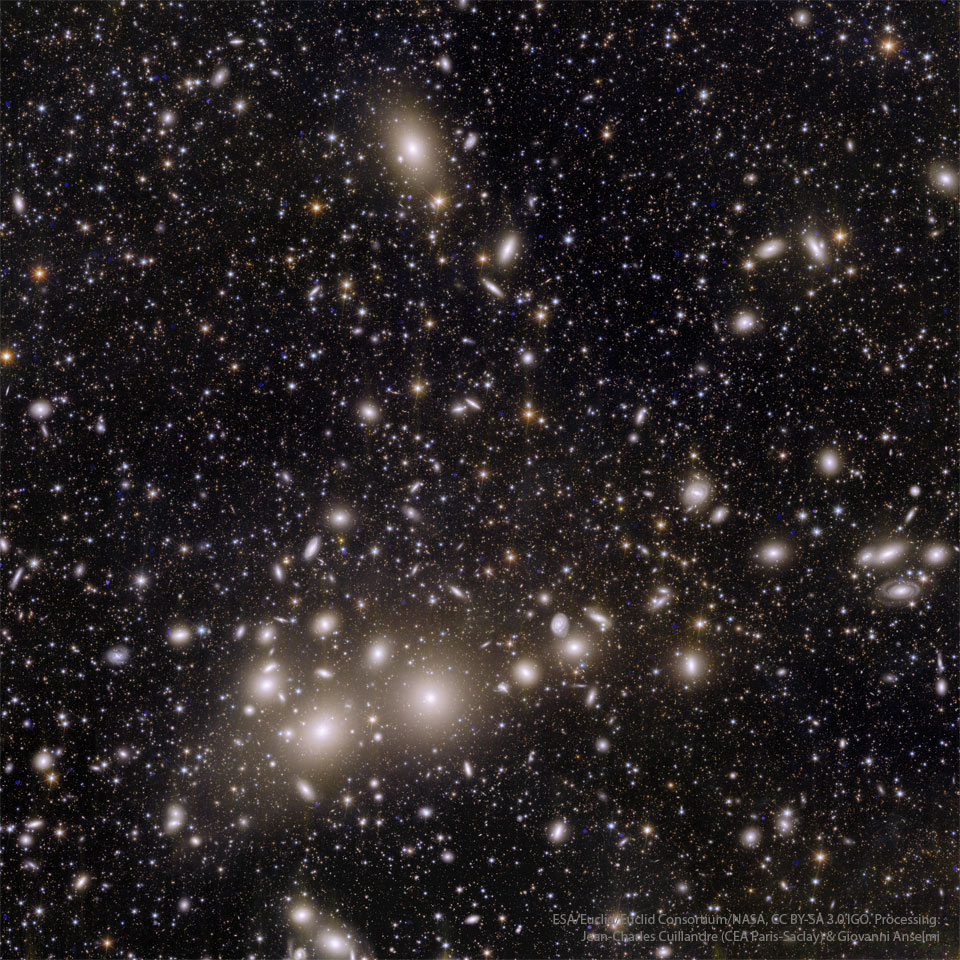
The first is entitled Measuring Luminosity Function for the Perseus Cluster of Galaxies using Euclid ERO data:
The article describing this work can be found on arXiv here; it perhaps makes up for the missing article in the title of the video.
The second one is this, about gravitational lensing and the search for high-redshift galaxies:
The paper for this one can be found on arXiv here.
The Perseus Cluster (Abell 426) – a dense concentration of over a thousand galaxies with a total mass of about 1.2 × 10¹⁵ M⊙ – is impressive in its own right, especially because the picture was taken in a single exposure, but the staggering thing about this image is that it contains hundreds of thousands of galaxies. In other words there are as many galaxies in this picture as there are words in a book. Most of these galaxies are in the background, not associated with the cluster, and many of them extremely distant. With so many objects in one field, you can perhaps see how much data we will get from the entire survey, which will last more than 6 years. It is these distant sources – billions of them – that Euclid will survey to glean information about the expansion history of the Universe.
P.S. Yesterday’s press conference resulted in a lot of media attention worldwide, even some in Ireland. There is a piece on the RTÉ website, for example, and another on Silicon Republic (which includes a quote from yours truly).
So today’s the day. The first science-quality observations from Euclid have now been released to the public. The official press release is here, and the press conference showcasing the new observations can be viewed here:
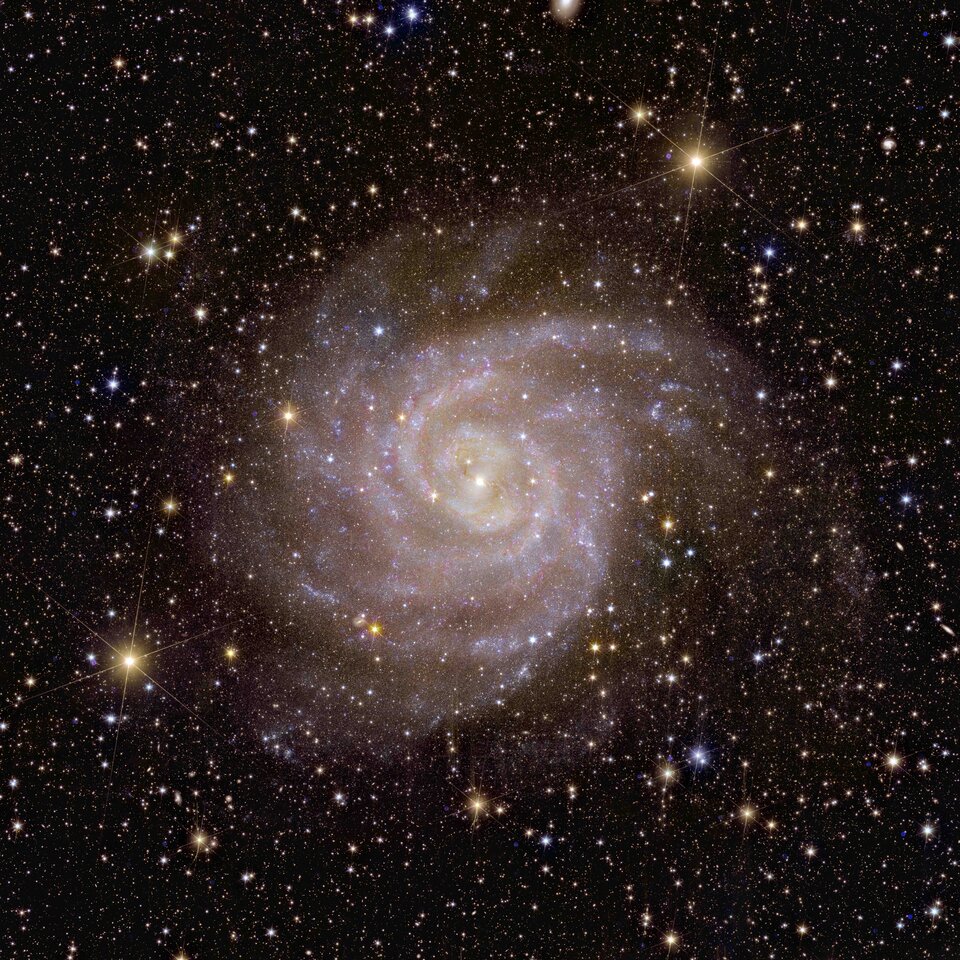
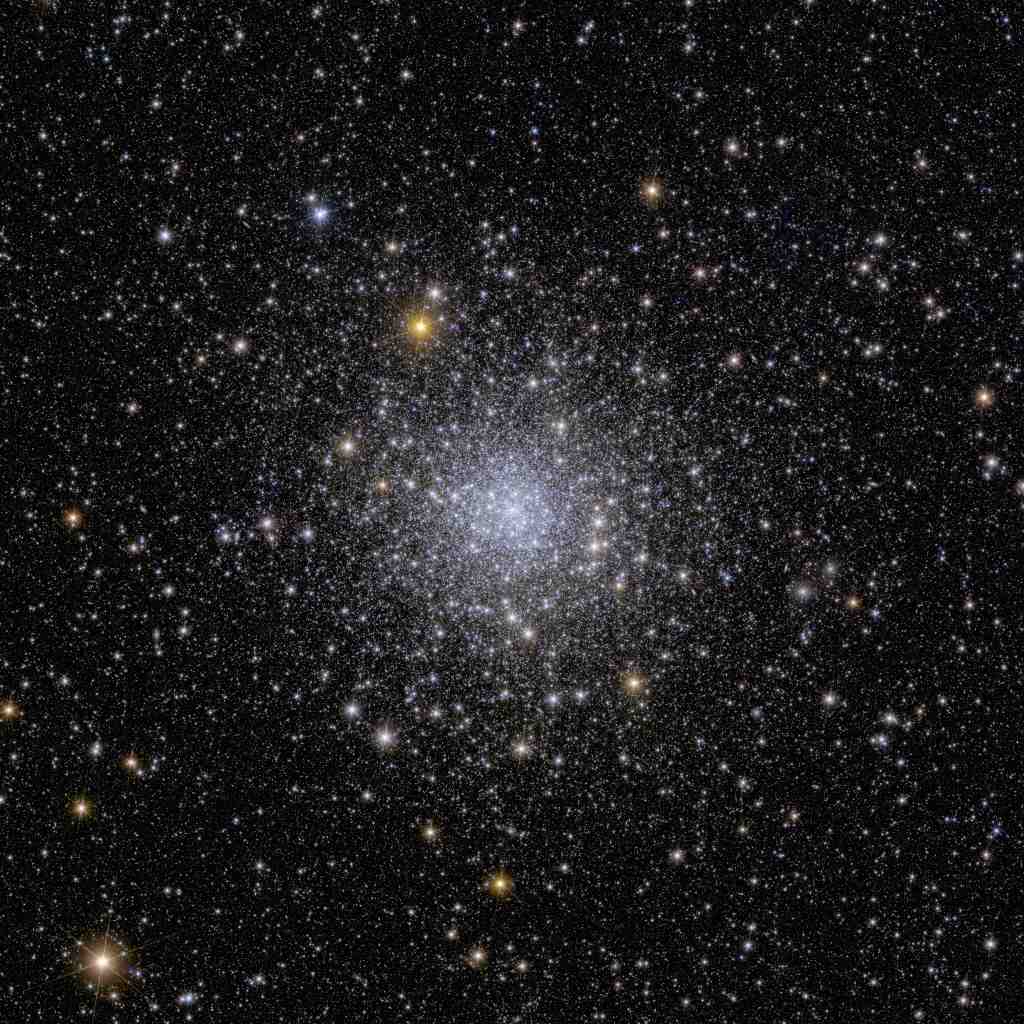
The images themselves can be found in this repository. In summary they are (in no particular order):
IC 342NGC 6822Horsehead NebulaNGC 6397Perseus Cluster
And here they are – you can click on them to make them bigger:
A few points of my own.
First, it is important to realise that these observations are not part of the full Euclid survey, which will start in early 2024, but were produced during the process of verification the capabilities of the telescope and detectors. They are all very short exposures, taking up less than a day to make all the images, but they demonstrate that Euclid is performing very well indeed!
Euclid is designed to achieve very sharp optical quality across a very wide field of view, so its strength is that it will produce beautiful images like these not only of a handful of objects but for billions. We need to map very large numbers of galaxies to perform the careful analysis needed to extract information about dark matter and dark energy, which is the main goal of the mission.
While these images are, in a sense, by-products of the Euclid mission, not specifically related to the main aims of the mission, they are interesting in their own right and there are proper scientific papers related to each of the five sets of observations released today. We expect many more non-cosmological spinoffs like these as the mission goes on.
There were some problems during the commissioning of the instruments carried by Euclid, the most serious of which was an issue with the Fine Guidance Sensor used to control the pointing of the telescope. This has been fixed by a software update and everything is now functioning well, as today’s new results confirm!
The views presented here are personal and not necessarily those of my employer (or anyone else for that matter).
Feel free to comment on any of the posts on this blog but comments may be moderated; anonymous comments and any considered by me to be vexatious and/or abusive and/or defamatory will not be accepted. I do not necessarily endorse, support, sanction, encourage, verify or agree with the opinions or statements of any information or other content in the comments on this site and do not in any way guarantee their accuracy or reliability.




 In the Dark