Archive for Physics

New Dark Energy Survey Supernovae Results

Posted in The Universe and Stuff with tags , , , , , , , on January 10, 2024 by telescoper

Some important cosmological results have just been announced by the Dark Energy Survey Collaboration. I haven’t had time to go through them in detail but I thought it was worth doing a quick post here to draw attention to them. The results concern a sample of Type Ia supernovae (SN Ia) discovered during the full five years of the Dark Energy Survey (DES) Supernova Program, which contains about 1500 new Type Ia Supernovae that can be used for cosmological analysis. The paper is available on the arXiv here; the abstract is:

The key numerical result of interest is the equation-of-state parameter for dark energy, designated by w, which occurs in the (assumed) relationship between pressure p and effective mass density ρ  of the form p=wρc2. A cosmological constant – which for many cosmologists is the default assumption for the form of dark energy – has w=-1 as I explained here. This parameter is one of the things Euclid is going to try to measure, using different methods. Interestingly, the DES results are offset a bit from the value of -1, but with quite a large uncertainty.

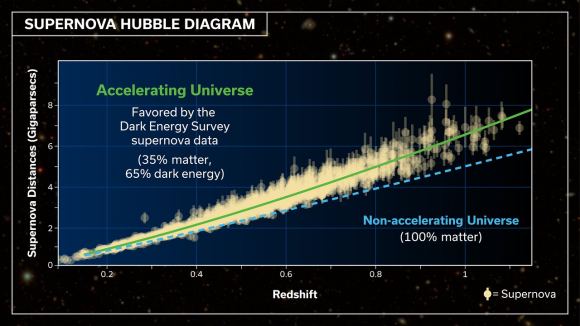
While the results for the equation-of-state parameter are somewhat equivocal, one thing that is clear is that the new SNIa measurements do confirm the existence of dark energy, in that the data can only be described by models with accelerating expansion, as dramatically demonstrated in this Figure:

I think this figure – or versions of it – will very rapidly appear in public talks on cosmology, including my own!

The Atwood Machine

Posted in Barcelona, Cute Problems, Education, Maynooth with tags , , , on November 14, 2023 by telescoper

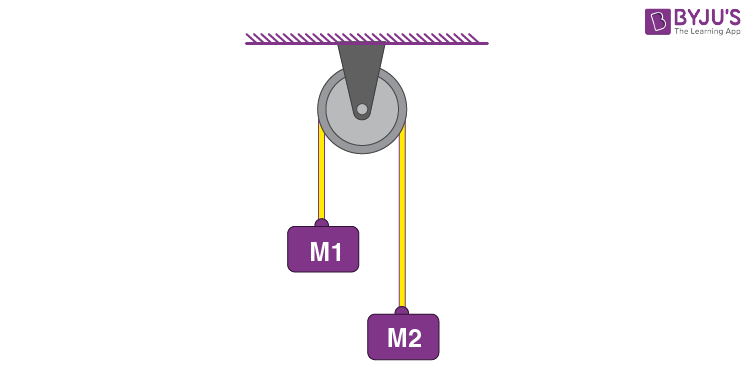
In the foyer of the Physics Department at the University of Barcelona you will find, as well as a fine refracting telescope, an example of the Atwood Machine. For some years before my current sabbatical I have been teaching Newtonian Mechanics to first-year students in Maynooth and used this as a simple worked example. I have to admit I’ve never seen an actual Atwood machine before, and what I’ve done in lectures is the simplified form on the right rather than the actual machine on the left.

The illustration on the right depicts the essential elements, but you can can see that the actual machine has a ruler which, together with a timing device, can be used to determine the acceleration of the suspended mass and how that varies with the other mass. You can work this out quite easily in the simplest case of a frictionless pulley by letting the tension in the string (which is light and inextensible) be T (say) and then eliminating it from the equations of motion for the two masses. I leave the rest as an exercise for the reader. A more interesting problem, for the advanced student, is when you have to take into account the rotational motion of the pulley wheel…

Spanish Practices

Posted in Barcelona, Education, History, Maynooth with tags , , , , , on October 20, 2023 by telescoper

When I was a lad, during the 1970s, the term Spanish Practices was used pejoratively in a union-bashing sense to describe restrictive practices in the workplace. Until recently I thought it was a modern invention that relied on a stereotypical view of Spanish people as being lazy. In fact it seems the term dates back to Tudor times and is religious in origin, referring to Roman Catholic rites, in contrast to the simpler Protestant forms of worship. Anyway, none of that is what this post is about. I just used the title as clickbait.

I’ve been here in Barcelona, and working in the University of Barcelona, for four weeks now and I thought I’d share a few observations about differences in practice here and in the Ireland (and the UK).

The other night I went out for dinner with colleagues from the Department. The restaurant was much closer to the University than to my flat so instead of going home first I stayed in my office and walked straight there. My route out of the building takes me past a number of teaching rooms. During this warm weather, most of the rooms have the doors open so it’s easy to have a quick look at what’s going on inside. On my way out at about 7.30pm I was surprised to see a number of classes still going on, and they weren’t sparsely attended either.

In Maynooth the latest regular lectures finish at 6pm. Even during the 5pm to 6pm lectures, many students have to leave before the end to catch the one and only bus back to their place of residence. Here the public transport system is so good that isn’t really an issue even for those who don’t live near the campus. As far as I know lectures start at 9am, so students potentially have a very long day. They work hard.

I have to say that I wouldn’t like to have teach late in the evening. I used to do that on Fridays at Queen Mary for the MSc course and didn’t enjoy it. I don’t mind doing 9am lectures, though, but I don’t think students agree – partly because of the difficulty of getting to campus at that time.

In the Faculty of Physics, all the lecture halls, classrooms and laboratories are in one building rather than spread around the campus like they are in Maynooth (and many places in the UK). Fortunately, the building has been designed with students in mind and there is plenty of space for students to use socially or for private study between teaching sessions.

In this picture you can see the inner courtyard of the building occupied by the Faculties of Chemistry and Physics. It’s a big open space, with teaching rooms, etc, on either side. In the far right-hand corner there is a café/bar where one can buy lunch, a coffee, or even a beer, to be consumed either inside or in the seating area in the courtyard. Many students seem to prefer bring their own lunch and eat it in this space., although the food available is pretty good and cheap compared to back home.

As well as being able to eat and drink here, there is plenty of room for students simply to hang out or to study, either alone or in groups. If they don’t feel like that they can use the tram, bus or Metro to go home, and come back later if they have a long gap between classes. None of this is possible at Maynooth.

This particular kind of open space would not work so well in Ireland or the UK because of the weather, though you can probably see in the picture that there had been a bit of rain before I took the photograph, but I hope I’ve made the point that having social spaces makes a huge amount of difference to the student experience, not least because it feels that the University has thought about them. In the neoliberal system that dominates in the UK and Ireland, students are simply a commodity, a source of revenue, to be crammed into every available space and processed as cheaply as possible. In Maynooth students have been, and are being, forced to pay an extra levy for a notional student centre that will probably never be built.

The contrast is very disheartening.

Getting back to educational matters, another thing I’ve noticed walking past classrooms is that it’s not unusual to see a student standing at the blackboard in front of the class going through a problem. I’ve seen that a number of times with quite large classes. Sometimes we ask students to do that sort of thing in tutorials, but I’ve never done so in a full lecture. I think our students would be shocked if we asked, but it’s clearly not unexpected here. That’s a Spanish Practice I’d be quite happy to try.

Physical Differences

Posted in Barcelona, Biographical, Education with tags , , on September 26, 2023 by telescoper

Today was my first day in the ICCUB

I spent quite a lot of this morning trying to get my internet connections to work and trying to sort out an office key, not with 100% success. I am currently in the office of a member of staff who happens to be away today instead of the office I was allocated, and my email address here is not yet activated – probably because I did something wrong in the registration process. I’m hopeful that these minor issues will be resolved tomorrow. Even Eduroam acted up for a while before finally letting me connect. Such is life.

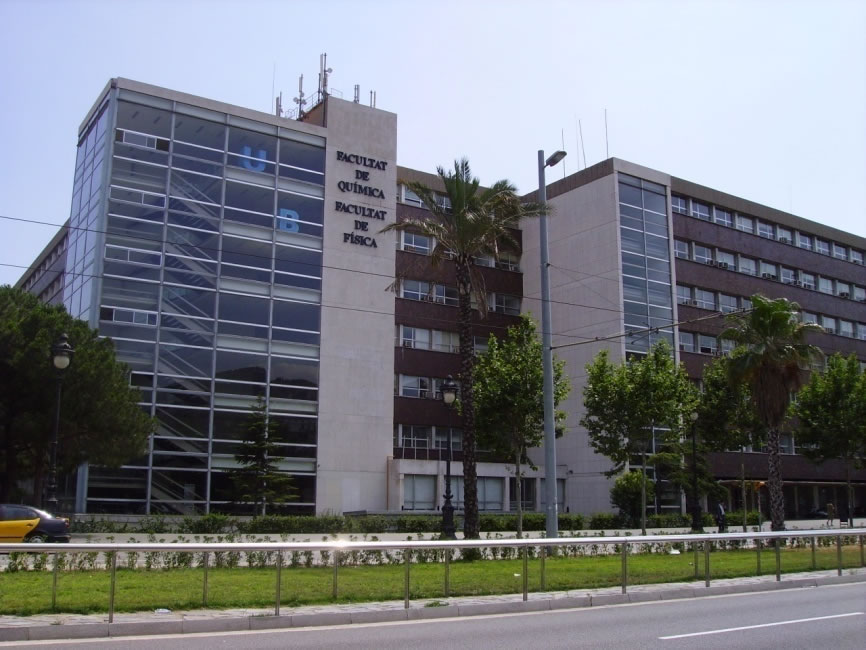
Anyway, my first impression on arriving in the building was of a huge difference in scale in Physics activity here at the University of Barcelona (UB) as compared to Maynooth (and indeed the UK Physics departments I have worked in). That’s not just the size of the building, which the Faculty of Physics shares with the Faculty of Chemistry. Physics and Chemistry also share a building in Maynooth, in fact, so the sharing was not in itself a surprise. The Science Building in Maynooth is very small, however, and it was a bit of a shock seeing how much space there is here compared with Maynooth, and also finding out how easy it is to get lost among the 7 floors. The sense of space is very refreshing, actually, as cramped accommodation is a constant reminder of financial and other constraints.

That’s not the only difference, though. There is enough activity in Physics in the University of Barcelona for it to be an entire Faculty. The UB Faculty of Physics contains Departments, covering the following areas: Electronic & Biomedical Engineering; Quantum Physics & Astrophysics; Condensed Matter Physics, and Applied Physics. It is also home to ICCUB, an interdisciplinary research institute that sits outside the Department structure and some of whose staff are paid from external agencies rather than the University itself.

In Maynooth there is a Faculty of Science and Engineering that covers all disciplines represented in the list above, and more besides. It would amuse my colleagues back in Ireland to see that Electronic Engineering is considered a small subset of Physics in Barcelona, whereas in Maynooth it is a free-standing department which is larger than Physics.

P.S. I just thought I’d mention another difference: that it is very warm here (26° C) so I may need to stop for a beer on the way home…

Examinations, Past and Future

Posted in Biographical, Education, mathematics, Maynooth with tags , , , , , on June 7, 2023 by telescoper

No sooner is yesterday’s departmental Examination Board done and dusted (after just two and a half hours) when attention switches to school examinations. The Junior Certificate and Leaving Certificate examinations both start today, so the first thing I need to do is wish everyone taking examinations the very best of luck!

Among other things, the results of the leaving certificate examinations are important for next year’s University admissions. As we gradually dispense with the restrictions imposed during the pandemic, it seems this year we just might have the results before the start of teaching at the end of September. That will make a nice change!

In the system operating in England and Wales the standard qualification for entry is the GCE A-level. Most students take A-levels in three subjects, which gives them a relatively narrow focus although the range of subjects to choose from is rather large. In Ireland the standard qualification is the Leaving Certificate, which comprises a minimum of six subjects, giving students a broader range of knowledge at the sacrifice (perhaps) of a certain amount of depth; it has been decreed for entry into this system that an Irish Leaving Certificate subject counts as about 2/3 of an A-level subject for admissions purposes, so Irish students do the equivalent of at least four A-levels, and many do more than this. It’s also worth noting that all students have to take Mathematics at Leaving Certificate level.

Overall I prefer the Leaving Certificate over the UK system of A-levels, as the former gives the students a broader range of subjects than the latter (as does the International Baccalaureate). I would have liked to have been allowed to take at least one arts subject past O-level, for example.

For University admissions points are awarded for each paper according to the marks obtained and then aggregated into a total CAO points, CAO being the Central Applications Office, the equivalent of the UK’s UCAS. This means, for example, that our main Science pathway at Maynooth allows students to study Physics without having done it at Leaving Certificate level. This obviously means that the first year has to be taught at a fairly elementary level, but it has the enormous benefit of allowing us to recruit students whose schools do not offer Physics.

As much as I like the Leaving Certificate, I have concerns about using a simple CAO points count for determining entry into third-level courses. My main concern about is with Mathematics. Since the pandemic struck, students have been able to choose to questions from just six out of ten sections. That means that students can get very high grades despite knowing nothing about 40% of the syllabus. That matters most for subjects that require students to have certain skills and knowledge for entry into University, such as Physics.

I’ve been teaching the first year Mathematical Physics course in Maynooth for about 5 years. At the start of the module I put up a questionnaire asking the students about various mathematical concepts and asking them how comfortable they feel with them. It’s been noticeable how the fraction that are comfortable with basic differentiation and integration has been falling. That’s not a reflection on the ability of the students, just on the way they have been taught. As well as making adjustments during the pandemic for online teaching, etc, I have changed various things about the teaching, in particular adjusting the way I have introduced calculus into the module. Another problem is that we have been forced to start teaching first-years a week late because of delays to the CAO process caused by the pandemic.

I’ll be on sabbatical next academic year so I won’t be teaching the first-years (or anyone else) in September. It’s time to hand these challenges on to someone else!

The Term Ahead

Posted in Biographical, Education, Maynooth with tags , , , , on January 29, 2023 by telescoper

It’s the day before the start of a new Semester in Maynooth. Last week we finished all due processes relating to the First Semester examinations and the provisional results will be uploaded to “The System” next week. They’re provisional at this stage because they’re not set in stone until the final meeting of the Examination Board. Obviously I can’t discuss the results here. I could comment here about how clunky the whole process is, including multiple downloads of spreadsheets and subsequent uploads somewhere else, but I won’t bother. Nobody seems to be interesting in fixing it. Perhaps by the time I retire “The System” will have been replaced by something that doesn’t waste an enormous amount of staff time. But I doubt it.

It’s a curiosity of the teaching allocation in the Department of Theoretical Physics that I do first-year and second-year modules (MP110 Mechanics and Special Relativity and MP201 Vector Calculus & Fourier Series) in Semester 1 while in Semester 2 it’s the third and fourth year students who have to put up with my ramblings.

The menu for this term involves MP354 Computational Physics 1, which entails just one hour of lectures per week but two two-hour lab sessions. Each student attends one of these sessions, so they get 3 contact hours per week but I have to look after both sessions. Our computer lab has a small cluster of Linux machines and, this term, a brand new display screen which I am looking forward to playing with. I’m also looking forward to seeing how the infamous ChatGPT copes with the Python coding exercises I give the students to do in class: I’ve only tried one so far, without much success. This is the first module I taught at Maynooth, back in 2018, so this will be the 6th time I’ve done it.

My other class is MP465 Advanced Electromagnetism, which I’m doing for the 3rd time now. This is a standard chalk-and-talk kind of module covering a well-established syllabus, and involving two lectures per week plus a tutorial. At least I’m teaching in a classroom rather than online like when I first did this module!

In 2020/21 (during the Pandemic restrictions) I did five modules as well as being Head of Department. At this time two academic staff departures left us severely short-staffed and struggling to deliver our programmes. My workload then was unmanageable and I asked to step down. I changed my mind when were eventually allowed to recruit two lecturers and saw out my three-year term to the end. I had better not repeat here what I think of the deliberate management decisions that left us reeling and had such negative effects on staff morale and on the education of students in the Department. I just hope the damage is not irreparable.

Although I am doing the same number of modules as last term, the number of contact hours I have to do is higher (8 versus 5) because of the labs and the fact that we don’t have tutors for 4th-year modules so lecturers have to do the tutorials themselves. Four modules a year is a much heavier teaching load than a Full Professor at a UK university would be expected to carry, but it seems normal in Ireland where the funding for sciences is far less than adequate. The impact on research productivity is obvious and is systemic. There are excellent physicists in Maynooth but they are given little time or other resources. It’s a big waste of potential. That’s another “System” that needs changing, but I see little appetite for change of the required sort at institutional level. It’s all about recruiting more and more students to be taught with fewer and fewer resources.

The impact of this on staff careers is severe: teaching loads are so heavy that it’s very difficult to reach the level of research productivity required for promotion. For myself, though, the next career step will be retirement so I don’t have to worry about promotion. Fortunately too, I enjoy teaching, so I’ll just get on with it. So I’ll stop writing and get on with preparing my first week of lectures and lab sessions!

Reflections on Exam Marking

Posted in Education, Maynooth with tags , , , on January 21, 2023 by telescoper

At long last I’ve finished my marking my examination scripts. I’ve also entered the marks onto a spreadsheet and combined them with coursework so I’m almost done with this task. They just need one more check through and I can upload the results onto the system. in good time for next week’s departmental exam board meeting. It took a lot longer than I had anticipated because we have a big first-year class this year. So much for my New Year resolution not to work at weekends…

I’m a bit tired now so I thought I’d just rehash an excerpt from something I posted a while ago on the subject of examinations and what I believe to be the over-assessment of students at modern universities.

My feelings about examinations agree pretty much with William Wordsworth, who studied at the same University as me, as expressed in this quotation from The Prelude:

Of College labours, of the Lecturer’s room
All studded round, as thick as chairs could stand,
With loyal students, faithful to their books,
Half-and-half idlers, hardy recusants,
And honest dunces–of important days,
Examinations, when the man was weighed
As in a balance! of excessive hopes,
Tremblings withal and commendable fears,
Small jealousies, and triumphs good or bad–
Let others that know more speak as they know.
Such glory was but little sought by me,
And little won.

It seems to me a great a pity that our system of education – and not only at Third Level- places such a great emphasis on examination and assessment to the detriment of real learning. In particular, the biggest problem  with physics education in many institutions is the way modular degrees have been implemented.

I’m not at all opposed to modularization in principle. I just think the way we teach modules often fails to develop any understanding of the interconnection between different aspects of the subject. That’s an educational disaster because what is most exciting and compelling about physics is its essential unity. Splitting it into little boxes, taught on their own with no relationship to the other boxes, provides us with no scope to nurture the kind of lateral thinking that is key to the way physicists attempt to solve problems. The small size of each module makes the syllabus very “bitty” and fragmented. No sooner have you started to explore something at a proper level than the module is over. More advanced modules, following perhaps the following year, have to recap a large fraction of the earlier modules so there isn’t time to go as deep as one would like even over the whole curriculum.

Students in Maynooth take 60 “credits” in a year, split into two semesters. These are usually split into 5-credit modules with an examination at the end of each semester. The first-year module I teach is different, being 7.5 credits. Projects, and other continuously-assessed work do not involve a written examination, but the system means that a typical  student will have four or five written examination papers in January and another four or five in May. Each paper is usually of two hours’ duration.

One consequence of the way modularization has been implemented throughout the sector is that the ratio of assessment to education has risen sharply over time  with a negative effect on real understanding. The system encourages students to think of modules as little bite-sized bits of education to be consumed and then forgotten. Instead of learning to rely on their brains to solve problems, students tend to approach learning by memorizing chunks of their notes and regurgitating them in the exam. I find it very sad when students ask me what derivations they should memorize to prepare for examinations. A brain is so much more than a memory device. What we should be doing is giving students the confidence to think for themselves and use their intellect to its full potential rather than encouraging rote learning.

You can contrast this diet of examinations with the regime when I was an undergraduate. My entire degree result was based on six three-hour written examinations taken at the end of my final year, rather than something like 30 examinations taken over 3 years. Moreover, my finals were all in a three-day period.

Morning and afternoon exams for three consecutive days is an ordeal I wouldn’t wish on anyone, so I’m not saying the old days were better, but I do think we’ve gone far too far to the opposite extreme. The one good thing about the system I went through was that there was no possibility of passing examinations on memory alone. Since they were so close together there was no way of mugging up anything in between them. I only got through  by figuring things out in the exam room.

I don’t want to denigrate the achievements of students who are successful under the current system.  What I’m saying is that I don’t think the education we provide does justice to their talents. That’s our fault, not theirs…


Putting girls off Physics

Posted in Education, mathematics, Maynooth, Politics with tags , , on January 9, 2023 by telescoper

I see that Katharine Birbalsingh has resigned from her job as UK Government commissioner for social mobility. Apparently she feels she was “doing more harm than good”. If only the rest of the Government had that level of self-awareness.

I wrote about Katharine Birbalsingh last year, and her departure gives me the excuse to repeat what I said then. Birbalsingh is Head of a school in which only 16% of the students taking physics A-level are female (the national average is about 23%) and tried to explain this by saying that girls don’t like doing “hard maths”.

..physics isn’t something that girls tend to fancy. They don’t want to do it, they don’t like it.

Gender stereotyping begins at school, it seems.

There is an easy rebuttal of this line of “reasoning”. First, there is no “hard maths” in Physics A-level. Most of the mathematical content (especially differential calculus) was removed years ago. Second, the percentage of students taking actual A-level Mathematics in the UK who are female is more like 40% than 20% and girls do better at Mathematics than boys at A-level. The argument that girls are put off Physics because it includes Maths is therefore demonstrably bogus.

An alternative explanation for the figures is that schools (especially the one led by Katharine Birbalsingh, where the take-up is even worse than the national average) provide an environment that actively discourages girls from being interested in Physics by reinforcing gender stereotypes even in schools that offer Physics A-level in the first place. The attitudes of teachers and school principals undoubtedly have a big influence on the life choices of students, which is why it is so depressing to hear lazy stereotypes repeated once again.

There is no evidence whatsoever that women aren’t as good at Maths and Physics as men once they get into the subject, but plenty of evidence that the system dissuades then early on from considering Physics as a discipline they want to pursue. Indeed, at University female students generally out-perform male students in Physics when it comes to final results; it’s just that there are few of them to start with.

Anyway, I thought of a way of addressing gender inequality in physics admissions about 8 years ago. The idea was to bring together two threads. I’ll repeat the arguments here.

The first is that, despite strenuous efforts by many parties, the fraction of female students taking A-level Physics has flat-lined at around 20% for at least two decades. This is the reason why the proportion of female physics students at university is the same, i.e. 20%. In short, the problem lies within the school system.

The second line of argument is that A-level Physics is not a useful preparation for a Physics degree anyway because it does not develop the sort of problem-solving skills or the ability to express physical concepts in mathematical language on which university physics depends. In other words it not only avoids “hard maths” but virtually all mathematics and, worse, is really very boring. As a consequence, most physics admissions tutors that I know care much more about the performance of students at A-level Mathematics than Physics, which is a far better indicator of their ability to study Physics at University than the Physics A-level.

Hitherto, most of the effort that has been expended on the first problem has been directed at persuading more girls to do Physics A-level. Since all UK universities require a Physics A-level for entry into a degree programme, this makes sense but it has not been very successful.

I believe that the only practical way to improve the gender balance on university physics course is to drop the requirement that applicants have A-level Physics entirely and only insist on Mathematics (which has a much more even gender mix). I do not believe that this would require many changes to course content but I do believe it would circumvent the barriers that our current school system places in the way of aspiring female physicists, bypassing the bottleneck at one stroke.

I suggested this idea when I was Head of the School of Mathematical and Physical Sciences at Sussex, but it was firmly rejected by Senior Management because we would be out of line with other Physics departments. I took the view that in this context being out of line was a positive thing but that wasn’t the view of my bosses so the idea sank.

In case you think such a radical step is unworkable, I give you the example of our Physics programmes in Maynooth. We have a variety of these, including Theoretical Physics & Mathematics, Physics with Astrophysics, and Mathematical Physics and/or Experimental Physics through our omnibus science programme. Not one of these courses requires students to have taken Physics in their Leaving Certificate (roughly the equivalent of A-level) though as I explained in yesterday’s post, Mathematics is a compulsory subject at Leaving Certificate. The group of about first-year 130 students I taught this academic year is considerably more diverse than any physics class I ever taught in the UK, and not only in terms of gender…

I contend that the evidence suggests it’s not Mathematics that puts female students off Physics, a large part of it is A-level Physics.

How to be good at Physics

Posted in Education, The Universe and Stuff with tags , , , on October 22, 2022 by telescoper

A couple of articles appeared recently that I encourage people to read who are studying physics, or interested in studying physics.

The first article by Carl Wieman is from Physics Today and is entitled How to become a successful physicist. It is aimed at graduate students, though most of what it says is relevant to those at an earlier stage of their studies. Here’s an excerpt from near the beginning:

The primary characteristic of a successful physicist is being a good problem solver.

The article goes on to say some very interesting and instructive things, and is well worth reading in its entirety. There are one or two things that I don’t agree with though. One is the statement that…

…textbook problems provide all the information needed and have a single well-defined path to a solution.

That’s true of many problems at an elementary level, but problems at undergraduate or graduate level often have more than one way of finding the solution. That’s certainly true of many that I set as assignments. Indeed, sometimes the students come up with better ways of approaching them than I did! The important difference between textbook and research problems is that you know the textbook problems have a solution. Research is scarier because you don’t know at the outset that an answer can be found!

The second article, by Ethan Siegel, is called The secret to becoming an excellent physicist. Here is a quote from that, revealing the “secret”:

It’s simplicity itself: you become good at physics by solving physics problems. That’s it: that’s the secret. If you want to become competent at physics, you will solve physics problems in the area you wish to learn.

I hope you get the message. It’s not about rote-learning facts and formulae. The brain is much more than a memory device. It’s all about problem-solving. The ability to do that effectively can only be learned through practice.

I’m currently teaching two modules on Mathematical Physics and I devote most of the time in lectures for both of them to doing worked examples rather than proving theorems or presenting facts, theorems, derivations, formulae, etc to learn. I spend quite a lot of time in lectures giving students things to work out, which makes classes more interactive, but students also have tutorials built around problem-solving tasks to complement this.

If you’re interested you can see my post on How to Solve Physics Problems; there is also a video version here.

I’d add one piece of advice. If you really want to develop as a physicist, don’t just solve a lot of easy problems; challenge yourself by tackling difficult ones too. Don’t be afraid to get “stuck” or make a mistake, as those are both necessary parts of the learning process. Above all, develop the confidence in your ability to take on a problem and back yourself to solve it and don’t be deterred if the answer doesn’t come quickly!

How well-intentioned white male physicists maintain ignorance of inequity and justify inaction

Posted in Science Politics with tags , , , , , on October 10, 2022 by telescoper

I just noticed a paper on arXiv by Melissa Dancy and Apriel Hodari, which will probably annoy many people who deserve to be annoyed. Here is the abstract:

Background: We present an analysis of interviews with 27 self-identified progressive white-male physics faculty and graduate students discussing race and gender in physics. White men dominate most STEM fields and are particularly overrepresented in positions of status and influence (i.e. full professors, chairs, deans, etc.), positioning them as a potentially powerful demographic for enacting systemic reform. Despite their proclaimed outrage at and interest in addressing inequity, they frequently engage in patterns of belief, speech and (in)action that ultimately support the status quo of white male privilege in opposition to their intentions.


Results: The white male physicists we interviewed used numerous discourses which support racist and sexist norms and position them as powerless to disrupt their own privilege. We present and discuss three overarching themes, seen in our data, demonstrating how highly intelligent, well-intentioned people of privilege maintain their power and privilege despite their own intentions: 1) Denying inequity is physically near them, 2) Locating causes of inequity in large societal systems over which they have little influence and 3) Justifying inaction.


Conclusions: Despite being progressively minded, well-meaning, and highly intelligent, these men are frequently complicit in racism and sexism in physics. We end with recommendations for helping these men to engage the power they hold to better work with women and people of color in disrupting inequity in physics.

(I added the spacing and underlining.)

The paper does not mention the additional issue that not all white male professors are even well-intentioned…