We present Denario, an AI multi-agent system designed to serve as a scientific research assistant. Denario can perform many different tasks, such as generating ideas, checking the literature, developing research plans, writing and executing code, making plots, and drafting and reviewing a scientific paper. The system has a modular architecture, allowing it to handle specific tasks, such as generating an idea, or carrying out end-to-end scientific analysis using Cmbagent as a deep-research backend. In this work, we describe in detail Denario and its modules, and illustrate its capabilities by presenting multiple AI-generated papers generated by it in many different scientific disciplines such as astrophysics, biology, biophysics, biomedical informatics, chemistry, material science, mathematical physics, medicine, neuroscience and planetary science. Denario also excels at combining ideas from different disciplines, and we illustrate this by showing a paper that applies methods from quantum physics and machine learning to astrophysical data. We report the evaluations performed on these papers by domain experts, who provided both numerical scores and review-like feedback. We then highlight the strengths, weaknesses, and limitations of the current system. Finally, we discuss the ethical implications of AI-driven research and reflect on how such technology relates to the philosophy of science. We publicly release the code at this https URL. A Denario demo can also be run directly on the web at this https URL, and the full app will be deployed on the cloud.
arXiv:2510.26887
Here’s a random picture from the paper:
I haven’t had time to read the paper yet – it’s 270 pages long – but I’m sure it will provoke strong reactions both in favour and against the idea of an AI research assistant. Comments are welcome through the box below.
P.S. The name Denario appears to be derived from the Latin “denarius”, a coin roughly equivalent to a day’s pay for a skilled worker in the days of the Roman Empire. More amusingly, “denarius” is the origin of the Polari word “dinarly”, meaning “money”. If I get time I must generate a Polari version of this manuscript.
I saw the news today that the Republic of Ireland is now officially an associate member state of the Conseil Européen pour la Recherche Nucléaire, better known as CERN. This has been in the pipeline for a while: I blogged about it here, for example. But today’s the day that Ireland formally joined.
I think this is a very good move for Irish physics, and indeed for Ireland generally. I will, however, repeat a worry that I have expressed previously. There is an important point about CERN membership, however, which I hope is not sidelined. The case for joining CERN made at political levels was largely about the return in terms of the potential in contracts to technology companies based in Ireland from instrumentation and other infrastructure investments. This was also the case for Ireland’s membership of the European Southern Observatory (ESO), which Ireland joined 7 years ago. The same thing is true for involvement in the European Space Agency, which Ireland joined in 1975. These benefits are of course real and valuable and it is entirely right that arguments should involve them.
Looking at CERN membership from a purely scientific point of view, however, the return to Ireland will be negligible unless there is a funding to support scientific exploitation of the facility. That would include funding for academic staff time, and for postgraduate and postdoctoral researchers to build up an active community as well as, e.g., computing facilities. This need not be expensive even relative to the modest cost of associate membership (approximately €1.9M). I would estimate a figure of around half that would be needed to support CERN-based science. I am given to understand that some funds have been made available as part of the joining arrangements, but I don’t know the details.
As I have mentioned before, Ireland’s membership of ESO provides a cautionary tale. The Irish astronomical community was very happy about the decision to join ESO, but that decision was not accompanied by significant funding to exploit the telescopes. Few astronomers have therefore been able to benefit from ESO membership. While there are other benefits of course, the return to science has been extremely limited. The phrase “to spoil a ship for a ha’porth of tar” springs to mind.
Although Ireland joined ESA almost fifty years ago, the same issue applies there. ESA member countries pay into a mandatory science programme which includes, for example, Euclid. However, the Irish Government did not put any resources on the table to allow full participation in the Euclid Consortium. There is Irish involvement in other ESA projects (such as JWST) but this is somewhat piecemeal. There is no funding programme in Ireland dedicated to the scientific exploitation of ESA projects.
Under current arrangements the best bet in Ireland for funding for ESA, ESO or CERN exploitation is via the European Research Council, but to get a grant from that one has to compete with much better developed communities in those areas.
The recent merger of Science Foundation Ireland and the Irish Research Council to form a single entity called Research Ireland could provide an opportunity to correct this shortfall in funding for science exploitation. The reorganization won’t do anything on its own, however: the overall level of public sector research funding will have to increase dramatically from its current level, well below the OECD average. The recent Budget in Ireland for 2026 does include an allocation of €426 million for research under the National Development Plan, but how much of this will find its way into basic research generally and CERN science in particular?
Many times on this blog (e.g. here) I have mentioned the SAO/NASA Astrophysics Data System which (for the uninitiated) is a Digital Library portal for researchers in astronomy and physics, operated by the Smithsonian Astrophysical Observatory (SAO) under a NASA grant. The ADS maintains three bibliographic databases containing more than 14.0 million records covering publications in Astronomy and Astrophysics, Physics, and (of course) the arXiv e-prints. In addition to maintaining its bibliographic corpus, the ADS tracks citations and other information, which means, that among many other things, it is an important tool for evaluating publication impact. I use it very frequently.
I’m not the only person to be worried about this, see e.g. here.
After the Trump administration’s sudden and devasting cuts to Federal science agencies such as the National Science Foundation, it seems very likely that NASA programmes will also be severely cut which calls the future of the ADS system into doubt. This facility is used by astronomers around the world and its loss would have serious consequences for the global research community. I sincerely hope that astronomical organizations around the world will get together and ensure that data is not lost and a replacement website is set up. If your’e an astronomer please put pressure on your national funders to look at this as a matter of agency. We NASA/ADS is a wonderful resource, and is not by any standards expensive to run. We will all regret it if it is lost.
Until about 5 years ago, when ADS underwent a major overhaul, there were mirror sites all around the world. These are all still listed by ADS but do not seem to be functional. At the very least these should be reactivated.
P.S. I have been asked if arXiv is under a similar threat. I don’t believe it is – yet – as it is not run by a Federal organization. We do have secure backups of all OJAp published articles, though, in case you were wondering.
The publishers sent me a copy of this book Introduction to Entropy – The Way of the World by Jonathan Allday and Simon Hands. Here are some thoughts on it.
The conventional way of teaching physics at an introductory level is to develop the subject in thematic strands – classical mechanics, electromagnetism, quantum mechanics and so on – and reinforce the resulting structure with a cross-weave of methods – experimental, mathematical or computational – to show how the discipline as a whole is bound together by the interplay between these two. Some approaches emphasize the themes, others the methods but generally the layout is a criss-cross pattern of this sort, embedded within which are various concepts which we encounter on the way.
This book by schoolteacher Jonathan Allday and particle physicist Simon Hands is provides a valuable alternative approach in that it focusses on neither themes nor methods but on a particular concept, that of entropy. This is an interesting idea because it allows the reader to follow a direction more-or-less orthogonal to the conventional approaches. It is especially interesting to deal with entropy in this way because it is a concept that is familiar on one level – even Homer Simpson knows what about the Second Law of Thermodynamics! – but very unfamiliar when it comes to its detailed application, for example in quantum mechanics.
Guided by the concept of entropy, the authors take us on a journey through physics that has three main stages. The first is fairly mainstream in undergraduate courses, from classical thermodynamics to statistical mechanics, with applications and basic ideas of probability and statistics introduced along the way. The second, more technical, leg takes us through the idea of entropy in quantum mechanics and quantum information theory. The final part of the excursion is much freer ramble through more speculative terrain, including the role of entropy in biology, cosmology and black holes. This final section on life, the universe, and (almost) everything, addresses a number of open research questions. The authors stop to point out common errors and misconceptions at various points too.
This is an interesting and engaging book to anyone with an undergraduate education in physics, or above, who wants to understand the concept of entropy in all its manifestations in modern physics. It covers a great deal of territory but the narrative is coherent and well thought-out, and the material is very well organized and presented.
Just a quick post to draw your attention to a blog post by eminent pyschologist Dorothy Bishop, who has just taken the decision to resign as a Fellow of the Royal Society in protest at that institution’s refusal to strip Elon Musk of the status of FRS he was awarded in 2018.
Here’s an excerpt from the post:
For many scientists, election to the Royal Society is the pinnacle of their scientific career. It establishes that their achievements are recognised as exceptional, and the title FRS brings immediate respect from colleagues. Of course, things do not always work out as they should. Some Fellows may turn out to have published fraudulent work, or go insane and start promoting crackpot ideas. Although there are procedures that allow a fellow to be expelled from the Royal Society, I have been told this has not happened for over 150 years.
The post – which is very well written – goes on to explain why Musk is unfit to hold the title FRS and why attempts to expel him have stalled. I suggest you read it all.
I’m not a Fellow of the Royal Society, and will never be elected such, but it beats me why any self-respecting scientist would want to be a member of the Elon Musk Fan Club anyway.
We live in a cyclic universe of a sort because every few years somebody tries to resurrect the idea that dark matter is somehow related to primordial black holes, i.e. black holes formed in the very early stages of the history of the Universe so that they have masses much smaller than black holes formed more recently by the collapse of stars or the merger of other black holes. If it forms very early the mass of a PBH could in principle be very small, much less than a star or a planet. The problem with very small black holes is that they evaporate very quickly via Hawking Radiation so would not survive the 14 billion years or so needed to still be in existence today and able to be dark matter.
An idea that was used in the past to circumvent this issue was that something might stop Hawking Radiation proceeding to reduce the mass of a PBH to zero, leaving a relic of finite mass usually taken to be the Planck mass. The suggestion has returned in different (but still speculative) guise recently, fueling a number of media articles of varying degrees of comprehensibility, e.g. here. The technical papers on which these articles are based can be found here and here.
Fortunately, there is now one of those excellent Cosmology Talks explaining the latest idea of how Hawking Radiation might break down and what the consequences are for Primordial Black Holes as a form of Dark Matter.
Looking at the title of this paper you might be tempted to dismiss it on the grounds that warp drives are the stuff of science fiction (which they are), but this paper is really a rigorous technical study of the dynamical evolution and stability of spacetimes that violate the null energy condition, inspired by the idea of a warp drive. As soon as I announced this paper on social media it started to get attention. That will probably increase because there is now a press release to accompany the paper. I’ve taken the liberty of reproducing the text of the press release here:
–o–
Imagine a spaceship driven not by engines, but by compressing the spacetime in front of it. That’s the realm of science fiction, right? Well, not entirely. Physicists have been exploring the theoretical possibility of “warp drives” for decades, and a new study published in the Open Journal of Astrophysics takes things a step further – simulating the gravitational waves such a drive might emit if it broke down.
Warp drives are staples of science fiction, and in principle could propel spaceships faster than the speed of light. Unfortunately, there are many problems with constructing them in practice, such as the requirement for an exotic type of matter with negative energy. Other issues with the warp drive metric include the potential to use it to create closed time-like curves that violate causality and, from a more practical perspective, the difficulties for those in the ship in actually controlling and deactivating the bubble.
This new research is the result of a collaboration between specialists in gravitational physics at Queen Mary University of London, the University of Potsdam, the Max Planck Institute (MPI) for Gravitational Physics in Potsdam and Cardiff University. Whilst it doesn’t claim to have cracked the warp drive code, it explores the theoretical consequences of a warp drive “containment failure” using numerical simulations.
Dr Katy Clough of Queen Mary University of London, the first author of the study explains: “Even though warp drives are purely theoretical, they have a well-defined description in Einstein’s theory of General Relativity, and so numerical simulations allow us to explore the impact they might have on spacetime in the form of gravitational waves.”
Co-author Dr Sebastian Khan, from Cardiff University’s School of Physics and Astronomy, adds: “Miguel Alcubierre created the first warp drive solution during his PhD at Cardiff University in 1994, and subsequently worked at the MPI in Potsdam. So it’s only natural that we carry on the tradition of warp drive research in the era of gravitational wave astronomy .”
The results are fascinating. The collapsing warp drive generates a distinct burst of gravitational waves, a ripple in spacetime that could be detectable by gravitational wave detectors that normally target black hole and neutron star mergers. Unlike the chirps from merging astrophysical objects, this signal would be a short, high-frequency burst, and so current detectors wouldn’t pick it up. However, future higher-frequency instruments might, and although no such instruments have yet been funded, the technology to build them exists. This raises the possibility of using these signals to search for evidence of warp drive technology, even if we can’t build it ourselves.
Dr Khan cautions “In our study, the initial shape of the spacetime is the warp bubble described by Alcubierre. While we were able to demonstrate that an observable signal could in principle be found by future detectors, given the speculative nature of the work this isn’t sufficient to drive instrument development.”
The study also delves into the energy dynamics of the collapsing warp drive. The process emits a wave of negative energy matter, followed by alternating positive and negative waves. This complex dance results in a net increase in the overall energy of the system, and in principle could provide another signature of the collapse if the outgoing waves interacted with normal matter.
This research pushes the boundaries of our understanding of exotic spacetimes and gravitational waves. Prof Dietrich comments: “For me, the most important aspect of the study is the novelty of accurately modelling the dynamics of negative energy spacetimes, and the possibility of extending the techniques to physical situations that can help us better understand the evolution and origin of our universe, or the avoidance of singularities at the centre of black holes.”
Dr Clough adds: “It’s a reminder that theoretical ideas can push us to explore the universe in new ways. Even though we are sceptical about the likelihood of seeing anything, I do think it is sufficiently interesting to be worth looking!”
The researchers plan to investigate how the signal changes with different warp drive models and explore the collapse of bubbles travelling at speeds exceeding the speed of light itself. Warp speed may be a long way off, but the quest to understand the universe’s secrets continues, one simulated crash at a time.
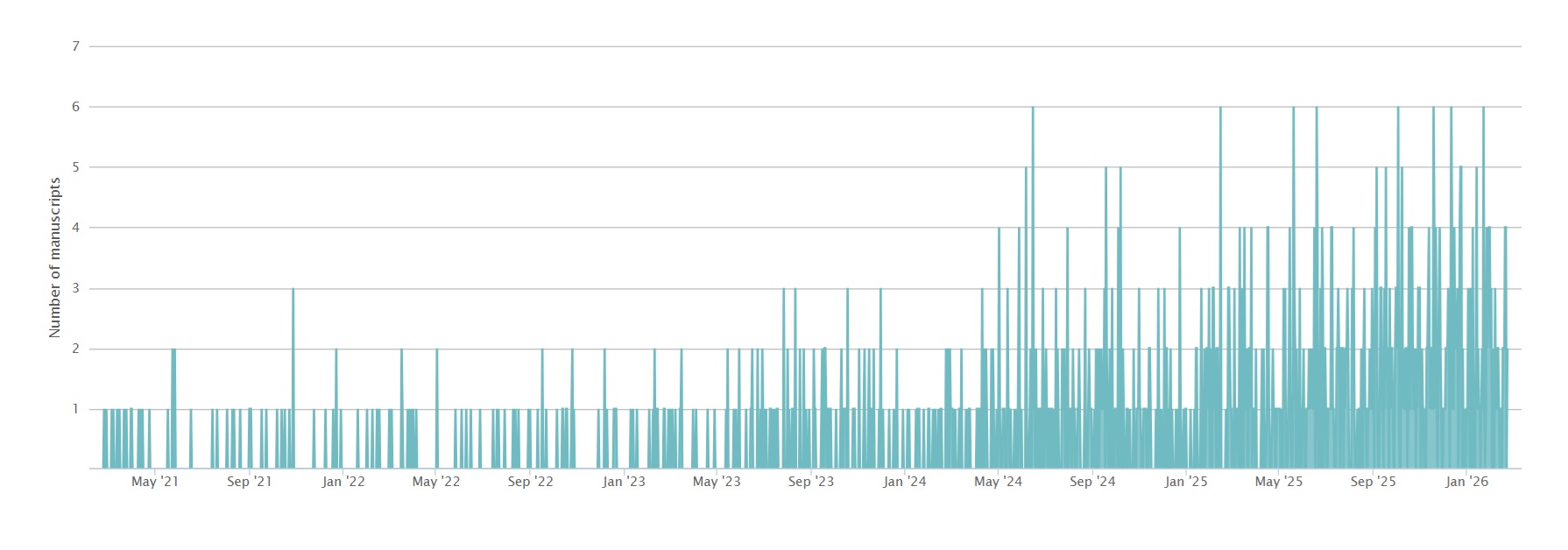
Just over halfway into 2024 the number of papers submitted to the Open Journal of Astrophysics continues to rise, as demonstrated by this nice graphic which shows the submission stats for the last five years:
The increasing number of articles is of course very welcome indeed, but it is increasing the load on our Editorial Board and that includes me! We’re therefore looking for volunteers to join the team, in any area of astrophysics. As a reminder, here are the areas we cover, corresponding to the sections of astro-ph on the arXiv:
astro-ph.GA – Astrophysics of Galaxies. Phenomena pertaining to galaxies or the Milky Way. Star clusters, HII regions and planetary nebulae, the interstellar medium, atomic and molecular clouds, dust. Stellar populations. Galactic structure, formation, dynamics. Galactic nuclei, bulges, disks, halo. Active Galactic Nuclei, supermassive black holes, quasars. Gravitational lens systems. The Milky Way and its contents
astro-ph.CO – Cosmology and Nongalactic Astrophysics. Phenomenology of early universe, cosmic microwave background, cosmological parameters, primordial element abundances, extragalactic distance scale, large-scale structure of the universe. Groups, superclusters, voids, intergalactic medium. Particle astrophysics: dark energy, dark matter, baryogenesis, leptogenesis, inflationary models, reheating, monopoles, WIMPs, cosmic strings, primordial black holes, cosmological gravitational radiation
astro-ph.EP – Earth and Planetary Astrophysics. Interplanetary medium, planetary physics, planetary astrobiology, extrasolar planets, comets, asteroids, meteorites. Structure and formation of the solar system
astro-ph.HE – High Energy Astrophysical Phenomena. Cosmic ray production, acceleration, propagation, detection. Gamma ray astronomy and bursts, X-rays, charged particles, supernovae and other explosive phenomena, stellar remnants and accretion systems, jets, microquasars, neutron stars, pulsars, black holes
astro-ph.IM – Instrumentation and Methods for Astrophysics. Detector and telescope design, experiment proposals. Laboratory Astrophysics. Methods for data analysis, statistical methods. Software, database design
astro-ph.SR – Solar and Stellar Astrophysics. White dwarfs, brown dwarfs, cataclysmic variables. Star formation and protostellar systems, stellar astrobiology, binary and multiple systems of stars, stellar evolution and structure, coronas. Central stars of planetary nebulae. Helioseismology, solar neutrinos, production and detection of gravitational radiation from stellar systems.
We are looking for experienced scientists in any of these areas, and it would indeed be useful to have people who can cover a range of subjects (as some of our existing editors do), but there are two specific topics that have seen a big increase recently: (a) galaxy formation simulations (especially involving hydrodynamics) covered by astro-ph.CO; and (b) galactic dynamics, covered by astro-ph.GA. The latter increase is driven Gaia data, an immensely rich source for discovery science.
Since we don’t charge authors or readers we can not offer payment to Editors but it is nevertheless a way of providing a service to the community.
Please get in touch either through the Open Journal website here, or through a message Mastodon here, BlueSky here, or Facebook here. You could even send a message through this form:
Following on – sort of – from yesterday’s post – here is a little promotional video about the ‘Omnibus’ Bachelor of Science undergraduate course (codename MH201). I have blogged about this course before (e.g. here) but this gives me an opportunity to repeat the salient points.
Currently, most students doing Science subjects here in Maynooth enter on the General Science programme a four-year Omnibus BSc course that involves doing four subjects in the first year, but becoming increasingly specialized thereafter. That’s not unlike the Natural Sciences course I did at Cambridge, except that students at Maynooth can do both Mathematical Physics and Experimental Physics in the first year as separate choices. I’d recommend anyone who wants to do Physics in the long run to do both of these, as they do complement each other. Other possibilities include Chemistry, Computer Science, Biology, etc.
In Year 1 students do four subjects (one of which has to be Mathematics). That is narrowed down to three in Year 2 and two in Year 3. In their final year, students can stick with two subjects for a Joint Honours (Double Major) degree, or specialise in one, for Single Honours.
I like this programme very much because it does not force the students to choose a specialism before they have had a taste of the subject, and that it is flexible enough to accommodate Joint Honours qualifications in, e.g., Theoretical Physics and Mathematics. It also allows us to enrol students onto Physics degrees who have not done Physics or Applied Mathematics as part of the Leaving Certificate.
Anyway, this video features Oisín Davey, who took Mathematical Physics, Experimental Physics, Chemistry and Mathematics in his first year. As a matter of fact I taught him in Year 1 (Mechanics & Special Relativity) and Year 2 (Vector Calculus and Fourier Series) but, despite that, as he explains, he has decided to persist with Mathematical Physics. He will be in the final year next academic year, after he returns from his summer in CERN, and I’ll be back from sabbatical.
I took my first degree in the Natural Sciences Tripos at the University of Cambridge. This involved doing a very general first year comprising four different elements that could be chosen flexibly. I quickly settled on Physics, Chemistry and Mathematics for Natural Sciences to reflect my A-level results but was struggling for the fourth. In the end I picked the one that seemed most like Physics, a course called Crystalline Materials. I didn’t like that at all, and wish I’d done some Biology instead – Biology of Cells and Biology of Organisms were both options – or even Geology, but I stuck with it for the first year.
Having to do such a wide range of subjects was very challenging. The timetable was densely packed and the pace was considerable. In the second year, however, I was able to focus on Mathematics and Physics and although it was still intense it was a bit more focussed. I ended up doing Theoretical Physics in my final year, including a theory project.
My best teacher at School, Dr Geoeff Swinden, was a chemist (he had a doctorate in organic chemistry from Oxford University) and when I went to Cambridge I fully expected to specialisze in Chemistry rather than Physics. I loved the curly arrows and all that. But two things changed. One was that I found the Physics content of the first year far more interesting – and the lecturers and tutors far more inspiring – than Chemistry, and the other was that my considerable ineptitude at practical work made me doubt that I had a future in a chemistry laboratory. And so it came to pass that I switched allegiance to Physics, a decision I am very glad I made.
(It was only towards the end of my degree that I started to take Astrophysics seriously as a possible specialism, but that’s another story…)
Anyway, when I turned up at Cambridge over 40 years ago to begin my course, and having Chemistry as a probable end point, I bought all the recommended text books, one of which was Physical Chemistry by P.W. Atkins. I found a picture (above) of the 1982 edition which may well be the one I bought (although I vaguely remember the one I had being in paperback). I thought it was a very good book, and it has gone into many subsequent editions. I also found the Physical part of Chemistry quite straightforward because it is basically Physics. I even got higher marks in Chemistry in the first year than I did in Physics but that didn’t alter my decision to drop Chemistry after the first year. When I did so, I followed tradition and sold my copy to a new undergraduate along with the other books relating to courses that I dropped.
Yesterday I found out that Peter Atkins has decided to make one of his books available to download. The book concerned is however not the compendious tome I bought, but a shorter summary called Concepts in Physical Chemistry, which was published in 1995. This is no doubt a very useful text for beginning Chemistry students so I thought I’d pass on this information. You can download it here, although you have to do it chapter by chapter in PDF files.
P.S. Chemistry in Spanish is ‘Química’. Since Physics and Chemistry share the same building in the University of Barcelona, where I am currently working, I frequently walk past rooms with doors marked ‘Quim’ (but I have never taken the opportunity to enter one).
The views presented here are personal and not necessarily those of my employer (or anyone else for that matter).
Feel free to comment on any of the posts on this blog but comments may be moderated; anonymous comments and any considered by me to be vexatious and/or abusive and/or defamatory will not be accepted. I do not necessarily endorse, support, sanction, encourage, verify or agree with the opinions or statements of any information or other content in the comments on this site and do not in any way guarantee their accuracy or reliability.