Archive for The Open Journal of Astrophysics

Five New Publications at the Open Journal of Astrophysics

Posted in OJAp Papers, Open Access, The Universe and Stuff with tags , , , , , , , , , on April 6, 2024 by telescoper

As promised a couple of days ago, I am taking the opportunity today to announce the batch of papers at the Open Journal of Astrophysics that were paused slightly while we updated our system. This batch includes five papers, which I now present to you here. These five take the count in Volume 7 (2024) up to 25 and the total published by OJAp up to 140. We’re publishing roughly two papers a week these days so we expect publish about 100 this year.

In chronological order, the five papers, with their overlays, are as follows. You can click on the images of the overlays to make them larger should you wish to do so.

This paper, by Yingtian Chen and Oleg Gnedin of the University of Michigan, is the 21st paper to be published in Volume 7 and the 136th altogether. It is a study of kinematic, chemical and age data of globular clusters from Gaia yielding clues to how the Milky Way Galaxy assembled. Here’s a screenshot of the overlay which includes the abstract. Note the new-style DOI at the bottom left.

You can read the article on arXiv directly here. This paper has a publication date of 20th March 2024, and is in the folder marked Astrophysics of Galaxies.

The second paper is “Generation of realistic input parameters for simulating atmospheric point-spread functions at astronomical observatories” by Claire-Alice Hébert (Stanford), Joshua E. Meyers (Stanford), My H. Do (Cal. State U, Pomona), Patricia R. Burchat (Stanford) and the LSST Dark Energy Science Collaboration. It explores the use of atmospheric modelling to generate realistic estimates of the point-spread function for observational work, especially for the Vera C. Rubin Observatory. This one is in the folder marked Instrumentation and Methods for Astrophysics and was published on 4th April 2024. Here is a screen grab of the overlay which includes the abstract:


You can find the officially accepted version of the paper on the arXiv here.

The third paper to announce is “Cosmic Dragons: A Two-Component Mixture Model of COSMOS Galaxies” by William K. Black and August E. Evrard of the University of Michigan (Ann Arbor, USA). This paper was also published on 4th April 2024,  is in the folder Astrophysics of Galaxies and you can see the overlay here:


The accepted version of this paper can be found on the arXiv here.

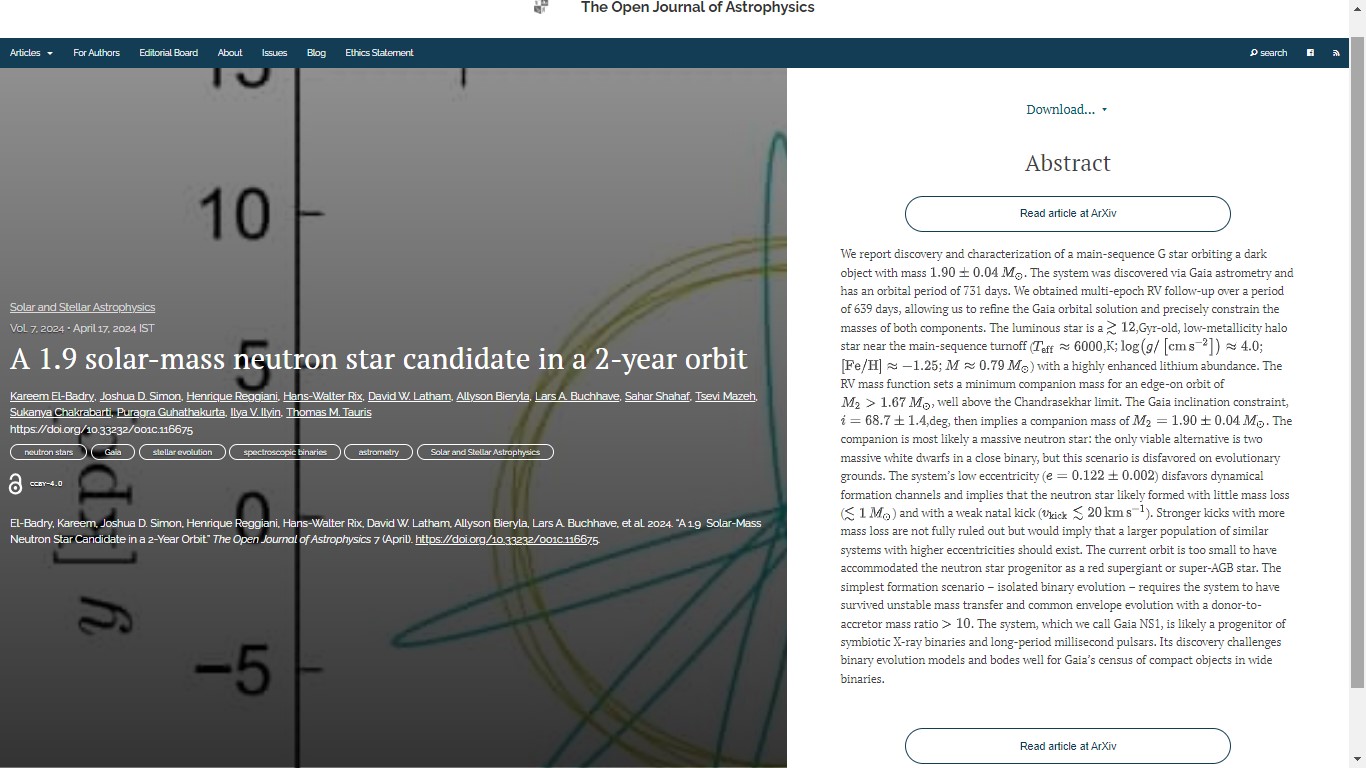
The next paper is “High mass function ellipsoidal variables in the Gaia Focused Product Release: searching for black hole candidates in the binary zoo” by Dominick M. Rowan, Todd A. Thompson,
Tharindu Jayasinghe, Christopher S. Kochanek and Krzysztof Z. Stanek of Ohio State University (USA). This paper, in the Solar and Stellar Astrophysics collection, describes a search for massive unseen stellar companions variable star systems found in Gaia data. This one was also published on 4th April 2024.

Here is the overlay:


You can find the full text for this one on the arXiv here.

Last in this batch, but by no means least, published yesterday (5th April 2024), we have a paper “Machine Learning the Dark Matter Halo Mass of Milky Way-Like Systems” by Elaheh Hayati & Peter Behroozi (University of Arizona, USA) and Ekta Patel (University of Utah, USA).  The primary classification for this one is once again Astrophysics of Galaxies and it presents a method for estimating the mass of a galaxy halo using neural networks that does not assume, for example,  dynamical equilibrium:


You can click on the image of the overlay to make it larger should you wish to do so. You can find the officially accepted version of the paper on the arXiv here.

As you can see this is quite a diverse collection of papers. Given the increase in submissions in the area of galactic astrophysics we are very happy to welcome another expert in that area to our Editorial Board, in the form of Professor Walter Dehnen of the University of Heidelberg.

Changes at the Open Journal of Astrophysics

Posted in Maynooth, Open Access with tags , , , , , , , on April 1, 2024 by telescoper

Regular readers of this blog – both of them – will have noticed that I haven’t posted any new publications from the Open Journal of Astrophysics for a couple of weeks. The reason for this is that we are switching to a new system of publishing that automatically integrates the Scholastica platform with Crossref, the system that (among many other things) keeps track of citations to published articles.

Up to now, I have had to prepare manually an XML file containing the metadata for each paper for upload, then send it to a colleague to register with Crossref. There are two problems with this. One is that transcribing the information from each overlay is prone to errors (made by me), especially if there is a long author list. The other problem is that it is rather slow and inefficient, which wasn’t such a problem when we were only publishing a few papers, but now that we are handling much more it is taking up too much time.

The obvious solution is to cut out the middle man (i.e. me) and register everything with Crossref directly from our platform. That will ensure that what goes to Crossref will be exactly the same as on our website and it will go there much faster. Another advantage is that if there is an error on the platform, such as a spelling mistake in an author name, correcting it there will automatically update the metadata on Crossref. You have no idea how much time and frustration this will save. Up to now we have to raise a ticket with Crossref for their staff to make the change, which can take a while to complete.

Scholastica offers a way to do this integration, but it doesn’t work with our existing Digital Object Identifiers (DOIs), which have the format 10.21105/astro.1234.56789, because it doesn’t allow us to include the “astro” which we need it to do because we share the prefix (10.21105) with another journal, the Journal of Open Source Software and we need to keep the two separate; they use 10.21105/joss at the start of their DOIs. After much to-ing and fro-ing we were unable to persuade Scholastica to change their policy, so to use their integration we have been forced to change prefix. Fortunately, Maynooth University (which runs Maynooth Academic Publishing, the official publisher of OJAp) is registered to mint its own DOIs so we can switch to a new prefix (10.33232) and avoid potential problems with the old one.

This change seems straightforward but it requires Crossref to switch the “ownership” of the journal and give us permission to add new papers with the same journal title “The Open Journal of Astrophysics” from what is effect a new publisher. This is a straightforward process, but has been a bit slower than expected because of the Easter break. I expect it to be completed in a week or so, at the latest.

It is important to stress that this change only affects the DOIs and registration of new papers. Existing papers are not affected at all: they continue with the old DOIs. The DOI is meant to be a persistent identifier so this is as it should be. The name of our website domain (astro.theoj.org) remains unchanged too. In other words, nothing visible to authors will change except for the format of the DOIs and the fact we go from acceptance to publication even faster.

If al this seems rather boring, that’s because it is. But please bear with us while we complete this change. It’s definitely going to be worth it in the long run, for me if nobody else!

New Publication at the Open Journal of Astrophysics

Posted in OJAp Papers, Open Access, The Universe and Stuff with tags , , , , , , , on March 2, 2024 by telescoper

It’s a rainy Saturday afternoon here in Sydney, and here’s the last update from the Open Journal of Astrophysics before I change time zones. In fact there is only one paper to report this week, being  the 16th paper in Volume 7 (2024)  and the 131st altogether. It was published on February 29th 2024.

The title is “Bound circumplanetary orbits under the influence of radiation pressure: Application to dust in directly imaged exoplanet systems” and it  is in the folder marked Earth and Planetary Astrophysics. It presents an investigation into the effect of radiation pressure on bound orbits, with applications to the behaviour of dust in exoplanet systems in general and to the Fomalhaut system in particular. The authors are Bradley Hansen of UCLA and Kevin Hayakawa of California State University (both in the USA).

Here is the overlay of the paper containing the abstract:

You can click on the image of the overlay to make it larger should you wish to do so. You can also find the officially accepted version of the paper on the arXiv here.

There are quite a few papers in the pipeline which I expect to be published during the next week or soon after.

Western Sydney

Posted in Biographical, Open Access with tags , , , , , , on February 26, 2024 by telescoper

Today I made a journey by train to Kingswood, a suburb of Sydney which is the location of one of the campuses of Western Sydney University (WSU). The journey of about 50 km takes about an hour on the stopping train (T1) from Sydney Central Station. I was intrigued that the final destination for the train I got was Emu Plains; I had visions of vast herds of Emus gathered there, but I had to get off the stop before the terminus so never saw them. There’s about a 20-minute walk to the campus from Kingswood Station. It was quite warm so I was grateful when one of my hosts offered me a lift back to Kingswood Station at the end of my visit.

The reason for my visit was set another seminar about Open Access Publishing in Astrophysics. Here are the slides:

Although I’ve given a talk based on more-or-less the same slides recently, it always comes out slightly different. There was a bigger audience than I expected in the room, supplemented by even more on Zoom. The topic of Open Access Publishing does seem to be pretty hot these days in Australia and there was quite a lively discussion. I have a feeling we might have a manuscript or two submitted from WSU before too long.

Kingswood is a far less affluent area than where I am staying in Ultimo, and WSU is an institution that’s very different from the University of Sydney itself, but it was good to see another side of the city, geographically as well as socially. Thank you to everyone who attended and, especially, to Luke Barnes for inviting me and for lunch and coffee!

On the train back into Sydney I noticed that trains going in the opposite direction where crammed full, with (mostly) teenage girls heading to Olympic Park for a Taylor Swift concert. My train, heading into Sydney was fairly empty by contrast and the journey back pleasant enough.

Two New Publications at the Open Journal of Astrophysics

Posted in OJAp Papers, Open Access, The Universe and Stuff with tags , , , , , , , , , , on February 24, 2024 by telescoper

It’s Saturday morning in Sydney, and time to post another update relating to the  Open Journal of Astrophysics.  Since the last update we have published two more papers, taking  the count in Volume 7 (2024) up to 15 and the total published by OJAp up to 130. I should have posted these before leaving but it slipped my mind.

The first paper of the most recent pair – published on  Thursday 22nd February – is “Modelling cross-correlations of ultra-high-energy cosmic rays and galaxies” by Federico Urban (Prague, Czech Republic), Stefano Camera (Torino, Italy) and David Alonso (Oxford, UK). It presents a discussion of the possible statistical correlations between Ultra-High-Energy Cosmic-Ray (UHECR) directions in various models and structure in the galaxy distribution and whether or not this signal could be measurable.  This one is in the folder marked “High-Energy Astrophysical Phenomena“.

Here is a screen grab of the overlay which includes the abstract:

You can click on the image of the overlay to make it larger should you wish to do so. You can find the officially accepted version of the paper on the arXiv here.

The second paper was published on Friday 23rd February and has the title “The IA Guide: A Breakdown of Intrinsic Alignment Formalisms” and the authors are: Claire Lamman (Harvard, USA);  Eleni Tsaprazi (Stockholm, Sweden);  Jingjing Shi (Tokyo, Japan); Nikolina Niko Šarčević (Newcastle, UK); Susan Pyne (UCL, UK); Elisa Legnani (Barcelona, Spain); and Tassia Ferreira (Oxford, UK). This one, which is in the folder marked Cosmology and NonGalactic Astrophysics, presents a review of Intrinsic Alignments, i.e. physical correlations involving galaxy shapes, galaxy spins, and larger scale structure, especially important for weak gravitational lensing

Here is a screen grab of the overlay which includes the abstract:


You can click on the image of the overlay to make it larger should you wish to do so. You can find the officially accepted version of the paper on the arXiv here.

That concludes this week’s update!

Open Access Talk at UNSW

Posted in Biographical, Open Access, The Universe and Stuff with tags , , , on February 21, 2024 by telescoper

After an exciting start to the day involving a fire alarm and consequent evacuation of my hotel, I today ventured into the suburbs of Sydney via the Light Rail system (i.e. the tram) to the University of New South Wales. The tram ride took about 20 minutes from Central and, incidentally, took me right past the Sydney Cricket Ground. Anyway, the UNSW campus at Kensington is very impressive:

After a few gremlins with the WIFI connection, the talk I gave was a longer version of the one I did at the University of Sydney on Monday. In discussions with the Astrophysics group at UNSW, I found they were particularly unhappy about the decision of Monthly Notices of the Royal Astronomical Society to charge a high level of APC (Article Processing Artificial Profit Charge) so is looking at alternative journals that aren’t so exploitative. A journal has no right to call itself “open access” if it excludes researchers on grounds of cost. The problem with the Open Journal of Astrophysics in this case is that they need their publications to be in “high impact journals” for research assessment purposes, and OJAp doesn’t have an “official” journal impact factor yet. The fascination of bureaucrats with the obviously flawed journal impact factor disturbs me greatly but I hope we will have one soon so we may be able to help them out before too long.

Anyway, here are the slides from today’s talk:

Talking Down Under

Posted in OJAp Papers, Open Access, The Universe and Stuff with tags , , , on February 19, 2024 by telescoper

This morning I gave a short talk at the “Astronomy Tea” at the Sydney Institute for Astronomy. No prizes for guessing what I talked about. The talk was followed by questions and then by a huge thunderstorm.

Here are the slides:

P.S. Today was the first day of teaching of the new academic year at the University of Sydney, so the campus was much busier today than it has been.

New Publication at the Open Journal of Astrophysics

Posted in OJAp Papers, Open Access, The Universe and Stuff with tags , , , , , , , on February 16, 2024 by telescoper

It’s Saturday morning here in Sydney, which means it is time for another weekly update from the Open Journal of Astrophysics. In fact there is only one paper to report this week, being  the 13th paper in Volume 7 (2024)  and the 128th altogether. It was published on February 15th 2024.

The title is “Jet – counter-jet asymmetry in the jittering jets explosion mechanism of supernovae” and it  This one is in the folder called High-Energy Astrophysical Phenomena. The paper presents a discussion of the production of jets in core-collapse supernovae and the resulting formation of neutron stars, and the implications for the morphology of the supernova remnant.

The sole author of the paper is Noam Soker of Technion, Haifa, in Israel.

Here is the overlay of the paper containing the abstract:


You can click on the image of the overlay to make it larger should you wish to do so. You can find the officially accepted version of the paper on the arXiv here.

New Publication at the Open Journal of Astrophysics

Posted in OJAp Papers, Open Access, The Universe and Stuff with tags , , , , , , on February 12, 2024 by telescoper

With all the excitement of my first weekend in Sydney I completely forgot to post an update from the Open Journal of Astrophysics. In fact there is only one paper to report from last week, being  the 12th paper in Volume 7 (2024)  and the 127th altogether. This one was published on 9th February 2024 and is the first published from Down Under.

The title is “Galaxy Clusters Discovered via the Thermal Sunyaev-Zel’dovich Effect in the 500-square-degree SPTpol Survey” and it presents a catalogue of 689 galaxy clusters detected through the thermal Sunyaev-Zel’dovich using the dual-frequency polarization-sensitive camera SPTPol on the South Pole Telescope. This one is in the folder called Cosmology and NonGalactic Astrophysics.

This paper has lead author Lindsey Bleem  of the Argonne National Laboratory in the USA and has 127 other authors – too many to list individually here – but you can see them on the overlay below. I see quite a few names of people I know well!

Here is the overlay of the paper containing the abstract:


You can click on the image of the overlay to make it larger should you wish to do so. You can find the officially accepted version of the paper on the arXiv here.

P.S. Incidentally, while I’m here I thought I’d share this little graphic I’ve generated (for other purposes) that shows how the rate of submissions to OJAp has increased over the last 5 years:

Two New Publications at the Open Journal of Astrophysics

Posted in OJAp Papers, Open Access, The Universe and Stuff with tags , , , , , , , on February 5, 2024 by telescoper

Now that I’m settled in Sydney it’s time to post another update relating to the  Open Journal of Astrophysics.  Since the last update we have published two more papers, taking  the count in Volume 7 (2024) up to 11 and the total published by OJAp up to 126. I should have posted these before leaving but it slipped my mind.

Both the current papers discussed here are in the folder marked Cosmology and NonGalactic Astrophysics, our most popular category.

Anyway, the first paper of the most recent pair – published on February 1st – is “LimberJack.jl: auto-differentiable methods for angular power spectra analyses”, Jaime Ruiz-Zapatero (Oxford, UK), David Alonso (Oxford, UK), Carlos García-García (Oxford, UK) , Andrina Nicola (Bonn, Germany), Arrykrishna Mootoovaloo (Oxford, UK), Jamie Sullivan (Berkeley, USA), Marco Bonici (Milan, Italy), and Pedro Ferreira (Oxford, UK). This paper presents a fully auto-differentiable code for cosmological analyses of two-point auto- and cross-correlation measurements from galaxy clustering, CMB lensing and weak lensing data written in Julia.

Here is a screen grab of the overlay which includes the abstract:


You can click on the image of the overlay to make it larger should you wish to do so. You can find the officially accepted version of the paper on the arXiv here.

The second paper was published on Friday 2nd February and has the title “Can we constrain structure growth from galaxy proper motions?” which, as its title suggests, looks at the feasibility of using transverse peculiar velocities (i.e. proper motions) of galaxies for cosmological studies. The authors are Iain Duncan (Oxford, UK), David Alonso (Oxford, UK), Anže Slosar (Brookhaven National Laboratory, USA), and Kate Storey-Fisher (New York University, USA). To find out the answer to the question posed in its title you’ll have to read the paper!

Here is a screen grab of the overlay which includes the abstract:


You can click on the image of the overlay to make it larger should you wish to do so. You can find the officially accepted version of the paper on the arXiv here.

Because of the high rate of publications coming out, we’re moving to a system where we register papers in batches once a week rather than individually as they are published. This is just a temporary measure until we can automate this process more fully. Anyway, you can expect another update in a week or so.